General Chemistry 2
Quarter 4 – Module 5:
Redox Reactions
Maria Teresa Esperanza H. Badon
Learning Facilitator
Quarter 4 – Module 5: Redox Reactions
Most Essential Learning Competencies
1) Define oxidation and reduction. (STEM_GC11ABIVf-
g-169)
2) Identify the substance which is reduced and
oxidized in a chemical equation
3) Determine whether the chemical reaction is a redox
reaction
4) Balance redox reactions using the change in
oxidation number method. (STEM_GC11ABIVf-g-
170)
Redox Reactions.
Oxidation
Reduction
REDOX DEFINITIONS
Redox Reactions are a combination of reduction and
oxidation
1) Oxidation is the loss of electrons
2) Reduction is the gain of electrons
In a redox, reaction, electrons transfer from one
particle to another:
 One particle must be oxidized (lose its electron)
 Another particle must be reduced (gain the
transferred electron).
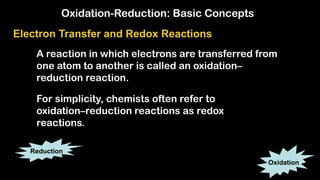
Electron Transfer and Redox Reactions
Oxidation
Reduction
Oxidation-Reduction: Basic Concepts
A reaction in which electrons are transferred from
one atom to another is called an oxidation–
reduction reaction.
For simplicity, chemists often refer to
oxidation–reduction reactions as redox
reactions.
Redox Reactions
Oxidation:
Loss of electrons
Reduction:
Gain of electrons
Increase in
oxidation
number
Decrease in
oxidation
number
• To state this reaction more clearly,
How do oxidation and reduction differ?
Oxidation-Reduction: Basic Concepts
• For oxidation to take place, the electrons lost by the
substance that is oxidized must be accepted by atoms
or ions of another substance.
• In other words, there must be an accompanying
process that involves the gain of electrons.
• Reduction is defined as the gain of electrons by
atoms of a substance.
Following our sodium chloride example further, the
reduction reaction that accompanies the oxidation of
sodium is the reduction of chlorine.
How do oxidation and reduction differ?
Oxidation-Reduction: Basic Concepts
Can oxidation occur without reduction? By our
definition, oxidation and reduction are complementary
processes; oxidation cannot occur unless reduction
also occurs.
It is important to recognize and distinguish between
oxidation and reduction.
Topic
19
• The following memory aid may help.
LEO the lion says GER or, for short, LEO GER
• Loss of Electrons is Oxidation LEO
• Gain of Electrons is Reduction. GER
Oxidation-Reduction: Basic Concepts
How do oxidation and reduction differ?
REDOX DEFINITIONS
• The oxidation number of an atom in an ionic
compound is the number of electrons lost or gained
by the atom when it forms ions.
Topic
19
• Oxidation numbers are tools that scientists use in
written chemical equations to help them keep track
of the movement of electrons in a redox reaction.
Oxidation-Reduction: Basic Concepts
Changes in oxidation number
Like some of the other tools you have learned about
in chemistry, oxidation numbers have a specific
notation.
Changes in oxidation number
Topic
19
Oxidation numbers are written with the positive or
negative sign before the number (+3, +2), whereas ionic
charge is written with the sign after the number (3+, 2+).
• Oxidation number: +3
• Ionic charge: 3+
Oxidation-Reduction: Basic Concepts
• The substance that oxidizes another substance by
accepting its electrons is called an oxidizing agent.
Oxidizing and Reducing Agents
Oxidation-Reduction: Basic Concepts
This term is another way of saying “the substance that
is reduced.”
The substance that reduces another substance by
losing electrons is called a reducing agent.
Oxidizing and Reducing Agents
Oxidation-Reduction: Basic Concepts
A reducing agent supplies electrons to the substance
getting reduced (gaining electrons) and oxidizes
itself because it loses electrons.
By this definition, the reducing agent in the potassium–
bromine reaction is potassium, the substance that is
oxidized.
Oxidizing and Reducing Agents
Oxidation-Reduction: Basic Concepts
It is important to recognize and distinguish between
oxidation and reduction.
Topic
19
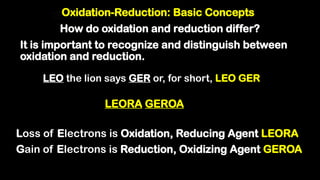
• The following memory aid may help.
LEORA GEROA
• Loss of Electrons is Oxidation, Reducing Agent LEORA
• Gain of Electrons is Reduction, Oxidizing Agent GEROA
Oxidation-Reduction: Basic Concepts
How do oxidation and reduction differ?
LEO the lion says GER or, for short, LEO GER
The following equation represents the redox reaction of aluminum
and iron.
Identifying Oxidation-Reduction Reactions
Oxidation-Reduction: Basic Concepts
Identify what is oxidized and what is reduced in this reaction.
Identify the oxidizing agent and the reducing agent.
The iron ion accepts the three electrons lost from aluminum in the
reduction process.
Identifying Oxidation–Reduction Reactions
Oxidation-Reduction: Basic Concepts
• Aluminum is oxidized and therefore is the reducing agent.
• Iron is reduced and therefore is the oxidizing agent.
Aluminum loses three electrons and becomes an aluminum ion in
the oxidation process.
Redox reactions involve electron transfer:
Lose e - =Oxidation
Cu (s) + 2 Ag + (aq) Cu 2+ (aq) + 2 Ag(s)
Gain e - =Reduction
Oxidation Numbers: Rules for Assigning Oxidation States
 The oxidation state of an atom in an uncombined element is 0.
 The oxidation state of a monatomic ion is the same as its charge.
 Oxygen is assigned an oxidation state of –2 in most of its covalent
compounds. Important exception: peroxides (compounds
containing the O2 2- group), in which each oxygen is assigned an
oxidation state of –1)
 In its covalent compounds with nonmetals, hydrogen is assigned an
oxidation state of +1
 For a compound, the sum total of ON s is zero.
 For an ionic species (like a polyatomic ion), the sum of the oxidation
states must equal the overall charge on that ion.
Writing Half-Reactions
• Ca0
+ 2 H+1
Cl-1
 Ca+2
Cl-1
2 + H2
0
• Oxidation: Ca0
 Ca+2
+ 2e-
• Reduction: 2H+1
+ 2e-
 H2
0
The two electrons lost
by Ca0
are gained by
the two H+1
(each H+1
picks up an electron).
PRACTICE SOME!
Practice Half-Reactions
• Don’t forget to determine the charge of each species first!
• 4 Li + O2  2 Li2O
• Oxidation Half-Reaction:
• Reduction Half-Reaction:
• Zn + Na2SO4  ZnSO4 + 2 Na
• Oxidation Half-Reaction:
• Reduction Half-Reaction:
Try the following:
What is a) oxidized b) reduced c) the oxidizing agent d) the
reducing agent in the following redox reactions?
a) 2SO2 + O2 → 2SO3
b) Cu + 2H2SO4 → CuSO4 + SO2 + 2H2O
c) 2MnO4
-
+ 16H+
+ 5C2O4
2-
→ 2Mn2+
+ 10CO2 + 8H2O
4 Experiments:
1. Burning magnesium
2. Copper in silver nitrate solution
3. Chlorine solution and potassium iodide solution
4. Exploding hydrogen
• Word equation
•Balanced symbol equation
2Mg(s) + O2(g)  2MgO(s)
1. Burning magnesium
2Mg(s) + O2(g)  2MgO(s)
Oxidised –
gains oxygen
Must be a redox!
Mg  Mg2+
O  O2-
Put the
e-
in.
+2e-
+2e-
Oxidised – loss of e-
Reduced – gain of e-
1. Burning magnesium
Cu(s) + 2AgNO3(aq)  Cu(NO3 )2(aq) + 2Ag(s)
2. Copper in silver nitrate solution
Cu(s) + 2AgNO3(aq)  Cu(NO3 )2(aq) + 2Ag(s)
Ag+
 Ag
Cu  Cu2+
Complete the half-
equations
+e-
+2e-
Oxidised?
Reduced?
Oxidised – loss of e-
Reduced – gain of e-
2. Copper in silver nitrate solution
Try Experiment No. 3.
Chlorine solution and potassium iodide solution
Cl2(aq) + 2KI(aq) I
→ 2 (aq) + 2KCl(aq)
Try Experiment No. 4.
Exploding hydrogen
2H2(g) + O2(g) 2H
→ 2O(g )
2H2(g) + O2(g)2H2O(g)
+1
0
-2
0
O
H
Oxidised?
H – increase
in oxidation
number
Reduced?
O – decrease
in oxidation
number
Oxidation Numbers
• The oxidation number of an atom in an
element is zero.
E.g. Mg in Mg, O in O2.
Answer me!
Direction: Identify the atoms that are oxidized and
those that are reduced in the following redox reactions.
1. Fe + H2SO4 FeSO
→ 4 + H2
2. 2Ag + PtCl2 AgCl
→ 2 + Pt
3. Mg + HCl MgCl
→ 2 + H2
4. AgNO3 + Cu CuNO
→ 3 + Ag
5. Na + FeCl2 NaCl + Fe
→ 5
Answer me!
Direction: Identify the atoms that are oxidized and
those that are reduced in the following redox reactions.
1. Fe + H2SO4 FeSO
→ 4 + H2
2. 2Ag + PtCl2 AgCl
→ 2 + Pt
3. Mg + HCl MgCl
→ 2 + H2
4. AgNO3 + Cu CuNO
→ 3 + Ag
5. 2Na + FeCl2 2 NaCl + Fe
→ 5
Oxidation Numbers
• The oxidation numbers of
atoms in a compound add
up to zero.
F -1
O -2
H +1
Cl -1
Oxidation state of
C in CO2?
? – 4 = 0
? = +4
Put the +!
Oxidation Numbers
• The oxidation numbers of
atoms in a compound add
up to zero.
F -1
O -2
H +1
Cl -1
Oxidation state of
Mg in MgCl2?
+2
Oxidation Numbers
• The oxidation numbers of
atoms in a compound add
up to zero.
F -1
O -2
H +1
Cl -1
Oxidation state of
N in NH3?
-3
Oxidation Numbers
• The oxidation
numbers of atoms
in an ion add up to
the charge on the
ion.
F -1
O -2
H +1
Cl -1
Oxidation state of
S in SO4
2-
?
? – 8 = -2
? = +6
Oxidation Numbers
• The oxidation
numbers of atoms
in an ion add up to
the charge on the
ion.
F -1
O -2
H +1
Cl -1
Oxidation state of
S in S2-
?
-2
Oxidation Numbers
• The oxidation
numbers of atoms
in an ion add up to
the charge on the
ion.
F -1
O -2
H +1
Cl -1
Oxidation state of
N in NH4
+
?
-3
Calculating Oxidation Numbers
Example 1: What is the oxidation number of the sulfur atom in
the H2SO4 molecule?
Solution:
- Let the O.N. of S = x
- The O.N. of H = +1
- The O.N. of O = -2
So,
2(1) + x + 4(-2) = 0
2 + x -8 = 0
x -6 = 0
x = 6 → O.N. of S atom = 6 H2 SO4
2(+1) +6 4(-2)
Example 2: What is the O.N. Of carbon in CO2?
Solution:
- Let the O.N. of C = x
- The O.N. of O = -2
So,
x + 2(-2) = 0
x -4 = 0
x = 4 → O.N. of C atom = 4
CO2
+4 2(-2)
Example 3:
What is the oxidation number of each of the elements in CuSO4
Note: Cu is a transition metal and can have variable oxidation states
Of the three elements in CuSO4, only one is mentioned in the
rules for assigning O.N.
- To work out the O.N.’s on Cu and S remember the ion
SO4
2-
- Therefore, in order to balance molecule Cu must have
+2 charge – Cu2+
- SO4
2-
ion:
- O.N. of S = x
- O.N. of O = -2
x + 4(-2) = -2
x -8 = -2
x = 6
Now:
O.N. Cu = +2
O.N. S = +6
O.N. O = -2
CuSO4
+2 +6 4(-2)
Try the following:
i) What is the oxidation number of sulphur in Na2S2O3
ii) What is the oxidation number of sulphur in Na2S4O6
Try this! What is the oxidation number of
1] Hydrogen in H2O
2] Hydrogen in H2O2
4] Oxygen in Cu2O
5] Calcium in CaCl2
6] Nitrogen in NH3
3] Oxygen in H2O2
7] Carbon in CO3
2-
8] Hydrogen in OH-
9] Sulfur in SO4
2-
10] Hydrogen in MgH2
11] Carbon in C6H12O6
12] Manganese in MnO4
-
We have previously learned how to balance equations by
inspection. This method is generally only appropriate for
fairly simple equations. So, for more complicated equations it
is useful to have a more systematic method. In the case of
oxidation-reduction reactions, we will use oxidation
numbers to balance the equations.
Balancing Redox Equations Using
Oxidation Numbers
HALF REACTIONS
In balanced redox, reactions, the number of electrons
lost by one reactant particle must equal the number
gained by another reactant particle.
To understand redox reactions, it is often necessary to
separate the reaction into two parts in order to see and
balance the number of electrons lost and gained.
Step 1: Assign oxidation numbers to all the atoms in the
equation
Step 2: Identify clearly any elements which show a
change in oxidation number.
Step 3: Show the number of electrons lost and gained
Step 4: Work out the ratio of oxidizing agent to
reducing agent
Step 5: Balance the remaining items in the equation using
the inspection method (As a general rule leave oxygen and
hydrogen atoms as the last items to be balanced.
 A redox half-reaction is a balanced equation that includes free
electrons.
 Every redox reaction is a result of two half-reactions: one that
loses electrons, and the other that gains the same number of
electrons.
 Half-reactions break a redox reaction into its two components:
- the oxidation
- the reduction
HALF REACTIONS
Balancing Charge in Half-reactions
 To balance redox reactions, it is often necessary yo balance the
half-reactions first.
HALF REACTIONS
Example 1:
Using oxidation numbers balance the following equation:
Example 1:
Using oxidation numbers balance the following equation:
Example 2:
Using oxidation numbers, balance the following equation:
Fe2+
+ Cl2 → Fe3+
+ Cl-
Example 2:
Using oxidation numbers, balance the following equation:
Fe2+
+ Cl2 → Fe3+
+ Cl-
Example 3:
Using oxidation numbers, balance the following equation:
Example 3:
Using oxidation numbers, balance the following equation:
Try the following:
Balancing Redox Using Oxidation Numbers
ACTIVITY 3. “Balancing Redox Reaction”
Direction: Identify the atom that is oxidized and reduced in
each redox reaction and balance it using the oxidation state
method.
ACTIVITY 3. “Balancing Redox Reaction”
Direction: Identify the atom that is oxidized and reduced in
each redox reaction and balance it using the oxidation state
method.
PERFORMANCE TASK 4.7: Find the Oxidation number
Well done!
REFERENCES
BOOKS
Ayson, Marissa F. et.al.(2016).General Chemistry
2.Quezon City, Philippines :Vibal Group, Inc.
Ilao , Lucian V.et.al.(2016).General Chemistry 2.Manila,
Philippines :Rex Bookstore, Inc.
Bayquen, Aristea V.(2011).Chemistry.Quzon City,
Philippines :Phoenix Publishing House, Inc.
B. Online and Electronic Sources
REFERENCES
B. Online and Electronic Sources
“Definition of Reduction Oxidation Reactions”. Accessed February 19, 2021.
https://chem.libretexts.org/Bookshelves/Analytical_Chemistry/Supplemental_Modules_(An
alytical_Chemistry)/Electrochemistry/Redox_Chemistry/
Definitions_of_Oxidation_and_Reduction
“Definition of Redox Reactions in Electrochemistry”. Accessed February 19,
2021.https://www.chemicool.com/definition/redox-reactions-electrochemistry.html
“Redox Reactions”. Accessed February 19, 2021.https://byjus.com/jee/redox-reactions/
“Chemistry”. Accessed February 19, 2021. https://www.toppr.com/ask/question/define-
oxidising-and-reducing-agents-by-giving-suitable-example/
“Balancing Redox Reactions: Oxidation Number Change Method”. Accessed February 19,
2021. https://flexbooks.ck12.org/cbook/ck-12-chemistry-flexbook-2.0/section/22.9/
primary/lesson/balancing-redox-reactions%253a-oxidation-number-change-method-chem

QUARTER 4 MODULE 5_REDOX_LESSON FILEpptx

  • 1.
    General Chemistry 2 Quarter4 – Module 5: Redox Reactions Maria Teresa Esperanza H. Badon Learning Facilitator
  • 2.
    Quarter 4 –Module 5: Redox Reactions Most Essential Learning Competencies 1) Define oxidation and reduction. (STEM_GC11ABIVf- g-169) 2) Identify the substance which is reduced and oxidized in a chemical equation 3) Determine whether the chemical reaction is a redox reaction 4) Balance redox reactions using the change in oxidation number method. (STEM_GC11ABIVf-g- 170)
  • 3.
  • 4.
    REDOX DEFINITIONS Redox Reactionsare a combination of reduction and oxidation 1) Oxidation is the loss of electrons 2) Reduction is the gain of electrons In a redox, reaction, electrons transfer from one particle to another:  One particle must be oxidized (lose its electron)  Another particle must be reduced (gain the transferred electron).
  • 5.
    Electron Transfer andRedox Reactions Oxidation Reduction Oxidation-Reduction: Basic Concepts A reaction in which electrons are transferred from one atom to another is called an oxidation– reduction reaction. For simplicity, chemists often refer to oxidation–reduction reactions as redox reactions.
  • 6.
    Redox Reactions Oxidation: Loss ofelectrons Reduction: Gain of electrons Increase in oxidation number Decrease in oxidation number
  • 7.
    • To statethis reaction more clearly, How do oxidation and reduction differ? Oxidation-Reduction: Basic Concepts • For oxidation to take place, the electrons lost by the substance that is oxidized must be accepted by atoms or ions of another substance. • In other words, there must be an accompanying process that involves the gain of electrons. • Reduction is defined as the gain of electrons by atoms of a substance.
  • 8.
    Following our sodiumchloride example further, the reduction reaction that accompanies the oxidation of sodium is the reduction of chlorine. How do oxidation and reduction differ? Oxidation-Reduction: Basic Concepts Can oxidation occur without reduction? By our definition, oxidation and reduction are complementary processes; oxidation cannot occur unless reduction also occurs.
  • 9.
    It is importantto recognize and distinguish between oxidation and reduction. Topic 19 • The following memory aid may help. LEO the lion says GER or, for short, LEO GER • Loss of Electrons is Oxidation LEO • Gain of Electrons is Reduction. GER Oxidation-Reduction: Basic Concepts How do oxidation and reduction differ?
  • 10.
  • 11.
    • The oxidationnumber of an atom in an ionic compound is the number of electrons lost or gained by the atom when it forms ions. Topic 19 • Oxidation numbers are tools that scientists use in written chemical equations to help them keep track of the movement of electrons in a redox reaction. Oxidation-Reduction: Basic Concepts Changes in oxidation number
  • 12.
    Like some ofthe other tools you have learned about in chemistry, oxidation numbers have a specific notation. Changes in oxidation number Topic 19 Oxidation numbers are written with the positive or negative sign before the number (+3, +2), whereas ionic charge is written with the sign after the number (3+, 2+). • Oxidation number: +3 • Ionic charge: 3+ Oxidation-Reduction: Basic Concepts
  • 13.
    • The substancethat oxidizes another substance by accepting its electrons is called an oxidizing agent. Oxidizing and Reducing Agents Oxidation-Reduction: Basic Concepts This term is another way of saying “the substance that is reduced.”
  • 14.
    The substance thatreduces another substance by losing electrons is called a reducing agent. Oxidizing and Reducing Agents Oxidation-Reduction: Basic Concepts A reducing agent supplies electrons to the substance getting reduced (gaining electrons) and oxidizes itself because it loses electrons.
  • 15.
    By this definition,the reducing agent in the potassium– bromine reaction is potassium, the substance that is oxidized. Oxidizing and Reducing Agents Oxidation-Reduction: Basic Concepts
  • 16.
    It is importantto recognize and distinguish between oxidation and reduction. Topic 19 • The following memory aid may help. LEORA GEROA • Loss of Electrons is Oxidation, Reducing Agent LEORA • Gain of Electrons is Reduction, Oxidizing Agent GEROA Oxidation-Reduction: Basic Concepts How do oxidation and reduction differ? LEO the lion says GER or, for short, LEO GER
  • 17.
    The following equationrepresents the redox reaction of aluminum and iron. Identifying Oxidation-Reduction Reactions Oxidation-Reduction: Basic Concepts Identify what is oxidized and what is reduced in this reaction. Identify the oxidizing agent and the reducing agent.
  • 18.
    The iron ionaccepts the three electrons lost from aluminum in the reduction process. Identifying Oxidation–Reduction Reactions Oxidation-Reduction: Basic Concepts • Aluminum is oxidized and therefore is the reducing agent. • Iron is reduced and therefore is the oxidizing agent. Aluminum loses three electrons and becomes an aluminum ion in the oxidation process.
  • 19.
    Redox reactions involveelectron transfer: Lose e - =Oxidation Cu (s) + 2 Ag + (aq) Cu 2+ (aq) + 2 Ag(s) Gain e - =Reduction
  • 20.
    Oxidation Numbers: Rulesfor Assigning Oxidation States  The oxidation state of an atom in an uncombined element is 0.  The oxidation state of a monatomic ion is the same as its charge.  Oxygen is assigned an oxidation state of –2 in most of its covalent compounds. Important exception: peroxides (compounds containing the O2 2- group), in which each oxygen is assigned an oxidation state of –1)  In its covalent compounds with nonmetals, hydrogen is assigned an oxidation state of +1  For a compound, the sum total of ON s is zero.  For an ionic species (like a polyatomic ion), the sum of the oxidation states must equal the overall charge on that ion.
  • 21.
    Writing Half-Reactions • Ca0 +2 H+1 Cl-1  Ca+2 Cl-1 2 + H2 0 • Oxidation: Ca0  Ca+2 + 2e- • Reduction: 2H+1 + 2e-  H2 0 The two electrons lost by Ca0 are gained by the two H+1 (each H+1 picks up an electron). PRACTICE SOME!
  • 22.
    Practice Half-Reactions • Don’tforget to determine the charge of each species first! • 4 Li + O2  2 Li2O • Oxidation Half-Reaction: • Reduction Half-Reaction: • Zn + Na2SO4  ZnSO4 + 2 Na • Oxidation Half-Reaction: • Reduction Half-Reaction:
  • 23.
    Try the following: Whatis a) oxidized b) reduced c) the oxidizing agent d) the reducing agent in the following redox reactions? a) 2SO2 + O2 → 2SO3 b) Cu + 2H2SO4 → CuSO4 + SO2 + 2H2O c) 2MnO4 - + 16H+ + 5C2O4 2- → 2Mn2+ + 10CO2 + 8H2O
  • 24.
    4 Experiments: 1. Burningmagnesium 2. Copper in silver nitrate solution 3. Chlorine solution and potassium iodide solution 4. Exploding hydrogen • Word equation •Balanced symbol equation
  • 25.
    2Mg(s) + O2(g) 2MgO(s) 1. Burning magnesium
  • 26.
    2Mg(s) + O2(g) 2MgO(s) Oxidised – gains oxygen Must be a redox! Mg  Mg2+ O  O2- Put the e- in. +2e- +2e- Oxidised – loss of e- Reduced – gain of e- 1. Burning magnesium
  • 27.
    Cu(s) + 2AgNO3(aq) Cu(NO3 )2(aq) + 2Ag(s) 2. Copper in silver nitrate solution
  • 28.
    Cu(s) + 2AgNO3(aq) Cu(NO3 )2(aq) + 2Ag(s) Ag+  Ag Cu  Cu2+ Complete the half- equations +e- +2e- Oxidised? Reduced? Oxidised – loss of e- Reduced – gain of e- 2. Copper in silver nitrate solution
  • 29.
    Try Experiment No.3. Chlorine solution and potassium iodide solution Cl2(aq) + 2KI(aq) I → 2 (aq) + 2KCl(aq)
  • 30.
    Try Experiment No.4. Exploding hydrogen 2H2(g) + O2(g) 2H → 2O(g )
  • 31.
    2H2(g) + O2(g)2H2O(g) +1 0 -2 0 O H Oxidised? H– increase in oxidation number Reduced? O – decrease in oxidation number
  • 32.
    Oxidation Numbers • Theoxidation number of an atom in an element is zero. E.g. Mg in Mg, O in O2.
  • 33.
    Answer me! Direction: Identifythe atoms that are oxidized and those that are reduced in the following redox reactions. 1. Fe + H2SO4 FeSO → 4 + H2 2. 2Ag + PtCl2 AgCl → 2 + Pt 3. Mg + HCl MgCl → 2 + H2 4. AgNO3 + Cu CuNO → 3 + Ag 5. Na + FeCl2 NaCl + Fe → 5
  • 34.
    Answer me! Direction: Identifythe atoms that are oxidized and those that are reduced in the following redox reactions. 1. Fe + H2SO4 FeSO → 4 + H2 2. 2Ag + PtCl2 AgCl → 2 + Pt 3. Mg + HCl MgCl → 2 + H2 4. AgNO3 + Cu CuNO → 3 + Ag 5. 2Na + FeCl2 2 NaCl + Fe → 5
  • 35.
    Oxidation Numbers • Theoxidation numbers of atoms in a compound add up to zero. F -1 O -2 H +1 Cl -1 Oxidation state of C in CO2? ? – 4 = 0 ? = +4 Put the +!
  • 36.
    Oxidation Numbers • Theoxidation numbers of atoms in a compound add up to zero. F -1 O -2 H +1 Cl -1 Oxidation state of Mg in MgCl2? +2
  • 37.
    Oxidation Numbers • Theoxidation numbers of atoms in a compound add up to zero. F -1 O -2 H +1 Cl -1 Oxidation state of N in NH3? -3
  • 38.
    Oxidation Numbers • Theoxidation numbers of atoms in an ion add up to the charge on the ion. F -1 O -2 H +1 Cl -1 Oxidation state of S in SO4 2- ? ? – 8 = -2 ? = +6
  • 39.
    Oxidation Numbers • Theoxidation numbers of atoms in an ion add up to the charge on the ion. F -1 O -2 H +1 Cl -1 Oxidation state of S in S2- ? -2
  • 40.
    Oxidation Numbers • Theoxidation numbers of atoms in an ion add up to the charge on the ion. F -1 O -2 H +1 Cl -1 Oxidation state of N in NH4 + ? -3
  • 41.
    Calculating Oxidation Numbers Example1: What is the oxidation number of the sulfur atom in the H2SO4 molecule? Solution: - Let the O.N. of S = x - The O.N. of H = +1 - The O.N. of O = -2 So, 2(1) + x + 4(-2) = 0 2 + x -8 = 0 x -6 = 0 x = 6 → O.N. of S atom = 6 H2 SO4 2(+1) +6 4(-2)
  • 42.
    Example 2: Whatis the O.N. Of carbon in CO2? Solution: - Let the O.N. of C = x - The O.N. of O = -2 So, x + 2(-2) = 0 x -4 = 0 x = 4 → O.N. of C atom = 4 CO2 +4 2(-2)
  • 43.
    Example 3: What isthe oxidation number of each of the elements in CuSO4 Note: Cu is a transition metal and can have variable oxidation states Of the three elements in CuSO4, only one is mentioned in the rules for assigning O.N.
  • 44.
    - To workout the O.N.’s on Cu and S remember the ion SO4 2- - Therefore, in order to balance molecule Cu must have +2 charge – Cu2+ - SO4 2- ion: - O.N. of S = x - O.N. of O = -2 x + 4(-2) = -2 x -8 = -2 x = 6 Now: O.N. Cu = +2 O.N. S = +6 O.N. O = -2 CuSO4 +2 +6 4(-2)
  • 45.
    Try the following: i)What is the oxidation number of sulphur in Na2S2O3 ii) What is the oxidation number of sulphur in Na2S4O6
  • 46.
    Try this! Whatis the oxidation number of 1] Hydrogen in H2O 2] Hydrogen in H2O2 4] Oxygen in Cu2O 5] Calcium in CaCl2 6] Nitrogen in NH3 3] Oxygen in H2O2 7] Carbon in CO3 2- 8] Hydrogen in OH- 9] Sulfur in SO4 2- 10] Hydrogen in MgH2 11] Carbon in C6H12O6 12] Manganese in MnO4 -
  • 47.
    We have previouslylearned how to balance equations by inspection. This method is generally only appropriate for fairly simple equations. So, for more complicated equations it is useful to have a more systematic method. In the case of oxidation-reduction reactions, we will use oxidation numbers to balance the equations. Balancing Redox Equations Using Oxidation Numbers
  • 48.
    HALF REACTIONS In balancedredox, reactions, the number of electrons lost by one reactant particle must equal the number gained by another reactant particle. To understand redox reactions, it is often necessary to separate the reaction into two parts in order to see and balance the number of electrons lost and gained.
  • 49.
    Step 1: Assignoxidation numbers to all the atoms in the equation Step 2: Identify clearly any elements which show a change in oxidation number. Step 3: Show the number of electrons lost and gained Step 4: Work out the ratio of oxidizing agent to reducing agent Step 5: Balance the remaining items in the equation using the inspection method (As a general rule leave oxygen and hydrogen atoms as the last items to be balanced.
  • 50.
     A redoxhalf-reaction is a balanced equation that includes free electrons.  Every redox reaction is a result of two half-reactions: one that loses electrons, and the other that gains the same number of electrons.  Half-reactions break a redox reaction into its two components: - the oxidation - the reduction HALF REACTIONS
  • 51.
    Balancing Charge inHalf-reactions  To balance redox reactions, it is often necessary yo balance the half-reactions first. HALF REACTIONS
  • 52.
    Example 1: Using oxidationnumbers balance the following equation:
  • 53.
    Example 1: Using oxidationnumbers balance the following equation:
  • 54.
    Example 2: Using oxidationnumbers, balance the following equation: Fe2+ + Cl2 → Fe3+ + Cl-
  • 55.
    Example 2: Using oxidationnumbers, balance the following equation: Fe2+ + Cl2 → Fe3+ + Cl-
  • 56.
    Example 3: Using oxidationnumbers, balance the following equation:
  • 57.
    Example 3: Using oxidationnumbers, balance the following equation:
  • 58.
  • 59.
    Balancing Redox UsingOxidation Numbers
  • 60.
    Balancing Redox UsingOxidation Numbers
  • 61.
    Balancing Redox UsingOxidation Numbers
  • 62.
    Balancing Redox UsingOxidation Numbers
  • 63.
    Balancing Redox UsingOxidation Numbers
  • 64.
    Balancing Redox UsingOxidation Numbers
  • 65.
    Balancing Redox UsingOxidation Numbers
  • 67.
    ACTIVITY 3. “BalancingRedox Reaction” Direction: Identify the atom that is oxidized and reduced in each redox reaction and balance it using the oxidation state method.
  • 68.
    ACTIVITY 3. “BalancingRedox Reaction” Direction: Identify the atom that is oxidized and reduced in each redox reaction and balance it using the oxidation state method.
  • 69.
    PERFORMANCE TASK 4.7:Find the Oxidation number
  • 70.
  • 71.
    REFERENCES BOOKS Ayson, Marissa F.et.al.(2016).General Chemistry 2.Quezon City, Philippines :Vibal Group, Inc. Ilao , Lucian V.et.al.(2016).General Chemistry 2.Manila, Philippines :Rex Bookstore, Inc. Bayquen, Aristea V.(2011).Chemistry.Quzon City, Philippines :Phoenix Publishing House, Inc. B. Online and Electronic Sources
  • 72.
    REFERENCES B. Online andElectronic Sources “Definition of Reduction Oxidation Reactions”. Accessed February 19, 2021. https://chem.libretexts.org/Bookshelves/Analytical_Chemistry/Supplemental_Modules_(An alytical_Chemistry)/Electrochemistry/Redox_Chemistry/ Definitions_of_Oxidation_and_Reduction “Definition of Redox Reactions in Electrochemistry”. Accessed February 19, 2021.https://www.chemicool.com/definition/redox-reactions-electrochemistry.html “Redox Reactions”. Accessed February 19, 2021.https://byjus.com/jee/redox-reactions/ “Redox Reactions”. Accessed February 19, 2021.https://byjus.com/jee/redox-reactions/ “Chemistry”. Accessed February 19, 2021. https://www.toppr.com/ask/question/define- oxidising-and-reducing-agents-by-giving-suitable-example/ “Balancing Redox Reactions: Oxidation Number Change Method”. Accessed February 19, 2021. https://flexbooks.ck12.org/cbook/ck-12-chemistry-flexbook-2.0/section/22.9/ primary/lesson/balancing-redox-reactions%253a-oxidation-number-change-method-chem

Editor's Notes

  • #9 Cinda, I don’t know if you want the bold-faced letters in a different color or not. I think they would definitely show up better if they are in a different color, but I’ll let you make that decision.
  • #16 Cinda, I don’t know if you want the bold-faced letters in a different color or not. I think they would definitely show up better if they are in a different color, but I’ll let you make that decision.