RADIOACTIVE DECAY
RADIOACTIVE DECAY
 Yesterday we learned that all elements have different
isotopes.
 Example:
 1H (1 proton, 0 neutrons)
 2H (1 proton, 1 neutron)
 3H (1 proton, 2 neutrons)
 Some isotopes are stable and will last essentially
forever.
 Some aren’t stable.
RADIOACTIVE DECAY
An unstable isotope is said to be radioactive.
Radioactive (unstable) isotopes =
radioisotopes
Radioisotopes eventually decay into more
stable forms.
A radioisotope releases energy by emitting
radiation during the process of radioactive
decay.
RADIOACTIVE DECAY
 Carbon-12 and carbon-13 are stable, but carbon-14 is
radioactive.
6 p+ and 6 n0 6 p+ and 7 n0 6 p+ and 8 n0
WHAT MAKES A RADIOISOTOPE
UNSTABLE?
An isotope can be unstable if:
it is too heavy (more than 83 protons).
its n0 to p+ ratio is too high.
its n0 to p+ ratio is too low.
TYPES OF RADIATION
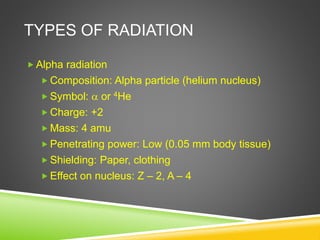
 Alpha radiation
 Composition: Alpha particle (helium nucleus)
 Symbol:  or 4He
 Charge: +2
 Mass: 4 amu
 Penetrating power: Low (0.05 mm body tissue)
 Shielding: Paper, clothing
 Effect on nucleus: Z – 2, A – 4
ALPHA DECAY
U235
92
alpha
Th231
90
TYPES OF RADIATION
 Beta radiation
 Composition: Beta particle (electron)
 Symbol:  or e-
 Charge: -1
 Mass: 1/1837 amu
 Penetrating Power: Moderate (4 mm body tissue)
 Shielding: Metal foil
 Effect on nucleus: Z + 1; A unchanged.
BETA DECAY
C14
6
e-
N14
7
TYPES OF RADIATION
 Gamma radiation
 Composition: High-energy EM radiation
 Symbol: 
 Charge: 0
 Mass: 0
 Penetrating power: Very high
 Shielding: Lead, concrete
 Effect on nucleus: decreases energy
USES OF RADIATION
Radioisotopic labelling – can be used to track
the movement of a particular substance
through a living organism.
Radiometric dating – used to determine the
age of ancient objects.
Many uses in medicine, from imaging to
cancer therapy.

Radioactive decay

  • 1.
  • 2.
    RADIOACTIVE DECAY  Yesterdaywe learned that all elements have different isotopes.  Example:  1H (1 proton, 0 neutrons)  2H (1 proton, 1 neutron)  3H (1 proton, 2 neutrons)  Some isotopes are stable and will last essentially forever.  Some aren’t stable.
  • 3.
    RADIOACTIVE DECAY An unstableisotope is said to be radioactive. Radioactive (unstable) isotopes = radioisotopes Radioisotopes eventually decay into more stable forms. A radioisotope releases energy by emitting radiation during the process of radioactive decay.
  • 4.
    RADIOACTIVE DECAY  Carbon-12and carbon-13 are stable, but carbon-14 is radioactive. 6 p+ and 6 n0 6 p+ and 7 n0 6 p+ and 8 n0
  • 5.
    WHAT MAKES ARADIOISOTOPE UNSTABLE? An isotope can be unstable if: it is too heavy (more than 83 protons). its n0 to p+ ratio is too high. its n0 to p+ ratio is too low.
  • 6.
    TYPES OF RADIATION Alpha radiation  Composition: Alpha particle (helium nucleus)  Symbol:  or 4He  Charge: +2  Mass: 4 amu  Penetrating power: Low (0.05 mm body tissue)  Shielding: Paper, clothing  Effect on nucleus: Z – 2, A – 4
  • 7.
  • 8.
    TYPES OF RADIATION Beta radiation  Composition: Beta particle (electron)  Symbol:  or e-  Charge: -1  Mass: 1/1837 amu  Penetrating Power: Moderate (4 mm body tissue)  Shielding: Metal foil  Effect on nucleus: Z + 1; A unchanged.
  • 9.
  • 10.
    TYPES OF RADIATION Gamma radiation  Composition: High-energy EM radiation  Symbol:   Charge: 0  Mass: 0  Penetrating power: Very high  Shielding: Lead, concrete  Effect on nucleus: decreases energy
  • 12.
    USES OF RADIATION Radioisotopiclabelling – can be used to track the movement of a particular substance through a living organism. Radiometric dating – used to determine the age of ancient objects. Many uses in medicine, from imaging to cancer therapy.