Acids and Bases
By: Faiq & Rizan
Acids
Produce H+ ions in water
Have a sour taste
Break down metals
Formula starts with H
Poisonous and corrosive to skin
pH less than 7
Acid
turn blue litmus red
Dissolve in water to form solution which conduct electricity
React with reactive metal metals to form salt and hydrogen (explained)
Acids react with carbonates and hydrogen carbonates to form a salt,
water and carbon dioxide (explained)
Acids react with metal oxides and hydroxides to form a salt and water
only(explained)
Alkalis
Produce OH- ions in water
Have a bitter taste and a slippery feel
Break down fats and oils
Formula ends with OH
Poisonous and corrosive to skin
pH greater than 7
Alkalis
turn red litmus blue
React with acids to form salt and water only.(explained)
Heated with ammonium salts gives off ammonia gas.(explained)
React with a solution of one metal salt to give another metal salt
and metal hydroxide.(explained)
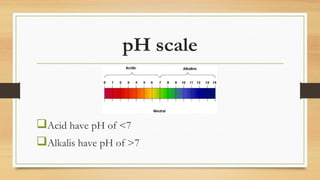
pH scale
Acid have pH of <7
Alkalis have pH of >7
Theories of acids and
bases
Arrhenius Concept of Acids and Bases
According to the Arrhenius concept of acids and bases, an acid is
a substance that, when dissolved in water, increases the
concentration of hydronium ion (H3O+).
Remember, however, that the aqueous hydrogen ion is actually
chemically bonded to water, that is, H3O+.
Arrhenius Concept of Acids and Bases
A base, in the Arrhenius concept, is a substance
that, when dissolved in water, increases the
concentration of hydroxide ion, OH-(aq).
Bronsted-Lowry Acid and Bases
Bronsted-Lowry Acid can donate a proton
Bronsted-Lowry Base can accept a proton
Must contain a non-bonding pair of electrons
Conjugate base of an acid is the species remaining after
the acid has lost a proton
Bronsted-Lowry Acid and Bases
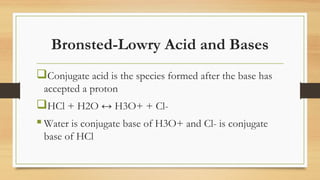
Conjugate acid is the species formed after the base has
accepted a proton
HCl + H2O ↔ H3O+ + Cl-
 Water is conjugate base of H3O+ and Cl- is conjugate
base of HCl
Bronsted-Lowry Acid and Bases
Water can act both as acid and base. Amphiprotic
Strong acids have weak conjugate base
Weak acids have strong conjugate base
 ACID: Ethanol (C2H5OH) =>weak
 CONJUGATE BASE: Ethoxide ion (C2H5O-) => strong
Lewis Acids and Bases
Bases can donate a pair of electrons
Acids can accept a pair of electrons
 Covalent bond is formed
Many Lewis Acids don’t contain hydrogen
Properties of Acids and
Bases
Properties of Acids and Bases
Neutralization reaction with bases
With hydroxides to form salt and water
 CH3COOH + NaOH  NaCH3COO + H2O
With metal oxides to form a salt and water
 H2SO4 + CuO  CuSO4 + H2O
With ammonia to form salt
 HCl + NH3  NH4Cl
Properties of Acids and Bases
With reactive metals to form salt and hydrogen
 2HCl + Mg  MgCl2 + H2
With carbonates to form salt, CO2, water
 2HCl + CaCO3  CaCl2 + CO2 + H2O
With hydrogen carbonates to form salt, CO2, water
 HCl + NaHCO3  NaCl + CO2 + H2O
Strong Acids and Bases
Strong acid and base is completely dissociated (ionized) into its
ions in aqueous solutions
Strong acids
 HCl (Hydrochloric acid)
 HNO3 (Nitric Acid)
 H2SO4 (Sulfuric Acid)
Strong Acids and Bases
Strong bases
 NaOH (Sodium Hydroxide)
 KOH (Potassium Hydroxide)
 Ba(OH)2 (Barium Hydroxide)
Weak Acids and Bases
Weak acids and bases is slightly dissociated into their ions in
aqueous solution
Weak acids
 CH3COOH (Ethanoic Acid)
 H2CO3(Carbonic acid)
Weak Acids and Bases
Weak bases
 NH3 (Ammonia)
 C2H5NH2 (Amino ethane)
Acidic oxides
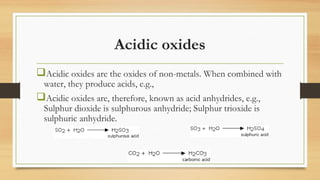
Acidic oxides are the oxides of non-metals. When combined with
water, they produce acids, e.g.,
Acidic oxides are, therefore, known as acid anhydrides, e.g.,
Sulphur dioxide is sulphurous anhydride; Sulphur trioxide is
sulphuric anhydride.
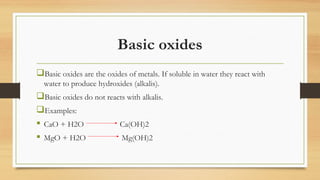
Basic oxides
Basic oxides are the oxides of metals. If soluble in water they react with
water to produce hydroxides (alkalis).
Basic oxides do not reacts with alkalis.
Examples:
 CaO + H2O Ca(OH)2
 MgO + H2O Mg(OH)2
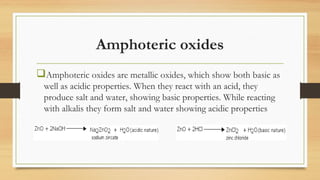
Amphoteric oxides
Amphoteric oxides are metallic oxides, which show both basic as
well as acidic properties. When they react with an acid, they
produce salt and water, showing basic properties. While reacting
with alkalis they form salt and water showing acidic properties
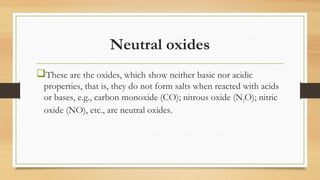
Neutral oxides
These are the oxides, which show neither basic nor acidic
properties, that is, they do not form salts when reacted with acids
or bases, e.g., carbon monoxide (CO); nitrous oxide (N2O); nitric
oxide (NO), etc., are neutral oxides.
Thank You for reading and
hope u all understand


Acids and bases

  • 1.
    Acids and Bases By:Faiq & Rizan
  • 2.
    Acids Produce H+ ionsin water Have a sour taste Break down metals Formula starts with H Poisonous and corrosive to skin pH less than 7
  • 3.
    Acid turn blue litmusred Dissolve in water to form solution which conduct electricity React with reactive metal metals to form salt and hydrogen (explained) Acids react with carbonates and hydrogen carbonates to form a salt, water and carbon dioxide (explained) Acids react with metal oxides and hydroxides to form a salt and water only(explained)
  • 4.
    Alkalis Produce OH- ionsin water Have a bitter taste and a slippery feel Break down fats and oils Formula ends with OH Poisonous and corrosive to skin pH greater than 7
  • 5.
    Alkalis turn red litmusblue React with acids to form salt and water only.(explained) Heated with ammonium salts gives off ammonia gas.(explained) React with a solution of one metal salt to give another metal salt and metal hydroxide.(explained)
  • 6.
    pH scale Acid havepH of <7 Alkalis have pH of >7
  • 7.
  • 8.
    Arrhenius Concept ofAcids and Bases According to the Arrhenius concept of acids and bases, an acid is a substance that, when dissolved in water, increases the concentration of hydronium ion (H3O+). Remember, however, that the aqueous hydrogen ion is actually chemically bonded to water, that is, H3O+.
  • 9.
    Arrhenius Concept ofAcids and Bases A base, in the Arrhenius concept, is a substance that, when dissolved in water, increases the concentration of hydroxide ion, OH-(aq).
  • 10.
    Bronsted-Lowry Acid andBases Bronsted-Lowry Acid can donate a proton Bronsted-Lowry Base can accept a proton Must contain a non-bonding pair of electrons Conjugate base of an acid is the species remaining after the acid has lost a proton
  • 11.
    Bronsted-Lowry Acid andBases Conjugate acid is the species formed after the base has accepted a proton HCl + H2O ↔ H3O+ + Cl-  Water is conjugate base of H3O+ and Cl- is conjugate base of HCl
  • 12.
    Bronsted-Lowry Acid andBases Water can act both as acid and base. Amphiprotic Strong acids have weak conjugate base Weak acids have strong conjugate base  ACID: Ethanol (C2H5OH) =>weak  CONJUGATE BASE: Ethoxide ion (C2H5O-) => strong
  • 13.
    Lewis Acids andBases Bases can donate a pair of electrons Acids can accept a pair of electrons  Covalent bond is formed Many Lewis Acids don’t contain hydrogen
  • 14.
  • 15.
    Properties of Acidsand Bases Neutralization reaction with bases With hydroxides to form salt and water  CH3COOH + NaOH  NaCH3COO + H2O With metal oxides to form a salt and water  H2SO4 + CuO  CuSO4 + H2O With ammonia to form salt  HCl + NH3  NH4Cl
  • 16.
    Properties of Acidsand Bases With reactive metals to form salt and hydrogen  2HCl + Mg  MgCl2 + H2 With carbonates to form salt, CO2, water  2HCl + CaCO3  CaCl2 + CO2 + H2O With hydrogen carbonates to form salt, CO2, water  HCl + NaHCO3  NaCl + CO2 + H2O
  • 17.
    Strong Acids andBases Strong acid and base is completely dissociated (ionized) into its ions in aqueous solutions Strong acids  HCl (Hydrochloric acid)  HNO3 (Nitric Acid)  H2SO4 (Sulfuric Acid)
  • 18.
    Strong Acids andBases Strong bases  NaOH (Sodium Hydroxide)  KOH (Potassium Hydroxide)  Ba(OH)2 (Barium Hydroxide)
  • 19.
    Weak Acids andBases Weak acids and bases is slightly dissociated into their ions in aqueous solution Weak acids  CH3COOH (Ethanoic Acid)  H2CO3(Carbonic acid)
  • 20.
    Weak Acids andBases Weak bases  NH3 (Ammonia)  C2H5NH2 (Amino ethane)
  • 21.
    Acidic oxides Acidic oxidesare the oxides of non-metals. When combined with water, they produce acids, e.g., Acidic oxides are, therefore, known as acid anhydrides, e.g., Sulphur dioxide is sulphurous anhydride; Sulphur trioxide is sulphuric anhydride.
  • 22.
    Basic oxides Basic oxidesare the oxides of metals. If soluble in water they react with water to produce hydroxides (alkalis). Basic oxides do not reacts with alkalis. Examples:  CaO + H2O Ca(OH)2  MgO + H2O Mg(OH)2
  • 23.
    Amphoteric oxides Amphoteric oxidesare metallic oxides, which show both basic as well as acidic properties. When they react with an acid, they produce salt and water, showing basic properties. While reacting with alkalis they form salt and water showing acidic properties
  • 24.
    Neutral oxides These arethe oxides, which show neither basic nor acidic properties, that is, they do not form salts when reacted with acids or bases, e.g., carbon monoxide (CO); nitrous oxide (N2O); nitric oxide (NO), etc., are neutral oxides.
  • 25.
    Thank You forreading and hope u all understand 