Dr. Neetika Naudiyal
Assistant Professor,
Department of Life Sciences,
Kristu Jayanti College (Autonomous),
Bengaluru
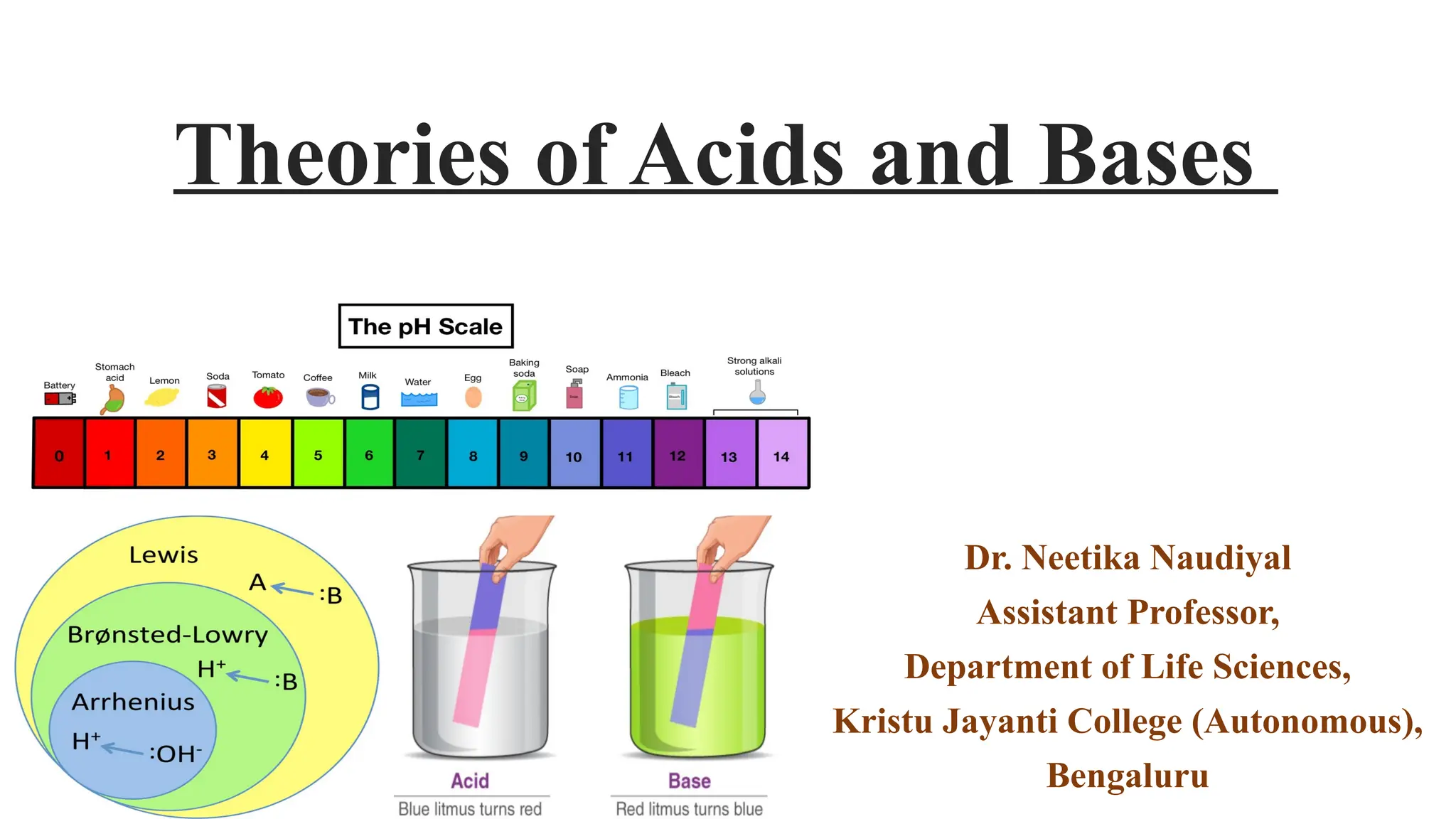
Theories of Acids and Bases
r Neetika Naudiyal
Main theories of Acids and Bases
The three main theories of acids and bases are:
1. Arrhenius Theory
a) Acids: Substances that increase the concentration of H ions in water.
⁺
b) Bases: Substances that increase the concentration of OH ions in water.
⁻
2. Brønsted-Lowry Theory
a) Acids: Proton donors.
b) Bases: Proton acceptors.
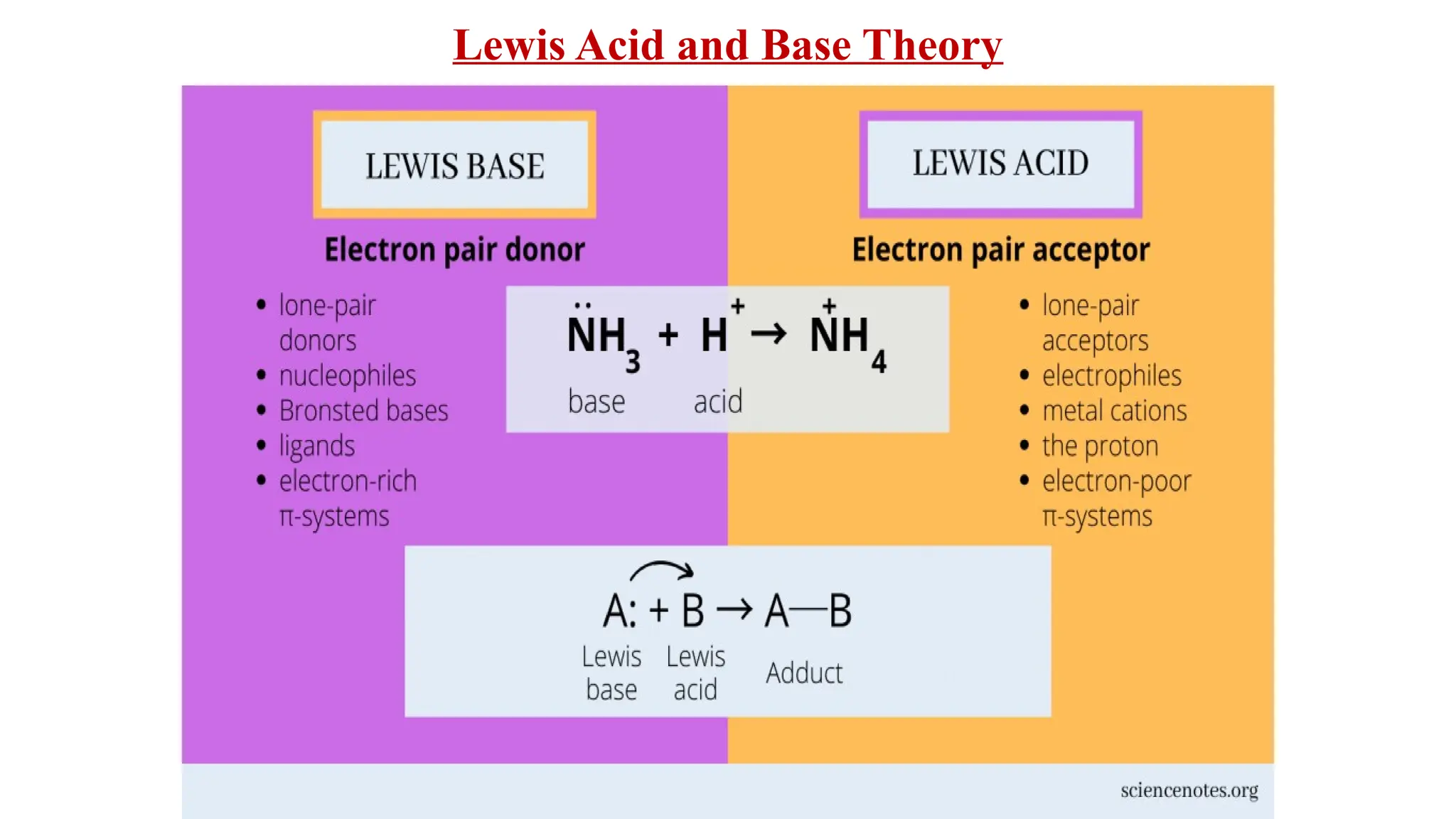
3. Lewis Theory
a) Acids: Electron pair acceptors.
b) Bases: Electron pair donors.
Arrhenius Theory
r Neetika Naudiyal
Arrhenius Theory
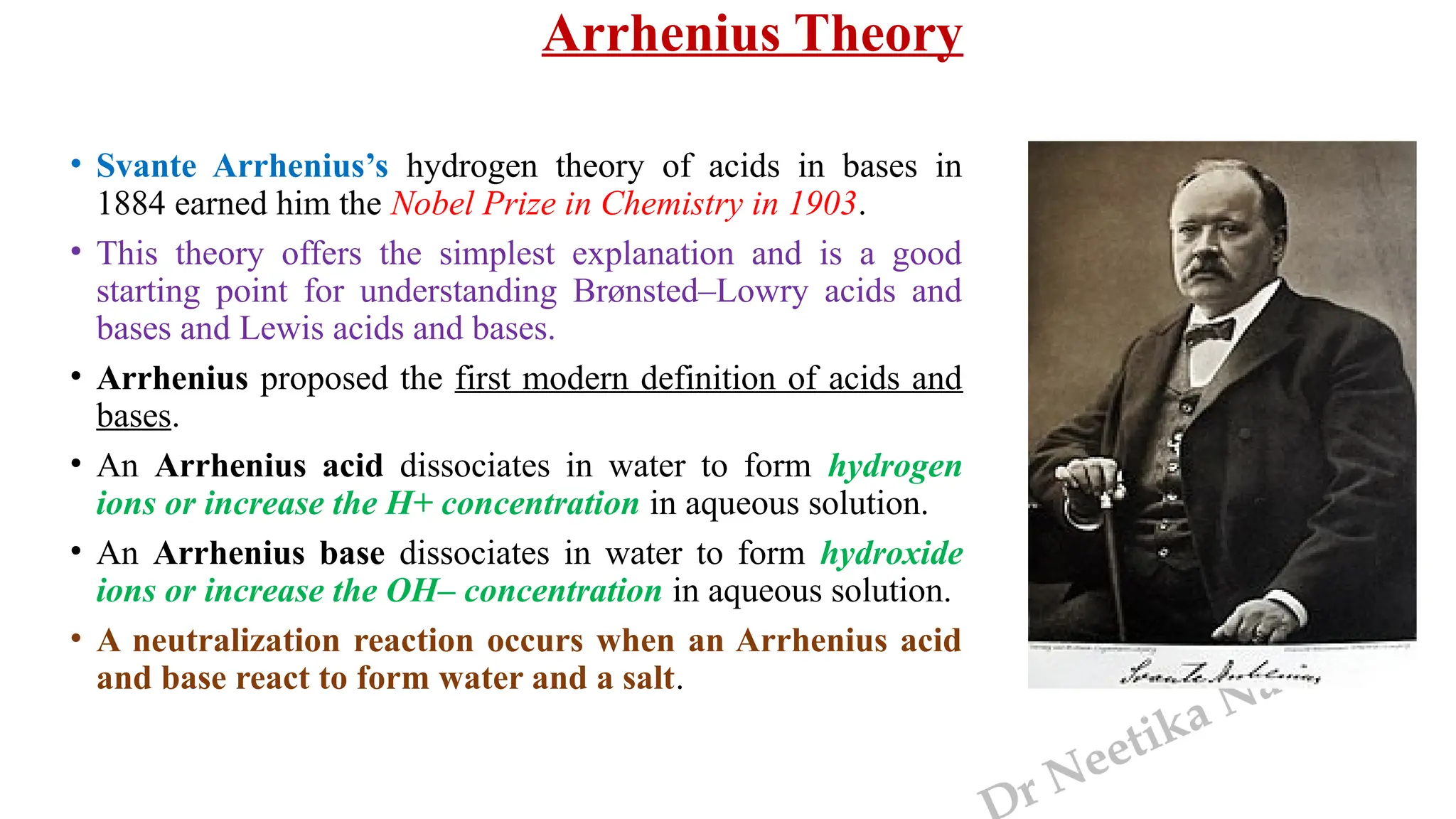
• Svante Arrhenius’s hydrogen theory of acids in bases in
1884 earned him the Nobel Prize in Chemistry in 1903.
• This theory offers the simplest explanation and is a good
starting point for understanding Brønsted–Lowry acids and
bases and Lewis acids and bases.
• Arrhenius proposed the first modern definition of acids and
bases.
• An Arrhenius acid dissociates in water to form hydrogen
ions or increase the H+ concentration in aqueous solution.
• An Arrhenius base dissociates in water to form hydroxide
ions or increase the OH– concentration in aqueous solution.
• A neutralization reaction occurs when an Arrhenius acid
and base react to form water and a salt.
r Neetika Naudiyal
Arrhenius Acid Definition
• An Arrhenius acid is a chemical species that increases the concentration of the hydrogen
ion (H+) in aqueous solution. The general form of the chemical reaction for Arrhenius acid
dissociation is:
HA(aq) → H+(aq) + A–(aq)
• For example, Hydrochloric Acid (HCl) is an Arrhenius acid that dissociates in water to form
the hydrogen ion and the chloride ion:
HCl(aq) → H+(aq) + Cl–(aq)
r Neetika Naudiyal
Arrhenius Base Definition
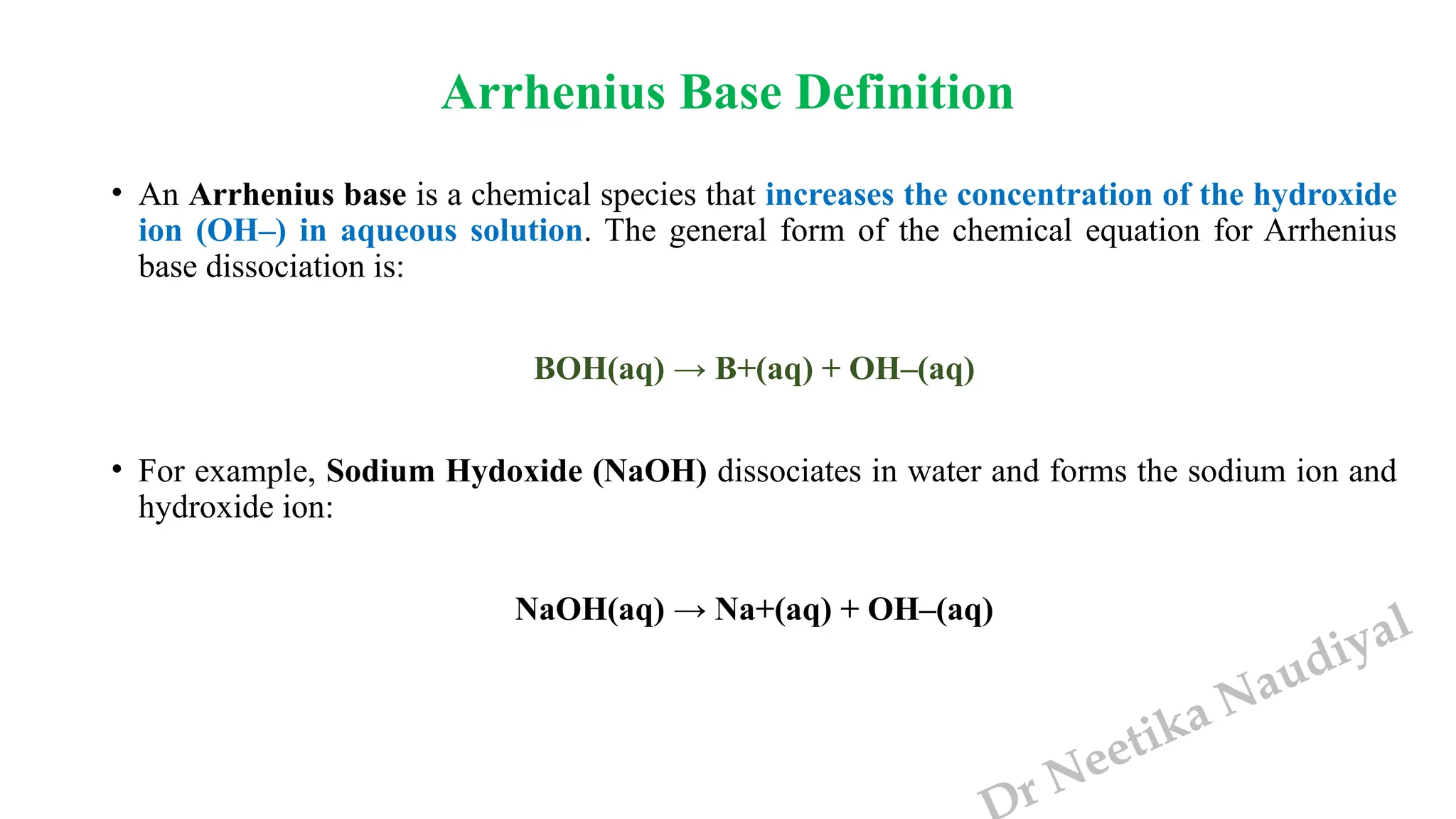
• An Arrhenius base is a chemical species that increases the concentration of the hydroxide
ion (OH–) in aqueous solution. The general form of the chemical equation for Arrhenius
base dissociation is:
BOH(aq) → B+(aq) + OH–(aq)
• For example, Sodium Hydoxide (NaOH) dissociates in water and forms the sodium ion and
hydroxide ion:
NaOH(aq) → Na+(aq) + OH–(aq)
r Neetika Naudiyal
Arrhenius Acid-Base Reaction
(Neutralization)
• An Arrhenius acid and an Arrhenius base react usually reaction with each other in a
neutralization reaction that forms water and a salt.
• The hydrogen ion from the acid and hydroxide ion from the base combine to form WATER
• While the cation from the dissociation of the base and the anion from the dissociation of the
acid combine to form a SALT.
Acid + Base → Water + Salt
• Consider, for example, the reaction between Hydrofluoric Acid (an Arrhenius acid) and Lithium
Hydroxide (an Arrhenius base).
1. HF(aq) H+(aq) + F−(aq)
⇌
2. LiOH(aq) → Li+(aq) + OH−(aq)
• The overall reaction is:
HF(aq) + LiOH(aq) → H2​
O(l) + LiF(aq)
eetika Naudiyal
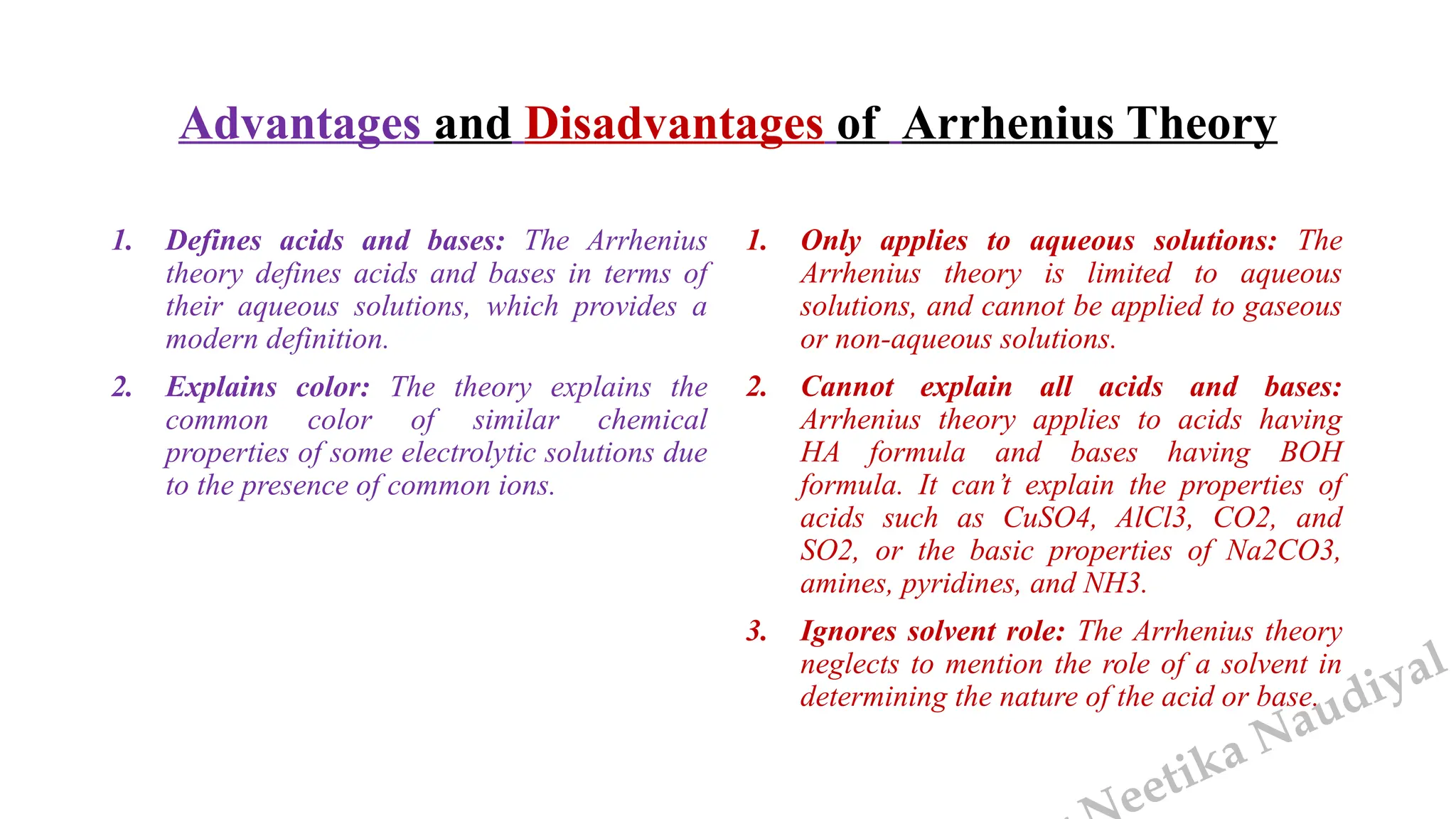
Advantages and Disadvantages of Arrhenius Theory
1. Defines acids and bases: The Arrhenius
theory defines acids and bases in terms of
their aqueous solutions, which provides a
modern definition.
2. Explains color: The theory explains the
common color of similar chemical
properties of some electrolytic solutions due
to the presence of common ions.
1. Only applies to aqueous solutions: The
Arrhenius theory is limited to aqueous
solutions, and cannot be applied to gaseous
or non-aqueous solutions.
2. Cannot explain all acids and bases:
Arrhenius theory applies to acids having
HA formula and bases having BOH
formula. It can’t explain the properties of
acids such as CuSO4, AlCl3, CO2, and
SO2, or the basic properties of Na2CO3,
amines, pyridines, and NH3.
3. Ignores solvent role: The Arrhenius theory
neglects to mention the role of a solvent in
determining the nature of the acid or base.
Bronsted Lowry Acid and Base Theory
r Neetika Naudiyal
Bronsted Lowry Acid and Base Theory
• Other names: Brønsted–Lowry theory or proton theory of acids and bases.
• Johannes Nicolaus Brønsted and Thomas Martin Lowry independently outlined the theory in 1923 as a
generalization of the Arrhenius theory of acids and bases.
• The Brønsted–Lowry theory defines acids as proton donors and bases as proton acceptors.
• Acids and bases exist as conjugate pairs:
1. When the acid donates a proton, it forms its conjugate base.
2. When a base accepts a proton, it forms its conjugate acid.
• Some compounds act as either an acid or a base, depending on the reaction. Compounds which are both
acids and bases are amphoteric.
r Neetika Naudiyal
• According to the Bronsted Lowry theory, an acid is a proton donor and base is a proton acceptor.
• Since a proton is essentially the H+ ion, all Bronsted-Lowry acids contain hydrogen.
• An amphoteric compound is species that can either donate or accept a proton.
• For example, consider the reaction between Hydrochloric Acid (HCl) and Ammonia (NH3) that
forms the ammonium ion (NH4+) and chloride ion (Cl–).
HCl(aq) + NH3(aq) → NH4+(aq) + Cl–(aq)
• In this reaction, HCl donates a hydrogen to NH3. HCl is the Bronsted Lowry acid and NH3 is the
Bronsted Lowry base.
• When HCl donates its proton, it forms its conjugate base, Cl–.
• When NH3 accepts a proton, it forms its conjugate acid, NH4+.
• So, the reaction contains two conjugate pairs:
HCl (acid) and Cl– (conjugate base)
NH3​(base) and NH4+ (conjugate acid)
Defining Bronsted Lowry Acids and Bases
r Neetika Naudiyal
Strong and Weak Bronsted Lowry Acids and Bases
• An acid or base is either strong or weak.
• A strong acid or base fully dissociates into its ion in its solvent, which is usually water.
• All of a strong acid converts into its conjugate base, while all of a strong base converts into its conjugate
acid.
• The conjugate base of a strong acid is a very weak base.
• The conjugate acid of a strong base is a very weak acid.
• Examples of strong Bronsted Lowry acids include hydrochloric acid (HCl), nitric acid (HNO3), sulfuric acid
(H2SO4), and hydrobromic acid (HBr).
• Examples of strong bases include sodium hydroxide (NaOH), potassium hydroxide (KOH), lithium
hydroxide (LiOH), and calcium hydroxide (Ca(OH)2).
• A weak acid or base incompletely dissociates, reaching an equilibrium condition where both the weak
acid and its conjugate base or weak base and its conjugate acid both remain in solution.
• Examples of weak Bronsted Lowry acids include phosphoric acid (H3PO4), nitrous acid (HNO2), and acetic
acid (CH3COOH).
• Examples of weak bases include ammonia (NH3), copper hydroxide (Cu(OH)2), and methylamine
(CH NH ).
₃ ₂
r Neetika Naudiyal
• Water is amphoteric and acts as an acid in some reactions and as a base in other reactions.
• When we dissolve a strong acid in water, the water acts as a base.
• When we dissolve a strong base in water, the water acts as an acid.
• For example:
HCl(aq) + H2O(l) → H3O+(aq) + Cl–(aq)
• The conjugate pairs are as follows:
• HCl (acid) and Cl- (conjugate base)
• H2O (base) and H3O+ (conjugate acid)
NaOH(s) + H2O(l) → Na+(aq) + OH–(aq)
• The conjugate pairs are as follows:
• NaOH (base) and Na+ (conjugate acid)
• H2O (acid) and OH– (conjugate base)
eetika Naudiyal
Advantages and Disadvantages of Bronsted Lowry Acid
and Base Theory
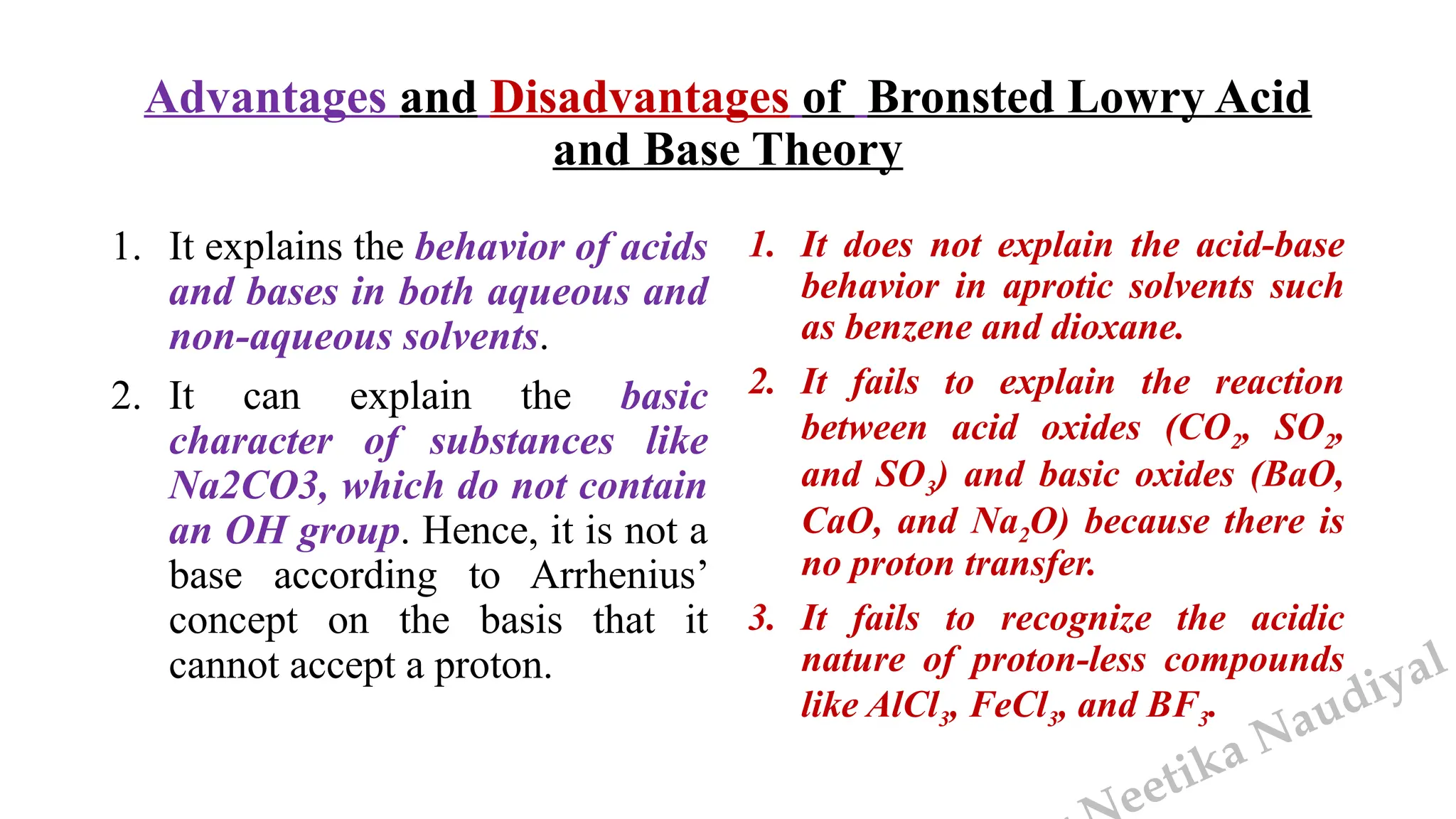
1. It explains the behavior of acids
and bases in both aqueous and
non-aqueous solvents.
2. It can explain the basic
character of substances like
Na2CO3, which do not contain
an OH group. Hence, it is not a
base according to Arrhenius’
concept on the basis that it
cannot accept a proton.
1. It does not explain the acid-base
behavior in aprotic solvents such
as benzene and dioxane.
2. It fails to explain the reaction
between acid oxides (CO2, SO2,
and SO3) and basic oxides (BaO,
CaO, and Na2O) because there is
no proton transfer.
3. It fails to recognize the acidic
nature of proton-less compounds
like AlCl3, FeCl3, and BF3.
Lewis Acid and Base Theory
r Neetika Naudiyal
Lewis Acid and Base Theory
• In 1916, Gilbert N. Lewis proposed that a covalent bond
forms when each atom contributes one electron to form an
electron pair that the atoms share.
• When both electrons come from one atom, the chemical
bond is a coordinate or dative covalent bond.
• In 1923, Lewis described an acid as a substance which “can
employ an electron lone pair from another molecule in
completing the stable group of one of its own atoms.”
• In 1963, the theory was expanded to classify hard and soft
acids and bases (HSAB theory).
r Neetika Naudiyal
How Lewis Acids and Bases Work
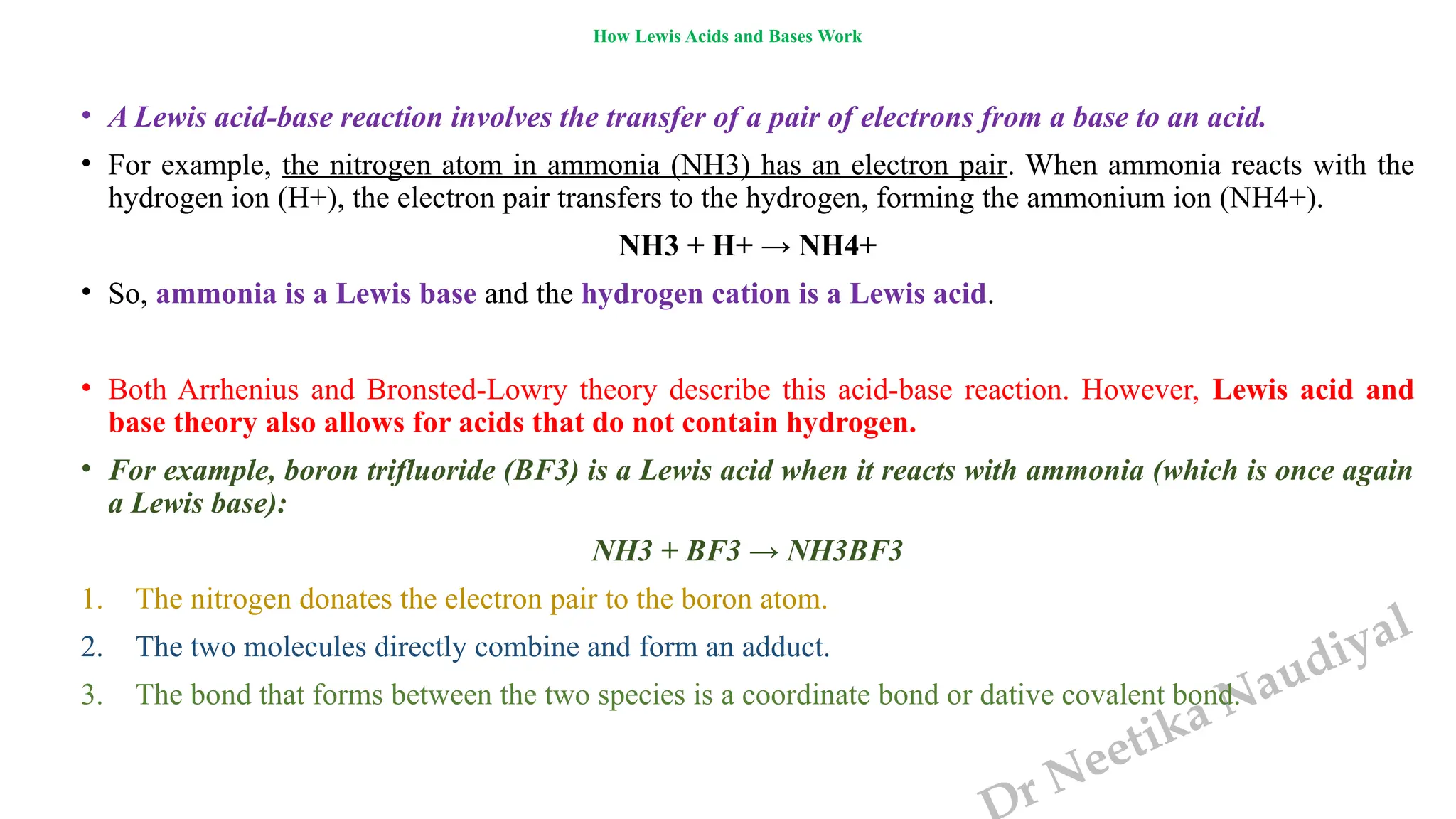
• A Lewis acid-base reaction involves the transfer of a pair of electrons from a base to an acid.
• For example, the nitrogen atom in ammonia (NH3) has an electron pair. When ammonia reacts with the
hydrogen ion (H+), the electron pair transfers to the hydrogen, forming the ammonium ion (NH4+).
NH3 + H+ → NH4+
• So, ammonia is a Lewis base and the hydrogen cation is a Lewis acid.
• Both Arrhenius and Bronsted-Lowry theory describe this acid-base reaction. However, Lewis acid and
base theory also allows for acids that do not contain hydrogen.
• For example, boron trifluoride (BF3) is a Lewis acid when it reacts with ammonia (which is once again
a Lewis base):
NH3 + BF3 → NH3BF3
1. The nitrogen donates the electron pair to the boron atom.
2. The two molecules directly combine and form an adduct.
3. The bond that forms between the two species is a coordinate bond or dative covalent bond.
r Neetika Naudiyal
Examples of Lewis Acids and Bases
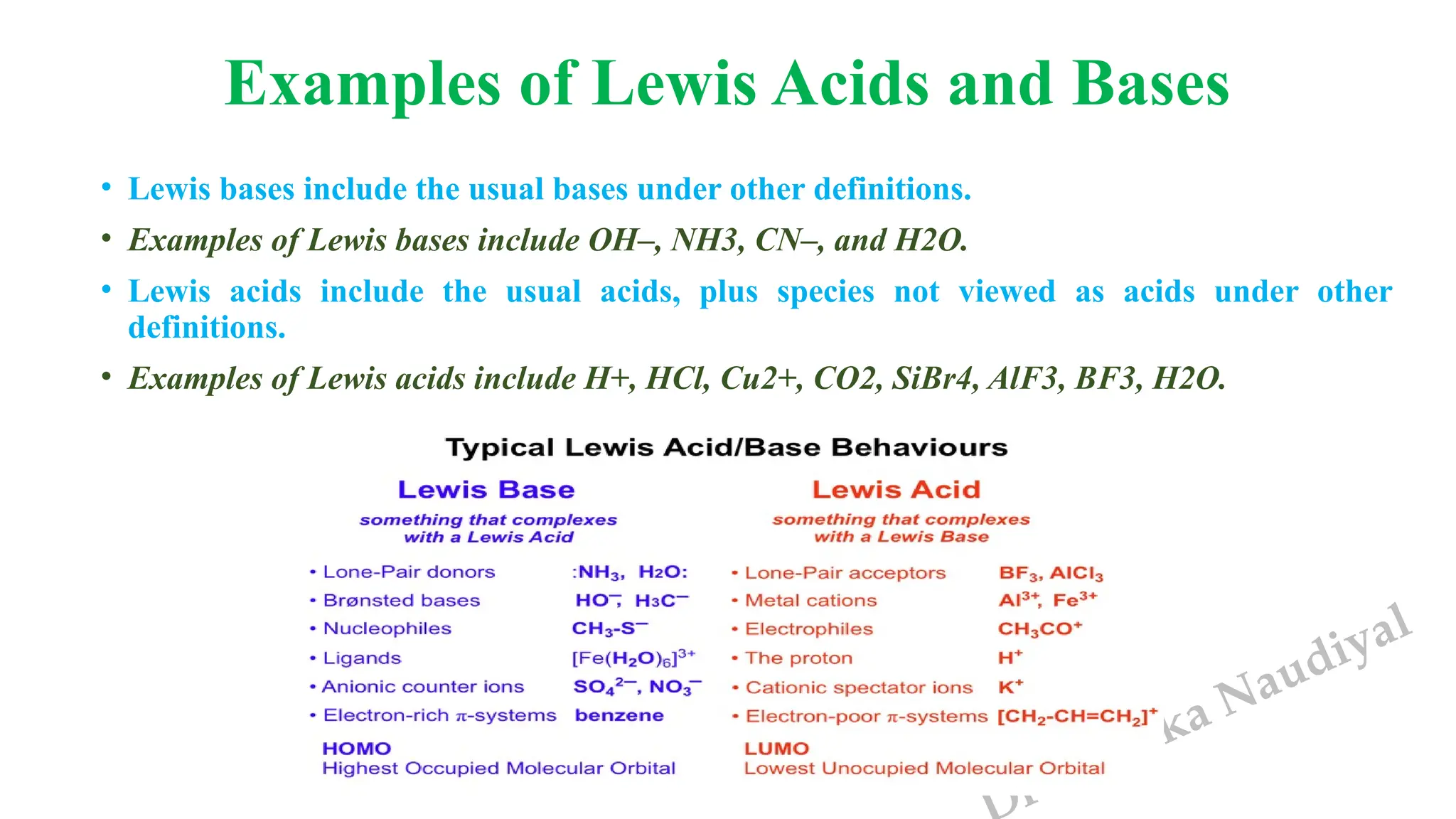
• Lewis bases include the usual bases under other definitions.
• Examples of Lewis bases include OH–, NH3, CN–, and H2O.
• Lewis acids include the usual acids, plus species not viewed as acids under other
definitions.
• Examples of Lewis acids include H+, HCl, Cu2+, CO2, SiBr4, AlF3, BF3, H2O.
r Neetika Naudiyal
Amphoteric Species
• Some chemical species are amphoteric, meaning they can act as either a Lewis acid or as a Lewis base,
depending on the situation.
• Water (H2O) is a great example.
Water acts as an acid when it reacts with ammonia:
H2O + NH3 → NH4+ + OH−
It acts as a base when it reacts with hydrochloric acid:
H2O + HCl → Cl– + H3O+
• Aluminum hydroxide [Al(OH)3] is an example of an amphoteric compound under the Lewis theory.
It acts as a Lewis base in the reaction with the hydrogen ion:
Al(OH)3 + 3H+ → Al3+ + 3H2O
It acts as a Lewis acid in the reaction with the hydroxide ion:
Al(OH)3 + OH− → Al(OH)4–
eetika Naudiyal
Advantages and Disadvantages of Lewis Acid and Base
Theory
1. Broad definition: The Lewis
theory's broad definition of
acids and bases increases the
number of acid-base reactions
that can occur.
2. Explains nonmetal oxides:
The Lewis theory can explain
why nonmetal oxides like
carbon dioxide (CO2) dissolve
in water to form acids.
1. Doesn't explain protonic acids: The
Lewis theory can't explain the behavior of
protonic acids like sulfuric acid and
hydrochloric acid.
2. Doesn't explain relative strengths: The
Lewis theory can't explain the relative
strengths of acids and bases.
3. Slow reactions: Lewis acid-base reactions
are generally slower than neutralization
reactions, which are usually very fast.
4. Doesn't explain all acid-base reactions:
Not all acid-base reactions involve the
formation of coordinate bonds
Hierarchal definitions of acids and bases via the three
primary theories.

Theories of Acids and Bases (Arrhenius, Bronsted and Lewis)

  • 1.
    Dr. Neetika Naudiyal AssistantProfessor, Department of Life Sciences, Kristu Jayanti College (Autonomous), Bengaluru Theories of Acids and Bases
  • 2.
    r Neetika Naudiyal Maintheories of Acids and Bases The three main theories of acids and bases are: 1. Arrhenius Theory a) Acids: Substances that increase the concentration of H ions in water. ⁺ b) Bases: Substances that increase the concentration of OH ions in water. ⁻ 2. Brønsted-Lowry Theory a) Acids: Proton donors. b) Bases: Proton acceptors. 3. Lewis Theory a) Acids: Electron pair acceptors. b) Bases: Electron pair donors.
  • 3.
  • 4.
    r Neetika Naudiyal ArrheniusTheory • Svante Arrhenius’s hydrogen theory of acids in bases in 1884 earned him the Nobel Prize in Chemistry in 1903. • This theory offers the simplest explanation and is a good starting point for understanding Brønsted–Lowry acids and bases and Lewis acids and bases. • Arrhenius proposed the first modern definition of acids and bases. • An Arrhenius acid dissociates in water to form hydrogen ions or increase the H+ concentration in aqueous solution. • An Arrhenius base dissociates in water to form hydroxide ions or increase the OH– concentration in aqueous solution. • A neutralization reaction occurs when an Arrhenius acid and base react to form water and a salt.
  • 5.
    r Neetika Naudiyal ArrheniusAcid Definition • An Arrhenius acid is a chemical species that increases the concentration of the hydrogen ion (H+) in aqueous solution. The general form of the chemical reaction for Arrhenius acid dissociation is: HA(aq) → H+(aq) + A–(aq) • For example, Hydrochloric Acid (HCl) is an Arrhenius acid that dissociates in water to form the hydrogen ion and the chloride ion: HCl(aq) → H+(aq) + Cl–(aq)
  • 6.
    r Neetika Naudiyal ArrheniusBase Definition • An Arrhenius base is a chemical species that increases the concentration of the hydroxide ion (OH–) in aqueous solution. The general form of the chemical equation for Arrhenius base dissociation is: BOH(aq) → B+(aq) + OH–(aq) • For example, Sodium Hydoxide (NaOH) dissociates in water and forms the sodium ion and hydroxide ion: NaOH(aq) → Na+(aq) + OH–(aq)
  • 7.
    r Neetika Naudiyal ArrheniusAcid-Base Reaction (Neutralization) • An Arrhenius acid and an Arrhenius base react usually reaction with each other in a neutralization reaction that forms water and a salt. • The hydrogen ion from the acid and hydroxide ion from the base combine to form WATER • While the cation from the dissociation of the base and the anion from the dissociation of the acid combine to form a SALT. Acid + Base → Water + Salt • Consider, for example, the reaction between Hydrofluoric Acid (an Arrhenius acid) and Lithium Hydroxide (an Arrhenius base). 1. HF(aq) H+(aq) + F−(aq) ⇌ 2. LiOH(aq) → Li+(aq) + OH−(aq) • The overall reaction is: HF(aq) + LiOH(aq) → H2​ O(l) + LiF(aq)
  • 8.
    eetika Naudiyal Advantages andDisadvantages of Arrhenius Theory 1. Defines acids and bases: The Arrhenius theory defines acids and bases in terms of their aqueous solutions, which provides a modern definition. 2. Explains color: The theory explains the common color of similar chemical properties of some electrolytic solutions due to the presence of common ions. 1. Only applies to aqueous solutions: The Arrhenius theory is limited to aqueous solutions, and cannot be applied to gaseous or non-aqueous solutions. 2. Cannot explain all acids and bases: Arrhenius theory applies to acids having HA formula and bases having BOH formula. It can’t explain the properties of acids such as CuSO4, AlCl3, CO2, and SO2, or the basic properties of Na2CO3, amines, pyridines, and NH3. 3. Ignores solvent role: The Arrhenius theory neglects to mention the role of a solvent in determining the nature of the acid or base.
  • 9.
    Bronsted Lowry Acidand Base Theory
  • 10.
    r Neetika Naudiyal BronstedLowry Acid and Base Theory • Other names: Brønsted–Lowry theory or proton theory of acids and bases. • Johannes Nicolaus Brønsted and Thomas Martin Lowry independently outlined the theory in 1923 as a generalization of the Arrhenius theory of acids and bases. • The Brønsted–Lowry theory defines acids as proton donors and bases as proton acceptors. • Acids and bases exist as conjugate pairs: 1. When the acid donates a proton, it forms its conjugate base. 2. When a base accepts a proton, it forms its conjugate acid. • Some compounds act as either an acid or a base, depending on the reaction. Compounds which are both acids and bases are amphoteric.
  • 11.
    r Neetika Naudiyal •According to the Bronsted Lowry theory, an acid is a proton donor and base is a proton acceptor. • Since a proton is essentially the H+ ion, all Bronsted-Lowry acids contain hydrogen. • An amphoteric compound is species that can either donate or accept a proton. • For example, consider the reaction between Hydrochloric Acid (HCl) and Ammonia (NH3) that forms the ammonium ion (NH4+) and chloride ion (Cl–). HCl(aq) + NH3(aq) → NH4+(aq) + Cl–(aq) • In this reaction, HCl donates a hydrogen to NH3. HCl is the Bronsted Lowry acid and NH3 is the Bronsted Lowry base. • When HCl donates its proton, it forms its conjugate base, Cl–. • When NH3 accepts a proton, it forms its conjugate acid, NH4+. • So, the reaction contains two conjugate pairs: HCl (acid) and Cl– (conjugate base) NH3​(base) and NH4+ (conjugate acid) Defining Bronsted Lowry Acids and Bases
  • 12.
    r Neetika Naudiyal Strongand Weak Bronsted Lowry Acids and Bases • An acid or base is either strong or weak. • A strong acid or base fully dissociates into its ion in its solvent, which is usually water. • All of a strong acid converts into its conjugate base, while all of a strong base converts into its conjugate acid. • The conjugate base of a strong acid is a very weak base. • The conjugate acid of a strong base is a very weak acid. • Examples of strong Bronsted Lowry acids include hydrochloric acid (HCl), nitric acid (HNO3), sulfuric acid (H2SO4), and hydrobromic acid (HBr). • Examples of strong bases include sodium hydroxide (NaOH), potassium hydroxide (KOH), lithium hydroxide (LiOH), and calcium hydroxide (Ca(OH)2). • A weak acid or base incompletely dissociates, reaching an equilibrium condition where both the weak acid and its conjugate base or weak base and its conjugate acid both remain in solution. • Examples of weak Bronsted Lowry acids include phosphoric acid (H3PO4), nitrous acid (HNO2), and acetic acid (CH3COOH). • Examples of weak bases include ammonia (NH3), copper hydroxide (Cu(OH)2), and methylamine (CH NH ). ₃ ₂
  • 13.
    r Neetika Naudiyal •Water is amphoteric and acts as an acid in some reactions and as a base in other reactions. • When we dissolve a strong acid in water, the water acts as a base. • When we dissolve a strong base in water, the water acts as an acid. • For example: HCl(aq) + H2O(l) → H3O+(aq) + Cl–(aq) • The conjugate pairs are as follows: • HCl (acid) and Cl- (conjugate base) • H2O (base) and H3O+ (conjugate acid) NaOH(s) + H2O(l) → Na+(aq) + OH–(aq) • The conjugate pairs are as follows: • NaOH (base) and Na+ (conjugate acid) • H2O (acid) and OH– (conjugate base)
  • 14.
    eetika Naudiyal Advantages andDisadvantages of Bronsted Lowry Acid and Base Theory 1. It explains the behavior of acids and bases in both aqueous and non-aqueous solvents. 2. It can explain the basic character of substances like Na2CO3, which do not contain an OH group. Hence, it is not a base according to Arrhenius’ concept on the basis that it cannot accept a proton. 1. It does not explain the acid-base behavior in aprotic solvents such as benzene and dioxane. 2. It fails to explain the reaction between acid oxides (CO2, SO2, and SO3) and basic oxides (BaO, CaO, and Na2O) because there is no proton transfer. 3. It fails to recognize the acidic nature of proton-less compounds like AlCl3, FeCl3, and BF3.
  • 15.
    Lewis Acid andBase Theory
  • 16.
    r Neetika Naudiyal LewisAcid and Base Theory • In 1916, Gilbert N. Lewis proposed that a covalent bond forms when each atom contributes one electron to form an electron pair that the atoms share. • When both electrons come from one atom, the chemical bond is a coordinate or dative covalent bond. • In 1923, Lewis described an acid as a substance which “can employ an electron lone pair from another molecule in completing the stable group of one of its own atoms.” • In 1963, the theory was expanded to classify hard and soft acids and bases (HSAB theory).
  • 17.
    r Neetika Naudiyal HowLewis Acids and Bases Work • A Lewis acid-base reaction involves the transfer of a pair of electrons from a base to an acid. • For example, the nitrogen atom in ammonia (NH3) has an electron pair. When ammonia reacts with the hydrogen ion (H+), the electron pair transfers to the hydrogen, forming the ammonium ion (NH4+). NH3 + H+ → NH4+ • So, ammonia is a Lewis base and the hydrogen cation is a Lewis acid. • Both Arrhenius and Bronsted-Lowry theory describe this acid-base reaction. However, Lewis acid and base theory also allows for acids that do not contain hydrogen. • For example, boron trifluoride (BF3) is a Lewis acid when it reacts with ammonia (which is once again a Lewis base): NH3 + BF3 → NH3BF3 1. The nitrogen donates the electron pair to the boron atom. 2. The two molecules directly combine and form an adduct. 3. The bond that forms between the two species is a coordinate bond or dative covalent bond.
  • 18.
    r Neetika Naudiyal Examplesof Lewis Acids and Bases • Lewis bases include the usual bases under other definitions. • Examples of Lewis bases include OH–, NH3, CN–, and H2O. • Lewis acids include the usual acids, plus species not viewed as acids under other definitions. • Examples of Lewis acids include H+, HCl, Cu2+, CO2, SiBr4, AlF3, BF3, H2O.
  • 19.
    r Neetika Naudiyal AmphotericSpecies • Some chemical species are amphoteric, meaning they can act as either a Lewis acid or as a Lewis base, depending on the situation. • Water (H2O) is a great example. Water acts as an acid when it reacts with ammonia: H2O + NH3 → NH4+ + OH− It acts as a base when it reacts with hydrochloric acid: H2O + HCl → Cl– + H3O+ • Aluminum hydroxide [Al(OH)3] is an example of an amphoteric compound under the Lewis theory. It acts as a Lewis base in the reaction with the hydrogen ion: Al(OH)3 + 3H+ → Al3+ + 3H2O It acts as a Lewis acid in the reaction with the hydroxide ion: Al(OH)3 + OH− → Al(OH)4–
  • 20.
    eetika Naudiyal Advantages andDisadvantages of Lewis Acid and Base Theory 1. Broad definition: The Lewis theory's broad definition of acids and bases increases the number of acid-base reactions that can occur. 2. Explains nonmetal oxides: The Lewis theory can explain why nonmetal oxides like carbon dioxide (CO2) dissolve in water to form acids. 1. Doesn't explain protonic acids: The Lewis theory can't explain the behavior of protonic acids like sulfuric acid and hydrochloric acid. 2. Doesn't explain relative strengths: The Lewis theory can't explain the relative strengths of acids and bases. 3. Slow reactions: Lewis acid-base reactions are generally slower than neutralization reactions, which are usually very fast. 4. Doesn't explain all acid-base reactions: Not all acid-base reactions involve the formation of coordinate bonds
  • 21.
    Hierarchal definitions ofacids and bases via the three primary theories.