Experiment No. 2 To synthesis and submit chlorobutanol.
1.
BP607P Medicinal ChemistryIII
Experiment No. 3
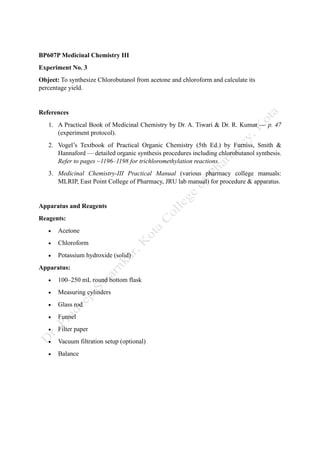
Object: To synthesize Chlorobutanol from acetone and chloroform and calculate its
percentage yield.
References
1. A Practical Book of Medicinal Chemistry by Dr. A. Tiwari & Dr. R. Kumar — p. 47
(experiment protocol).
2. Vogel’s Textbook of Practical Organic Chemistry (5th Ed.) by Furniss, Smith &
Hannaford — detailed organic synthesis procedures including chlorobutanol synthesis.
Refer to pages ~1196–1198 for trichloromethylation reactions.
3. Medicinal Chemistry-III Practical Manual (various pharmacy college manuals:
MLRIP, East Point College of Pharmacy, JRU lab manual) for procedure & apparatus.
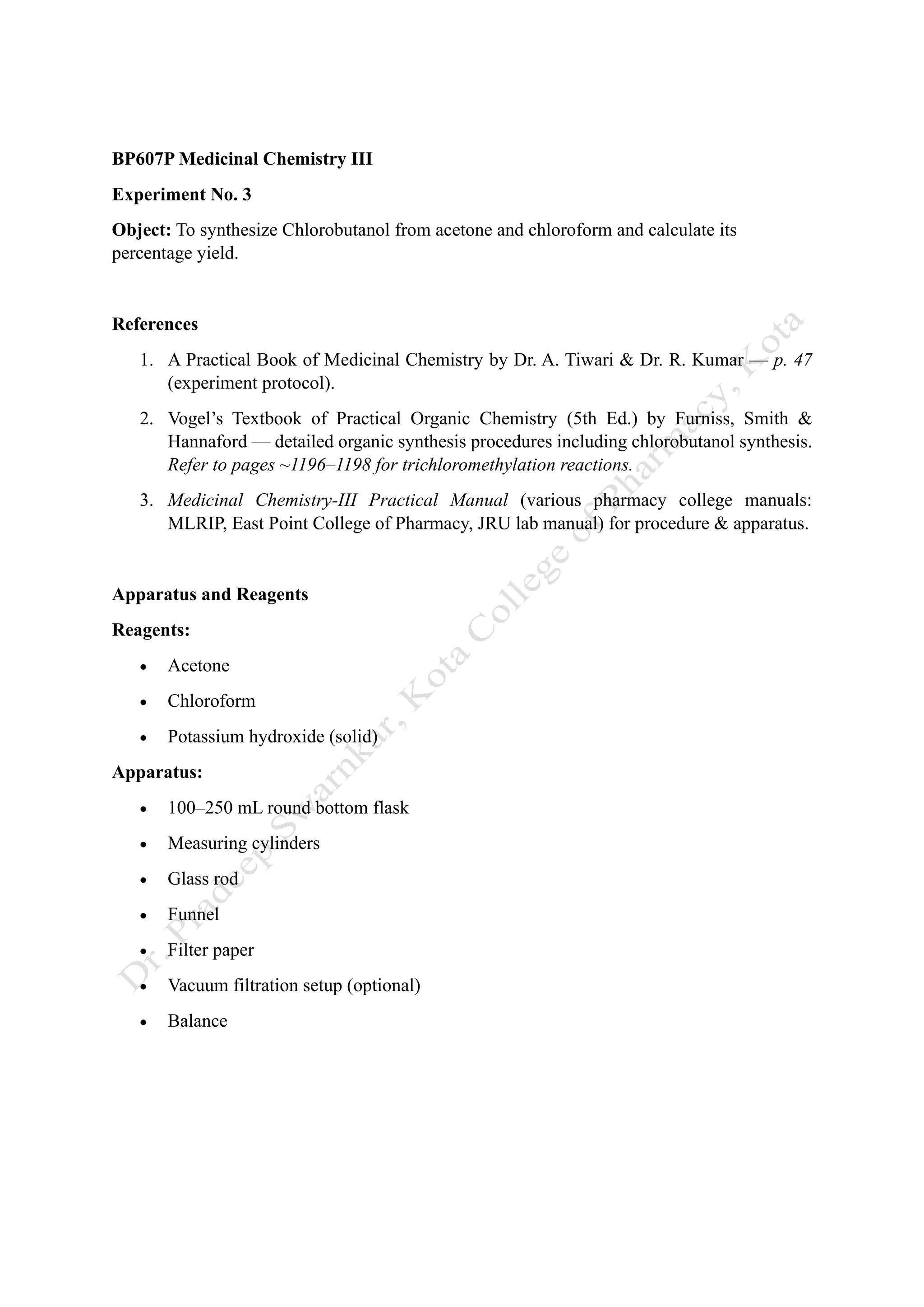
Apparatus and Reagents
Reagents:
• Acetone
• Chloroform
• Potassium hydroxide (solid)
Apparatus:
• 100–250 mL round bottom flask
• Measuring cylinders
• Glass rod
• Funnel
• Filter paper
• Vacuum filtration setup (optional)
• Balance
2.
Principle
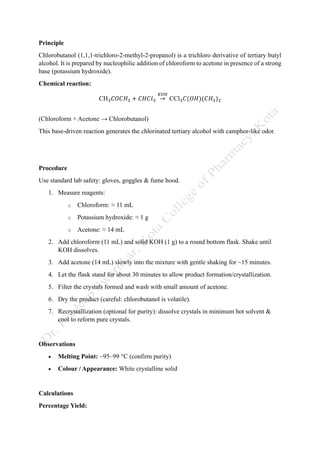
Chlorobutanol (1,1,1-trichloro-2-methyl-2-propanol) isa trichloro derivative of tertiary butyl
alcohol. It is prepared by nucleophilic addition of chloroform to acetone in presence of a strong
base (potassium hydroxide).
Chemical reaction:
CH3𝐶𝑂𝐶𝐻3 + 𝐶𝐻𝐶𝑙3 →
𝐾𝑂𝐻
CCl3𝐶(𝑂𝐻)(𝐶𝐻3)2
(Chloroform + Acetone → Chlorobutanol)
This base-driven reaction generates the chlorinated tertiary alcohol with camphor-like odor.
Procedure
Use standard lab safety: gloves, goggles & fume hood.
1. Measure reagents:
o Chloroform: ≈ 11 mL
o Potassium hydroxide: ≈ 1 g
o Acetone: ≈ 14 mL
2. Add chloroform (11 mL) and solid KOH (1 g) to a round bottom flask. Shake until
KOH dissolves.
3. Add acetone (14 mL) slowly into the mixture with gentle shaking for ~15 minutes.
4. Let the flask stand for about 30 minutes to allow product formation/crystallization.
5. Filter the crystals formed and wash with small amount of acetone.
6. Dry the product (careful: chlorobutanol is volatile).
7. Recrystallization (optional for purity): dissolve crystals in minimum hot solvent &
cool to reform pure crystals.
Observations
• Melting Point: ~95–99 °C (confirm purity)
• Colour / Appearance: White crystalline solid
Calculations
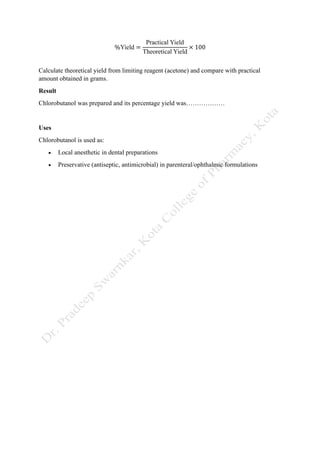
Percentage Yield:
3.
%Yield =
Practical Yield
TheoreticalYield
× 100
Calculate theoretical yield from limiting reagent (acetone) and compare with practical
amount obtained in grams.
Result
Chlorobutanol was prepared and its percentage yield was………………
Uses
Chlorobutanol is used as:
• Local anesthetic in dental preparations
• Preservative (antiseptic, antimicrobial) in parenteral/ophthalmic formulations