Solutions
What Is A Solution?
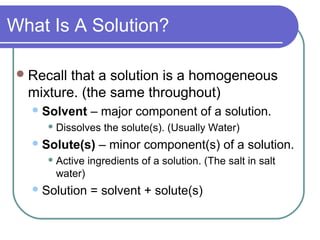
Recall that a solution is a homogeneous
mixture. (the same throughout)
Solvent – major component of a solution.
 Dissolves the solute(s). (Usually Water)
Solute(s) – minor component(s) of a solution.
 Active ingredients of a solution. (The salt in salt
water)
Solution = solvent + solute(s)
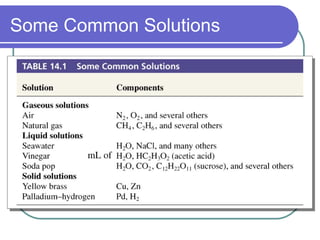
Some Common Solutions
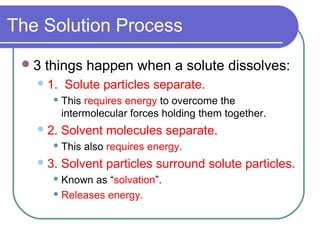
The Solution Process
3 things happen when a solute dissolves:
1. Solute particles separate.
 This requires energy to overcome the
intermolecular forces holding them together.
2. Solvent molecules separate.
 This also requires energy.
3. Solvent particles surround solute particles.
 Known as “solvation”.
 Releases energy.
The Solution Process
1. Particles separate from
solute.
2. Solvent molecules move apart
to accommodate solute.
3. Solvation
Ions in Solution
Solvated
cation
Solvated
anion
The Solution Process
Energy Changes in Solutions
 The formation of a solution always involves a
temperature change.
 Can be a large or small temperature change.
 Can get warmer or cooler as solute dissolves.
 ∆H = enthalpy (heat) of solution
 Energy absorbed or released as a solute dissolves in
a solvent.
 +∆H = endothermic sol’n process.
 More heat absorbed than released.
 Temperature decreases as sol’n is formed.
 -∆H = exothermic sol’n process.
 More heat released than absorbed.
 Temperature increases as sol’n is formed.
Energy Changes in Solutions
Solubility
 Not all substances dissolve in water.
 Remember, “like dissolves like”.
 Polar solutes tend to dissolve more in polar solvents.
 Non-polar solutes tend to dissolve more in non-polar
solvents.
 Some (but not all) ionic compounds will dissolve
in water.
 Of those that do, temperature affects how much
they dissolve.
 Solids usually dissolve more in warm water.
 Gases usually dissolve more in cool water.
Solubility
 Insoluble – less than 0.1 grams of solute will dissolve in
100 grams of solvent.
 BaSO4 is insoluble in water.
 Only 0.0002448 grams of BaSO4 will dissolve in 100 grams of
water.
 Slightly soluble – 0.1 to 1 gram of solute will dissolve in
100 grams of solvent.
 Ag2SO4 is slightly soluble in water.
 About 0.8 grams of Ag2SO4 will dissolve in 100 grams of water
at 20ºC.
 Soluble – more than 1 gram of solute will dissolve in
100 grams of solvent.
 NaCl is soluble in water.
 35.9 grams of NaCl will dissolve in 100 grams of water at
20ºC.
Solubility Rules
Use your list of solubility rules to
determine whether each of the following
salts is soluble or insoluble in water.
NaCl
K2SO4
CaCO3
NH4NO3
Cu3(PO4)2
AgBr
NaCl is soluble.
K2SO4 is soluble.
CaCO3 is insoluble.
NH4NO3 is soluble.
Cu3(PO4)2 is insoluble.
AgBr is insoluble.
Saturation
 Saturated solution
 A sol’n containing the max. amt. of solute for a given amt. of
solvent at constant temp. and pressure.
 If additional solute is added it will not dissolve.
 Unsaturated solution
 A sol’n that does not contain the max. amt. of solute for a
given amt. of solvent.
 Additional solute can dissolve in an unsaturated solution.
 Supersaturated solution
 A sol’n that contains more solute than it can theoretically hold
at a given temperature.
 Addition of more solute causes the excess solute to precipitate.
Solubility Curves
Solubility curve chart – compares the
solubilities of several compounds in
water as a function of temperature.
Usually expresses solubility in terms of
grams of solute per 100 grams of water.
Solubility
Curves
 How many grams
of KNO3 can
dissolve in 100
grams of water at
30ºC?
 Answer: About
48 grams.
Solubility
Curves
 How many grams
of KClO3 can
dissolve in 100
grams of water at
55ºC?
 Answer: About
25 grams.
Solubility
Curves
 How many
grams of NH4Cl
can be
dissolved in
200 grams of
water at 40ºC?
 Answer: About
96 grams.
Solubility
Curves
 A saturated
solution of NaNO3
is prepared at
70ºC in 100
grams of water. If
the temperature is
lowered to 40ºC,
how many grams
of NaNO3 will
precipitate?
 Answer: About
30 grams will
precipitate out.
Solubility
Curves
 If 35 grams of
NH4Cl are
dissolved in 100
grams of water at
30ºC, is the
solution
unsaturated,
saturated, or
supersaturated?
 Answer: The
solution is
unsaturated.
Solubilities of Gases
 Henry’s Law – The solubility
of a gas in a liquid increases
as the pressure above the
liquid increases.
 Explains decompression
sickness (the “bends”).
 Nitrogen is forced to
dissolve in scuba divers’
blood by high pressure.
 If the diver ascends too
quickly, the nitrogen
bubbles come out of
solution and form painful
and possibly fatal gas
embolisms.

Solutions

  • 1.
  • 2.
    What Is ASolution? Recall that a solution is a homogeneous mixture. (the same throughout) Solvent – major component of a solution.  Dissolves the solute(s). (Usually Water) Solute(s) – minor component(s) of a solution.  Active ingredients of a solution. (The salt in salt water) Solution = solvent + solute(s)
  • 3.
  • 4.
    The Solution Process 3things happen when a solute dissolves: 1. Solute particles separate.  This requires energy to overcome the intermolecular forces holding them together. 2. Solvent molecules separate.  This also requires energy. 3. Solvent particles surround solute particles.  Known as “solvation”.  Releases energy.
  • 5.
    The Solution Process 1.Particles separate from solute. 2. Solvent molecules move apart to accommodate solute. 3. Solvation
  • 6.
  • 7.
  • 8.
    Energy Changes inSolutions  The formation of a solution always involves a temperature change.  Can be a large or small temperature change.  Can get warmer or cooler as solute dissolves.  ∆H = enthalpy (heat) of solution  Energy absorbed or released as a solute dissolves in a solvent.  +∆H = endothermic sol’n process.  More heat absorbed than released.  Temperature decreases as sol’n is formed.  -∆H = exothermic sol’n process.  More heat released than absorbed.  Temperature increases as sol’n is formed.
  • 9.
  • 10.
    Solubility  Not allsubstances dissolve in water.  Remember, “like dissolves like”.  Polar solutes tend to dissolve more in polar solvents.  Non-polar solutes tend to dissolve more in non-polar solvents.  Some (but not all) ionic compounds will dissolve in water.  Of those that do, temperature affects how much they dissolve.  Solids usually dissolve more in warm water.  Gases usually dissolve more in cool water.
  • 11.
    Solubility  Insoluble –less than 0.1 grams of solute will dissolve in 100 grams of solvent.  BaSO4 is insoluble in water.  Only 0.0002448 grams of BaSO4 will dissolve in 100 grams of water.  Slightly soluble – 0.1 to 1 gram of solute will dissolve in 100 grams of solvent.  Ag2SO4 is slightly soluble in water.  About 0.8 grams of Ag2SO4 will dissolve in 100 grams of water at 20ºC.  Soluble – more than 1 gram of solute will dissolve in 100 grams of solvent.  NaCl is soluble in water.  35.9 grams of NaCl will dissolve in 100 grams of water at 20ºC.
  • 12.
    Solubility Rules Use yourlist of solubility rules to determine whether each of the following salts is soluble or insoluble in water. NaCl K2SO4 CaCO3 NH4NO3 Cu3(PO4)2 AgBr NaCl is soluble. K2SO4 is soluble. CaCO3 is insoluble. NH4NO3 is soluble. Cu3(PO4)2 is insoluble. AgBr is insoluble.
  • 13.
    Saturation  Saturated solution A sol’n containing the max. amt. of solute for a given amt. of solvent at constant temp. and pressure.  If additional solute is added it will not dissolve.  Unsaturated solution  A sol’n that does not contain the max. amt. of solute for a given amt. of solvent.  Additional solute can dissolve in an unsaturated solution.  Supersaturated solution  A sol’n that contains more solute than it can theoretically hold at a given temperature.  Addition of more solute causes the excess solute to precipitate.
  • 14.
    Solubility Curves Solubility curvechart – compares the solubilities of several compounds in water as a function of temperature. Usually expresses solubility in terms of grams of solute per 100 grams of water.
  • 15.
    Solubility Curves  How manygrams of KNO3 can dissolve in 100 grams of water at 30ºC?  Answer: About 48 grams.
  • 16.
    Solubility Curves  How manygrams of KClO3 can dissolve in 100 grams of water at 55ºC?  Answer: About 25 grams.
  • 17.
    Solubility Curves  How many gramsof NH4Cl can be dissolved in 200 grams of water at 40ºC?  Answer: About 96 grams.
  • 18.
    Solubility Curves  A saturated solutionof NaNO3 is prepared at 70ºC in 100 grams of water. If the temperature is lowered to 40ºC, how many grams of NaNO3 will precipitate?  Answer: About 30 grams will precipitate out.
  • 19.
    Solubility Curves  If 35grams of NH4Cl are dissolved in 100 grams of water at 30ºC, is the solution unsaturated, saturated, or supersaturated?  Answer: The solution is unsaturated.
  • 20.
    Solubilities of Gases Henry’s Law – The solubility of a gas in a liquid increases as the pressure above the liquid increases.  Explains decompression sickness (the “bends”).  Nitrogen is forced to dissolve in scuba divers’ blood by high pressure.  If the diver ascends too quickly, the nitrogen bubbles come out of solution and form painful and possibly fatal gas embolisms.