Chapter 4:
Atomic Structure
4.1 Defining the Atom
• An Atom is the smallest particle of an
element that retains its identity in a
chemical reaction.
• The Greek Philosopher
Democritus, was among the
First to suggest the existence
Of atoms.
Dalton’s Atomic Theory
1. All elements are composed of tiny indivisible particles
called atoms.
2. Atoms of the same element are identical. The atoms of any
one element are different from those of any other element.
3. Atoms of different elements can physically mix together or
can chemically combine in simple whole-number ratios to
form compounds.
4. Chemical reactions occur when atoms are separated, joined,
or rearranged.
4.2 Structure of the Nuclear Atom
• Much of Dalton’s atomic theory is
accepted today. One important change
however, is that atoms are now known to
be divisible.
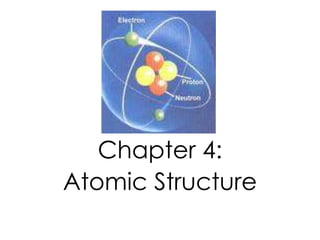
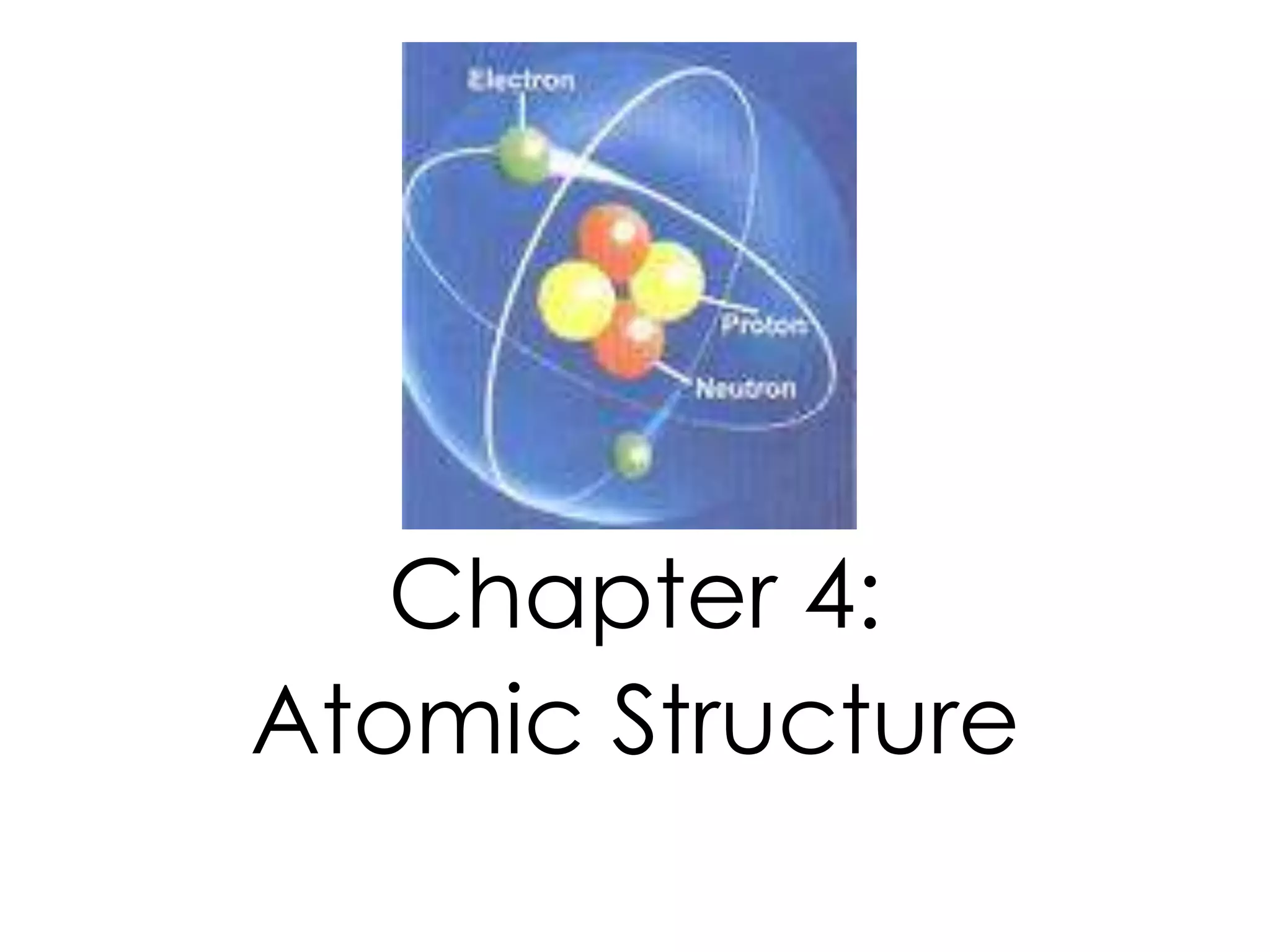
• Three kinds of subatomic particles are
electrons, protons, and neutrons.
Electrons
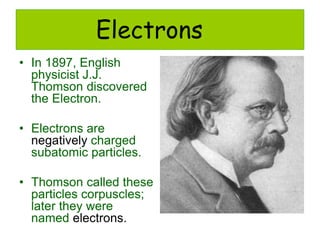
• In 1897, English
physicist J.J.
Thomson discovered
the Electron.
• Electrons are
negatively charged
subatomic particles.
• Thomson called these
particles corpuscles;
later they were
named electrons.
Robert A. Millikan (1868-1953)
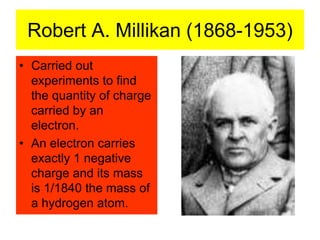
• Carried out
experiments to find
the quantity of charge
carried by an
electron.
• An electron carries
exactly 1 negative
charge and its mass
is 1/1840 the mass of
a hydrogen atom.
»You need to understand….
•Atoms have NO
CHARGE!!
»They are electrically neutral.
• Next……..
•Electric charges are
carried by particles of
matter.
Third……
•There are NO
fractions of charges,
only whole number
multiples!!!
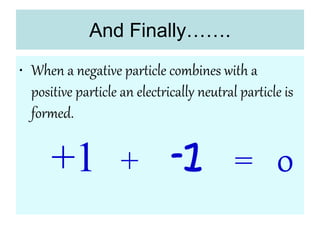
And Finally…….
• When a negative particle combines with a
positive particle an electrically neutral particle is
formed.
+1 + -1 = 0
Eugene Goldstein
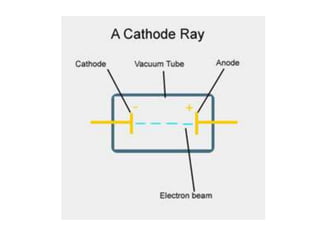
• Observed a cathode-ray tube and found
rays traveling in the direction opposite to
that of the cathode rays.
• He called these rays canal rays and
concluded that they were composed of
positive particles.
• These positive particles are called
Protons.
James Chadwick
• In 1932, an English Physicist confirmed
the existence of yet another subatomic
particle: The Neutron.
• A neutron is a subatomic particle with no
charge but with a mass nearly equal to
that of a proton.
Plum Pudding Model
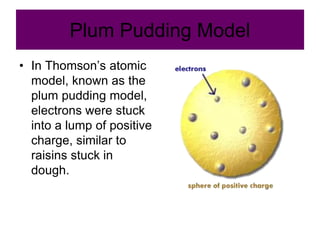
• In Thomson’s atomic
model, known as the
plum pudding model,
electrons were stuck
into a lump of positive
charge, similar to
raisins stuck in
dough.
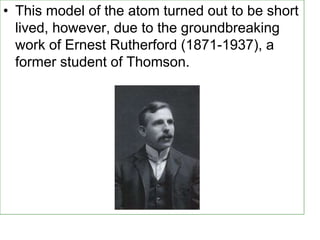
• This model of the atom turned out to be short
lived, however, due to the groundbreaking
work of Ernest Rutherford (1871-1937), a
former student of Thomson.
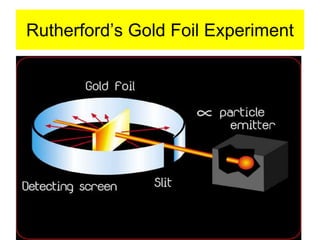
Rutherford’s Gold Foil Experiment
•Rutherford’s Gold Foil
Experiment
»Here is a video of what
happened!!!
Rutherford Atomic Model
• He proposed that the atom is mostly empty
space, thus explaining the lack of
deflection of most of the alpha particles.
• He concluded that all the positive charge
and almost all the mass are concentrated in
a small region.
• He called this region the Nucleus.
• The nucleus is the tiny central core of an atom and is
composed of protons and neutrons.
Key Concept
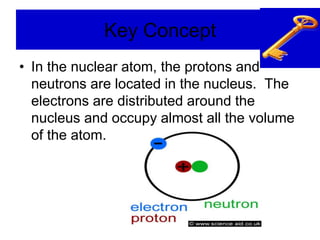
• In the nuclear atom, the protons and
neutrons are located in the nucleus. The
electrons are distributed around the
nucleus and occupy almost all the volume
of the atom.
4.3 Distinguishing Among Atoms
• Elements
are different
because they
contain
different
numbers of
protons.
Atomic Number
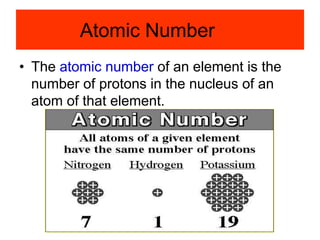
• The atomic number of an element is the
number of protons in the nucleus of an
atom of that element.
Mass Number
• The total number of protons and neutrons
in an atom is called the mass number.
• Number of neutrons = mass number – atomic number
• The number of neutrons in an atom is the difference
between the mass number and atomic number.
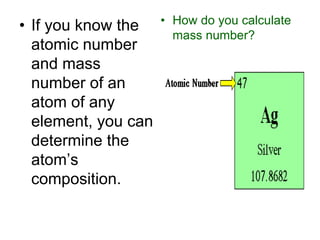
• If you know the
atomic number
and mass
number of an
atom of any
element, you can
determine the
atom’s
composition.
• How do you calculate
mass number?
Isotopes
Isotopes are atoms that have the same
number of protons but different
numbers of neutrons.
Because isotopes of an element have
different numbers of neutrons, they
have different mass numbers.
Isotopes Cont…
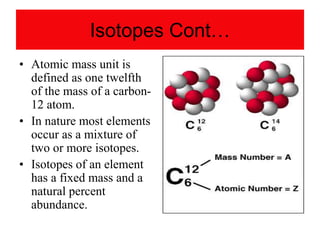
• Atomic mass unit is
defined as one twelfth
of the mass of a carbon-
12 atom.
• In nature most elements
occur as a mixture of
two or more isotopes.
• Isotopes of an element
has a fixed mass and a
natural percent
abundance.
Relative Abundance
• The Atomic Mass of an element is
a weighted average mass of the
atoms in a naturally occurring
sample of the element.
• A weighted average mass reflects
both the mass and the relative
abundance of the isotopes as they
occur in nature.
Determine Atomic Mass
1. # stable isotopes
2. Mass of each isotope
3. Natural % abundance of each isotope
Atomic Mass = Mass of Isotope x natural
abundance = add them together
Look on page 117 for practice problems!!
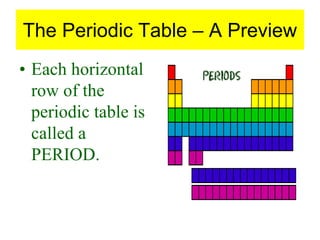
The Periodic Table – A Preview
• Each horizontal
row of the
periodic table is
called a
PERIOD.
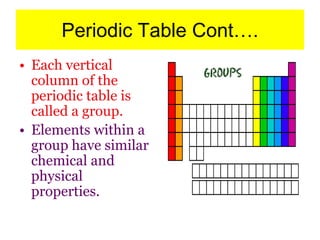
Periodic Table Cont….
• Each vertical
column of the
periodic table is
called a group.
• Elements within a
group have similar
chemical and
physical
properties.
Lets Review!!!
• Atoms are the smallest particle of an element that
retains its identity in a chemical reaction.
• Democritus believed that atoms were indivisible
and indestructible.
• Dalton’s atomic theory states that
1. All elements are composed of atoms
2. Atoms of different elements combine to form compounds
3. Atoms of the same element are identical
4. Chemical reactions occur when atoms are separated,
joined, or rearranged.
Review Cont….
• There are 3 subatomic particles
1. Proton
– Identifies the atom
– Positive charge
2. Electron
– Determines chemical reactions
– Negative Charge
3. Neutron
– Determines Isotope
– Neutral Charge
Review Cont…
• Thomson atomic model, known as the plum pudding
model, electrons were stuck into a lump of positive
charge.
• Rutherford’s Gold Foil Experiment: He proposed that
atoms are mostly empty space.
• The nucleus is the tiny central core of an atom made of
protons and neutrons. Electrons surround the nucleus.
• Atomic number is the number of protons.
• Mass number is the # of protons and neutrons.
• Isotopes are atoms that have the same number of
protons but a different number of neutrons.
Review Cont…
• Atomic mass unit is defined as one twelfth of
the mass of a carbon-12 atom.
• The atomic mass of an element is the weighted
average mass of the atoms in a naturally
occurring sample of the element.
• To calculate the atomic mass of an element,
multiply the mass by its natural abundance and
then add the products.
Review Cont…
• Periodic Table allows you to easily
compare the properties of one element to
another element.
• Groups go down!!
• Periods all across!!
• Elements within a group has similar
physical and chemical properties.

Chapter 4 pp (1)

  • 1.
  • 2.
    4.1 Defining theAtom • An Atom is the smallest particle of an element that retains its identity in a chemical reaction. • The Greek Philosopher Democritus, was among the First to suggest the existence Of atoms.
  • 3.
    Dalton’s Atomic Theory 1.All elements are composed of tiny indivisible particles called atoms. 2. Atoms of the same element are identical. The atoms of any one element are different from those of any other element. 3. Atoms of different elements can physically mix together or can chemically combine in simple whole-number ratios to form compounds. 4. Chemical reactions occur when atoms are separated, joined, or rearranged.
  • 4.
    4.2 Structure ofthe Nuclear Atom • Much of Dalton’s atomic theory is accepted today. One important change however, is that atoms are now known to be divisible. • Three kinds of subatomic particles are electrons, protons, and neutrons.
  • 5.
    Electrons • In 1897,English physicist J.J. Thomson discovered the Electron. • Electrons are negatively charged subatomic particles. • Thomson called these particles corpuscles; later they were named electrons.
  • 7.
    Robert A. Millikan(1868-1953) • Carried out experiments to find the quantity of charge carried by an electron. • An electron carries exactly 1 negative charge and its mass is 1/1840 the mass of a hydrogen atom.
  • 8.
    »You need tounderstand…. •Atoms have NO CHARGE!! »They are electrically neutral.
  • 9.
    • Next…….. •Electric chargesare carried by particles of matter.
  • 10.
    Third…… •There are NO fractionsof charges, only whole number multiples!!!
  • 11.
    And Finally……. • Whena negative particle combines with a positive particle an electrically neutral particle is formed. +1 + -1 = 0
  • 12.
    Eugene Goldstein • Observeda cathode-ray tube and found rays traveling in the direction opposite to that of the cathode rays. • He called these rays canal rays and concluded that they were composed of positive particles. • These positive particles are called Protons.
  • 13.
    James Chadwick • In1932, an English Physicist confirmed the existence of yet another subatomic particle: The Neutron. • A neutron is a subatomic particle with no charge but with a mass nearly equal to that of a proton.
  • 14.
    Plum Pudding Model •In Thomson’s atomic model, known as the plum pudding model, electrons were stuck into a lump of positive charge, similar to raisins stuck in dough.
  • 15.
    • This modelof the atom turned out to be short lived, however, due to the groundbreaking work of Ernest Rutherford (1871-1937), a former student of Thomson.
  • 16.
  • 17.
    •Rutherford’s Gold Foil Experiment »Hereis a video of what happened!!!
  • 18.
    Rutherford Atomic Model •He proposed that the atom is mostly empty space, thus explaining the lack of deflection of most of the alpha particles. • He concluded that all the positive charge and almost all the mass are concentrated in a small region. • He called this region the Nucleus. • The nucleus is the tiny central core of an atom and is composed of protons and neutrons.
  • 19.
    Key Concept • Inthe nuclear atom, the protons and neutrons are located in the nucleus. The electrons are distributed around the nucleus and occupy almost all the volume of the atom.
  • 20.
    4.3 Distinguishing AmongAtoms • Elements are different because they contain different numbers of protons.
  • 21.
    Atomic Number • Theatomic number of an element is the number of protons in the nucleus of an atom of that element.
  • 22.
    Mass Number • Thetotal number of protons and neutrons in an atom is called the mass number. • Number of neutrons = mass number – atomic number • The number of neutrons in an atom is the difference between the mass number and atomic number.
  • 23.
    • If youknow the atomic number and mass number of an atom of any element, you can determine the atom’s composition. • How do you calculate mass number?
  • 24.
    Isotopes Isotopes are atomsthat have the same number of protons but different numbers of neutrons. Because isotopes of an element have different numbers of neutrons, they have different mass numbers.
  • 25.
    Isotopes Cont… • Atomicmass unit is defined as one twelfth of the mass of a carbon- 12 atom. • In nature most elements occur as a mixture of two or more isotopes. • Isotopes of an element has a fixed mass and a natural percent abundance.
  • 26.
    Relative Abundance • TheAtomic Mass of an element is a weighted average mass of the atoms in a naturally occurring sample of the element. • A weighted average mass reflects both the mass and the relative abundance of the isotopes as they occur in nature.
  • 27.
    Determine Atomic Mass 1.# stable isotopes 2. Mass of each isotope 3. Natural % abundance of each isotope Atomic Mass = Mass of Isotope x natural abundance = add them together Look on page 117 for practice problems!!
  • 28.
    The Periodic Table– A Preview • Each horizontal row of the periodic table is called a PERIOD.
  • 29.
    Periodic Table Cont…. •Each vertical column of the periodic table is called a group. • Elements within a group have similar chemical and physical properties.
  • 30.
    Lets Review!!! • Atomsare the smallest particle of an element that retains its identity in a chemical reaction. • Democritus believed that atoms were indivisible and indestructible. • Dalton’s atomic theory states that 1. All elements are composed of atoms 2. Atoms of different elements combine to form compounds 3. Atoms of the same element are identical 4. Chemical reactions occur when atoms are separated, joined, or rearranged.
  • 31.
    Review Cont…. • Thereare 3 subatomic particles 1. Proton – Identifies the atom – Positive charge 2. Electron – Determines chemical reactions – Negative Charge 3. Neutron – Determines Isotope – Neutral Charge
  • 32.
    Review Cont… • Thomsonatomic model, known as the plum pudding model, electrons were stuck into a lump of positive charge. • Rutherford’s Gold Foil Experiment: He proposed that atoms are mostly empty space. • The nucleus is the tiny central core of an atom made of protons and neutrons. Electrons surround the nucleus. • Atomic number is the number of protons. • Mass number is the # of protons and neutrons. • Isotopes are atoms that have the same number of protons but a different number of neutrons.
  • 33.
    Review Cont… • Atomicmass unit is defined as one twelfth of the mass of a carbon-12 atom. • The atomic mass of an element is the weighted average mass of the atoms in a naturally occurring sample of the element. • To calculate the atomic mass of an element, multiply the mass by its natural abundance and then add the products.
  • 34.
    Review Cont… • PeriodicTable allows you to easily compare the properties of one element to another element. • Groups go down!! • Periods all across!! • Elements within a group has similar physical and chemical properties.