Redox Reaction - A reaction
where one species gains electrons
and one species loses electrons.
Must have both processes occurring.
Remember acid-base reactions where protons
are transferred. One has to give, the other has to
take.
3
Oxidation is…
–the loss of electrons
–an increase in
oxidation state
–the addition of oxygen
–the loss of hydrogen
2 Mg + O2  2 MgO
notice the magnesium is
losing electrons
Reduction is…
–the gain of electrons
–a decrease in oxidation
state
–the loss of oxygen
–the addition of hydrogen
MgO + H2  Mg + H2O
notice the Mg2+ in MgO is gaining
electrons
Oxidation number
Number assigned to each atom to estimate its excess
charge or deficiency.
There is ALWAYS a change in oxidation numbers
in a redox reaction.
2Mg (s) + O2 (g) 2MgO (s)
0 0 2+ 2-
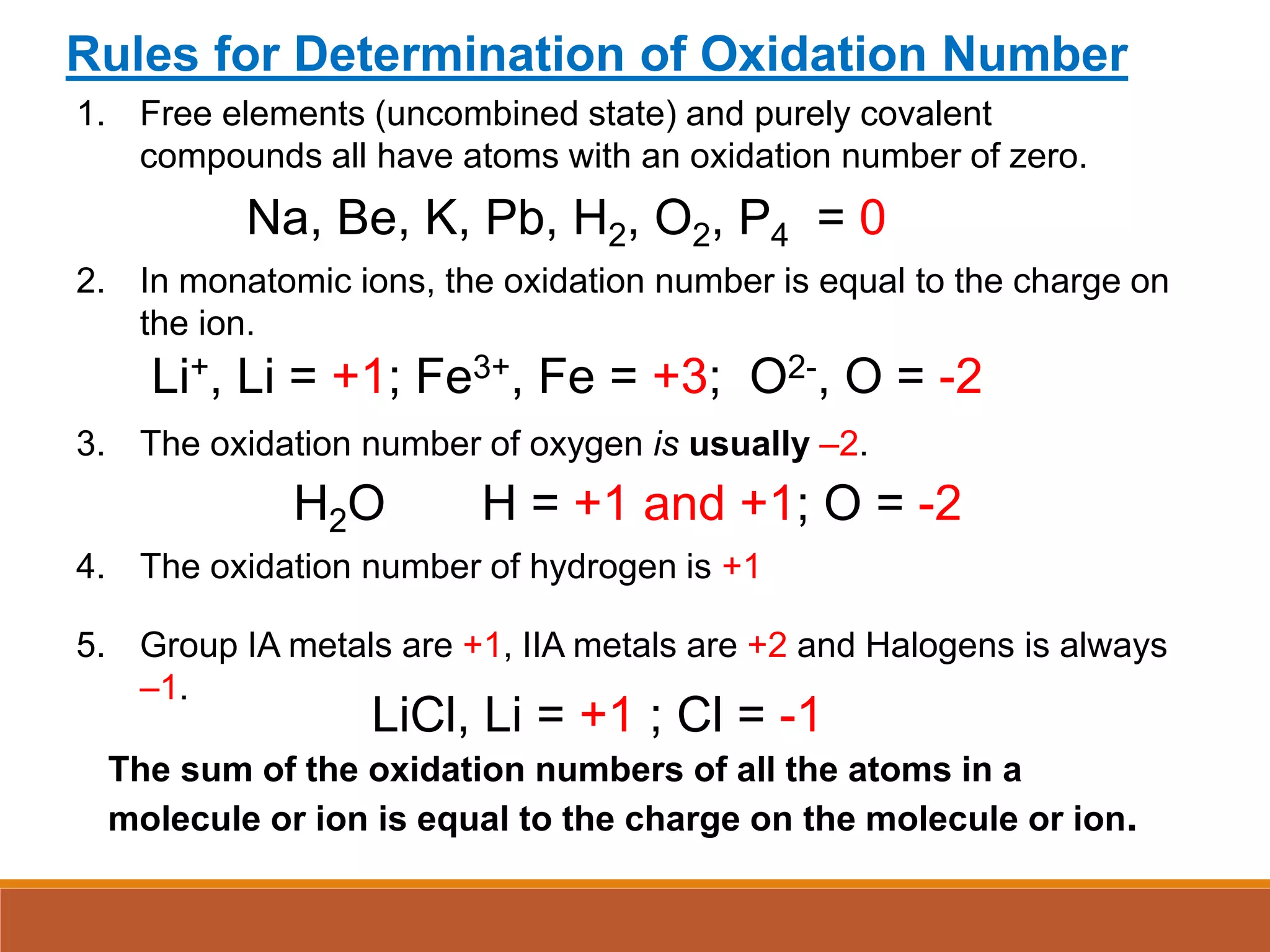
4. The oxidation number of hydrogen is +1
The sum of the oxidation numbers of all the atoms in a
molecule or ion is equal to the charge on the molecule or ion.
5. Group IA metals are +1, IIA metals are +2 and Halogens is always
–1.
2. In monatomic ions, the oxidation number is equal to the charge on
the ion.
Li+, Li = +1; Fe3+, Fe = +3; O2-, O = -2
3. The oxidation number of oxygen is usually –2.
Rules for Determination of Oxidation Number
1. Free elements (uncombined state) and purely covalent
compounds all have atoms with an oxidation number of zero.
Na, Be, K, Pb, H2, O2, P4 = 0
H2O H = +1 and +1; O = -2
LiCl, Li = +1 ; Cl = -1
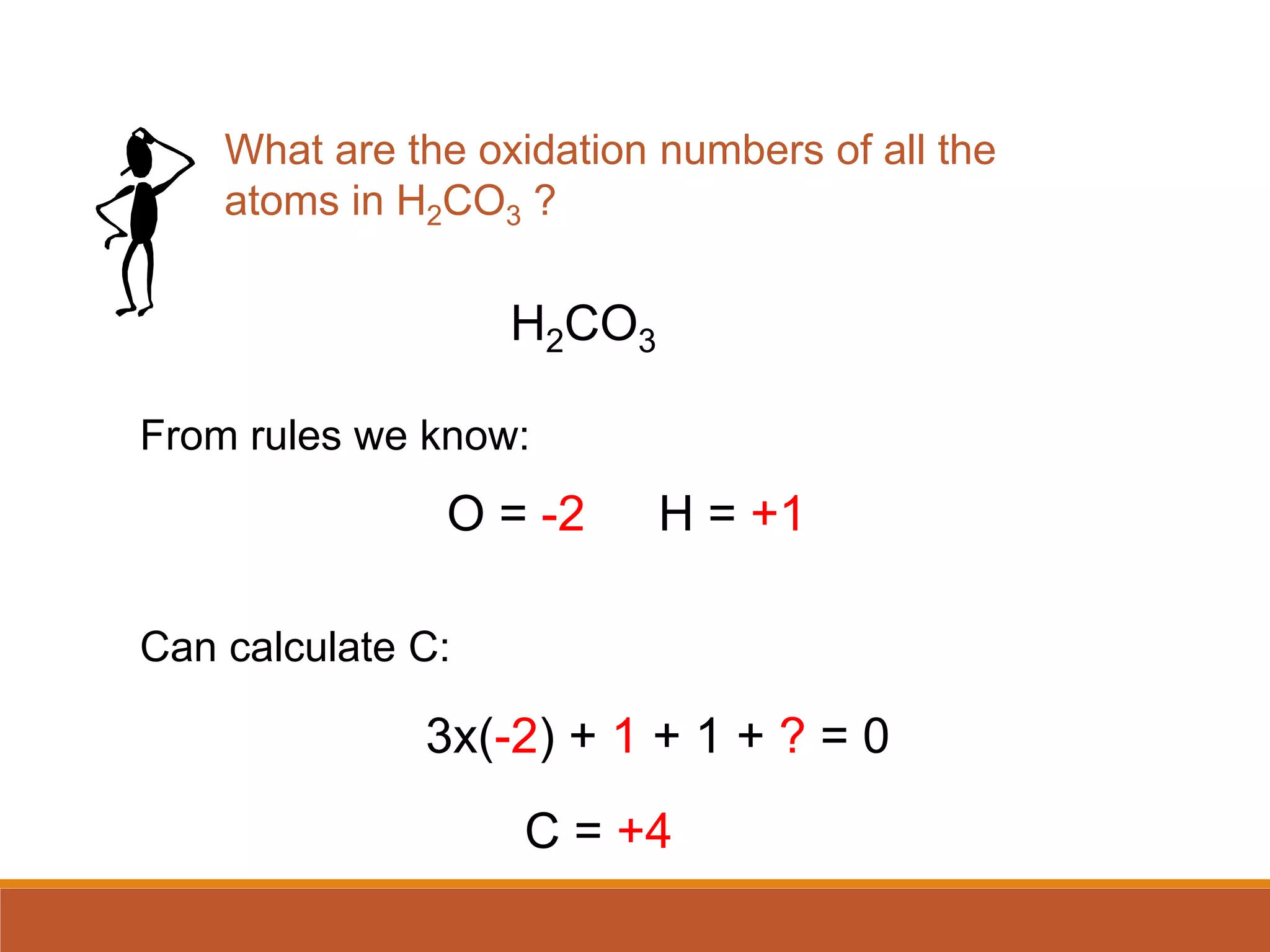
H2CO3
O = -2 H = +1
3x(-2) + 1 + 1 + ? = 0
C = +4
What are the oxidation numbers of all the
atoms in H2CO3 ?
From rules we know:
Can calculate C:
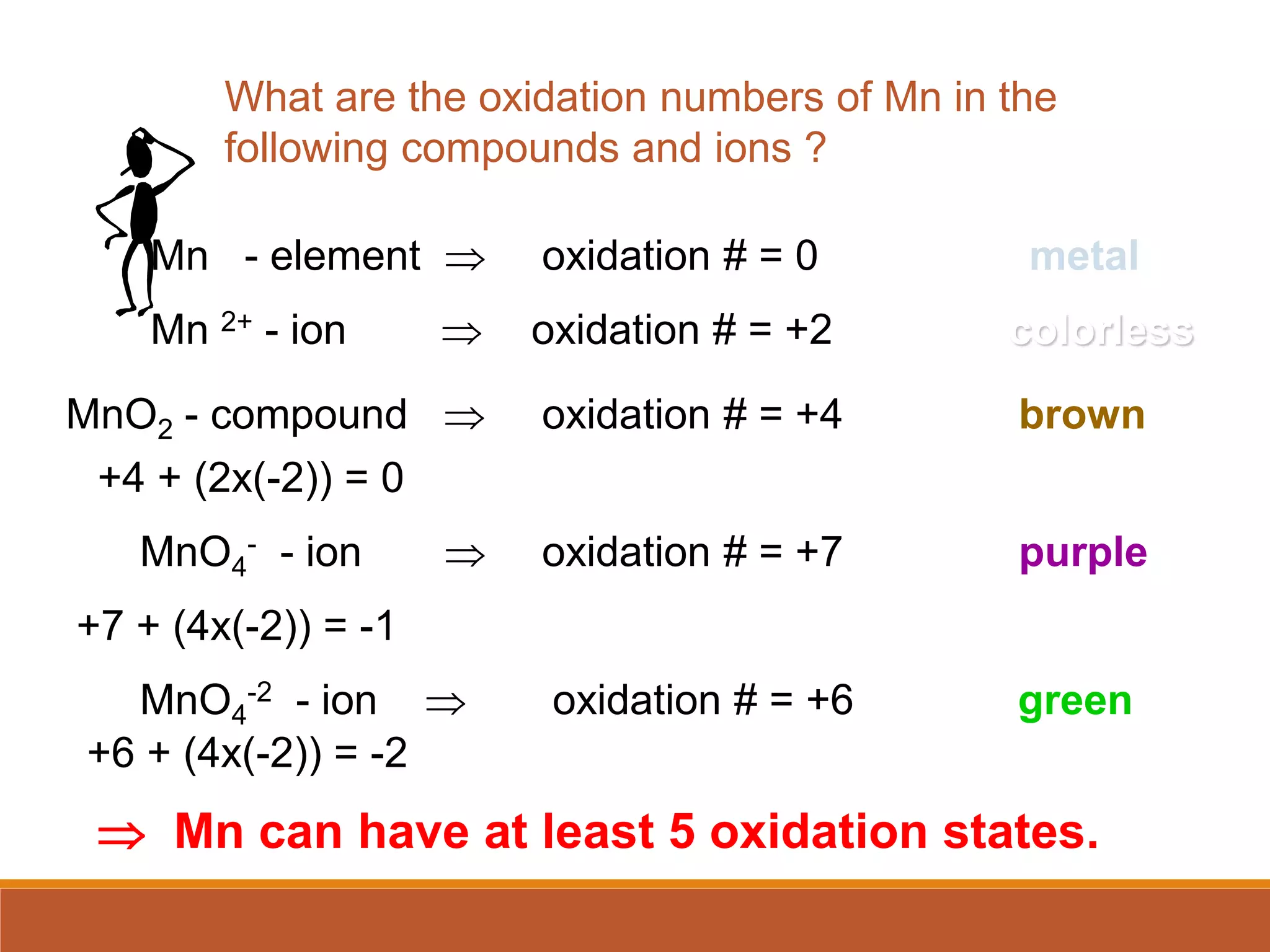
What are the oxidation numbers of Mn in the
following compounds and ions ?
 Mn can have at least 5 oxidation states.
Mn - element  oxidation # = 0 metal
Mn 2+ - ion  oxidation # = +2 colorless
MnO2 - compound  oxidation # = +4 brown
+4 + (2x(-2)) = 0
MnO4
- - ion  oxidation # = +7 purple
+7 + (4x(-2)) = -1
MnO4
-2 - ion 
+6 + (4x(-2)) = -2
oxidation # = +6 green
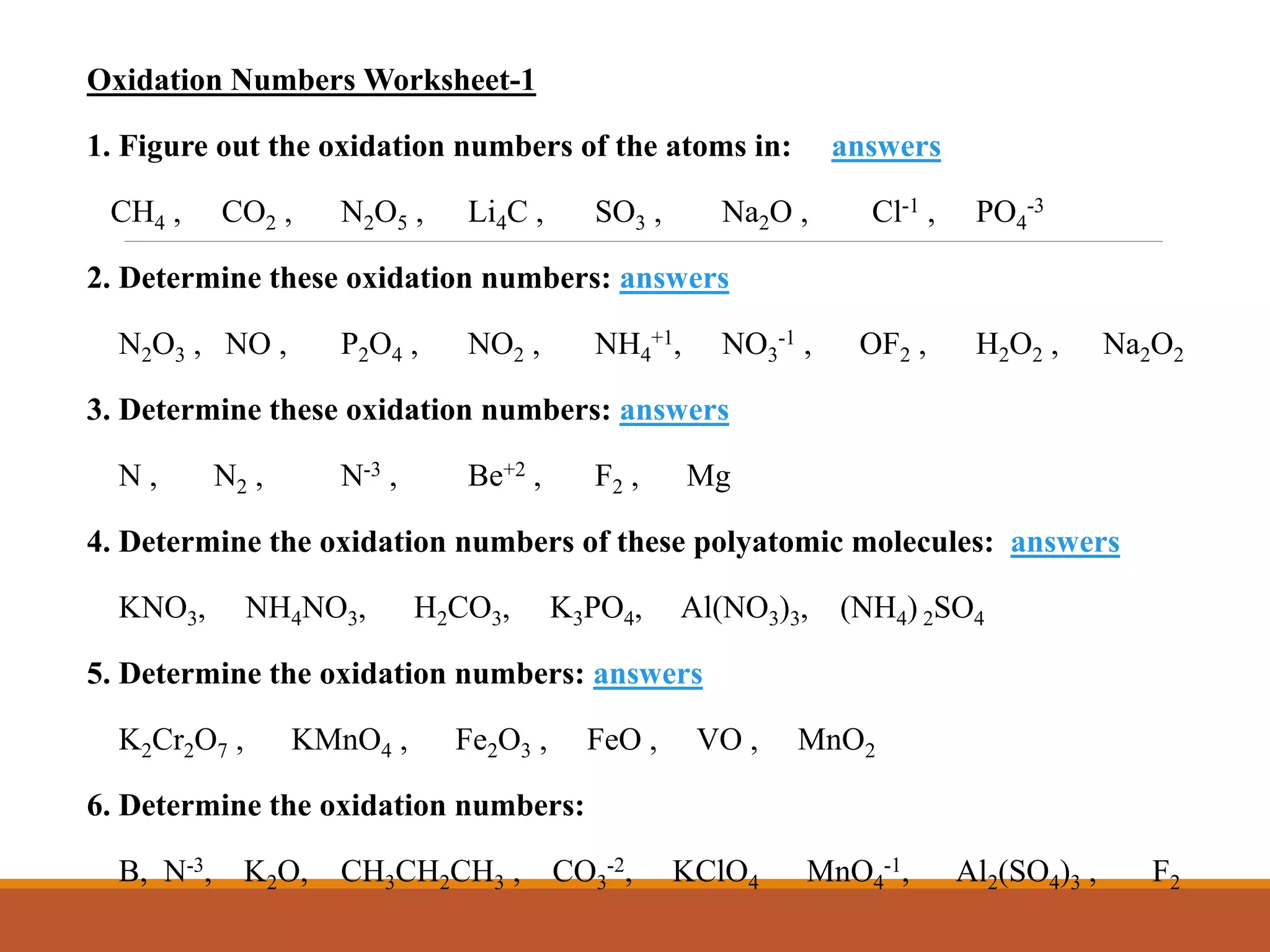
Oxidation Numbers Worksheet-1
1. Figure out the oxidation numbers of the atoms in: answers
CH4 , CO2 , N2O5 , Li4C , SO3 , Na2O , Cl-1 , PO4
-3
2. Determine these oxidation numbers: answers
N2O3 , NO , P2O4 , NO2 , NH4
+1, NO3
-1 , OF2 , H2O2 , Na2O2
3. Determine these oxidation numbers: answers
N , N2 , N-3 , Be+2 , F2 , Mg
4. Determine the oxidation numbers of these polyatomic molecules: answers
KNO3, NH4NO3, H2CO3, K3PO4, Al(NO3)3, (NH4) 2SO4
5. Determine the oxidation numbers: answers
K2Cr2O7 , KMnO4 , Fe2O3 , FeO , VO , MnO2
6. Determine the oxidation numbers:
B, N-3, K2O, CH3CH2CH3 , CO3
-2, KClO4 MnO4
-1, Al2(SO4)3 , F2
Examples
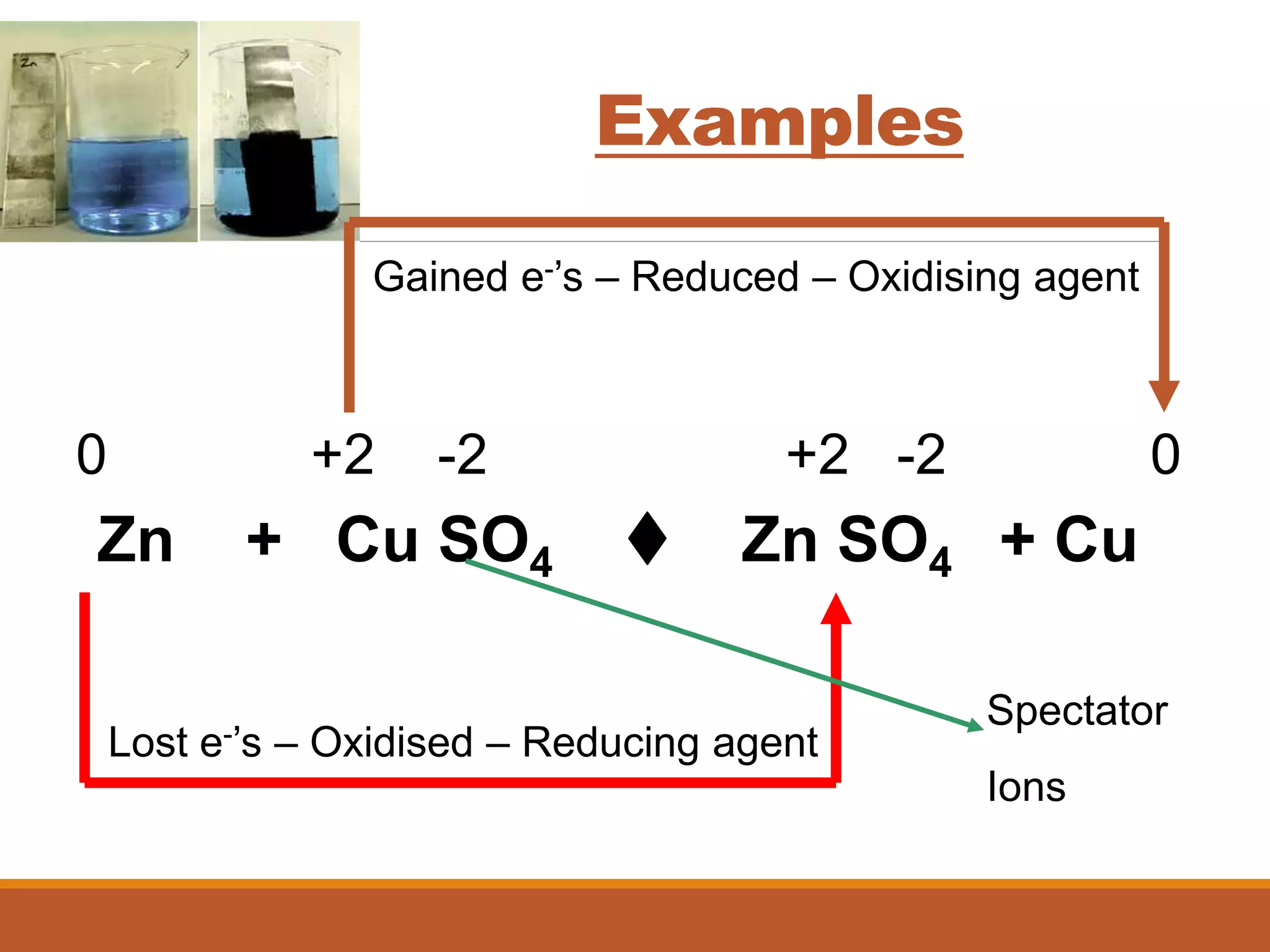
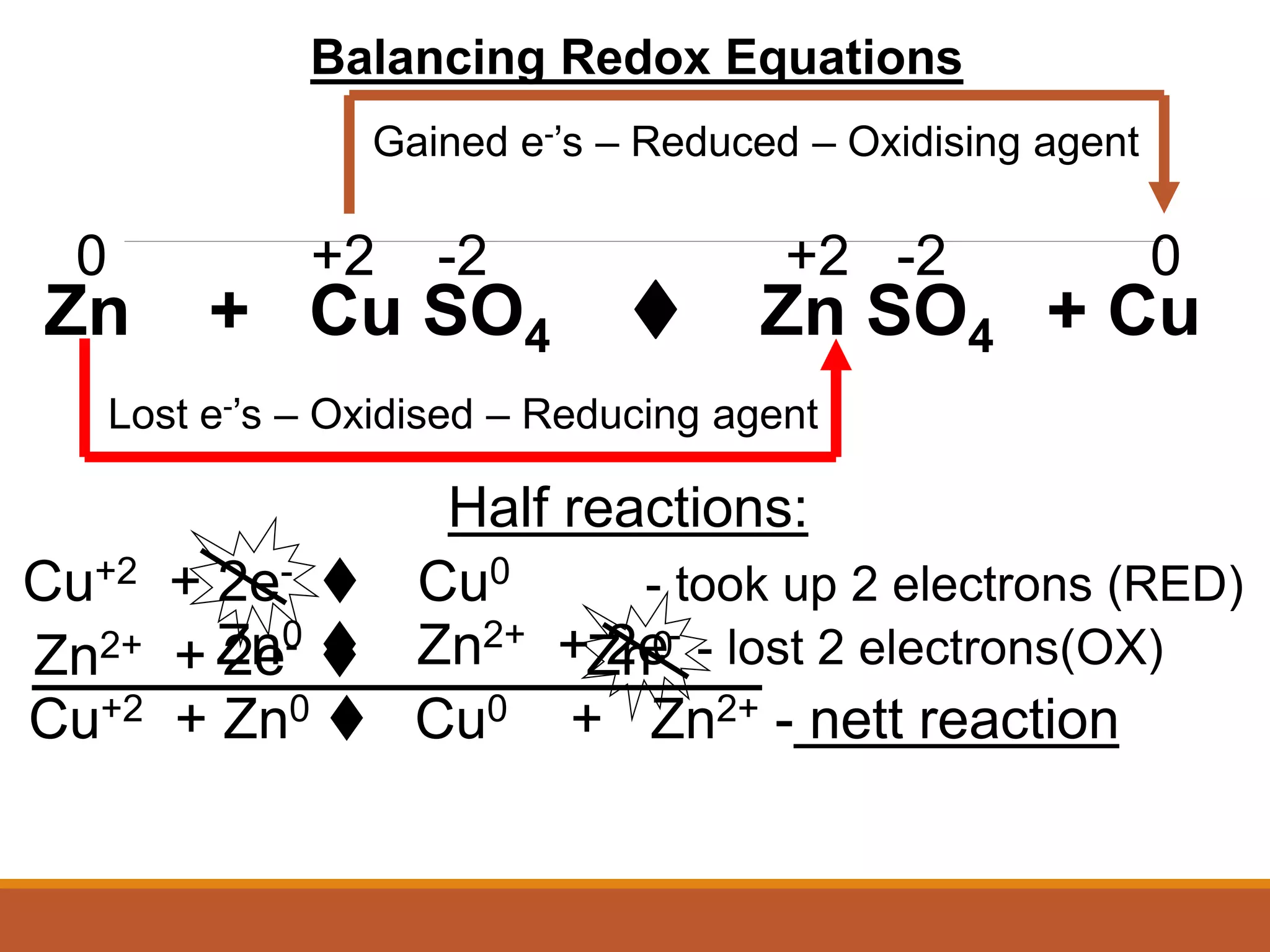
Zn + Cu SO4 t Zn SO4 + Cu
0 +2 -2 +2 -2 0
Gained e-’s – Reduced – Oxidising agent
Lost e-’s – Oxidised – Reducing agent
Spectator
Ions
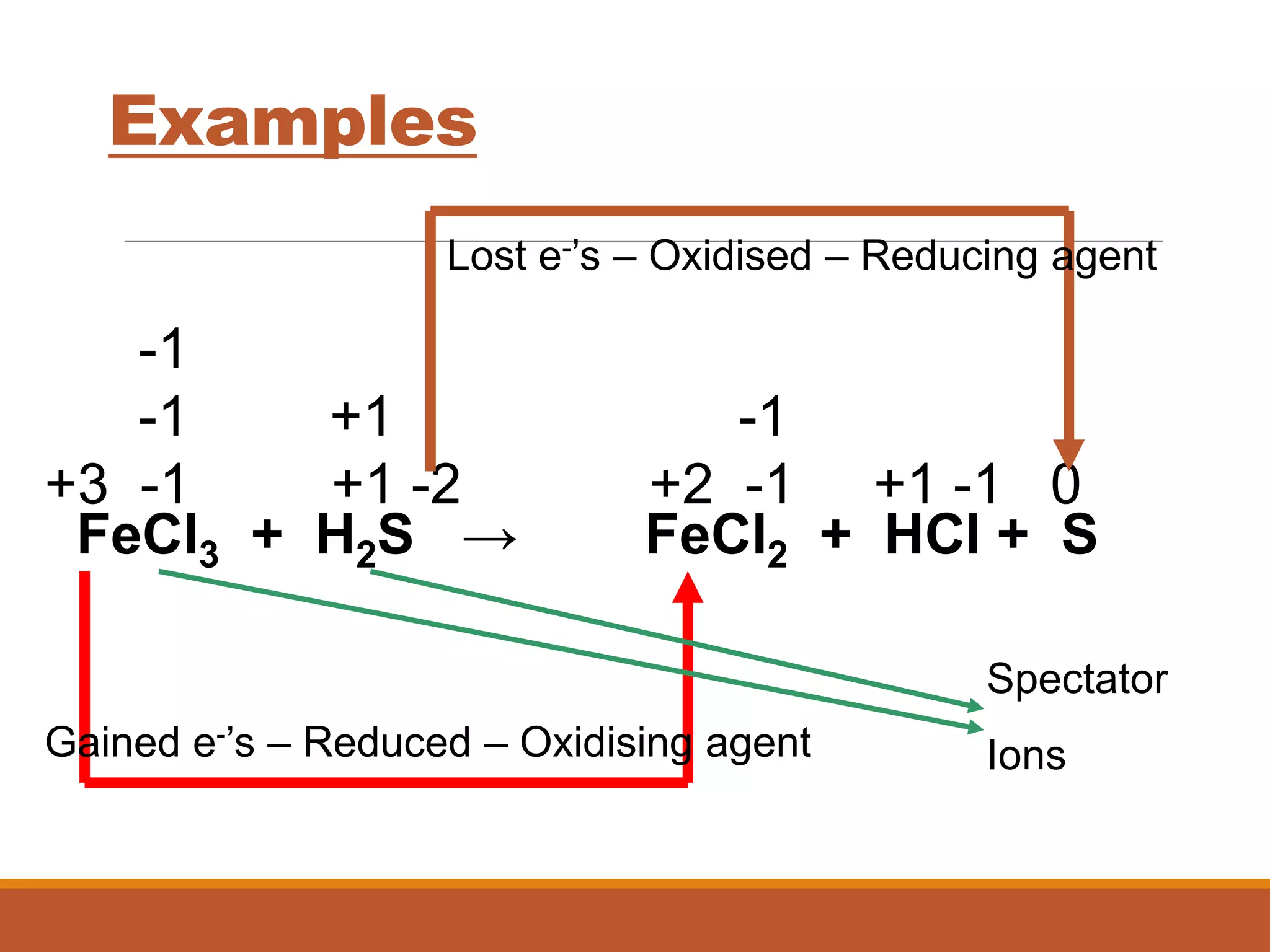
-1
-1 +1 -1
+3 -1 +1 -2 +2 -1 +1 -1 0
Examples
FeCl3 + H2S → FeCl2 + HCl + S
Lost e-’s – Oxidised – Reducing agent
Gained e-’s – Reduced – Oxidising agent
Spectator
Ions
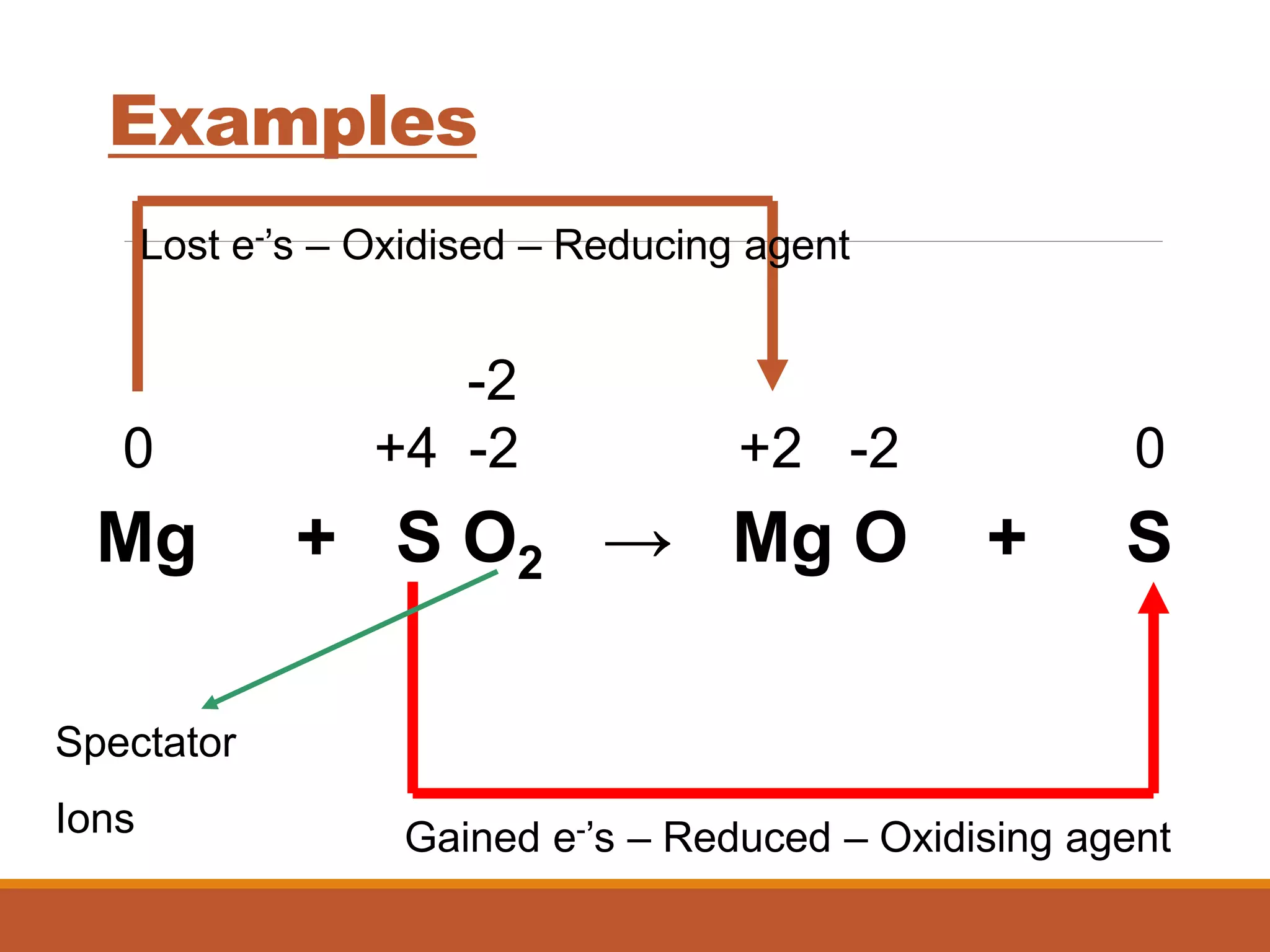
-2
0 +4 -2 +2 -2 0
Examples
Mg + S O2 → Mg O + S
Lost e-’s – Oxidised – Reducing agent
Gained e-’s – Reduced – Oxidising agent
Spectator
Ions
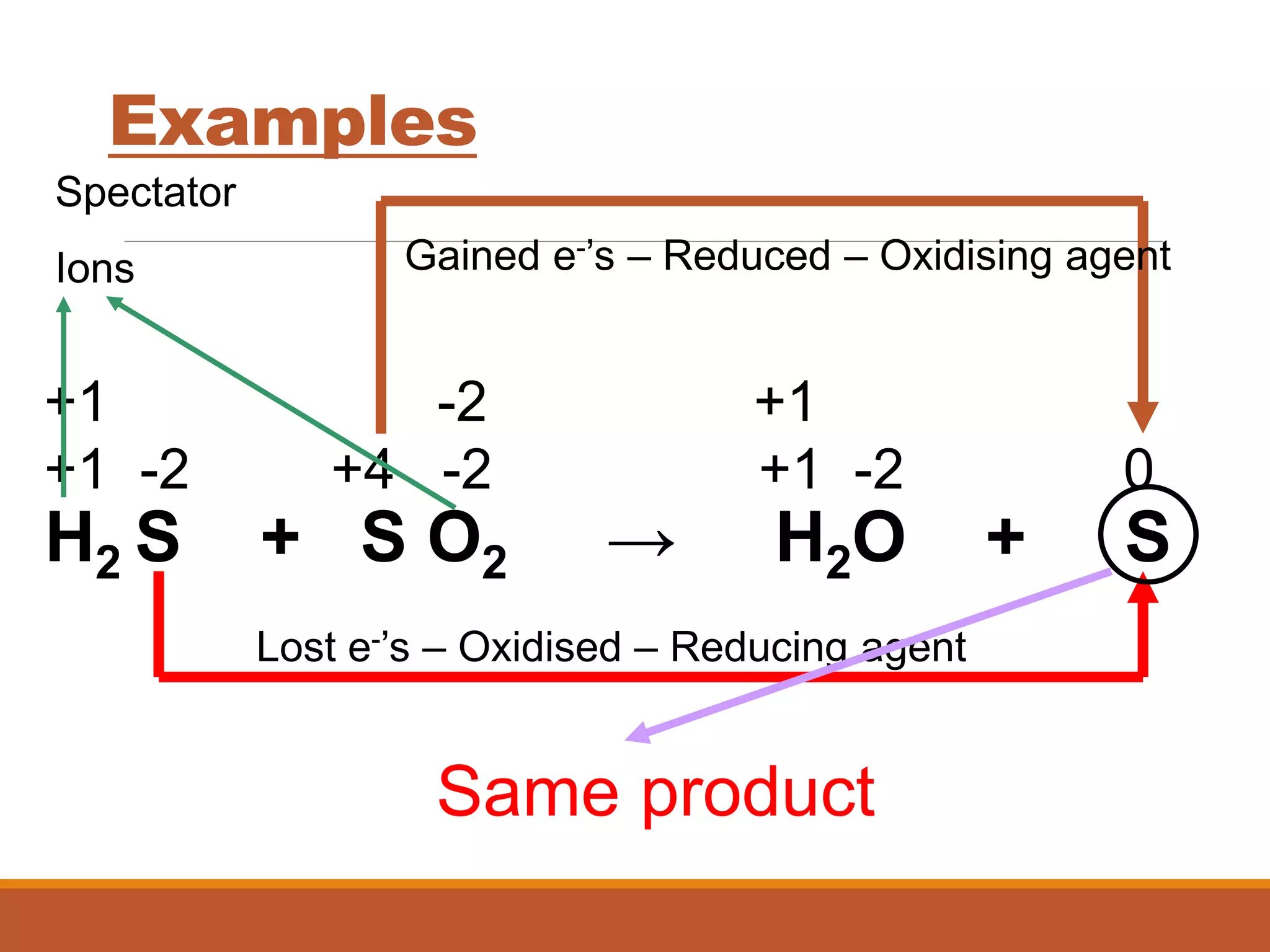
+1 -2 +1
+1 -2 +4 -2 +1 -2 0
Examples
H2 S + S O2 → H2O + S
Lost e-’s – Oxidised – Reducing agent
Gained e-’s – Reduced – Oxidising agent
Spectator
Ions
Same product
+1 -2 -2 +1 -2
0 +1 +6 -2 -2 +2 -2 +1 -2 +4 -2
Examples
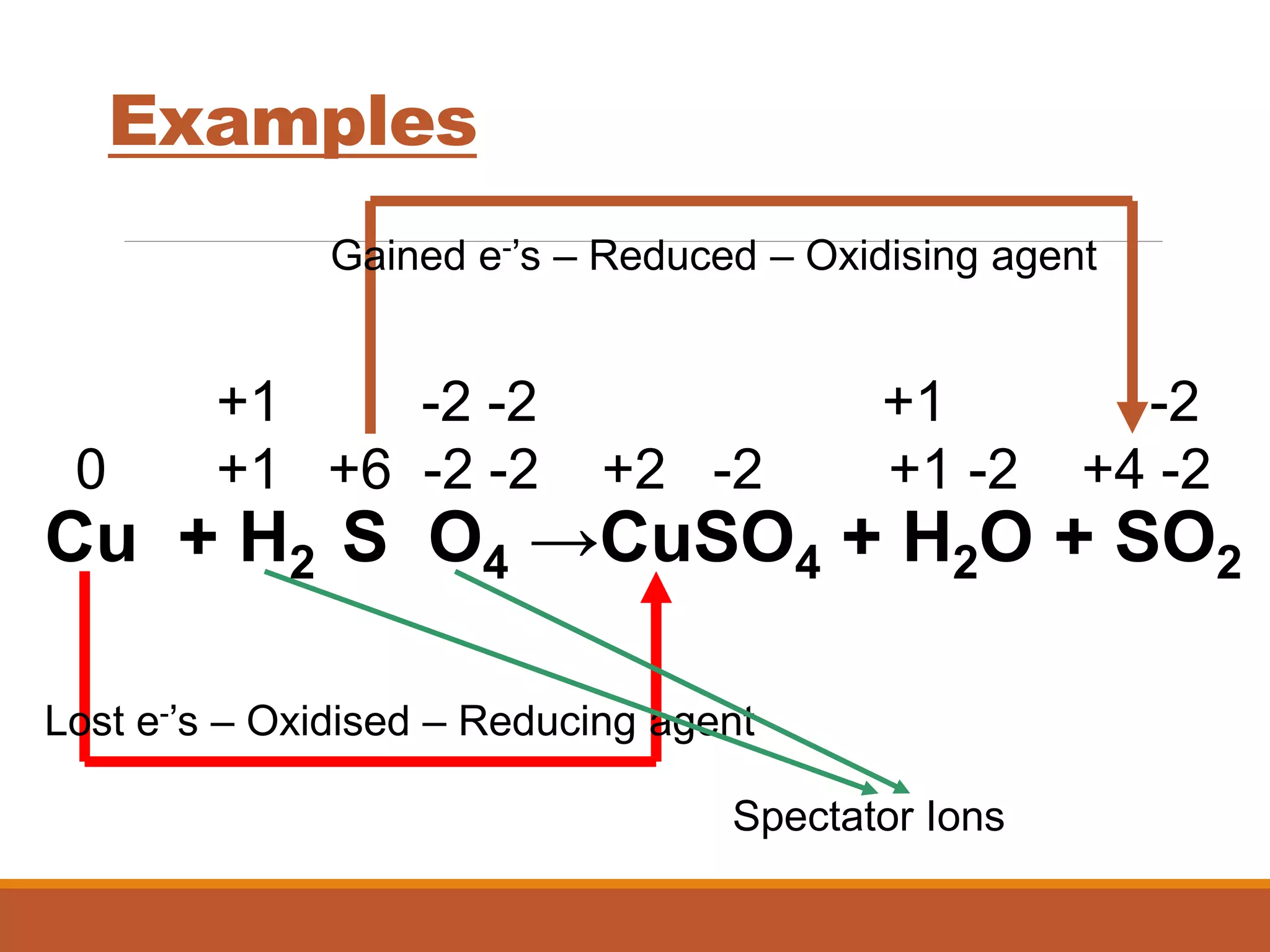
Cu + H2 S O4 →CuSO4 + H2O + SO2
Lost e-’s – Oxidised – Reducing agent
Gained e-’s – Reduced – Oxidising agent
Spectator Ions
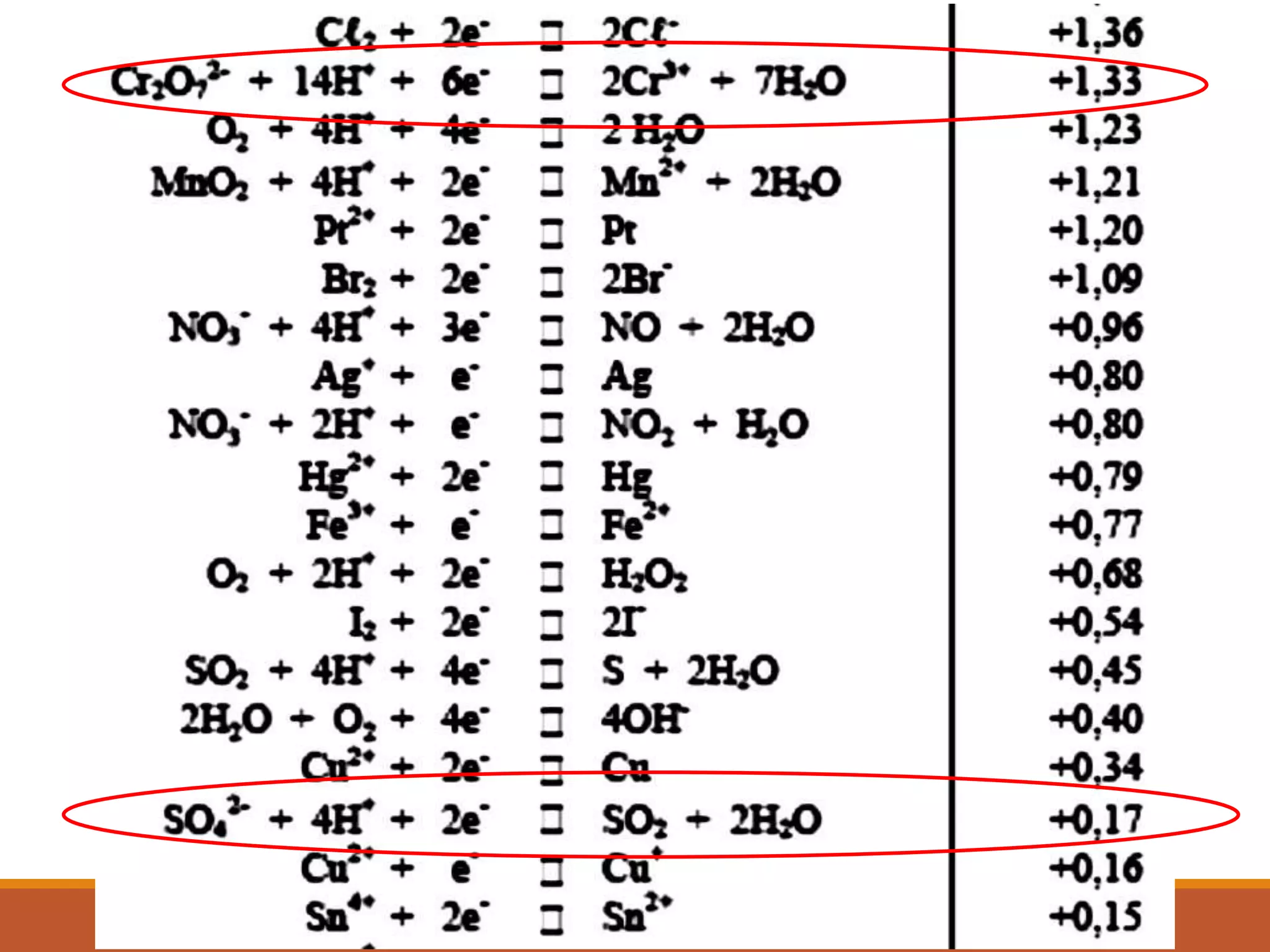
STANDARD
ELECTRODE
POTENTIALS
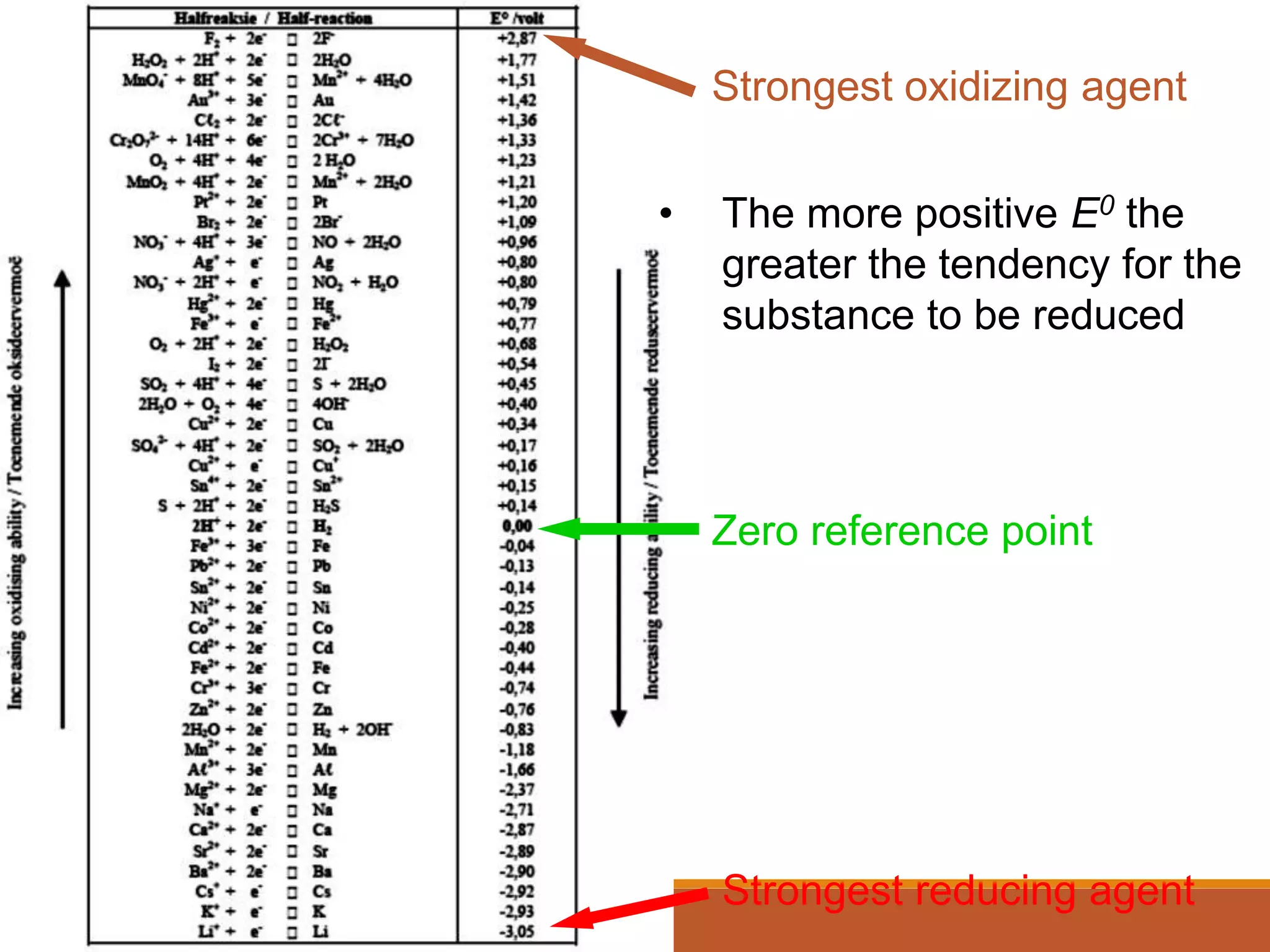
• The more positive E0 the
greater the tendency for the
substance to be reduced
Strongest oxidizing agent
Strongest reducing agent
Zero reference point
Half reactions:
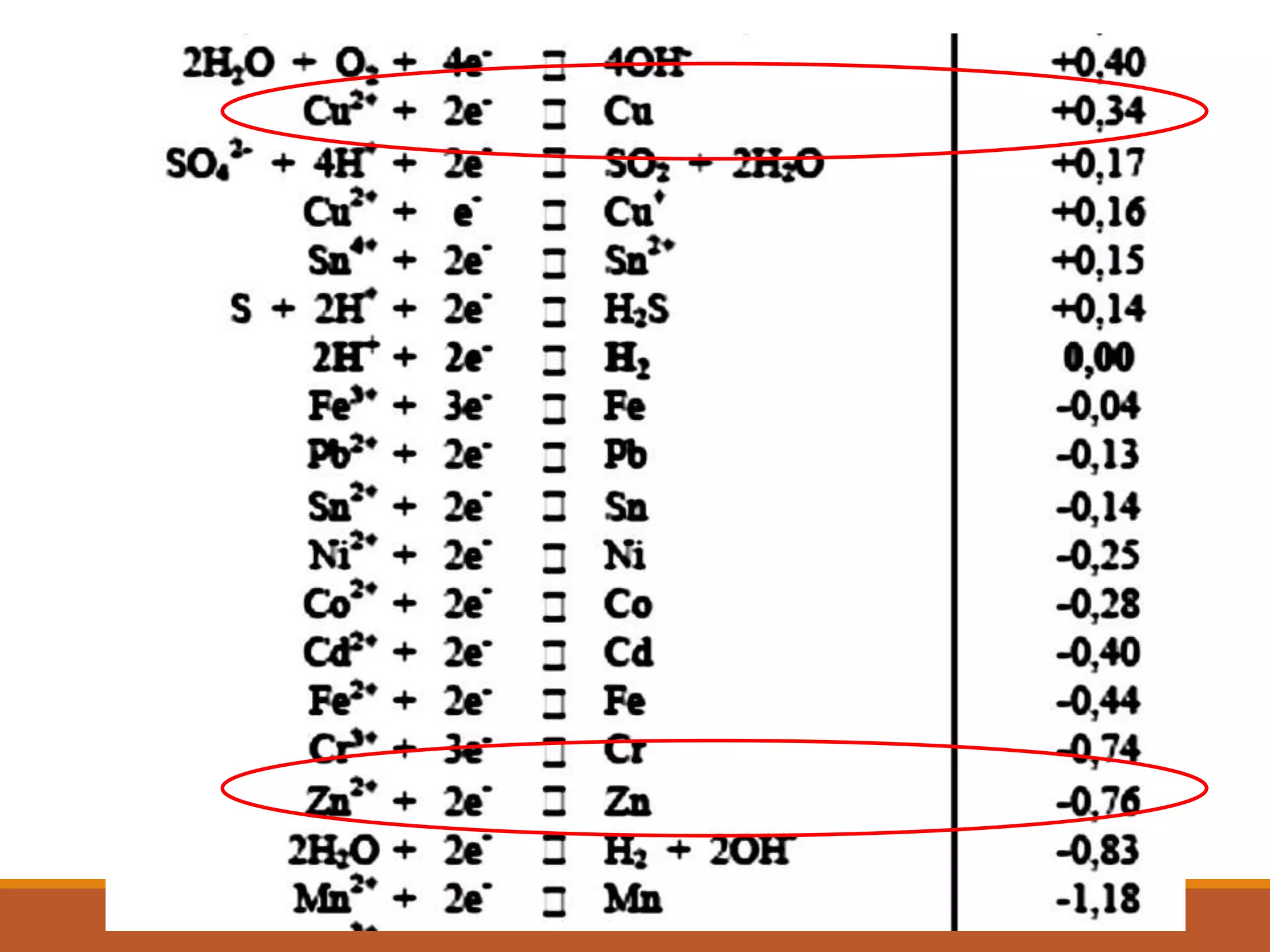
Zn0 t Zn2+ + 2e- - lost 2 electrons(OX)
Cu+2 + 2e- t Cu0 - took up 2 electrons (RED)
Cu+2 + Zn0 t Cu0 + Zn2+ - nett reaction
Balancing Redox Equations
Zn + Cu SO4 t Zn SO4 + Cu
0 +2 -2 +2 -2 0
Gained e-’s – Reduced – Oxidising agent
Lost e-’s – Oxidised – Reducing agent
Zn2+ + 2e- t Zn0
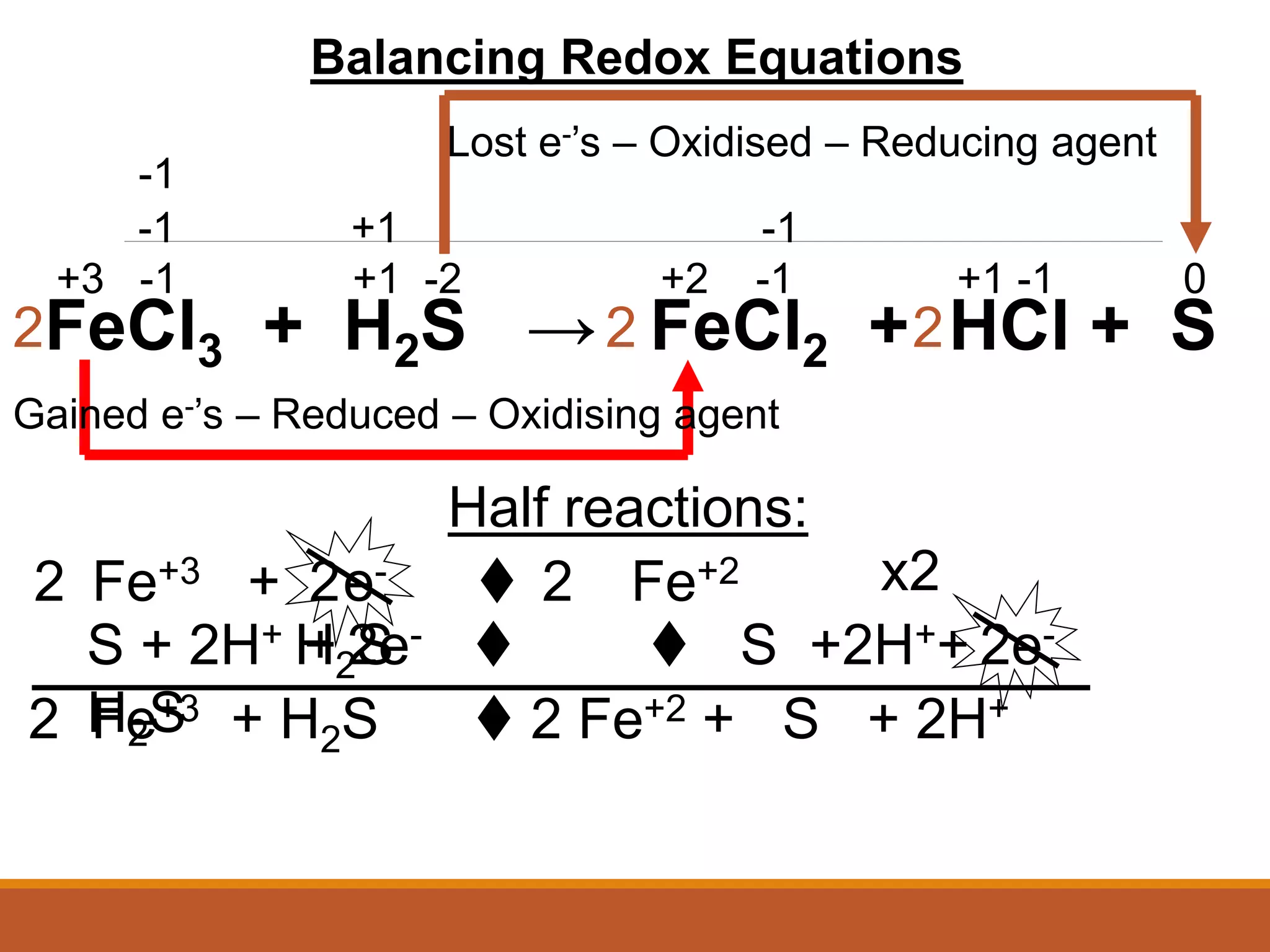
Half reactions:
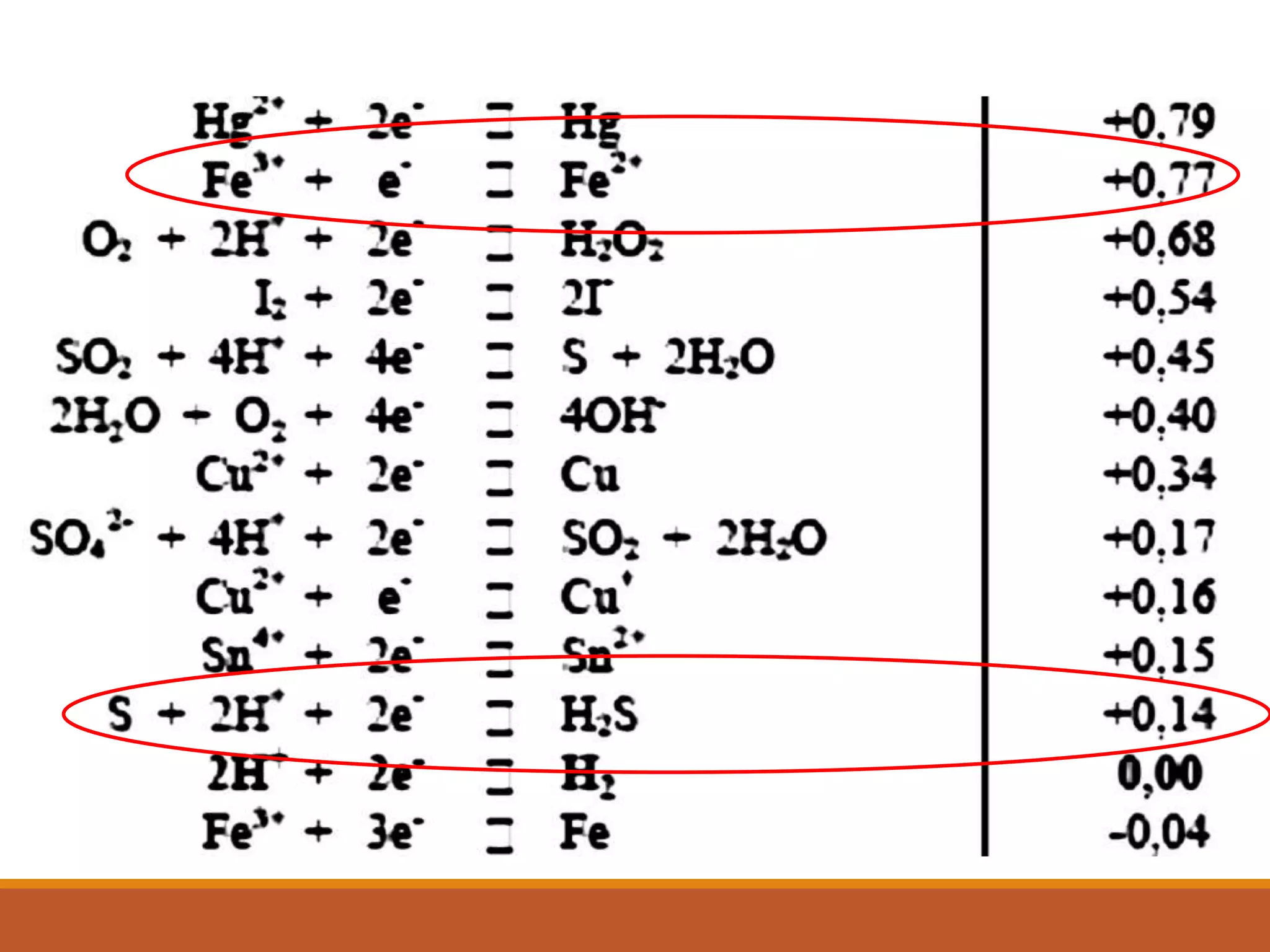
H2S t S +2H++ 2e-
Fe+3 + e- t Fe+2
2 Fe+3 + H2S t 2 Fe+2 + S + 2H+
Balancing Redox Equations
S + 2H+ + 2e- t
H2S
-1
-1 +1 -1
+3 -1 +1 -2 +2 -1 +1 -1 0
FeCl3 + H2S → FeCl2 + HCl + S
Lost e-’s – Oxidised – Reducing agent
Gained e-’s – Reduced – Oxidising agent
x2
2 2 2
2 2 2
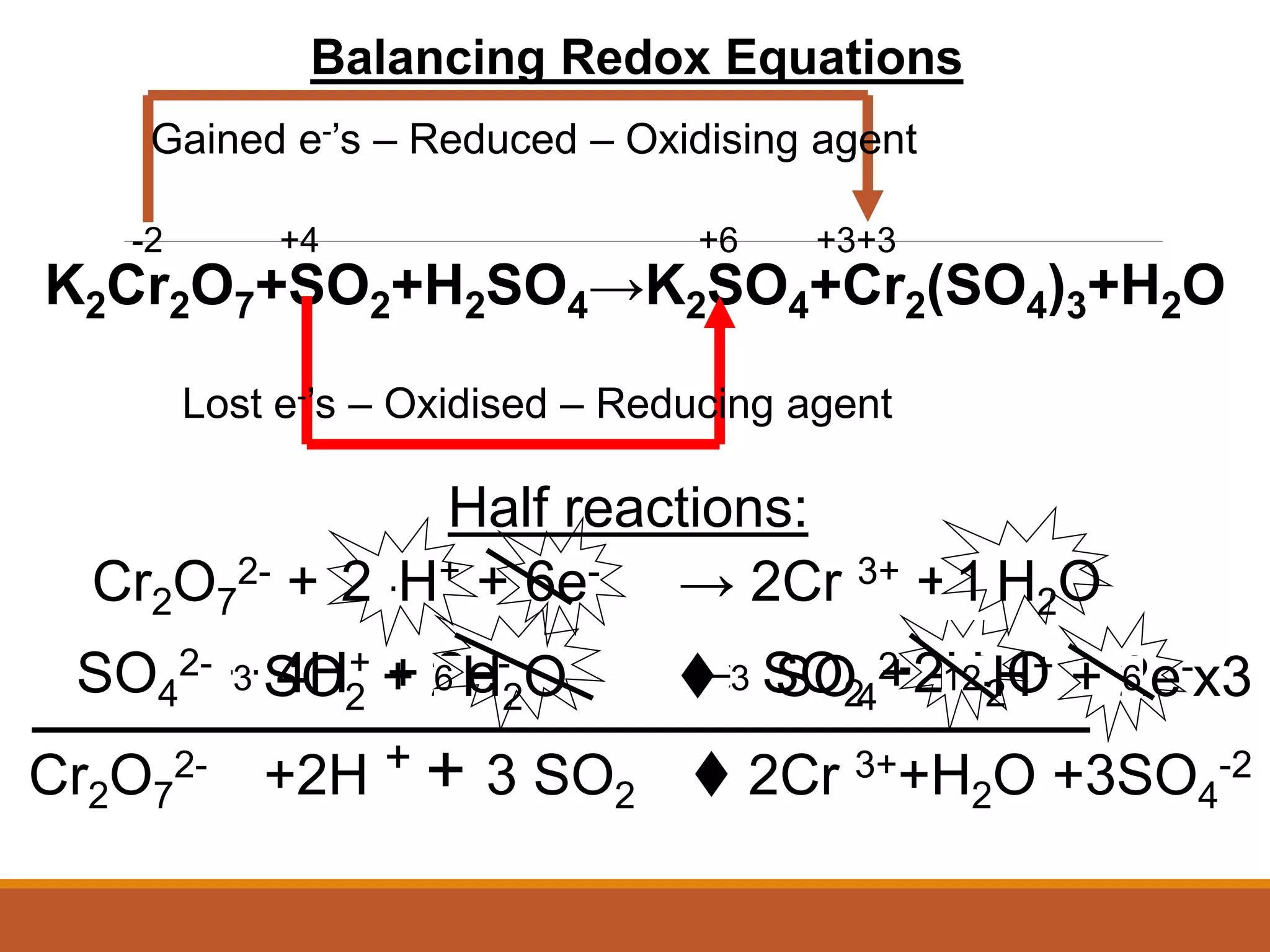
Half reactions:
SO2 + 2H2O t SO4
2- +4H+ + 2e-
Cr2O7
2- + 14H+ + 6e- → 2Cr 3+ + 7H2O
Cr2O7
2- +2H + + 3 SO2 t 2Cr 3++H2O +3SO4
-2
Balancing Redox Equations
SO4
2- + 4H+ + 2e- → SO2 +2H2O
-2 +4 +6 +3+3
K2Cr2O7+SO2+H2SO4→K2SO4+Cr2(SO4)3+H2O
Lost e-’s – Oxidised – Reducing agent
Gained e-’s – Reduced – Oxidising agent
x3
3 6 3 12 6
2 1
Balancing Redox Equations
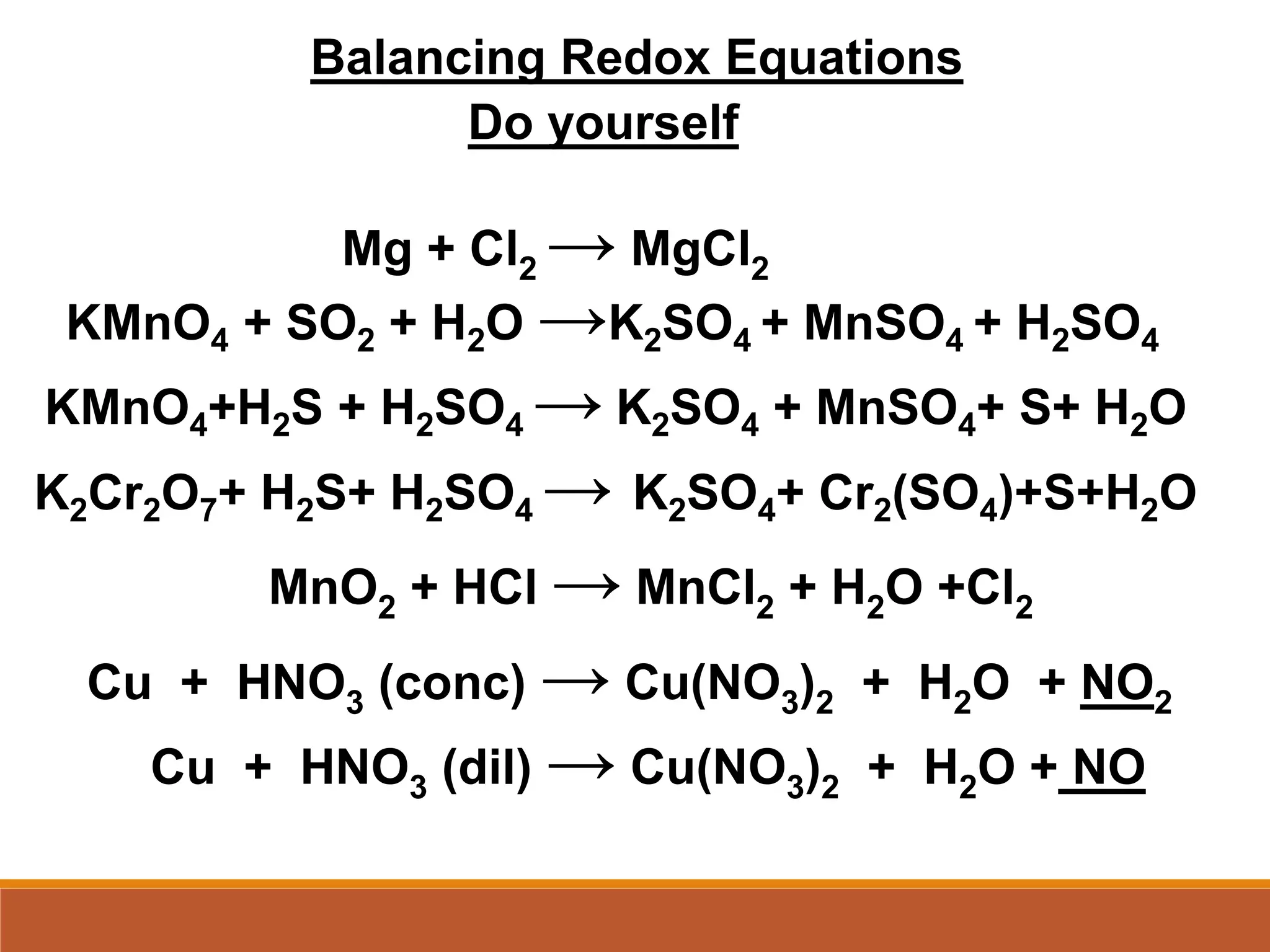
Do yourself
KMnO4 + SO2 + H2O →K2SO4 + MnSO4 + H2SO4
KMnO4+H2S + H2SO4 → K2SO4 + MnSO4+ S+ H2O
K2Cr2O7+ H2S+ H2SO4 → K2SO4+ Cr2(SO4)+S+H2O
MnO2 + HCl → MnCl2 + H2O +Cl2
Mg + Cl2 → MgCl2
Cu + HNO3 (conc) → Cu(NO3)2 + H2O + NO2
Cu + HNO3 (dil) → Cu(NO3)2 + H2O + NO
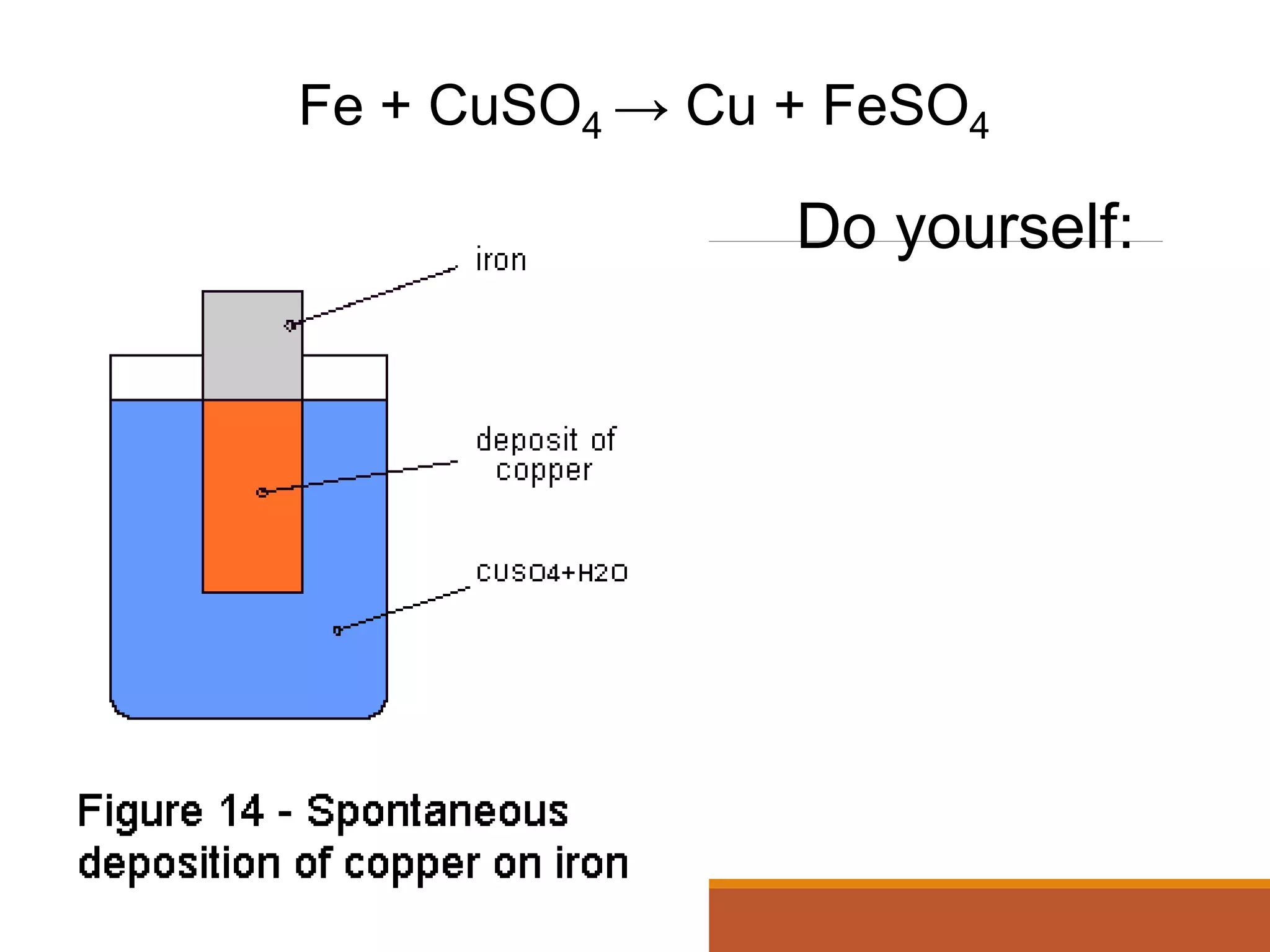
Fe + CuSO4 → Cu + FeSO4
Do yourself:
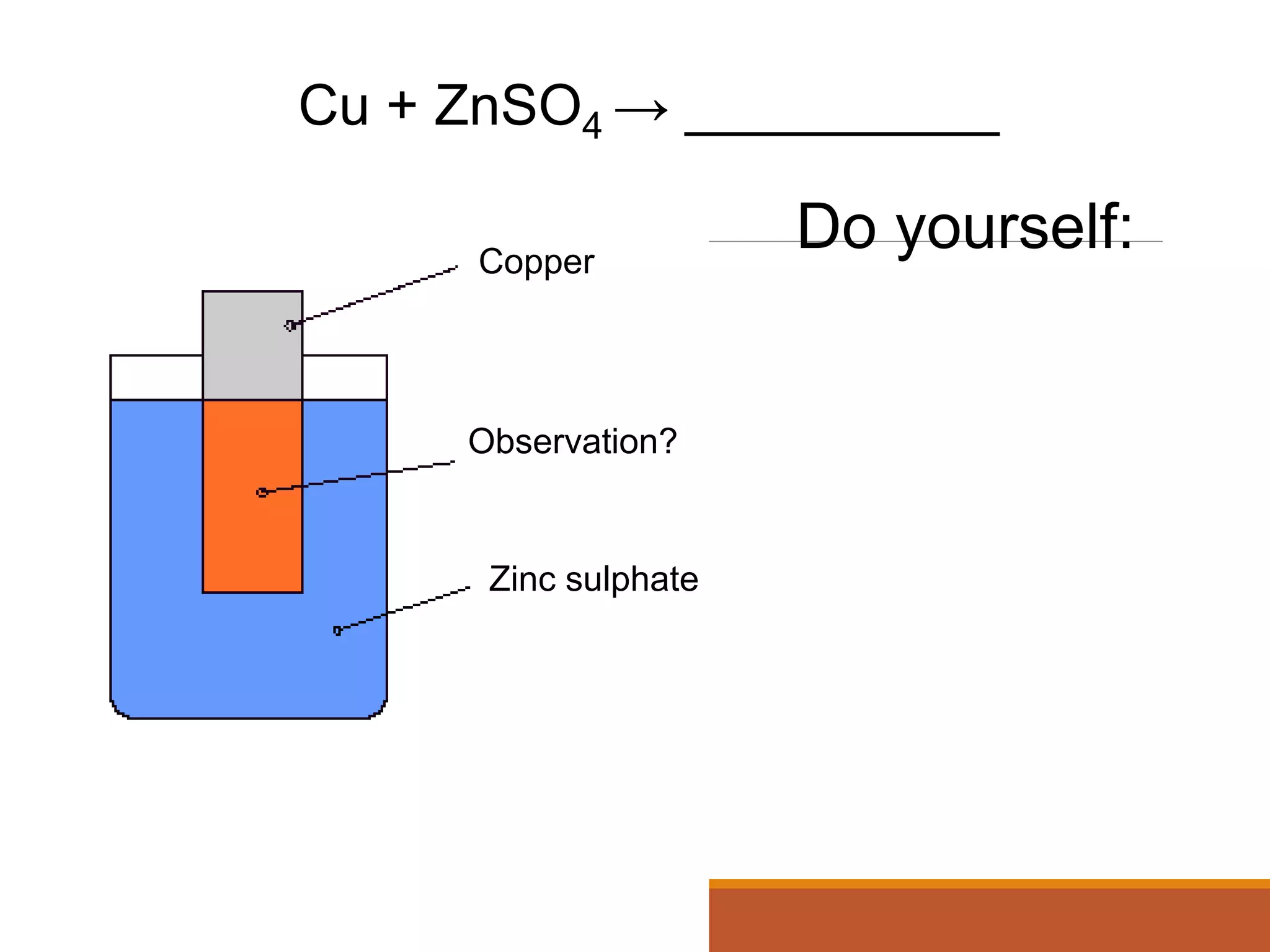
Cu + ZnSO4 → __________
Copper
Zinc sulphate
Observation?
Do yourself:
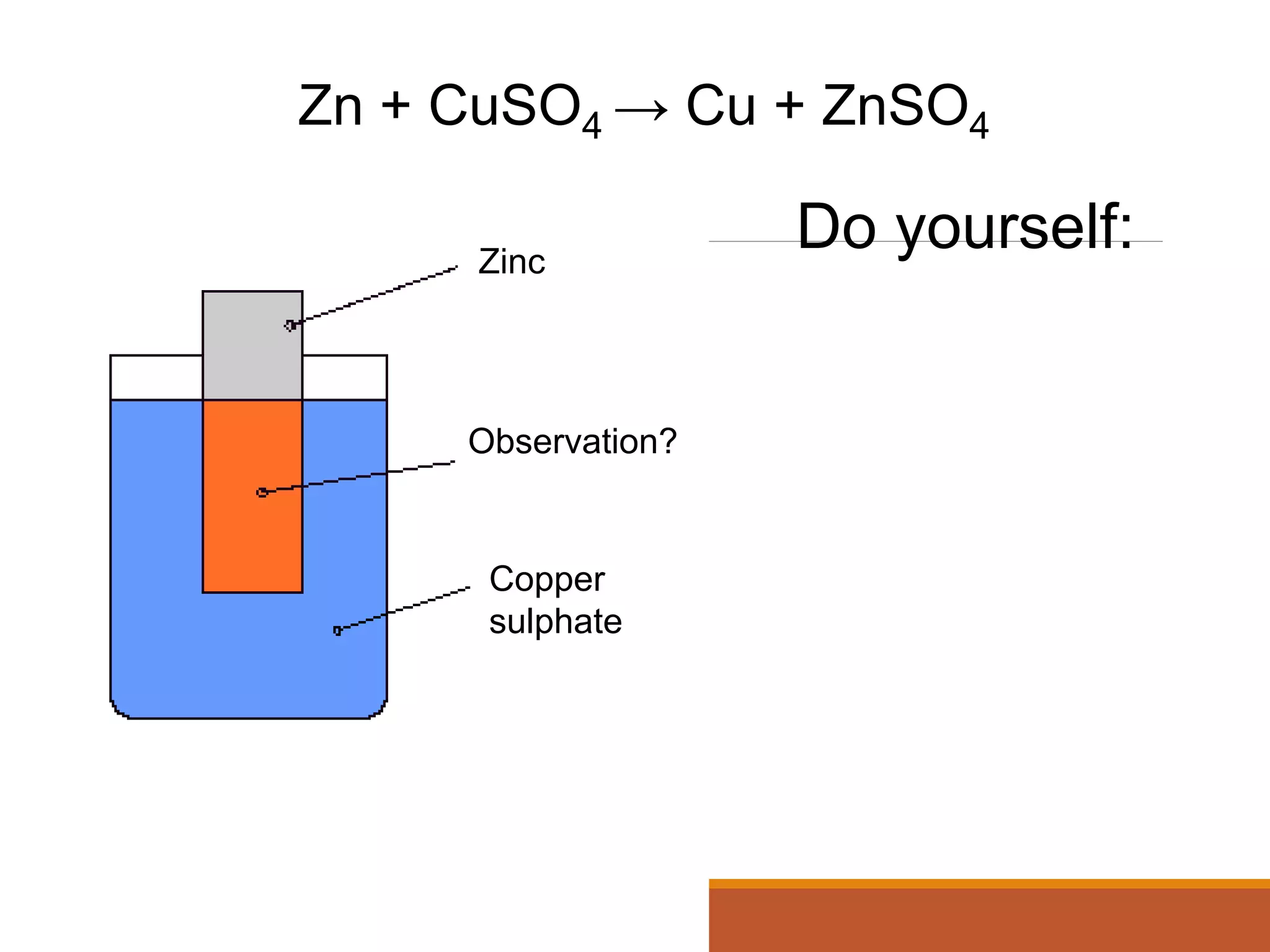
Zn + CuSO4 → Cu + ZnSO4
Zinc
Copper
sulphate
Observation?
Do yourself:
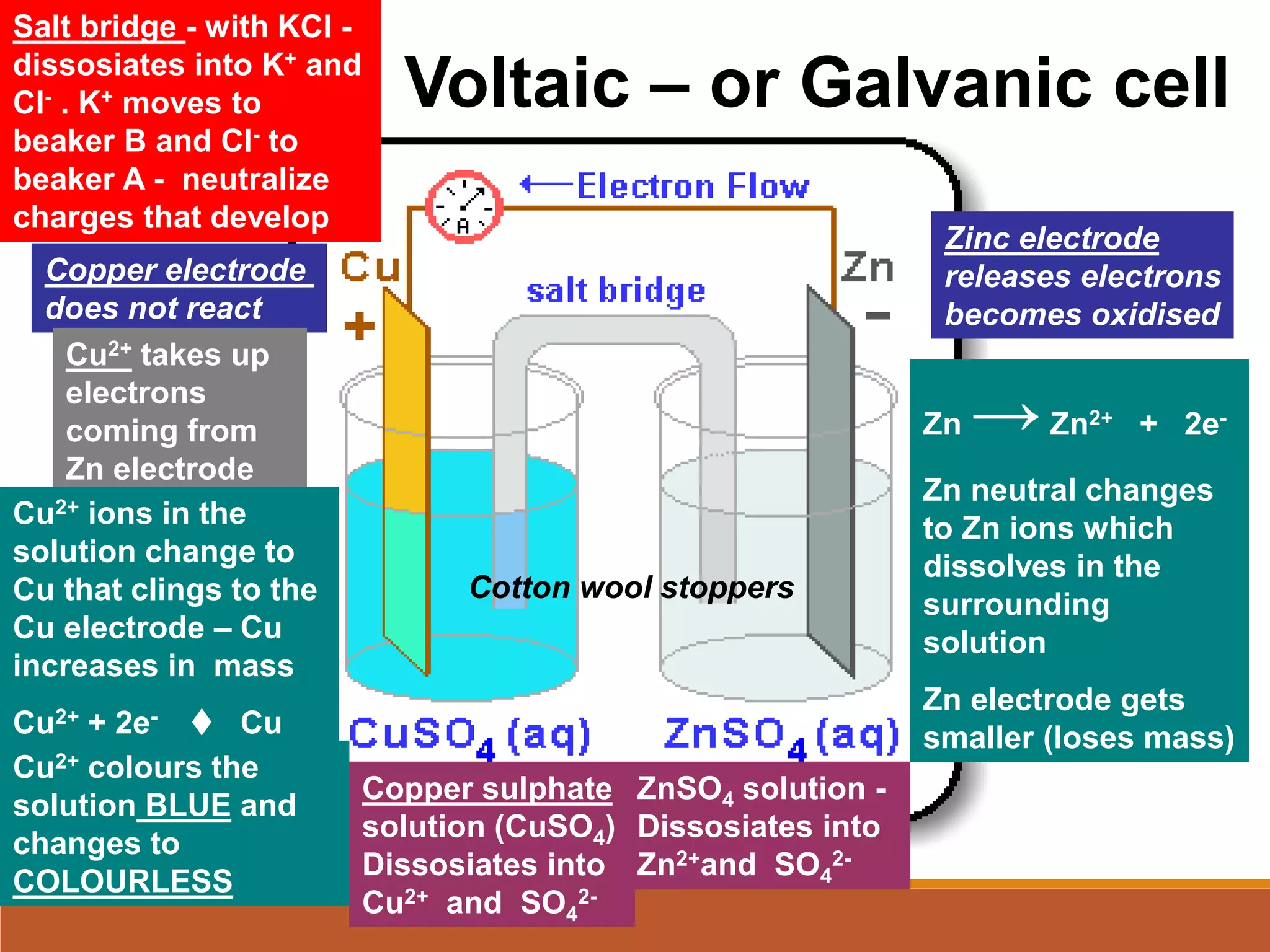
Salt bridge - with KCl -
dissosiates into K+ and
Cl- . K+ moves to
beaker B and Cl- to
beaker A - neutralize
charges that develop
Zinc electrode
releases electrons
becomes oxidised
Copper electrode
does not react
Zn →Zn2+ + 2e-
Zn neutral changes
to Zn ions which
dissolves in the
surrounding
solution
Zn electrode gets
smaller (loses mass)
Cotton wool stoppers
Copper sulphate
solution (CuSO4)
Dissosiates into
Cu2+ and SO4
2-
ZnSO4 solution -
Dissosiates into
Zn2+and SO4
2-
Cu2+ takes up
electrons
coming from
Zn electrode
Cu2+ ions in the
solution change to
Cu that clings to the
Cu electrode – Cu
increases in mass
Cu2+ + 2e- t Cu
Voltaic – or Galvanic cell
Cu2+ colours the
solution BLUE and
changes to
COLOURLESS
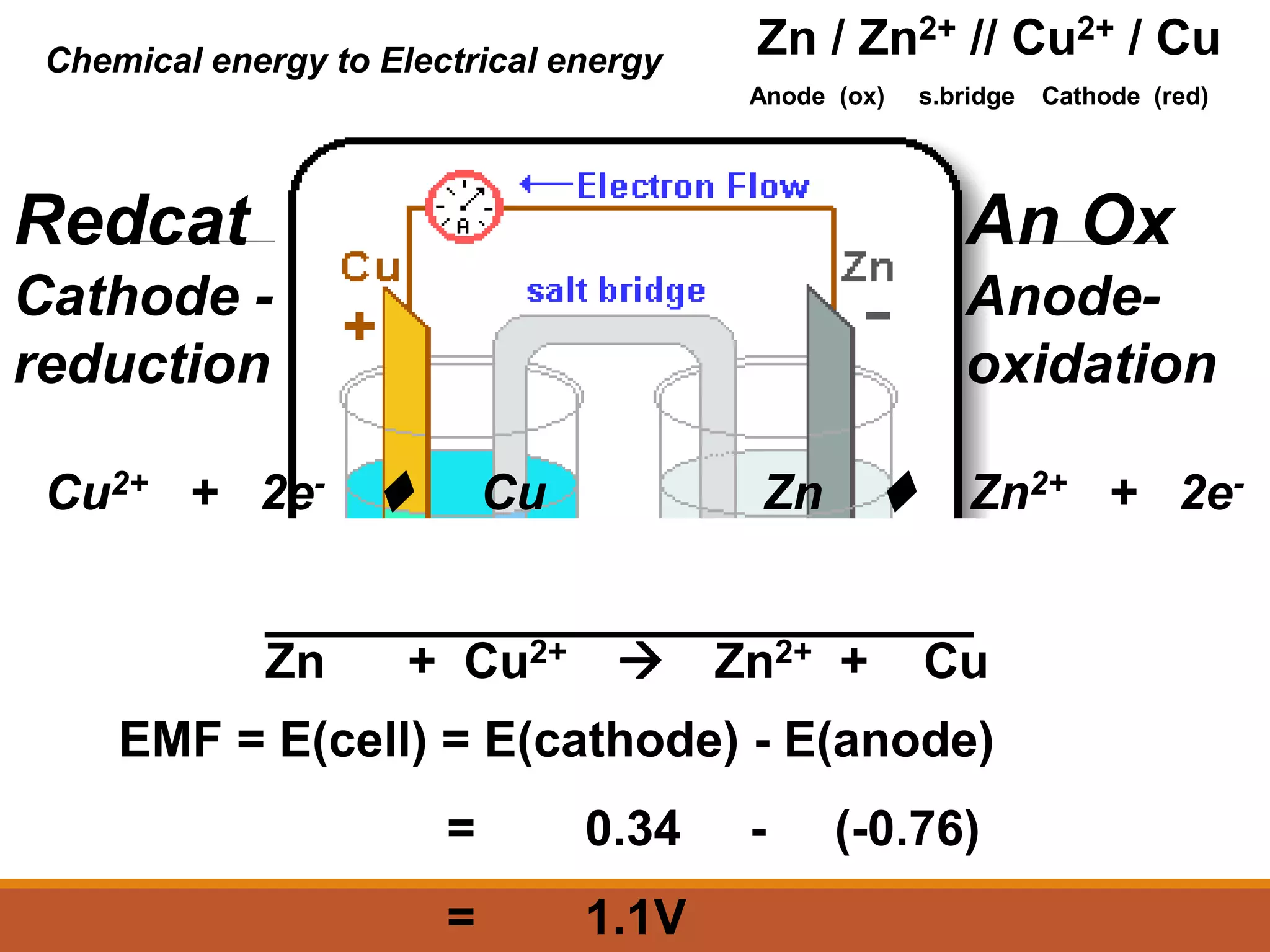
Zn t Zn2+ + 2e-
Cu2+ + 2e- t Cu
Zn + Cu2+  Zn2+ + Cu
Chemical energy to Electrical energy
Redcat
Cathode -
reduction
An Ox
Anode-
oxidation
Zn / Zn2+ // Cu2+ / Cu
Anode (ox) s.bridge Cathode (red)
EMF = E(cell) = E(cathode) - E(anode)
= 0.34 - (-0.76)
= 1.1V
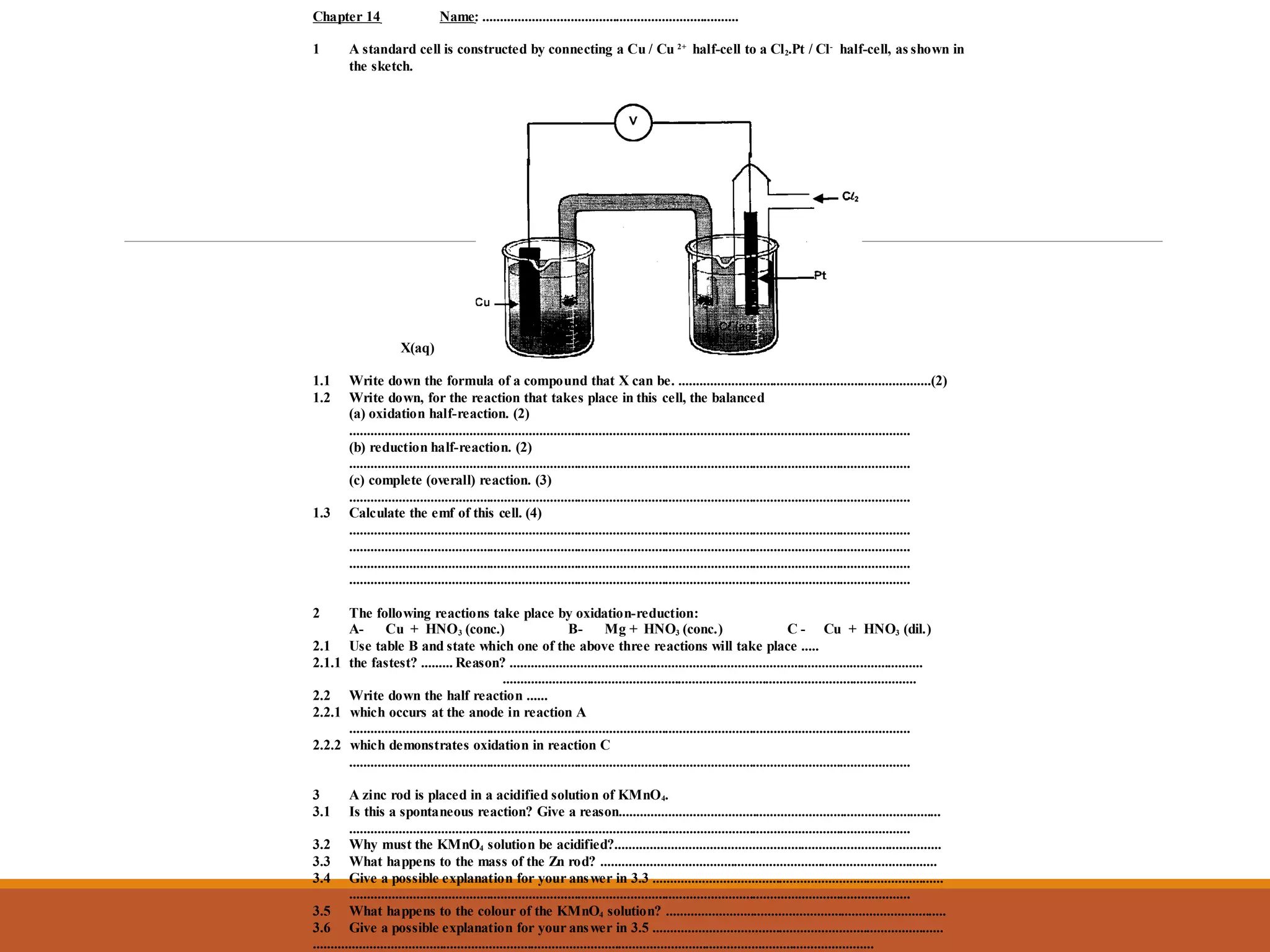
Chapter 14 Name: .........................................................................
1 A standard cell is constructed by connecting a Cu / Cu 2+
half-cell to a Cl2.Pt / Cl-
half-cell, as shown in
the sketch.
X(aq)
1.1 Write down the formula of a compound that X can be. ........................................................................(2)
1.2 Write down, for the reaction that takes place in this cell, the balanced
(a) oxidation half-reaction. (2)
................................................................................................................................................................
(b) reduction half-reaction. (2)
................................................................................................................................................................
(c) complete (overall) reaction. (3)
................................................................................................................................................................
1.3 Calculate the emf of this cell. (4)
................................................................................................................................................................
................................................................................................................................................................
................................................................................................................................................................
................................................................................................................................................................
2 The following reactions take place by oxidation-reduction:
A- Cu + HNO3 (conc.) B- Mg + HNO3 (conc.) C - Cu + HNO3 (dil.)
2.1 Use table B and state which one of the above three reactions will take place .....
2.1.1 the fastest? ......... Reason? ......................................................................................................................
......................................................................................................................
2.2 Write down the half reaction ......
2.2.1 which occurs at the anode in reaction A
................................................................................................................................................................
2.2.2 which demonstrates oxidation in reaction C
................................................................................................................................................................
3 A zinc rod is placed in a acidified solution of KMnO4.
3.1 Is this a spontaneous reaction? Give a reason............................................................................................
................................................................................................................................................................
3.2 Why must the KMnO4 solution be acidified?.............................................................................................
3.3 What happens to the mass of the Zn rod? ................................................................................................
3.4 Give a possible explanation for your answer in 3.3 ...................................................................................
................................................................................................................................................................
3.5 What happens to the colour of the KMnO4 solution? ................................................................................
3.6 Give a possible explanation for your answer in 3.5 ...................................................................................
................................................................................................................................................................
Electrochemical Cells
19.2
spontaneous
redox reaction
anode
oxidation
cathode
reduction
Attracts anions Attracts cations
Electrochemical Cells
19.2
The difference in electrical
potential between the anode
and cathode is called:
• cell voltage
• electromotive force (emf)
• cell potential
Cell Diagram
Zn (s) + Cu2+ (aq) Cu (s) + Zn2+ (aq)
[Cu2+] = 1 M & [Zn2+] = 1 M
Zn (s) | Zn2+ (1 M) || Cu2+ (1 M) | Cu (s)
anode cathode
Use || to separate half cells
Use | to separate reactants/phases in each half cell
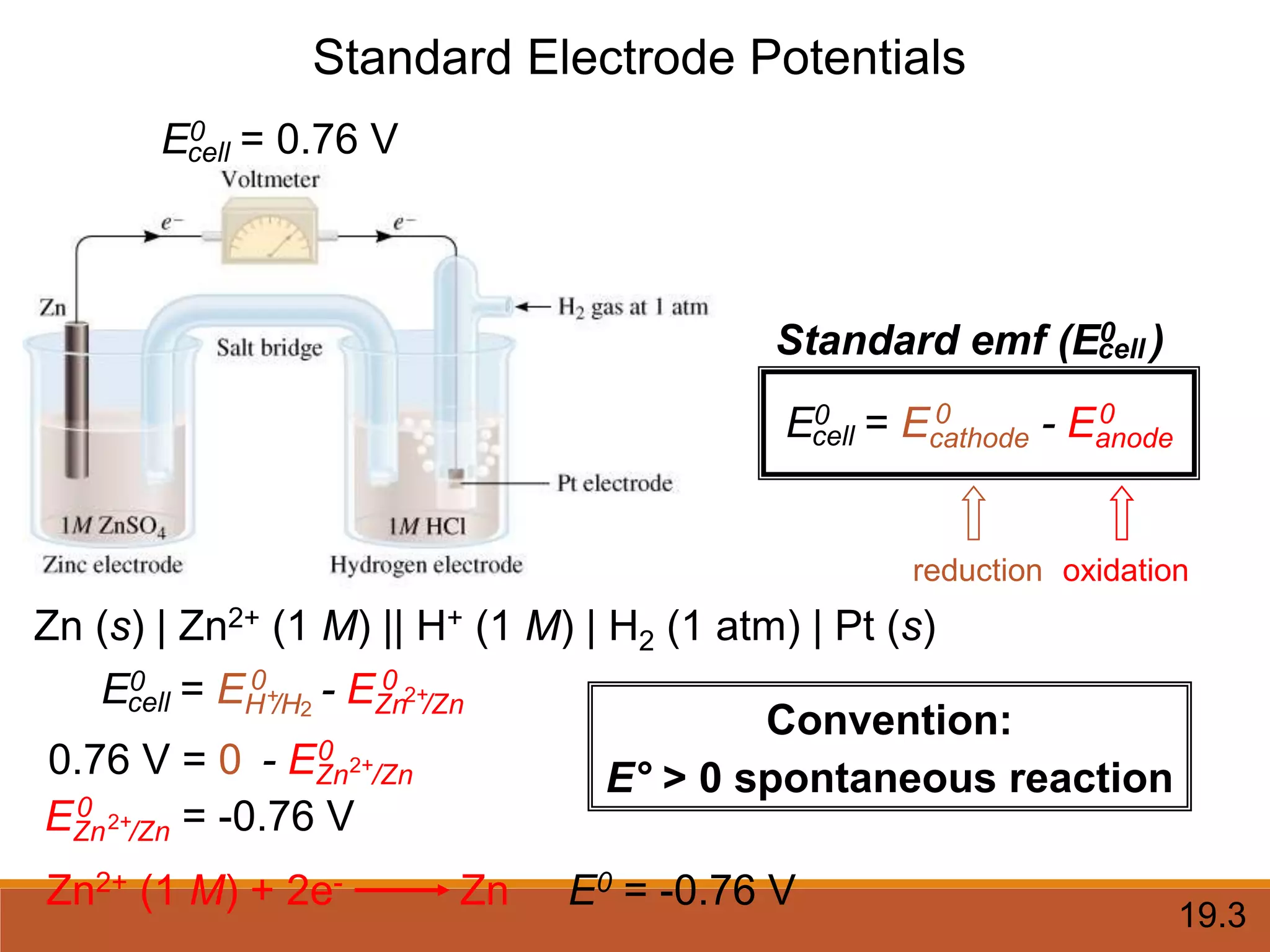
Standard Electrode Potentials
19.3
Zn (s) | Zn2+ (1 M) || H+ (1 M) | H2 (1 atm) | Pt (s)
2e- + 2H+ (1 M) H2 (1 atm)
Zn (s) Zn2+ (1 M) + 2e-
Anode (oxidation):
Cathode (reduction):
Zn (s) + 2H+ (1 M) Zn2+ + H2 (1 atm)
Standard Electrode Potentials
19.3
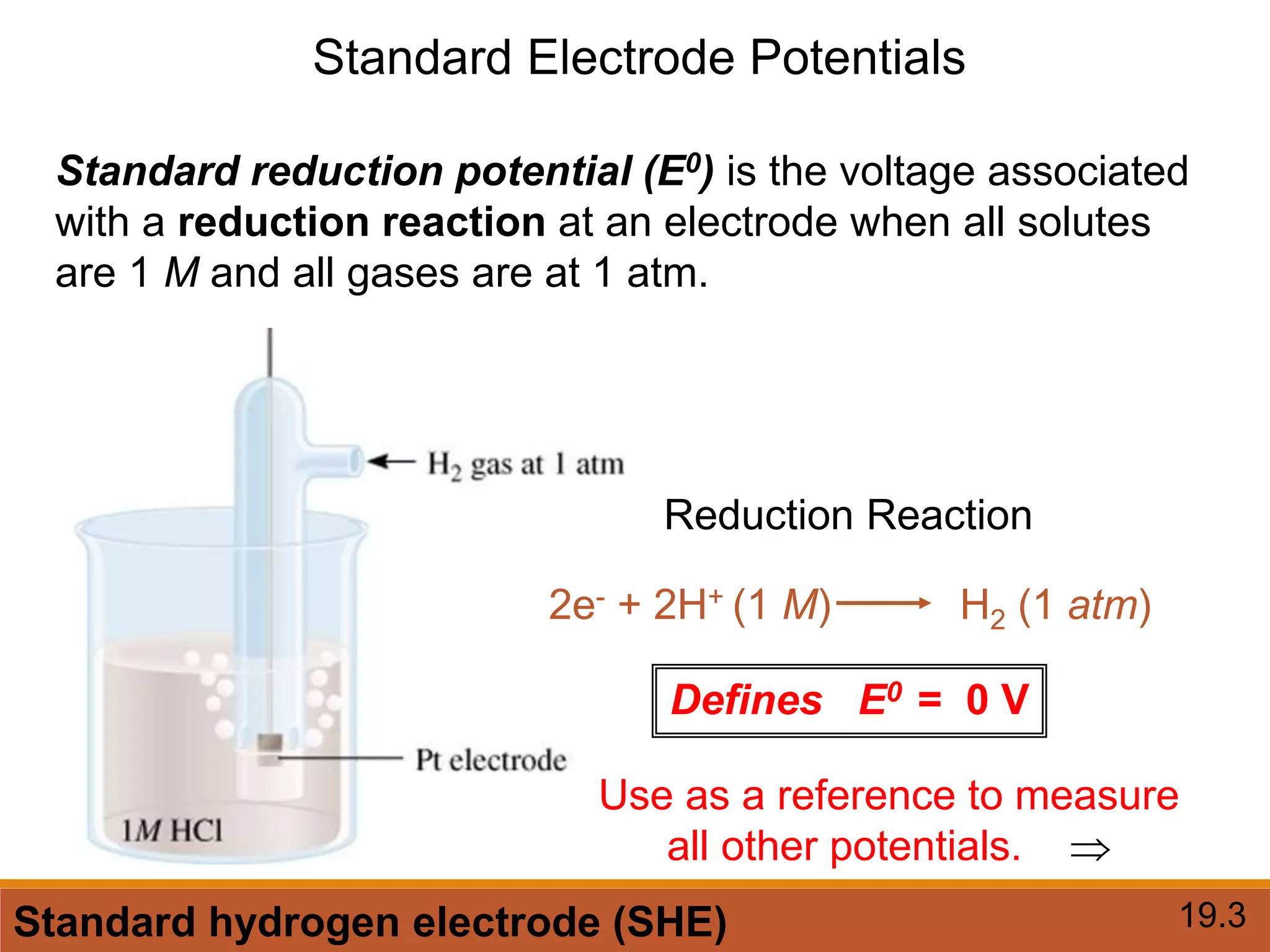
Standard reduction potential (E0) is the voltage associated
with a reduction reaction at an electrode when all solutes
are 1 M and all gases are at 1 atm.
Defines E0 = 0 V
Standard hydrogen electrode (SHE)
2e- + 2H+ (1 M) H2 (1 atm)
Reduction Reaction
Use as a reference to measure
all other potentials. 
19.3
E0 = 0.76 V
cell
Standard emf (E0 )
cell
0.76 V = 0 - EZn /Zn
0 2+
EZn /Zn = -0.76 V
0 2+
Zn2+ (1 M) + 2e- Zn E0 = -0.76 V
E0 = EH /H - EZn /Zn
cell
0 0
+ 2+
2
Standard Electrode Potentials
E0 = Ecathode - Eanode
cell
0 0
Zn (s) | Zn2+ (1 M) || H+ (1 M) | H2 (1 atm) | Pt (s)
Convention:
E° > 0 spontaneous reaction
reduction oxidation
Standard Electrode Potentials
19.3
Pt (s) | H2 (1 atm) | H+ (1 M) || Cu2+ (1 M) | Cu (s)
2e- + Cu2+ (1 M) Cu (s)
H2 (1 atm) 2H+ (1 M) + 2e-
Anode (oxidation):
Cathode (reduction):
H2 (1 atm) + Cu2+ (1 M) Cu (s) + 2H+ (1 M)
E0 = Ecathode - Eanode
cell
0 0
E0 = 0.34 V
cell
Ecell = ECu /Cu – EH /H
2+ +
2
0 0 0
0.34 = ECu /Cu - 0
0 2+
ECu /Cu = 0.34 V
2+
0
19.3
• E0 is for the reaction as
written
• The half-cell reactions are
reversible
• The sign of E0 changes
when the reaction is
reversed (E° red = -E°oxid)
• Changing the stoichiometric
coefficients of a half-cell
reaction does not change
the value of E0
• The more positive E0 the
greater the tendency for the
substance to be reduced
Strongest oxidizing agent
Strongest reducing agent
Zero reference point
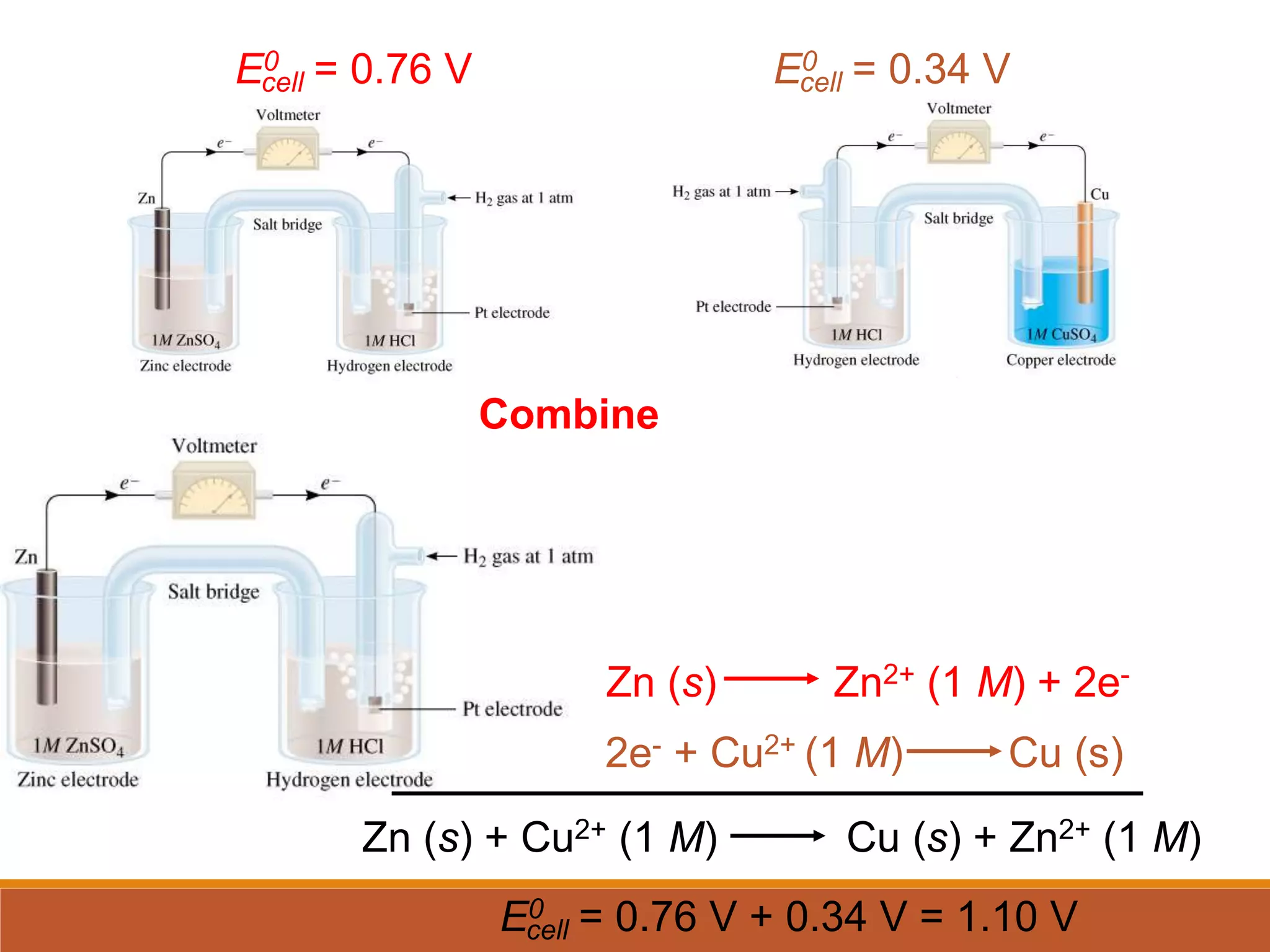
E0 = 0.76 V
cell E0 = 0.34 V
cell
Combine
Zn (s) Zn2+ (1 M) + 2e-
2e- + Cu2+ (1 M) Cu (s)
Zn (s) + Cu2+ (1 M) Cu (s) + Zn2+ (1 M)
E0 = 0.76 V + 0.34 V = 1.10 V
cell
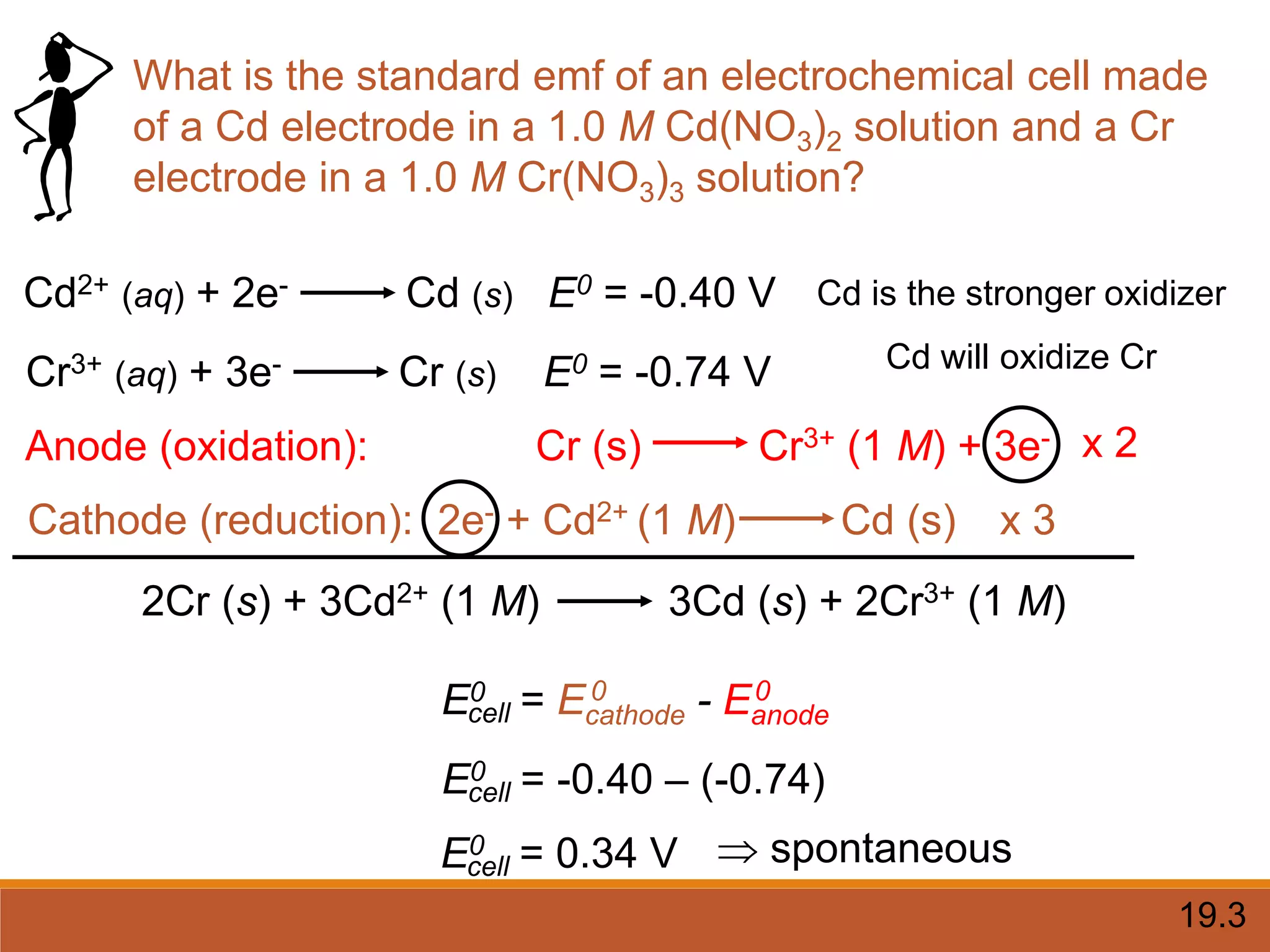
What is the standard emf of an electrochemical cell made
of a Cd electrode in a 1.0 M Cd(NO3)2 solution and a Cr
electrode in a 1.0 M Cr(NO3)3 solution?
Cd2+ (aq) + 2e- Cd (s) E0 = -0.40 V
Cr3+ (aq) + 3e- Cr (s) E0 = -0.74 V
Cd is the stronger oxidizer
Cd will oxidize Cr
2e- + Cd2+ (1 M) Cd (s)
Cr (s) Cr3+ (1 M) + 3e-
Anode (oxidation):
Cathode (reduction):
2Cr (s) + 3Cd2+ (1 M) 3Cd (s) + 2Cr3+ (1 M)
x 2
x 3
E0 = Ecathode - Eanode
cell
0 0
E0 = -0.40 – (-0.74)
cell
E0 = 0.34 V
cell
19.3
 spontaneous
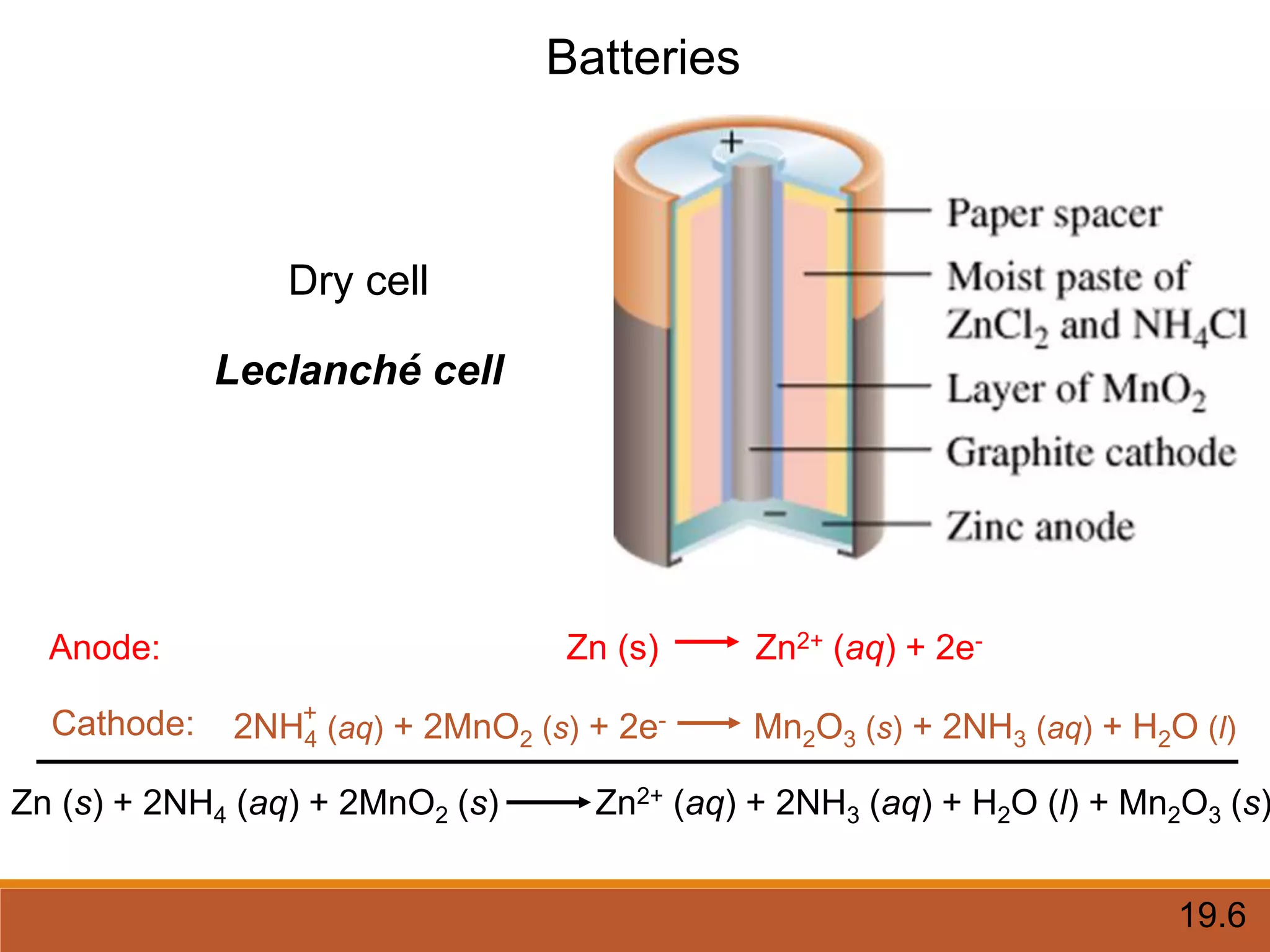
Batteries
19.6
Leclanché cell
Dry cell
Zn (s) Zn2+ (aq) + 2e-
Anode:
Cathode: 2NH4 (aq) + 2MnO2 (s) + 2e- Mn2O3 (s) + 2NH3 (aq) + H2O (l)
+
Zn (s) + 2NH4 (aq) + 2MnO2 (s) Zn2+ (aq) + 2NH3 (aq) + H2O (l) + Mn2O3 (s)
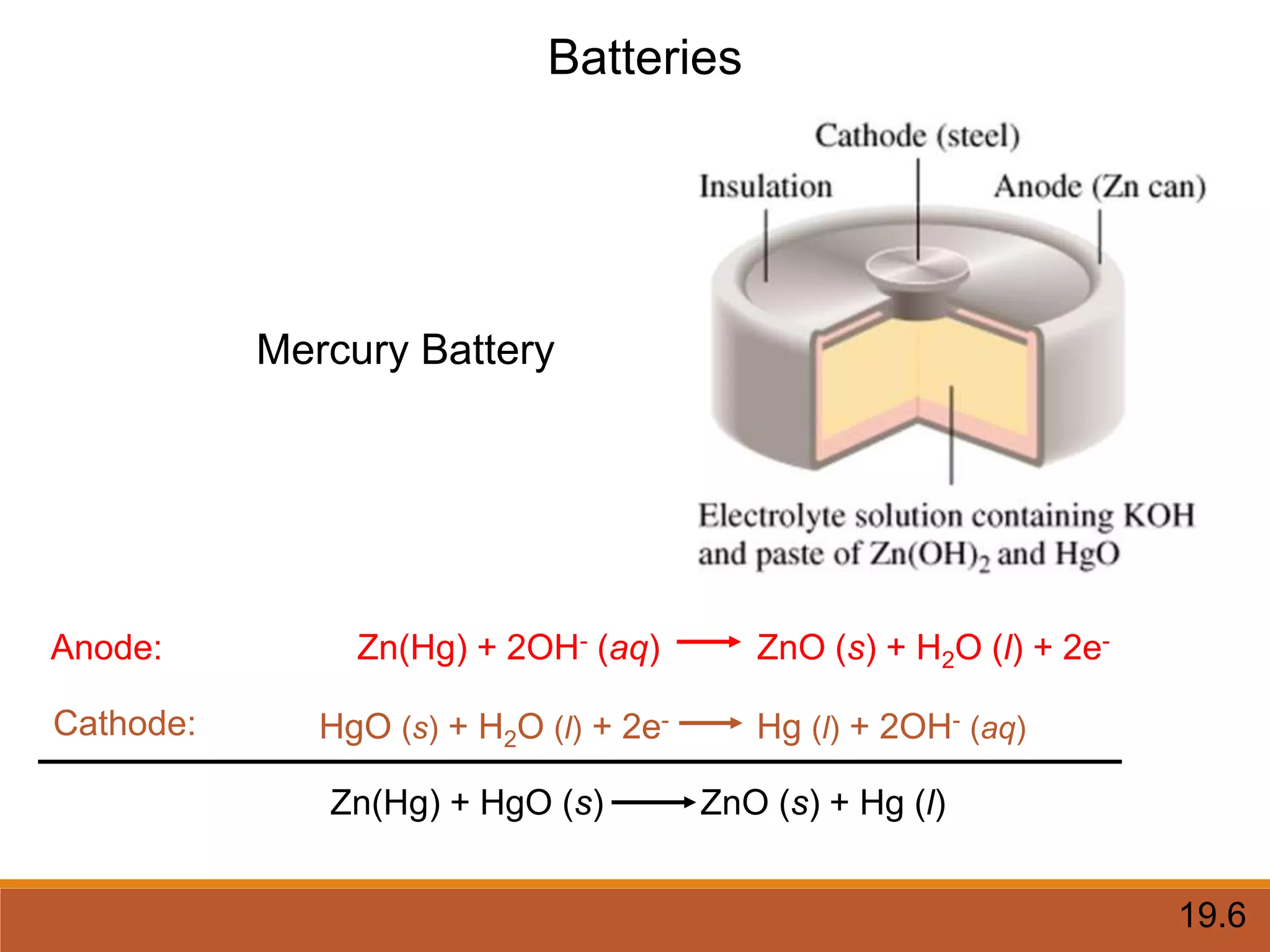
Batteries
Zn(Hg) + 2OH- (aq) ZnO (s) + H2O (l) + 2e-
Anode:
Cathode: HgO (s) + H2O (l) + 2e- Hg (l) + 2OH- (aq)
Zn(Hg) + HgO (s) ZnO (s) + Hg (l)
Mercury Battery
19.6
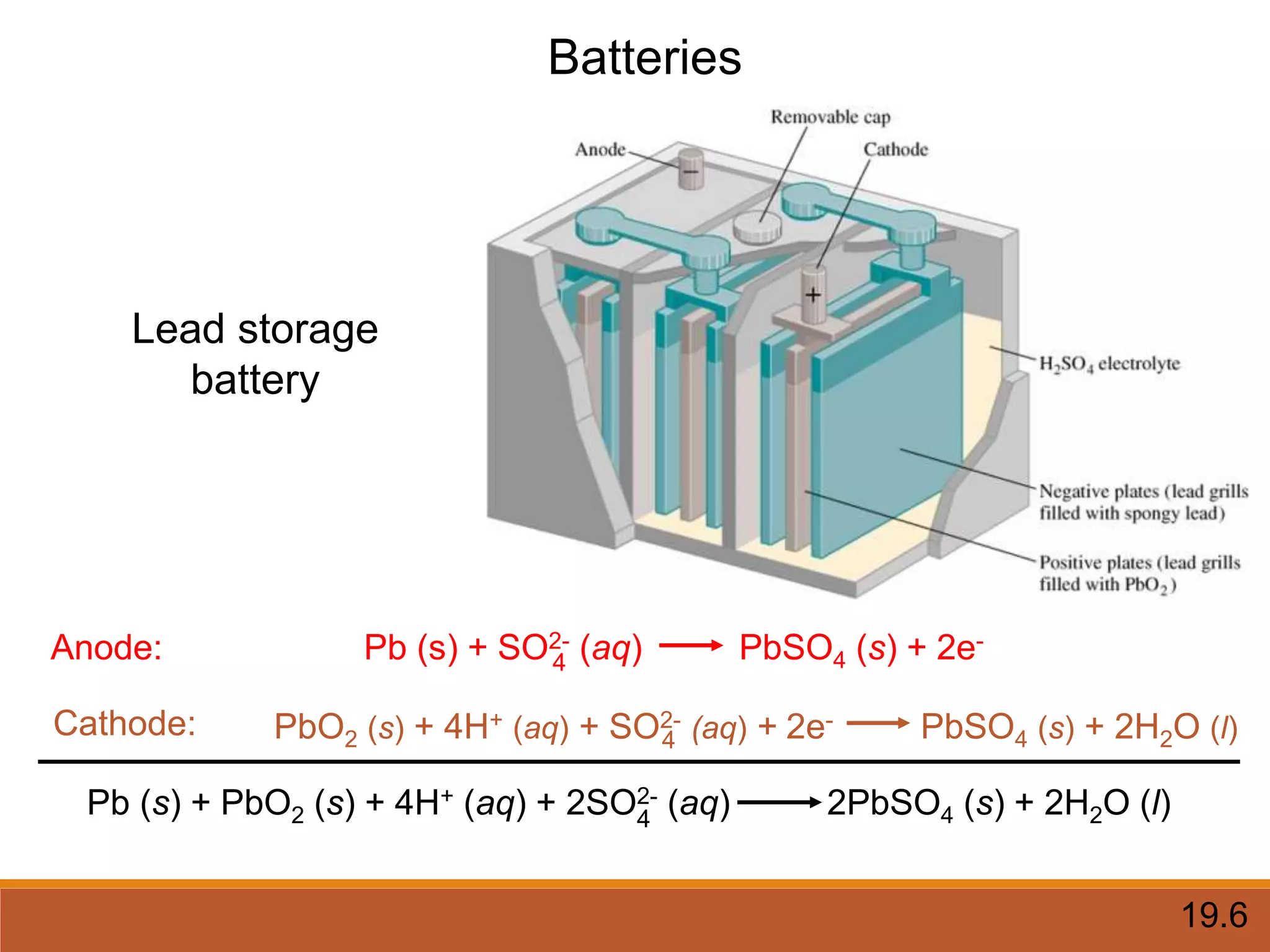
Batteries
19.6
Anode:
Cathode:
Lead storage
battery
PbO2 (s) + 4H+ (aq) + SO2- (aq) + 2e- PbSO4 (s) + 2H2O (l)
4
Pb (s) + SO2- (aq) PbSO4 (s) + 2e-
4
Pb (s) + PbO2 (s) + 4H+ (aq) + 2SO2- (aq) 2PbSO4 (s) + 2H2O (l)
4
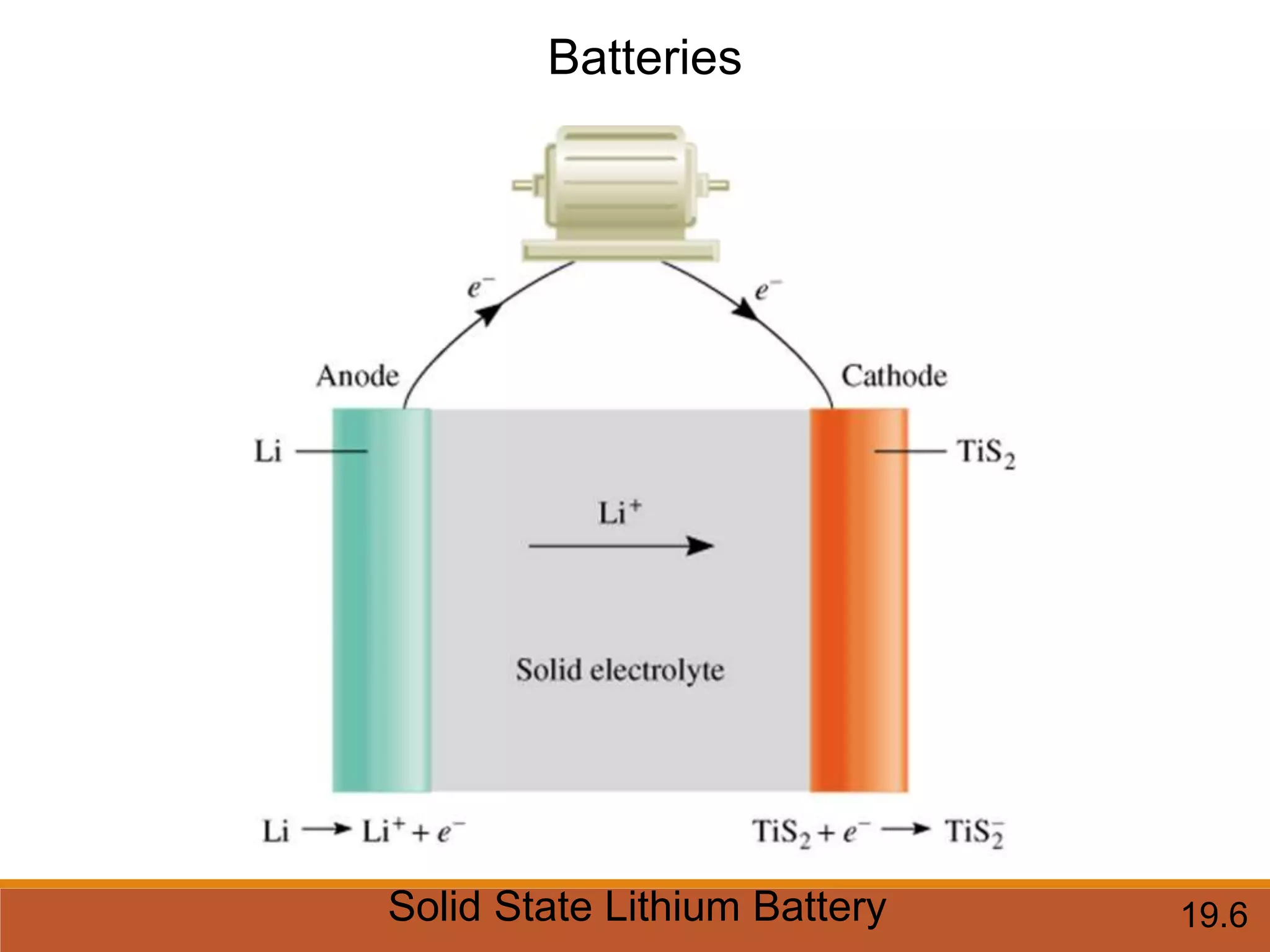
Batteries
19.6
Solid State Lithium Battery
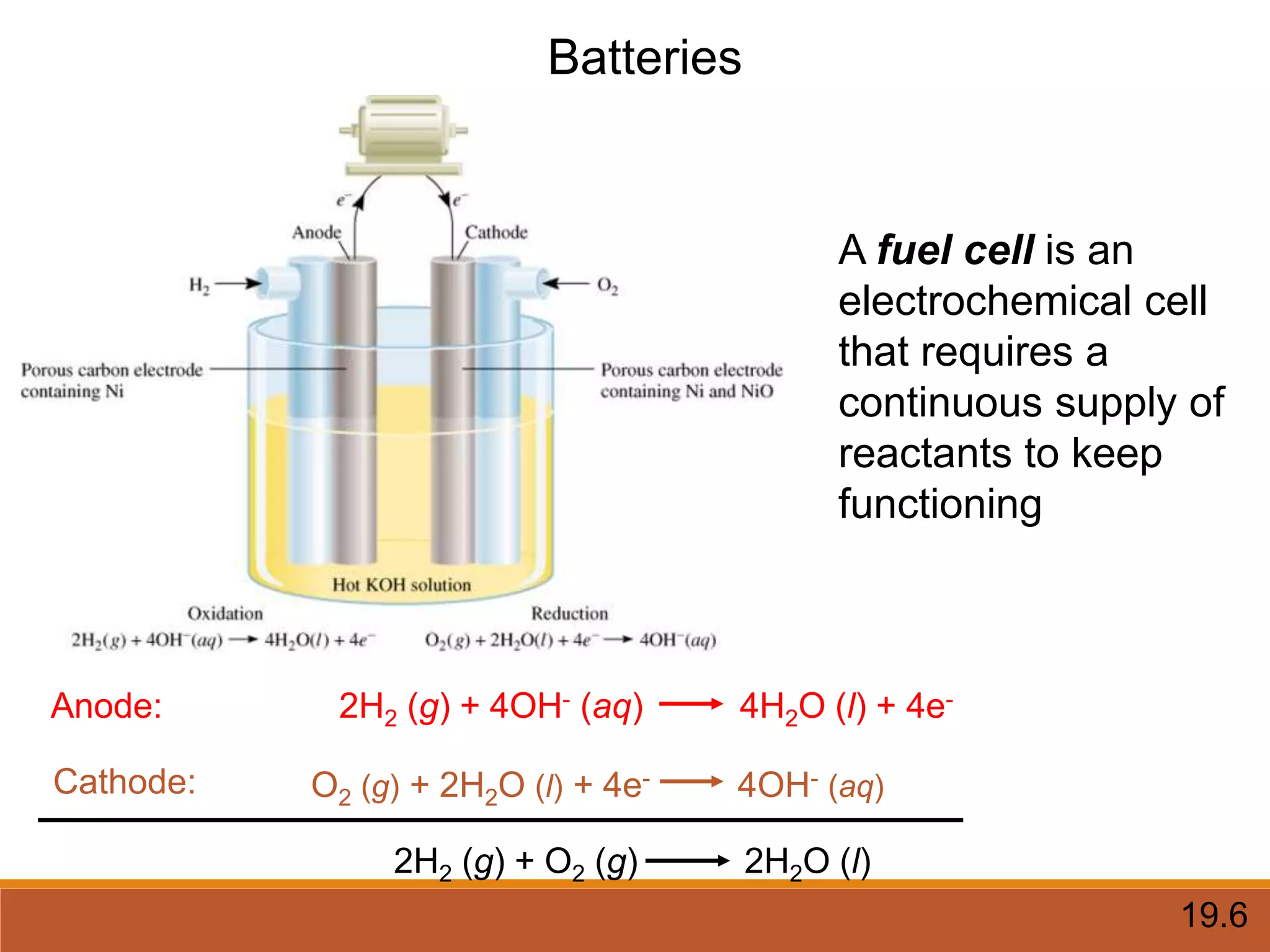
Batteries
19.6
A fuel cell is an
electrochemical cell
that requires a
continuous supply of
reactants to keep
functioning
Anode:
Cathode: O2 (g) + 2H2O (l) + 4e- 4OH- (aq)
2H2 (g) + 4OH- (aq) 4H2O (l) + 4e-
2H2 (g) + O2 (g) 2H2O (l)
Corrosion
19.7
Dissolved oxygen in
water causes oxidation
E°red = -0.44 V
Rust Fe2O3
E°red = 1.23 V
Since E°red (Fe3+) < E°red (O2)
Fe can be oxidized by oxygen
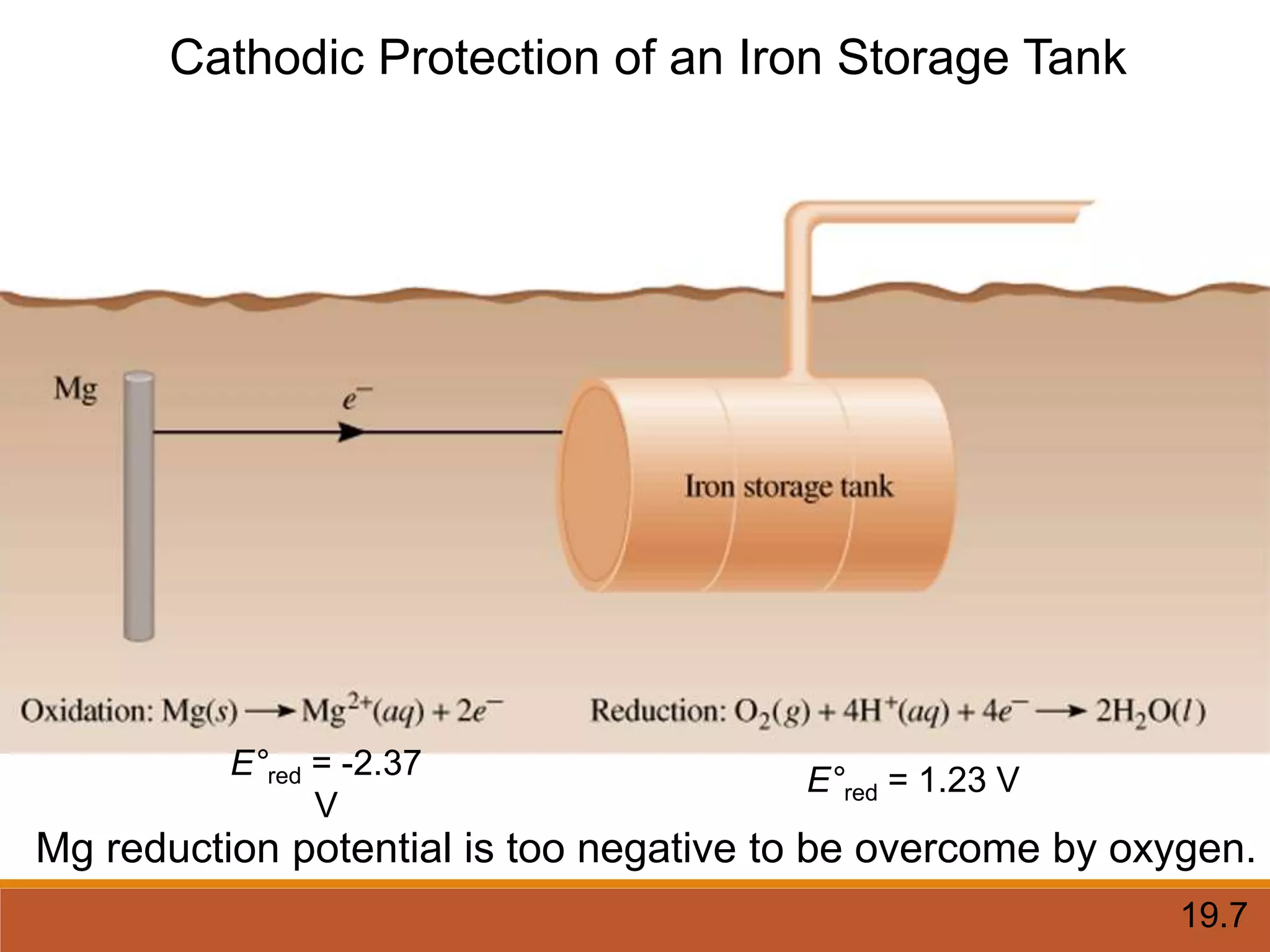
Cathodic Protection of an Iron Storage Tank
19.7
E°red = -2.37
V
E°red = 1.23 V
Mg reduction potential is too negative to be overcome by oxygen.
19.8
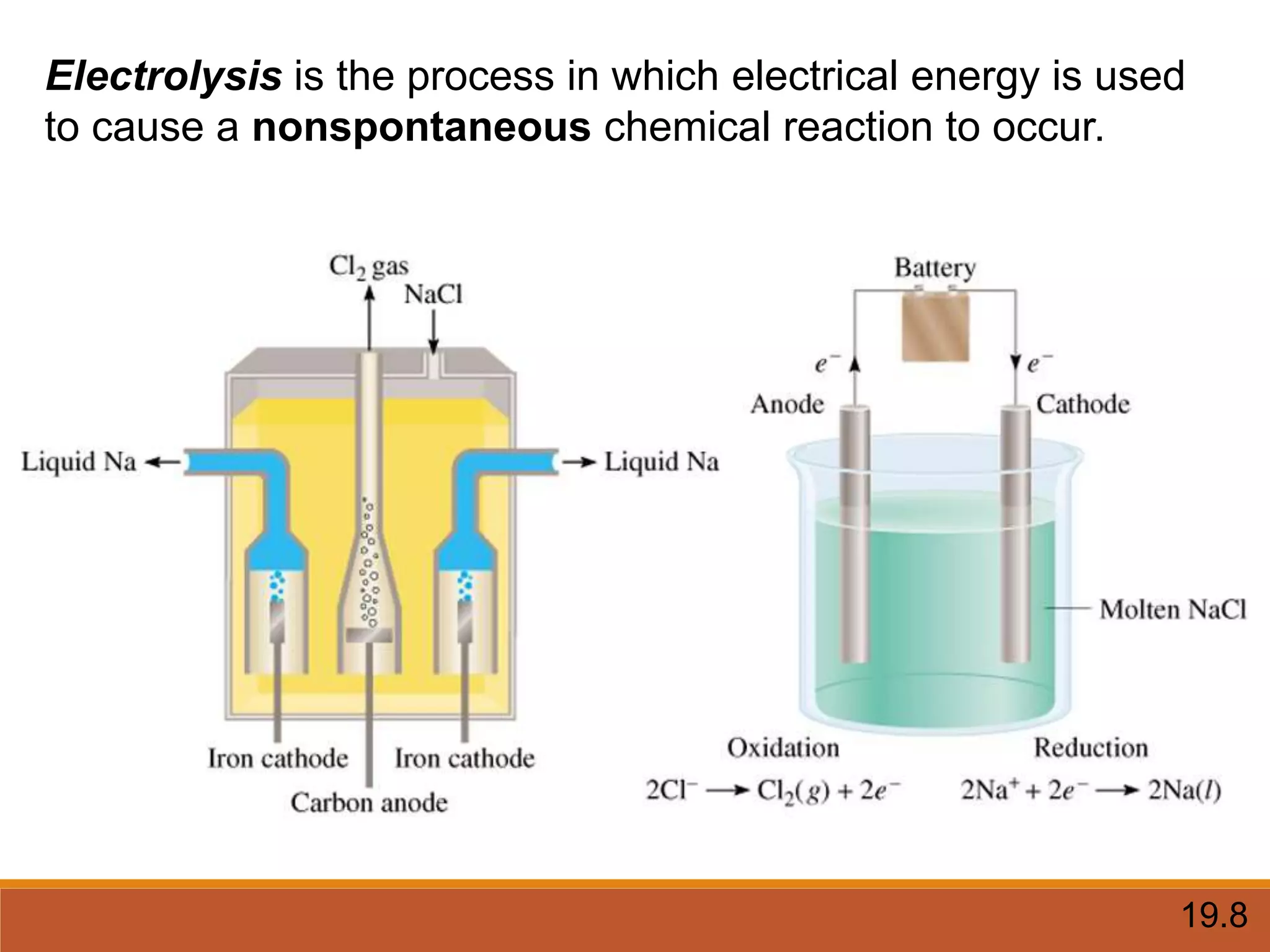
Electrolysis is the process in which electrical energy is used
to cause a nonspontaneous chemical reaction to occur.
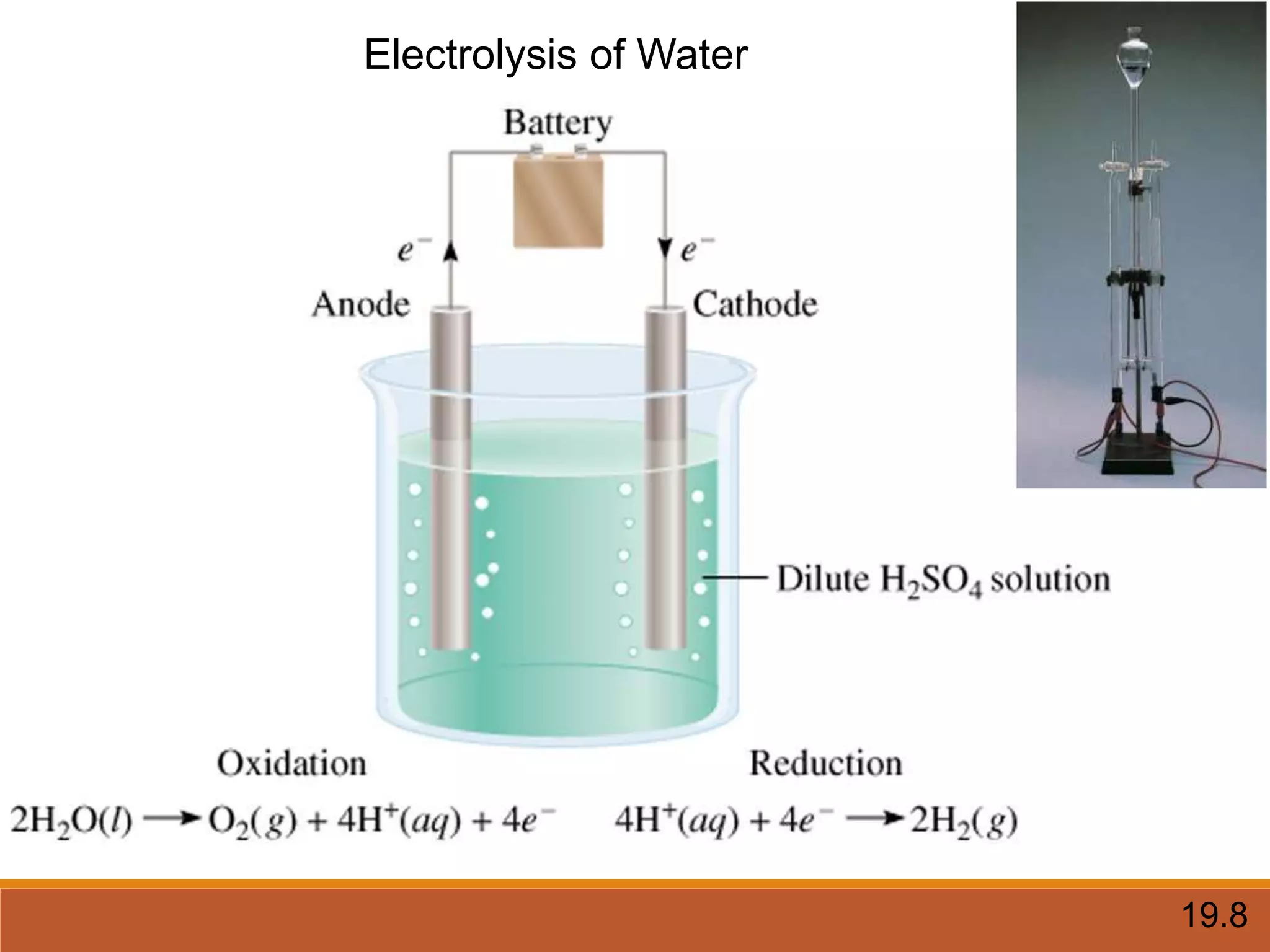
Electrolysis of Water
19.8

1. redox reactions summary presentation.ppt

  • 2.
    Redox Reaction -A reaction where one species gains electrons and one species loses electrons. Must have both processes occurring. Remember acid-base reactions where protons are transferred. One has to give, the other has to take.
  • 3.
    3 Oxidation is… –the lossof electrons –an increase in oxidation state –the addition of oxygen –the loss of hydrogen 2 Mg + O2  2 MgO notice the magnesium is losing electrons Reduction is… –the gain of electrons –a decrease in oxidation state –the loss of oxygen –the addition of hydrogen MgO + H2  Mg + H2O notice the Mg2+ in MgO is gaining electrons
  • 4.
    Oxidation number Number assignedto each atom to estimate its excess charge or deficiency. There is ALWAYS a change in oxidation numbers in a redox reaction. 2Mg (s) + O2 (g) 2MgO (s) 0 0 2+ 2-
  • 5.
    4. The oxidationnumber of hydrogen is +1 The sum of the oxidation numbers of all the atoms in a molecule or ion is equal to the charge on the molecule or ion. 5. Group IA metals are +1, IIA metals are +2 and Halogens is always –1. 2. In monatomic ions, the oxidation number is equal to the charge on the ion. Li+, Li = +1; Fe3+, Fe = +3; O2-, O = -2 3. The oxidation number of oxygen is usually –2. Rules for Determination of Oxidation Number 1. Free elements (uncombined state) and purely covalent compounds all have atoms with an oxidation number of zero. Na, Be, K, Pb, H2, O2, P4 = 0 H2O H = +1 and +1; O = -2 LiCl, Li = +1 ; Cl = -1
  • 6.
    H2CO3 O = -2H = +1 3x(-2) + 1 + 1 + ? = 0 C = +4 What are the oxidation numbers of all the atoms in H2CO3 ? From rules we know: Can calculate C:
  • 7.
    What are theoxidation numbers of Mn in the following compounds and ions ?  Mn can have at least 5 oxidation states. Mn - element  oxidation # = 0 metal Mn 2+ - ion  oxidation # = +2 colorless MnO2 - compound  oxidation # = +4 brown +4 + (2x(-2)) = 0 MnO4 - - ion  oxidation # = +7 purple +7 + (4x(-2)) = -1 MnO4 -2 - ion  +6 + (4x(-2)) = -2 oxidation # = +6 green
  • 8.
    Oxidation Numbers Worksheet-1 1.Figure out the oxidation numbers of the atoms in: answers CH4 , CO2 , N2O5 , Li4C , SO3 , Na2O , Cl-1 , PO4 -3 2. Determine these oxidation numbers: answers N2O3 , NO , P2O4 , NO2 , NH4 +1, NO3 -1 , OF2 , H2O2 , Na2O2 3. Determine these oxidation numbers: answers N , N2 , N-3 , Be+2 , F2 , Mg 4. Determine the oxidation numbers of these polyatomic molecules: answers KNO3, NH4NO3, H2CO3, K3PO4, Al(NO3)3, (NH4) 2SO4 5. Determine the oxidation numbers: answers K2Cr2O7 , KMnO4 , Fe2O3 , FeO , VO , MnO2 6. Determine the oxidation numbers: B, N-3, K2O, CH3CH2CH3 , CO3 -2, KClO4 MnO4 -1, Al2(SO4)3 , F2
  • 9.
    Examples Zn + CuSO4 t Zn SO4 + Cu 0 +2 -2 +2 -2 0 Gained e-’s – Reduced – Oxidising agent Lost e-’s – Oxidised – Reducing agent Spectator Ions
  • 10.
    -1 -1 +1 -1 +3-1 +1 -2 +2 -1 +1 -1 0 Examples FeCl3 + H2S → FeCl2 + HCl + S Lost e-’s – Oxidised – Reducing agent Gained e-’s – Reduced – Oxidising agent Spectator Ions
  • 11.
    -2 0 +4 -2+2 -2 0 Examples Mg + S O2 → Mg O + S Lost e-’s – Oxidised – Reducing agent Gained e-’s – Reduced – Oxidising agent Spectator Ions
  • 12.
    +1 -2 +1 +1-2 +4 -2 +1 -2 0 Examples H2 S + S O2 → H2O + S Lost e-’s – Oxidised – Reducing agent Gained e-’s – Reduced – Oxidising agent Spectator Ions Same product
  • 13.
    +1 -2 -2+1 -2 0 +1 +6 -2 -2 +2 -2 +1 -2 +4 -2 Examples Cu + H2 S O4 →CuSO4 + H2O + SO2 Lost e-’s – Oxidised – Reducing agent Gained e-’s – Reduced – Oxidising agent Spectator Ions
  • 14.
  • 15.
    • The morepositive E0 the greater the tendency for the substance to be reduced Strongest oxidizing agent Strongest reducing agent Zero reference point
  • 19.
    Half reactions: Zn0 tZn2+ + 2e- - lost 2 electrons(OX) Cu+2 + 2e- t Cu0 - took up 2 electrons (RED) Cu+2 + Zn0 t Cu0 + Zn2+ - nett reaction Balancing Redox Equations Zn + Cu SO4 t Zn SO4 + Cu 0 +2 -2 +2 -2 0 Gained e-’s – Reduced – Oxidising agent Lost e-’s – Oxidised – Reducing agent Zn2+ + 2e- t Zn0
  • 20.
    Half reactions: H2S tS +2H++ 2e- Fe+3 + e- t Fe+2 2 Fe+3 + H2S t 2 Fe+2 + S + 2H+ Balancing Redox Equations S + 2H+ + 2e- t H2S -1 -1 +1 -1 +3 -1 +1 -2 +2 -1 +1 -1 0 FeCl3 + H2S → FeCl2 + HCl + S Lost e-’s – Oxidised – Reducing agent Gained e-’s – Reduced – Oxidising agent x2 2 2 2 2 2 2
  • 21.
    Half reactions: SO2 +2H2O t SO4 2- +4H+ + 2e- Cr2O7 2- + 14H+ + 6e- → 2Cr 3+ + 7H2O Cr2O7 2- +2H + + 3 SO2 t 2Cr 3++H2O +3SO4 -2 Balancing Redox Equations SO4 2- + 4H+ + 2e- → SO2 +2H2O -2 +4 +6 +3+3 K2Cr2O7+SO2+H2SO4→K2SO4+Cr2(SO4)3+H2O Lost e-’s – Oxidised – Reducing agent Gained e-’s – Reduced – Oxidising agent x3 3 6 3 12 6 2 1
  • 22.
    Balancing Redox Equations Doyourself KMnO4 + SO2 + H2O →K2SO4 + MnSO4 + H2SO4 KMnO4+H2S + H2SO4 → K2SO4 + MnSO4+ S+ H2O K2Cr2O7+ H2S+ H2SO4 → K2SO4+ Cr2(SO4)+S+H2O MnO2 + HCl → MnCl2 + H2O +Cl2 Mg + Cl2 → MgCl2 Cu + HNO3 (conc) → Cu(NO3)2 + H2O + NO2 Cu + HNO3 (dil) → Cu(NO3)2 + H2O + NO
  • 23.
    Fe + CuSO4→ Cu + FeSO4 Do yourself:
  • 24.
    Cu + ZnSO4→ __________ Copper Zinc sulphate Observation? Do yourself:
  • 25.
    Zn + CuSO4→ Cu + ZnSO4 Zinc Copper sulphate Observation? Do yourself:
  • 26.
    Salt bridge -with KCl - dissosiates into K+ and Cl- . K+ moves to beaker B and Cl- to beaker A - neutralize charges that develop Zinc electrode releases electrons becomes oxidised Copper electrode does not react Zn →Zn2+ + 2e- Zn neutral changes to Zn ions which dissolves in the surrounding solution Zn electrode gets smaller (loses mass) Cotton wool stoppers Copper sulphate solution (CuSO4) Dissosiates into Cu2+ and SO4 2- ZnSO4 solution - Dissosiates into Zn2+and SO4 2- Cu2+ takes up electrons coming from Zn electrode Cu2+ ions in the solution change to Cu that clings to the Cu electrode – Cu increases in mass Cu2+ + 2e- t Cu Voltaic – or Galvanic cell Cu2+ colours the solution BLUE and changes to COLOURLESS
  • 27.
    Zn t Zn2++ 2e- Cu2+ + 2e- t Cu Zn + Cu2+  Zn2+ + Cu Chemical energy to Electrical energy Redcat Cathode - reduction An Ox Anode- oxidation Zn / Zn2+ // Cu2+ / Cu Anode (ox) s.bridge Cathode (red) EMF = E(cell) = E(cathode) - E(anode) = 0.34 - (-0.76) = 1.1V
  • 28.
    Chapter 14 Name:......................................................................... 1 A standard cell is constructed by connecting a Cu / Cu 2+ half-cell to a Cl2.Pt / Cl- half-cell, as shown in the sketch. X(aq) 1.1 Write down the formula of a compound that X can be. ........................................................................(2) 1.2 Write down, for the reaction that takes place in this cell, the balanced (a) oxidation half-reaction. (2) ................................................................................................................................................................ (b) reduction half-reaction. (2) ................................................................................................................................................................ (c) complete (overall) reaction. (3) ................................................................................................................................................................ 1.3 Calculate the emf of this cell. (4) ................................................................................................................................................................ ................................................................................................................................................................ ................................................................................................................................................................ ................................................................................................................................................................ 2 The following reactions take place by oxidation-reduction: A- Cu + HNO3 (conc.) B- Mg + HNO3 (conc.) C - Cu + HNO3 (dil.) 2.1 Use table B and state which one of the above three reactions will take place ..... 2.1.1 the fastest? ......... Reason? ...................................................................................................................... ...................................................................................................................... 2.2 Write down the half reaction ...... 2.2.1 which occurs at the anode in reaction A ................................................................................................................................................................ 2.2.2 which demonstrates oxidation in reaction C ................................................................................................................................................................ 3 A zinc rod is placed in a acidified solution of KMnO4. 3.1 Is this a spontaneous reaction? Give a reason............................................................................................ ................................................................................................................................................................ 3.2 Why must the KMnO4 solution be acidified?............................................................................................. 3.3 What happens to the mass of the Zn rod? ................................................................................................ 3.4 Give a possible explanation for your answer in 3.3 ................................................................................... ................................................................................................................................................................ 3.5 What happens to the colour of the KMnO4 solution? ................................................................................ 3.6 Give a possible explanation for your answer in 3.5 ................................................................................... ................................................................................................................................................................
  • 29.
  • 30.
    Electrochemical Cells 19.2 The differencein electrical potential between the anode and cathode is called: • cell voltage • electromotive force (emf) • cell potential Cell Diagram Zn (s) + Cu2+ (aq) Cu (s) + Zn2+ (aq) [Cu2+] = 1 M & [Zn2+] = 1 M Zn (s) | Zn2+ (1 M) || Cu2+ (1 M) | Cu (s) anode cathode Use || to separate half cells Use | to separate reactants/phases in each half cell
  • 31.
    Standard Electrode Potentials 19.3 Zn(s) | Zn2+ (1 M) || H+ (1 M) | H2 (1 atm) | Pt (s) 2e- + 2H+ (1 M) H2 (1 atm) Zn (s) Zn2+ (1 M) + 2e- Anode (oxidation): Cathode (reduction): Zn (s) + 2H+ (1 M) Zn2+ + H2 (1 atm)
  • 32.
    Standard Electrode Potentials 19.3 Standardreduction potential (E0) is the voltage associated with a reduction reaction at an electrode when all solutes are 1 M and all gases are at 1 atm. Defines E0 = 0 V Standard hydrogen electrode (SHE) 2e- + 2H+ (1 M) H2 (1 atm) Reduction Reaction Use as a reference to measure all other potentials. 
  • 33.
    19.3 E0 = 0.76V cell Standard emf (E0 ) cell 0.76 V = 0 - EZn /Zn 0 2+ EZn /Zn = -0.76 V 0 2+ Zn2+ (1 M) + 2e- Zn E0 = -0.76 V E0 = EH /H - EZn /Zn cell 0 0 + 2+ 2 Standard Electrode Potentials E0 = Ecathode - Eanode cell 0 0 Zn (s) | Zn2+ (1 M) || H+ (1 M) | H2 (1 atm) | Pt (s) Convention: E° > 0 spontaneous reaction reduction oxidation
  • 34.
    Standard Electrode Potentials 19.3 Pt(s) | H2 (1 atm) | H+ (1 M) || Cu2+ (1 M) | Cu (s) 2e- + Cu2+ (1 M) Cu (s) H2 (1 atm) 2H+ (1 M) + 2e- Anode (oxidation): Cathode (reduction): H2 (1 atm) + Cu2+ (1 M) Cu (s) + 2H+ (1 M) E0 = Ecathode - Eanode cell 0 0 E0 = 0.34 V cell Ecell = ECu /Cu – EH /H 2+ + 2 0 0 0 0.34 = ECu /Cu - 0 0 2+ ECu /Cu = 0.34 V 2+ 0
  • 35.
    19.3 • E0 isfor the reaction as written • The half-cell reactions are reversible • The sign of E0 changes when the reaction is reversed (E° red = -E°oxid) • Changing the stoichiometric coefficients of a half-cell reaction does not change the value of E0
  • 36.
    • The morepositive E0 the greater the tendency for the substance to be reduced Strongest oxidizing agent Strongest reducing agent Zero reference point
  • 37.
    E0 = 0.76V cell E0 = 0.34 V cell Combine Zn (s) Zn2+ (1 M) + 2e- 2e- + Cu2+ (1 M) Cu (s) Zn (s) + Cu2+ (1 M) Cu (s) + Zn2+ (1 M) E0 = 0.76 V + 0.34 V = 1.10 V cell
  • 38.
    What is thestandard emf of an electrochemical cell made of a Cd electrode in a 1.0 M Cd(NO3)2 solution and a Cr electrode in a 1.0 M Cr(NO3)3 solution? Cd2+ (aq) + 2e- Cd (s) E0 = -0.40 V Cr3+ (aq) + 3e- Cr (s) E0 = -0.74 V Cd is the stronger oxidizer Cd will oxidize Cr 2e- + Cd2+ (1 M) Cd (s) Cr (s) Cr3+ (1 M) + 3e- Anode (oxidation): Cathode (reduction): 2Cr (s) + 3Cd2+ (1 M) 3Cd (s) + 2Cr3+ (1 M) x 2 x 3 E0 = Ecathode - Eanode cell 0 0 E0 = -0.40 – (-0.74) cell E0 = 0.34 V cell 19.3  spontaneous
  • 39.
    Batteries 19.6 Leclanché cell Dry cell Zn(s) Zn2+ (aq) + 2e- Anode: Cathode: 2NH4 (aq) + 2MnO2 (s) + 2e- Mn2O3 (s) + 2NH3 (aq) + H2O (l) + Zn (s) + 2NH4 (aq) + 2MnO2 (s) Zn2+ (aq) + 2NH3 (aq) + H2O (l) + Mn2O3 (s)
  • 40.
    Batteries Zn(Hg) + 2OH-(aq) ZnO (s) + H2O (l) + 2e- Anode: Cathode: HgO (s) + H2O (l) + 2e- Hg (l) + 2OH- (aq) Zn(Hg) + HgO (s) ZnO (s) + Hg (l) Mercury Battery 19.6
  • 41.
    Batteries 19.6 Anode: Cathode: Lead storage battery PbO2 (s)+ 4H+ (aq) + SO2- (aq) + 2e- PbSO4 (s) + 2H2O (l) 4 Pb (s) + SO2- (aq) PbSO4 (s) + 2e- 4 Pb (s) + PbO2 (s) + 4H+ (aq) + 2SO2- (aq) 2PbSO4 (s) + 2H2O (l) 4
  • 42.
  • 43.
    Batteries 19.6 A fuel cellis an electrochemical cell that requires a continuous supply of reactants to keep functioning Anode: Cathode: O2 (g) + 2H2O (l) + 4e- 4OH- (aq) 2H2 (g) + 4OH- (aq) 4H2O (l) + 4e- 2H2 (g) + O2 (g) 2H2O (l)
  • 44.
    Corrosion 19.7 Dissolved oxygen in watercauses oxidation E°red = -0.44 V Rust Fe2O3 E°red = 1.23 V Since E°red (Fe3+) < E°red (O2) Fe can be oxidized by oxygen
  • 45.
    Cathodic Protection ofan Iron Storage Tank 19.7 E°red = -2.37 V E°red = 1.23 V Mg reduction potential is too negative to be overcome by oxygen.
  • 46.
    19.8 Electrolysis is theprocess in which electrical energy is used to cause a nonspontaneous chemical reaction to occur.
  • 47.