02
02
HYDROGEN BONDING
&APPLICATIONS
By-Nikhil Sharma
Md Azharuddin
Yash
24
HYDROGEN BONDING
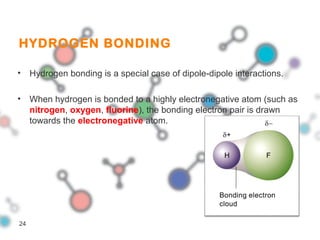
• Hydrogen bonding is a special case of dipole-dipole interactions.
• When hydrogen is bonded to a highly electronegative atom (such as
nitrogen, oxygen, fluorine), the bonding electron pair is drawn
towards the electronegative atom.
24
Hydrogen bonding
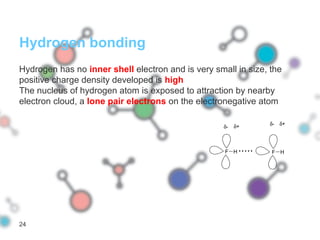
F H F H.....
δ- δ+ δ- δ+
Hydrogen has no inner shell electron and is very small in size, the
positive charge density developed is high
The nucleus of hydrogen atom is exposed to attraction by nearby
electron cloud, a lone pair electrons on the electronegative atom
24
H
F
.
..
.
.
.
H
F
.
..
. .
.
H
F
.
..
.
.
.
H
F
.
..
.
.
.
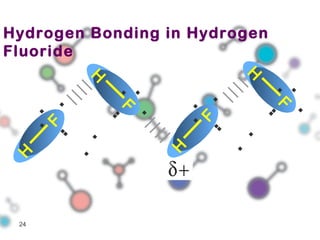
Hydrogen Bonding in Hydrogen
Fluoride
24
Hydrogen bonding
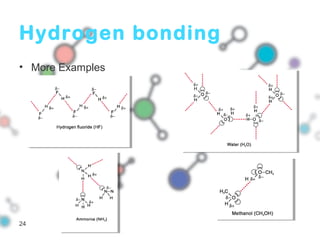
• More Examples
24
CONDITION FOR H-BONDING
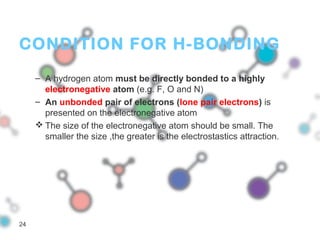
– A hydrogen atom must be directly bonded to a highly
electronegative atom (e.g. F, O and N)
– An unbonded pair of electrons (lone pair electrons) is
presented on the electronegative atom
 The size of the electronegative atom should be small. The
smaller the size ,the greater is the electrostastics attraction.
24
NOTES
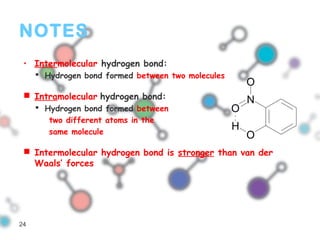
• Intermolecular hydrogen bond:
 Hydrogen bond formed between two molecules
 Intramolecular hydrogen bond:
 Hydrogen bond formed between
two different atoms in the
same molecule
 Intermolecular hydrogen bond is stronger than van der
Waals’ forces
N
O
O
O
H
24
Strength of hydrogen bond
• Hydrogen bonding is very weak bond.The strength of
hydrogen bond is intermediate between the weak van
der waal’s forces and the strong covalent bonds.Thus
whereas the bond dissociation energy of a covalent bond
is 209-418 Kj/mol.That for H-bond is only 12.6-41.8
kj/mol.
24
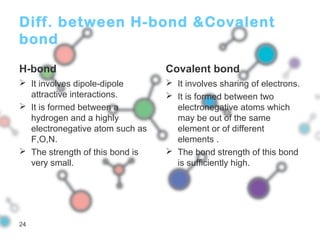
Diff. between H-bond &Covalent
bond
H-bond
 It involves dipole-dipole
attractive interactions.
 It is formed between a
hydrogen and a highly
electronegative atom such as
F,O,N.
 The strength of this bond is
very small.
Covalent bond
 It involves sharing of electrons.
 It is formed between two
electronegative atoms which
may be out of the same
element or of different
elements .
 The bond strength of this bond
is sufficiently high.
24
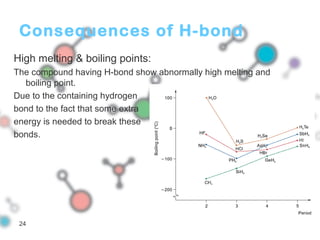
Consequences of H-bond
High melting & boiling points:
The compound having H-bond show abnormally high melting and
boiling point.
Due to the containing hydrogen
bond to the fact that some extra
energy is needed to break these
bonds.
24
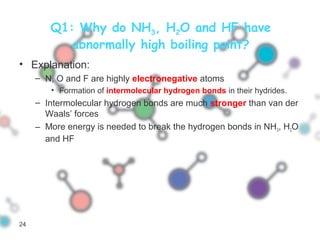
Q1: Why do NH3, H2O and HF have
abnormally high boiling point?
• Explanation:
– N, O and F are highly electronegative atoms
• Formation of intermolecular hydrogen bonds in their hydrides.
– Intermolecular hydrogen bonds are much stronger than van der
Waals’ forces
– More energy is needed to break the hydrogen bonds in NH3, H2O
and HF
24
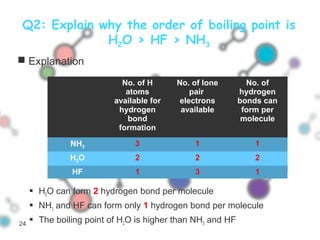
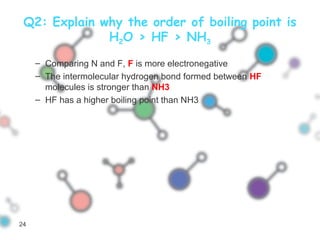
Q2: Explain why the order of boiling point is
H2O > HF > NH3
 Explanation
 H2O can form 2 hydrogen bond per molecule
 NH3 and HF can form only 1 hydrogen bond per molecule
 The boiling point of H2O is higher than NH3 and HF
No. of H
atoms
available for
hydrogen
bond
formation
No. of lone
pair
electrons
available
No. of
hydrogen
bonds can
form per
molecule
NH3 3 1 1
H2O 2 2 2
HF 1 3 1
24
Q2: Explain why the order of boiling point is
H2O > HF > NH3
– Comparing N and F, F is more electronegative
– The intermolecular hydrogen bond formed between HF
molecules is stronger than NH3
– HF has a higher boiling point than NH3
24
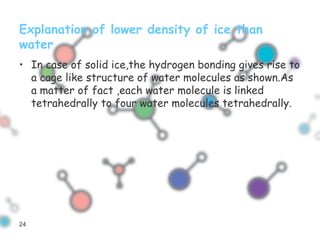
Explanation of lower density of ice than
water
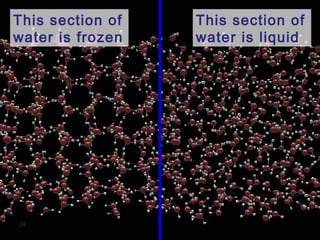
• In case of solid ice,the hydrogen bonding gives rise to
a cage like structure of water molecules as shown.As
a matter of fact ,each water molecule is linked
tetrahedrally to four water molecules tetrahedrally.
24
This section of
water is frozen
This section of
water is liquid
24
APPLICATIONS
24
Importance of Hydrogen Bonding in Physical
Phenomena
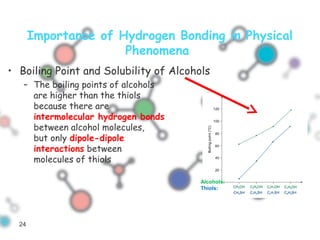
• Boiling Point and Solubility of Alcohols
– The boiling points of alcohols
are higher than the thiols
because there are
intermolecular hydrogen bonds
between alcohol molecules,
but only dipole-dipole
interactions between
molecules of thiols
Alcohols:
Thiols:
24
• Alcohols of low molecular masses are soluble in water
because they can form intermolecular hydrogen
bonds with water molecules
24
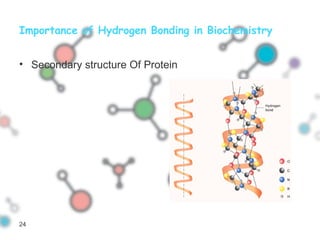
Importance of Hydrogen Bonding in Biochemistry
• Secondary structure Of Protein
24
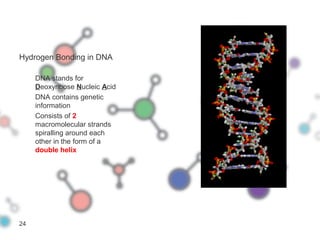
Hydrogen Bonding in DNA
DNA stands for
Deoxyribose Nucleic Acid
DNA contains genetic
information
Consists of 2
macromolecular strands
spiralling around each
other in the form of a
double helix
24
H-BOMB
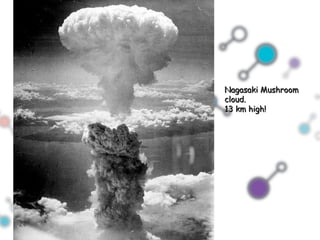
• The hydrogen bomb is a nuclear weapon that used
a mixture of fission and fusion (Hydrogen fuel) to
produce a massive explosion
• It produces 700-times the energy released by the
bombs exploded in Hiroshima and Nagasaki.
24
Nagasaki MushroomNagasaki Mushroom
cloud.cloud.
13 km high!13 km high!
24
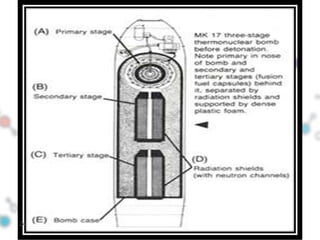
• It is made up of essentially, 3 things:-
1.Implosion Type Fission Bomb:- It contains a core of
U-235 and a tamper of U-238
2.Fusion Bomb:- A cylinder containing a core rod of
Plutonium-239 surrounded by lithium-duterate fuel
with a tamper of U-238.
3.Polystyrene foam:- The empty spaces are filled by it.
24
24

Chemistry hydrogen bonding

  • 1.
  • 2.
    HYDROGEN BONDING • Hydrogenbonding is a special case of dipole-dipole interactions. • When hydrogen is bonded to a highly electronegative atom (such as nitrogen, oxygen, fluorine), the bonding electron pair is drawn towards the electronegative atom. 24
  • 3.
    Hydrogen bonding F HF H..... δ- δ+ δ- δ+ Hydrogen has no inner shell electron and is very small in size, the positive charge density developed is high The nucleus of hydrogen atom is exposed to attraction by nearby electron cloud, a lone pair electrons on the electronegative atom 24
  • 4.
  • 5.
  • 6.
    CONDITION FOR H-BONDING –A hydrogen atom must be directly bonded to a highly electronegative atom (e.g. F, O and N) – An unbonded pair of electrons (lone pair electrons) is presented on the electronegative atom  The size of the electronegative atom should be small. The smaller the size ,the greater is the electrostastics attraction. 24
  • 7.
    NOTES • Intermolecular hydrogenbond:  Hydrogen bond formed between two molecules  Intramolecular hydrogen bond:  Hydrogen bond formed between two different atoms in the same molecule  Intermolecular hydrogen bond is stronger than van der Waals’ forces N O O O H 24
  • 8.
    Strength of hydrogenbond • Hydrogen bonding is very weak bond.The strength of hydrogen bond is intermediate between the weak van der waal’s forces and the strong covalent bonds.Thus whereas the bond dissociation energy of a covalent bond is 209-418 Kj/mol.That for H-bond is only 12.6-41.8 kj/mol. 24
  • 9.
    Diff. between H-bond&Covalent bond H-bond  It involves dipole-dipole attractive interactions.  It is formed between a hydrogen and a highly electronegative atom such as F,O,N.  The strength of this bond is very small. Covalent bond  It involves sharing of electrons.  It is formed between two electronegative atoms which may be out of the same element or of different elements .  The bond strength of this bond is sufficiently high. 24
  • 10.
    Consequences of H-bond Highmelting & boiling points: The compound having H-bond show abnormally high melting and boiling point. Due to the containing hydrogen bond to the fact that some extra energy is needed to break these bonds. 24
  • 11.
    Q1: Why doNH3, H2O and HF have abnormally high boiling point? • Explanation: – N, O and F are highly electronegative atoms • Formation of intermolecular hydrogen bonds in their hydrides. – Intermolecular hydrogen bonds are much stronger than van der Waals’ forces – More energy is needed to break the hydrogen bonds in NH3, H2O and HF 24
  • 12.
    Q2: Explain whythe order of boiling point is H2O > HF > NH3  Explanation  H2O can form 2 hydrogen bond per molecule  NH3 and HF can form only 1 hydrogen bond per molecule  The boiling point of H2O is higher than NH3 and HF No. of H atoms available for hydrogen bond formation No. of lone pair electrons available No. of hydrogen bonds can form per molecule NH3 3 1 1 H2O 2 2 2 HF 1 3 1 24
  • 13.
    Q2: Explain whythe order of boiling point is H2O > HF > NH3 – Comparing N and F, F is more electronegative – The intermolecular hydrogen bond formed between HF molecules is stronger than NH3 – HF has a higher boiling point than NH3 24
  • 14.
    Explanation of lowerdensity of ice than water • In case of solid ice,the hydrogen bonding gives rise to a cage like structure of water molecules as shown.As a matter of fact ,each water molecule is linked tetrahedrally to four water molecules tetrahedrally. 24
  • 15.
    This section of wateris frozen This section of water is liquid 24
  • 16.
  • 17.
    Importance of HydrogenBonding in Physical Phenomena • Boiling Point and Solubility of Alcohols – The boiling points of alcohols are higher than the thiols because there are intermolecular hydrogen bonds between alcohol molecules, but only dipole-dipole interactions between molecules of thiols Alcohols: Thiols: 24
  • 18.
    • Alcohols oflow molecular masses are soluble in water because they can form intermolecular hydrogen bonds with water molecules 24
  • 19.
    Importance of HydrogenBonding in Biochemistry • Secondary structure Of Protein 24
  • 20.
    Hydrogen Bonding inDNA DNA stands for Deoxyribose Nucleic Acid DNA contains genetic information Consists of 2 macromolecular strands spiralling around each other in the form of a double helix 24
  • 21.
    H-BOMB • The hydrogenbomb is a nuclear weapon that used a mixture of fission and fusion (Hydrogen fuel) to produce a massive explosion • It produces 700-times the energy released by the bombs exploded in Hiroshima and Nagasaki. 24
  • 22.
  • 23.
    • It ismade up of essentially, 3 things:- 1.Implosion Type Fission Bomb:- It contains a core of U-235 and a tamper of U-238 2.Fusion Bomb:- A cylinder containing a core rod of Plutonium-239 surrounded by lithium-duterate fuel with a tamper of U-238. 3.Polystyrene foam:- The empty spaces are filled by it. 24
  • 24.