Downloaded 93 times




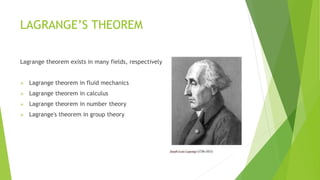

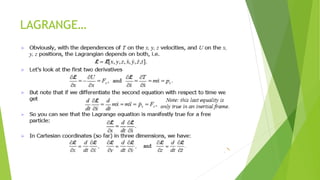


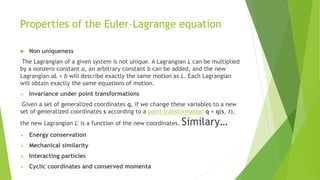


Lagrange's theorem describes fluid motion using a Lagrangian description that tracks individual fluid particles over time rather than describing the fluid properties at fixed spatial locations like the Eulerian description. The Lagrangian description follows Newton's laws of motion for individual particles, making it easier to apply concepts from solid mechanics. However, the Eulerian description is more commonly used in fluid mechanics problems because it is not practical to track every particle in complex flows. Lagrange's equations, derived using the calculus of variations, provide an alternative formulation of classical mechanics that has advantages over Newtonian mechanics such as applying to any coordinate system.


![Lecture lagrange[1]](https://cdn.slidesharecdn.com/ss_thumbnails/lecturelagrange1-100921035646-phpapp01-thumbnail.jpg?width=640&height=640&fit=bounds)


