The Inverse Laplace Transform
The University of Tennessee
Electrical and Computer Engineering Department
Knoxville, Tennessee
wlg
Inverse Laplace Transforms
Background:
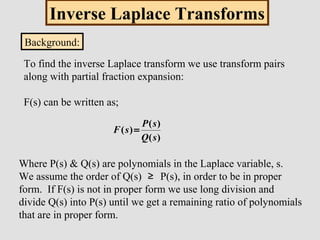
To find the inverse Laplace transform we use transform pairs
along with partial fraction expansion:
F(s) can be written as;
)(
)(
)(
sQ
sP
sF =
Where P(s) & Q(s) are polynomials in the Laplace variable, s.
We assume the order of Q(s) P(s), in order to be in proper
form. If F(s) is not in proper form we use long division and
divide Q(s) into P(s) until we get a remaining ratio of polynomials
that are in proper form.
≥
Inverse Laplace Transforms
Background:
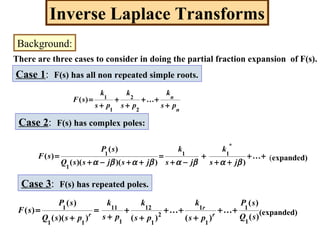
There are three cases to consider in doing the partial fraction expansion of F(s).
Case 1: F(s) has all non repeated simple roots.
n
n
ps
k
ps
k
ps
k
sF
+
++
+
+
+
= ...)(
2
2
1
1
Case 2: F(s) has complex poles:
++
++
+
−+
=
++−+
= ...
)))()((
)(
)(
*
11
1
1
βαβαβαβα js
k
js
k
jsjssQ
sP
sF
Case 3: F(s) has repeated poles.
)(
)(
...
)(
...
)())((
)(
)(
1
1
1
1
2
1
12
1
11
11
1
sQ
sP
ps
k
ps
k
ps
k
pssQ
sP
sF r
r
r
++
+
++
+
+
+
=
+
= (expanded)
(expanded)
Inverse Laplace Transforms
Case 1: Illustration:
Given:
)10()4()1()10)(4)(1(
)2(4
)( 321
+
+
+
+
+
=
+++
+
=
s
A
s
A
s
A
sss
s
sF
274
)10)(4)(1(
)2(4)1(
| 11
=
+++
++
= −=s
sss
ss
A 94
)10)(4)(1(
)2(4)4(
| 42
=
+++
++
= −=ssss
ss
A
2716
)10)(4)(1(
)2(4)10(
| 103
−=
+++
++
= −=ssss
ss
A
[ ] )()2716()94()274()( 104
tueeetf ttt −−−
−++=
Find A1, A2, A3 from Heavyside
Inverse Laplace Transforms
Case 3: Repeated roots.
When we have repeated roots we find the coefficients of the
terms as follows:
[ ]|
111
)()( 1 psr
sFps
ds
d
k r
−=−
+=
[ ]|
121
)()(
!2 12
2
psr
sFps
ds
d
k r
−=−
+=
[ ]|
11
)()(
)!( 1 psj
sFps
dsjr
d
k r
jr
jr
−=+
−
= −
−
Inverse Laplace Transforms
Case 3: Repeated roots. Example
=
=
=
+
+
+
+=
+
+
=
2
1
1
2
211
2
)3()3()3(
)1(
)(
K
K
A
s
K
s
K
s
A
ss
s
sF
[ ] [ ] [ ][ ] )(____________________)( 33
tuteetf tt −−
++= ? ? ?
Inverse Laplace Transforms
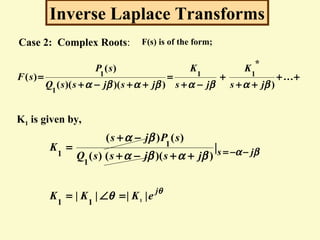
Case 2: Complex Roots:
++
++
+
−+
=
++−+
= ...
)))()((
)(
)(
*
11
1
1
βαβαβαβα js
K
js
K
jsjssQ
sP
sF
F(s) is of the form;
K1 is given by,
θ
θ
βαβα
βα
βα
j
eKKK
jsjssQ
sPjs
K js
||||
))(()(
)()(
1
11
1
1
1
|
=∠=
++−+
−+
= −−=
Inverse Laplace Transforms
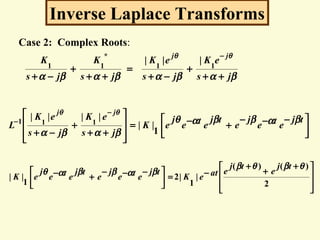
Case 2: Complex Roots:
βαβαβαβα
θθ
js
eK
js
eK
js
K
js
K
jj
++
+
−+
=
++
+
−+
−
11
*
11
|||





 −−−
+−=








++
+
−+
−
− tj
ete
j
e
tj
ete
j
eK
js
eK
js
eK
L
jj
βαββαθ
βαβα
θθ
1
||
|||| 111







 +
+
+
−=




 −−−
+−
2
)()(
|
1
|2
1
||
θβθβ
βαββαθ
tj
e
tj
eateK
tj
ete
j
e
tj
ete
j
eK
Inverse Laplace Transforms
[ ])cos(||2
|||
1
111
θβ
βαβα
α
θθ
+=








++
+
−+
−
−
−
teK
js
eK
js
eK
L t
jj
Case 2: Complex Roots:
Therefore:
You should put this in your memory:
Inverse Laplace Transforms
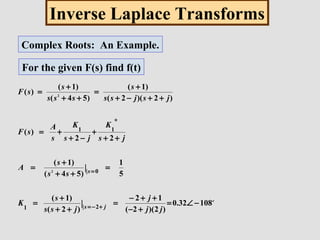
Complex Roots: An Example.
For the given F(s) find f(t)
o
jj
j
jss
s
K
ss
s
A
js
K
js
K
s
A
sF
jsjss
s
sss
s
sF
js
s
10832.0
)2)(2(
12
)2(
)1(
5
1
)54(
)1(
22
)(
)2)(2(
)1(
)54(
)1(
)(
|
|
2|1
0|
11
2
2
*
−∠=
+−
++−
=
++
+
=
=
++
+
=
++
+
−+
+=
++−+
+
=
++
+
=
+−=
=
Inverse Laplace Transforms
Complex Roots: An Example. (continued)
We then have;
jsjss
sF
oo
++
+∠
+
−+
−∠
+=
2
10832.0
2
10832.02.0
)(
Recalling the form of the inverse for complex roots;
[ ] )(108cos(64.02.0)( 2
tutetf ot
−+= −
Inverse Laplace Transforms
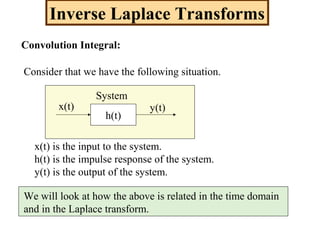
Convolution Integral:
Consider that we have the following situation.
h(t)
x(t) y(t)
x(t) is the input to the system.
h(t) is the impulse response of the system.
y(t) is the output of the system.
System
We will look at how the above is related in the time domain
and in the Laplace transform.
Inverse Laplace Transforms
Convolution Integral:
In the time domain we can write the following:
∫∫
=
=
=
=
−=−=⊕=
tt
dxthdhtxthtxty
τ
τ
τ
τ
ττττττ
00
)()()()()()()(
In this case x(t) and h(t) are said to be convolved and the
integral on the right is called the convolution integral.
It can be shown that,
[ ] ( )sHsXsYthtxL )()()()( ==⊕
This is very important
* note
Inverse Laplace Transforms
Convolution Integral:
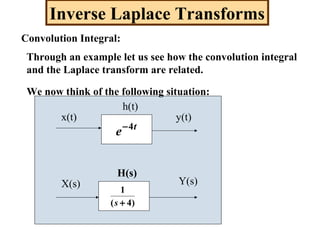
Through an example let us see how the convolution integral
and the Laplace transform are related.
We now think of the following situation:
x(t) y(t)
X(s) Y(s)
t
e 4−
h(t)
H(s)
)4(
1
+s
Inverse Laplace Transforms
Convolution Integral:
From the previous diagram we note the following:
[ ] [ ] [ ])()(;)()(;)()( thLsHtyLsYtxLsX ===
h(t) is called the system impulse response for the following
reason.
)()()( sHsXsY =
If the input x(t) is a unit impulse, δ(t), the L(x(t)) = X(s) = 1.
Since x(t) is an impulse, we say that y(t) is the impulse
response. From Eq A, if X(s) = 1, then Y(s) = H(s). Since,
Eq A
[ ] [ ]
.)(,
)()()()( 11
responseimpulsesystemthSo
thsHLresponseimpulsetysYL
=
==== −−
Inverse Laplace Transforms
Convolution Integral:
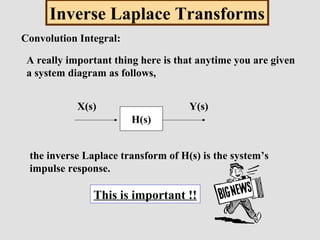
A really important thing here is that anytime you are given
a system diagram as follows,
H(s)
X(s) Y(s)
the inverse Laplace transform of H(s) is the system’s
impulse response.
This is important !!
Inverse Laplace Transforms
Convolution Integral:
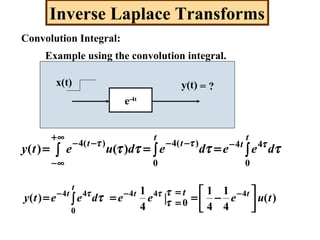
Example using the convolution integral.
e-4t
x(t) y(t) = ?
∫∫∫
−−−
∞+
∞−
−−
===
t
t
t
tt
deededuety
0
44
0
)(4)(4
)()( ττττ τττ
)(
4
1
4
1
4
1
)( 444
0
44
| 0 tueeedeety tt
t
t t




−=== −−− =
=∫
τ
τ
ττ
τ
Inverse Laplace Transforms
Convolution Integral:
Same example but using Laplace.
x(t) = u(t)
s
sX
1
)( =
h(t) = e-4t
u(t)
4
1
)(
+
=
s
sH
[ ] )(1
4
1
)(
4
4141
4)4(
1
)(
4
tuety
sss
B
s
A
ss
sY
t−
−=
+
−=
+
+=
+
=
Inverse Laplace Transforms
Convolution Integral:
Practice problems:
?)(,
)2(
3
)(
2
)()( thiswhat
s
sYand
s
sXIfa
+
==
).(),()()()()( 6
thfindtutetyandtutxIfb t−
==
).(,
)4(
2
)()()()( 2
tyfind
s
sHandttutxIfc
+
==
Answers given on note page
[ ])(2)(5.1)( 2
tuetth t−
−= δ
Inverse Laplace Transforms
Circuit theory problem:
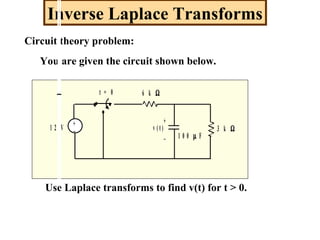
You are given the circuit shown below.
+_
• •
•
t = 0 6 k Ω
3 k Ω
1 0 0 µ F
+
_
v ( t )1 2 V
Use Laplace transforms to find v(t) for t > 0.
Circuit theory problem:
Inverse Laplace Transforms
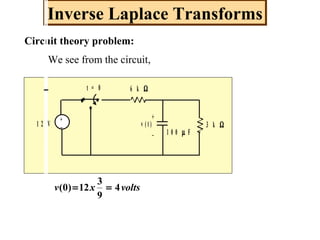
We see from the circuit,
+_
• •
•
t = 0 6 k Ω
3 k Ω
1 0 0 µ F
+
_
v ( t )1 2 V
voltsxv 4
9
3
12)0( ==
Circuit theory problem:
Inverse Laplace Transforms
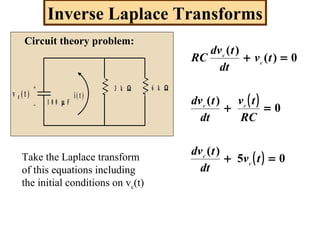
+
_
v c ( t ) i ( t )
3 k Ω
1 0 0 µ F
6 k Ω
( )
( ) 05
)(
0
)(
0)(
)(
=+
=+
=+
tv
dt
tdv
RC
tv
dt
tdv
tv
dt
tdv
RC
c
c
cc
c
c
Take the Laplace transform
of this equations including
the initial conditions on vc(t)
Circuit theory problem:
Inverse Laplace Transforms
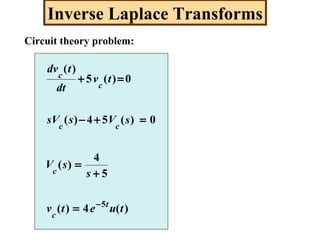
)(4)(
5
4
)(
0)(54)(
0)(5
)(
5
tuetv
s
sV
sVssV
tv
dt
tdv
t
c
c
cc
c
c
−
=
+
=
=+−
=+
Stop

Inverse laplace transforms

  • 1.
    The Inverse LaplaceTransform The University of Tennessee Electrical and Computer Engineering Department Knoxville, Tennessee wlg
  • 2.
    Inverse Laplace Transforms Background: Tofind the inverse Laplace transform we use transform pairs along with partial fraction expansion: F(s) can be written as; )( )( )( sQ sP sF = Where P(s) & Q(s) are polynomials in the Laplace variable, s. We assume the order of Q(s) P(s), in order to be in proper form. If F(s) is not in proper form we use long division and divide Q(s) into P(s) until we get a remaining ratio of polynomials that are in proper form. ≥
  • 3.
    Inverse Laplace Transforms Background: Thereare three cases to consider in doing the partial fraction expansion of F(s). Case 1: F(s) has all non repeated simple roots. n n ps k ps k ps k sF + ++ + + + = ...)( 2 2 1 1 Case 2: F(s) has complex poles: ++ ++ + −+ = ++−+ = ... )))()(( )( )( * 11 1 1 βαβαβαβα js k js k jsjssQ sP sF Case 3: F(s) has repeated poles. )( )( ... )( ... )())(( )( )( 1 1 1 1 2 1 12 1 11 11 1 sQ sP ps k ps k ps k pssQ sP sF r r r ++ + ++ + + + = + = (expanded) (expanded)
  • 4.
    Inverse Laplace Transforms Case1: Illustration: Given: )10()4()1()10)(4)(1( )2(4 )( 321 + + + + + = +++ + = s A s A s A sss s sF 274 )10)(4)(1( )2(4)1( | 11 = +++ ++ = −=s sss ss A 94 )10)(4)(1( )2(4)4( | 42 = +++ ++ = −=ssss ss A 2716 )10)(4)(1( )2(4)10( | 103 −= +++ ++ = −=ssss ss A [ ] )()2716()94()274()( 104 tueeetf ttt −−− −++= Find A1, A2, A3 from Heavyside
  • 5.
    Inverse Laplace Transforms Case3: Repeated roots. When we have repeated roots we find the coefficients of the terms as follows: [ ]| 111 )()( 1 psr sFps ds d k r −=− += [ ]| 121 )()( !2 12 2 psr sFps ds d k r −=− += [ ]| 11 )()( )!( 1 psj sFps dsjr d k r jr jr −=+ − = − −
  • 6.
    Inverse Laplace Transforms Case3: Repeated roots. Example = = = + + + += + + = 2 1 1 2 211 2 )3()3()3( )1( )( K K A s K s K s A ss s sF [ ] [ ] [ ][ ] )(____________________)( 33 tuteetf tt −− ++= ? ? ?
  • 7.
    Inverse Laplace Transforms Case2: Complex Roots: ++ ++ + −+ = ++−+ = ... )))()(( )( )( * 11 1 1 βαβαβαβα js K js K jsjssQ sP sF F(s) is of the form; K1 is given by, θ θ βαβα βα βα j eKKK jsjssQ sPjs K js |||| ))(()( )()( 1 11 1 1 1 | =∠= ++−+ −+ = −−=
  • 8.
    Inverse Laplace Transforms Case2: Complex Roots: βαβαβαβα θθ js eK js eK js K js K jj ++ + −+ = ++ + −+ − 11 * 11 |||       −−− +−=         ++ + −+ − − tj ete j e tj ete j eK js eK js eK L jj βαββαθ βαβα θθ 1 || |||| 111         + + + −=      −−− +− 2 )()( | 1 |2 1 || θβθβ βαββαθ tj e tj eateK tj ete j e tj ete j eK
  • 9.
    Inverse Laplace Transforms [])cos(||2 ||| 1 111 θβ βαβα α θθ +=         ++ + −+ − − − teK js eK js eK L t jj Case 2: Complex Roots: Therefore: You should put this in your memory:
  • 10.
    Inverse Laplace Transforms ComplexRoots: An Example. For the given F(s) find f(t) o jj j jss s K ss s A js K js K s A sF jsjss s sss s sF js s 10832.0 )2)(2( 12 )2( )1( 5 1 )54( )1( 22 )( )2)(2( )1( )54( )1( )( | | 2|1 0| 11 2 2 * −∠= +− ++− = ++ + = = ++ + = ++ + −+ += ++−+ + = ++ + = +−= =
  • 11.
    Inverse Laplace Transforms ComplexRoots: An Example. (continued) We then have; jsjss sF oo ++ +∠ + −+ −∠ += 2 10832.0 2 10832.02.0 )( Recalling the form of the inverse for complex roots; [ ] )(108cos(64.02.0)( 2 tutetf ot −+= −
  • 12.
    Inverse Laplace Transforms ConvolutionIntegral: Consider that we have the following situation. h(t) x(t) y(t) x(t) is the input to the system. h(t) is the impulse response of the system. y(t) is the output of the system. System We will look at how the above is related in the time domain and in the Laplace transform.
  • 13.
    Inverse Laplace Transforms ConvolutionIntegral: In the time domain we can write the following: ∫∫ = = = = −=−=⊕= tt dxthdhtxthtxty τ τ τ τ ττττττ 00 )()()()()()()( In this case x(t) and h(t) are said to be convolved and the integral on the right is called the convolution integral. It can be shown that, [ ] ( )sHsXsYthtxL )()()()( ==⊕ This is very important * note
  • 14.
    Inverse Laplace Transforms ConvolutionIntegral: Through an example let us see how the convolution integral and the Laplace transform are related. We now think of the following situation: x(t) y(t) X(s) Y(s) t e 4− h(t) H(s) )4( 1 +s
  • 15.
    Inverse Laplace Transforms ConvolutionIntegral: From the previous diagram we note the following: [ ] [ ] [ ])()(;)()(;)()( thLsHtyLsYtxLsX === h(t) is called the system impulse response for the following reason. )()()( sHsXsY = If the input x(t) is a unit impulse, δ(t), the L(x(t)) = X(s) = 1. Since x(t) is an impulse, we say that y(t) is the impulse response. From Eq A, if X(s) = 1, then Y(s) = H(s). Since, Eq A [ ] [ ] .)(, )()()()( 11 responseimpulsesystemthSo thsHLresponseimpulsetysYL = ==== −−
  • 16.
    Inverse Laplace Transforms ConvolutionIntegral: A really important thing here is that anytime you are given a system diagram as follows, H(s) X(s) Y(s) the inverse Laplace transform of H(s) is the system’s impulse response. This is important !!
  • 17.
    Inverse Laplace Transforms ConvolutionIntegral: Example using the convolution integral. e-4t x(t) y(t) = ? ∫∫∫ −−− ∞+ ∞− −− === t t t tt deededuety 0 44 0 )(4)(4 )()( ττττ τττ )( 4 1 4 1 4 1 )( 444 0 44 | 0 tueeedeety tt t t t     −=== −−− = =∫ τ τ ττ τ
  • 18.
    Inverse Laplace Transforms ConvolutionIntegral: Same example but using Laplace. x(t) = u(t) s sX 1 )( = h(t) = e-4t u(t) 4 1 )( + = s sH [ ] )(1 4 1 )( 4 4141 4)4( 1 )( 4 tuety sss B s A ss sY t− −= + −= + += + =
  • 19.
    Inverse Laplace Transforms ConvolutionIntegral: Practice problems: ?)(, )2( 3 )( 2 )()( thiswhat s sYand s sXIfa + == ).(),()()()()( 6 thfindtutetyandtutxIfb t− == ).(, )4( 2 )()()()( 2 tyfind s sHandttutxIfc + == Answers given on note page [ ])(2)(5.1)( 2 tuetth t− −= δ
  • 20.
    Inverse Laplace Transforms Circuittheory problem: You are given the circuit shown below. +_ • • • t = 0 6 k Ω 3 k Ω 1 0 0 µ F + _ v ( t )1 2 V Use Laplace transforms to find v(t) for t > 0.
  • 21.
    Circuit theory problem: InverseLaplace Transforms We see from the circuit, +_ • • • t = 0 6 k Ω 3 k Ω 1 0 0 µ F + _ v ( t )1 2 V voltsxv 4 9 3 12)0( ==
  • 22.
    Circuit theory problem: InverseLaplace Transforms + _ v c ( t ) i ( t ) 3 k Ω 1 0 0 µ F 6 k Ω ( ) ( ) 05 )( 0 )( 0)( )( =+ =+ =+ tv dt tdv RC tv dt tdv tv dt tdv RC c c cc c c Take the Laplace transform of this equations including the initial conditions on vc(t)
  • 23.
    Circuit theory problem: InverseLaplace Transforms )(4)( 5 4 )( 0)(54)( 0)(5 )( 5 tuetv s sV sVssV tv dt tdv t c c cc c c − = + = =+− =+
  • 24.

Editor's Notes

  • #14 Comment: The convolution integral is extremely important in signals and systems. It can be implemented with a PC in real time and can be very useful in that form. However, if we do the integration by hand, it is tedious, difficult at times. It is much easier to use: Y(s) = X(s)H(s) And the take the inverse to find y(t). Here we simply multiply X(s) and H(s) together, expand in partial fractions and take the inverse to get y(t). Most always this is easier than carrying out the integration.
  • #20 1.5[(t) – 2e-2tu(t)] [e-6t - 6te-6t]u(t) [(-1/32) + (1/16)t - (1/32)e-4t + (1/16)te-4t]u(t)