CONVERGENCE OF A SEQUENCE
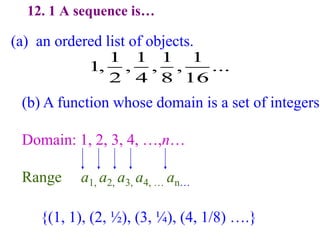
12. 1 A sequence is…
(a) an ordered list of objects.
(b) A function whose domain is a set of integers.
Domain: 1, 2, 3, 4, …,n…
Range a1, a2, a3, a4, … an…
1 1 1 1
1, , , , ...
2 4 8 16
{(1, 1), (2, ½), (3, ¼), (4, 1/8) ….}
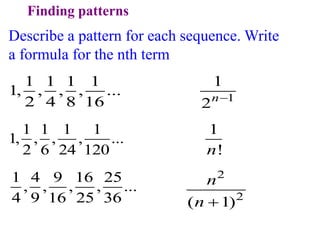
Finding patterns
Describe a pattern for each sequence. Write
a formula for the nth term
1 1 1 1
1, , , , ...
2 4 8 16
1 1 1 1
1, , , , ...
2 6 24 120
1 4 9 16 25
, , , , ...
4 9 16 25 36
1
1
2n
1
!
n
2
2
( 1)
n
n 
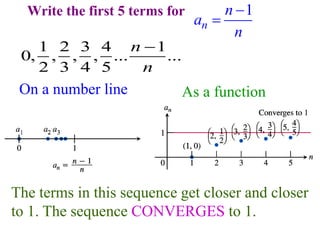
Write the first 5 terms for
1 2 3 4 1
0, , , , ... ...
2 3 4 5
n
n

The terms in this sequence get closer and closer
to 1. The sequence CONVERGES to 1.
On a number line As a function
1
n
n
a
n


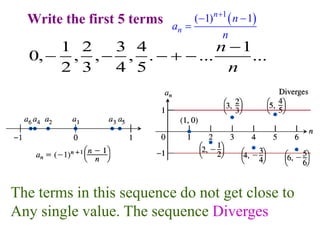
Write the first 5 terms
1 2 3 4 1
0, , , , . ... ...
2 3 4 5
n
n

    
The terms in this sequence do not get close to
Any single value. The sequence Diverges
 
1
( 1) 1
n
n
n
a
n

 

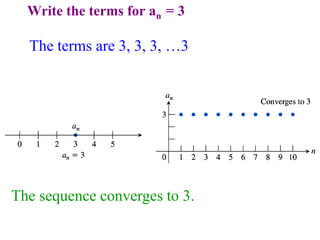
Write the terms for an = 3
The terms are 3, 3, 3, …3
The sequence converges to 3.
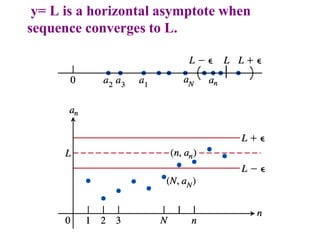
y= L is a horizontal asymptote when
sequence converges to L.
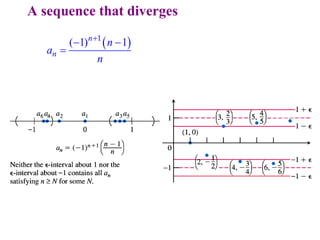
A sequence that diverges
 
1
( 1) 1
n
n
n
a
n

 

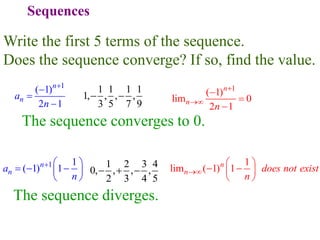
Sequences
Write the first 5 terms of the sequence.
Does the sequence converge? If so, find the value.
1
( 1)
2 1
n
n
a
n




1 1 1 1
1, , , ,
3 5 7 9
 
1
( 1)
lim 0
2 1
n
n
n





1 1
( 1) 1
n
n
a
n
  
  
 
 
1 2 3 4
0, , , ,
2 3 4 5
  
1
lim ( 1) 1
n
n does not exist
n

 
 
 
 
The sequence converges to 0.
The sequence diverges.
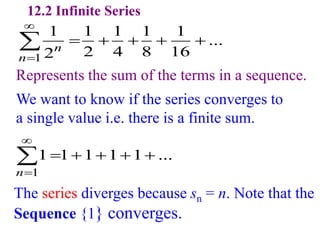
12.2 Infinite Series
1
1 1 1 1 1
...
2 4 8 16
2n
n


    

1
1 1 1 1 1 ...
n


    

The series diverges because sn = n. Note that the
Sequence {1} converges.
Represents the sum of the terms in a sequence.
We want to know if the series converges to
a single value i.e. there is a finite sum.
1
1
( 1)
n n n

 

1
1 1 1 1 1 1
...
( 1) 2 6 12 20 30
n n n


     


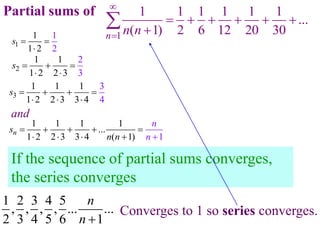
Partial sums of
1
1
1
1
2
2
s  

2
2
3
1 1
1 2 2 3
s   
 
3
1 1 1
1 2 2 4
4
3
3 3
s    
  
1 1 1 1
...
1 2 2 3 3 4 ( 1 1
)
n
n
s
n n
n
    
   

If the sequence of partial sums converges,
the series converges
and
1 2 3 4 5
, , , , ... ...
2 3 4 5 6 1
n
n 
Converges to 1 so series converges.
1
1 1 1 1 1 1
...
( 1) 2 6 12 20 30
n n n


     


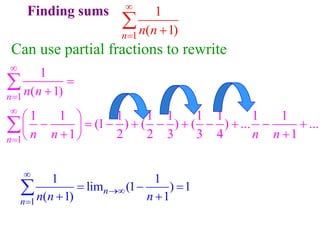
Finding sums
1
1
( 1)
n n n

 

1
1
1
( 1)
1 1 1 1 1 1 1 1 1
(1 ) ( ) ( ) ... ...
1 2 2 3 3 4 1
n
n
n n
n n n n






 
         
 
 
 


Can use partial fractions to rewrite
1
1 1
lim (1 ) 1
( 1) 1
n
n n n n



  
 

.
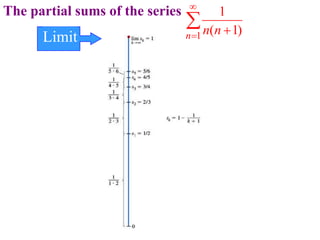
The partial sums of the series
1
1
( 1)
n n n

 

Limit
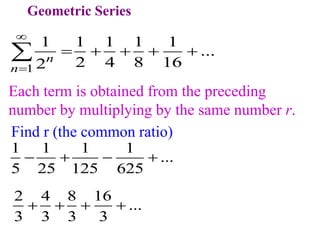
Geometric Series
1
1 1 1 1 1
...
2 4 8 16
2n
n


    

Each term is obtained from the preceding
number by multiplying by the same number r.
1 1 1 1
...
5 25 125 625
   
2 4 8 16
...
3 3 3 3
   
Find r (the common ratio)
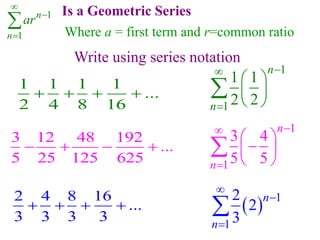
Is a Geometric Series
1 1 1 1
...
2 4 8 16
   
3 12 48 192
...
5 25 125 625
   
2 4 8 16
...
3 3 3 3
   
1
1
n
n
ar



 Where a = first term and r=common ratio
Write using series notation
1
1
1 1
2 2
n
n



 
 
 

1
1
3 4
5 5
n
n



 

 
 

  1
1
2
2
3
n
n




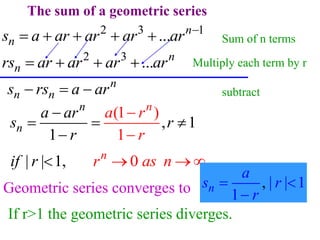
The sum of a geometric series
2 3
... n
n
rs ar ar ar ar
   
2 3 1
... n
n
s a ar ar ar ar 
    
n
n n
s rs a ar
  
(
1
1
1
,
)
1
n
n
n
a ar
s
a r
r
r
r



  

1 .
| 0
| , n
r as n
if r 
  
| | 1
1
,
n
a
s r
r
 

Geometric series converges to
If r>1 the geometric series diverges.
Multiply each term by r
Sum of n terms
subtract
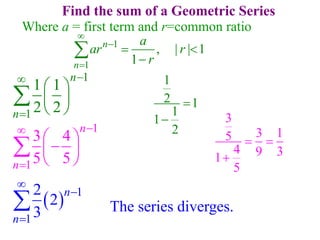
Find the sum of a Geometric Series
1
1
, | | 1
1
n
n
a
ar r
r



 


Where a = first term and r=common ratio
1
1
1 1
2 2
n
n



 
 
 

1
1
3 4
5 5
n
n



 

 
 

  1
1
2
2
3
n
n



 The series diverges.
1
2 1
1
1
2

 3
3 1
5
4 9 3
1
5
 

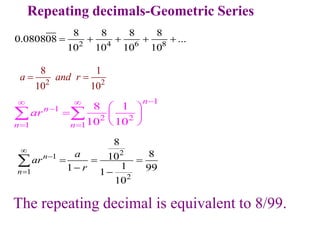
Repeating decimals-Geometric Series
2 4 6 8
8 8 8 8
0.080808 ...
10 10 10 10
    
2
1
1
2
8
8
10
1
1 99
1
10
n
n
a
ar
r



  
 

The repeating decimal is equivalent to 8/99.
2 2
8 1
10 10
a and r
 
1
1
2 2
1 1
8 1
10 10
n
n
n n
ar

 

 
 
  
 
 
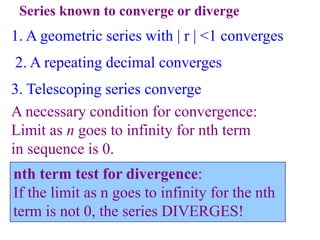
Series known to converge or diverge
1. A geometric series with | r | <1 converges
2. A repeating decimal converges
3. Telescoping series converge
A necessary condition for convergence:
Limit as n goes to infinity for nth term
in sequence is 0.
nth term test for divergence:
If the limit as n goes to infinity for the nth
term is not 0, the series DIVERGES!
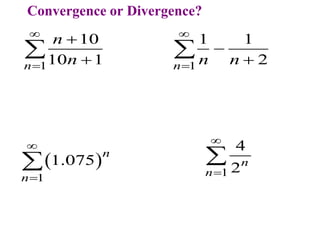
Convergence or Divergence?
1
10
10 1
n
n
n





1
1 1
2
n n n





 
1
1.075
n
n


 1
4
2n
n



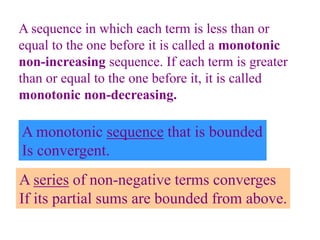
A series of non-negative terms converges
If its partial sums are bounded from above.
A sequence in which each term is less than or
equal to the one before it is called a monotonic
non-increasing sequence. If each term is greater
than or equal to the one before it, it is called
monotonic non-decreasing.
A monotonic sequence that is bounded
Is convergent.
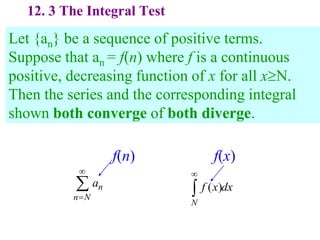
12. 3 The Integral Test
Let {an} be a sequence of positive terms.
Suppose that an = f(n) where f is a continuous
positive, decreasing function of x for all xN.
Then the series and the corresponding integral
shown both converge of both diverge.
n
n N
a


 ( )
N
f x dx


f(n) f(x)
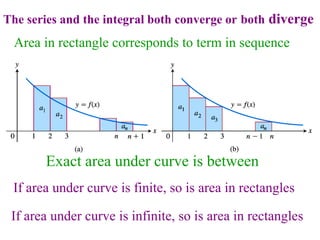
The series and the integral both converge or both diverge
Exact area under curve is between
If area under curve is finite, so is area in rectangles
If area under curve is infinite, so is area in rectangles
Area in rectangle corresponds to term in sequence
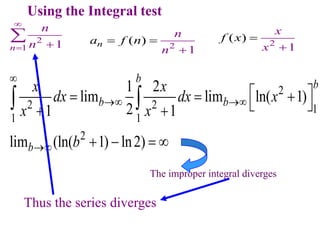
Using the Integral test
2
1 1
n
n
n

 

2
2 2 1
1 1
2
1 2
lim lim ln( 1)
2
1 1
lim (ln( 1) ln2)
b b
b b
b
x x
dx dx x
x x
b

 

 
  
 
 
   
 
Thus the series diverges
2
( )
1
n
n
a f n
n


 2
(
1
)
x
f
x
x 

The improper integral diverges
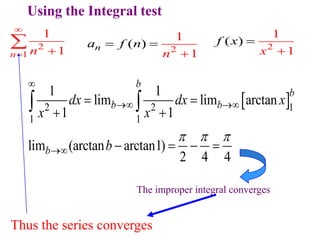
Using the Integral test
2
1
1
1
n n

 

 
2 2 1
1 1
1 1
lim lim arctan
1 1
lim (arctan arctan1)
2 4 4
b
b
b b
b
dx dx x
x x
b
  

 

 
 
   
 
Thus the series converges
2
( )
1
1
n
a f n
n
 

2
1
( )
1
f x
x


The improper integral converges
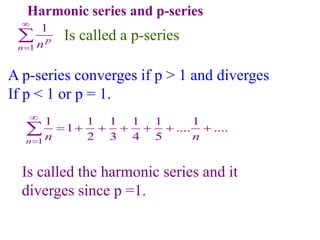
Harmonic series and p-series
1
1
p
n n


 Is called a p-series
A p-series converges if p > 1 and diverges
If p < 1 or p = 1.
1
1 1 1 1 1 1
1 .... ....
2 3 4 5
n n n


      

Is called the harmonic series and it
diverges since p =1.
1
1 3
1
n
n



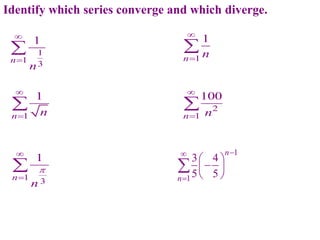
Identify which series converge and which diverge.
1
1
n n



1 3
1
n
n




1
1
n n



2
1
100
n n



1
1
3 4
5 5
n
n



 

 
 

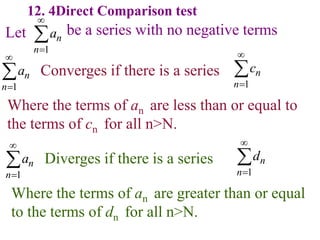
12. 4Direct Comparison test
Let
1
n
n
a


 be a series with no negative terms
1
n
n
a


 Converges if there is a series
Where the terms of an are less than or equal to
the terms of cn for all n>N.
1
n
n
c



1
n
n
a


 Diverges if there is a series
Where the terms of an are greater than or equal
to the terms of dn for all n>N.
1
n
n
d



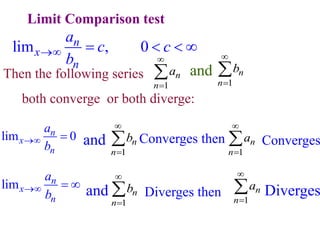
Limit Comparison test
both converge or both diverge:
Limit Comparison test
lim , 0
n
x
n
a
c c
b
    
Then the following series
1
n
n
a


 1
n
n
b



and
lim 0
n
x
n
a
b
 
Amd
1
n
n
b


 Converges then
1
n
n
a


 Converges
lim n
x
n
a
b
  
1
n
n
b


 Diverges then 1
n
n
a


 Diverges
and
and
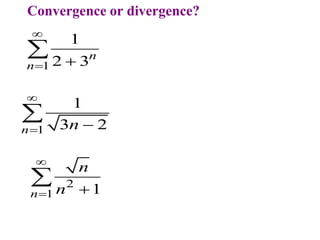
Convergence or divergence?
1
1
2 3n
n

 

2
1 1
n
n
n

 

1
1
3 2
n n

 

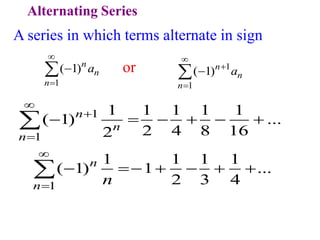
Alternating Series
A series in which terms alternate in sign
1
( 1)n
n
n
a



 1
1
( 1)n
n
n
a





or
1
1
1 1 1 1 1
( 1) ...
2 4 8 16
2
n
n
n



     

1
1 1 1 1
( 1) 1 ...
2 3 4
n
n n


     

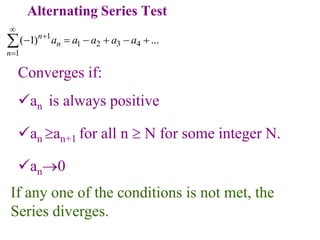
Alternating Series Test
1
1 2 3 4
1
( 1) ...
n
n
n
a a a a a



     

Converges if:
an is always positive
an an+1 for all n  N for some integer N.
an0
If any one of the conditions is not met, the
Series diverges.
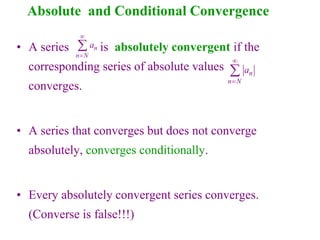
Absolute and Conditional Convergence
• A series is absolutely convergent if the
corresponding series of absolute values
converges.
• A series that converges but does not converge
absolutely, converges conditionally.
• Every absolutely convergent series converges.
(Converse is false!!!)
n
n N
a



n
n N
a



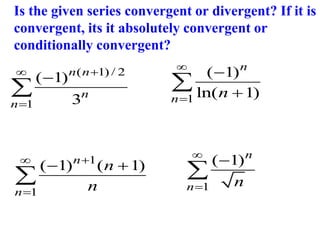
Is the given series convergent or divergent? If it is
convergent, its it absolutely convergent or
conditionally convergent?
( 1) / 2
1
( 1)
3
n n
n
n


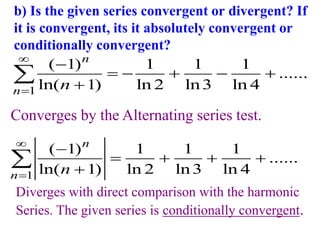


 1
( 1)
ln( 1)
n
n n





1
( 1)n
n n




1
1
( 1) ( 1)
n
n
n
n



 

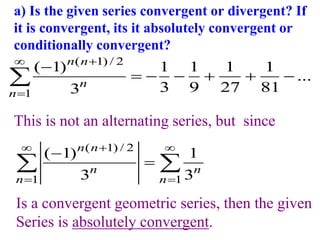
a) Is the given series convergent or divergent? If
it is convergent, its it absolutely convergent or
conditionally convergent?
( 1) / 2
1
( 1) 1 1 1 1
...
3 9 27 81
3
n n
n
n




     

This is not an alternating series, but since
( 1) / 2
1 1
( 1) 1
3 3
n n
n n
n n

 
 


 
Is a convergent geometric series, then the given
Series is absolutely convergent.
b) Is the given series convergent or divergent? If
it is convergent, its it absolutely convergent or
conditionally convergent?
1
( 1) 1 1 1
......
ln( 1) ln 2 ln3 ln 4
n
n n



    


Diverges with direct comparison with the harmonic
Series. The given series is conditionally convergent.
1
( 1) 1 1 1
......
ln( 1) ln 2 ln3 ln 4
n
n n



   


Converges by the Alternating series test.
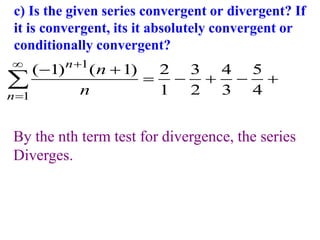
c) Is the given series convergent or divergent? If
it is convergent, its it absolutely convergent or
conditionally convergent?
1
1
( 1) ( 1) 2 3 4 5
1 2 3 4
n
n
n
n



 
    

By the nth term test for divergence, the series
Diverges.
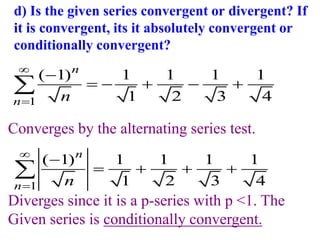
d) Is the given series convergent or divergent? If
it is convergent, its it absolutely convergent or
conditionally convergent?
1
( 1) 1 1 1 1
1 2 3 4
n
n n



    

Converges by the alternating series test.
1
( 1) 1 1 1 1
1 2 3 4
n
n n



   

Diverges since it is a p-series with p <1. The
Given series is conditionally convergent.
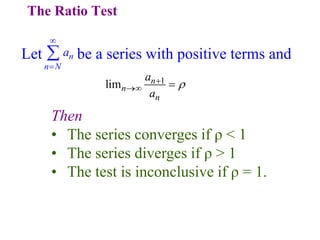
The Ratio Test
Let be a series with positive terms and
n
n N
a



1
lim n
n
n
a
a


 
Then
• The series converges if ρ < 1
• The series diverges if ρ > 1
• The test is inconclusive if ρ = 1.
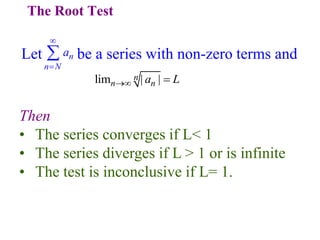
The Root Test
Let be a series with non-zero terms and
n
n N
a



lim | |
n
n n
a L
 
Then
• The series converges if L< 1
• The series diverges if L > 1 or is infinite
• The test is inconclusive if L= 1.
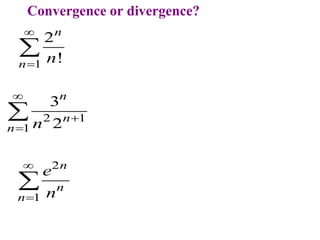
1
2
!
n
n n



2 1
1
3
2
n
n
n n




Convergence or divergence?
2
1
n
n
n
e
n



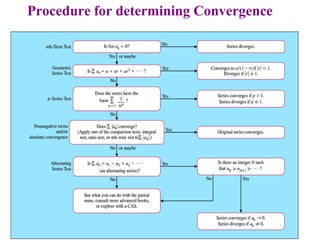
. Procedure for determining Convergence
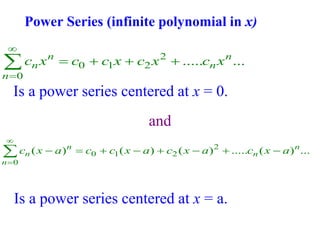
Power Series (infinite polynomial in x)
2
0 1 2
0
..... ...
n n
n n
n
c x c c x c x c x


   

2
0 1 2
0
( ) ( ) ( ) ..... ( ) ...
n n
n n
n
c x a c c x a c x a c x a


       

Is a power series centered at x = 0.
Is a power series centered at x = a.
and
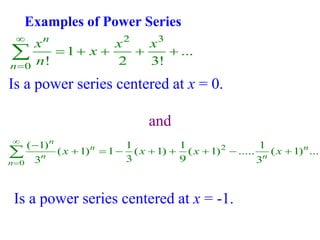
Examples of Power Series
2 3
0
1 ...
! 2 3!
n
n
x x x
x
n


    

2
0
( 1) 1 1 1
( 1) 1 ( 1) ( 1) ..... ( 1) ...
3 9
3 3
n
n n
n n
n
x x x x



       

Is a power series centered at x = 0.
Is a power series centered at x = -1.
and
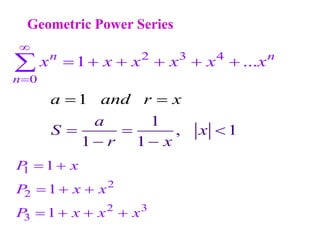
Geometric Power Series
2 3 4
0
1 ...
n n
n
x x x x x x


     

1
, 1
1 1
1
a
S x
r x
a and r x
 
  
 
1
2
2
2 3
3
1
1
1
P x
P x x
P x x x
 
  
   
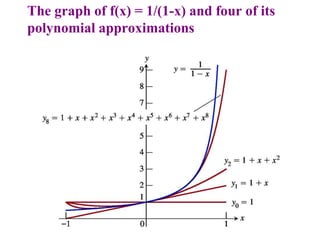
. The graph of f(x) = 1/(1-x) and four of its
polynomial approximations
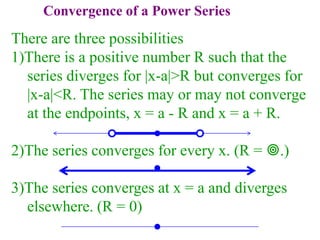
Convergence of a Power Series
There are three possibilities
1)There is a positive number R such that the
series diverges for |x-a|>R but converges for
|x-a|<R. The series may or may not converge
at the endpoints, x = a - R and x = a + R.
2)The series converges for every x. (R = .)
3)The series converges at x = a and diverges
elsewhere. (R = 0)
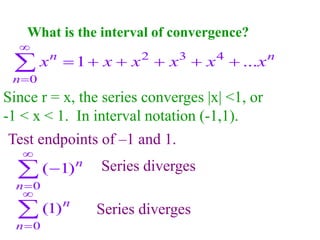
What is the interval of convergence?
0
( 1)n
n




Since r = x, the series converges |x| <1, or
-1 < x < 1. In interval notation (-1,1).
Test endpoints of –1 and 1.
0
(1)n
n



Series diverges
Series diverges
2 3 4
0
1 ...
n n
n
x x x x x x


     

Geometric Power Series
1 3 3
1 3 ( 1) 4
1
1
1 ( 1)
3
1
( 1)
3
a and r x
x
a
S
r x x
  
   


   

2
0
( 1) 1 1 1
( 1) 1 ( 1) ( 1) ..... ( 1) ...
3 9
3 3
n
n n
n n
n
x x x x



       

1
( 1
3
1
1 1
)
( )
3
r x
x
  
 

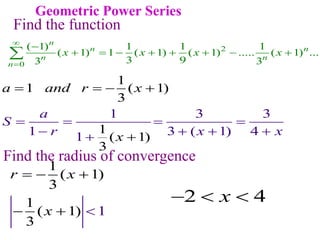
Find the function
Find the radius of convergence
2 4
x
  
Geometric Power Series
0
( 1)
( 1)
3
n
n
n
n
x





Find the radius of convergence
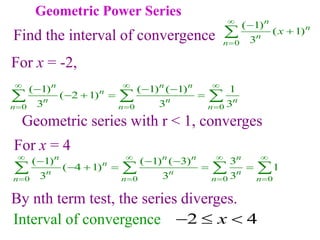
Find the interval of convergence
For x = -2,
0 0 0
( 1) ( 1) ( 1) 1
( 2 1)
3 3 3
n n n
n
n n n
n n n
  
  
  
   
  
Geometric series with r < 1, converges
0 0 0 0
( 1) ( 1) ( 3) 3
( 4 1) 1
3 3 3
n n n n
n
n n n
n n n n
   
   
  
    
   
By nth term test, the series diverges.
For x = 4
2 4
x
  
Interval of convergence
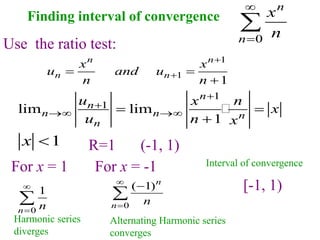
Finding interval of convergence
1
x 
Use the ratio test:
1
1
1
n n
n n
x x
u and u
n n


 

1
1
lim lim
1
n
n
n n n
n
u x n
x
u n x


 
 

R=1
For x = 1 For x = -1
0
n
n
x
n



(-1, 1)
0
1
n n


 0
( 1)n
n n




Harmonic series
diverges
Alternating Harmonic series
converges
1
1
lim lim
1
n
n
n n n
n
u x n
x
u n x


 
 

[-1, 1)
Interval of convergence
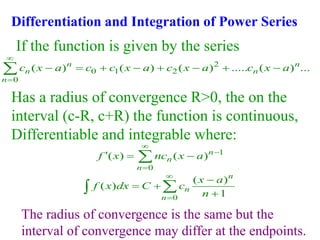
Differentiation and Integration of Power Series
2
0 1 2
0
( ) ( ) ( ) ..... ( ) ...
n n
n n
n
c x a c c x a c x a c x a


       

If the function is given by the series
Has a radius of convergence R>0, the on the
interval (c-R, c+R) the function is continuous,
Differentiable and integrable where:
1
0
( ) ( )n
n
n
f x nc x a



  

0
( )
( )
1
n
n
n
x a
f x dx C c
n



 



The radius of convergence is the same but the
interval of convergence may differ at the endpoints.
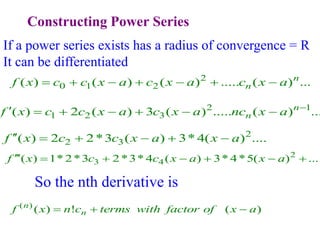
Constructing Power Series
If a power series exists has a radius of convergence = R
It can be differentiated
2
0 1 2
( ) ( ) ( ) ..... ( ) ...
n
n
f x c c x a c x a c x a
      
2 1
1 2 3
( ) 2 ( ) 3 ( ) ..... ( ) ...
n
n
f x c c x a c x a nc x a 
      
2
2 3
( ) 2 2*3 ( ) 3* 4( ) ....
f x c c x a x a
     
2
3 4
( ) 1* 2*3 2*3* 4 ( ) 3* 4*5( ) ...
f x c c x a x a
      
( )
( ) ! ( )
n
n
f x n c terms with factor of x a
  
So the nth derivative is
( )
( ) ! ( )
n
n
f x n c terms with factor of x a
  
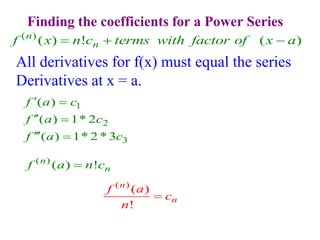
All derivatives for f(x) must equal the series
Derivatives at x = a.
1
2
3
( )
( ) 1* 2
( ) 1* 2 *3
f a c
f a c
f a c
 
 
 
( )
( ) !
n
n
f a n c

( )
( )
!
n
n
f a
c
n

Finding the coefficients for a Power Series
( )
2 3
0
( )
( ) ( ) ( )
( ) ( ) ( ) ( ) ...
! 2! 3!
( )
...
!
k
k
n
n
f a f a f a
f a f x a x a x a
k
f a
x
n


 

      
 

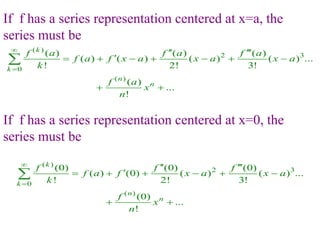
If f has a series representation centered at x=a, the
series must be
If f has a series representation centered at x=0, the
series must be
( )
2 3
0
( )
(0) (0) (0)
( ) (0) ( ) ( ) ...
! 2! 3!
(0)
...
!
k
k
n
n
f f f
f a f x a x a
k
f
x
n


 

     
 

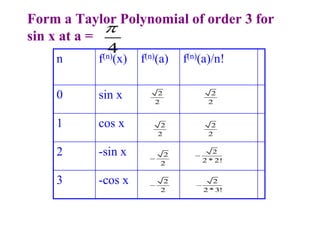
Form a Taylor Polynomial of order 3 for
sin x at a =
n f(n)(x) f(n)(a) f(n)(a)/n!
0 sin x
1 cos x
2 -sin x
3 -cos x
2
2
2
2
2
2

2
2

2
2
2
2
2
2 * 2!

2
2 *3!

4

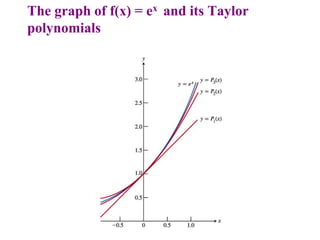
The graph of f(x) = ex and its Taylor
polynomials
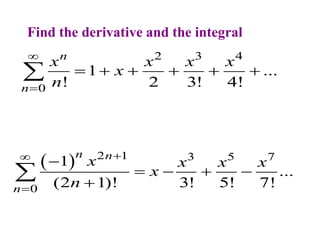
2 3 4
0
1 ...
! 2 3! 4!
n
n
x x x x
x
n


     

Find the derivative and the integral
  2 1 3 5 7
0
1
...
(2 1)! 3! 5! 7!
n n
n
x x x x
x
n




   


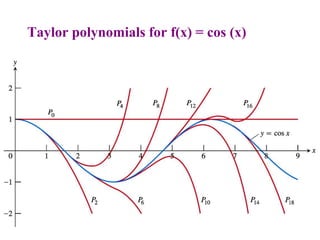
Taylor polynomials for f(x) = cos (x)
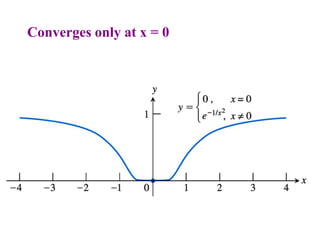
Converges only at x = 0

CONVERGENCE.ppt

  • 1.
  • 2.
    12. 1 Asequence is… (a) an ordered list of objects. (b) A function whose domain is a set of integers. Domain: 1, 2, 3, 4, …,n… Range a1, a2, a3, a4, … an… 1 1 1 1 1, , , , ... 2 4 8 16 {(1, 1), (2, ½), (3, ¼), (4, 1/8) ….}
  • 3.
    Finding patterns Describe apattern for each sequence. Write a formula for the nth term 1 1 1 1 1, , , , ... 2 4 8 16 1 1 1 1 1, , , , ... 2 6 24 120 1 4 9 16 25 , , , , ... 4 9 16 25 36 1 1 2n 1 ! n 2 2 ( 1) n n 
  • 4.
    Write the first5 terms for 1 2 3 4 1 0, , , , ... ... 2 3 4 5 n n  The terms in this sequence get closer and closer to 1. The sequence CONVERGES to 1. On a number line As a function 1 n n a n  
  • 5.
    Write the first5 terms 1 2 3 4 1 0, , , , . ... ... 2 3 4 5 n n       The terms in this sequence do not get close to Any single value. The sequence Diverges   1 ( 1) 1 n n n a n    
  • 6.
    Write the termsfor an = 3 The terms are 3, 3, 3, …3 The sequence converges to 3.
  • 7.
    y= L isa horizontal asymptote when sequence converges to L.
  • 8.
    A sequence thatdiverges   1 ( 1) 1 n n n a n    
  • 9.
    Sequences Write the first5 terms of the sequence. Does the sequence converge? If so, find the value. 1 ( 1) 2 1 n n a n     1 1 1 1 1, , , , 3 5 7 9   1 ( 1) lim 0 2 1 n n n      1 1 ( 1) 1 n n a n           1 2 3 4 0, , , , 2 3 4 5    1 lim ( 1) 1 n n does not exist n          The sequence converges to 0. The sequence diverges.
  • 10.
    12.2 Infinite Series 1 11 1 1 1 ... 2 4 8 16 2n n         1 1 1 1 1 1 ... n         The series diverges because sn = n. Note that the Sequence {1} converges. Represents the sum of the terms in a sequence. We want to know if the series converges to a single value i.e. there is a finite sum.
  • 11.
    1 1 ( 1) n nn     1 1 1 1 1 1 1 ... ( 1) 2 6 12 20 30 n n n          
  • 12.
    Partial sums of 1 1 1 1 2 2 s   2 2 3 1 1 1 2 2 3 s      3 1 1 1 1 2 2 4 4 3 3 3 s        1 1 1 1 ... 1 2 2 3 3 4 ( 1 1 ) n n s n n n           If the sequence of partial sums converges, the series converges and 1 2 3 4 5 , , , , ... ... 2 3 4 5 6 1 n n  Converges to 1 so series converges. 1 1 1 1 1 1 1 ... ( 1) 2 6 12 20 30 n n n          
  • 13.
    Finding sums 1 1 ( 1) nn n     1 1 1 ( 1) 1 1 1 1 1 1 1 1 1 (1 ) ( ) ( ) ... ... 1 2 2 3 3 4 1 n n n n n n n n                           Can use partial fractions to rewrite 1 1 1 lim (1 ) 1 ( 1) 1 n n n n n         
  • 14.
    . The partial sumsof the series 1 1 ( 1) n n n     Limit
  • 15.
    Geometric Series 1 1 11 1 1 ... 2 4 8 16 2n n         Each term is obtained from the preceding number by multiplying by the same number r. 1 1 1 1 ... 5 25 125 625     2 4 8 16 ... 3 3 3 3     Find r (the common ratio)
  • 16.
    Is a GeometricSeries 1 1 1 1 ... 2 4 8 16     3 12 48 192 ... 5 25 125 625     2 4 8 16 ... 3 3 3 3     1 1 n n ar     Where a = first term and r=common ratio Write using series notation 1 1 1 1 2 2 n n           1 1 3 4 5 5 n n              1 1 2 2 3 n n    
  • 17.
    The sum ofa geometric series 2 3 ... n n rs ar ar ar ar     2 3 1 ... n n s a ar ar ar ar       n n n s rs a ar    ( 1 1 1 , ) 1 n n n a ar s a r r r r        1 . | 0 | , n r as n if r     | | 1 1 , n a s r r    Geometric series converges to If r>1 the geometric series diverges. Multiply each term by r Sum of n terms subtract
  • 18.
    Find the sumof a Geometric Series 1 1 , | | 1 1 n n a ar r r        Where a = first term and r=common ratio 1 1 1 1 2 2 n n           1 1 3 4 5 5 n n              1 1 2 2 3 n n     The series diverges. 1 2 1 1 1 2   3 3 1 5 4 9 3 1 5   
  • 19.
    Repeating decimals-Geometric Series 24 6 8 8 8 8 8 0.080808 ... 10 10 10 10      2 1 1 2 8 8 10 1 1 99 1 10 n n a ar r          The repeating decimal is equivalent to 8/99. 2 2 8 1 10 10 a and r   1 1 2 2 1 1 8 1 10 10 n n n n ar               
  • 20.
    Series known toconverge or diverge 1. A geometric series with | r | <1 converges 2. A repeating decimal converges 3. Telescoping series converge A necessary condition for convergence: Limit as n goes to infinity for nth term in sequence is 0. nth term test for divergence: If the limit as n goes to infinity for the nth term is not 0, the series DIVERGES!
  • 21.
    Convergence or Divergence? 1 10 101 n n n      1 1 1 2 n n n        1 1.075 n n    1 4 2n n   
  • 22.
    A series ofnon-negative terms converges If its partial sums are bounded from above. A sequence in which each term is less than or equal to the one before it is called a monotonic non-increasing sequence. If each term is greater than or equal to the one before it, it is called monotonic non-decreasing. A monotonic sequence that is bounded Is convergent.
  • 23.
    12. 3 TheIntegral Test Let {an} be a sequence of positive terms. Suppose that an = f(n) where f is a continuous positive, decreasing function of x for all xN. Then the series and the corresponding integral shown both converge of both diverge. n n N a    ( ) N f x dx   f(n) f(x)
  • 24.
    The series andthe integral both converge or both diverge Exact area under curve is between If area under curve is finite, so is area in rectangles If area under curve is infinite, so is area in rectangles Area in rectangle corresponds to term in sequence
  • 25.
    Using the Integraltest 2 1 1 n n n     2 2 2 1 1 1 2 1 2 lim lim ln( 1) 2 1 1 lim (ln( 1) ln2) b b b b b x x dx dx x x x b                    Thus the series diverges 2 ( ) 1 n n a f n n    2 ( 1 ) x f x x   The improper integral diverges
  • 26.
    Using the Integraltest 2 1 1 1 n n       2 2 1 1 1 1 1 lim lim arctan 1 1 lim (arctan arctan1) 2 4 4 b b b b b dx dx x x x b                  Thus the series converges 2 ( ) 1 1 n a f n n    2 1 ( ) 1 f x x   The improper integral converges
  • 27.
    Harmonic series andp-series 1 1 p n n    Is called a p-series A p-series converges if p > 1 and diverges If p < 1 or p = 1. 1 1 1 1 1 1 1 1 .... .... 2 3 4 5 n n n           Is called the harmonic series and it diverges since p =1.
  • 28.
    1 1 3 1 n n    Identify whichseries converge and which diverge. 1 1 n n    1 3 1 n n     1 1 n n    2 1 100 n n    1 1 3 4 5 5 n n           
  • 29.
    12. 4Direct Comparisontest Let 1 n n a    be a series with no negative terms 1 n n a    Converges if there is a series Where the terms of an are less than or equal to the terms of cn for all n>N. 1 n n c    1 n n a    Diverges if there is a series Where the terms of an are greater than or equal to the terms of dn for all n>N. 1 n n d   
  • 30.
    Limit Comparison test bothconverge or both diverge: Limit Comparison test lim , 0 n x n a c c b      Then the following series 1 n n a    1 n n b    and lim 0 n x n a b   Amd 1 n n b    Converges then 1 n n a    Converges lim n x n a b    1 n n b    Diverges then 1 n n a    Diverges and and
  • 31.
    Convergence or divergence? 1 1 23n n     2 1 1 n n n     1 1 3 2 n n    
  • 32.
    Alternating Series A seriesin which terms alternate in sign 1 ( 1)n n n a     1 1 ( 1)n n n a      or 1 1 1 1 1 1 1 ( 1) ... 2 4 8 16 2 n n n           1 1 1 1 1 ( 1) 1 ... 2 3 4 n n n         
  • 33.
    Alternating Series Test 1 12 3 4 1 ( 1) ... n n n a a a a a           Converges if: an is always positive an an+1 for all n  N for some integer N. an0 If any one of the conditions is not met, the Series diverges.
  • 34.
    Absolute and ConditionalConvergence • A series is absolutely convergent if the corresponding series of absolute values converges. • A series that converges but does not converge absolutely, converges conditionally. • Every absolutely convergent series converges. (Converse is false!!!) n n N a    n n N a   
  • 35.
    Is the givenseries convergent or divergent? If it is convergent, its it absolutely convergent or conditionally convergent? ( 1) / 2 1 ( 1) 3 n n n n      1 ( 1) ln( 1) n n n      1 ( 1)n n n     1 1 ( 1) ( 1) n n n n      
  • 36.
    a) Is thegiven series convergent or divergent? If it is convergent, its it absolutely convergent or conditionally convergent? ( 1) / 2 1 ( 1) 1 1 1 1 ... 3 9 27 81 3 n n n n            This is not an alternating series, but since ( 1) / 2 1 1 ( 1) 1 3 3 n n n n n n          Is a convergent geometric series, then the given Series is absolutely convergent.
  • 37.
    b) Is thegiven series convergent or divergent? If it is convergent, its it absolutely convergent or conditionally convergent? 1 ( 1) 1 1 1 ...... ln( 1) ln 2 ln3 ln 4 n n n           Diverges with direct comparison with the harmonic Series. The given series is conditionally convergent. 1 ( 1) 1 1 1 ...... ln( 1) ln 2 ln3 ln 4 n n n          Converges by the Alternating series test.
  • 38.
    c) Is thegiven series convergent or divergent? If it is convergent, its it absolutely convergent or conditionally convergent? 1 1 ( 1) ( 1) 2 3 4 5 1 2 3 4 n n n n            By the nth term test for divergence, the series Diverges.
  • 39.
    d) Is thegiven series convergent or divergent? If it is convergent, its it absolutely convergent or conditionally convergent? 1 ( 1) 1 1 1 1 1 2 3 4 n n n          Converges by the alternating series test. 1 ( 1) 1 1 1 1 1 2 3 4 n n n         Diverges since it is a p-series with p <1. The Given series is conditionally convergent.
  • 40.
    The Ratio Test Letbe a series with positive terms and n n N a    1 lim n n n a a     Then • The series converges if ρ < 1 • The series diverges if ρ > 1 • The test is inconclusive if ρ = 1.
  • 41.
    The Root Test Letbe a series with non-zero terms and n n N a    lim | | n n n a L   Then • The series converges if L< 1 • The series diverges if L > 1 or is infinite • The test is inconclusive if L= 1.
  • 42.
    1 2 ! n n n    2 1 1 3 2 n n nn     Convergence or divergence? 2 1 n n n e n   
  • 43.
    . Procedure fordetermining Convergence
  • 44.
    Power Series (infinitepolynomial in x) 2 0 1 2 0 ..... ... n n n n n c x c c x c x c x        2 0 1 2 0 ( ) ( ) ( ) ..... ( ) ... n n n n n c x a c c x a c x a c x a            Is a power series centered at x = 0. Is a power series centered at x = a. and
  • 45.
    Examples of PowerSeries 2 3 0 1 ... ! 2 3! n n x x x x n         2 0 ( 1) 1 1 1 ( 1) 1 ( 1) ( 1) ..... ( 1) ... 3 9 3 3 n n n n n n x x x x             Is a power series centered at x = 0. Is a power series centered at x = -1. and
  • 46.
    Geometric Power Series 23 4 0 1 ... n n n x x x x x x          1 , 1 1 1 1 a S x r x a and r x        1 2 2 2 3 3 1 1 1 P x P x x P x x x         
  • 47.
    . The graphof f(x) = 1/(1-x) and four of its polynomial approximations
  • 48.
    Convergence of aPower Series There are three possibilities 1)There is a positive number R such that the series diverges for |x-a|>R but converges for |x-a|<R. The series may or may not converge at the endpoints, x = a - R and x = a + R. 2)The series converges for every x. (R = .) 3)The series converges at x = a and diverges elsewhere. (R = 0)
  • 49.
    What is theinterval of convergence? 0 ( 1)n n     Since r = x, the series converges |x| <1, or -1 < x < 1. In interval notation (-1,1). Test endpoints of –1 and 1. 0 (1)n n    Series diverges Series diverges 2 3 4 0 1 ... n n n x x x x x x         
  • 50.
    Geometric Power Series 13 3 1 3 ( 1) 4 1 1 1 ( 1) 3 1 ( 1) 3 a and r x x a S r x x               2 0 ( 1) 1 1 1 ( 1) 1 ( 1) ( 1) ..... ( 1) ... 3 9 3 3 n n n n n n x x x x             1 ( 1 3 1 1 1 ) ( ) 3 r x x       Find the function Find the radius of convergence 2 4 x   
  • 51.
    Geometric Power Series 0 (1) ( 1) 3 n n n n x      Find the radius of convergence Find the interval of convergence For x = -2, 0 0 0 ( 1) ( 1) ( 1) 1 ( 2 1) 3 3 3 n n n n n n n n n n                 Geometric series with r < 1, converges 0 0 0 0 ( 1) ( 1) ( 3) 3 ( 4 1) 1 3 3 3 n n n n n n n n n n n n                     By nth term test, the series diverges. For x = 4 2 4 x    Interval of convergence
  • 52.
    Finding interval ofconvergence 1 x  Use the ratio test: 1 1 1 n n n n x x u and u n n      1 1 lim lim 1 n n n n n n u x n x u n x        R=1 For x = 1 For x = -1 0 n n x n    (-1, 1) 0 1 n n    0 ( 1)n n n     Harmonic series diverges Alternating Harmonic series converges 1 1 lim lim 1 n n n n n n u x n x u n x        [-1, 1) Interval of convergence
  • 53.
    Differentiation and Integrationof Power Series 2 0 1 2 0 ( ) ( ) ( ) ..... ( ) ... n n n n n c x a c c x a c x a c x a            If the function is given by the series Has a radius of convergence R>0, the on the interval (c-R, c+R) the function is continuous, Differentiable and integrable where: 1 0 ( ) ( )n n n f x nc x a        0 ( ) ( ) 1 n n n x a f x dx C c n         The radius of convergence is the same but the interval of convergence may differ at the endpoints.
  • 54.
    Constructing Power Series Ifa power series exists has a radius of convergence = R It can be differentiated 2 0 1 2 ( ) ( ) ( ) ..... ( ) ... n n f x c c x a c x a c x a        2 1 1 2 3 ( ) 2 ( ) 3 ( ) ..... ( ) ... n n f x c c x a c x a nc x a         2 2 3 ( ) 2 2*3 ( ) 3* 4( ) .... f x c c x a x a       2 3 4 ( ) 1* 2*3 2*3* 4 ( ) 3* 4*5( ) ... f x c c x a x a        ( ) ( ) ! ( ) n n f x n c terms with factor of x a    So the nth derivative is
  • 55.
    ( ) ( )! ( ) n n f x n c terms with factor of x a    All derivatives for f(x) must equal the series Derivatives at x = a. 1 2 3 ( ) ( ) 1* 2 ( ) 1* 2 *3 f a c f a c f a c       ( ) ( ) ! n n f a n c  ( ) ( ) ! n n f a c n  Finding the coefficients for a Power Series
  • 56.
    ( ) 2 3 0 () ( ) ( ) ( ) ( ) ( ) ( ) ( ) ... ! 2! 3! ( ) ... ! k k n n f a f a f a f a f x a x a x a k f a x n                If f has a series representation centered at x=a, the series must be If f has a series representation centered at x=0, the series must be ( ) 2 3 0 ( ) (0) (0) (0) ( ) (0) ( ) ( ) ... ! 2! 3! (0) ... ! k k n n f f f f a f x a x a k f x n              
  • 57.
    Form a TaylorPolynomial of order 3 for sin x at a = n f(n)(x) f(n)(a) f(n)(a)/n! 0 sin x 1 cos x 2 -sin x 3 -cos x 2 2 2 2 2 2  2 2  2 2 2 2 2 2 * 2!  2 2 *3!  4 
  • 58.
    The graph off(x) = ex and its Taylor polynomials
  • 59.
    2 3 4 0 1... ! 2 3! 4! n n x x x x x n          Find the derivative and the integral   2 1 3 5 7 0 1 ... (2 1)! 3! 5! 7! n n n x x x x x n          
  • 60.
    Taylor polynomials forf(x) = cos (x)
  • 61.