1
The Wave Equation
SPECIAL TOPICS:
PARTIAL DIFFERENTIAL
EQUATIONS
Dhaval Jalalpara A.
2
 Sub:- Maths
 Division:- A
 Topic:- Wave Equation
3
Motion of a string
Imagine that a stretched string is vibrating.
The wave equation says that, at any position on the
string, acceleration in the direction perpendicular to
the string is proportional to the curvature of the string.
x
u
displacement =u(x,t)
4
The one-dimensional wave
equation
Let
• x = position on the string
• t = time
• u(x, t) = displacement of the string at position x and
time t.
• T = tension (parameter)
• ρ = mass per unit length (parameter)
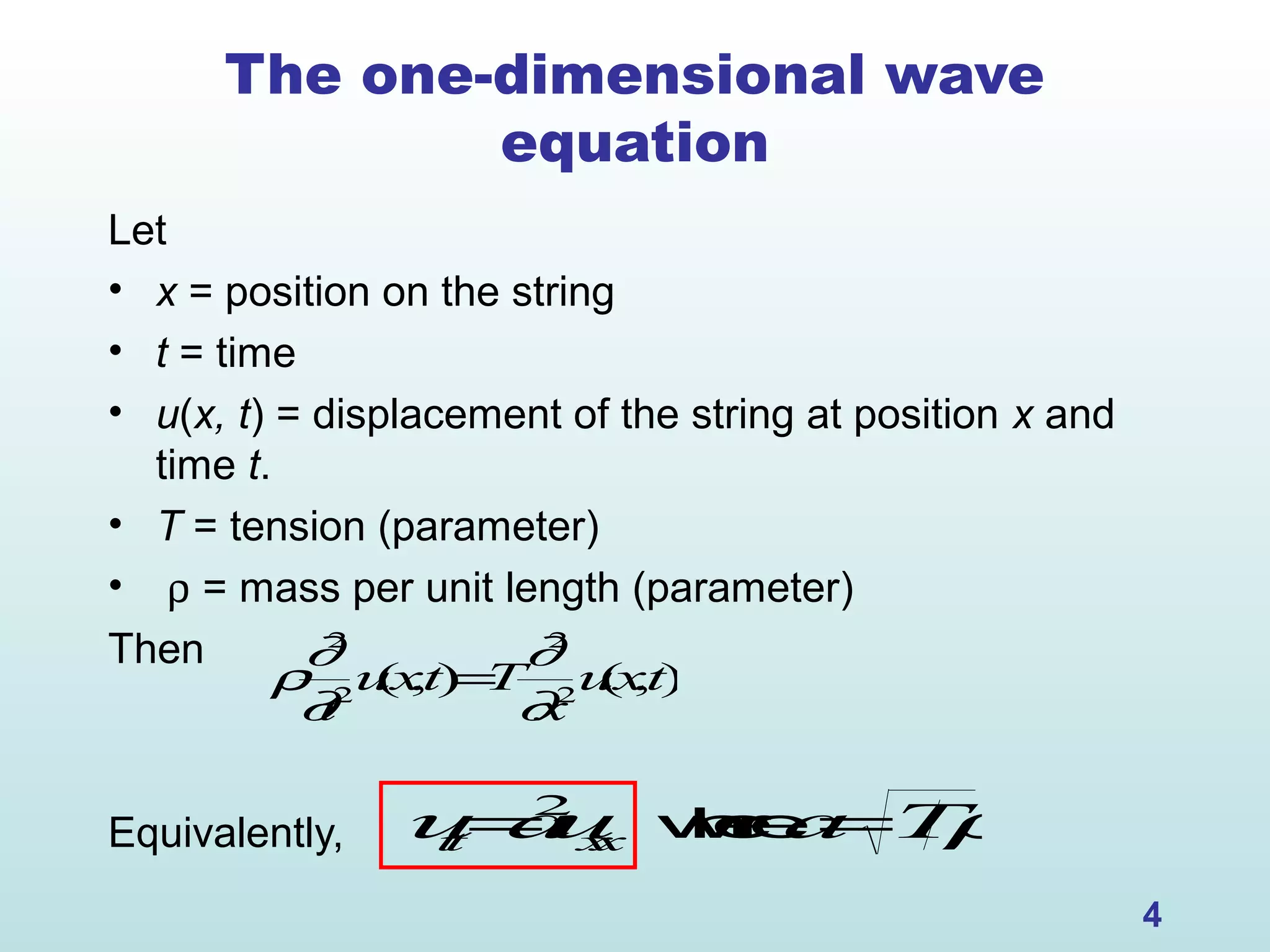
Then
Equivalently,
ρ
∂2
∂t2
u(x,t)=T
∂2
∂x2
u(x,t)
utt=a2
uxx wherea=Tρ
5
Solving the one-dimensional WE
First, we make a wild assumption: suppose that u is a
product of a function of x and a function of t:
Then the wave equation becomes
So,
The only way for this equation to be true for all x and
for all t is for both sides to be constant; that is,
T’’(t)/a2
T(t) = λ and X”(x)/X(x) = λ.
u(x,t)=X(x)T(t)
X(x)′′T(t)=a2
′′X(x)T(t)
′′T (t)
a2
T(t)
=
′′X(x)
X(x)
6
Separation of variables
Now
means that
If λ < 0, T(t) and X(x) are both trig functions.*
′′T(t)
a2
T(t)
=
′′X(x)
X(x)
=λ
′′T(t)−λa2
T(t)=0,and
′′X(x)−λX(x)=0,
*If λ = 0, they’re linear, and if λ > 0, they’re exponential.
7
Clarification: the sign of λ
There are three types of solutions to the equation
1. if λ = 0, then X(x) is linear (ax + b), which won't
satisfy the boundary conditions;
2. if λ > 0, X(x) is exponential (ke√λt
), which also won't
satisfy the boundary conditions; and
3. if λ < 0, then X(x) is a sinusoid
that satisfies the boundary conditions.
′′X(x)−λX(x)=0
X(x)=ksin −λ( )x( )
8
Boundary conditions
In a stringed instrument, each end of the string is fixed;
if the string has length L, then, for all t,
Since T(t) ≠ 0 for all t, X(0) = X(L) = 0; thus, X(x) could
be a sum of sine terms with zeros at x = L:
u(0,t)=X(0)T(t)=0,and
u(L,t)=X(L)T(t)=0.
X(x)=ksinnπx/L( )
0 L
9
Finding T(t)
Now we know two things:
This means that
Now substitute λ into the equation for T:
And find the solution:
X(x)=ksinnπx/L( )′′X(x)−λX(x)=0
λ=−
n2
π2
L2
′′T(t)−λa2
T(t)=0
T(t)=bsin
anπt
L
+ccos
anπt
L
10
Putting it all together
We now have a family of solutions for the wave
equation (one for every n):
Suppose we choose an x0 and look at how the
displacement varies at this point as t changes.
This is the equation of a sinusoid with frequency =
u(x,t)=X(x)T(t)=sin
nπx
L
bsin
anπt
L
+ccos
anπt
L






u(x0,t)=Kbsin
anπt
L
+ccos
anπt
L






an
2 L
K=sin
nπx0
L






where n = 1, 2, 3…
11
Take it higher
So there are three ways to increase the frequency of a
sound, producing a “higher” note:
frequency=
an
2L
Increase a
(continuous changes)
Tuning
Increase n
(discrete changes)
Overblowing
Playing harmonics
Decrease L
(continuous changes)
Shortening
Fretting
12
Boundary conditions
With wind instruments, it’s not always true that if L is the
length of the tube, u(0, t) = u(L, t) = 0.
This is true with the flute (because the pressure doesn’t
change at the ends).
However, what happens with some instruments (like the
sax) is that ux(0, t) = ux(L, t) = 0, which means that the
X(x) functions are cosine terms rather than sines.
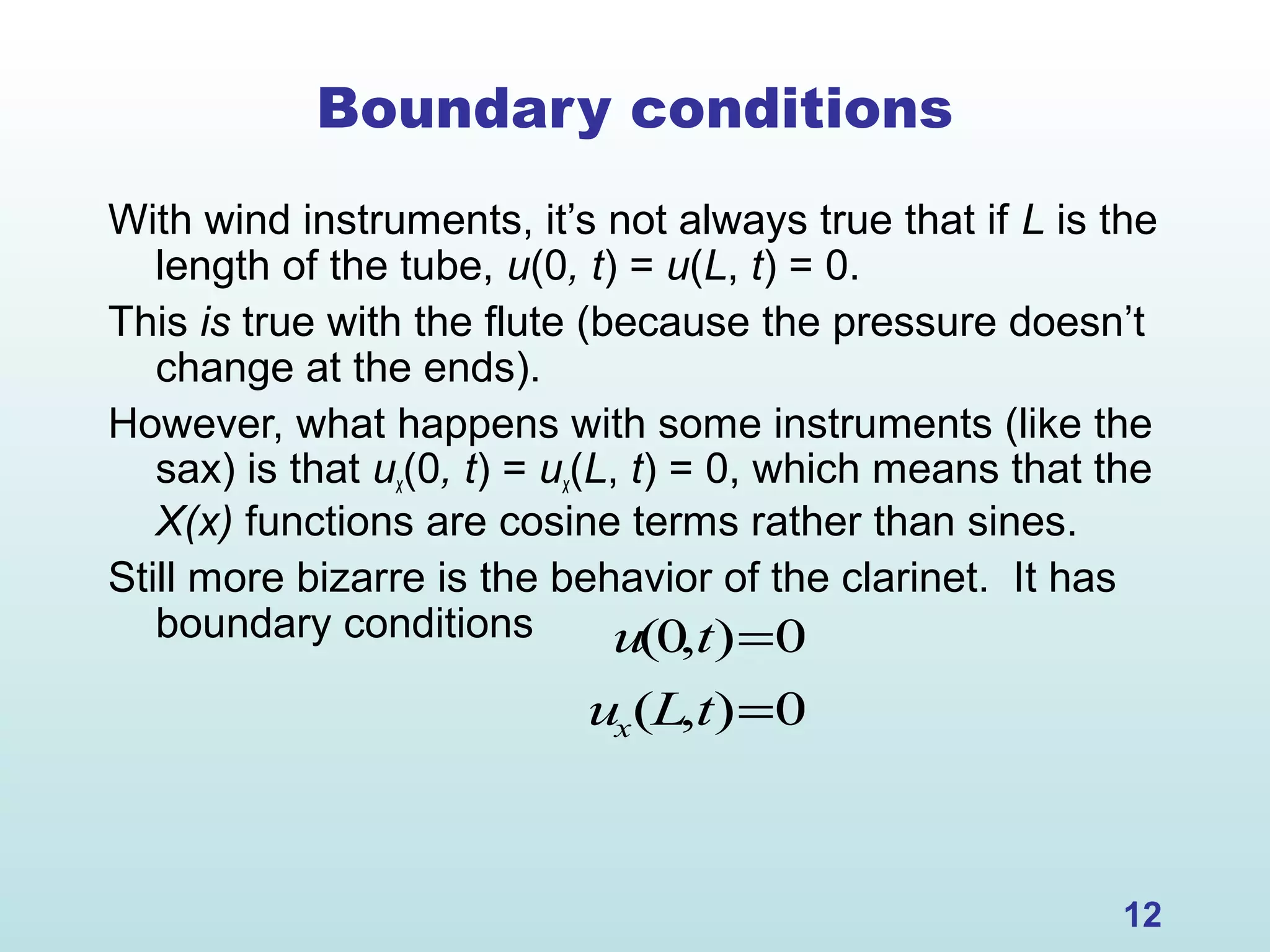
Still more bizarre is the behavior of the clarinet. It has
boundary conditions u(0,t)=0
ux(L,t)=0
13
Standing waves
The harmonics we hear on a stringed instrument and
the overtones on a wind instrument are actually
produced by standing waves, which are solutions of
the form
L
tan
L
xn
b
ππ
cossin
Example :- of one dimentional eqn
• Find the solution of the wave equation
d2
y/dt2
= c2
d2
y/dx2
such that
y=a cos pt when x=l, and y=0 when
x=0.
14
15
Thank you

The wave equation

  • 1.
    1 The Wave Equation SPECIALTOPICS: PARTIAL DIFFERENTIAL EQUATIONS Dhaval Jalalpara A.
  • 2.
    2  Sub:- Maths Division:- A  Topic:- Wave Equation
  • 3.
    3 Motion of astring Imagine that a stretched string is vibrating. The wave equation says that, at any position on the string, acceleration in the direction perpendicular to the string is proportional to the curvature of the string. x u displacement =u(x,t)
  • 4.
    4 The one-dimensional wave equation Let •x = position on the string • t = time • u(x, t) = displacement of the string at position x and time t. • T = tension (parameter) • ρ = mass per unit length (parameter) Then Equivalently, ρ ∂2 ∂t2 u(x,t)=T ∂2 ∂x2 u(x,t) utt=a2 uxx wherea=Tρ
  • 5.
    5 Solving the one-dimensionalWE First, we make a wild assumption: suppose that u is a product of a function of x and a function of t: Then the wave equation becomes So, The only way for this equation to be true for all x and for all t is for both sides to be constant; that is, T’’(t)/a2 T(t) = λ and X”(x)/X(x) = λ. u(x,t)=X(x)T(t) X(x)′′T(t)=a2 ′′X(x)T(t) ′′T (t) a2 T(t) = ′′X(x) X(x)
  • 6.
    6 Separation of variables Now meansthat If λ < 0, T(t) and X(x) are both trig functions.* ′′T(t) a2 T(t) = ′′X(x) X(x) =λ ′′T(t)−λa2 T(t)=0,and ′′X(x)−λX(x)=0, *If λ = 0, they’re linear, and if λ > 0, they’re exponential.
  • 7.
    7 Clarification: the signof λ There are three types of solutions to the equation 1. if λ = 0, then X(x) is linear (ax + b), which won't satisfy the boundary conditions; 2. if λ > 0, X(x) is exponential (ke√λt ), which also won't satisfy the boundary conditions; and 3. if λ < 0, then X(x) is a sinusoid that satisfies the boundary conditions. ′′X(x)−λX(x)=0 X(x)=ksin −λ( )x( )
  • 8.
    8 Boundary conditions In astringed instrument, each end of the string is fixed; if the string has length L, then, for all t, Since T(t) ≠ 0 for all t, X(0) = X(L) = 0; thus, X(x) could be a sum of sine terms with zeros at x = L: u(0,t)=X(0)T(t)=0,and u(L,t)=X(L)T(t)=0. X(x)=ksinnπx/L( ) 0 L
  • 9.
    9 Finding T(t) Now weknow two things: This means that Now substitute λ into the equation for T: And find the solution: X(x)=ksinnπx/L( )′′X(x)−λX(x)=0 λ=− n2 π2 L2 ′′T(t)−λa2 T(t)=0 T(t)=bsin anπt L +ccos anπt L
  • 10.
    10 Putting it alltogether We now have a family of solutions for the wave equation (one for every n): Suppose we choose an x0 and look at how the displacement varies at this point as t changes. This is the equation of a sinusoid with frequency = u(x,t)=X(x)T(t)=sin nπx L bsin anπt L +ccos anπt L       u(x0,t)=Kbsin anπt L +ccos anπt L       an 2 L K=sin nπx0 L       where n = 1, 2, 3…
  • 11.
    11 Take it higher Sothere are three ways to increase the frequency of a sound, producing a “higher” note: frequency= an 2L Increase a (continuous changes) Tuning Increase n (discrete changes) Overblowing Playing harmonics Decrease L (continuous changes) Shortening Fretting
  • 12.
    12 Boundary conditions With windinstruments, it’s not always true that if L is the length of the tube, u(0, t) = u(L, t) = 0. This is true with the flute (because the pressure doesn’t change at the ends). However, what happens with some instruments (like the sax) is that ux(0, t) = ux(L, t) = 0, which means that the X(x) functions are cosine terms rather than sines. Still more bizarre is the behavior of the clarinet. It has boundary conditions u(0,t)=0 ux(L,t)=0
  • 13.
    13 Standing waves The harmonicswe hear on a stringed instrument and the overtones on a wind instrument are actually produced by standing waves, which are solutions of the form L tan L xn b ππ cossin
  • 14.
    Example :- ofone dimentional eqn • Find the solution of the wave equation d2 y/dt2 = c2 d2 y/dx2 such that y=a cos pt when x=l, and y=0 when x=0. 14
  • 15.