8/19/2022 Berhanu G(Dr) 1
Line and Surface Integrals
4. 1 Line Integral
C
A
B
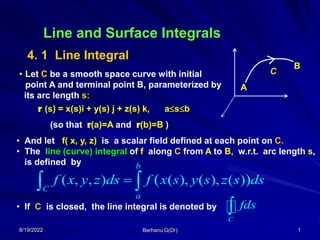
• Let C be a smooth space curve with initial
point A and terminal point B, parameterized by
its arc length s:
• And let f( x, y, z) is a scalar field defined at each point on C.
• The line (curve) integral of f along C from A to B, w.r.t. arc length s,
is defined by
r (s) = x(s)i + y(s) j + z(s) k, asb
(so that r(a)=A and r(b)=B )
( , , ) ( ), ( ), ( )
( )
C
b
a
f x y z ds f x s y s z s ds

 
• If C is closed, the line integral is denoted by
C
fds

8/19/2022 Berhanu G(Dr) 2
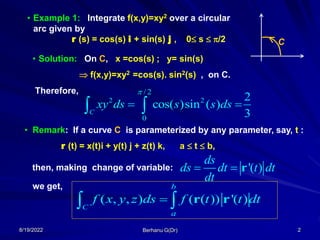
• Example 1: Integrate f(x,y)=xy2 over a circular
arc given by
r (s) = cos(s) i + sin(s) j , 0 s  /2
• Remark: If a curve C is parameterized by any parameter, say, t :
2 2
/ 2
0
2
cos( )sin ( )
3
C
xy ds s s ds

 
 
C
• Solution: On C, x =cos(s) ; y= sin(s)
 f(x,y)=xy2 =cos(s). sin2(s) , on C.
Therefore,
r (t) = x(t)i + y(t) j + z(t) k, a  t  b,
'( )
ds
ds dt t dt
dt
  r
then, making change of variable:
we get,
( , , ) ( ( )) '( )
C
b
a
f x y z ds f t t dt

  r r
8/19/2022 Berhanu G(Dr) 3
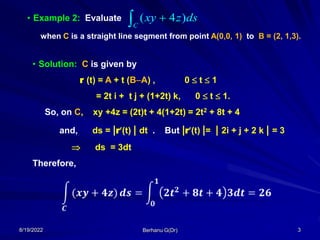
• Example 2: Evaluate ( 4 )
C
xy z ds


• Solution: C is given by
r (t) = A + t (BA) , 0  t  1
= 2t i + t j + (1+2t) k, 0  t  1.
So, on C, xy +4z = (2t)t + 4(1+2t) = 2t2 + 8t + 4
and, ds = |r(t) | dt . But |r(t) |= | 2i + j + 2 k | = 3
 ds = 3dt
Therefore,
when C is a straight line segment from point A(0,0, 1) to B = (2, 1,3).
8/19/2022 Berhanu G(Dr) 4
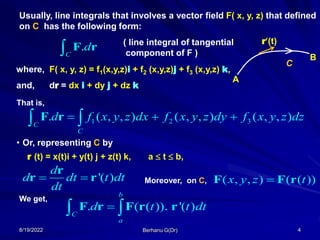
Usually, line integrals that involves a vector field F( x, y, z) that defined
on C has the following form:
C
r(t)
A
B
• Or, representing C by
r (t) = x(t)i + y(t) j + z(t) k, a  t  b,
.
C
d
 F r
where, F( x, y, z) = f1(x,y,z)i + f2 (x,y,z)j + f3 (x,y,z) k,
and, dr = dx i + dy j + dz k
( line integral of tangential
component of F )
That is,
1 2 3
( , , ) ( , , ) ( , , )
.
C
C
d f x y z dx f x y z dy f x y z dz
  
 
F r
'( )
d
d dt t dt
dt
 
r
r r ( , , ) ( ( ))
x y z t

F F r
Moreover, on C,
We get,
( ( )) '( )
. .
b
C
a
d t t dt

 
F r F r r
8/19/2022 Berhanu G(Dr) 5
• Example 3: Let F(x,y) = (x + y) i + (xy) j . Evaluate
when C is: (a) the parabola y=x2 from (1,1) to (4,2)
(b) the circle x2+y2 = 1
• Solution: (a) F.dr = (x+y)dx + (xy)dy. But on C, y=x2 , dy=2xdx
= (x+x2) dx + (xx2)2x dx
= (x + 3x2 2x3) dx, 1  x  4.
Hence,
(b) C, parametrically, r (t) = cost i + sint j , 0  t  2
r (t) = cost i + sint j ,  r (t) = sint i + cost j ,
and, F(r(t) ) = (cost + sint) i + (costsint) j .
Hence,
.
C
d
 F r
( ) ( )
.
C C
d x y dx x y dy
   
 
F r
4
2 3
1
34
3
( 3 2 )
x x x dx
   

2 2
0 0
( ( )) '( ) (cos(2 ) sin(2 )) 0
. .
C
d t t dt t t dt
 
   
  
F r F r r
8/19/2022 Berhanu G(Dr) 6
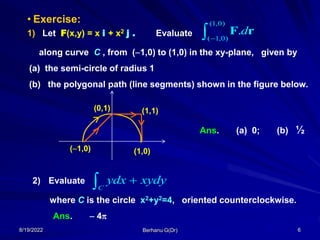
• Exercise:
1) Let F(x,y) = x i + x2 j . Evaluate
Ans.  4
(1,0)
( 1,0)
.d

 F r
along curve C , from (1,0) to (1,0) in the xy-plane, given by
(a) the semi-circle of radius 1
(b) the polygonal path (line segments) shown in the figure below.
(1,0) (1,0)
(1,1)
(0,1)
2) Evaluate
where C is the circle x2+y2=4, oriented counterclockwise.
C
ydx xydy


Ans. (a) 0; (b) ½
8/19/2022 Berhanu G(Dr) 7
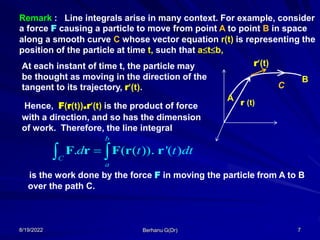
At each instant of time t, the particle may
be thought as moving in the direction of the
tangent to its trajectory, r(t).
Hence, F(r(t)).r(t) is the product of force
with a direction, and so has the dimension
of work. Therefore, the line integral
is the work done by the force F in moving the particle from A to B
over the path C.
( ( )) '( )
. .
b
C
a
d t t dt

 
F r F r r
Remark : Line integrals arise in many context. For example, consider
a force F causing a particle to move from point A to point B in space
along a smooth curve C whose vector equation r(t) is representing the
position of the particle at time t, such that atb,
C
r(t)
A
B
r (t)
8/19/2022 Berhanu G(Dr) 8
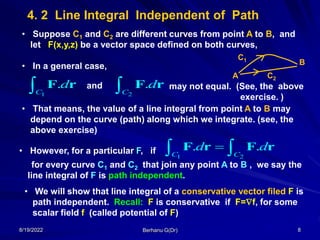
• Suppose C1 and C2 are different curves from point A to B, and
let F(x,y,z) be a vector space defined on both curves,
4. 2 Line Integral Independent of Path
A
B
C1
C2
• In a general case,
1
.
C
d
 F r and
2
.
C
d
 F r may not equal. (See, the above
exercise. )
• That means, the value of a line integral from point A to B may
depend on the curve (path) along which we integrate. (see, the
above exercise)
• However, for a particular F, if
for every curve C1 and C2 that join any point A to B , we say the
line integral of F is path independent.
1 2
. .
C C
d d

 
F r F r
• We will show that line integral of a conservative vector filed F is
path independent. Recall: F is conservative if F=f, for some
scalar field f (called potential of F)
8/19/2022 Berhanu G(Dr) 9
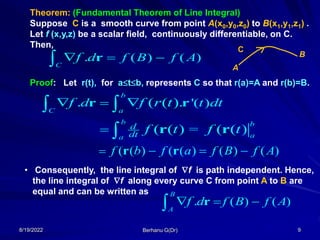
Theorem: (Fundamental Theorem of Line Integral)
Suppose C is a smooth curve from point A(x0,y0,z0) to B(x1,y1,z1) .
Let f (x,y,z) be a scalar field, continuously differentiable, on C.
Then,
A
B
C
Proof: Let r(t), for atb, represents C so that r(a)=A and r(b)=B.
( ) ( )
.
C
d f B f A
f  

 r
• Consequently, the line integral of f is path independent. Hence,
the line integral of f along every curve C from point A to B are
equal and can be written as
'( )
. ( ( ).
b
C a
d t dt
f f r t

 
 
r r
=
( ( ) ( ( )
b b
a
a
d
dt f t f t
  r r
( ( ) ( ( ) ( ) ( )
f b f a f B f A
   
r r
( ) ( )
.
B
A
d f B f A
f  

 r
8/19/2022 Berhanu G(Dr) 10
Theorem: (Line Integral of Conservative Vector Fields)
The line integral of a conservative vector field is independent of path.
In particular, if F is a conservative vector field and C is a curve from
point A to B, then
where  is a potential of F; i.e., F= 
Thus, the line integral of a conservative F over a curve C is the
difference of the values of its potential function at the end points of C.
( ) ( )
. .
C C
d d B A
 

  

 
r r
F
( ) ( )
.
C
d B A
 
 
 F r
Further, if C is a closed curve, then 0
.
C
d 
 F r
• The proof follows directly from the previous Theorem since,
8/19/2022 Berhanu G(Dr) 11
Example. Evaluate
2
(1, /8)
(0,0)
2 cos(2 ) 2 sin(2 )
x y dx x y dy



Solution: This is line integral of F(x,y) = 2xcos(2y) i – 2x2sin(2y) j
along certain curve from (0,0) to (1, /8). You can check that F is
conservative and its potential function is (x,y) = x2cos(2y). Hence,
along any curve in the xy-plane from (0,0) to (1, /8), we get
2
(1, /8)
8
(0,0)
2
2
2 cos(2 ) 2 sin(2 ) (1, ) (0,0)
x y dx x y dy


 
  


8/19/2022 Berhanu G(Dr) 12
Exercise.
2
(2,3)
(0,1)
(2 1) ( 1)
xy dx x dy
  

(a)
2. For the following integrals, C is the ellipse x2 + 4y2 = 16
(5,3,2)
(0,0,0)
.dr
 F
(b) , where F(x,y,z) = 3i + zj + (y+2z)k
1. Show that each of the following line integrals are independent
of path and evaluate the integrals.
.
C
dr
 F
(i) , F(x,y,z) = (2xy+z2)i + x2j + (2xz+  cos(z) )k
(ii)
2 3
C
3x ydx x dy


8/19/2022 Berhanu G(Dr) 13
• Green’s Theorem relates certain line integrals over a closed curve
with double integrals over plane region enclosed by the curve.
4. 3 Green’s Theorem
• Recall the following definition of double integrals:
If R ={ (x,y) | a  x b, g1(x) y g2(x) },
y=g1(x)
y=g2(x)
a b
R
 
2
1
( )
( )
R
( , )
( , )
g x
g x
b
a
f x y dxdy x y x
f y d
d
 
 
• OR, if R ={ (x,y) | h1(y) x h2(y) ,c y d },
 
2
1
( )
( )
R
( , )
( , )
h y
h y
d
c
f x y dxdy x y y
f x d
d
 
  c
d
R
8/19/2022 Berhanu G(Dr) 14
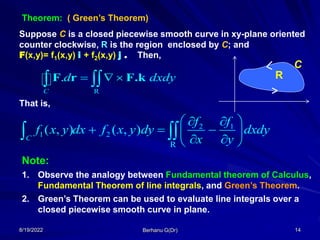
Theorem: ( Green’s Theorem)
2 1
1 2
R
( , ) ( , )
C
f f
f x y dx f x y dy dxdy
x y
 
 
  
 
 
 
 
Suppose C is a closed piecewise smooth curve in xy-plane oriented
counter clockwise, R is the region enclosed by C; and
F(x,y)= f1(x,y) i + f2(x,y) j . Then,
R
C
That is,
R
.
C
d dxdy
  
 
F r F.k
Note:
1. Observe the analogy between Fundamental theorem of Calculus,
Fundamental Theorem of line integrals, and Green’s Theorem.
2. Green’s Theorem can be used to evaluate line integrals over a
closed piecewise smooth curve in plane.
8/19/2022 Berhanu G(Dr) 15
Example: Use Green’s Theorem to evaluate
3
( ) ( 1)
C
x xy dx y dy
  

where C is the boundary of a square with vertices at the points
(1, 0), (2,0), (2, 1) and (1, 1), as shown in the figure below.
Solution: f1= x – xy and f2 = y3 +1 (1,0) (2,0)
(2,1)
(1,1)
R
C
3 2 1
R
( ) ( 1)
C
f f
x xy dx y dy dxdy
x y
 
 
    
 
 
 
 
2 2
1 1
1 1 1
0 0 0
3
2
3
=
2
xdx dy x d d
dx y y
   
  
   
   
 
  
8/19/2022 Berhanu G(Dr) 16
Exercise: Use Green’s Theorem to evaluate
where F(x,y)= y i + 5x j and C is the closed curve formed by the
three sides of the triangle whose vertices is at (0,0), (2,0) and (0,3),
shown in the figure below.
.
C
d
 F r
0 2
3
Ans. 12
( will become 4  area of the triangle )
.
C
d
 F r
Reading Assignment: Use of Green’s Theorem to find area
of a plane region
8/19/2022 Berhanu G(Dr) 17
• Aim: To evaluate integrals of quantities defined on a surface S.
4. 4 Integrals over Surfaces
• Recall: If a surface S is given by
f(x,y,z)=c,
where c is a constant and f is a differentiable scalar field, then
f(x,y,z) is a normal vector to S, at each point (x,y,z) on S;
• Like tangent for a curve, normal vector to a surface plays
important role to describe the surface (or for various discussion
related to the surface).
• Also, parametric representation of surfaces is very useful
(Since a surface is 2 dimensional, two parameters are required for
its parametric representation).
4. 4.1 Surfaces and Normal Vectors
8/19/2022
Berhanu G(Dr)
18
• Examples:
1. A sphere of radius  centered at 0, can be parameterized using:
x= cos(u) sin(v) , 0  u 2, and 0  v ,
y= sin(u) sin(v) ,
z= cos(v) .
• In particular, if every point (x,y,z) on a surface S can be written in
terms of two parameters u and v; i.e., if
x=x(u,v), y=y(u,v) and z=z(u,v), where a  u b, and c  v d,
then S is said to be parametrically represented by
r(u,v) = x(u,v) i + y(u,v) j + z(u,v) k, for a  u b & c  v d .
u
v
(x,y,z)

(x,y,0)
Thus,
r(u,v) =cos(u)sin(v)i +sin(u)sin(v)j + cos(v) k,
when 0  u 2, and 0  v .
8/19/2022 Berhanu G(Dr) 19
(x,y,0)

u
(x,y,z)
z=v
2. The lateral surface of a vertical circular cylinder of radius  and
height h can be parameterized using:
3. If S is given by x+y+z=1 over x,y[0,1] , then S can be
parameterized using
x=u, y=v, z=1uv, where 0  u 1, and 0  v 1.
x=cos(u), 0  u 2,
y=sin(u),
z=v, 0  v h.
Thus,
r(u,v) =cos(u)i +sin(u)j + v k,
when 0  u 2, and 0  vh.
Thus, r(u,v) =ui + v j + (1uv) k, when 0  u, v  1.
8/19/2022 Berhanu G(Dr) 20
• Normal vector: If a surface S is given by a differentiable
• In general, if S is given by z=f(x,y), for x[a,b] and y[c,d] , then
putting x=u and y=v, we can represent S by
• r(u,v) = u i + v j + f(u,v) k, where a  u b & c  v d
r(u,v) = x(u,v) i + y(u,v) j + z(u,v) k, for a  u b & c  v d ,
the, a normal vector N to S , called outward normal, is given by
N = ru  rv
v -constant
u -const
ru
rv
N
where ru & rv are partial derivatives of
r(u,v) w.r.t u & v, respectively
In this case, the unit outward normal of S is given by
|| ||
u v
u v



r r
r r
n
when N = ru  rv  0.
8/19/2022 Berhanu G(Dr) 21
• Definition: A surface S is said to be smooth if it has
continuously differentiable parametric representation r(u,v)
such that N = ru  rv  0 at every point on S.
( If this definition fails at only some finite points, then S is called
piecewise smooth)
Surface area: Let S be a smooth surface given parametrically by
r(u,v) over a region R = { (u,v) | a u b , c v d }
To find the area element A at r(u,v) :
Let b = r(u+u,v)  r(u,v) = ruu
h = r (u,v+u)  r(u,v) = rvv
 A  || b  h || = || ruu  rvv || = || ru rv|| u v
|| ||
R
u v dudv
 
  r r Some times, dA is
used instead of dS
So, taking u, v 0, we get dS = || ru rv|| du dv.
Hence, the total surface area of S is given by
A
h
r(u,v) b
8/19/2022 Berhanu G(Dr) 22
Exercise: Show that the surface area of a sphere of radius  is
42 .
|| ||
R
u v dudv
 
  r r
To show this:
recall that the parametric representation of sphere is
r(u,v) =cos(u)sin(v)i +sin(u)sin(v)j + cos(v) k
over the region R = { (u,v) | 0  u 2, 0  v  } ;
and surface area is given by
8/19/2022 Berhanu G(Dr) 23
4. 4.2 Surface Integral
• Let S be a surface of finite area and f(x,y,z) is a function (scalar
quantity) defined on S. The total quantity of f on S is given by the
following integral, called surface integral of f over S:
( , , )
f x y z d

S
S
Some times, dS is
used instead of dA
• To evaluate surface integral, we reduce it to double integral using
parametric representation of S. In particular, if S is given by
r(u,v) =x(u,v)i + y(u,v)j + z(u,v)k, for a  u b & c  v d,
then, f(x,y,z) = f(r(u,v)) over R = {(u,v) | a  u b , c  v d }
and dS = || ru rv|| du dv.
( , , ) ( ( , )) || ||
u v
R
f x y z d f u v dudv
 
 
S
S r r r
Hence,
8/19/2022 Berhanu G(Dr) 24
Example: Evaluate ( , , )
f x y z d

S
S
where f(x,y,z) = x+z and S is given by x2+y2=4, 0 z 3 .
Solution: Parametric representation of S ( which is cylinder) is:
( , , ) ( ( , )) || ||
u v
R
f x y z d f u v dudv
 
 
S
S r r r
r(u,v) = 2cos(u) i + 2sin(u) j + v k , over R= {(u,v) | 0  u 2, 0 v 3}
f(r(u,v)) = cos(u) +v; and
 ru rv = 2cos(u) i + 2sin(u) j
 ||ru rv || =2
ru = 2sin(u) i + 2cos(u) j + o k , rv = 0i + 0 j + 1 k .
Hence,
 
3 3
0
0
0
2
(cos ) 2 9
d
u v du v dv
v

 
  

 

8/19/2022 Berhanu G(Dr) 25
( ( , ))
R
u v
d u v dudv
 
 
S
F.n S F r . r r
|| ||
u v
u v



r r
r r
n
Recall: and dS = || ru rv|| du dv.
Hence, if a vector field
F(x,y) =f1(x,y,z)i + f2(x,y,z)j + f3(x,y,z)k,
is defined on a surface S whose parametric representation is
r(u,v) =x(u,v)i+y(u,v)j+z(u,v)k over R={(u,v) | a  u b , c  v d },
then, the flux integral through S is given by
• Flux integral through a surface S is a surface integral over S in
which the integrand is given by F.n :
where F is a vector field defined on S and n is the unit outward
normal vector to S.
d

S
F.n S
8/19/2022 Berhanu G(Dr) 26
• Example: Compute the flux integral of F(x,y) = i +xyj through
triangular surface S given by x+y+z=1, where 0x, y 1.
• Solution: Setting x=u, y=v, z=1uv, S is given by
r(u,v) =ui+vj+(1uv)k over R={(u,v) | 0  u, v 1 },
 F(r(u,v)) = i +uvj = (1, uv, 0)
ru  rv= i + j + k = (1, 1, 1)
F(r(u,v))  ru  rv = 1+ uv
Hence,
N
S
( ( , ))
R
u v
d u v dudv
 
 
S
F.n S F r . r r
 
1
1
0
0
(1 )
5
4
uv du dv
  
 
8/19/2022 Berhanu G(Dr) 27
Ans: idea
• S is composed of six piecewise smooth
surfaces S1, S2, …, S6. Hence, represent
each by parametric vector function and
compute:
• Exercise: Compute the flux integral , of
F(x,y,z) = ½ x2 i +yz j +x3yk through the surface (six sides) of the
unit cube whose vertices are at (0,0,0), (1, 0, 0), (0,1, 0) and (0, 0,1),
as shown in the figure below.
d

S
F.n S
(1,0,0) (0,1,0)
(0,0,1)
1 2 6
1
4
d dS dS dS
    
   
S S S S
F.n S F.n F.n F.n
( The next theorem, Divergence Theorem, provides you with
another way of com putting such flux integral)
8/19/2022 Berhanu G(Dr) 28
Theorem (Divergence Theorem):
• Let F(x, y, z) be a vector field, S be a piecewise smooth closed
surface enclosing a bounded 3D space (volume) V. Then,
.
V
dV d
 
 
S
F F.n S
• Divergence Theorem, also called Gauss Theorem, relates
surface(flux) integral across a closed surface S with volume integral
over V , where V is the volume (interior space) enclosed by S.
• It is 3D analogue of FTC, FTLI and Green’s Theorem)
(Here, dV = dx dy dz )
Or
(div )
V
d dV

 
S
F.n S F
In other words, the flux integral of F through a closed surface S is
identical to the volume integral of div F taken throughout V.
4. 5 Divergence and Stokes’ Theorems
8/19/2022 Berhanu G(Dr) 29
Solution: div F = .F = x + z
V = { (x,y,z) | 0  x, y, z 1 }
• Example: Using divergence Theorem, compute the flux integral
of F(x,y,z) = ½ x2 i +yz j +x3yk across the closed surface of the
unit cube whose vertices are at (0,0,0), (1, 0, 0), (0,1, 0) and (0, 0,1),
as shown in the figure below.
d

S
F.n S
(1,0,0) (0,1,0)
(0,0,1)
V
div
d dV

 
S
F.n S F
 
 
1
0 0
1
0
1
(
1
)
4
x dy
z dx dz

 
  
8/19/2022 Berhanu G(Dr) 30
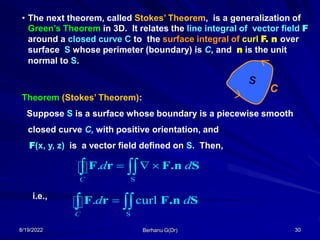
Theorem (Stokes’ Theorem):
Suppose S is a surface whose boundary is a piecewise smooth
closed curve C, with positive orientation, and
F(x, y, z) is a vector field defined on S. Then,
• The next theorem, called Stokes’ Theorem, is a generalization of
Green’s Theorem in 3D. It relates the line integral of vector field F
around a closed curve C to the surface integral of curl F. n over
surface S whose perimeter (boundary) is C, and n is the unit
normal to S.
i.e.,
C
S
S
.
C
d d
  
 
F r F.n S
S
curl
.
C
d d

 
F r F.n S
8/19/2022 Berhanu G(Dr) 31
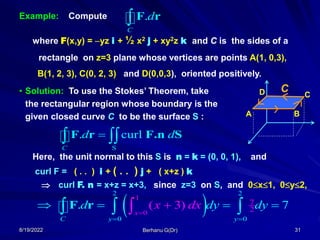
Example: Compute
• Solution: To use the Stokes’ Theorem, take
the rectangular region whose boundary is the
given closed curve C to be the surface S :
where F(x,y) = yz i + ½ x2 j + xy2z k and C is the sides of a
rectangle on z=3 plane whose vertices are points A(1, 0,3),
B(1, 2, 3), C(0, 2, 3) and D(0,0,3), oriented positively.
.
C
d
 F r
D
A B
C
C
S
curl
.
C
d d

 
F r F.n S
Here, the unit normal to this S is n = k = (0, 0, 1), and
curl F = ( . . ) i + ( . . ) j + ( x+z ) k
 curl F. n = x+z = x+3, since z=3 on S, and 0x1, 0y2,
 
1
2 2
0 0
0
7
2
( 3 7
)
.
C y y
x
x y
d dy
x
d d



 
  
   
F r
8/19/2022 Berhanu G(Dr) 32
(a) F(x,y) = 2y i + xz3j  zy3 k and C is the circle x2+y2=4 on z=3
plane . (ans. 284 )
(b) F(x,y) = y i + zj + 3y k and C is the intersection of x2+y2+z2=6z
and z=x+3 . (ans. )
(c) F(x,y) = y2 i + x2 j  (x+z) k and C is the boundary of the
triangle with vertices at (0, 0,0), (1, 0, 0) and (1,1,0).
(ans. 1/3 )
Exercise: Using Stokes’ Theorem, evaluate .
C
d
 F r
where the vector field F and positively oriented curve C are
as given below.
18 2


8/19/2022 Berhanu G(Dr) 33

Line integral.ppt

  • 1.
    8/19/2022 Berhanu G(Dr)1 Line and Surface Integrals 4. 1 Line Integral C A B • Let C be a smooth space curve with initial point A and terminal point B, parameterized by its arc length s: • And let f( x, y, z) is a scalar field defined at each point on C. • The line (curve) integral of f along C from A to B, w.r.t. arc length s, is defined by r (s) = x(s)i + y(s) j + z(s) k, asb (so that r(a)=A and r(b)=B ) ( , , ) ( ), ( ), ( ) ( ) C b a f x y z ds f x s y s z s ds    • If C is closed, the line integral is denoted by C fds 
  • 2.
    8/19/2022 Berhanu G(Dr)2 • Example 1: Integrate f(x,y)=xy2 over a circular arc given by r (s) = cos(s) i + sin(s) j , 0 s  /2 • Remark: If a curve C is parameterized by any parameter, say, t : 2 2 / 2 0 2 cos( )sin ( ) 3 C xy ds s s ds      C • Solution: On C, x =cos(s) ; y= sin(s)  f(x,y)=xy2 =cos(s). sin2(s) , on C. Therefore, r (t) = x(t)i + y(t) j + z(t) k, a  t  b, '( ) ds ds dt t dt dt   r then, making change of variable: we get, ( , , ) ( ( )) '( ) C b a f x y z ds f t t dt    r r
  • 3.
    8/19/2022 Berhanu G(Dr)3 • Example 2: Evaluate ( 4 ) C xy z ds   • Solution: C is given by r (t) = A + t (BA) , 0  t  1 = 2t i + t j + (1+2t) k, 0  t  1. So, on C, xy +4z = (2t)t + 4(1+2t) = 2t2 + 8t + 4 and, ds = |r(t) | dt . But |r(t) |= | 2i + j + 2 k | = 3  ds = 3dt Therefore, when C is a straight line segment from point A(0,0, 1) to B = (2, 1,3).
  • 4.
    8/19/2022 Berhanu G(Dr)4 Usually, line integrals that involves a vector field F( x, y, z) that defined on C has the following form: C r(t) A B • Or, representing C by r (t) = x(t)i + y(t) j + z(t) k, a  t  b, . C d  F r where, F( x, y, z) = f1(x,y,z)i + f2 (x,y,z)j + f3 (x,y,z) k, and, dr = dx i + dy j + dz k ( line integral of tangential component of F ) That is, 1 2 3 ( , , ) ( , , ) ( , , ) . C C d f x y z dx f x y z dy f x y z dz      F r '( ) d d dt t dt dt   r r r ( , , ) ( ( )) x y z t  F F r Moreover, on C, We get, ( ( )) '( ) . . b C a d t t dt    F r F r r
  • 5.
    8/19/2022 Berhanu G(Dr)5 • Example 3: Let F(x,y) = (x + y) i + (xy) j . Evaluate when C is: (a) the parabola y=x2 from (1,1) to (4,2) (b) the circle x2+y2 = 1 • Solution: (a) F.dr = (x+y)dx + (xy)dy. But on C, y=x2 , dy=2xdx = (x+x2) dx + (xx2)2x dx = (x + 3x2 2x3) dx, 1  x  4. Hence, (b) C, parametrically, r (t) = cost i + sint j , 0  t  2 r (t) = cost i + sint j ,  r (t) = sint i + cost j , and, F(r(t) ) = (cost + sint) i + (costsint) j . Hence, . C d  F r ( ) ( ) . C C d x y dx x y dy       F r 4 2 3 1 34 3 ( 3 2 ) x x x dx      2 2 0 0 ( ( )) '( ) (cos(2 ) sin(2 )) 0 . . C d t t dt t t dt          F r F r r
  • 6.
    8/19/2022 Berhanu G(Dr)6 • Exercise: 1) Let F(x,y) = x i + x2 j . Evaluate Ans.  4 (1,0) ( 1,0) .d   F r along curve C , from (1,0) to (1,0) in the xy-plane, given by (a) the semi-circle of radius 1 (b) the polygonal path (line segments) shown in the figure below. (1,0) (1,0) (1,1) (0,1) 2) Evaluate where C is the circle x2+y2=4, oriented counterclockwise. C ydx xydy   Ans. (a) 0; (b) ½
  • 7.
    8/19/2022 Berhanu G(Dr)7 At each instant of time t, the particle may be thought as moving in the direction of the tangent to its trajectory, r(t). Hence, F(r(t)).r(t) is the product of force with a direction, and so has the dimension of work. Therefore, the line integral is the work done by the force F in moving the particle from A to B over the path C. ( ( )) '( ) . . b C a d t t dt    F r F r r Remark : Line integrals arise in many context. For example, consider a force F causing a particle to move from point A to point B in space along a smooth curve C whose vector equation r(t) is representing the position of the particle at time t, such that atb, C r(t) A B r (t)
  • 8.
    8/19/2022 Berhanu G(Dr)8 • Suppose C1 and C2 are different curves from point A to B, and let F(x,y,z) be a vector space defined on both curves, 4. 2 Line Integral Independent of Path A B C1 C2 • In a general case, 1 . C d  F r and 2 . C d  F r may not equal. (See, the above exercise. ) • That means, the value of a line integral from point A to B may depend on the curve (path) along which we integrate. (see, the above exercise) • However, for a particular F, if for every curve C1 and C2 that join any point A to B , we say the line integral of F is path independent. 1 2 . . C C d d    F r F r • We will show that line integral of a conservative vector filed F is path independent. Recall: F is conservative if F=f, for some scalar field f (called potential of F)
  • 9.
    8/19/2022 Berhanu G(Dr)9 Theorem: (Fundamental Theorem of Line Integral) Suppose C is a smooth curve from point A(x0,y0,z0) to B(x1,y1,z1) . Let f (x,y,z) be a scalar field, continuously differentiable, on C. Then, A B C Proof: Let r(t), for atb, represents C so that r(a)=A and r(b)=B. ( ) ( ) . C d f B f A f     r • Consequently, the line integral of f is path independent. Hence, the line integral of f along every curve C from point A to B are equal and can be written as '( ) . ( ( ). b C a d t dt f f r t      r r = ( ( ) ( ( ) b b a a d dt f t f t   r r ( ( ) ( ( ) ( ) ( ) f b f a f B f A     r r ( ) ( ) . B A d f B f A f     r
  • 10.
    8/19/2022 Berhanu G(Dr)10 Theorem: (Line Integral of Conservative Vector Fields) The line integral of a conservative vector field is independent of path. In particular, if F is a conservative vector field and C is a curve from point A to B, then where  is a potential of F; i.e., F=  Thus, the line integral of a conservative F over a curve C is the difference of the values of its potential function at the end points of C. ( ) ( ) . . C C d d B A          r r F ( ) ( ) . C d B A      F r Further, if C is a closed curve, then 0 . C d   F r • The proof follows directly from the previous Theorem since,
  • 11.
    8/19/2022 Berhanu G(Dr)11 Example. Evaluate 2 (1, /8) (0,0) 2 cos(2 ) 2 sin(2 ) x y dx x y dy    Solution: This is line integral of F(x,y) = 2xcos(2y) i – 2x2sin(2y) j along certain curve from (0,0) to (1, /8). You can check that F is conservative and its potential function is (x,y) = x2cos(2y). Hence, along any curve in the xy-plane from (0,0) to (1, /8), we get 2 (1, /8) 8 (0,0) 2 2 2 cos(2 ) 2 sin(2 ) (1, ) (0,0) x y dx x y dy         
  • 12.
    8/19/2022 Berhanu G(Dr)12 Exercise. 2 (2,3) (0,1) (2 1) ( 1) xy dx x dy     (a) 2. For the following integrals, C is the ellipse x2 + 4y2 = 16 (5,3,2) (0,0,0) .dr  F (b) , where F(x,y,z) = 3i + zj + (y+2z)k 1. Show that each of the following line integrals are independent of path and evaluate the integrals. . C dr  F (i) , F(x,y,z) = (2xy+z2)i + x2j + (2xz+  cos(z) )k (ii) 2 3 C 3x ydx x dy  
  • 13.
    8/19/2022 Berhanu G(Dr)13 • Green’s Theorem relates certain line integrals over a closed curve with double integrals over plane region enclosed by the curve. 4. 3 Green’s Theorem • Recall the following definition of double integrals: If R ={ (x,y) | a  x b, g1(x) y g2(x) }, y=g1(x) y=g2(x) a b R   2 1 ( ) ( ) R ( , ) ( , ) g x g x b a f x y dxdy x y x f y d d     • OR, if R ={ (x,y) | h1(y) x h2(y) ,c y d },   2 1 ( ) ( ) R ( , ) ( , ) h y h y d c f x y dxdy x y y f x d d     c d R
  • 14.
    8/19/2022 Berhanu G(Dr)14 Theorem: ( Green’s Theorem) 2 1 1 2 R ( , ) ( , ) C f f f x y dx f x y dy dxdy x y                Suppose C is a closed piecewise smooth curve in xy-plane oriented counter clockwise, R is the region enclosed by C; and F(x,y)= f1(x,y) i + f2(x,y) j . Then, R C That is, R . C d dxdy      F r F.k Note: 1. Observe the analogy between Fundamental theorem of Calculus, Fundamental Theorem of line integrals, and Green’s Theorem. 2. Green’s Theorem can be used to evaluate line integrals over a closed piecewise smooth curve in plane.
  • 15.
    8/19/2022 Berhanu G(Dr)15 Example: Use Green’s Theorem to evaluate 3 ( ) ( 1) C x xy dx y dy     where C is the boundary of a square with vertices at the points (1, 0), (2,0), (2, 1) and (1, 1), as shown in the figure below. Solution: f1= x – xy and f2 = y3 +1 (1,0) (2,0) (2,1) (1,1) R C 3 2 1 R ( ) ( 1) C f f x xy dx y dy dxdy x y                  2 2 1 1 1 1 1 0 0 0 3 2 3 = 2 xdx dy x d d dx y y                    
  • 16.
    8/19/2022 Berhanu G(Dr)16 Exercise: Use Green’s Theorem to evaluate where F(x,y)= y i + 5x j and C is the closed curve formed by the three sides of the triangle whose vertices is at (0,0), (2,0) and (0,3), shown in the figure below. . C d  F r 0 2 3 Ans. 12 ( will become 4  area of the triangle ) . C d  F r Reading Assignment: Use of Green’s Theorem to find area of a plane region
  • 17.
    8/19/2022 Berhanu G(Dr)17 • Aim: To evaluate integrals of quantities defined on a surface S. 4. 4 Integrals over Surfaces • Recall: If a surface S is given by f(x,y,z)=c, where c is a constant and f is a differentiable scalar field, then f(x,y,z) is a normal vector to S, at each point (x,y,z) on S; • Like tangent for a curve, normal vector to a surface plays important role to describe the surface (or for various discussion related to the surface). • Also, parametric representation of surfaces is very useful (Since a surface is 2 dimensional, two parameters are required for its parametric representation). 4. 4.1 Surfaces and Normal Vectors
  • 18.
    8/19/2022 Berhanu G(Dr) 18 • Examples: 1.A sphere of radius  centered at 0, can be parameterized using: x= cos(u) sin(v) , 0  u 2, and 0  v , y= sin(u) sin(v) , z= cos(v) . • In particular, if every point (x,y,z) on a surface S can be written in terms of two parameters u and v; i.e., if x=x(u,v), y=y(u,v) and z=z(u,v), where a  u b, and c  v d, then S is said to be parametrically represented by r(u,v) = x(u,v) i + y(u,v) j + z(u,v) k, for a  u b & c  v d . u v (x,y,z)  (x,y,0) Thus, r(u,v) =cos(u)sin(v)i +sin(u)sin(v)j + cos(v) k, when 0  u 2, and 0  v .
  • 19.
    8/19/2022 Berhanu G(Dr)19 (x,y,0)  u (x,y,z) z=v 2. The lateral surface of a vertical circular cylinder of radius  and height h can be parameterized using: 3. If S is given by x+y+z=1 over x,y[0,1] , then S can be parameterized using x=u, y=v, z=1uv, where 0  u 1, and 0  v 1. x=cos(u), 0  u 2, y=sin(u), z=v, 0  v h. Thus, r(u,v) =cos(u)i +sin(u)j + v k, when 0  u 2, and 0  vh. Thus, r(u,v) =ui + v j + (1uv) k, when 0  u, v  1.
  • 20.
    8/19/2022 Berhanu G(Dr)20 • Normal vector: If a surface S is given by a differentiable • In general, if S is given by z=f(x,y), for x[a,b] and y[c,d] , then putting x=u and y=v, we can represent S by • r(u,v) = u i + v j + f(u,v) k, where a  u b & c  v d r(u,v) = x(u,v) i + y(u,v) j + z(u,v) k, for a  u b & c  v d , the, a normal vector N to S , called outward normal, is given by N = ru  rv v -constant u -const ru rv N where ru & rv are partial derivatives of r(u,v) w.r.t u & v, respectively In this case, the unit outward normal of S is given by || || u v u v    r r r r n when N = ru  rv  0.
  • 21.
    8/19/2022 Berhanu G(Dr)21 • Definition: A surface S is said to be smooth if it has continuously differentiable parametric representation r(u,v) such that N = ru  rv  0 at every point on S. ( If this definition fails at only some finite points, then S is called piecewise smooth) Surface area: Let S be a smooth surface given parametrically by r(u,v) over a region R = { (u,v) | a u b , c v d } To find the area element A at r(u,v) : Let b = r(u+u,v)  r(u,v) = ruu h = r (u,v+u)  r(u,v) = rvv  A  || b  h || = || ruu  rvv || = || ru rv|| u v || || R u v dudv     r r Some times, dA is used instead of dS So, taking u, v 0, we get dS = || ru rv|| du dv. Hence, the total surface area of S is given by A h r(u,v) b
  • 22.
    8/19/2022 Berhanu G(Dr)22 Exercise: Show that the surface area of a sphere of radius  is 42 . || || R u v dudv     r r To show this: recall that the parametric representation of sphere is r(u,v) =cos(u)sin(v)i +sin(u)sin(v)j + cos(v) k over the region R = { (u,v) | 0  u 2, 0  v  } ; and surface area is given by
  • 23.
    8/19/2022 Berhanu G(Dr)23 4. 4.2 Surface Integral • Let S be a surface of finite area and f(x,y,z) is a function (scalar quantity) defined on S. The total quantity of f on S is given by the following integral, called surface integral of f over S: ( , , ) f x y z d  S S Some times, dS is used instead of dA • To evaluate surface integral, we reduce it to double integral using parametric representation of S. In particular, if S is given by r(u,v) =x(u,v)i + y(u,v)j + z(u,v)k, for a  u b & c  v d, then, f(x,y,z) = f(r(u,v)) over R = {(u,v) | a  u b , c  v d } and dS = || ru rv|| du dv. ( , , ) ( ( , )) || || u v R f x y z d f u v dudv     S S r r r Hence,
  • 24.
    8/19/2022 Berhanu G(Dr)24 Example: Evaluate ( , , ) f x y z d  S S where f(x,y,z) = x+z and S is given by x2+y2=4, 0 z 3 . Solution: Parametric representation of S ( which is cylinder) is: ( , , ) ( ( , )) || || u v R f x y z d f u v dudv     S S r r r r(u,v) = 2cos(u) i + 2sin(u) j + v k , over R= {(u,v) | 0  u 2, 0 v 3} f(r(u,v)) = cos(u) +v; and  ru rv = 2cos(u) i + 2sin(u) j  ||ru rv || =2 ru = 2sin(u) i + 2cos(u) j + o k , rv = 0i + 0 j + 1 k . Hence,   3 3 0 0 0 2 (cos ) 2 9 d u v du v dv v          
  • 25.
    8/19/2022 Berhanu G(Dr)25 ( ( , )) R u v d u v dudv     S F.n S F r . r r || || u v u v    r r r r n Recall: and dS = || ru rv|| du dv. Hence, if a vector field F(x,y) =f1(x,y,z)i + f2(x,y,z)j + f3(x,y,z)k, is defined on a surface S whose parametric representation is r(u,v) =x(u,v)i+y(u,v)j+z(u,v)k over R={(u,v) | a  u b , c  v d }, then, the flux integral through S is given by • Flux integral through a surface S is a surface integral over S in which the integrand is given by F.n : where F is a vector field defined on S and n is the unit outward normal vector to S. d  S F.n S
  • 26.
    8/19/2022 Berhanu G(Dr)26 • Example: Compute the flux integral of F(x,y) = i +xyj through triangular surface S given by x+y+z=1, where 0x, y 1. • Solution: Setting x=u, y=v, z=1uv, S is given by r(u,v) =ui+vj+(1uv)k over R={(u,v) | 0  u, v 1 },  F(r(u,v)) = i +uvj = (1, uv, 0) ru  rv= i + j + k = (1, 1, 1) F(r(u,v))  ru  rv = 1+ uv Hence, N S ( ( , )) R u v d u v dudv     S F.n S F r . r r   1 1 0 0 (1 ) 5 4 uv du dv     
  • 27.
    8/19/2022 Berhanu G(Dr)27 Ans: idea • S is composed of six piecewise smooth surfaces S1, S2, …, S6. Hence, represent each by parametric vector function and compute: • Exercise: Compute the flux integral , of F(x,y,z) = ½ x2 i +yz j +x3yk through the surface (six sides) of the unit cube whose vertices are at (0,0,0), (1, 0, 0), (0,1, 0) and (0, 0,1), as shown in the figure below. d  S F.n S (1,0,0) (0,1,0) (0,0,1) 1 2 6 1 4 d dS dS dS          S S S S F.n S F.n F.n F.n ( The next theorem, Divergence Theorem, provides you with another way of com putting such flux integral)
  • 28.
    8/19/2022 Berhanu G(Dr)28 Theorem (Divergence Theorem): • Let F(x, y, z) be a vector field, S be a piecewise smooth closed surface enclosing a bounded 3D space (volume) V. Then, . V dV d     S F F.n S • Divergence Theorem, also called Gauss Theorem, relates surface(flux) integral across a closed surface S with volume integral over V , where V is the volume (interior space) enclosed by S. • It is 3D analogue of FTC, FTLI and Green’s Theorem) (Here, dV = dx dy dz ) Or (div ) V d dV    S F.n S F In other words, the flux integral of F through a closed surface S is identical to the volume integral of div F taken throughout V. 4. 5 Divergence and Stokes’ Theorems
  • 29.
    8/19/2022 Berhanu G(Dr)29 Solution: div F = .F = x + z V = { (x,y,z) | 0  x, y, z 1 } • Example: Using divergence Theorem, compute the flux integral of F(x,y,z) = ½ x2 i +yz j +x3yk across the closed surface of the unit cube whose vertices are at (0,0,0), (1, 0, 0), (0,1, 0) and (0, 0,1), as shown in the figure below. d  S F.n S (1,0,0) (0,1,0) (0,0,1) V div d dV    S F.n S F     1 0 0 1 0 1 ( 1 ) 4 x dy z dx dz      
  • 30.
    8/19/2022 Berhanu G(Dr)30 Theorem (Stokes’ Theorem): Suppose S is a surface whose boundary is a piecewise smooth closed curve C, with positive orientation, and F(x, y, z) is a vector field defined on S. Then, • The next theorem, called Stokes’ Theorem, is a generalization of Green’s Theorem in 3D. It relates the line integral of vector field F around a closed curve C to the surface integral of curl F. n over surface S whose perimeter (boundary) is C, and n is the unit normal to S. i.e., C S S . C d d      F r F.n S S curl . C d d    F r F.n S
  • 31.
    8/19/2022 Berhanu G(Dr)31 Example: Compute • Solution: To use the Stokes’ Theorem, take the rectangular region whose boundary is the given closed curve C to be the surface S : where F(x,y) = yz i + ½ x2 j + xy2z k and C is the sides of a rectangle on z=3 plane whose vertices are points A(1, 0,3), B(1, 2, 3), C(0, 2, 3) and D(0,0,3), oriented positively. . C d  F r D A B C C S curl . C d d    F r F.n S Here, the unit normal to this S is n = k = (0, 0, 1), and curl F = ( . . ) i + ( . . ) j + ( x+z ) k  curl F. n = x+z = x+3, since z=3 on S, and 0x1, 0y2,   1 2 2 0 0 0 7 2 ( 3 7 ) . C y y x x y d dy x d d             F r
  • 32.
    8/19/2022 Berhanu G(Dr)32 (a) F(x,y) = 2y i + xz3j  zy3 k and C is the circle x2+y2=4 on z=3 plane . (ans. 284 ) (b) F(x,y) = y i + zj + 3y k and C is the intersection of x2+y2+z2=6z and z=x+3 . (ans. ) (c) F(x,y) = y2 i + x2 j  (x+z) k and C is the boundary of the triangle with vertices at (0, 0,0), (1, 0, 0) and (1,1,0). (ans. 1/3 ) Exercise: Using Stokes’ Theorem, evaluate . C d  F r where the vector field F and positively oriented curve C are as given below. 18 2  
  • 33.