Complex Numbers
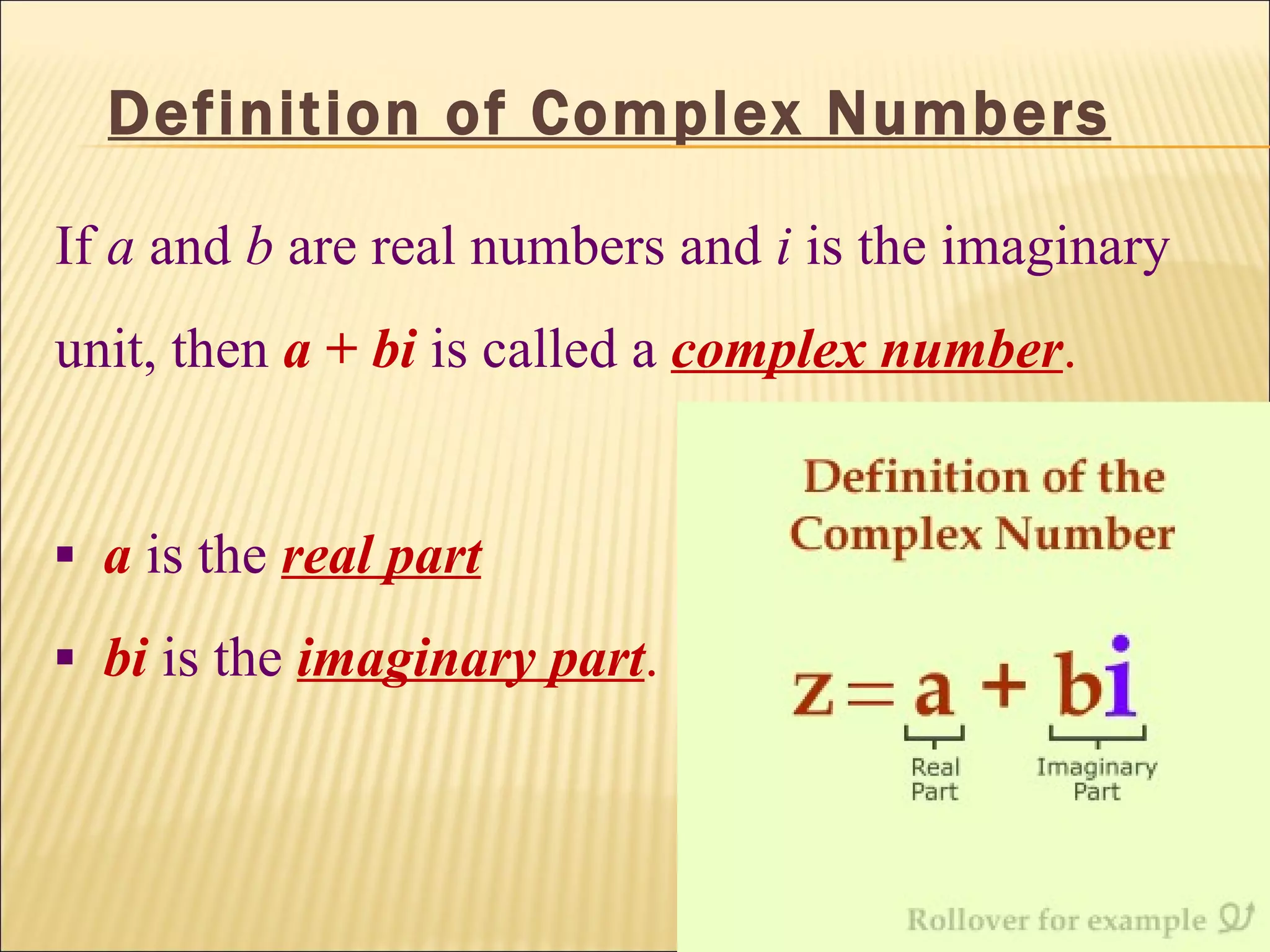
If  a  and  b  are real numbers and  i  is the imaginary  unit, then  a  +  bi   is called a  complex number .  ▪  a   is the  real part   ▪  bi  is the  imaginary part . Definition of Complex Numbers
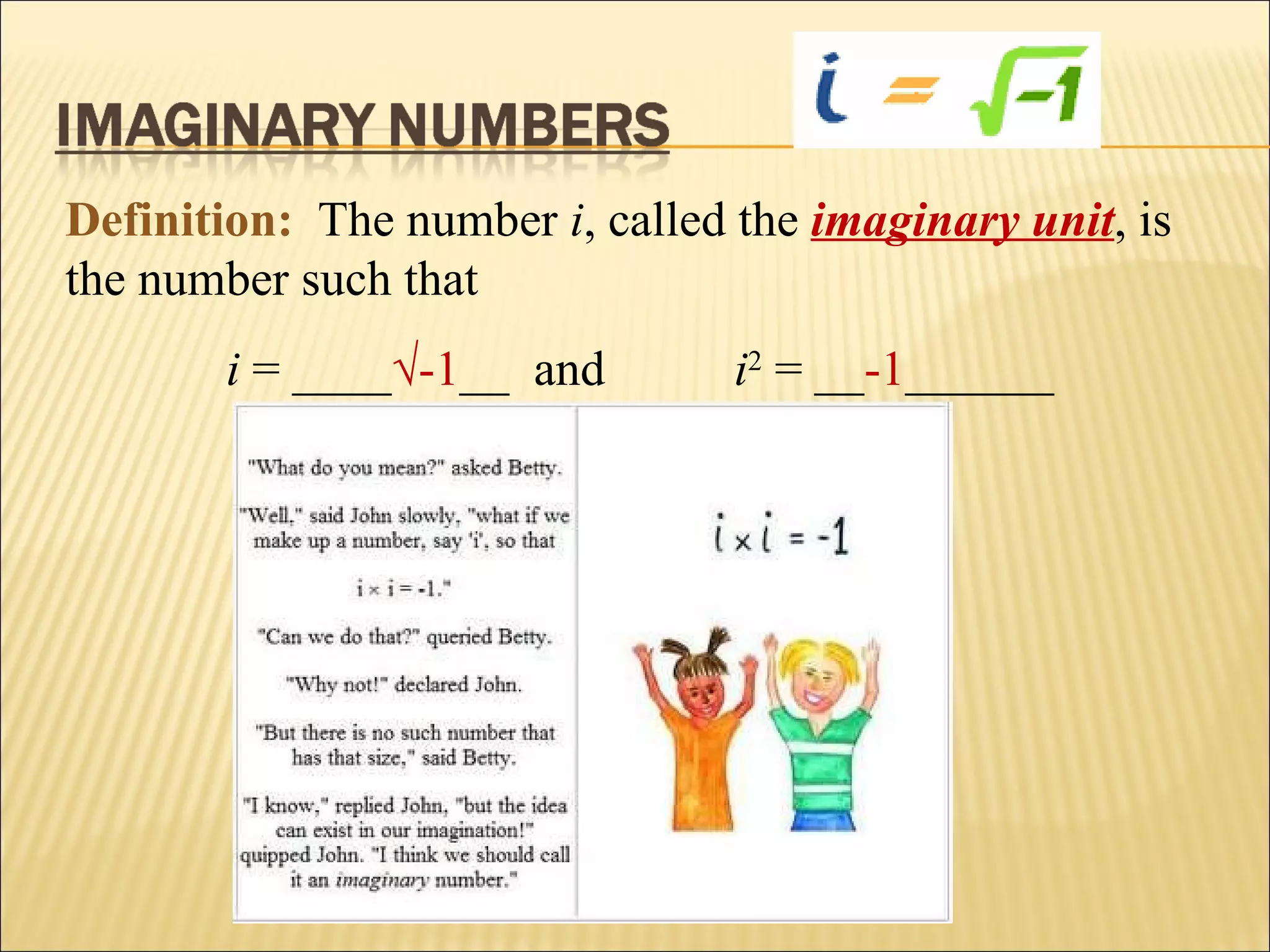
Definition:   The number  i , called the  imaginary unit , is the number such that i  = ____ √-1 __  and  i 2  = __ -1 ______
Powers of i
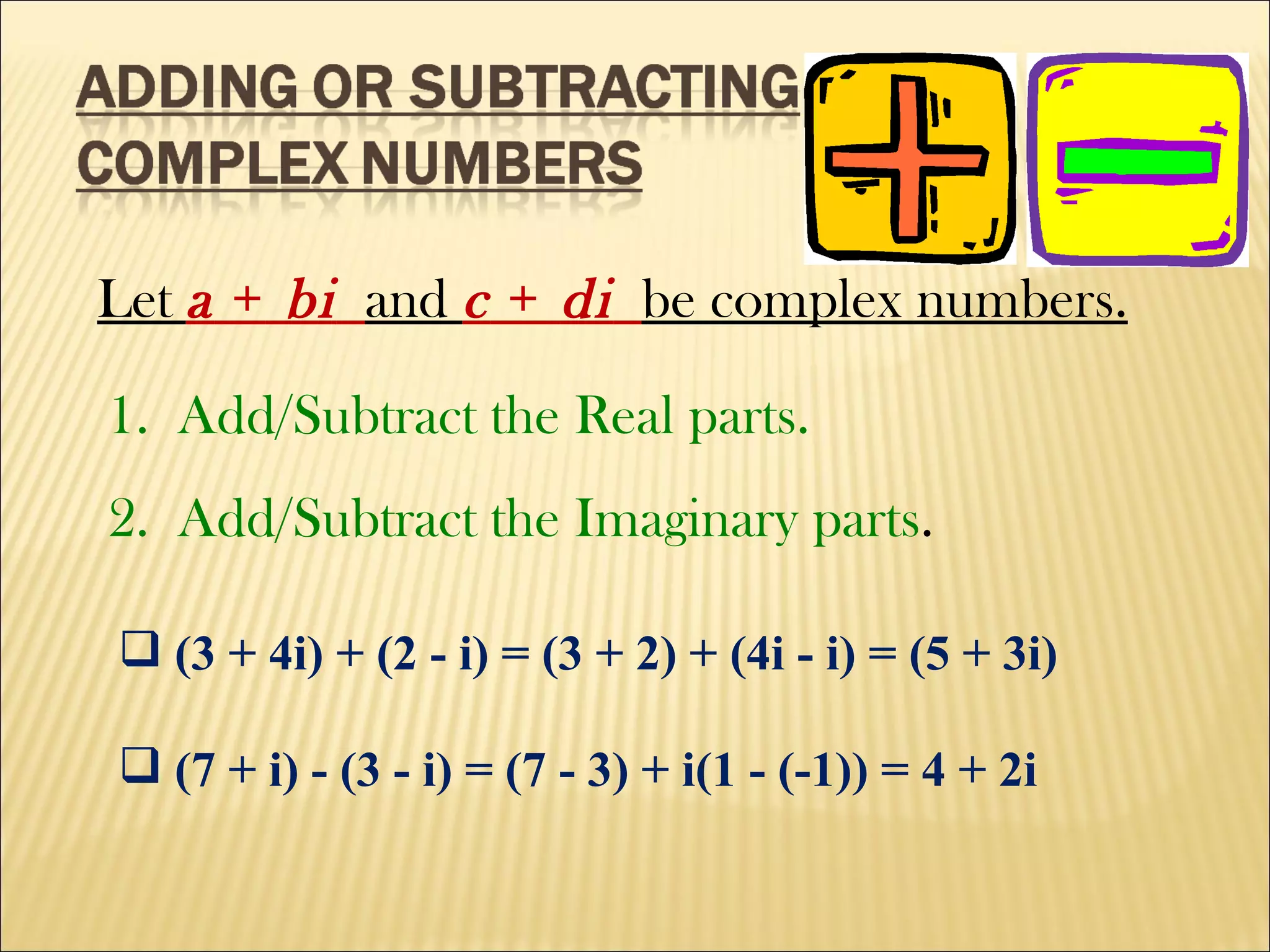
Let  a  +  bi   and  c  +  di   be complex numbers. 1.  Add/Subtract the Real parts. 2.  Add/Subtract the Imaginary parts . (3 + 4i) + (2 - i) = (3 + 2) + (4i - i) = (5 + 3i) (7 + i) - (3 - i) = (7 - 3) + i(1 - (-1)) = 4 + 2i
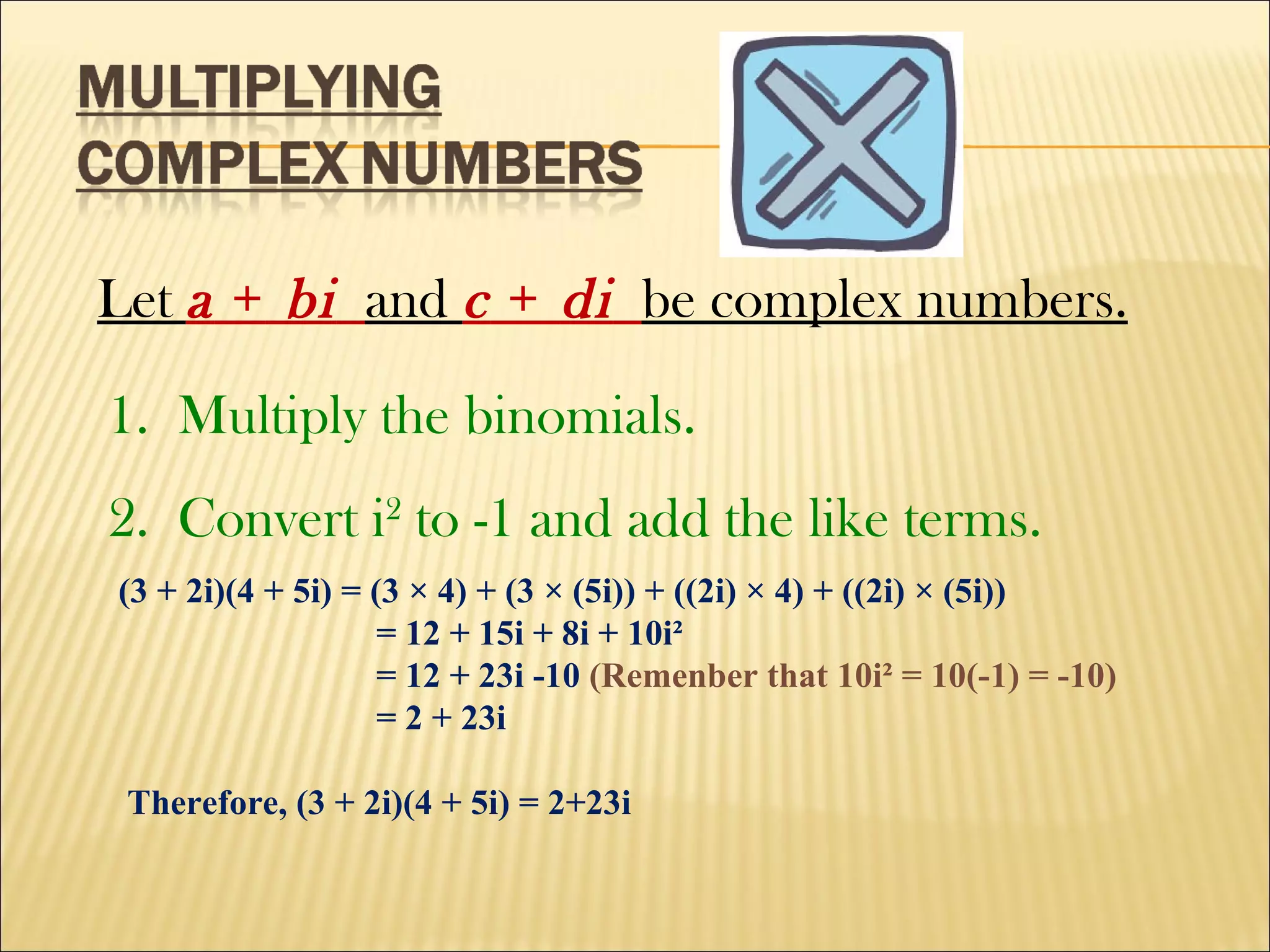
Let  a  +  bi   and  c  +  di   be complex numbers. 1.  Multiply the binomials. 2.  Convert i 2  to -1 and add the like terms. (3 + 2i)(4 + 5i) = (3 × 4) + (3 × (5i)) + ((2i) × 4) + ((2i) × (5i))                              = 12 + 15i + 8i + 10i²                              = 12 + 23i -10  (Remenber that 10i² = 10(-1) = -10)                              = 2 + 23i  Therefore, (3 + 2i)(4 + 5i) = 2+23i
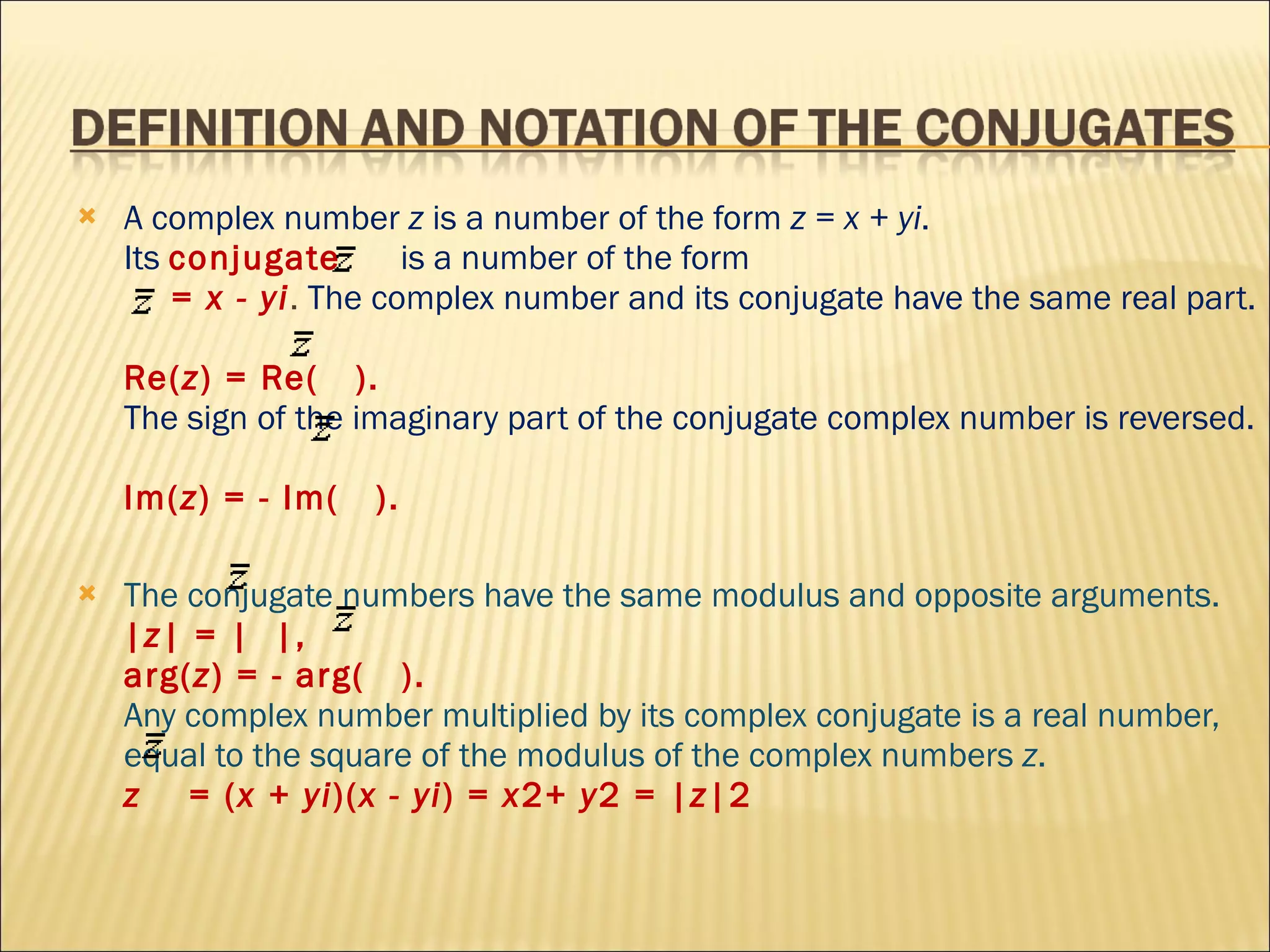
A complex number  z  is a number of the form  z = x + yi .  Its  conjugate  is a number of the form    =  x - yi .  The complex number and its conjugate have the same real part.  Re( z ) = Re(  ).  The sign of the imaginary part of the conjugate complex number is reversed.  Im( z ) = - Im(  ).  The conjugate numbers have the same modulus and opposite arguments. | z | = |  |,  arg( z ) = - arg(  ).  Any complex number multiplied by its complex conjugate is a real number, equal to the square of the modulus of the complex numbers  z .  z   = ( x + yi )( x - yi ) =  x 2+  y 2 = | z |2
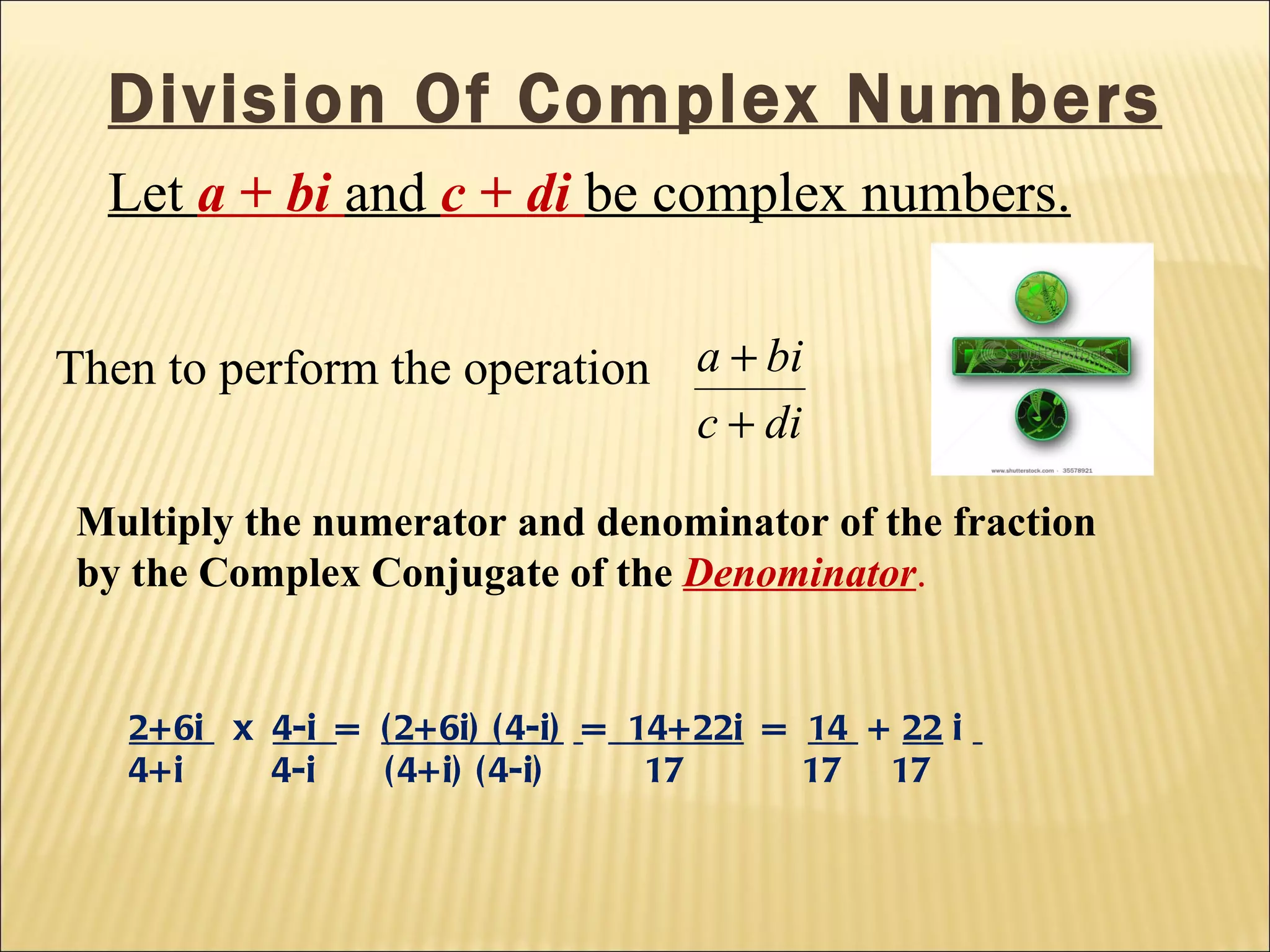
Division Of Complex Numbers Let  a  +  bi   and  c  +  di   be complex numbers.   Multiply the numerator and denominator of the fraction by the Complex Conjugate of the  Denominator . Then to perform the operation 2+6i  x  4-i  =  (2+6i) (4-i)   =   14+22i   =  14  +  22  i  4+i  4-i  (4+i) (4-i)  17  17  17
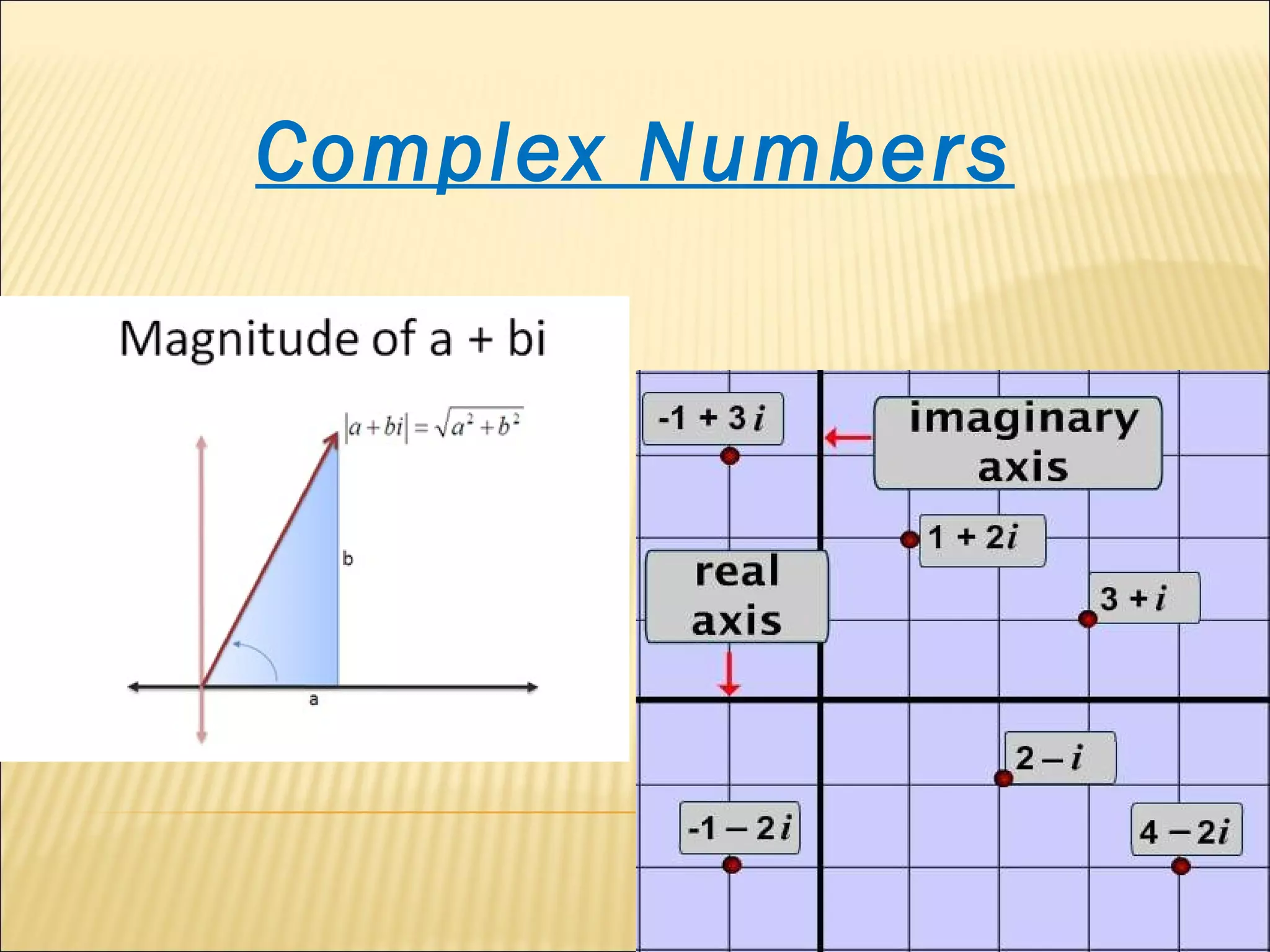
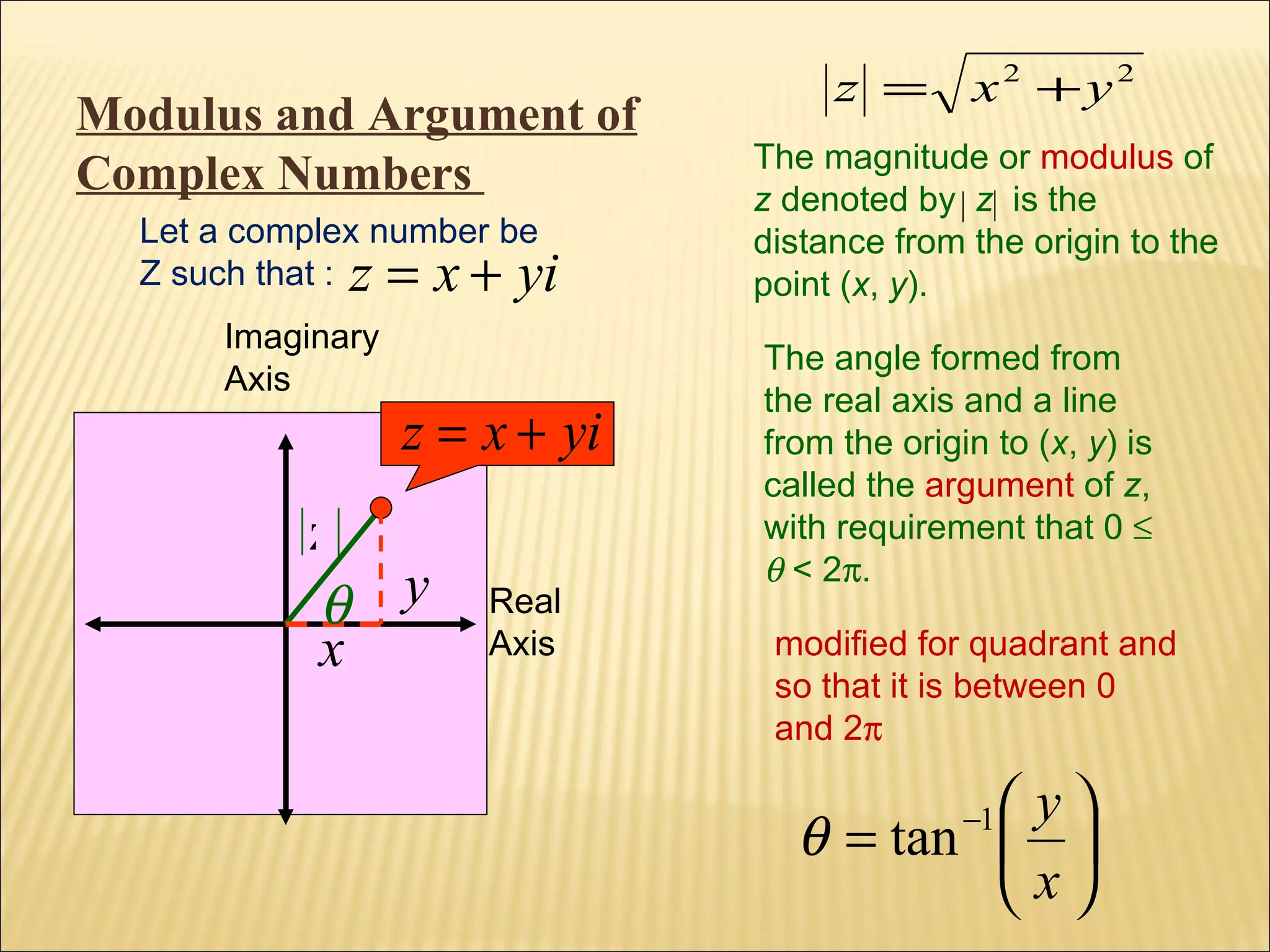
Real Axis Imaginary Axis y x  The angle formed from the real axis and a line from the origin to ( x ,  y ) is called the  argument  of  z , with requirement that 0       < 2  . modified for quadrant and so that it is between 0 and 2  Let a complex number be Z such that : z Modulus and Argument of Complex Numbers  The magnitude or  modulus  of  z  denoted by  z  is the distance from the origin to the point ( x ,  y ).
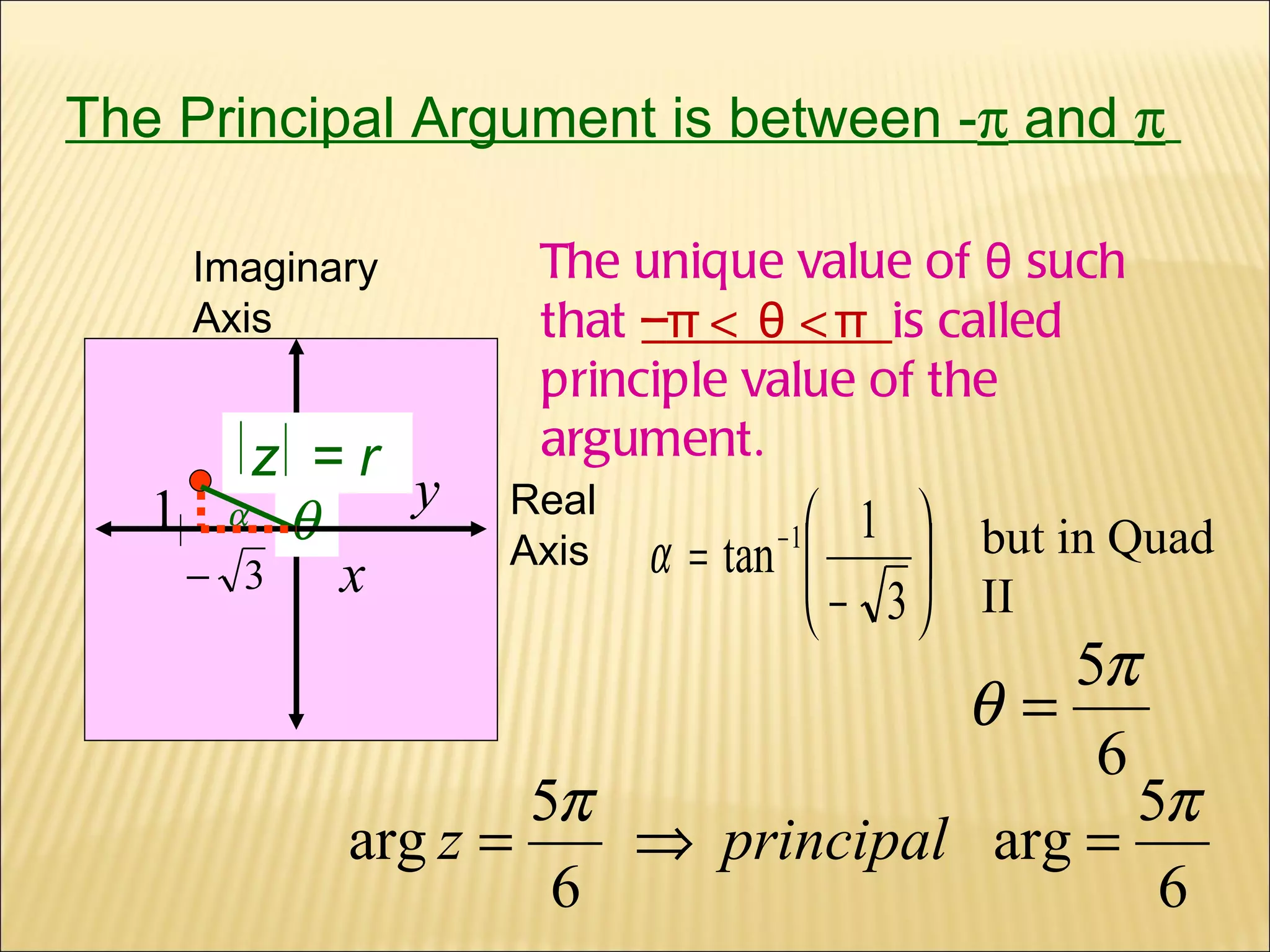
The Principal Argument is between -   and     Real Axis Imaginary Axis y x z  = r   1  The unique value of  θ  such that  – π  <  θ  < π   is called principle value of the argument. but in Quad II
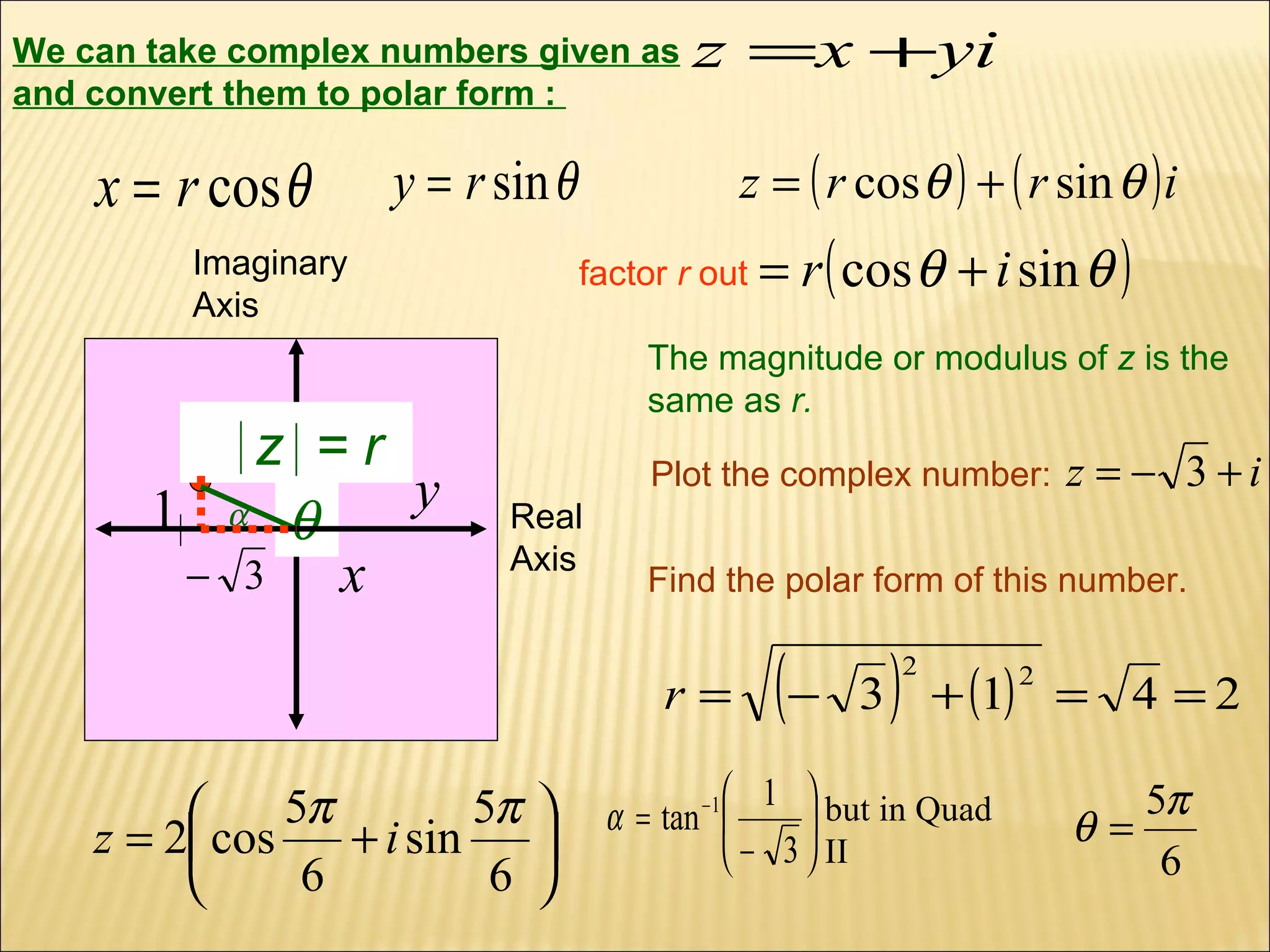
The magnitude or modulus of  z  is the same as  r. We can take complex numbers given as and convert them to polar form :  Real Axis Imaginary Axis y x z  = r   Plot the complex number:  Find the polar form of this number.  1  factor  r  out but in Quad II
 

complex numbers

  • 1.
  • 2.
    If a and b are real numbers and i is the imaginary unit, then a + bi is called a complex number . ▪ a is the real part ▪ bi is the imaginary part . Definition of Complex Numbers
  • 3.
    Definition: The number i , called the imaginary unit , is the number such that i = ____ √-1 __ and i 2 = __ -1 ______
  • 4.
  • 5.
    Let a + bi and c + di be complex numbers. 1. Add/Subtract the Real parts. 2. Add/Subtract the Imaginary parts . (3 + 4i) + (2 - i) = (3 + 2) + (4i - i) = (5 + 3i) (7 + i) - (3 - i) = (7 - 3) + i(1 - (-1)) = 4 + 2i
  • 6.
    Let a + bi and c + di be complex numbers. 1. Multiply the binomials. 2. Convert i 2 to -1 and add the like terms. (3 + 2i)(4 + 5i) = (3 × 4) + (3 × (5i)) + ((2i) × 4) + ((2i) × (5i))                              = 12 + 15i + 8i + 10i²                              = 12 + 23i -10 (Remenber that 10i² = 10(-1) = -10)                              = 2 + 23i  Therefore, (3 + 2i)(4 + 5i) = 2+23i
  • 7.
    A complex number z is a number of the form z = x + yi . Its conjugate is a number of the form = x - yi . The complex number and its conjugate have the same real part. Re( z ) = Re( ). The sign of the imaginary part of the conjugate complex number is reversed. Im( z ) = - Im( ). The conjugate numbers have the same modulus and opposite arguments. | z | = | |, arg( z ) = - arg( ). Any complex number multiplied by its complex conjugate is a real number, equal to the square of the modulus of the complex numbers z . z = ( x + yi )( x - yi ) = x 2+ y 2 = | z |2
  • 8.
    Division Of ComplexNumbers Let a + bi and c + di be complex numbers. Multiply the numerator and denominator of the fraction by the Complex Conjugate of the Denominator . Then to perform the operation 2+6i x 4-i = (2+6i) (4-i) = 14+22i = 14 + 22 i 4+i 4-i (4+i) (4-i) 17 17 17
  • 9.
    Real Axis ImaginaryAxis y x  The angle formed from the real axis and a line from the origin to ( x , y ) is called the argument of z , with requirement that 0   < 2  . modified for quadrant and so that it is between 0 and 2  Let a complex number be Z such that : z Modulus and Argument of Complex Numbers The magnitude or modulus of z denoted by z is the distance from the origin to the point ( x , y ).
  • 10.
    The Principal Argumentis between -  and  Real Axis Imaginary Axis y x z = r  1  The unique value of θ such that – π < θ < π is called principle value of the argument. but in Quad II
  • 11.
    The magnitude ormodulus of z is the same as r. We can take complex numbers given as and convert them to polar form : Real Axis Imaginary Axis y x z = r  Plot the complex number: Find the polar form of this number. 1  factor r out but in Quad II
  • 12.