What is conformal mapping?
• A conformal map is the transformation of a complex
valued function from one coordinate system to
another.
• This is accomplished by means of a transformation
function that is applied to the original complex
function.
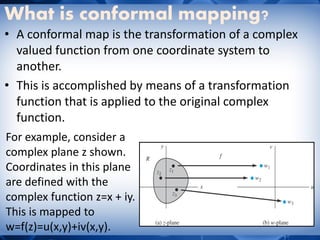
For example, consider a
complex plane z shown.
Coordinates in this plane
are defined with the
complex function z=x + iy.
This is mapped to
w=f(z)=u(x,y)+iv(x,y).
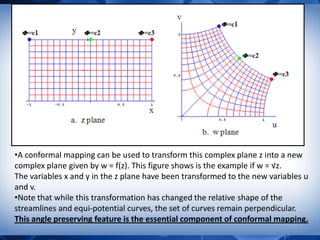
•A conformal mapping can be used to transform this complex plane z into a new
complex plane given by w = f(z). This figure shows is the example if w = √z.
The variables x and y in the z plane have been transformed to the new variables u
and v.
•Note that while this transformation has changed the relative shape of the
streamlines and equi-potential curves, the set of curves remain perpendicular.
This angle preserving feature is the essential component of conformal mapping.
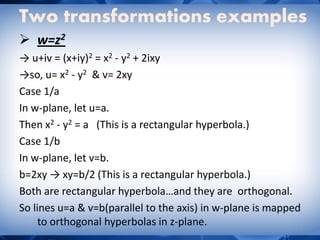
Two transformations examples
 w=z2
→ u+iv = (x+iy)2 = x2 - y2 + 2ixy
→so, u= x2 - y2 & v= 2xy
Case 1/a
In w-plane, let u=a.
Then x2 - y2 = a (This is a rectangular hyperbola.)
Case 1/b
In w-plane, let v=b.
b=2xy → xy=b/2 (This is a rectangular hyperbola.)
Both are rectangular hyperbola…and they are orthogonal.
So lines u=a & v=b(parallel to the axis) in w-plane is mapped
to orthogonal hyperbolas in z-plane.
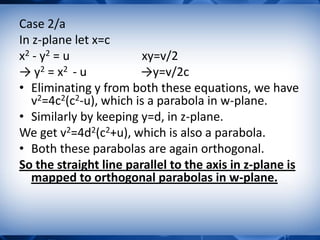
Case 2/a
In z-plane let x=c
x2 - y2 = u xy=v/2
→ y2 = x2 - u →y=v/2c
• Eliminating y from both these equations, we have
v2=4c2(c2-u), which is a parabola in w-plane.
• Similarly by keeping y=d, in z-plane.
We get v2=4d2(c2+u), which is also a parabola.
• Both these parabolas are again orthogonal.
So the straight line parallel to the axis in z-plane is
mapped to orthogonal parabolas in w-plane.
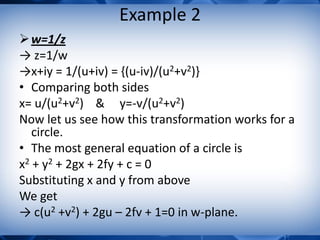
Example 2
w=1/z
→ z=1/w
→x+iy = 1/(u+iv) = {(u-iv)/(u2+v2)}
• Comparing both sides
x= u/(u2+v2) & y=-v/(u2+v2)
Now let us see how this transformation works for a
circle.
• The most general equation of a circle is
x2 + y2 + 2gx + 2fy + c = 0
Substituting x and y from above
We get
→ c(u2 +v2) + 2gu – 2fv + 1=0 in w-plane.
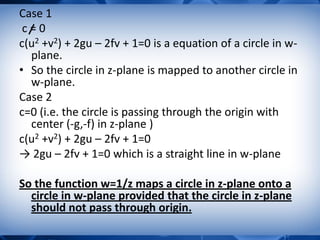
Case 1
c = 0
c(u2 +v2) + 2gu – 2fv + 1=0 is a equation of a circle in w-
plane.
• So the circle in z-plane is mapped to another circle in
w-plane.
Case 2
c=0 (i.e. the circle is passing through the origin with
center (-g,-f) in z-plane )
c(u2 +v2) + 2gu – 2fv + 1=0
→ 2gu – 2fv + 1=0 which is a straight line in w-plane
So the function w=1/z maps a circle in z-plane onto a
circle in w-plane provided that the circle in z-plane
should not pass through origin.
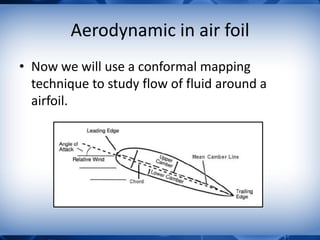
Aerodynamic in air foil
• Now we will use a conformal mapping
technique to study flow of fluid around a
airfoil.
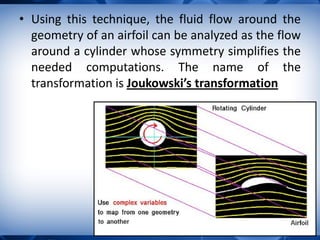
• Using this technique, the fluid flow around the
geometry of an airfoil can be analyzed as the flow
around a cylinder whose symmetry simplifies the
needed computations. The name of the
transformation is Joukowski’s transformation
Joukowski’s transformation
• The joukowski's transformation is used because it has the
property of transforming circles in the z plane into
shapes that resemble airfoils in the w plane.
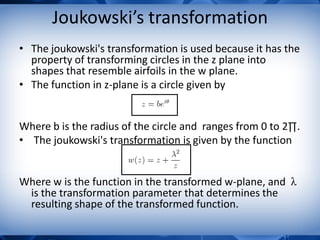
• The function in z-plane is a circle given by
Where b is the radius of the circle and ranges from 0 to 2∏.
• The joukowski's transformation is given by the function
Where w is the function in the transformed w-plane, and λ
is the transformation parameter that determines the
resulting shape of the transformed function.
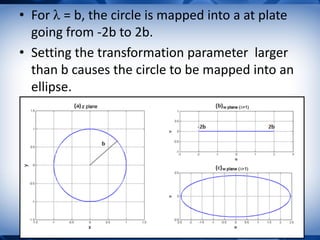
• For λ = b, the circle is mapped into a at plate
going from -2b to 2b.
• Setting the transformation parameter larger
than b causes the circle to be mapped into an
ellipse.
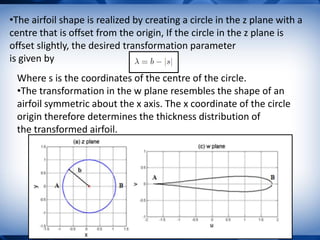
•The airfoil shape is realized by creating a circle in the z plane with a
centre that is offset from the origin, If the circle in the z plane is
offset slightly, the desired transformation parameter
is given by
Where s is the coordinates of the centre of the circle.
•The transformation in the w plane resembles the shape of an
airfoil symmetric about the x axis. The x coordinate of the circle
origin therefore determines the thickness distribution of
the transformed airfoil.
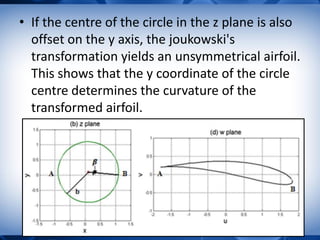
• If the centre of the circle in the z plane is also
offset on the y axis, the joukowski's
transformation yields an unsymmetrical airfoil.
This shows that the y coordinate of the circle
centre determines the curvature of the
transformed airfoil.
• In addition to the circle in the z plane being
transformed to air foils in w-plane, the flow
around the circle can also be transformed
because of the previously mentioned angle
preserving feature of conformal mapping
functions.
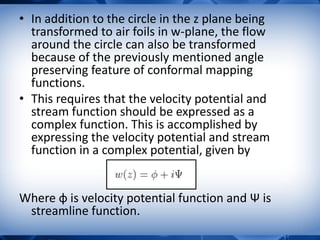
• This requires that the velocity potential and
stream function should be expressed as a
complex function. This is accomplished by
expressing the velocity potential and stream
function in a complex potential, given by
Where ɸ is velocity potential function and Ψ is
streamline function.
Please visit(for more presentations)

Joukowski's airfoils, introduction to conformal mapping

  • 2.
    What is conformalmapping? • A conformal map is the transformation of a complex valued function from one coordinate system to another. • This is accomplished by means of a transformation function that is applied to the original complex function. For example, consider a complex plane z shown. Coordinates in this plane are defined with the complex function z=x + iy. This is mapped to w=f(z)=u(x,y)+iv(x,y).
  • 3.
    •A conformal mappingcan be used to transform this complex plane z into a new complex plane given by w = f(z). This figure shows is the example if w = √z. The variables x and y in the z plane have been transformed to the new variables u and v. •Note that while this transformation has changed the relative shape of the streamlines and equi-potential curves, the set of curves remain perpendicular. This angle preserving feature is the essential component of conformal mapping.
  • 4.
    Two transformations examples w=z2 → u+iv = (x+iy)2 = x2 - y2 + 2ixy →so, u= x2 - y2 & v= 2xy Case 1/a In w-plane, let u=a. Then x2 - y2 = a (This is a rectangular hyperbola.) Case 1/b In w-plane, let v=b. b=2xy → xy=b/2 (This is a rectangular hyperbola.) Both are rectangular hyperbola…and they are orthogonal. So lines u=a & v=b(parallel to the axis) in w-plane is mapped to orthogonal hyperbolas in z-plane.
  • 5.
    Case 2/a In z-planelet x=c x2 - y2 = u xy=v/2 → y2 = x2 - u →y=v/2c • Eliminating y from both these equations, we have v2=4c2(c2-u), which is a parabola in w-plane. • Similarly by keeping y=d, in z-plane. We get v2=4d2(c2+u), which is also a parabola. • Both these parabolas are again orthogonal. So the straight line parallel to the axis in z-plane is mapped to orthogonal parabolas in w-plane.
  • 6.
    Example 2 w=1/z → z=1/w →x+iy= 1/(u+iv) = {(u-iv)/(u2+v2)} • Comparing both sides x= u/(u2+v2) & y=-v/(u2+v2) Now let us see how this transformation works for a circle. • The most general equation of a circle is x2 + y2 + 2gx + 2fy + c = 0 Substituting x and y from above We get → c(u2 +v2) + 2gu – 2fv + 1=0 in w-plane.
  • 7.
    Case 1 c =0 c(u2 +v2) + 2gu – 2fv + 1=0 is a equation of a circle in w- plane. • So the circle in z-plane is mapped to another circle in w-plane. Case 2 c=0 (i.e. the circle is passing through the origin with center (-g,-f) in z-plane ) c(u2 +v2) + 2gu – 2fv + 1=0 → 2gu – 2fv + 1=0 which is a straight line in w-plane So the function w=1/z maps a circle in z-plane onto a circle in w-plane provided that the circle in z-plane should not pass through origin.
  • 8.
    Aerodynamic in airfoil • Now we will use a conformal mapping technique to study flow of fluid around a airfoil.
  • 9.
    • Using thistechnique, the fluid flow around the geometry of an airfoil can be analyzed as the flow around a cylinder whose symmetry simplifies the needed computations. The name of the transformation is Joukowski’s transformation
  • 10.
    Joukowski’s transformation • Thejoukowski's transformation is used because it has the property of transforming circles in the z plane into shapes that resemble airfoils in the w plane. • The function in z-plane is a circle given by Where b is the radius of the circle and ranges from 0 to 2∏. • The joukowski's transformation is given by the function Where w is the function in the transformed w-plane, and λ is the transformation parameter that determines the resulting shape of the transformed function.
  • 11.
    • For λ= b, the circle is mapped into a at plate going from -2b to 2b. • Setting the transformation parameter larger than b causes the circle to be mapped into an ellipse.
  • 12.
    •The airfoil shapeis realized by creating a circle in the z plane with a centre that is offset from the origin, If the circle in the z plane is offset slightly, the desired transformation parameter is given by Where s is the coordinates of the centre of the circle. •The transformation in the w plane resembles the shape of an airfoil symmetric about the x axis. The x coordinate of the circle origin therefore determines the thickness distribution of the transformed airfoil.
  • 13.
    • If thecentre of the circle in the z plane is also offset on the y axis, the joukowski's transformation yields an unsymmetrical airfoil. This shows that the y coordinate of the circle centre determines the curvature of the transformed airfoil.
  • 14.
    • In additionto the circle in the z plane being transformed to air foils in w-plane, the flow around the circle can also be transformed because of the previously mentioned angle preserving feature of conformal mapping functions. • This requires that the velocity potential and stream function should be expressed as a complex function. This is accomplished by expressing the velocity potential and stream function in a complex potential, given by Where ɸ is velocity potential function and Ψ is streamline function.
  • 15.
    Please visit(for morepresentations)