Real Life Application
of Gauss, Stokes and
Green’s Theorem
Gauss’ Law and Applications
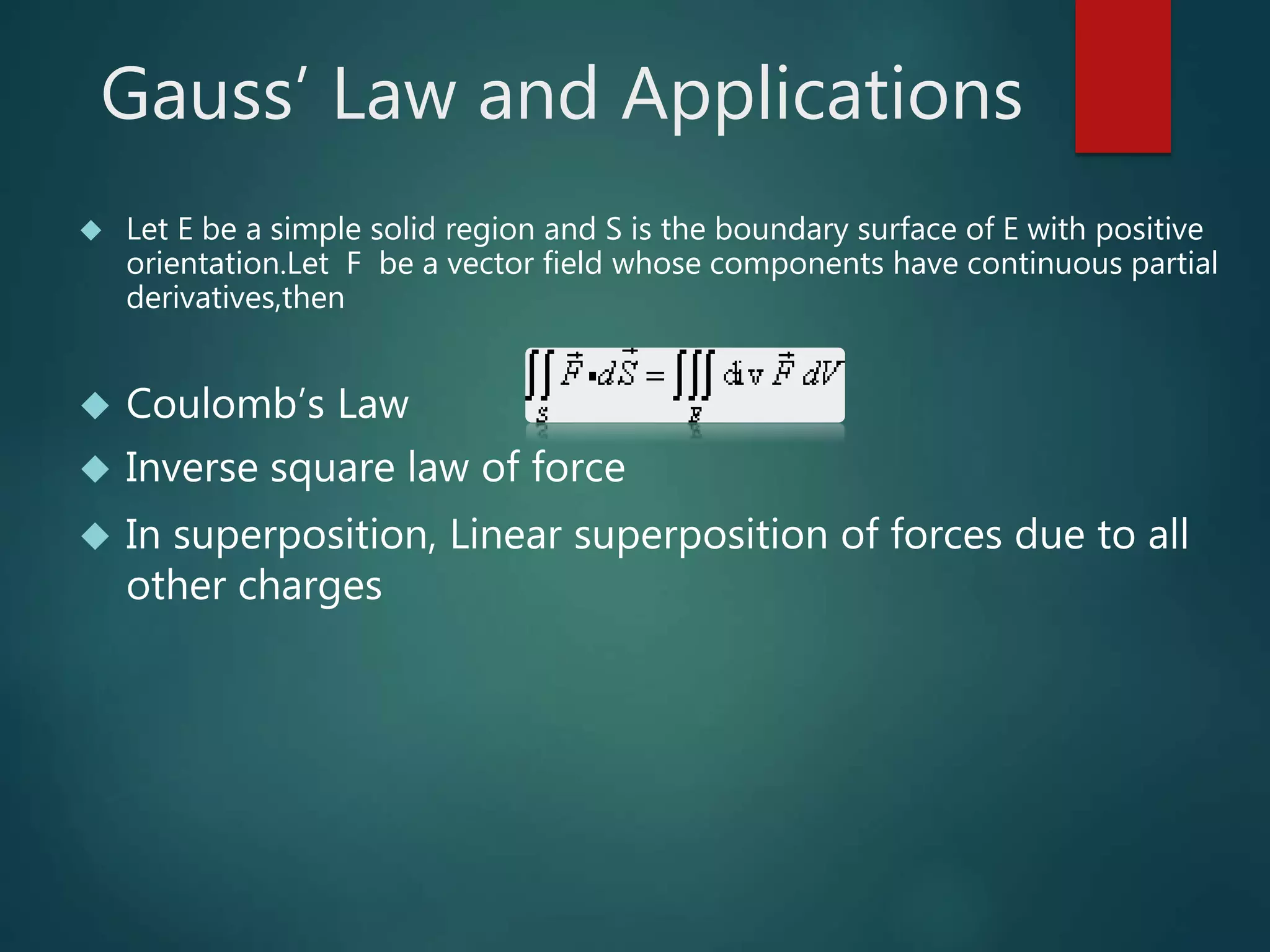
 Let E be a simple solid region and S is the boundary surface of E with positive
orientation.Let F be a vector field whose components have continuous partial
derivatives,then
 Coulomb’s Law
 Inverse square law of force
 In superposition, Linear superposition of forces due to all
other charges
Electric Field
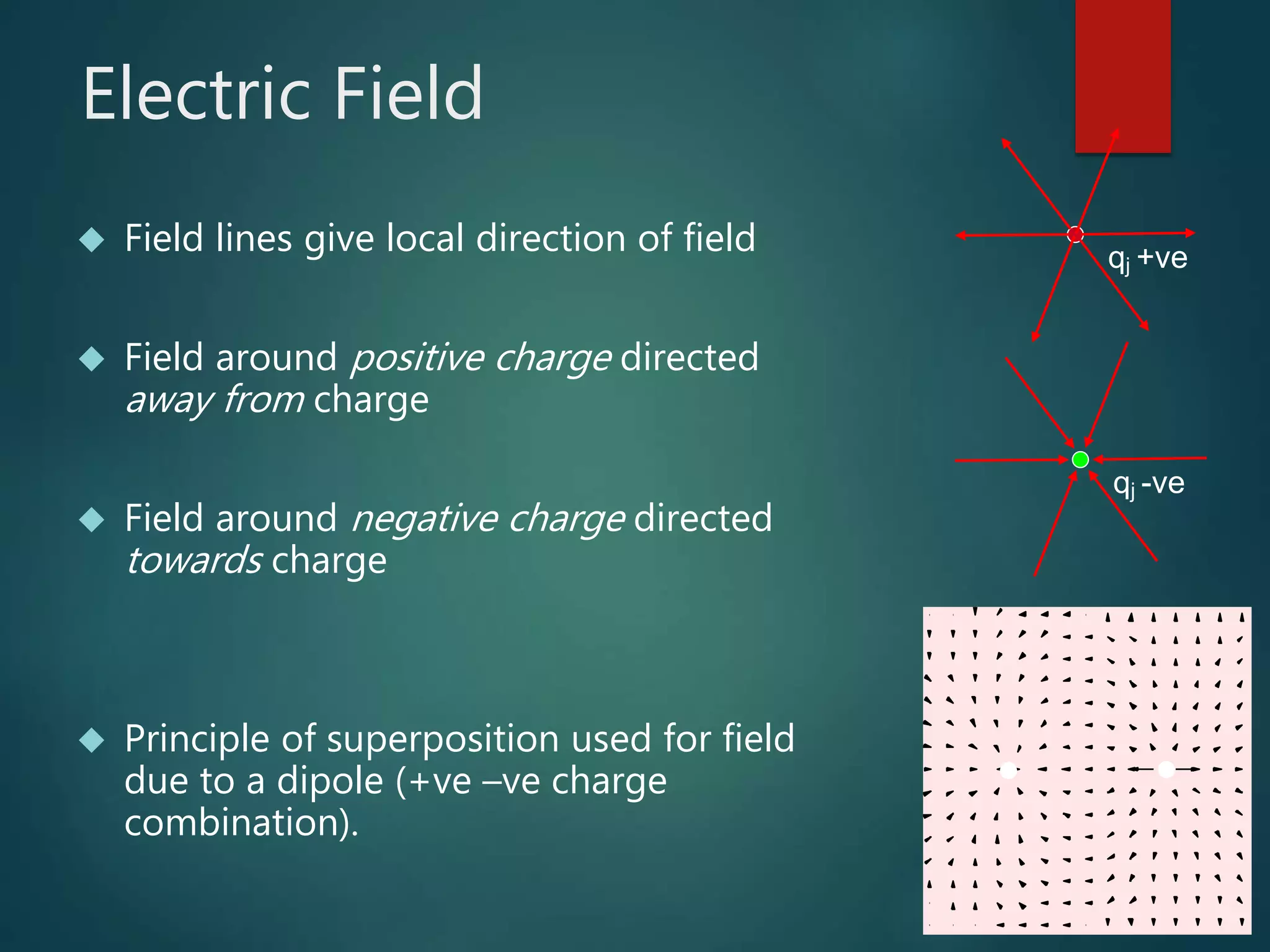
 Field lines give local direction of field
 Field around positive charge directed
away from charge
 Field around negative charge directed
towards charge
 Principle of superposition used for field
due to a dipole (+ve –ve charge
combination).
qj +ve
qj -ve
Flux of a Vector Field
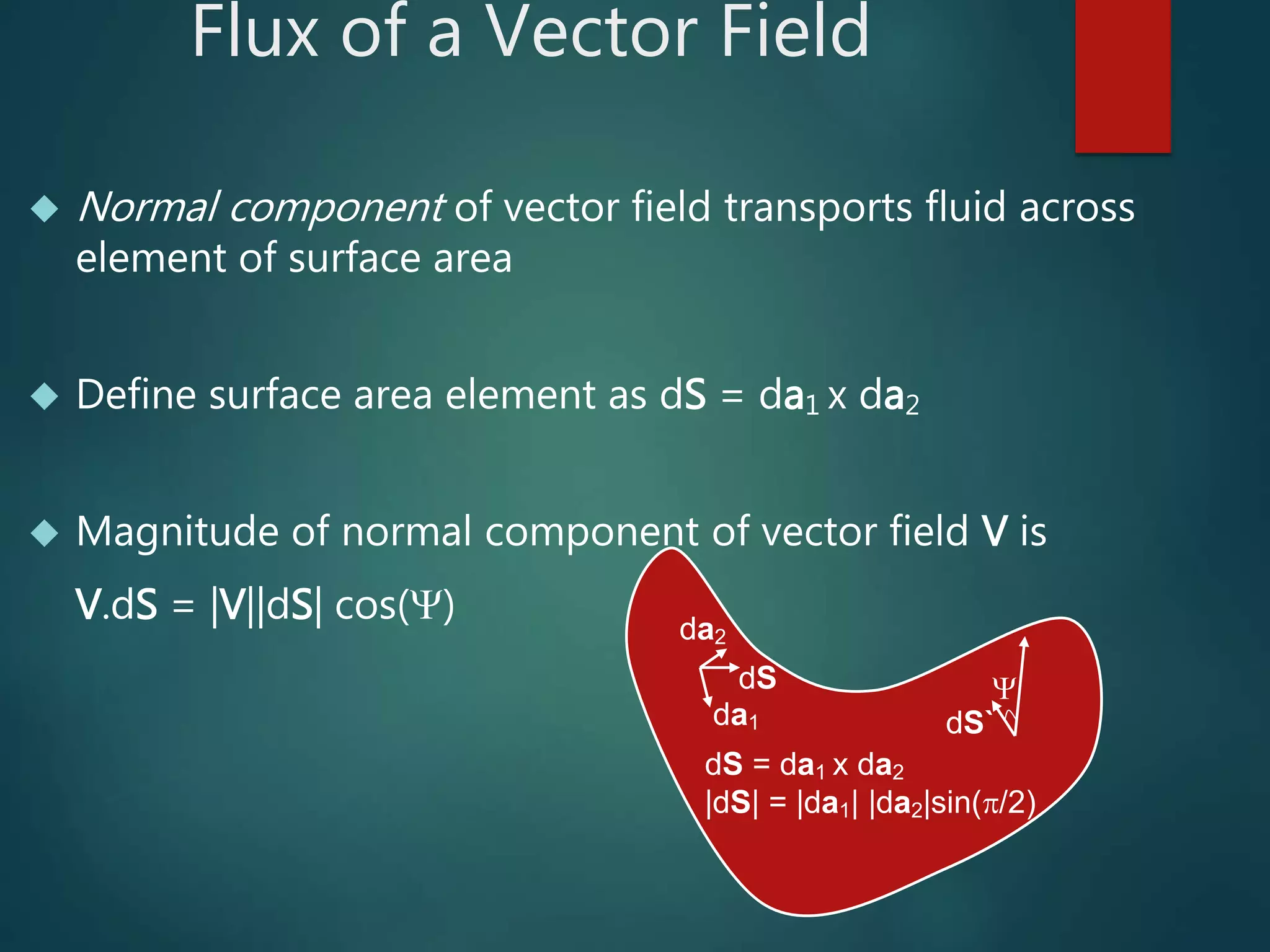
 Normal component of vector field transports fluid across
element of surface area
 Define surface area element as dS = da1 x da2
 Magnitude of normal component of vector field V is
V.dS = |V||dS| cos(Y)
da1
da2
dS
dS = da1 x da2
|dS| = |da1| |da2|sin(p/2)
Y
dS`
Gauss’ Law to charge sheet AND
Plate
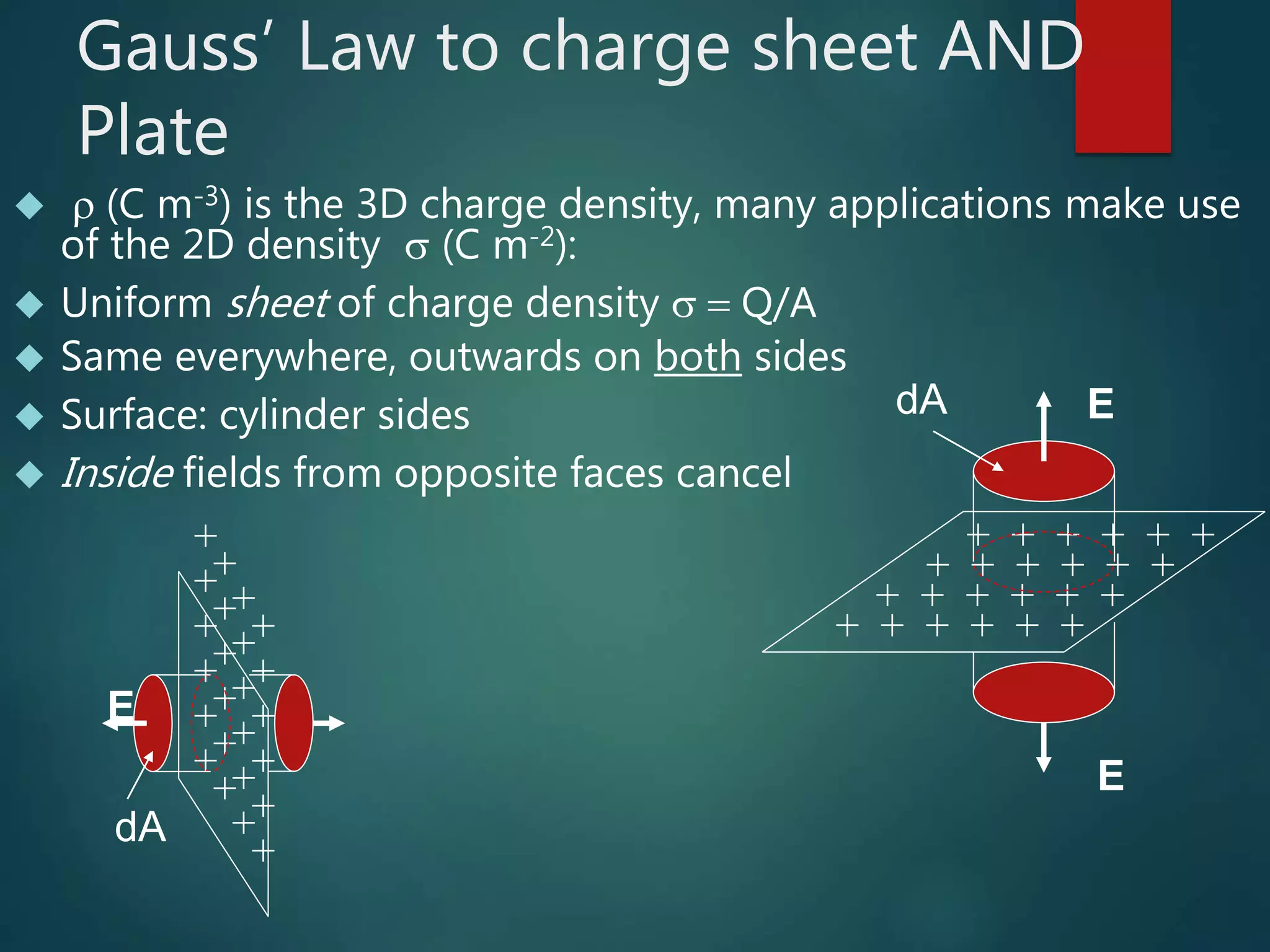
 r (C m-3) is the 3D charge density, many applications make use
of the 2D density s (C m-2):
 Uniform sheet of charge density s = Q/A
 Same everywhere, outwards on both sides
 Surface: cylinder sides
 Inside fields from opposite faces cancel
+ + + + + +
+ + + + + +
+ + + + + +
+ + + + + +
E
EdA
++++++++++++++++++++++++
E
dA
Electrostatic energy of charges
In vacuum
 Potential energy of a pair of point charges
 Potential energy of a group of point charges
 Potential energy of a charge distribution
In a dielectric (later)
 Potential energy of free charges
 Electrostatic energy of charge distribution
 Energy in vacuum in terms
Stokes Theorem and
Applications
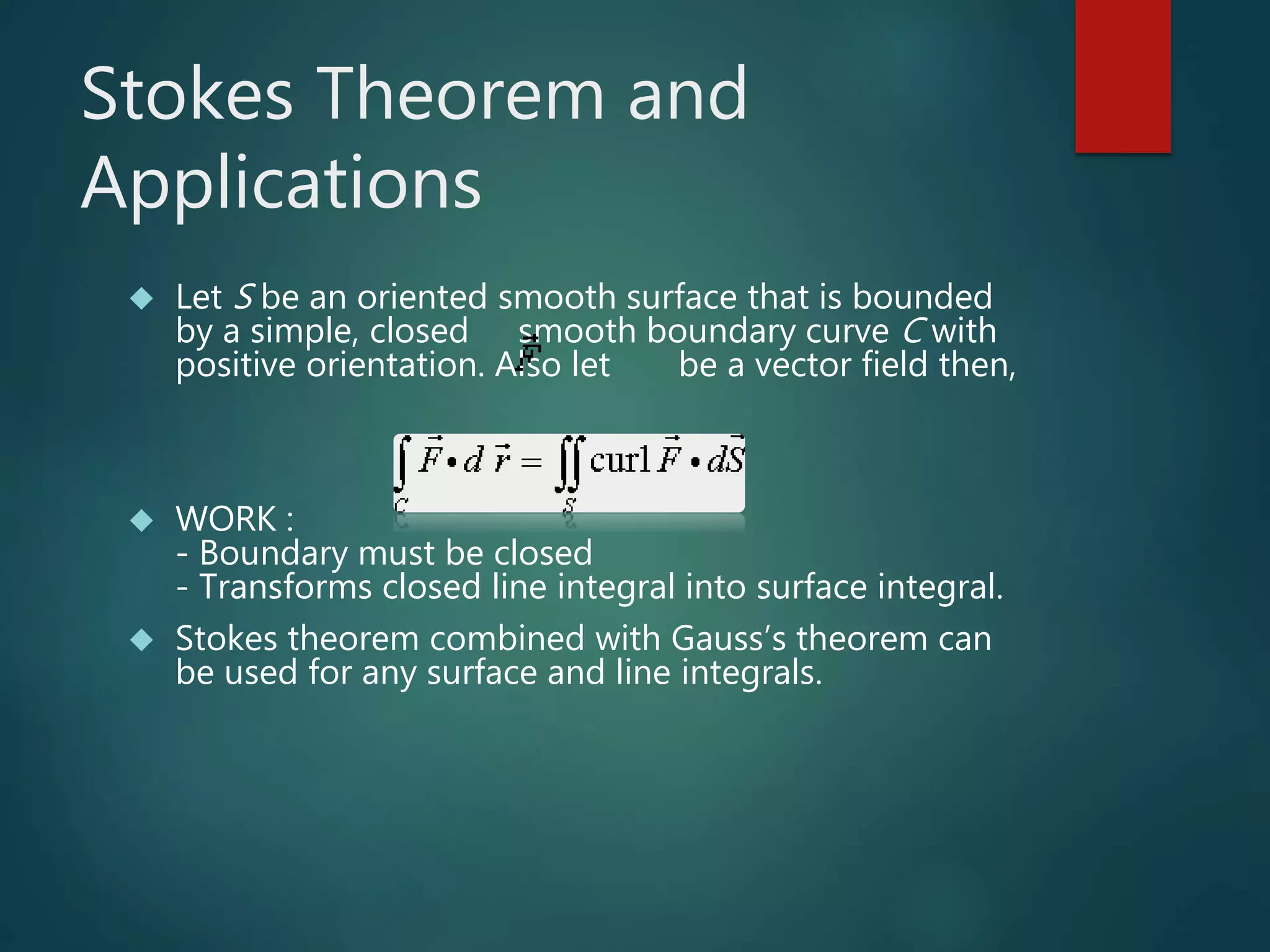
 Let S be an oriented smooth surface that is bounded
by a simple, closed smooth boundary curve C with
positive orientation. Also let be a vector field then,
 WORK :
- Boundary must be closed
- Transforms closed line integral into surface integral.
 Stokes theorem combined with Gauss’s theorem can
be used for any surface and line integrals.
Green’s Theorem and
Applications
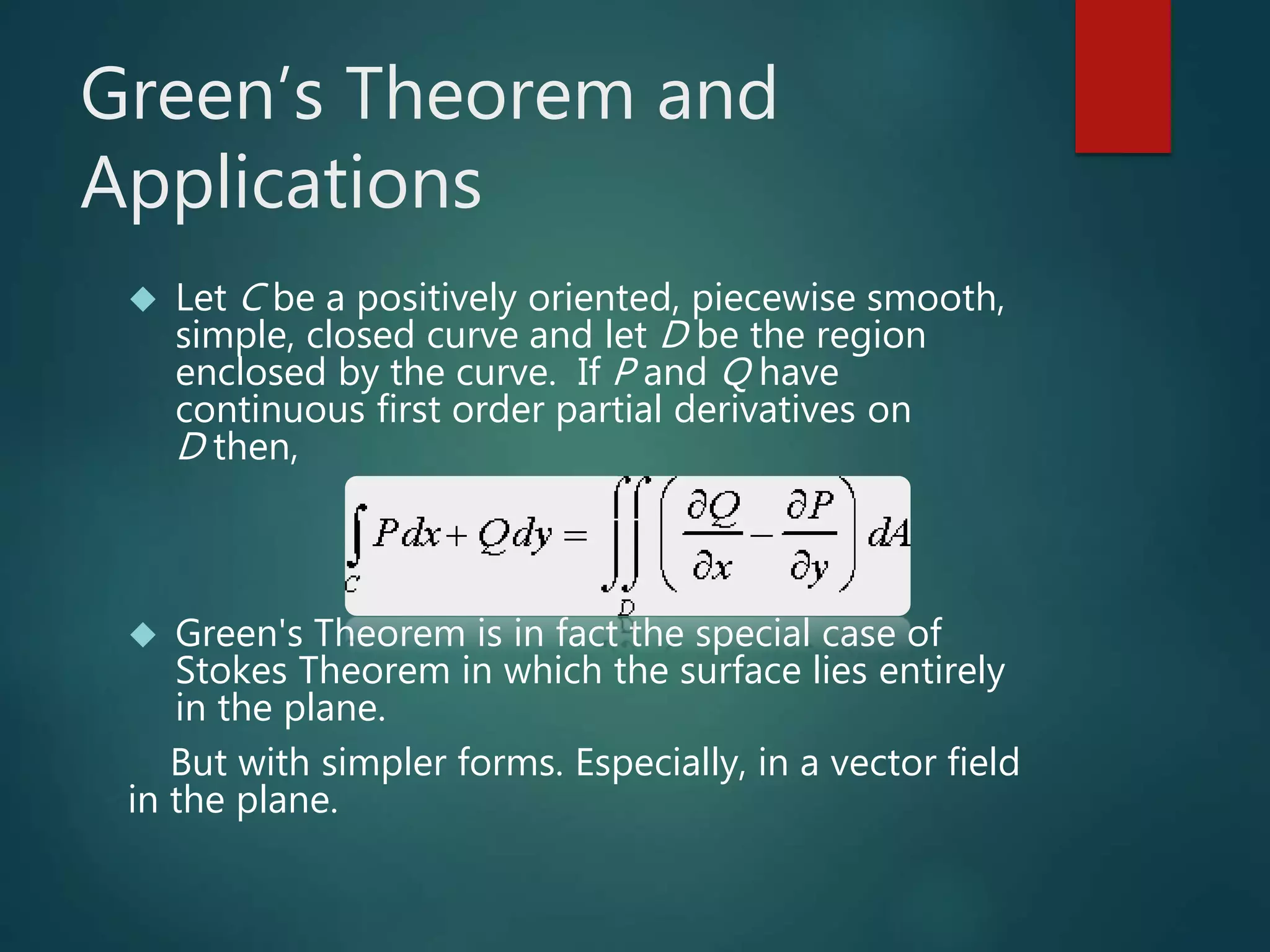
 Let C be a positively oriented, piecewise smooth,
simple, closed curve and let D be the region
enclosed by the curve. If P and Q have
continuous first order partial derivatives on
D then,
 Green's Theorem is in fact the special case of
Stokes Theorem in which the surface lies entirely
in the plane.
But with simpler forms. Especially, in a vector field
in the plane.
More of greens and Stokes
 In terms of circulation Green's theorem
converts the line integral to a double integral
of the microscopic circulation.
 Water turbines and cyclone may be a
example of stokes and green’s theorem.
 Green’s theorem also used for calculating
mass/area and momenta, to prove kepler’s
law, measuring the energy of steady currents.
Electrodynamics is entirely based on green’s
theorem.
Thank You

Application of Gauss,Green and Stokes Theorem

  • 1.
    Real Life Application ofGauss, Stokes and Green’s Theorem
  • 2.
    Gauss’ Law andApplications  Let E be a simple solid region and S is the boundary surface of E with positive orientation.Let F be a vector field whose components have continuous partial derivatives,then  Coulomb’s Law  Inverse square law of force  In superposition, Linear superposition of forces due to all other charges
  • 3.
    Electric Field  Fieldlines give local direction of field  Field around positive charge directed away from charge  Field around negative charge directed towards charge  Principle of superposition used for field due to a dipole (+ve –ve charge combination). qj +ve qj -ve
  • 4.
    Flux of aVector Field  Normal component of vector field transports fluid across element of surface area  Define surface area element as dS = da1 x da2  Magnitude of normal component of vector field V is V.dS = |V||dS| cos(Y) da1 da2 dS dS = da1 x da2 |dS| = |da1| |da2|sin(p/2) Y dS`
  • 5.
    Gauss’ Law tocharge sheet AND Plate  r (C m-3) is the 3D charge density, many applications make use of the 2D density s (C m-2):  Uniform sheet of charge density s = Q/A  Same everywhere, outwards on both sides  Surface: cylinder sides  Inside fields from opposite faces cancel + + + + + + + + + + + + + + + + + + + + + + + + E EdA ++++++++++++++++++++++++ E dA
  • 6.
    Electrostatic energy ofcharges In vacuum  Potential energy of a pair of point charges  Potential energy of a group of point charges  Potential energy of a charge distribution In a dielectric (later)  Potential energy of free charges  Electrostatic energy of charge distribution  Energy in vacuum in terms
  • 7.
    Stokes Theorem and Applications Let S be an oriented smooth surface that is bounded by a simple, closed smooth boundary curve C with positive orientation. Also let be a vector field then,  WORK : - Boundary must be closed - Transforms closed line integral into surface integral.  Stokes theorem combined with Gauss’s theorem can be used for any surface and line integrals.
  • 8.
    Green’s Theorem and Applications Let C be a positively oriented, piecewise smooth, simple, closed curve and let D be the region enclosed by the curve. If P and Q have continuous first order partial derivatives on D then,  Green's Theorem is in fact the special case of Stokes Theorem in which the surface lies entirely in the plane. But with simpler forms. Especially, in a vector field in the plane.
  • 9.
    More of greensand Stokes  In terms of circulation Green's theorem converts the line integral to a double integral of the microscopic circulation.  Water turbines and cyclone may be a example of stokes and green’s theorem.  Green’s theorem also used for calculating mass/area and momenta, to prove kepler’s law, measuring the energy of steady currents. Electrodynamics is entirely based on green’s theorem.
  • 10.