APPLICATION OF
DIFFERENTIAL
EQUATION
DHANUSHKUMAR.M
DINESHKUMAR.
GOGUL.S.S
GOGUL ANANTH.
GOWRI SANKAR.
OBJECTIVES:
 What is differential equation?
 Newton’s law of cooling
 Applications of Newton’s law of cooling.
What is differential
equation?
 It is a branch of mathematics dealing with concepts of
derivative and differential.
 Differential equation have many forms and its order is
determined based on the highest order of a derivative in
it.
 First order differential equations are such equation that
have the unknown derivatives is the first derivatives and
its own function.
Ex: It is used in newton’s law of cooling.
Newton’s law of cooling
 It is a direct application for differential equation
 Formulated by sir Isaac Newton.
 Has many applications in our everyday life
 Sir Isaac Newton found this equation behaves like what is called in math
(differential equations) so he used some techniques to find its general
solution.
 Newton's law of cooling states that the rate of heat loss of a body is
directly proportional to the difference in the temperatures between the
body and its surroundings provided the temperature difference is small
and the nature of radiating surface remains same
Derivation of Newton’s law of
cooling
 Newton’s observation.
He observed that the temperature of the body is
proportional to the difference between its own temperature
and the temperature of the objects in contact with it.
 Formulatting
First order seperable differential equation
 Applying calculus
DT/dt=-K(T0-Te)
Where K is the positive proportionality constant.
 By separation of variables we get
DT/(T-Te)=-Kdt
 By integrating both side w get
In(T-Te)+C=-Kt
 At time (t=0) the temperature is T0
-In(T0-Te)=C
 By substituting C with –In(T0-Te) we get
In(T0-Te)/(T0-Te)=-Kt
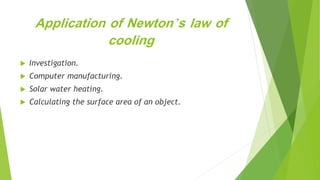
Application of Newton’s law of
cooling
 Investigation.
 Computer manufacturing.
 Solar water heating.
 Calculating the surface area of an object.
Applications of
Newton’s law of cooling
By using
Differential equation
For Investigation purpose
For a postmortem report, a doctor requires to know approximately the time of death
of the deceased . He records the first temperature at 10.00am to be 93.49°F .After 2
hours he finds the temperature to be 91.4°F. If the room temperature (which is
constant)is 72°F,Estimate the time of death.(Assume normal temperature of a human
body to be 98.6° F).
Let T be the temperature of the body at any time t
By Newton’s law of cooling dT/dt ∞ (T-72)Since S=72°F
dT/dt=k(T-72) T-72=cekt
Or T=72+cekt
At t=0,t=93.4 c=21.4[First recorded time 10 a.m ,is t=0]
T=72+21.4ekt
When t=120,T=91.4 e120k=19.4/21.4 k=1 /120 loge(19.4/21.4)
=1/120(-0.0426×2.303)
Let t1 be the elapsed time after the death .
Continued:
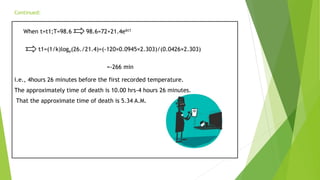
When t=t1;T=98.6 98.6=72+21.4ekt1
t1=(1/k)loge(26./21.4)=(-120×0.0945×2.303)/(0.0426×2.303)
=-266 min
i.e., 4hours 26 minutes before the first recorded temperature.
The approximately time of death is 10.00 hrs-4 hours 26 minutes.
That the approximate time of death is 5.34 A.M.
APPLICATION OD NEWTON’S
LAW OF COOLING
BY USING
DIFFERENTIAL EQUATIONS
FOR COMPUTER MANUFACTURING:(processors)
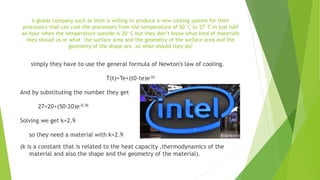
A global company such as Intel is willing to produce a new cooling system for their
processors that can cool the processors from the temperature of 50°C to 27°C in just half
an hour when the temperature outside is 20°C but they don’t know what kind of materials
they should us or what the surface area and the geometry of the surface area and the
geometry of the shape are .so what should they do?
simply they have to use the general formula of Newton's law of cooling.
T(t)=Te+(t0-te)e-kt
And by substituting the number they get
27=20+(50-20)e-0.5k
Solving we get k=2.9
so they need a material with k=2.9
(k is a constant that is related to the heat capacity ,thermodynamics of the
material and also the shape and the geometry of the material).
DIFFERENTIAL
CALCULUS
AND ITS APPLICATIONS
DIFFERENTIAL CALCULUS
 Calculus – is that branch of mathematics that deals with growth
(development), motion (process or power of changing place or position),
maxima (greatest quantity) and minima (least quantity). Calculus is a
particular method or system of calculation or reasoning.
Before calculus (precalculus)
 In American mathematics education, precalculus, is an advanced form of
secondary school algebra, and a foundational mathematical discipline. It is
also called Introduction to Analysis. In many schools, precalculus is actually
two separate courses: Algebra and Trigonometry.
 Algebra - the part of mathematics in which letters and other general symbols
are used to represent numbers and quantities in formulate and equations.
 Trigonometry - the branch of mathematics dealing with the relations of the
sides and angles of triangles and with the relevant functions of any angles.
MEAN VALUE THEOREM
 The Mean Value Theorem is one of the most important theoretical tools in
Calculus. It states that if f(x) is defined and continuous on the interval [a,b]
and differentiable on (a,b), then there is at least one number c in the
interval (a,b) (that is a<c<b) such that
 In other words, there exists a point in the interval (a,b) which has a
horizontal tangent. In fact, the Mean Value Theorem can be stated also in
terms of slopes. Indeed, the number
is the slope of the line passing through (a, f(a)) and (b, f(b)). So the
conclusion of the Mean Value Theorem states that there exists a point
such that the tangent line is parallel to the line passing through (a, f(a))
and (b, f(b)).
ab
afbf
cf



)()(
)('
ab
afbf

 )()(
Mean Value Theorem- MVT
1.
a b
If: f is continuous on [a, b],
differentiable on (a, b)
Then: there is a c in (a, b) such
that
ab
afbf
cf



)()(
)('
f
APPLICATIONS
Calculus is the language of engineers, scientists, and economists. The work of
these professionals has a huge impact on our daily life - from your
microwaves, cell phones, TV, and car to medicine, economy, and national
defense.
here are few examples in our day today life usage :
1. Credit card companies
2. Biologists
3. An electrical engineer
4. An architect
5. Space flight engineers
6. Statisticians
7. A physicist
8. An operations research analyst
9. A graphics artist
 Credit card companies use calculus to set the minimum payments due on
credit card statements at the exact time the statement is processed by
considering multiple variables such as changing interest rates and a
fluctuating available balance.
 Biologists use differential calculus to determine the exact rate of growth in a
bacterial culture when different variables such as temperature and food
source are changed. This research can help increase the rate of growth of
necessary bacteria, or decrease the rate of growth for harmful and
potentially threatening bacteria.
 An electrical engineer uses integration to determine the exact length of
power cable needed to connect two substations that are miles apart. Because
the cable is hung from poles, it is constantly curving. Calculus allows a
precise figure to be determined.
 An architect will use integration to determine the amount of materials
necessary to construct a curved dome over a new sports arena, as well as
calculate the weight of that dome and determine the type of support
structure required.
 Space flight engineers frequently use calculus when planning lengthy
missions. To launch an exploratory probe, they must consider the different
orbiting velocities of the Earth and the planet the probe is targeted for, as
well as other gravitational influences like the sun and the moon. Calculus
allows each of those variables to be accurately taken into account.
 Statisticians will use calculus to evaluate survey data to help develop
business plans for different companies. Because a survey involves many
different questions with a range of possible answers, calculus allows a more
accurate prediction for appropriate action.
 A physicist uses calculus to find the center of mass of a sports utility vehicle
to design appropriate safety features that must adhere to federal
specifications on different road surfaces and at different speeds.
 An operations research analyst will use calculus when observing different
processes at a manufacturing corporation. By considering the value of
different variables, they can help a company improve operating efficiency,
increase production, and raise profits.
 A graphics artist uses calculus to determine how different three-dimensional
models will behave when subjected to rapidly changing conditions. This can
create a realistic environment for movies or video games.
Obviously, a wide variety of careers regularly use calculus. Universities, the
military, government agencies, airlines, entertainment studios, software
companies, and construction companies are only a few employers who seek
individuals with a solid knowledge of calculus. Even doctors and lawyers use
calculus to help build the discipline necessary for solving complex problems,
such as diagnosing patients or planning a prosecution case. Despite its
mystique as a more complex branch of mathematics, calculus touches our
lives each day, in ways too numerous to calculate.
APPLICATION OF MEAN VALUE
THEOREM
(MVT)
When an object is removed from a furnace and placed in an
environment with a constant temperature of 90o F, its core
temperature is 1500o F. Five hours later the core temperature is
390o F. Explain why there must exist a time in the interval
when the temperature is decreasing at a rate of 222o F per hour.
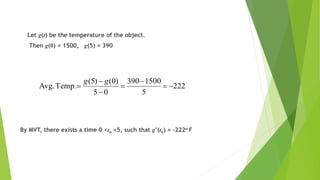
Let g(t) be the temperature of the object.
Then g(0) = 1500, g(5) = 390
By MVT, there exists a time 0 <to <5, such that g’(to) = –222o F
222
5
1500390
05
)0()5(
Temp.Avg. 





gg
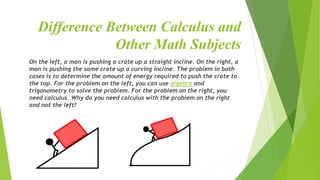
Difference Between Calculus and
Other Math Subjects
On the left, a man is pushing a crate up a straight incline. On the right, a
man is pushing the same crate up a curving incline. The problem in both
cases is to determine the amount of energy required to push the crate to
the top. For the problem on the left, you can use algebra and
trigonometry to solve the problem. For the problem on the right, you
need calculus. Why do you need calculus with the problem on the right
and not the left?
This is because with the straight incline, the man pushes with an unchanging
force and the crate goes up the incline at an unchanging speed. With the
curved incline on the right, things are constantly changing. Since the
steepness of the incline is constantly changing, the amount of energy
expended is also changing. This is why calculus is described as "the
mathematics of change". Calculus takes regular rules of math and applies
them to evolving problems.
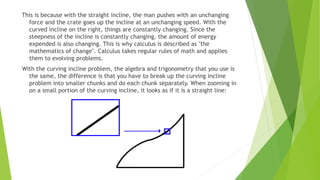
With the curving incline problem, the algebra and trigonometry that you use is
the same, the difference is that you have to break up the curving incline
problem into smaller chunks and do each chunk separately. When zooming in
on a small portion of the curving incline, it looks as if it is a straight line:
Then, because it is straight, you can solve the small chunk just like the straight
incline problem. When all of the small chunks are solved, you can just add
them up.
This is basically the way calculus works - it takes problems that cannot be done
with regular math because things are constantly changing, zooms in on the
changing curve until it becomes straight, and then it lets regular math finish
off the problem.
What makes calculus such a brilliant achievement is that it actually zooms in
infinitely. In fact, everything you do in calculus involves infinity in one way or
another, because if something is constantly changing, it is changing infinitely
from each infinitesimal moment to the next. All of calculus relies on the
fundamental principle that you can always use approximations of increasing
accuracy to find the exact answer.
Just like you can approximate a curve by a series of straight lines, you can also
approximate a spherical solid by a series of cubes that fit inside the sphere.
Application   of   differentiation

Application of differentiation

  • 1.
  • 2.
    OBJECTIVES:  What isdifferential equation?  Newton’s law of cooling  Applications of Newton’s law of cooling.
  • 3.
    What is differential equation? It is a branch of mathematics dealing with concepts of derivative and differential.  Differential equation have many forms and its order is determined based on the highest order of a derivative in it.  First order differential equations are such equation that have the unknown derivatives is the first derivatives and its own function. Ex: It is used in newton’s law of cooling.
  • 4.
    Newton’s law ofcooling  It is a direct application for differential equation  Formulated by sir Isaac Newton.  Has many applications in our everyday life  Sir Isaac Newton found this equation behaves like what is called in math (differential equations) so he used some techniques to find its general solution.  Newton's law of cooling states that the rate of heat loss of a body is directly proportional to the difference in the temperatures between the body and its surroundings provided the temperature difference is small and the nature of radiating surface remains same
  • 5.
    Derivation of Newton’slaw of cooling  Newton’s observation. He observed that the temperature of the body is proportional to the difference between its own temperature and the temperature of the objects in contact with it.  Formulatting First order seperable differential equation  Applying calculus DT/dt=-K(T0-Te) Where K is the positive proportionality constant.
  • 6.
     By separationof variables we get DT/(T-Te)=-Kdt  By integrating both side w get In(T-Te)+C=-Kt  At time (t=0) the temperature is T0 -In(T0-Te)=C  By substituting C with –In(T0-Te) we get In(T0-Te)/(T0-Te)=-Kt
  • 7.
    Application of Newton’slaw of cooling  Investigation.  Computer manufacturing.  Solar water heating.  Calculating the surface area of an object.
  • 8.
    Applications of Newton’s lawof cooling By using Differential equation For Investigation purpose
  • 9.
    For a postmortemreport, a doctor requires to know approximately the time of death of the deceased . He records the first temperature at 10.00am to be 93.49°F .After 2 hours he finds the temperature to be 91.4°F. If the room temperature (which is constant)is 72°F,Estimate the time of death.(Assume normal temperature of a human body to be 98.6° F). Let T be the temperature of the body at any time t By Newton’s law of cooling dT/dt ∞ (T-72)Since S=72°F dT/dt=k(T-72) T-72=cekt Or T=72+cekt At t=0,t=93.4 c=21.4[First recorded time 10 a.m ,is t=0] T=72+21.4ekt When t=120,T=91.4 e120k=19.4/21.4 k=1 /120 loge(19.4/21.4) =1/120(-0.0426×2.303) Let t1 be the elapsed time after the death .
  • 10.
    Continued: When t=t1;T=98.6 98.6=72+21.4ekt1 t1=(1/k)loge(26./21.4)=(-120×0.0945×2.303)/(0.0426×2.303) =-266min i.e., 4hours 26 minutes before the first recorded temperature. The approximately time of death is 10.00 hrs-4 hours 26 minutes. That the approximate time of death is 5.34 A.M.
  • 11.
    APPLICATION OD NEWTON’S LAWOF COOLING BY USING DIFFERENTIAL EQUATIONS FOR COMPUTER MANUFACTURING:(processors)
  • 12.
    A global companysuch as Intel is willing to produce a new cooling system for their processors that can cool the processors from the temperature of 50°C to 27°C in just half an hour when the temperature outside is 20°C but they don’t know what kind of materials they should us or what the surface area and the geometry of the surface area and the geometry of the shape are .so what should they do? simply they have to use the general formula of Newton's law of cooling. T(t)=Te+(t0-te)e-kt And by substituting the number they get 27=20+(50-20)e-0.5k Solving we get k=2.9 so they need a material with k=2.9 (k is a constant that is related to the heat capacity ,thermodynamics of the material and also the shape and the geometry of the material).
  • 13.
  • 14.
    DIFFERENTIAL CALCULUS  Calculus– is that branch of mathematics that deals with growth (development), motion (process or power of changing place or position), maxima (greatest quantity) and minima (least quantity). Calculus is a particular method or system of calculation or reasoning.
  • 15.
    Before calculus (precalculus) In American mathematics education, precalculus, is an advanced form of secondary school algebra, and a foundational mathematical discipline. It is also called Introduction to Analysis. In many schools, precalculus is actually two separate courses: Algebra and Trigonometry.  Algebra - the part of mathematics in which letters and other general symbols are used to represent numbers and quantities in formulate and equations.  Trigonometry - the branch of mathematics dealing with the relations of the sides and angles of triangles and with the relevant functions of any angles.
  • 16.
    MEAN VALUE THEOREM The Mean Value Theorem is one of the most important theoretical tools in Calculus. It states that if f(x) is defined and continuous on the interval [a,b] and differentiable on (a,b), then there is at least one number c in the interval (a,b) (that is a<c<b) such that  In other words, there exists a point in the interval (a,b) which has a horizontal tangent. In fact, the Mean Value Theorem can be stated also in terms of slopes. Indeed, the number is the slope of the line passing through (a, f(a)) and (b, f(b)). So the conclusion of the Mean Value Theorem states that there exists a point such that the tangent line is parallel to the line passing through (a, f(a)) and (b, f(b)). ab afbf cf    )()( )(' ab afbf   )()(
  • 17.
    Mean Value Theorem-MVT 1. a b If: f is continuous on [a, b], differentiable on (a, b) Then: there is a c in (a, b) such that ab afbf cf    )()( )(' f
  • 18.
    APPLICATIONS Calculus is thelanguage of engineers, scientists, and economists. The work of these professionals has a huge impact on our daily life - from your microwaves, cell phones, TV, and car to medicine, economy, and national defense. here are few examples in our day today life usage : 1. Credit card companies 2. Biologists 3. An electrical engineer 4. An architect 5. Space flight engineers 6. Statisticians 7. A physicist 8. An operations research analyst 9. A graphics artist
  • 19.
     Credit cardcompanies use calculus to set the minimum payments due on credit card statements at the exact time the statement is processed by considering multiple variables such as changing interest rates and a fluctuating available balance.  Biologists use differential calculus to determine the exact rate of growth in a bacterial culture when different variables such as temperature and food source are changed. This research can help increase the rate of growth of necessary bacteria, or decrease the rate of growth for harmful and potentially threatening bacteria.  An electrical engineer uses integration to determine the exact length of power cable needed to connect two substations that are miles apart. Because the cable is hung from poles, it is constantly curving. Calculus allows a precise figure to be determined.  An architect will use integration to determine the amount of materials necessary to construct a curved dome over a new sports arena, as well as calculate the weight of that dome and determine the type of support structure required.
  • 20.
     Space flightengineers frequently use calculus when planning lengthy missions. To launch an exploratory probe, they must consider the different orbiting velocities of the Earth and the planet the probe is targeted for, as well as other gravitational influences like the sun and the moon. Calculus allows each of those variables to be accurately taken into account.  Statisticians will use calculus to evaluate survey data to help develop business plans for different companies. Because a survey involves many different questions with a range of possible answers, calculus allows a more accurate prediction for appropriate action.  A physicist uses calculus to find the center of mass of a sports utility vehicle to design appropriate safety features that must adhere to federal specifications on different road surfaces and at different speeds.  An operations research analyst will use calculus when observing different processes at a manufacturing corporation. By considering the value of different variables, they can help a company improve operating efficiency, increase production, and raise profits.
  • 21.
     A graphicsartist uses calculus to determine how different three-dimensional models will behave when subjected to rapidly changing conditions. This can create a realistic environment for movies or video games. Obviously, a wide variety of careers regularly use calculus. Universities, the military, government agencies, airlines, entertainment studios, software companies, and construction companies are only a few employers who seek individuals with a solid knowledge of calculus. Even doctors and lawyers use calculus to help build the discipline necessary for solving complex problems, such as diagnosing patients or planning a prosecution case. Despite its mystique as a more complex branch of mathematics, calculus touches our lives each day, in ways too numerous to calculate.
  • 22.
    APPLICATION OF MEANVALUE THEOREM (MVT) When an object is removed from a furnace and placed in an environment with a constant temperature of 90o F, its core temperature is 1500o F. Five hours later the core temperature is 390o F. Explain why there must exist a time in the interval when the temperature is decreasing at a rate of 222o F per hour.
  • 23.
    Let g(t) bethe temperature of the object. Then g(0) = 1500, g(5) = 390 By MVT, there exists a time 0 <to <5, such that g’(to) = –222o F 222 5 1500390 05 )0()5( Temp.Avg.       gg
  • 24.
    Difference Between Calculusand Other Math Subjects On the left, a man is pushing a crate up a straight incline. On the right, a man is pushing the same crate up a curving incline. The problem in both cases is to determine the amount of energy required to push the crate to the top. For the problem on the left, you can use algebra and trigonometry to solve the problem. For the problem on the right, you need calculus. Why do you need calculus with the problem on the right and not the left?
  • 25.
    This is becausewith the straight incline, the man pushes with an unchanging force and the crate goes up the incline at an unchanging speed. With the curved incline on the right, things are constantly changing. Since the steepness of the incline is constantly changing, the amount of energy expended is also changing. This is why calculus is described as "the mathematics of change". Calculus takes regular rules of math and applies them to evolving problems. With the curving incline problem, the algebra and trigonometry that you use is the same, the difference is that you have to break up the curving incline problem into smaller chunks and do each chunk separately. When zooming in on a small portion of the curving incline, it looks as if it is a straight line:
  • 26.
    Then, because itis straight, you can solve the small chunk just like the straight incline problem. When all of the small chunks are solved, you can just add them up. This is basically the way calculus works - it takes problems that cannot be done with regular math because things are constantly changing, zooms in on the changing curve until it becomes straight, and then it lets regular math finish off the problem. What makes calculus such a brilliant achievement is that it actually zooms in infinitely. In fact, everything you do in calculus involves infinity in one way or another, because if something is constantly changing, it is changing infinitely from each infinitesimal moment to the next. All of calculus relies on the fundamental principle that you can always use approximations of increasing accuracy to find the exact answer. Just like you can approximate a curve by a series of straight lines, you can also approximate a spherical solid by a series of cubes that fit inside the sphere.