Mrs. Harsh 6 th  Grade Science 2/9/2010
Air Rises at the Equator & Sinks at the Poles Differences in air pressure are generally cause by unequal heating of the earth. Area at equator receives more direct sunlight, causing warm, less dense air to rise to create an area of low pressure. Warm air flows toward poles. At the poles the air cools & sinks. As cold air sinks, pressure increases. The cold air then flows toward equator.  P. 459 Winds that blow from 30 degrees latitude almost to the equator are called  trade winds .
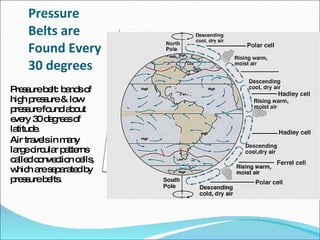
Pressure Belts are Found Every 30 degrees Pressure belt: bands of high pressure & low pressure found about every 30 degrees of latitude. Air travels in many large circular patterns called convection cells, which are separated by pressure belts.
The Coriolis Effect Not only affects ocean currents, but also the path of winds as well. Winds traveling north curve east and winds traveling south curve to the west.
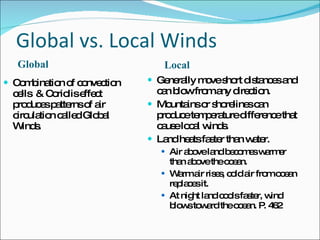
Global vs. Local Winds Global Local Combination of convection cells  & Coriolis effect produces patterns of air circulation called Global Winds. Generally move short distances and can blow from any direction. Mountains or shorelines can produce temperature difference that cause local winds. Land heats faster than water.  Air above land becomes warmer than above the ocean. Warm air rises, cold air from ocean replaces it. At night land cools faster, wind  blows toward the ocean. P. 462
Jet Streams Narrow belts of high-speed winds that blow in the upper troposphere and lower stratosphere. Unlike global winds, jet streams do not follow regular paths around the earth. Jet streams affect the movement of storms, thus meteorologists can track a storm if they know the location of a jet stream.
Review: How does air temperature over landmasses and adjacent bodies of water change between day and night. During the day, the air is cooler over  water.  At night, the air is cooler over land.

Global Winds And Local Winds

  • 1.
    Mrs. Harsh 6th Grade Science 2/9/2010
  • 2.
    Air Rises atthe Equator & Sinks at the Poles Differences in air pressure are generally cause by unequal heating of the earth. Area at equator receives more direct sunlight, causing warm, less dense air to rise to create an area of low pressure. Warm air flows toward poles. At the poles the air cools & sinks. As cold air sinks, pressure increases. The cold air then flows toward equator. P. 459 Winds that blow from 30 degrees latitude almost to the equator are called trade winds .
  • 3.
    Pressure Belts areFound Every 30 degrees Pressure belt: bands of high pressure & low pressure found about every 30 degrees of latitude. Air travels in many large circular patterns called convection cells, which are separated by pressure belts.
  • 4.
    The Coriolis EffectNot only affects ocean currents, but also the path of winds as well. Winds traveling north curve east and winds traveling south curve to the west.
  • 5.
    Global vs. LocalWinds Global Local Combination of convection cells & Coriolis effect produces patterns of air circulation called Global Winds. Generally move short distances and can blow from any direction. Mountains or shorelines can produce temperature difference that cause local winds. Land heats faster than water. Air above land becomes warmer than above the ocean. Warm air rises, cold air from ocean replaces it. At night land cools faster, wind blows toward the ocean. P. 462
  • 6.
    Jet Streams Narrowbelts of high-speed winds that blow in the upper troposphere and lower stratosphere. Unlike global winds, jet streams do not follow regular paths around the earth. Jet streams affect the movement of storms, thus meteorologists can track a storm if they know the location of a jet stream.
  • 7.
    Review: How doesair temperature over landmasses and adjacent bodies of water change between day and night. During the day, the air is cooler over water. At night, the air is cooler over land.