Air Movement Section 3
Forming Wind Wind is the movement of air from an area of high pressure to an area of lower pressure.
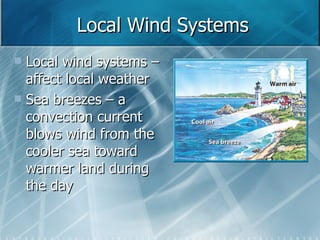
Local Wind Systems Local wind systems – affect local weather Sea breezes – a convection current blows wind from the cooler sea toward warmer land during the day
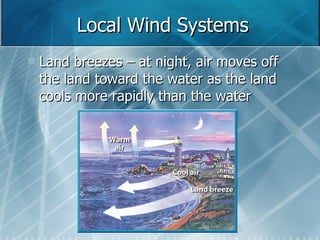
Local Wind Systems Land breezes – at night, air moves off the land toward the water as the land cools more rapidly than the water
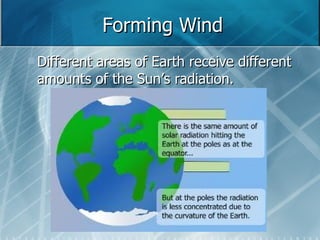
Forming Wind Different areas of Earth receive different amounts of the Sun’s radiation.
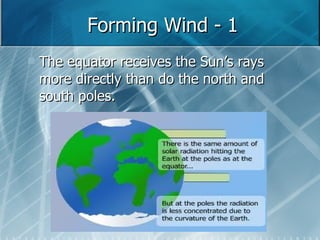
Forming Wind - 1 The equator receives the Sun’s rays more directly than do the north and south poles.
Forming Wind - 2 As a result, the air near the equator is less dense than the colder air masses near the poles.
Forming Wind - 3 Dense air moves from the poles toward the less dense air near the equator to cause wind.
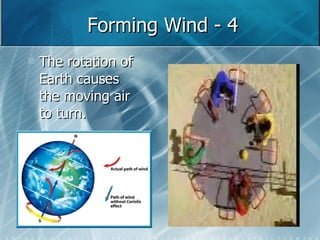
Forming Wind - 4 The rotation of Earth causes the moving air to turn.
Forming Wind - 5 Thus, the Coriolis effect causes surface wind to blow in bands: the polar easterlies, westerlies, and trade winds. Near the equator, very little wind and daily rain patterns the  doldrums
Global Winds Surface Winds Between the equator and 30 latitude (north and south) are steady trade winds, blowing to the west Between 30 and 60 latitude (north and south) the prevailing westerlies blow to the east, in the opposite direction of trade winds. Polar easterlies blow from northeast to southwest near the north pole and from southeast to northwest near the south pole.
Global Wind Affecting Trade The Coriolis Effect on Trade

Section 3 Notes

  • 1.
  • 2.
    Forming Wind Windis the movement of air from an area of high pressure to an area of lower pressure.
  • 3.
    Local Wind SystemsLocal wind systems – affect local weather Sea breezes – a convection current blows wind from the cooler sea toward warmer land during the day
  • 4.
    Local Wind SystemsLand breezes – at night, air moves off the land toward the water as the land cools more rapidly than the water
  • 5.
    Forming Wind Differentareas of Earth receive different amounts of the Sun’s radiation.
  • 6.
    Forming Wind -1 The equator receives the Sun’s rays more directly than do the north and south poles.
  • 7.
    Forming Wind -2 As a result, the air near the equator is less dense than the colder air masses near the poles.
  • 8.
    Forming Wind -3 Dense air moves from the poles toward the less dense air near the equator to cause wind.
  • 9.
    Forming Wind -4 The rotation of Earth causes the moving air to turn.
  • 10.
    Forming Wind -5 Thus, the Coriolis effect causes surface wind to blow in bands: the polar easterlies, westerlies, and trade winds. Near the equator, very little wind and daily rain patterns the doldrums
  • 11.
    Global Winds SurfaceWinds Between the equator and 30 latitude (north and south) are steady trade winds, blowing to the west Between 30 and 60 latitude (north and south) the prevailing westerlies blow to the east, in the opposite direction of trade winds. Polar easterlies blow from northeast to southwest near the north pole and from southeast to northwest near the south pole.
  • 12.
    Global Wind AffectingTrade The Coriolis Effect on Trade