Movement Of Air
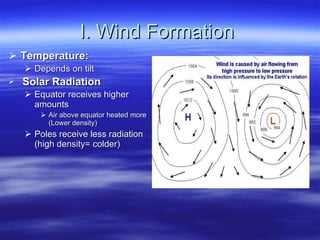
I. Wind Formation  Temperature:   Depends on tilt   Solar Radiation   Equator receives higher amounts   Air above equator heated more (Lower density) Poles receive less radiation (high density= colder)
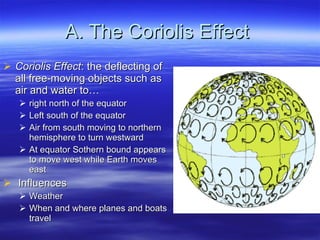
A. The Coriolis Effect  Coriolis Effect : the deflecting of all free-moving objects such as air and water to… right north of the equator  Left south of the equator Air from south moving to northern hemisphere to turn westward  At equator Sothern bound appears to move west while Earth moves east  Influences  Weather  When and where planes and boats travel
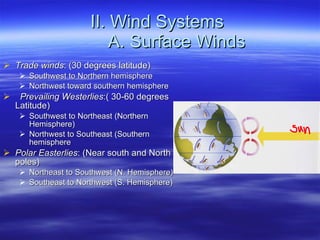
II. Wind Systems  A. Surface Winds  Trade winds : (30 degrees latitude) Southwest to Northern hemisphere Northwest toward southern hemisphere Prevailing Westerlies :( 30-60 degrees Latitude) Southwest to Northeast (Northern Hemisphere) Northwest to Southeast (Southern hemisphere Polar Easterlies : (Near south and North poles) Northeast to Southwest (N. Hemisphere) Southeast to Northwest (S. Hemisphere)
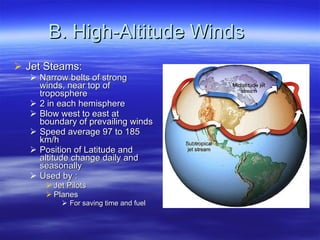
B. High-Altitude Winds  Jet Steams:  Narrow belts of strong winds, near top of troposphere  2 in each hemisphere  Blow west to east at boundary of prevailing winds  Speed average 97 to 185 km/h Position of Latitude and altitude change daily and seasonally  Used by : Jet Pilots  Planes  For saving time and fuel
III. Daily and Seasonal Winds Land and Sea Breezes determine local weather Sea Breezes : ( Convection current ) During the Day  Land warmed by solar radiation > then water Land air heated : by conduction Less dense , forced upward and inland from the ocean by denser air  Land Breezes : At night  Land air cooler then ocean ,Dense cold air forces warm air up and over water

Movement of air

  • 1.
  • 2.
    I. Wind Formation Temperature: Depends on tilt Solar Radiation Equator receives higher amounts Air above equator heated more (Lower density) Poles receive less radiation (high density= colder)
  • 3.
    A. The CoriolisEffect Coriolis Effect : the deflecting of all free-moving objects such as air and water to… right north of the equator Left south of the equator Air from south moving to northern hemisphere to turn westward At equator Sothern bound appears to move west while Earth moves east Influences Weather When and where planes and boats travel
  • 4.
    II. Wind Systems A. Surface Winds Trade winds : (30 degrees latitude) Southwest to Northern hemisphere Northwest toward southern hemisphere Prevailing Westerlies :( 30-60 degrees Latitude) Southwest to Northeast (Northern Hemisphere) Northwest to Southeast (Southern hemisphere Polar Easterlies : (Near south and North poles) Northeast to Southwest (N. Hemisphere) Southeast to Northwest (S. Hemisphere)
  • 5.
    B. High-Altitude Winds Jet Steams: Narrow belts of strong winds, near top of troposphere 2 in each hemisphere Blow west to east at boundary of prevailing winds Speed average 97 to 185 km/h Position of Latitude and altitude change daily and seasonally Used by : Jet Pilots Planes For saving time and fuel
  • 6.
    III. Daily andSeasonal Winds Land and Sea Breezes determine local weather Sea Breezes : ( Convection current ) During the Day Land warmed by solar radiation > then water Land air heated : by conduction Less dense , forced upward and inland from the ocean by denser air Land Breezes : At night Land air cooler then ocean ,Dense cold air forces warm air up and over water