Iffat Anjum (Roll : 16) 
Tabassum Tahrin Trisha (Roll : 32) 
Bashira Akter Anima (Roll : 48) 
Tamanna Yasmin (Roll : 49) 
1
WWhhyy VVLLSSII?? 
2 
Very Large Scale Integration 
 Integration is a technique that allows to build a system with 
many more transistors allowing much more computing power 
to be applied to solve a problem. 
 Integration improves the design: 
 lower parasitics = higher speed 
 lower power 
 physically smaller 
 Integration reduces manufacturing cost-(almost) no manual 
assembly.
WWhhaatt iiss FFPPGGAA?? 
3 
Field Programmable Gate Array 
 FPGA were introduced in 1985 by Xilinx. 
 Very high logic capacity. 
 Consists of an array of programmable logic blocks 
surrounded by programmable interconnects. 
 Can be configured by end-users to implement specific 
applications. 
 Capacity up to multi-millions logic gates and speed up to 
500MHz.
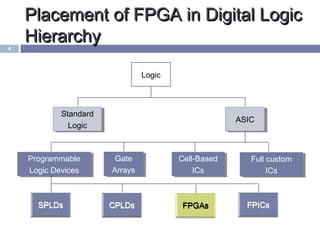
Placement ooff FFPPGGAA iinn DDiiggiittaall LLooggiicc 
HHiieerraarrcchhyy 
4 
Standard 
Logic 
Standard 
Logic 
Logic 
AASSICIC 
Full custom 
Full custom 
ICs 
ICs 
Cell-Based 
Cell-Based 
ICs 
ICs 
Gate 
Arrays 
Gate 
Arrays 
Programmable 
Logic Devices 
Programmable 
Logic Devices 
SPLDs CPLDs FPGAs FPICs
FFPPGGAA –– AA DDeettaaiilleedd LLooookk 
 Based on the principle of functional completeness. 
 In it, functionally complete elements (Logic Blocks) placed in 
an interconnect framework. 
 Interconnection framework comprises of wire segments and 
switches. 
 Circuits are partitioned to logic block size, mapped and 
routed. 
LE 
LE 
LE 
Interconnect 
network 
LE 
LE 
LE 
5
BBlloocckk DDiiaaggrraamm ooff aa FFPPGGAA 
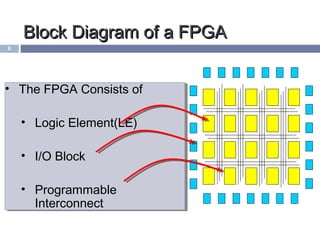
• The FPGA Consists of 
• Logic Element(LE) 
• I/O Block 
• Programmable 
• The FPGA Consists of 
• Logic Element(LE) 
• I/O Block 
• Programmable 
Interconnect 
Interconnect 
6
FFPPGGAA aarrcchhiitteeccttuurree 
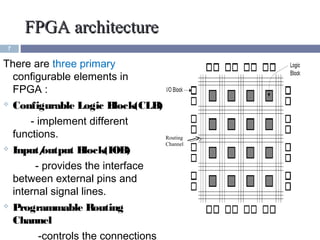
There are three primary 
configurable elements in 
FPGA : 
 Configurable Logic Block(CLB) 
- implement different 
functions. 
 Input/output Block(IOB) 
- provides the interface 
between external pins and 
internal signal lines. 
 Programmable Routing 
Channel 
-controls the connections 
7 
Routing 
Channel
Configurable LLooggiicc BBlloocckk((CCLLBB)) 
8 
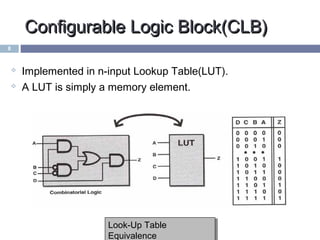
 Implemented in n-input Lookup Table(LUT). 
 A LUT is simply a memory element. 
Look-Up Table 
Equivalence 
Look-Up Table 
Equivalence
CCoonnffiigguurraabbllee LLooggiicc BBlloocckk((CCLLBB)) 
9 
Simplified Xilinx 
CLB 
Simplified Xilinx 
CLB
Configurable LLooggiicc BBlloocckk((CCLLBB)) 
10 
11.. TThhee CCrroossss PPooiinntt bblloocckk:: 
 Transistors are 
interconnected. 
 Logic block is 
implemented using 
transistor pair tiles.
Configurable LLooggiicc BBlloocckk((CCLLBB)) 
11 
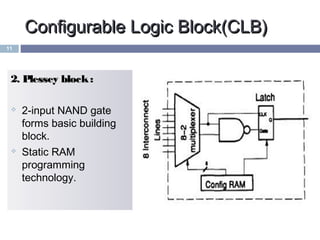
2.. PPlleesssseeyy bblloocckk :: 
 2-input NAND gate 
forms basic building 
block. 
 Static RAM 
programming 
technology.
CCoonnffiigguurraabbllee LLooggiicc BBlloocckk((CCLLBB)) 
3. The Xilinx Logic Block: 
 A SRAM function as a LUT. 
 Address line of SRAM as input. 
 Output of SRAM gives the logic 
output. 
12
Configurable LLooggiicc BBlloocckk((CCLLBB)) 
13 
44.. AAcctteell llooggiicc bblloocckk :: 
 An Actel logic block consists of multiple number of 
multiplexers and logic gates. 
 If inputs of a multiplexer are connected to a constant or to 
a signal, it can be used to implement different logic 
functions.
IInnppuutt//OOuuttppuutt BBlloocckk((IIOOBB)) 
14 
Two types of IOBs are there 
1)Dedicated for configuration of FPGA 
2)User Configurable 
IInnppuutt//OOuuttppuutt BBlloocckk 
 An IOB includes input and output registers, control signals, 
muxes and clock signals. 
 Unused FPGA inputs should not be left floating. 
 Single-ended and differential operational modes are typically 
supported
IInnppuutt//OOuuttppuutt BBlloocckk((IIOOBB)) 
15 
 The ring of I/O blocks is used to interface the FPGA device to 
external components. 
FPGA I/O 
block. 
FPGA I/O 
block.
Programmable RRoouuttiinngg CChhaannnneell 
 Routing Channel-metallic conductor used to make connection. 
 Three types are there 
 CLB Routing Channel : runs along each row and columns of 
CLBs. 
 IOB Routing Channel : forms CLB array & connects IOB 
with CLB routing channels. 
 Global Routing Channel : routes global signals (eg. Clock) 
with minimum delay. 
 Programmability in routing channels is obtained by using : 
(a)connection box and, 
(b)switch box 
16
PPrrooggrraammmmaabbllee RRoouuttiinngg CChhaannnneell 
  Connection Box: 
connects channel wires 
to the i/o pins of CLBs. 
  Switch Box: 
allow wires to switch 
between vertical and 
horizontal wires. 
Switch 
box 
Connection 
box 
17
Programmable RRoouuttiinngg CChhaannnneell 
Routing channels of CLBs` may be of three types : 
 Single length lines span through one CLB & provide short 
connections among CLBs. 
 Double length line spans two CLBs, offers low routing 
delay. 
 Long lines run along entire length or width of the array . 
 Interconnect Point in both switching and connection box is 
implemented through 6 Pass Transistors. 
18
Programmable IInntteerrccoonnnneeccttiioonn PPooiinntt 
 Programmable interconnect points provide the routing 
paths used to connect the inputs and outputs of IOBs and 
CLBs into logic networks. 
D Q 
19
Programmable wwiirriinngg ppaatthhss 
 Organized into channels. 
 Many wires per channel. 
 Connection between wire made at programmable 
interconnection points. 
 Must choose: 
 Channels from source to destination. 
 Wires within the channels 
20
FPGA RRoouuttiinngg MMaattrriixx aanndd GGlloobbaall 
SSiiggnnaallss 21 
FFPPGGAA s sigignnaal lR Roouutitningg
CChhoooossiinngg aa ppaatthh 
22 
LE 
LE
FFPPGGAA MMeemmoorryy 
 Two primary types of memory within FPGAs. 
 Distributed memory: 
Takes advantage of the fact that LUT elements are 
implementation of SRAM memory blocks. 
 Block memory: 
The implementation of dedicated SRAM memory blocks 
within the FPGA 
23
FFPPGGAA DDeessiiggnn 
 FPGA manufacturer creates an 
FPGA fabric; system designer 
uses this fabric. 
 FPGA fabric design issues: 
 Study sample user designs. 
 Select interconnect topology. 
 Create logic element 
structures. 
 Design circuits, layout. 
Major levels of 
abstraction: 
 Specification 
 Architecture 
 Logic Design 
 Circuit Design 
 Layout 
24
CCoonnffiigguurraattiioonn vvss.. PPrrooggrraammmmiinngg 
 CPU programming: 
 Instructions are fetched from a memory. 
 Instructions select complex operations. 
add r1, r2 addI Rr1, r2 
memory CPU 
 FPGA configuration: 
 Bits stay at the device they program. 
 A configuration bit controls a switch or a logic bit. 
25
AAddvvaannttaaggeess ooff FFPPGGAA 
 Small development overhead. 
 shorter design cycle. 
 No NRE (non-recurring engineering) costs. 
 Quick time to market. 
 no manufacturing delay. 
 Reprogrammable. 
 FPGAs reduce inventory. 
26
DDiissaaddvvaannttaaggeess ooff FFPPGGAA 
 Least efficient use of silicon/wiring resources 
 Limited size options 
 Limited performance 
 Not good for high volume applications 
 If used for prototyping, still may have significant changes 
when migrate to higher performance design and package 
solution. 
27
AA NNOOVVEELL DDEESSIIGGNN OOFF AA 
RREEVVEERRSSIIBBLLEE FFIIEELLDD 
28 
PPRROOGGRRAAMMMMAABBLLEE GGAATTEE AARRRRAAYY
UUsseedd RReevveerrssiibbllee GGaatteess 
29 
FFGG 
AA 
BB 
AA 
AA Å B B 
AA 
BB TTGG 
C C 
AA 
BB 
AABBÅ C C 
AA 
BB FFRRGG 
C C 
AA 
AA’B’B Å A ACC 
AABBÅ A A’C’C 
D D 
BB 
Å 
Å 
AABBCC D D 
BB 
BSP 
Gate 
BSP 
Gate 
AA 
C C 
AA 
AABB C C
44 ttoo 11 MMUUXX 
Input S0 S1 Output 
I0 0 0 I0 
I1 0 1 I1 
I2 1 0 I2 
I3 1 1 I3 
The characteristics equation of a 4-to-1 MUX can be written as 
Output =I0 S´0S´1 + I1S´0S1+I2 S0S´1 + I3 S0 S1. 
30
DDEESSIIGGNN OOFF TTHHEE PPRROOPPOOSSEEDD 
RREEVVEERRSSIIBBLLEE 44--11 MMUUXX 
Output = I0 S´ 0S´ 1 + I1S´ 0S1+ I2 S0S´ 1 + I3 S0 S1 Output = I0 S´ 0S´ 1 + I1S´ 0S1+ I2 S0S´ 1 + I3 S0 S1 
 The first 2 FGs are 
used to complement 
the select bits (S0, S1) 
 BSP gates are used to 
generate the 3-input 
AND-ed output 
 Last 3 FGs are used to 
combine the AND 
outputs of BSP gates 
31
CCoommppaarriissoonn 
4 to 1 MUX 
COMPONENTS AND COST 
No of gates Garbage Output 
Using Existing Gates 11 13 
Ours 9 11 
32
DD LLaattcchh 
Clock D Q 
Rising Edge 0 0 
Rising Edge 1 1 
Non rising X (Don’t Care) Qprev (No change) 
33 
The characteristics equation of D latch can be 
written as, 
Q =CD+C’Q
DDEESSIIGGNN OOFF TTHHEE PPRROOPPOOSSEEDD 
RREEVVEERRSSIIBBLLEE DD--LLAATTCCHH 34 
 The FRG is used to generate the output Q =CD+C’Q 
 NH gate is used to make the copy and complement of the 
generated output
CCoommppaarriissoonn 
D-Latches COMPONENTS AND COST 
No of gates Garbage Output Quantum Cost 
Existing circuit 
[4] 
7 8 48 
Existing circuit 
[5] 
11 12 42 
Existing circuit 
[6] 
5 3 12 
Existing circuit 
[7] 
2 2 10 
Proposed 2 2 9 
35
MMaasstteerr SSllaavvee FFFF 
36 
 A master–slave D flip-flop is created by connecting two gated 
D latches in series, and inverting the enable input to one of 
them. 
 It is called master–slave because the second latch in the 
series only changes in response to a change in the first 
(master) latch.
DDeessiiggnn ooff tthhee PPpprrooppoosseedd RReevveerrssiibbllee 
WWrriittee EEeennaabbllee MMaasstteerr SSllaavvee FFFF 
37 
 The FRG is used to generate the desired output of the write 
enable master slave flip flop. 
 The first FG is used make the complement of the Clock 
Pulse(CP). 
 The D-FFs are used to register the result. 
 The last FG is used to make a copy the output so that it can 
be fed back to the FRG.
CCoommppaarriissoonn 
Write Enable 
Master Slave FF 
COMPONENTS AND COST 
No of gates Garbage Output Quantum Cost 
Existing circuit 
[6] 
9 9 38 
Ours 7 7 25 
38
CCoonncclluussiioonn 
 Here we presented the design of a first ever proposed 
reversible logic block of FPGA. 
 The sequential circuits that are used to realize the FPGA 
have been improved. 
 Efficiency of the proposed circuits is clearly highlighted by 
using comparison here. 
 The number of gates, number of garbage outputs and 
quantum cost have been reduced as well. 
39
References 
40 
[1] R. Landauer, “Irreversibility and Heat Generation in the Computational Process”, 
IBM Jo urna l o f Re s e a rch a nd De ve lo pm e nt, vol. 3, pp. 183-191, 1961. 
[2] C.H. Bennett, “Logical Reversibility of Computation”, IBM J. o f Re s e a rch a nd 
De ve lo pm e nt, pp. 525-532, November 1973. 
[3] N. Huda, “On the Implementation of Reversible Random Access Memory”, M.Sc. 
thesis, Session: 2003-04, Department of CSE , University of Dhaka. 
[4] H. Thapliyal, Vinod, A.P.,”Design of Reversible Sequential Elements with 
Feasibility of Transistor Implementation”, Circuits and Systems, 2007. ISCAS 
2007. IEEE International Symposium on Volume, Issue , 27-30 May 2007 
Page(s):625 – 628 
[5] H. M. H. Babu, M. R. Islam, A. R. Chowdhury, and S. M. A. Chowdhury, 
“Reversible Logic Synthesis for Minimization of Full-Adder Circuit,” IEEE 
Conference on Digital System Design 2003; 50-4. 
[6] H. M. H. Babu, M. R. Islam, A. R. Chowdhury, and S. M. A. Chowdhury, 
“Synthesis of Full-Adder Circuit Using Reversible Logic,” 17th International 
Conference on VLSI Design 2004; 757-60. 
[7] Richard P. Feynman, “Quantum Mechanical Computers,” Foundations of Physics, 
vol. 16, no. 6, pp. 507-531, 1986.
TThhaannkk 
YYoo uu 
41

Fpga(field programmable gate array)

  • 1.
    Iffat Anjum (Roll: 16) Tabassum Tahrin Trisha (Roll : 32) Bashira Akter Anima (Roll : 48) Tamanna Yasmin (Roll : 49) 1
  • 2.
    WWhhyy VVLLSSII?? 2 Very Large Scale Integration  Integration is a technique that allows to build a system with many more transistors allowing much more computing power to be applied to solve a problem.  Integration improves the design:  lower parasitics = higher speed  lower power  physically smaller  Integration reduces manufacturing cost-(almost) no manual assembly.
  • 3.
    WWhhaatt iiss FFPPGGAA?? 3 Field Programmable Gate Array  FPGA were introduced in 1985 by Xilinx.  Very high logic capacity.  Consists of an array of programmable logic blocks surrounded by programmable interconnects.  Can be configured by end-users to implement specific applications.  Capacity up to multi-millions logic gates and speed up to 500MHz.
  • 4.
    Placement ooff FFPPGGAAiinn DDiiggiittaall LLooggiicc HHiieerraarrcchhyy 4 Standard Logic Standard Logic Logic AASSICIC Full custom Full custom ICs ICs Cell-Based Cell-Based ICs ICs Gate Arrays Gate Arrays Programmable Logic Devices Programmable Logic Devices SPLDs CPLDs FPGAs FPICs
  • 5.
    FFPPGGAA –– AADDeettaaiilleedd LLooookk  Based on the principle of functional completeness.  In it, functionally complete elements (Logic Blocks) placed in an interconnect framework.  Interconnection framework comprises of wire segments and switches.  Circuits are partitioned to logic block size, mapped and routed. LE LE LE Interconnect network LE LE LE 5
  • 6.
    BBlloocckk DDiiaaggrraamm ooffaa FFPPGGAA • The FPGA Consists of • Logic Element(LE) • I/O Block • Programmable • The FPGA Consists of • Logic Element(LE) • I/O Block • Programmable Interconnect Interconnect 6
  • 7.
    FFPPGGAA aarrcchhiitteeccttuurree Thereare three primary configurable elements in FPGA :  Configurable Logic Block(CLB) - implement different functions.  Input/output Block(IOB) - provides the interface between external pins and internal signal lines.  Programmable Routing Channel -controls the connections 7 Routing Channel
  • 8.
    Configurable LLooggiicc BBlloocckk((CCLLBB)) 8  Implemented in n-input Lookup Table(LUT).  A LUT is simply a memory element. Look-Up Table Equivalence Look-Up Table Equivalence
  • 9.
    CCoonnffiigguurraabbllee LLooggiicc BBlloocckk((CCLLBB)) 9 Simplified Xilinx CLB Simplified Xilinx CLB
  • 10.
    Configurable LLooggiicc BBlloocckk((CCLLBB)) 10 11.. TThhee CCrroossss PPooiinntt bblloocckk::  Transistors are interconnected.  Logic block is implemented using transistor pair tiles.
  • 11.
    Configurable LLooggiicc BBlloocckk((CCLLBB)) 11 2.. PPlleesssseeyy bblloocckk ::  2-input NAND gate forms basic building block.  Static RAM programming technology.
  • 12.
    CCoonnffiigguurraabbllee LLooggiicc BBlloocckk((CCLLBB)) 3. The Xilinx Logic Block:  A SRAM function as a LUT.  Address line of SRAM as input.  Output of SRAM gives the logic output. 12
  • 13.
    Configurable LLooggiicc BBlloocckk((CCLLBB)) 13 44.. AAcctteell llooggiicc bblloocckk ::  An Actel logic block consists of multiple number of multiplexers and logic gates.  If inputs of a multiplexer are connected to a constant or to a signal, it can be used to implement different logic functions.
  • 14.
    IInnppuutt//OOuuttppuutt BBlloocckk((IIOOBB)) 14 Two types of IOBs are there 1)Dedicated for configuration of FPGA 2)User Configurable IInnppuutt//OOuuttppuutt BBlloocckk  An IOB includes input and output registers, control signals, muxes and clock signals.  Unused FPGA inputs should not be left floating.  Single-ended and differential operational modes are typically supported
  • 15.
    IInnppuutt//OOuuttppuutt BBlloocckk((IIOOBB)) 15  The ring of I/O blocks is used to interface the FPGA device to external components. FPGA I/O block. FPGA I/O block.
  • 16.
    Programmable RRoouuttiinngg CChhaannnneell  Routing Channel-metallic conductor used to make connection.  Three types are there  CLB Routing Channel : runs along each row and columns of CLBs.  IOB Routing Channel : forms CLB array & connects IOB with CLB routing channels.  Global Routing Channel : routes global signals (eg. Clock) with minimum delay.  Programmability in routing channels is obtained by using : (a)connection box and, (b)switch box 16
  • 17.
    PPrrooggrraammmmaabbllee RRoouuttiinngg CChhaannnneell   Connection Box: connects channel wires to the i/o pins of CLBs.   Switch Box: allow wires to switch between vertical and horizontal wires. Switch box Connection box 17
  • 18.
    Programmable RRoouuttiinngg CChhaannnneell Routing channels of CLBs` may be of three types :  Single length lines span through one CLB & provide short connections among CLBs.  Double length line spans two CLBs, offers low routing delay.  Long lines run along entire length or width of the array .  Interconnect Point in both switching and connection box is implemented through 6 Pass Transistors. 18
  • 19.
    Programmable IInntteerrccoonnnneeccttiioonn PPooiinntt  Programmable interconnect points provide the routing paths used to connect the inputs and outputs of IOBs and CLBs into logic networks. D Q 19
  • 20.
    Programmable wwiirriinngg ppaatthhss  Organized into channels.  Many wires per channel.  Connection between wire made at programmable interconnection points.  Must choose:  Channels from source to destination.  Wires within the channels 20
  • 21.
    FPGA RRoouuttiinngg MMaattrriixxaanndd GGlloobbaall SSiiggnnaallss 21 FFPPGGAA s sigignnaal lR Roouutitningg
  • 22.
  • 23.
    FFPPGGAA MMeemmoorryy Two primary types of memory within FPGAs.  Distributed memory: Takes advantage of the fact that LUT elements are implementation of SRAM memory blocks.  Block memory: The implementation of dedicated SRAM memory blocks within the FPGA 23
  • 24.
    FFPPGGAA DDeessiiggnn FPGA manufacturer creates an FPGA fabric; system designer uses this fabric.  FPGA fabric design issues:  Study sample user designs.  Select interconnect topology.  Create logic element structures.  Design circuits, layout. Major levels of abstraction:  Specification  Architecture  Logic Design  Circuit Design  Layout 24
  • 25.
    CCoonnffiigguurraattiioonn vvss.. PPrrooggrraammmmiinngg  CPU programming:  Instructions are fetched from a memory.  Instructions select complex operations. add r1, r2 addI Rr1, r2 memory CPU  FPGA configuration:  Bits stay at the device they program.  A configuration bit controls a switch or a logic bit. 25
  • 26.
    AAddvvaannttaaggeess ooff FFPPGGAA  Small development overhead.  shorter design cycle.  No NRE (non-recurring engineering) costs.  Quick time to market.  no manufacturing delay.  Reprogrammable.  FPGAs reduce inventory. 26
  • 27.
    DDiissaaddvvaannttaaggeess ooff FFPPGGAA  Least efficient use of silicon/wiring resources  Limited size options  Limited performance  Not good for high volume applications  If used for prototyping, still may have significant changes when migrate to higher performance design and package solution. 27
  • 28.
    AA NNOOVVEELL DDEESSIIGGNNOOFF AA RREEVVEERRSSIIBBLLEE FFIIEELLDD 28 PPRROOGGRRAAMMMMAABBLLEE GGAATTEE AARRRRAAYY
  • 29.
    UUsseedd RReevveerrssiibbllee GGaatteess 29 FFGG AA BB AA AA Å B B AA BB TTGG C C AA BB AABBÅ C C AA BB FFRRGG C C AA AA’B’B Å A ACC AABBÅ A A’C’C D D BB Å Å AABBCC D D BB BSP Gate BSP Gate AA C C AA AABB C C
  • 30.
    44 ttoo 11MMUUXX Input S0 S1 Output I0 0 0 I0 I1 0 1 I1 I2 1 0 I2 I3 1 1 I3 The characteristics equation of a 4-to-1 MUX can be written as Output =I0 S´0S´1 + I1S´0S1+I2 S0S´1 + I3 S0 S1. 30
  • 31.
    DDEESSIIGGNN OOFF TTHHEEPPRROOPPOOSSEEDD RREEVVEERRSSIIBBLLEE 44--11 MMUUXX Output = I0 S´ 0S´ 1 + I1S´ 0S1+ I2 S0S´ 1 + I3 S0 S1 Output = I0 S´ 0S´ 1 + I1S´ 0S1+ I2 S0S´ 1 + I3 S0 S1  The first 2 FGs are used to complement the select bits (S0, S1)  BSP gates are used to generate the 3-input AND-ed output  Last 3 FGs are used to combine the AND outputs of BSP gates 31
  • 32.
    CCoommppaarriissoonn 4 to1 MUX COMPONENTS AND COST No of gates Garbage Output Using Existing Gates 11 13 Ours 9 11 32
  • 33.
    DD LLaattcchh ClockD Q Rising Edge 0 0 Rising Edge 1 1 Non rising X (Don’t Care) Qprev (No change) 33 The characteristics equation of D latch can be written as, Q =CD+C’Q
  • 34.
    DDEESSIIGGNN OOFF TTHHEEPPRROOPPOOSSEEDD RREEVVEERRSSIIBBLLEE DD--LLAATTCCHH 34  The FRG is used to generate the output Q =CD+C’Q  NH gate is used to make the copy and complement of the generated output
  • 35.
    CCoommppaarriissoonn D-Latches COMPONENTSAND COST No of gates Garbage Output Quantum Cost Existing circuit [4] 7 8 48 Existing circuit [5] 11 12 42 Existing circuit [6] 5 3 12 Existing circuit [7] 2 2 10 Proposed 2 2 9 35
  • 36.
    MMaasstteerr SSllaavvee FFFF 36  A master–slave D flip-flop is created by connecting two gated D latches in series, and inverting the enable input to one of them.  It is called master–slave because the second latch in the series only changes in response to a change in the first (master) latch.
  • 37.
    DDeessiiggnn ooff tthheePPpprrooppoosseedd RReevveerrssiibbllee WWrriittee EEeennaabbllee MMaasstteerr SSllaavvee FFFF 37  The FRG is used to generate the desired output of the write enable master slave flip flop.  The first FG is used make the complement of the Clock Pulse(CP).  The D-FFs are used to register the result.  The last FG is used to make a copy the output so that it can be fed back to the FRG.
  • 38.
    CCoommppaarriissoonn Write Enable Master Slave FF COMPONENTS AND COST No of gates Garbage Output Quantum Cost Existing circuit [6] 9 9 38 Ours 7 7 25 38
  • 39.
    CCoonncclluussiioonn  Herewe presented the design of a first ever proposed reversible logic block of FPGA.  The sequential circuits that are used to realize the FPGA have been improved.  Efficiency of the proposed circuits is clearly highlighted by using comparison here.  The number of gates, number of garbage outputs and quantum cost have been reduced as well. 39
  • 40.
    References 40 [1]R. Landauer, “Irreversibility and Heat Generation in the Computational Process”, IBM Jo urna l o f Re s e a rch a nd De ve lo pm e nt, vol. 3, pp. 183-191, 1961. [2] C.H. Bennett, “Logical Reversibility of Computation”, IBM J. o f Re s e a rch a nd De ve lo pm e nt, pp. 525-532, November 1973. [3] N. Huda, “On the Implementation of Reversible Random Access Memory”, M.Sc. thesis, Session: 2003-04, Department of CSE , University of Dhaka. [4] H. Thapliyal, Vinod, A.P.,”Design of Reversible Sequential Elements with Feasibility of Transistor Implementation”, Circuits and Systems, 2007. ISCAS 2007. IEEE International Symposium on Volume, Issue , 27-30 May 2007 Page(s):625 – 628 [5] H. M. H. Babu, M. R. Islam, A. R. Chowdhury, and S. M. A. Chowdhury, “Reversible Logic Synthesis for Minimization of Full-Adder Circuit,” IEEE Conference on Digital System Design 2003; 50-4. [6] H. M. H. Babu, M. R. Islam, A. R. Chowdhury, and S. M. A. Chowdhury, “Synthesis of Full-Adder Circuit Using Reversible Logic,” 17th International Conference on VLSI Design 2004; 757-60. [7] Richard P. Feynman, “Quantum Mechanical Computers,” Foundations of Physics, vol. 16, no. 6, pp. 507-531, 1986.
  • 41.

Editor's Notes

  • #15 User configurable IOBs can be configured as i/p,o/p or bidirectional for providing connections of internal CLBs to external package pins