Converting Regular Expressions to NFAs
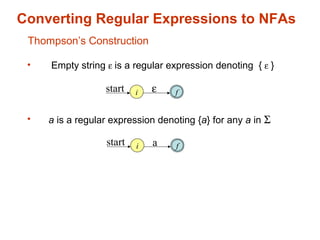
• Empty string ε is a regular expression denoting { ε }
• a is a regular expression denoting {a} for any a in Σ
i ε fstart
i a fstart
Thompson’s Construction
Converting Regular Expressions to NFAs
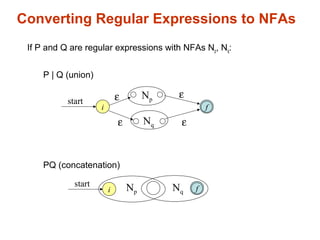
If P and Q are regular expressions with NFAs Np, Nq:
P | Q (union)
PQ (concatenation)
Np
Nq
i f
ε
ε ε
ε
start
NqNpi f
start
Converting Regular Expressions to NFAs
If Q is a regular expression with NFA Nq:
Q* (closure)
ε
Nq f
ε
i
start ε
ε
Example (ab* | a*b)*
Starting with:
43
a*b b
a
startab* 1 2
a
b
start
1 2
a
43
5 6
ab* | a*b
ε
ε ε
ε
a
b
b
start
Example (ab* | a*b)*
1 2
a
43
5 6
ab* | a*b
ε
ε ε
ε
a
b
b
start
1 2
a
43
5 6
(ab* | a*b)*
7 8
ε
ε
ε ε
ε
ε ε
ε
b
b
a
start
Properties of Construction
1. N(r) has #of states ≤ 2*(#symbols + #operators) of r
2. N(r) has exactly one start and one accepting state
3. Each state of N(r) has at most one outgoing edge a∈Σ
or at most two outgoing ∈-transition
Let r be a regular expression, with NFA N(r), then
Detailed Example
r13
r12r5
r3 r11r4
r9
r10
r8r7
r6
r0
r1 r2
b
*
c
a a
|
( )
b
|
*
c
(ab*c) | (a(b|c*))
Parse Tree for this regular expression:
What is the NFA? Let’s construct it !
Detailed Example – Construction(1)
r3: a
r0: b
r2: c
b ∈
∈
∈
∈r1:
r4 : r1 r2
b ∈
∈
∈
∈ c
r5 : r3 r4
b ∈
∈
∈
∈a c
(ab*c) | (a(b|c*))
Detailed Example – Construction(2)
r11: a
r7: b
r6: c
c ∈
∈
∈
∈r9 : r7 | r8
∈
∈
b
r10 : r9
c ∈
∈
∈
∈r8:
c ∈
∈
∈
∈r12 : r11 r10
∈
∈
b
a
∈ ∈
∈ ∈
(ab*c) | (a(b|c*))
Detailed Example – Final Step
r13 : r5 | r12
b ∈
∈
∈
∈a c
c ∈
∈
∈
∈
∈
∈
b
a
∈
∈∈
∈
1
6543
8
2
10
9 12 13 14
11
15
7
16
17
∈∈
Converting NFAs to DFAs (subset
construction)
• Idea: Each state in the new DFA will correspond to
some set of states from the NFA. The DFA will be in
state {s0,s1,…} after input if the NFA could be in any of
these states for the same input.
• Input: NFA N with state set SN, alphabet Σ, start state sN,
final states FN, transition function TN: SN x {Σ U ε}  SN
• Output: DFA D with state set SD, alphabet Σ, start state
sD = ε-closure(sN), final states FD, transition function
TD: SD x Σ  SD
Terminology: ε-closure
ε-closure(T) = T + all NFA states reachable from any state in T
using only ε transitions.
1
5
2
43
b
ε
a ε
b
b
a
ε-closure({1,2,5}) = {1,2,5}
ε-closure({4}) = {1,4}
ε-closure({3}) = {1,3,4}
ε-closure({3,5}) = {1,3,4,5}
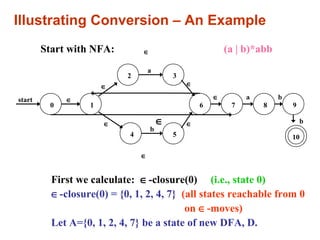
Illustrating Conversion – An Example
First we calculate: ∈-closure(0) (i.e., state 0)
∈-closure(0) = {0, 1, 2, 4, 7} (all states reachable from 0
on ∈-moves)
Let A={0, 1, 2, 4, 7} be a state of new DFA, D.
0 1
2 3
54
6 7 8 9
10
∈
∈
∈
∈
∈
∈
∈
∈ a
a
b
b
b
start
Start with NFA: (a | b)*abb
∈
Conversion Example – continued (1)
b : ∈-closure(move(A,b)) = ∈-closure(move({0,1,2,4,7},b))
adds {5} ( since move(4,b)=5)
From this we have : ∈-closure({5}) = {1,2,4,5,6,7}
(since 5→6 →1 →4, 6 →7, and 1 →2 all by ∈-moves)
Let C={1,2,4,5,6,7} be a new state. Define Dtran[A,b] = C.
2nd
, we calculate : a : ∈-closure(move(A,a)) and
b : ∈-closure(move(A,b))
a : ∈-closure(move(A,a)) = ∈-closure(move({0,1,2,4,7},a))}
adds {3,8} ( since move(2,a)=3 and move(7,a)=8)
From this we have : ∈-closure({3,8}) = {1,2,3,4,6,7,8}
(since 3→6 →1 →4, 6 →7, and 1 →2 all by ∈-moves)
Let B={1,2,3,4,6,7,8} be a new state. Define Dtran[A,a] = B.
Conversion Example – continued (2)
3rd
, we calculate for state B on {a,b}
a : ∈-closure(move(B,a)) = ∈-closure(move({1,2,3,4,6,7,8},a))}
= {1,2,3,4,6,7,8} = B
Define Dtran[B,a] = B.
b : ∈-closure(move(B,b)) = ∈-closure(move({1,2,3,4,6,7,8},b))}
= {1,2,4,5,6,7,9} = D
Define Dtran[B,b] = D.
4th
, we calculate for state C on {a,b}
a : ∈-closure(move(C,a)) = ∈-closure(move({1,2,4,5,6,7},a))}
= {1,2,3,4,6,7,8} = B
Define Dtran[C,a] = B.
b : ∈-closure(move(C,b)) = ∈-closure(move({1,2,4,5,6,7},b))}
= {1,2,4,5,6,7} = C
Define Dtran[C,b] = C.
Conversion Example – continued (3)
5th
, we calculate for state D on {a,b}
a : ∈-closure(move(D,a)) = ∈-closure(move({1,2,4,5,6,7,9},a))}
= {1,2,3,4,6,7,8} = B
Define Dtran[D,a] = B.
b : ∈-closure(move(D,b)) = ∈-closure(move({1,2,4,5,6,7,9},b))}
= {1,2,4,5,6,7,10} = E
Define Dtran[D,b] = E.
Finally, we calculate for state E on {a,b}
a : ∈-closure(move(E,a)) = ∈-closure(move({1,2,4,5,6,7,10},a))}
= {1,2,3,4,6,7,8} = B
Define Dtran[E,a] = B.
b : ∈-closure(move(E,b)) = ∈-closure(move({1,2,4,5,6,7,10},b))}
= {1,2,4,5,6,7} = C
Define Dtran[E,b] = C.
Conversion Example – continued (4)
Dstates
Input Symbol
a b
A B C
B B D
C B C
E B C
D B E
A
C
B D Estart bb
b
b
b
a
a
a
a
This gives the transition table Dtran for the DFA of:
Algorithm For Subset Construction
push all states in T onto stack;
initialize ∈-closure(T) to T;
while stack is not empty do begin
pop t, the top element, off the stack;
for each state u with edge from t to u labeled ∈ do
if u is not in ∈-closure(T) do begin
add u to ∈-closure(T) ;
push u onto stack
end
end
computing the
∈-closure
Algorithm For Subset Construction – (2)
initially, ∈-closure(s0) is only (unmarked) state in Dstates;
while there is unmarked state T in Dstates do begin
mark T;
for each input symbol a do begin
U := ∈-closure(move(T,a));
if U is not in Dstates then
add U as an unmarked state to Dstates;
Dtran[T,a] := U
end
end
Example 2: Subset Construction
NFA
1
5
2
43
ε
b
a b
a,b
a,b
start
NFA N with
• State set SN = {1,2,3,4,5},
• Alphabet Σ = {a,b}
• Start state sN=1,
• Final states FN={5},
• Transition function TN: SN x {Σ ∪ ε}  SN
a b ε
1 3 - 2
2 5 5, 4 -
3 - 4 -
4 5 5 -
5 - - -
Example 2: Subset Construction
NFA
1,2
T ∈-closure(move(T,
a))
∈-closure(move(T, b))
{1,2}
1
5
2
43
ε
b
a b
a,b
a,b
start
start
Example 2: Subset Construction
NFA
1,2 4,5
3,5
b
a
T ∈-closure(move(T,
a))
∈-closure(move(T, b))
{1,2} {3,5} {4,5}
{3,5}
{4,5}
1
5
2
43
ε
b
a b
a,b
a,b
start
start
Example 2: Subset Construction
1
5
2
43
ε
b
a b
a,b
a,b
NFA
1,2 4,5
3,5 4
b
a
b
T ∈-closure(move(T,
a))
∈-closure(move(T,
b))
{1,2} {3,5} {4,5}
{3,5} - {4}
{4,5}
{4}
start
start
Example 2: Subset Construction
1
5
2
43
ε
b
a b
a,b
a,b
NFA
1,2 4,5 5
3,5 4
a,bb
a
b
T ∈-closure(move(T,
a))
∈-closure(move(T, b))
{1,2} {3,5} {4,5}
{3,5} - {4}
{4,5} {5} {5}
{4}
{5}
start
start
Example 2: Subset Construction
1
5
2
43
ε
b
a b
a,b
a,b
NFA
1,2 4,5 5
3,5 4
a,b
a,b
b
a
b
T ∈-closure(move(T,
a))
∈-closure(move(T, b))
{1,2} {3,5} {4,5}
{3,5} - {4}
{4,5} {5} {5}
{4} {5} {5}
{5} - -
start
start
Example 2: Subset Construction
1
5
2
43
ε
b
a b
a,b
a,b
NFA
T ∈-closure(move(T,
a))
∈-closure(move(T, b))
{1,2} {3,5} {4,5}
{3,5} - {4}
{4,5} {5} {5}
{4} {5} {5}
{5} - -
All final states since the
NFA final state is included
start
1,2 4,5 5
3,5 4
a,b
a,b
b
a
b
start
Example 3: Subset Construction
1
5
2
43
b
ε
a b
b
a
NFA
ε
start
Example 3: Subset Construction
1
5
2
43
b
ε
a b
b
a
1 1,3,4
2
1,4,5
a
b
b
NFA DFA
ε
1,3,
4,5
a
a
a
b
b b
start start
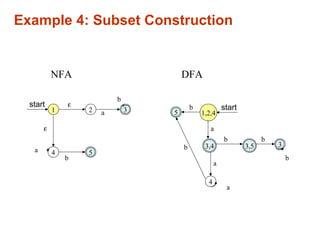
Example 4: Subset Construction
1 2
54
ε
b
ε
1,2,4
NFA DFA
a
b
a 5
3,4 3,5
4
3
3
b
b
a
b
a
b
b
a
start start
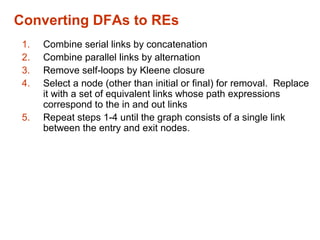
Converting DFAs to REs
1. Combine serial links by concatenation
2. Combine parallel links by alternation
3. Remove self-loops by Kleene closure
4. Select a node (other than initial or final) for removal. Replace
it with a set of equivalent links whose path expressions
correspond to the in and out links
5. Repeat steps 1-4 until the graph consists of a single link
between the entry and exit nodes.
Example
1 2 3 4 5
6 7
d
a
b
c
d
0
d a
d bb
c
1 2 3 4 5
6 7
d a|b|c d
0
d a
d b
b|c
parallel edges become alternation
start
start
a
b
c
Example
3 4 5
d (a|b|c) d d
0
a
b (b|c) d
1 2 3 4 5
6 7
d a|b|c d
0
d a
d b
b|c
serial edges become concatenation
start
start
Example
3 4 5
d (a|b|c) d d
0
a
b (b|c) d
3 4 5
d (a|b|c) d d
0
a
b(b|c)da
Find paths that can be “shortened”
start
start
Example
3 4 5
d (a|b|c) d d
0
a
b(b|c)da
3 4 5
d (a|b|c) d (b(b|c)da)*d
0
a
5
d (a|b|c) d (b(b|c)da)*d
0
a
eliminate self-loops
serial edges become concatenation
start
start
start
Relationship among RE, NFA, DFA
• The set of strings recognized by an NFA can be described by a
Regular Expression.
• The set of strings described by a Regular Expression can be
recognized by an NFA.
• The set of strings recognized by an DFA can be described by a
Regular Expression.
• The set of strings described by a Regular Expression can be
recognized by an DFA.
• DFAs, NFAs, and Regular Expressions all have the same “power”.
They describe “Regular Sets” (“Regular Languages”)
• The DFA may have a lot more states than the NFA.

Lecture 03 lexical analysis

  • 1.
    Converting Regular Expressionsto NFAs • Empty string ε is a regular expression denoting { ε } • a is a regular expression denoting {a} for any a in Σ i ε fstart i a fstart Thompson’s Construction
  • 2.
    Converting Regular Expressionsto NFAs If P and Q are regular expressions with NFAs Np, Nq: P | Q (union) PQ (concatenation) Np Nq i f ε ε ε ε start NqNpi f start
  • 3.
    Converting Regular Expressionsto NFAs If Q is a regular expression with NFA Nq: Q* (closure) ε Nq f ε i start ε ε
  • 4.
    Example (ab* |a*b)* Starting with: 43 a*b b a startab* 1 2 a b start 1 2 a 43 5 6 ab* | a*b ε ε ε ε a b b start
  • 5.
    Example (ab* |a*b)* 1 2 a 43 5 6 ab* | a*b ε ε ε ε a b b start 1 2 a 43 5 6 (ab* | a*b)* 7 8 ε ε ε ε ε ε ε ε b b a start
  • 6.
    Properties of Construction 1.N(r) has #of states ≤ 2*(#symbols + #operators) of r 2. N(r) has exactly one start and one accepting state 3. Each state of N(r) has at most one outgoing edge a∈Σ or at most two outgoing ∈-transition Let r be a regular expression, with NFA N(r), then
  • 7.
    Detailed Example r13 r12r5 r3 r11r4 r9 r10 r8r7 r6 r0 r1r2 b * c a a | ( ) b | * c (ab*c) | (a(b|c*)) Parse Tree for this regular expression: What is the NFA? Let’s construct it !
  • 8.
    Detailed Example –Construction(1) r3: a r0: b r2: c b ∈ ∈ ∈ ∈r1: r4 : r1 r2 b ∈ ∈ ∈ ∈ c r5 : r3 r4 b ∈ ∈ ∈ ∈a c (ab*c) | (a(b|c*))
  • 9.
    Detailed Example –Construction(2) r11: a r7: b r6: c c ∈ ∈ ∈ ∈r9 : r7 | r8 ∈ ∈ b r10 : r9 c ∈ ∈ ∈ ∈r8: c ∈ ∈ ∈ ∈r12 : r11 r10 ∈ ∈ b a ∈ ∈ ∈ ∈ (ab*c) | (a(b|c*))
  • 10.
    Detailed Example –Final Step r13 : r5 | r12 b ∈ ∈ ∈ ∈a c c ∈ ∈ ∈ ∈ ∈ ∈ b a ∈ ∈∈ ∈ 1 6543 8 2 10 9 12 13 14 11 15 7 16 17 ∈∈
  • 11.
    Converting NFAs toDFAs (subset construction) • Idea: Each state in the new DFA will correspond to some set of states from the NFA. The DFA will be in state {s0,s1,…} after input if the NFA could be in any of these states for the same input. • Input: NFA N with state set SN, alphabet Σ, start state sN, final states FN, transition function TN: SN x {Σ U ε}  SN • Output: DFA D with state set SD, alphabet Σ, start state sD = ε-closure(sN), final states FD, transition function TD: SD x Σ  SD
  • 12.
    Terminology: ε-closure ε-closure(T) =T + all NFA states reachable from any state in T using only ε transitions. 1 5 2 43 b ε a ε b b a ε-closure({1,2,5}) = {1,2,5} ε-closure({4}) = {1,4} ε-closure({3}) = {1,3,4} ε-closure({3,5}) = {1,3,4,5}
  • 13.
    Illustrating Conversion –An Example First we calculate: ∈-closure(0) (i.e., state 0) ∈-closure(0) = {0, 1, 2, 4, 7} (all states reachable from 0 on ∈-moves) Let A={0, 1, 2, 4, 7} be a state of new DFA, D. 0 1 2 3 54 6 7 8 9 10 ∈ ∈ ∈ ∈ ∈ ∈ ∈ ∈ a a b b b start Start with NFA: (a | b)*abb ∈
  • 14.
    Conversion Example –continued (1) b : ∈-closure(move(A,b)) = ∈-closure(move({0,1,2,4,7},b)) adds {5} ( since move(4,b)=5) From this we have : ∈-closure({5}) = {1,2,4,5,6,7} (since 5→6 →1 →4, 6 →7, and 1 →2 all by ∈-moves) Let C={1,2,4,5,6,7} be a new state. Define Dtran[A,b] = C. 2nd , we calculate : a : ∈-closure(move(A,a)) and b : ∈-closure(move(A,b)) a : ∈-closure(move(A,a)) = ∈-closure(move({0,1,2,4,7},a))} adds {3,8} ( since move(2,a)=3 and move(7,a)=8) From this we have : ∈-closure({3,8}) = {1,2,3,4,6,7,8} (since 3→6 →1 →4, 6 →7, and 1 →2 all by ∈-moves) Let B={1,2,3,4,6,7,8} be a new state. Define Dtran[A,a] = B.
  • 15.
    Conversion Example –continued (2) 3rd , we calculate for state B on {a,b} a : ∈-closure(move(B,a)) = ∈-closure(move({1,2,3,4,6,7,8},a))} = {1,2,3,4,6,7,8} = B Define Dtran[B,a] = B. b : ∈-closure(move(B,b)) = ∈-closure(move({1,2,3,4,6,7,8},b))} = {1,2,4,5,6,7,9} = D Define Dtran[B,b] = D. 4th , we calculate for state C on {a,b} a : ∈-closure(move(C,a)) = ∈-closure(move({1,2,4,5,6,7},a))} = {1,2,3,4,6,7,8} = B Define Dtran[C,a] = B. b : ∈-closure(move(C,b)) = ∈-closure(move({1,2,4,5,6,7},b))} = {1,2,4,5,6,7} = C Define Dtran[C,b] = C.
  • 16.
    Conversion Example –continued (3) 5th , we calculate for state D on {a,b} a : ∈-closure(move(D,a)) = ∈-closure(move({1,2,4,5,6,7,9},a))} = {1,2,3,4,6,7,8} = B Define Dtran[D,a] = B. b : ∈-closure(move(D,b)) = ∈-closure(move({1,2,4,5,6,7,9},b))} = {1,2,4,5,6,7,10} = E Define Dtran[D,b] = E. Finally, we calculate for state E on {a,b} a : ∈-closure(move(E,a)) = ∈-closure(move({1,2,4,5,6,7,10},a))} = {1,2,3,4,6,7,8} = B Define Dtran[E,a] = B. b : ∈-closure(move(E,b)) = ∈-closure(move({1,2,4,5,6,7,10},b))} = {1,2,4,5,6,7} = C Define Dtran[E,b] = C.
  • 17.
    Conversion Example –continued (4) Dstates Input Symbol a b A B C B B D C B C E B C D B E A C B D Estart bb b b b a a a a This gives the transition table Dtran for the DFA of:
  • 18.
    Algorithm For SubsetConstruction push all states in T onto stack; initialize ∈-closure(T) to T; while stack is not empty do begin pop t, the top element, off the stack; for each state u with edge from t to u labeled ∈ do if u is not in ∈-closure(T) do begin add u to ∈-closure(T) ; push u onto stack end end computing the ∈-closure
  • 19.
    Algorithm For SubsetConstruction – (2) initially, ∈-closure(s0) is only (unmarked) state in Dstates; while there is unmarked state T in Dstates do begin mark T; for each input symbol a do begin U := ∈-closure(move(T,a)); if U is not in Dstates then add U as an unmarked state to Dstates; Dtran[T,a] := U end end
  • 20.
    Example 2: SubsetConstruction NFA 1 5 2 43 ε b a b a,b a,b start NFA N with • State set SN = {1,2,3,4,5}, • Alphabet Σ = {a,b} • Start state sN=1, • Final states FN={5}, • Transition function TN: SN x {Σ ∪ ε}  SN a b ε 1 3 - 2 2 5 5, 4 - 3 - 4 - 4 5 5 - 5 - - -
  • 21.
    Example 2: SubsetConstruction NFA 1,2 T ∈-closure(move(T, a)) ∈-closure(move(T, b)) {1,2} 1 5 2 43 ε b a b a,b a,b start start
  • 22.
    Example 2: SubsetConstruction NFA 1,2 4,5 3,5 b a T ∈-closure(move(T, a)) ∈-closure(move(T, b)) {1,2} {3,5} {4,5} {3,5} {4,5} 1 5 2 43 ε b a b a,b a,b start start
  • 23.
    Example 2: SubsetConstruction 1 5 2 43 ε b a b a,b a,b NFA 1,2 4,5 3,5 4 b a b T ∈-closure(move(T, a)) ∈-closure(move(T, b)) {1,2} {3,5} {4,5} {3,5} - {4} {4,5} {4} start start
  • 24.
    Example 2: SubsetConstruction 1 5 2 43 ε b a b a,b a,b NFA 1,2 4,5 5 3,5 4 a,bb a b T ∈-closure(move(T, a)) ∈-closure(move(T, b)) {1,2} {3,5} {4,5} {3,5} - {4} {4,5} {5} {5} {4} {5} start start
  • 25.
    Example 2: SubsetConstruction 1 5 2 43 ε b a b a,b a,b NFA 1,2 4,5 5 3,5 4 a,b a,b b a b T ∈-closure(move(T, a)) ∈-closure(move(T, b)) {1,2} {3,5} {4,5} {3,5} - {4} {4,5} {5} {5} {4} {5} {5} {5} - - start start
  • 26.
    Example 2: SubsetConstruction 1 5 2 43 ε b a b a,b a,b NFA T ∈-closure(move(T, a)) ∈-closure(move(T, b)) {1,2} {3,5} {4,5} {3,5} - {4} {4,5} {5} {5} {4} {5} {5} {5} - - All final states since the NFA final state is included start 1,2 4,5 5 3,5 4 a,b a,b b a b start
  • 27.
    Example 3: SubsetConstruction 1 5 2 43 b ε a b b a NFA ε start
  • 28.
    Example 3: SubsetConstruction 1 5 2 43 b ε a b b a 1 1,3,4 2 1,4,5 a b b NFA DFA ε 1,3, 4,5 a a a b b b start start
  • 29.
    Example 4: SubsetConstruction 1 2 54 ε b ε 1,2,4 NFA DFA a b a 5 3,4 3,5 4 3 3 b b a b a b b a start start
  • 30.
    Converting DFAs toREs 1. Combine serial links by concatenation 2. Combine parallel links by alternation 3. Remove self-loops by Kleene closure 4. Select a node (other than initial or final) for removal. Replace it with a set of equivalent links whose path expressions correspond to the in and out links 5. Repeat steps 1-4 until the graph consists of a single link between the entry and exit nodes.
  • 31.
    Example 1 2 34 5 6 7 d a b c d 0 d a d bb c 1 2 3 4 5 6 7 d a|b|c d 0 d a d b b|c parallel edges become alternation start start a b c
  • 32.
    Example 3 4 5 d(a|b|c) d d 0 a b (b|c) d 1 2 3 4 5 6 7 d a|b|c d 0 d a d b b|c serial edges become concatenation start start
  • 33.
    Example 3 4 5 d(a|b|c) d d 0 a b (b|c) d 3 4 5 d (a|b|c) d d 0 a b(b|c)da Find paths that can be “shortened” start start
  • 34.
    Example 3 4 5 d(a|b|c) d d 0 a b(b|c)da 3 4 5 d (a|b|c) d (b(b|c)da)*d 0 a 5 d (a|b|c) d (b(b|c)da)*d 0 a eliminate self-loops serial edges become concatenation start start start
  • 35.
    Relationship among RE,NFA, DFA • The set of strings recognized by an NFA can be described by a Regular Expression. • The set of strings described by a Regular Expression can be recognized by an NFA. • The set of strings recognized by an DFA can be described by a Regular Expression. • The set of strings described by a Regular Expression can be recognized by an DFA. • DFAs, NFAs, and Regular Expressions all have the same “power”. They describe “Regular Sets” (“Regular Languages”) • The DFA may have a lot more states than the NFA.