Field Programmable Gate
Arrays
Building Blocks and Routings
Dr. U. Saravanakumar
Associate Professor
Department of ECE
Anna University Sponsored Faculty Development Programme on VLSI Design at
Vel Tech Multi Tech Engineering College, Chennai on 13.12.2017
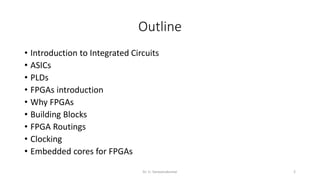
Outline
• Introduction to Integrated Circuits
• ASICs
• PLDs
• FPGAs introduction
• Why FPGAs
• Building Blocks
• FPGA Routings
• Clocking
• Embedded cores for FPGAs
Dr. U. Saravanakumar 2
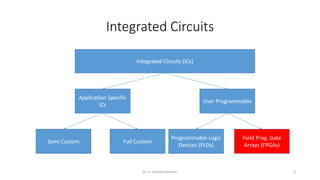
Integrated Circuits
Integrated Circuits (ICs)
Application Specific
ICs
User Programmable
Programmable Logic
Devices (PLDs)
Field Prog. Gate
Arrays (FPGAs)
Semi Custom Full Custom
Dr. U. Saravanakumar 3
IC - ASIC
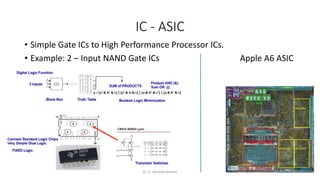
• Simple Gate ICs to High Performance Processor ICs.
• Example: 2 – Input NAND Gate ICs Apple A6 ASIC
Dr. U. Saravanakumar 4
PLDs
Types
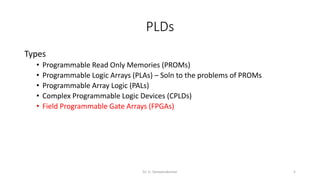
• Programmable Read Only Memories (PROMs)
• Programmable Logic Arrays (PLAs) – Soln to the problems of PROMs
• Programmable Array Logic (PALs)
• Complex Programmable Logic Devices (CPLDs)
• Field Programmable Gate Arrays (FPGAs)
Dr. U. Saravanakumar 5
PROMs
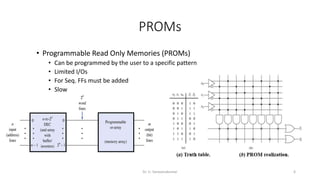
• Programmable Read Only Memories (PROMs)
• Can be programmed by the user to a specific pattern
• Limited I/Os
• For Seq. FFs must be added
• Slow
Dr. U. Saravanakumar 6
PLAs
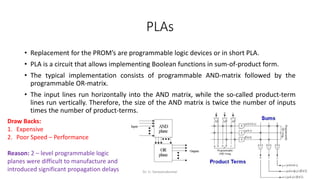
• Replacement for the PROM’s are programmable logic devices or in short PLA.
• PLA is a circuit that allows implementing Boolean functions in sum-of-product form.
• The typical implementation consists of programmable AND-matrix followed by the
programmable OR-matrix.
• The input lines run horizontally into the AND matrix, while the so-called product-term
lines run vertically. Therefore, the size of the AND matrix is twice the number of inputs
times the number of product-terms.
Draw Backs:
1. Expensive
2. Poor Speed – Performance
Reason: 2 – level programmable logic
planes were difficult to manufacture and
introduced significant propagation delays Dr. U. Saravanakumar 7
PALs
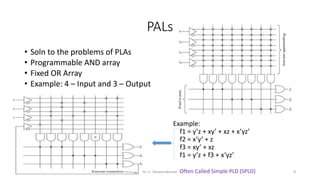
• Soln to the problems of PLAs
• Programmable AND array
• Fixed OR Array
• Example: 4 – Input and 3 – Output
Example:
f1 = y’z + xy’ + xz + x’yz’
f2 = x’y’ + z
f3 = xy’ + xz
f1 = y’z + f3 + x’yz’
Often Called Simple PLD (SPLD)Dr. U. Saravanakumar 8
CPLDs
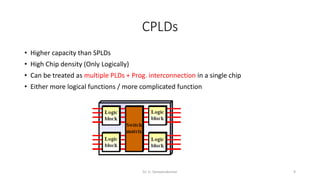
• Higher capacity than SPLDs
• High Chip density (Only Logically)
• Can be treated as multiple PLDs + Prog. interconnection in a single chip
• Either more logical functions / more complicated function
Dr. U. Saravanakumar 9
Gap B/W PLDs and ASICs
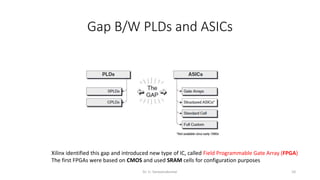
Xilinx identified this gap and introduced new type of IC, called Field Programmable Gate Array (FPGA)
The first FPGAs were based on CMOS and used SRAM cells for configuration purposes
Dr. U. Saravanakumar 10
FPGAs
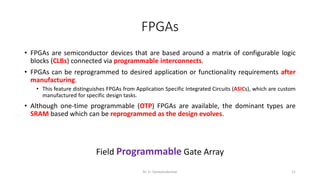
• FPGAs are semiconductor devices that are based around a matrix of configurable logic
blocks (CLBs) connected via programmable interconnects.
• FPGAs can be reprogrammed to desired application or functionality requirements after
manufacturing.
• This feature distinguishes FPGAs from Application Specific Integrated Circuits (ASICs), which are custom
manufactured for specific design tasks.
• Although one-time programmable (OTP) FPGAs are available, the dominant types are
SRAM based which can be reprogrammed as the design evolves.
Field Programmable Gate Array
Dr. U. Saravanakumar 11
FPGAs
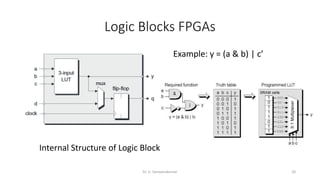
• The early devices were based on the concept of a programmable logic block, which
comprised a 3-input lookup table (LUT), a register that could act as a flip-flop or a latch,
and a multiplexer, along with a few other elements that are of little interest here.
Dr. U. Saravanakumar 12
Why FPGAs?
• Designing with FPGA: Faster, Cheaper
• Ideal for customized designs
• Product differentiation in a fast-changing market
• Offer the advantages of high integration
• High complexity, density, reliability
• Low cost, power consumption, small physical size
• Avoid the problems of ASICs
• high NRE cost, long delay in design and testing
• increasingly demanding electrical issues
Dr. U. Saravanakumar 13
Why FPGAs?
• Very fast custom logic
• massively parallel operation
• Faster than microcontrollers and microprocessors
• much faster than DSP engines
• More flexible than dedicated chipsets
• allows unlimited product differentiation
• More affordable and less risky than ASICs
• no NRE, minimum order size, or inventory risk
• Reprogrammable at any time
• in design, in manufacturing, after installation
Dr. U. Saravanakumar 14
Field Programmable Device
Field Programmable Devices (FPD) consist of,
• Basic Section of FPD:
• Logical Block (CLB: LUT, Mux, Gates and Flip-flops)
• Routing (Switch Matrix)
• Input Output Block
• More Advanced FPD Contains:
• On-chip Memory (as BRAMs)
• Embedded Processor
• Clock Management (PLL/DLL)
• High-Speed Transceiver
Dr. U. Saravanakumar 15
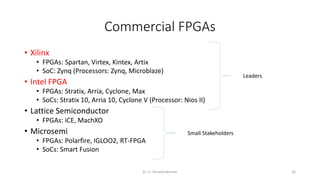
Commercial FPGAs
• Xilinx
• FPGAs: Spartan, Virtex, Kintex, Artix
• SoC: Zynq (Processors: Zynq, Microblaze)
• Intel FPGA
• FPGAs: Stratix, Arria, Cyclone, Max
• SoCs: Stratix 10, Arria 10, Cyclone V (Processor: Nios II)
• Lattice Semiconductor
• FPGAs: iCE, MachXO
• Microsemi
• FPGAs: Polarfire, IGLOO2, RT-FPGA
• SoCs: Smart Fusion
Leaders
Small Stakeholders
Dr. U. Saravanakumar 16
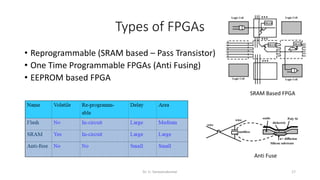
Types of FPGAs
• Reprogrammable (SRAM based – Pass Transistor)
• One Time Programmable FPGAs (Anti Fusing)
• EEPROM based FPGA
SRAM Based FPGA
Anti Fuse
Dr. U. Saravanakumar 17
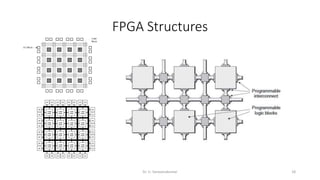
FPGA Structures
Dr. U. Saravanakumar 18
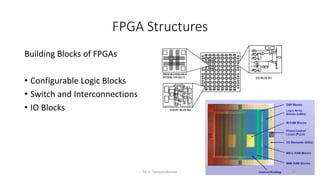
FPGA Structures
Building Blocks of FPGAs
• Configurable Logic Blocks
• Switch and Interconnections
• IO Blocks
Dr. U. Saravanakumar 19
Logic Blocks FPGAs
Example: y = (a & b) | c’
Internal Structure of Logic Block
Dr. U. Saravanakumar 20
Size of the Logic Blocks
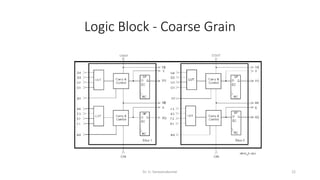
• Coarse grain
• Owing to SRAM interconnection area (6 transistors) the Logic Blocks are made large
in SRAM based FPGA
• Utilization is made high with configurability with in the logic block
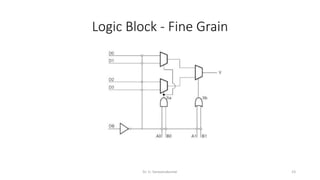
• Fine Grain
• Since the antifuse occupies less area and has less time delay, antifuse based FPGA’s
employs smaller size logic blocks
Dr. U. Saravanakumar 21
Logic Block - Coarse Grain
Dr. U. Saravanakumar 22
Logic Block - Fine Grain
Dr. U. Saravanakumar 23
Realization of Logic Blocks
• Mux Based
• LUT Based
Dr. U. Saravanakumar 24
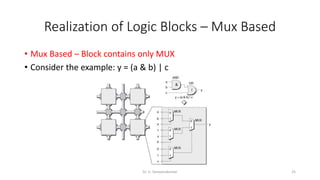
Realization of Logic Blocks – Mux Based
• Mux Based – Block contains only MUX
• Consider the example: y = (a & b) | c
Dr. U. Saravanakumar 25
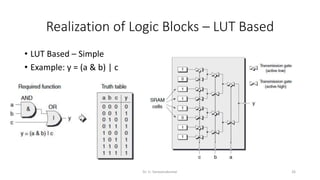
Realization of Logic Blocks – LUT Based
• LUT Based – Simple
• Example: y = (a & b) | c
Dr. U. Saravanakumar 26
LUT Based CLB
• LUT based CLBs are the best choice.
• Why?
Dr. U. Saravanakumar 27
LUT Based CLB
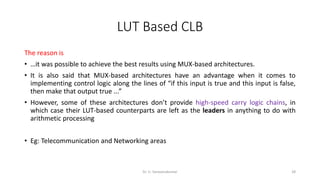
The reason is
• …it was possible to achieve the best results using MUX-based architectures.
• It is also said that MUX-based architectures have an advantage when it comes to
implementing control logic along the lines of “if this input is true and this input is false,
then make that output true ...”
• However, some of these architectures don’t provide high-speed carry logic chains, in
which case their LUT-based counterparts are left as the leaders in anything to do with
arithmetic processing
• Eg: Telecommunication and Networking areas
Dr. U. Saravanakumar 28
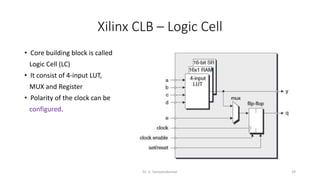
Xilinx CLB – Logic Cell
• Core building block is called
Logic Cell (LC)
• It consist of 4-input LUT,
MUX and Register
• Polarity of the clock can be
configured.
Dr. U. Saravanakumar 29
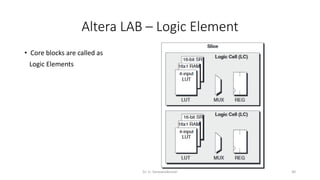
Altera LAB – Logic Element
• Core blocks are called as
Logic Elements
Dr. U. Saravanakumar 30
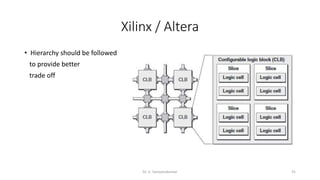
Xilinx / Altera
• Hierarchy should be followed
to provide better
trade off
Dr. U. Saravanakumar 31
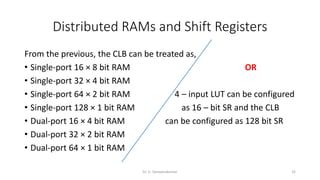
Distributed RAMs and Shift Registers
From the previous, the CLB can be treated as,
• Single-port 16 × 8 bit RAM OR
• Single-port 32 × 4 bit RAM
• Single-port 64 × 2 bit RAM 4 – input LUT can be configured
• Single-port 128 × 1 bit RAM as 16 – bit SR and the CLB
• Dual-port 16 × 4 bit RAM can be configured as 128 bit SR
• Dual-port 32 × 2 bit RAM
• Dual-port 64 × 1 bit RAM
Dr. U. Saravanakumar 32
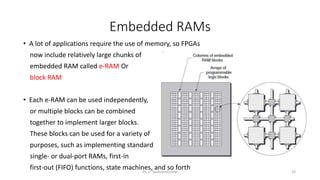
Embedded RAMs
• A lot of applications require the use of memory, so FPGAs
now include relatively large chunks of
embedded RAM called e-RAM Or
block RAM
• Each e-RAM can be used independently,
or multiple blocks can be combined
together to implement larger blocks.
These blocks can be used for a variety of
purposes, such as implementing standard
single- or dual-port RAMs, first-in
first-out (FIFO) functions, state machines, and so forthDr. U. Saravanakumar 33
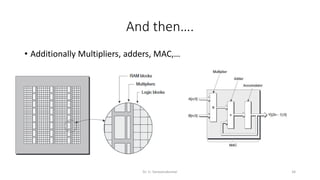
And then….
• Additionally Multipliers, adders, MAC,…
Dr. U. Saravanakumar 34
Embedded Processor too…
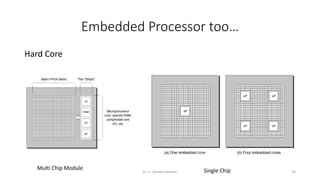
• High-end FPGAs have become available that contain one or more embedded
microprocessors, which are typically referred to as microprocessor cores
• Types:
• Hard
• Soft
Dr. U. Saravanakumar 35
Embedded Processor too…
Hard Core
Multi Chip Module Single ChipDr. U. Saravanakumar 36
Embedded Processor too…
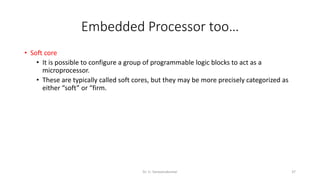
• Soft core
• It is possible to configure a group of programmable logic blocks to act as a
microprocessor.
• These are typically called soft cores, but they may be more precisely categorized as
either “soft” or “firm.
Dr. U. Saravanakumar 37
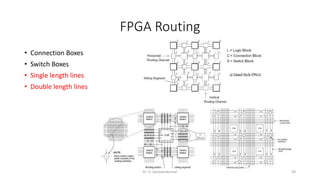
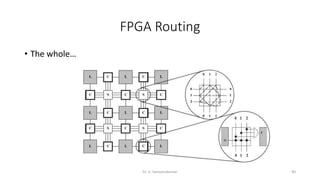
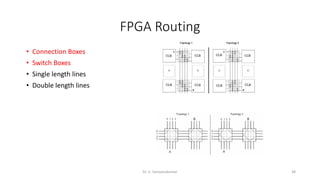
FPGA Routing
• Connection Boxes
• Switch Boxes
• Single length lines
• Double length lines
Dr. U. Saravanakumar 38
FPGA Routing
• Connection Boxes
• Switch Boxes
• Single length lines
• Double length lines
Dr. U. Saravanakumar 39
FPGA Routing
• The whole…
Dr. U. Saravanakumar 40
Clocking
All of the elements inside the FPGA are synchronous.
• The registers configured to act as flip-flops inside the programmable logic blocks—need
to be driven by a clock signal.
• Such a clock signal typically originates in the outside world, comes into the FPGA via a
special clock input pin, and is then routed through the device and connected to the
appropriate registers.
Dr. U. Saravanakumar 41
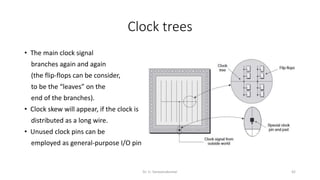
Clock trees
• The main clock signal
branches again and again
(the flip-flops can be consider,
to be the “leaves” on the
end of the branches).
• Clock skew will appear, if the clock is
distributed as a long wire.
• Unused clock pins can be
employed as general-purpose I/O pin
Dr. U. Saravanakumar 42
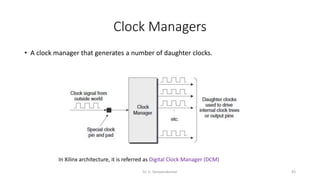
Clock Managers
• A clock manager that generates a number of daughter clocks.
In Xilinx architecture, it is referred as Digital Clock Manager (DCM)
Dr. U. Saravanakumar 43
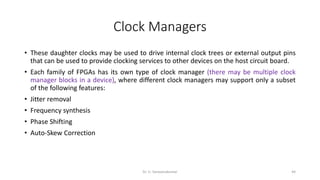
Clock Managers
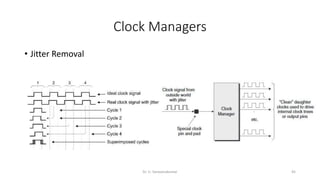
• These daughter clocks may be used to drive internal clock trees or external output pins
that can be used to provide clocking services to other devices on the host circuit board.
• Each family of FPGAs has its own type of clock manager (there may be multiple clock
manager blocks in a device), where different clock managers may support only a subset
of the following features:
• Jitter removal
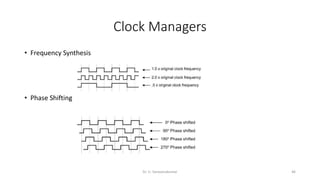
• Frequency synthesis
• Phase Shifting
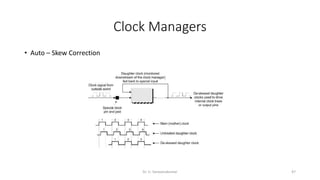
• Auto-Skew Correction
Dr. U. Saravanakumar 44
Clock Managers
• Jitter Removal
Dr. U. Saravanakumar 45
Clock Managers
• Frequency Synthesis
• Phase Shifting
Dr. U. Saravanakumar 46
Clock Managers
• Auto – Skew Correction
Dr. U. Saravanakumar 47
Clock Managers
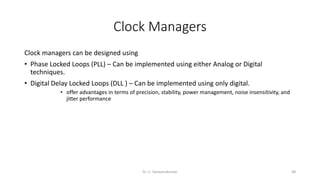
Clock managers can be designed using
• Phase Locked Loops (PLL) – Can be implemented using either Analog or Digital
techniques.
• Digital Delay Locked Loops (DLL ) – Can be implemented using only digital.
• offer advantages in terms of precision, stability, power management, noise insensitivity, and
jitter performance
Dr. U. Saravanakumar 48
General Purpose I/O
• Today’s FPGA packages can have more than 1,000 pins, which are arranged as an array
across the base of the package.
• When it comes to the silicon chip inside the package, flip-chip packaging strategies allow
the power, ground, clock, and I/O pins to be presented across the surface of the chip.
Dr. U. Saravanakumar 49
Configurable I/O Standards
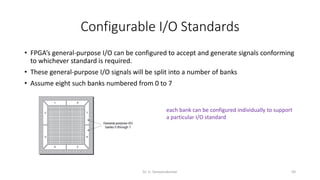
• FPGA’s general-purpose I/O can be configured to accept and generate signals conforming
to whichever standard is required.
• These general-purpose I/O signals will be split into a number of banks
• Assume eight such banks numbered from 0 to 7
each bank can be configured individually to support
a particular I/O standard
Dr. U. Saravanakumar 50
Supply Voltages
• Core Vs. I/O
• Voltage value: 5 V to < 1.2 V
• Core: The geometries of the structures on silicon chips became smaller because smaller
transistors have lower costs, higher speed, and lower power consumption. However,
these processes demanded lower supply voltages, which have continued to fall over the
years.
• The point is that, the supply is used to power the FPGA’s internal logic.
• I/O: However, different I/O standards may use signals with voltage levels significantly
different from the core voltage, so each bank of general-purpose I/Os can have its own
additional supply pins.
Dr. U. Saravanakumar 51
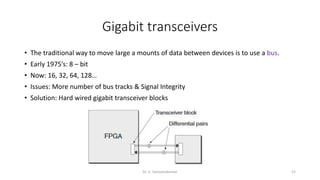
Gigabit transceivers
• The traditional way to move large a mounts of data between devices is to use a bus.
• Early 1975’s: 8 – bit
• Now: 16, 32, 64, 128…
• Issues: More number of bus tracks & Signal Integrity
• Solution: Hard wired gigabit transceiver blocks
Dr. U. Saravanakumar 52
Design Flows
• Schematic based design flow
• HDL based design flow
Dr. U. Saravanakumar 53
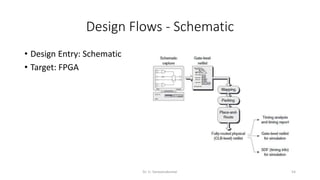
Design Flows - Schematic
• Design Entry: Schematic
• Target: FPGA
Dr. U. Saravanakumar 54
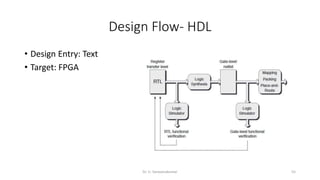
Design Flow- HDL
• Design Entry: Text
• Target: FPGA
Dr. U. Saravanakumar 55
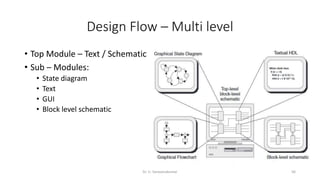
Design Flow – Multi level
• Top Module – Text / Schematic
• Sub – Modules:
• State diagram
• Text
• GUI
• Block level schematic
Dr. U. Saravanakumar 56
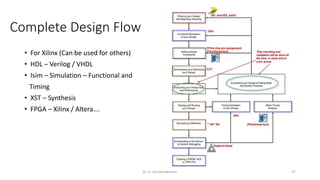
Complete Design Flow
• For Xilinx (Can be used for others)
• HDL – Verilog / VHDL
• Isim – Simulation – Functional and
Timing
• XST – Synthesis
• FPGA – Xilinx / Altera….
Dr. U. Saravanakumar 57
Programming Languages
• HDL – Verilog / VHDL
• System C
• System Verilog
• C / C++
• MatLab / Simulink
• LabVIEW
• Handle C / Open CL
• Now Python also – Suitable H/W – Pynq Z1 from Digilent
Dominant Languages
Xilinx
High level
Synthesis tool
is supporting
Dr. U. Saravanakumar 58
Software
• Xilinx – ISE /VIVADO
• Altera – Quartus II
• Lattice – ICE CUBE / Diamond can be used for
• Microsemi simulation +
• Icarus – Open Source synthesis
• Edaplayground.com – web based simulator
Dr. U. Saravanakumar 59
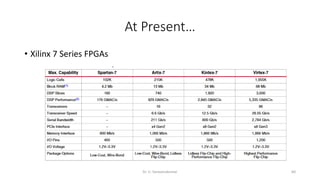
At Present…
• Xilinx 7 Series FPGAs
Dr. U. Saravanakumar 60
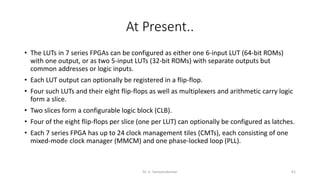
At Present..
• The LUTs in 7 series FPGAs can be configured as either one 6-input LUT (64-bit ROMs)
with one output, or as two 5-input LUTs (32-bit ROMs) with separate outputs but
common addresses or logic inputs.
• Each LUT output can optionally be registered in a flip-flop.
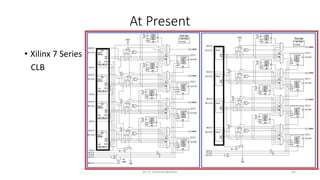
• Four such LUTs and their eight flip-flops as well as multiplexers and arithmetic carry logic
form a slice.
• Two slices form a configurable logic block (CLB).
• Four of the eight flip-flops per slice (one per LUT) can optionally be configured as latches.
• Each 7 series FPGA has up to 24 clock management tiles (CMTs), each consisting of one
mixed-mode clock manager (MMCM) and one phase-locked loop (PLL).
Dr. U. Saravanakumar 61
At Present
• Xilinx 7 Series
CLB
Dr. U. Saravanakumar 62
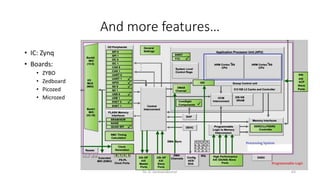
And more features…
• IC: Zynq
• Boards:
• ZYBO
• Zedboard
• Picozed
• Microzed
Dr. U. Saravanakumar 63
Finally…
Single gate to System on Chip
Dr. U. Saravanakumar 64
Books to Read
• “FPGA-Based System Design” by Wolf
• “Digital Systems Design with FPGAs and CPLDs” by Ian Grout
• “Digital System Designs and Practices: Using Verilog HDL and FPGAs” by Ming-Bo Lin
• “Design Recipes for FPGAs: Using Verilog and VHDL” by Peter Wilson
• “Advanced FPGA Design: Architecture, Implementation, and Optimization” by Steve Kilts
• “Verilog HDL” by Samir Palnitkar
• “VHDL : Programming By Example” by Douglas L. Perry
Dr. U. Saravanakumar 65
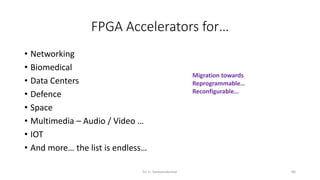
FPGA Accelerators for…
• Networking
• Biomedical
• Data Centers
• Defence
• Space
• Multimedia – Audio / Video …
• IOT
• And more… the list is endless…
Migration towards
Reprogrammable…
Reconfigurable…
Dr. U. Saravanakumar 66
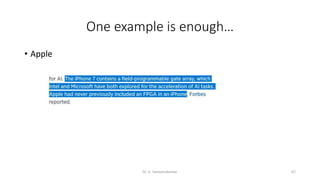
One example is enough…
• Apple
Dr. U. Saravanakumar 67
Thank You!
Dr. U. Saravanakumar 68

Field Programmable Gate Array: Building Blocks and Interconnections

  • 1.
    Field Programmable Gate Arrays BuildingBlocks and Routings Dr. U. Saravanakumar Associate Professor Department of ECE Anna University Sponsored Faculty Development Programme on VLSI Design at Vel Tech Multi Tech Engineering College, Chennai on 13.12.2017
  • 2.
    Outline • Introduction toIntegrated Circuits • ASICs • PLDs • FPGAs introduction • Why FPGAs • Building Blocks • FPGA Routings • Clocking • Embedded cores for FPGAs Dr. U. Saravanakumar 2
  • 3.
    Integrated Circuits Integrated Circuits(ICs) Application Specific ICs User Programmable Programmable Logic Devices (PLDs) Field Prog. Gate Arrays (FPGAs) Semi Custom Full Custom Dr. U. Saravanakumar 3
  • 4.
    IC - ASIC •Simple Gate ICs to High Performance Processor ICs. • Example: 2 – Input NAND Gate ICs Apple A6 ASIC Dr. U. Saravanakumar 4
  • 5.
    PLDs Types • Programmable ReadOnly Memories (PROMs) • Programmable Logic Arrays (PLAs) – Soln to the problems of PROMs • Programmable Array Logic (PALs) • Complex Programmable Logic Devices (CPLDs) • Field Programmable Gate Arrays (FPGAs) Dr. U. Saravanakumar 5
  • 6.
    PROMs • Programmable ReadOnly Memories (PROMs) • Can be programmed by the user to a specific pattern • Limited I/Os • For Seq. FFs must be added • Slow Dr. U. Saravanakumar 6
  • 7.
    PLAs • Replacement forthe PROM’s are programmable logic devices or in short PLA. • PLA is a circuit that allows implementing Boolean functions in sum-of-product form. • The typical implementation consists of programmable AND-matrix followed by the programmable OR-matrix. • The input lines run horizontally into the AND matrix, while the so-called product-term lines run vertically. Therefore, the size of the AND matrix is twice the number of inputs times the number of product-terms. Draw Backs: 1. Expensive 2. Poor Speed – Performance Reason: 2 – level programmable logic planes were difficult to manufacture and introduced significant propagation delays Dr. U. Saravanakumar 7
  • 8.
    PALs • Soln tothe problems of PLAs • Programmable AND array • Fixed OR Array • Example: 4 – Input and 3 – Output Example: f1 = y’z + xy’ + xz + x’yz’ f2 = x’y’ + z f3 = xy’ + xz f1 = y’z + f3 + x’yz’ Often Called Simple PLD (SPLD)Dr. U. Saravanakumar 8
  • 9.
    CPLDs • Higher capacitythan SPLDs • High Chip density (Only Logically) • Can be treated as multiple PLDs + Prog. interconnection in a single chip • Either more logical functions / more complicated function Dr. U. Saravanakumar 9
  • 10.
    Gap B/W PLDsand ASICs Xilinx identified this gap and introduced new type of IC, called Field Programmable Gate Array (FPGA) The first FPGAs were based on CMOS and used SRAM cells for configuration purposes Dr. U. Saravanakumar 10
  • 11.
    FPGAs • FPGAs aresemiconductor devices that are based around a matrix of configurable logic blocks (CLBs) connected via programmable interconnects. • FPGAs can be reprogrammed to desired application or functionality requirements after manufacturing. • This feature distinguishes FPGAs from Application Specific Integrated Circuits (ASICs), which are custom manufactured for specific design tasks. • Although one-time programmable (OTP) FPGAs are available, the dominant types are SRAM based which can be reprogrammed as the design evolves. Field Programmable Gate Array Dr. U. Saravanakumar 11
  • 12.
    FPGAs • The earlydevices were based on the concept of a programmable logic block, which comprised a 3-input lookup table (LUT), a register that could act as a flip-flop or a latch, and a multiplexer, along with a few other elements that are of little interest here. Dr. U. Saravanakumar 12
  • 13.
    Why FPGAs? • Designingwith FPGA: Faster, Cheaper • Ideal for customized designs • Product differentiation in a fast-changing market • Offer the advantages of high integration • High complexity, density, reliability • Low cost, power consumption, small physical size • Avoid the problems of ASICs • high NRE cost, long delay in design and testing • increasingly demanding electrical issues Dr. U. Saravanakumar 13
  • 14.
    Why FPGAs? • Veryfast custom logic • massively parallel operation • Faster than microcontrollers and microprocessors • much faster than DSP engines • More flexible than dedicated chipsets • allows unlimited product differentiation • More affordable and less risky than ASICs • no NRE, minimum order size, or inventory risk • Reprogrammable at any time • in design, in manufacturing, after installation Dr. U. Saravanakumar 14
  • 15.
    Field Programmable Device FieldProgrammable Devices (FPD) consist of, • Basic Section of FPD: • Logical Block (CLB: LUT, Mux, Gates and Flip-flops) • Routing (Switch Matrix) • Input Output Block • More Advanced FPD Contains: • On-chip Memory (as BRAMs) • Embedded Processor • Clock Management (PLL/DLL) • High-Speed Transceiver Dr. U. Saravanakumar 15
  • 16.
    Commercial FPGAs • Xilinx •FPGAs: Spartan, Virtex, Kintex, Artix • SoC: Zynq (Processors: Zynq, Microblaze) • Intel FPGA • FPGAs: Stratix, Arria, Cyclone, Max • SoCs: Stratix 10, Arria 10, Cyclone V (Processor: Nios II) • Lattice Semiconductor • FPGAs: iCE, MachXO • Microsemi • FPGAs: Polarfire, IGLOO2, RT-FPGA • SoCs: Smart Fusion Leaders Small Stakeholders Dr. U. Saravanakumar 16
  • 17.
    Types of FPGAs •Reprogrammable (SRAM based – Pass Transistor) • One Time Programmable FPGAs (Anti Fusing) • EEPROM based FPGA SRAM Based FPGA Anti Fuse Dr. U. Saravanakumar 17
  • 18.
    FPGA Structures Dr. U.Saravanakumar 18
  • 19.
    FPGA Structures Building Blocksof FPGAs • Configurable Logic Blocks • Switch and Interconnections • IO Blocks Dr. U. Saravanakumar 19
  • 20.
    Logic Blocks FPGAs Example:y = (a & b) | c’ Internal Structure of Logic Block Dr. U. Saravanakumar 20
  • 21.
    Size of theLogic Blocks • Coarse grain • Owing to SRAM interconnection area (6 transistors) the Logic Blocks are made large in SRAM based FPGA • Utilization is made high with configurability with in the logic block • Fine Grain • Since the antifuse occupies less area and has less time delay, antifuse based FPGA’s employs smaller size logic blocks Dr. U. Saravanakumar 21
  • 22.
    Logic Block -Coarse Grain Dr. U. Saravanakumar 22
  • 23.
    Logic Block -Fine Grain Dr. U. Saravanakumar 23
  • 24.
    Realization of LogicBlocks • Mux Based • LUT Based Dr. U. Saravanakumar 24
  • 25.
    Realization of LogicBlocks – Mux Based • Mux Based – Block contains only MUX • Consider the example: y = (a & b) | c Dr. U. Saravanakumar 25
  • 26.
    Realization of LogicBlocks – LUT Based • LUT Based – Simple • Example: y = (a & b) | c Dr. U. Saravanakumar 26
  • 27.
    LUT Based CLB •LUT based CLBs are the best choice. • Why? Dr. U. Saravanakumar 27
  • 28.
    LUT Based CLB Thereason is • …it was possible to achieve the best results using MUX-based architectures. • It is also said that MUX-based architectures have an advantage when it comes to implementing control logic along the lines of “if this input is true and this input is false, then make that output true ...” • However, some of these architectures don’t provide high-speed carry logic chains, in which case their LUT-based counterparts are left as the leaders in anything to do with arithmetic processing • Eg: Telecommunication and Networking areas Dr. U. Saravanakumar 28
  • 29.
    Xilinx CLB –Logic Cell • Core building block is called Logic Cell (LC) • It consist of 4-input LUT, MUX and Register • Polarity of the clock can be configured. Dr. U. Saravanakumar 29
  • 30.
    Altera LAB –Logic Element • Core blocks are called as Logic Elements Dr. U. Saravanakumar 30
  • 31.
    Xilinx / Altera •Hierarchy should be followed to provide better trade off Dr. U. Saravanakumar 31
  • 32.
    Distributed RAMs andShift Registers From the previous, the CLB can be treated as, • Single-port 16 × 8 bit RAM OR • Single-port 32 × 4 bit RAM • Single-port 64 × 2 bit RAM 4 – input LUT can be configured • Single-port 128 × 1 bit RAM as 16 – bit SR and the CLB • Dual-port 16 × 4 bit RAM can be configured as 128 bit SR • Dual-port 32 × 2 bit RAM • Dual-port 64 × 1 bit RAM Dr. U. Saravanakumar 32
  • 33.
    Embedded RAMs • Alot of applications require the use of memory, so FPGAs now include relatively large chunks of embedded RAM called e-RAM Or block RAM • Each e-RAM can be used independently, or multiple blocks can be combined together to implement larger blocks. These blocks can be used for a variety of purposes, such as implementing standard single- or dual-port RAMs, first-in first-out (FIFO) functions, state machines, and so forthDr. U. Saravanakumar 33
  • 34.
    And then…. • AdditionallyMultipliers, adders, MAC,… Dr. U. Saravanakumar 34
  • 35.
    Embedded Processor too… •High-end FPGAs have become available that contain one or more embedded microprocessors, which are typically referred to as microprocessor cores • Types: • Hard • Soft Dr. U. Saravanakumar 35
  • 36.
    Embedded Processor too… HardCore Multi Chip Module Single ChipDr. U. Saravanakumar 36
  • 37.
    Embedded Processor too… •Soft core • It is possible to configure a group of programmable logic blocks to act as a microprocessor. • These are typically called soft cores, but they may be more precisely categorized as either “soft” or “firm. Dr. U. Saravanakumar 37
  • 38.
    FPGA Routing • ConnectionBoxes • Switch Boxes • Single length lines • Double length lines Dr. U. Saravanakumar 38
  • 39.
    FPGA Routing • ConnectionBoxes • Switch Boxes • Single length lines • Double length lines Dr. U. Saravanakumar 39
  • 40.
    FPGA Routing • Thewhole… Dr. U. Saravanakumar 40
  • 41.
    Clocking All of theelements inside the FPGA are synchronous. • The registers configured to act as flip-flops inside the programmable logic blocks—need to be driven by a clock signal. • Such a clock signal typically originates in the outside world, comes into the FPGA via a special clock input pin, and is then routed through the device and connected to the appropriate registers. Dr. U. Saravanakumar 41
  • 42.
    Clock trees • Themain clock signal branches again and again (the flip-flops can be consider, to be the “leaves” on the end of the branches). • Clock skew will appear, if the clock is distributed as a long wire. • Unused clock pins can be employed as general-purpose I/O pin Dr. U. Saravanakumar 42
  • 43.
    Clock Managers • Aclock manager that generates a number of daughter clocks. In Xilinx architecture, it is referred as Digital Clock Manager (DCM) Dr. U. Saravanakumar 43
  • 44.
    Clock Managers • Thesedaughter clocks may be used to drive internal clock trees or external output pins that can be used to provide clocking services to other devices on the host circuit board. • Each family of FPGAs has its own type of clock manager (there may be multiple clock manager blocks in a device), where different clock managers may support only a subset of the following features: • Jitter removal • Frequency synthesis • Phase Shifting • Auto-Skew Correction Dr. U. Saravanakumar 44
  • 45.
    Clock Managers • JitterRemoval Dr. U. Saravanakumar 45
  • 46.
    Clock Managers • FrequencySynthesis • Phase Shifting Dr. U. Saravanakumar 46
  • 47.
    Clock Managers • Auto– Skew Correction Dr. U. Saravanakumar 47
  • 48.
    Clock Managers Clock managerscan be designed using • Phase Locked Loops (PLL) – Can be implemented using either Analog or Digital techniques. • Digital Delay Locked Loops (DLL ) – Can be implemented using only digital. • offer advantages in terms of precision, stability, power management, noise insensitivity, and jitter performance Dr. U. Saravanakumar 48
  • 49.
    General Purpose I/O •Today’s FPGA packages can have more than 1,000 pins, which are arranged as an array across the base of the package. • When it comes to the silicon chip inside the package, flip-chip packaging strategies allow the power, ground, clock, and I/O pins to be presented across the surface of the chip. Dr. U. Saravanakumar 49
  • 50.
    Configurable I/O Standards •FPGA’s general-purpose I/O can be configured to accept and generate signals conforming to whichever standard is required. • These general-purpose I/O signals will be split into a number of banks • Assume eight such banks numbered from 0 to 7 each bank can be configured individually to support a particular I/O standard Dr. U. Saravanakumar 50
  • 51.
    Supply Voltages • CoreVs. I/O • Voltage value: 5 V to < 1.2 V • Core: The geometries of the structures on silicon chips became smaller because smaller transistors have lower costs, higher speed, and lower power consumption. However, these processes demanded lower supply voltages, which have continued to fall over the years. • The point is that, the supply is used to power the FPGA’s internal logic. • I/O: However, different I/O standards may use signals with voltage levels significantly different from the core voltage, so each bank of general-purpose I/Os can have its own additional supply pins. Dr. U. Saravanakumar 51
  • 52.
    Gigabit transceivers • Thetraditional way to move large a mounts of data between devices is to use a bus. • Early 1975’s: 8 – bit • Now: 16, 32, 64, 128… • Issues: More number of bus tracks & Signal Integrity • Solution: Hard wired gigabit transceiver blocks Dr. U. Saravanakumar 52
  • 53.
    Design Flows • Schematicbased design flow • HDL based design flow Dr. U. Saravanakumar 53
  • 54.
    Design Flows -Schematic • Design Entry: Schematic • Target: FPGA Dr. U. Saravanakumar 54
  • 55.
    Design Flow- HDL •Design Entry: Text • Target: FPGA Dr. U. Saravanakumar 55
  • 56.
    Design Flow –Multi level • Top Module – Text / Schematic • Sub – Modules: • State diagram • Text • GUI • Block level schematic Dr. U. Saravanakumar 56
  • 57.
    Complete Design Flow •For Xilinx (Can be used for others) • HDL – Verilog / VHDL • Isim – Simulation – Functional and Timing • XST – Synthesis • FPGA – Xilinx / Altera…. Dr. U. Saravanakumar 57
  • 58.
    Programming Languages • HDL– Verilog / VHDL • System C • System Verilog • C / C++ • MatLab / Simulink • LabVIEW • Handle C / Open CL • Now Python also – Suitable H/W – Pynq Z1 from Digilent Dominant Languages Xilinx High level Synthesis tool is supporting Dr. U. Saravanakumar 58
  • 59.
    Software • Xilinx –ISE /VIVADO • Altera – Quartus II • Lattice – ICE CUBE / Diamond can be used for • Microsemi simulation + • Icarus – Open Source synthesis • Edaplayground.com – web based simulator Dr. U. Saravanakumar 59
  • 60.
    At Present… • Xilinx7 Series FPGAs Dr. U. Saravanakumar 60
  • 61.
    At Present.. • TheLUTs in 7 series FPGAs can be configured as either one 6-input LUT (64-bit ROMs) with one output, or as two 5-input LUTs (32-bit ROMs) with separate outputs but common addresses or logic inputs. • Each LUT output can optionally be registered in a flip-flop. • Four such LUTs and their eight flip-flops as well as multiplexers and arithmetic carry logic form a slice. • Two slices form a configurable logic block (CLB). • Four of the eight flip-flops per slice (one per LUT) can optionally be configured as latches. • Each 7 series FPGA has up to 24 clock management tiles (CMTs), each consisting of one mixed-mode clock manager (MMCM) and one phase-locked loop (PLL). Dr. U. Saravanakumar 61
  • 62.
    At Present • Xilinx7 Series CLB Dr. U. Saravanakumar 62
  • 63.
    And more features… •IC: Zynq • Boards: • ZYBO • Zedboard • Picozed • Microzed Dr. U. Saravanakumar 63
  • 64.
    Finally… Single gate toSystem on Chip Dr. U. Saravanakumar 64
  • 65.
    Books to Read •“FPGA-Based System Design” by Wolf • “Digital Systems Design with FPGAs and CPLDs” by Ian Grout • “Digital System Designs and Practices: Using Verilog HDL and FPGAs” by Ming-Bo Lin • “Design Recipes for FPGAs: Using Verilog and VHDL” by Peter Wilson • “Advanced FPGA Design: Architecture, Implementation, and Optimization” by Steve Kilts • “Verilog HDL” by Samir Palnitkar • “VHDL : Programming By Example” by Douglas L. Perry Dr. U. Saravanakumar 65
  • 66.
    FPGA Accelerators for… •Networking • Biomedical • Data Centers • Defence • Space • Multimedia – Audio / Video … • IOT • And more… the list is endless… Migration towards Reprogrammable… Reconfigurable… Dr. U. Saravanakumar 66
  • 67.
    One example isenough… • Apple Dr. U. Saravanakumar 67
  • 68.
    Thank You! Dr. U.Saravanakumar 68