CSE 420
Lecture 10
• Semantic Analysis computes additional information related to the
meaning of the program once the syntactic structure is known.
• In typed languages as C, semantic analysis involves
• adding information to the symbol table and
• performing type checking.
• The information to be computed is beyond the capabilities of
standard parsing techniques, therefore it is not regarded as
syntax.
• As for Lexical and Syntax analysis, also for Semantic Analysis we need
both a Representation Formalism and an Implementation
Mechanism.
• The Principle of Syntax Directed Translation states that
the meaning of an input sentence is related to its syntactic
structure, i.e., to its Parse-Tree.
• By Syntax Directed Translations we indicate those
formalisms for specifying translations for programming
language constructs guided by context-free grammars.
– We associate Attributes to the grammar symbols
representing the language constructs.
– Values for attributes are computed by Semantic Rules
associated with grammar productions.
• Evaluation of Semantic Rules may:
– Generate Code;
– Insert information into the Symbol Table;
– Perform Semantic Check;
– Issue error messages; etc.
• There are two notations for attaching semantic rules:
1. Syntax Directed Definitions.High-level specification hiding many
implementation details (also called Attribute Grammars).
2. Translation Schemes. More implementation oriented: Indicate the order
in which semantic rules are to be evaluated.
• Syntax Directed Definitions are a generalization of context-free
grammars in which:
1. Grammar symbols have an associated set of Attributes;
2. Productions are associated with Semantic Rules for computing
the values of attributes.
• Such formalism generates Annotated Parse-Trees where each node of
the tree is a record with a field for each attribute (e.g., X.a indicates the
attribute a of the grammar symbolX).
• The value of an attribute of a grammar symbol at a given parse-
tree node is defined by a semantic rule associated with the
production used at that node.
• We distinguish between two kinds of attributes:
1. Synthesized Attributes.They are computed from the
values of the attributes of the children nodes.
2. Inherited Attributes. They are computed from the
values of the attributes of both the siblings and the
parent nodes.
• Each production, A → α, is associated with a set of semantic
rules:
b : = f (c1, c2, . . . , ck), where f is a function and either
1. b is a synthesized attribute of A, and c1, c2, . . . , ck are attributes
of the grammar symbols of the production, or
2. b is an inherited attribute of a grammar symbol in α, and c1, c2, . .
. , ck are attributes of grammar symbols in α or attributes of A.
• Note. Terminal symbols are assumed to have synthesized attributes
supplied by the lexical analyzer.
• Procedure calls (e.g. print in the next slide) define values of
Dummy synthesized attributes of the non terminal on the left-
hand side of the production.
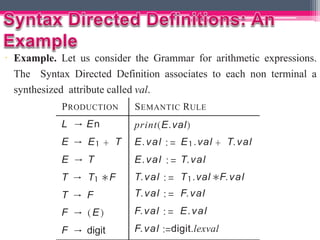
• Example. Let us consider the Grammar for arithmetic expressions.
The Syntax Directed Definition associates to each non terminal a
synthesized attribute called val.
PRODUCTION
L → En
E → E1 + T
E → T
T → T1 ∗F
T → F
F → ( E )
F → digit
SEMANTIC RULE
print(E.val)
E.val : = E1.val + T.val
E.val : = T.val
T.val : = T1.val ∗F.val
T.val : = F.val
F.val : = E.val
F.val :=digit.lexval
Definition. An S-Attributed Definition is a Syntax Directed
Definition that uses only synthesized attributes.
• Evaluation Order.Semantic rules in a S-Attributed
Definition can be evaluated by a bottom-up, or
PostOrder, traversal of the parse-tree.
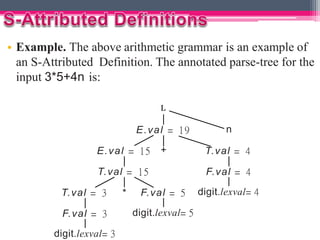
• Example. The above arithmetic grammar is an example of
an S-Attributed Definition. The annotated parse-tree for the
input 3*5+4n is:
E.val = 19 n
+ T.val = 4E.val = 15
T.val = 15
T.val = 3 *
F.val = 4
digit.lexval= 4F.val = 5
digit.lexval= 5F.val = 3
digit.lexval= 3
L
Lecture 10 semantic analysis 01

Lecture 10 semantic analysis 01

  • 1.
  • 2.
    • Semantic Analysiscomputes additional information related to the meaning of the program once the syntactic structure is known. • In typed languages as C, semantic analysis involves • adding information to the symbol table and • performing type checking. • The information to be computed is beyond the capabilities of standard parsing techniques, therefore it is not regarded as syntax. • As for Lexical and Syntax analysis, also for Semantic Analysis we need both a Representation Formalism and an Implementation Mechanism.
  • 3.
    • The Principleof Syntax Directed Translation states that the meaning of an input sentence is related to its syntactic structure, i.e., to its Parse-Tree. • By Syntax Directed Translations we indicate those formalisms for specifying translations for programming language constructs guided by context-free grammars. – We associate Attributes to the grammar symbols representing the language constructs. – Values for attributes are computed by Semantic Rules associated with grammar productions.
  • 4.
    • Evaluation ofSemantic Rules may: – Generate Code; – Insert information into the Symbol Table; – Perform Semantic Check; – Issue error messages; etc. • There are two notations for attaching semantic rules: 1. Syntax Directed Definitions.High-level specification hiding many implementation details (also called Attribute Grammars). 2. Translation Schemes. More implementation oriented: Indicate the order in which semantic rules are to be evaluated.
  • 5.
    • Syntax DirectedDefinitions are a generalization of context-free grammars in which: 1. Grammar symbols have an associated set of Attributes; 2. Productions are associated with Semantic Rules for computing the values of attributes. • Such formalism generates Annotated Parse-Trees where each node of the tree is a record with a field for each attribute (e.g., X.a indicates the attribute a of the grammar symbolX).
  • 6.
    • The valueof an attribute of a grammar symbol at a given parse- tree node is defined by a semantic rule associated with the production used at that node. • We distinguish between two kinds of attributes: 1. Synthesized Attributes.They are computed from the values of the attributes of the children nodes. 2. Inherited Attributes. They are computed from the values of the attributes of both the siblings and the parent nodes.
  • 7.
    • Each production,A → α, is associated with a set of semantic rules: b : = f (c1, c2, . . . , ck), where f is a function and either 1. b is a synthesized attribute of A, and c1, c2, . . . , ck are attributes of the grammar symbols of the production, or 2. b is an inherited attribute of a grammar symbol in α, and c1, c2, . . . , ck are attributes of grammar symbols in α or attributes of A. • Note. Terminal symbols are assumed to have synthesized attributes supplied by the lexical analyzer. • Procedure calls (e.g. print in the next slide) define values of Dummy synthesized attributes of the non terminal on the left- hand side of the production.
  • 8.
    • Example. Letus consider the Grammar for arithmetic expressions. The Syntax Directed Definition associates to each non terminal a synthesized attribute called val. PRODUCTION L → En E → E1 + T E → T T → T1 ∗F T → F F → ( E ) F → digit SEMANTIC RULE print(E.val) E.val : = E1.val + T.val E.val : = T.val T.val : = T1.val ∗F.val T.val : = F.val F.val : = E.val F.val :=digit.lexval
  • 9.
    Definition. An S-AttributedDefinition is a Syntax Directed Definition that uses only synthesized attributes. • Evaluation Order.Semantic rules in a S-Attributed Definition can be evaluated by a bottom-up, or PostOrder, traversal of the parse-tree.
  • 10.
    • Example. Theabove arithmetic grammar is an example of an S-Attributed Definition. The annotated parse-tree for the input 3*5+4n is: E.val = 19 n + T.val = 4E.val = 15 T.val = 15 T.val = 3 * F.val = 4 digit.lexval= 4F.val = 5 digit.lexval= 5F.val = 3 digit.lexval= 3 L