
Buoyancy & Flight
Review Newton’s Laws Explanation Summary First inertia Second When an object is acted on by an unbalanced force, it will accelerate in the direction of that force.  Third action-reaction
Review What is pressure? Amount of force applied to a unit of area.  What formula do we use to calculate pressure? P = F/A What units are used to measure pressure? pascals (Pa) What is Pascal’s Principle? A force applied to a fluid in a closed container will cause an increase in pressure,  equally  transmitted to all parts of the fluid. How does depth affect pressure? Pressure also increases with depth.
Density Density : How much mass is contained in a certain volume. Density = mass/volume  or  D =  m   v (Volume = length x width x depth) Units for density:  g/mL  (or g/cm 3  or g/cc) (1 milliliter = 1 cubic centimeter)
Calculating Density What is the density of a metal if a 4 gram sample has a volume of 10 cm 3 ? mass = 4 g volume = 10 cm 3 density = ? D = 4g    10 cm 3   density = 0.4 g/cm 3   D = 8 g    10 cm 3   density = 0.8 g/cm 3   D = m/v 4   g 8   g
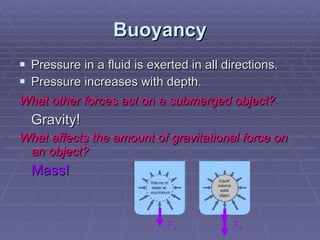
Buoyancy Pressure in a fluid is exerted in all directions. Pressure increases with depth. What other forces act on a submerged object?   Gravity! What affects the amount of gravitational force on an object? Mass! F g F g
Archimedes’ principle Archimedes’ Principle :  the buoyant force on an object is equal to the weight of the  fluid   displaced  by the object. Buoyant force:  the force that a fluid exerts on an object (upthrust) acts in an upward direction    against gravity makes objects feel lighter
Density and Buoyancy Water has a density of 1 g/mL at 25 degrees Celsius  (temperature affects density because it changes volume) This means 1 mL of water has a mass of 1 gram Objects with densities less than 1g/mL will float. Objects with densities greater than 1g/mL will sink.
Bernoulli’s Principle Bernoulli’s principle:   The pressure exerted by a moving fluid is less than the pressure of the surrounding fluid. Daniel Bernoulli was a mathematician who studied fluid mechanics (the motion of fluids). He found that  the faster a fluid moves the less pressure it exerts .
 
Prairie Dog Burrows Air is forced up and over the raised mound, causing an area of low pressure. Fresh air flows through since  fluids of higher pressure always move towards low pressure . Wouldn't work if both openings were level.
How would Bernouli's Principle help an architect design a weather-exposed house in the windy Columbia River Gorge?
How Airfoils Create Lift The air makes it over top and bottom in the same amount of time.  (Remember speed=distance/time?) Air moves faster to get    over the top curve. Faster fluids have less  pressure  (Bernoulli's principle) Slower air under wing pushes with greater force than the air above it, creating “lift” If the flying apparatus goes fast enough, the "lift" will be great enough to overcome the pull of gravity.
Wing Design

Buoyancy & Flight

  • 1.
  • 2.
    Review Newton’s LawsExplanation Summary First inertia Second When an object is acted on by an unbalanced force, it will accelerate in the direction of that force. Third action-reaction
  • 3.
    Review What ispressure? Amount of force applied to a unit of area. What formula do we use to calculate pressure? P = F/A What units are used to measure pressure? pascals (Pa) What is Pascal’s Principle? A force applied to a fluid in a closed container will cause an increase in pressure, equally transmitted to all parts of the fluid. How does depth affect pressure? Pressure also increases with depth.
  • 4.
    Density Density :How much mass is contained in a certain volume. Density = mass/volume or D = m v (Volume = length x width x depth) Units for density: g/mL (or g/cm 3 or g/cc) (1 milliliter = 1 cubic centimeter)
  • 5.
    Calculating Density Whatis the density of a metal if a 4 gram sample has a volume of 10 cm 3 ? mass = 4 g volume = 10 cm 3 density = ? D = 4g  10 cm 3 density = 0.4 g/cm 3 D = 8 g  10 cm 3 density = 0.8 g/cm 3 D = m/v 4 g 8 g
  • 6.
    Buoyancy Pressure ina fluid is exerted in all directions. Pressure increases with depth. What other forces act on a submerged object? Gravity! What affects the amount of gravitational force on an object? Mass! F g F g
  • 7.
    Archimedes’ principle Archimedes’Principle : the buoyant force on an object is equal to the weight of the fluid displaced by the object. Buoyant force: the force that a fluid exerts on an object (upthrust) acts in an upward direction against gravity makes objects feel lighter
  • 8.
    Density and BuoyancyWater has a density of 1 g/mL at 25 degrees Celsius (temperature affects density because it changes volume) This means 1 mL of water has a mass of 1 gram Objects with densities less than 1g/mL will float. Objects with densities greater than 1g/mL will sink.
  • 9.
    Bernoulli’s Principle Bernoulli’sprinciple: The pressure exerted by a moving fluid is less than the pressure of the surrounding fluid. Daniel Bernoulli was a mathematician who studied fluid mechanics (the motion of fluids). He found that the faster a fluid moves the less pressure it exerts .
  • 10.
  • 11.
    Prairie Dog BurrowsAir is forced up and over the raised mound, causing an area of low pressure. Fresh air flows through since fluids of higher pressure always move towards low pressure . Wouldn't work if both openings were level.
  • 12.
    How would Bernouli'sPrinciple help an architect design a weather-exposed house in the windy Columbia River Gorge?
  • 13.
    How Airfoils CreateLift The air makes it over top and bottom in the same amount of time. (Remember speed=distance/time?) Air moves faster to get over the top curve. Faster fluids have less pressure (Bernoulli's principle) Slower air under wing pushes with greater force than the air above it, creating “lift” If the flying apparatus goes fast enough, the "lift" will be great enough to overcome the pull of gravity.
  • 14.

Editor's Notes

  • #7 Buoyancy arises from the fact that fluid pressure increases with depth and from the fact that the increased pressure is exerted in all directions (Pascal's principle) so that there is an unbalanced upward force on the bottom of a submerged object. Since the "water ball" at left is exactly supported by the difference in pressure and the solid object at right experiences exactly the same pressure environment, it follows that the buoyant force on the solid object is equal to the weight of the water displaced (Archimedes' principle).
  • #9 What will happen to an object with a density equal to the fluid in which it's submerged? - it will be suspended just under the surface
  • #12 Bernoulli's Principle: faster moving air has lower pressure.
  • #15 What do we call the combination of all forces, or the resulting force on an object? Net Force