FORCES

“ A force to be reckoned with”
EQ: How do balanced and
unbalanced forces affect an
object?




S8P5.a – Recognize that every object exerts
gravitational force on every other object and
that the force exerted depends on how much
mass the objects have and how far apart they
are.
S8P3.b – Demonstrate the effect of balanced
and unbalanced forces on an object in terms of
gravity, inertia, and friction.
AS YOU ENTER…






Look around the room and think about
the objects you see in terms of FORCE.
HINT: A force is always exerted by one
object to another object.
Answer the following:
Where do you see a force happening?
Which object is exerting the forces?
Which is receiving it?
Definition of FORCE
A push or pull
 EX:
- Using your fingers to pull open books
- Pushing buttons on a computer keyboard

FORCE








Have both size and direction
Labeled in units called Newtons (N).
Two other concepts that have both size
and direction:
Velocity
Acceleration
DEFINITION OF NET FORCE


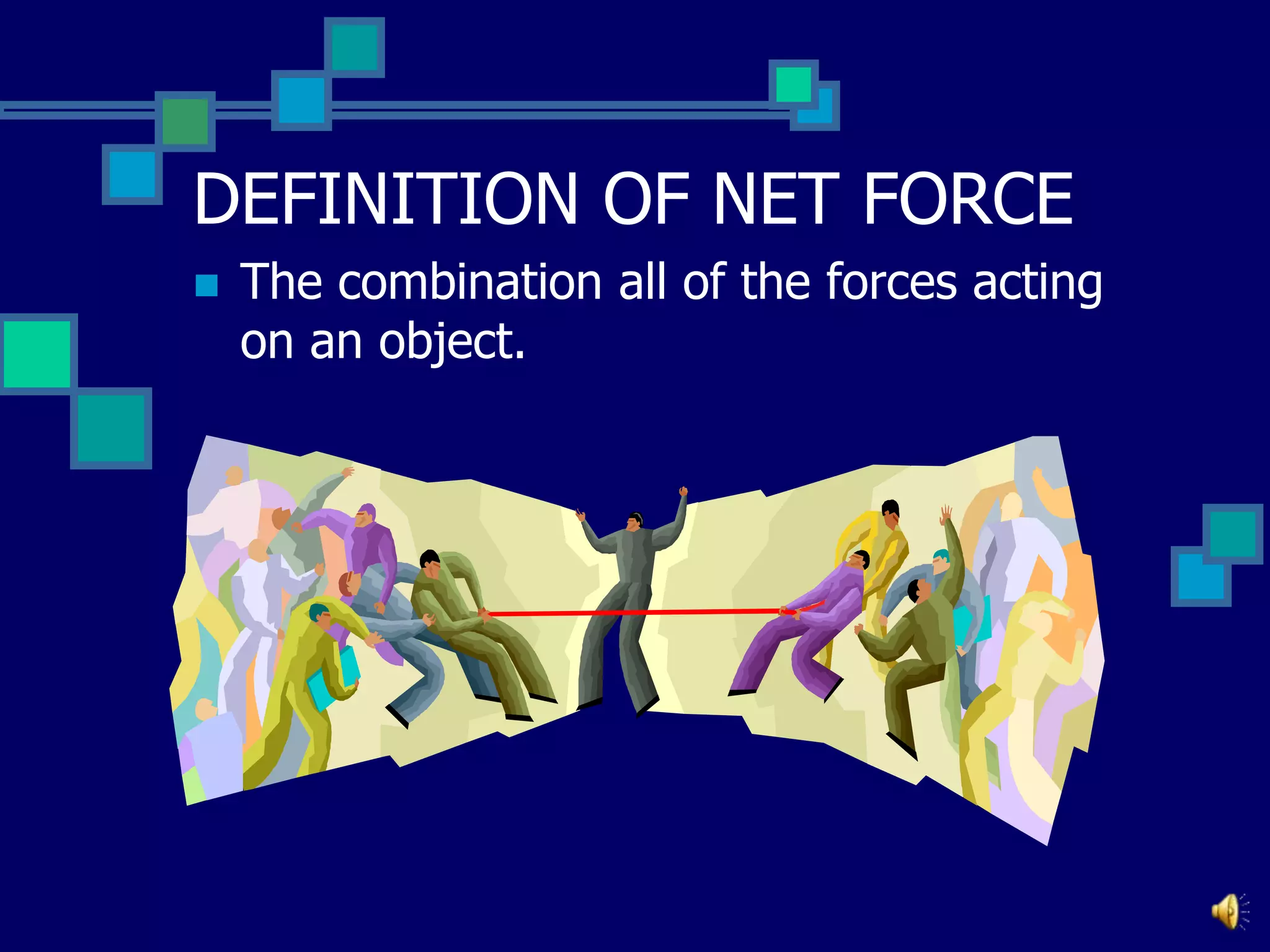
The combination all of the forces acting
on an object.
Determining the Net Force of
an object


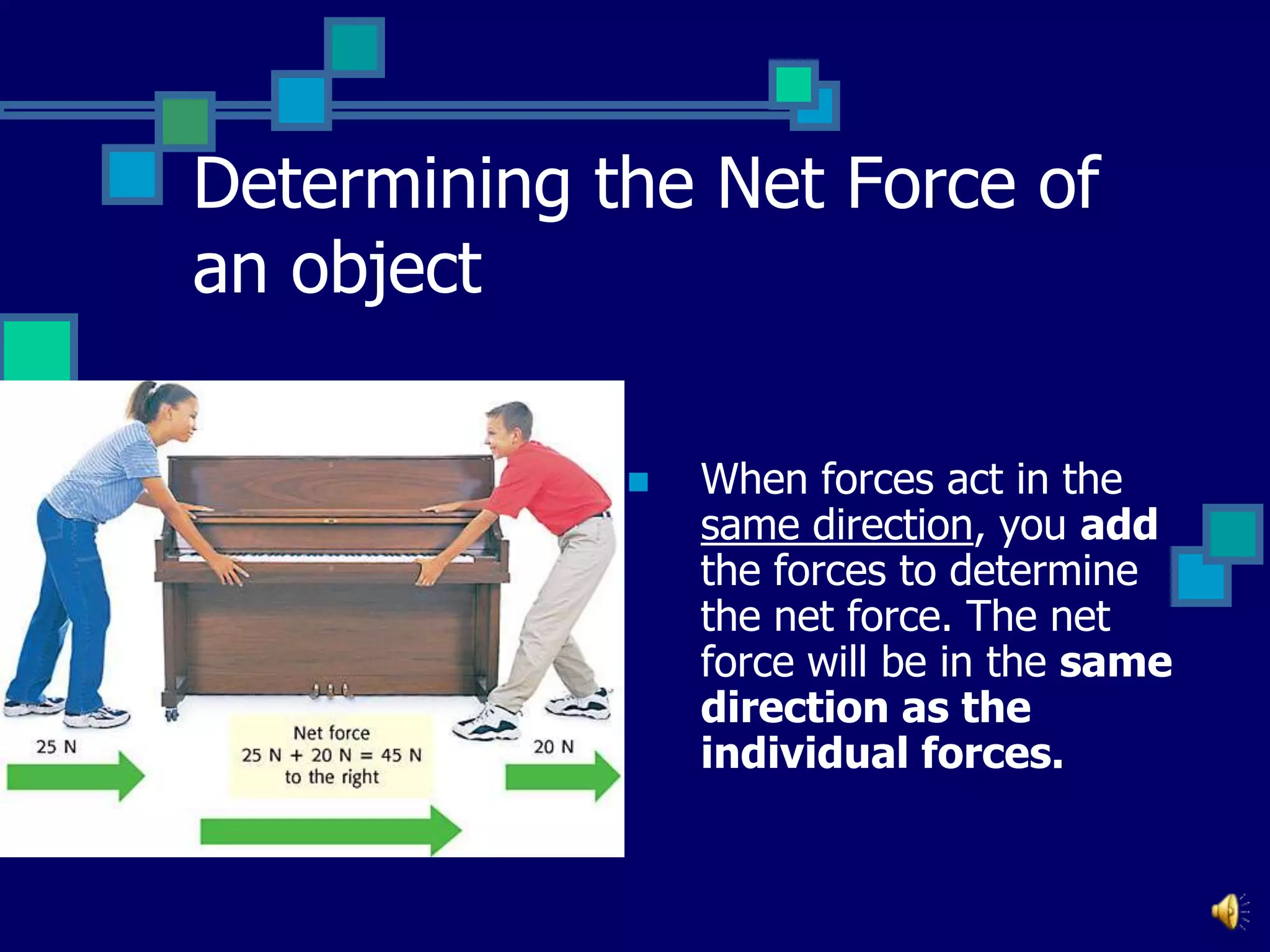
When forces act in the
same direction, you add
the forces to determine
the net force. The net
force will be in the same
direction as the
individual forces.
Determining the Net Force of
an object



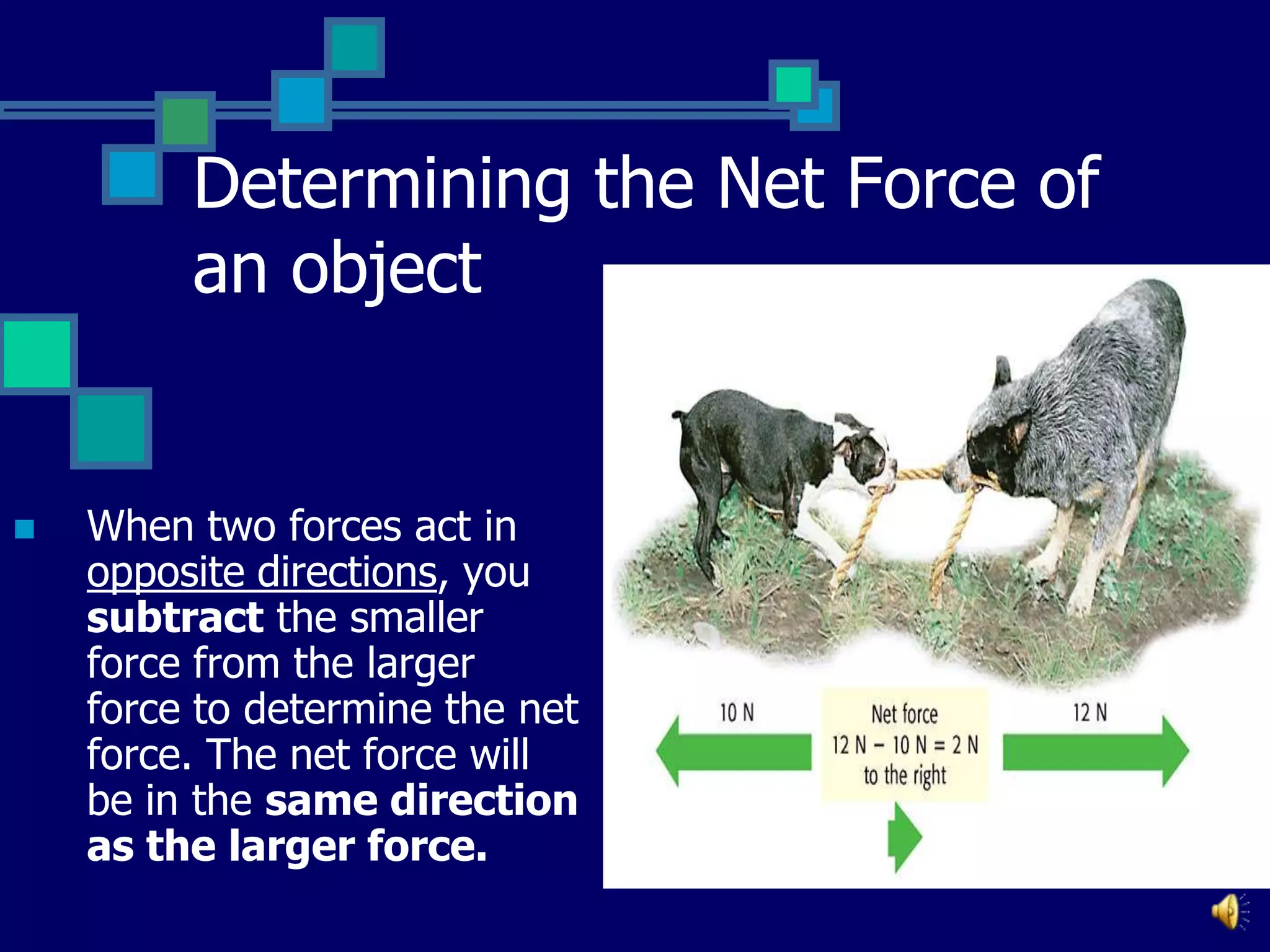
When two forces act in
opposite directions, you
subtract the smaller
force from the larger
force to determine the net
force. The net force will
be in the same direction
as the larger force.
Balanced Forces





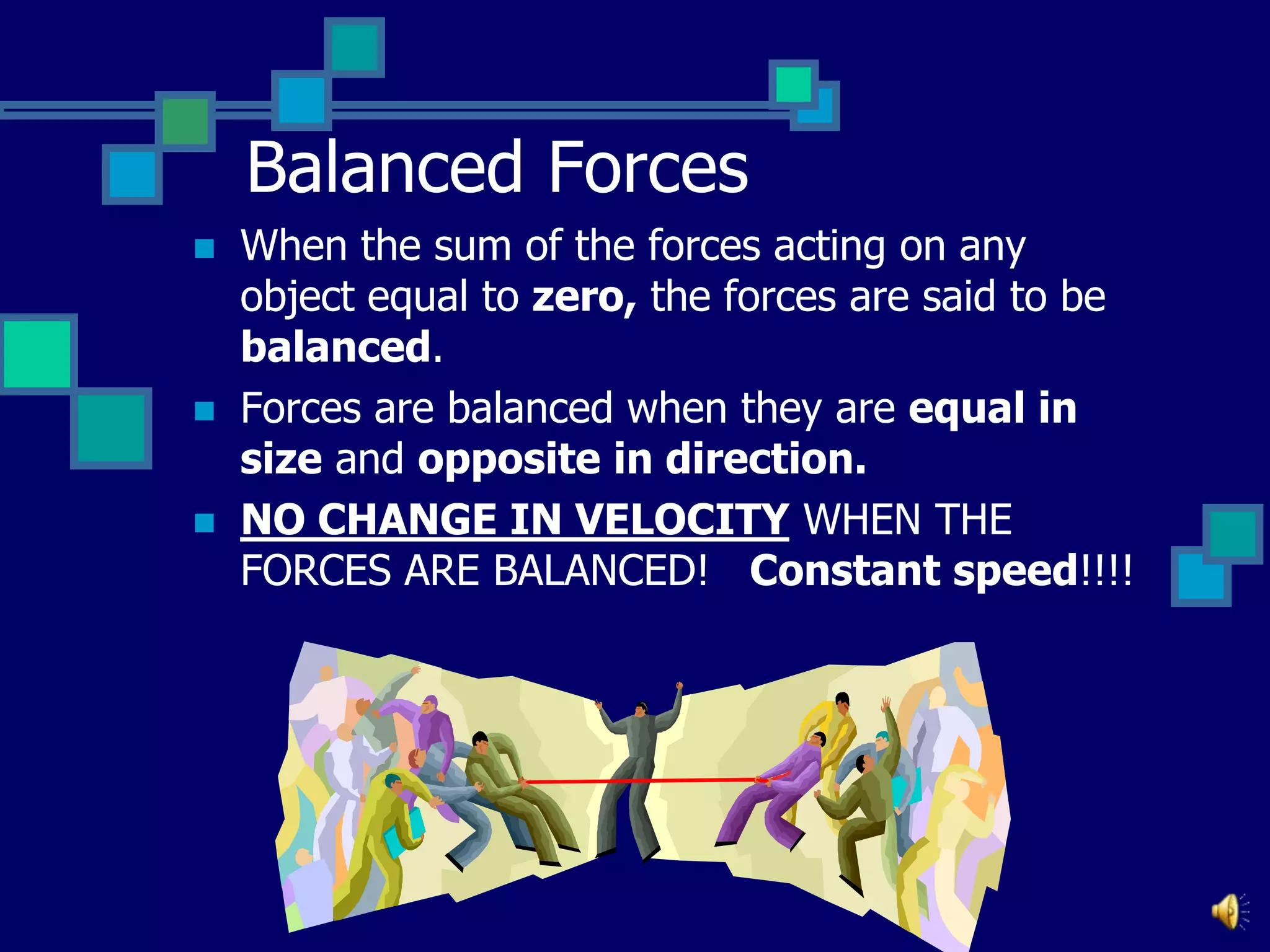
When the sum of the forces acting on any
object equal to zero, the forces are said to be
balanced.
Forces are balanced when they are equal in
size and opposite in direction.
NO CHANGE IN VELOCITY WHEN THE
FORCES ARE BALANCED! Constant speed!!!!
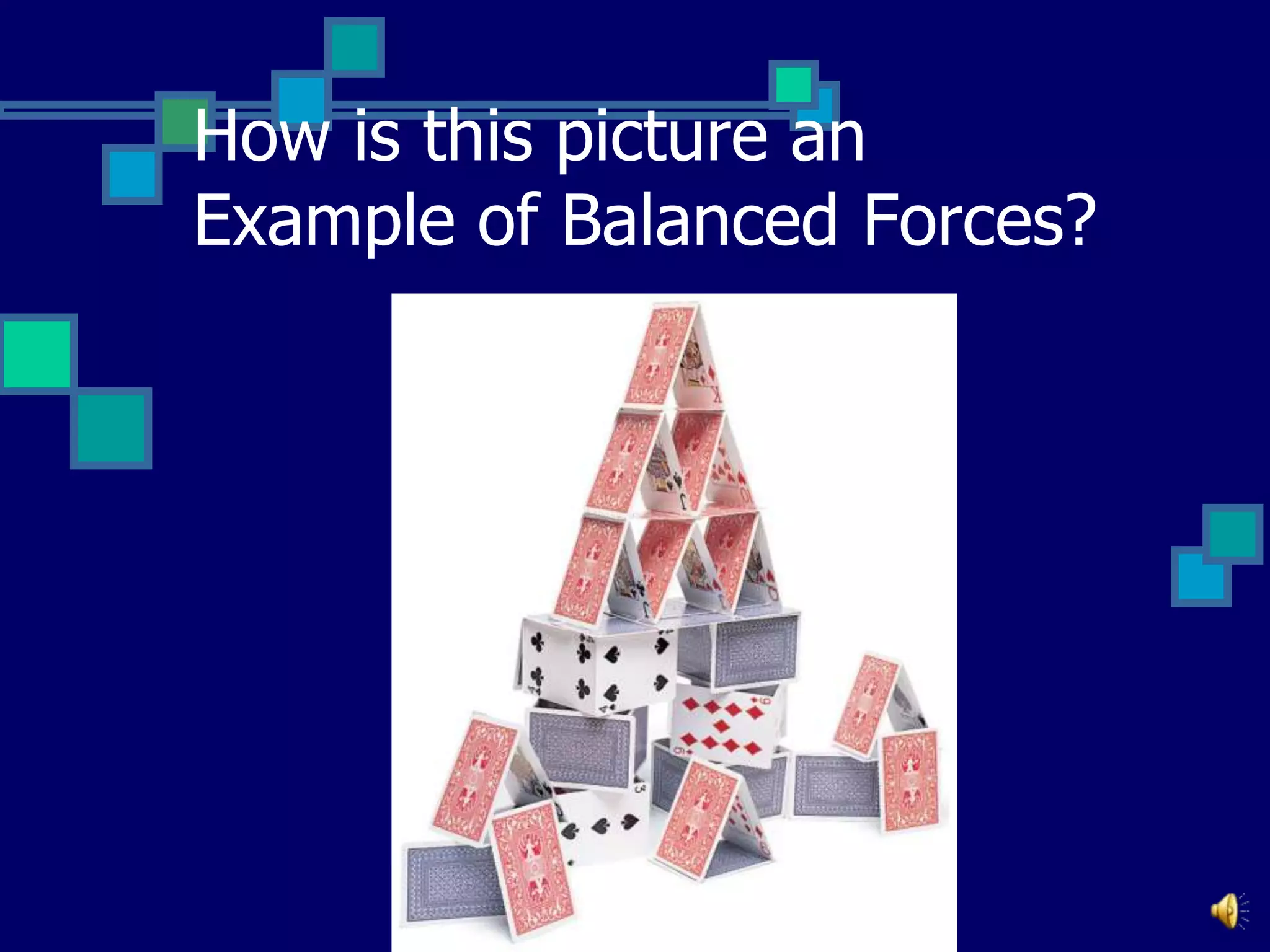
How is this picture an
Example of Balanced Forces?
Unbalanced Forces


Unbalanced forces occur when the sum of the
forces acting on any object is not equal to
zero.



Unbalanced forces produce a change in
motion, such as a change in speed or a change
in direction.



Unbalanced forces are necessary to cause a
nonmoving object to start moving.
Examples of Unbalanced
Forces



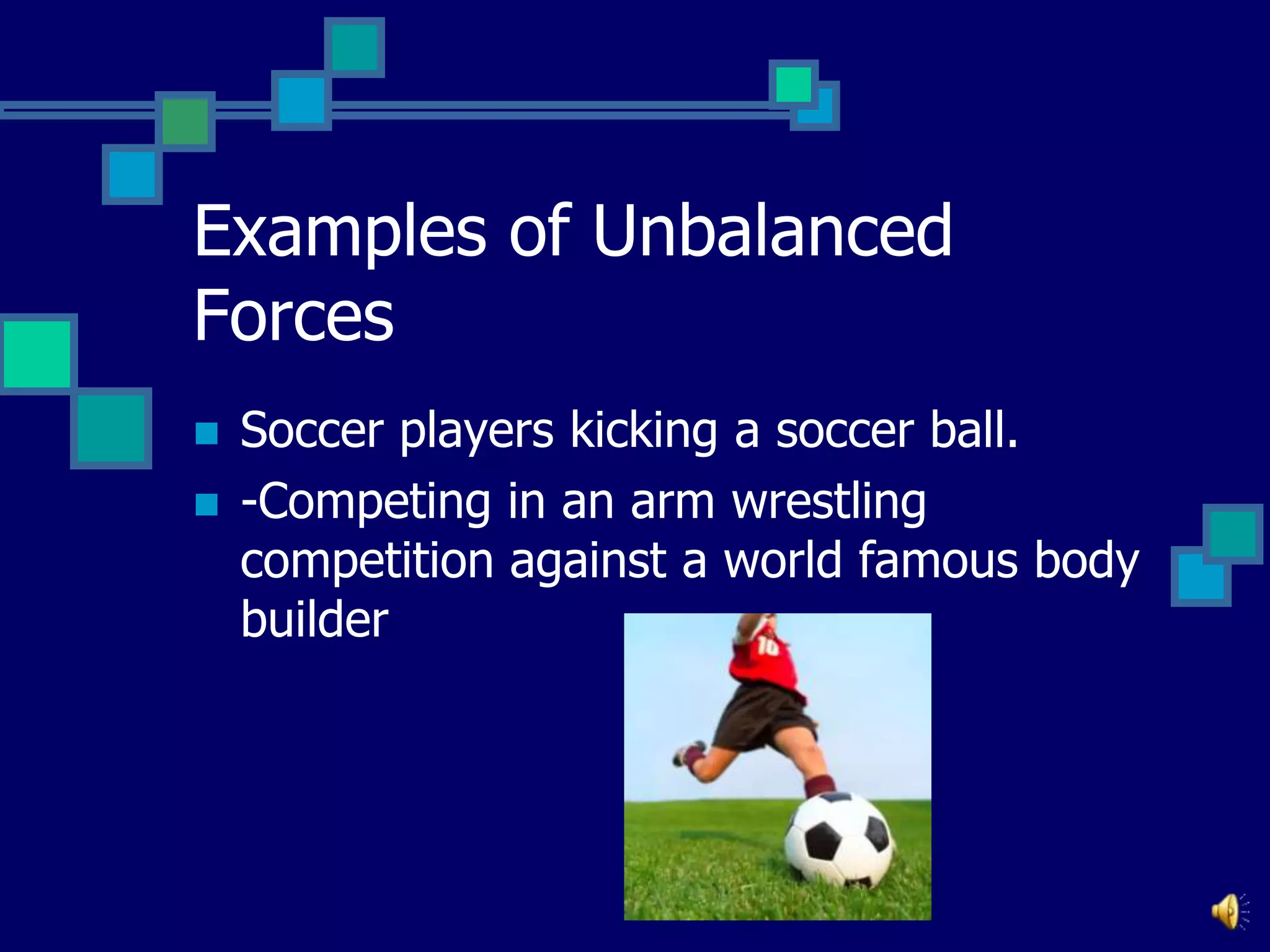
Soccer players kicking a soccer ball.
-Competing in an arm wrestling
competition against a world famous body
builder
THE BIG IDEA
 Unbalanced

forces cause
changes in motion that can
be predicted and described.
Bibliography






Motion basics. (1997). Retrieved from

http://www.physics4kids.com/files/motio
n_intro.html Force and motion facts.
(2013). Retrieved from
Force and motion facts. (2013).
Retrieved from
http://idahoptv.org/dialogue4kids/season
12/force_and_motion/facts.cfm/motion_i
ntro.html
Force. (2002). Retrieved from
http://library.thinkquest.org/CR0215468/f
orce_and_motion.htm

Forces notes power point

  • 1.
    FORCES “ A forceto be reckoned with”
  • 2.
    EQ: How dobalanced and unbalanced forces affect an object?   S8P5.a – Recognize that every object exerts gravitational force on every other object and that the force exerted depends on how much mass the objects have and how far apart they are. S8P3.b – Demonstrate the effect of balanced and unbalanced forces on an object in terms of gravity, inertia, and friction.
  • 3.
    AS YOU ENTER…      Lookaround the room and think about the objects you see in terms of FORCE. HINT: A force is always exerted by one object to another object. Answer the following: Where do you see a force happening? Which object is exerting the forces? Which is receiving it?
  • 4.
    Definition of FORCE Apush or pull  EX: - Using your fingers to pull open books - Pushing buttons on a computer keyboard 
  • 5.
    FORCE      Have both sizeand direction Labeled in units called Newtons (N). Two other concepts that have both size and direction: Velocity Acceleration
  • 6.
    DEFINITION OF NETFORCE  The combination all of the forces acting on an object.
  • 7.
    Determining the NetForce of an object  When forces act in the same direction, you add the forces to determine the net force. The net force will be in the same direction as the individual forces.
  • 8.
    Determining the NetForce of an object  When two forces act in opposite directions, you subtract the smaller force from the larger force to determine the net force. The net force will be in the same direction as the larger force.
  • 9.
    Balanced Forces    When thesum of the forces acting on any object equal to zero, the forces are said to be balanced. Forces are balanced when they are equal in size and opposite in direction. NO CHANGE IN VELOCITY WHEN THE FORCES ARE BALANCED! Constant speed!!!!
  • 10.
    How is thispicture an Example of Balanced Forces?
  • 11.
    Unbalanced Forces  Unbalanced forcesoccur when the sum of the forces acting on any object is not equal to zero.  Unbalanced forces produce a change in motion, such as a change in speed or a change in direction.  Unbalanced forces are necessary to cause a nonmoving object to start moving.
  • 12.
    Examples of Unbalanced Forces   Soccerplayers kicking a soccer ball. -Competing in an arm wrestling competition against a world famous body builder
  • 13.
    THE BIG IDEA Unbalanced forces cause changes in motion that can be predicted and described.
  • 14.
    Bibliography    Motion basics. (1997).Retrieved from http://www.physics4kids.com/files/motio n_intro.html Force and motion facts. (2013). Retrieved from Force and motion facts. (2013). Retrieved from http://idahoptv.org/dialogue4kids/season 12/force_and_motion/facts.cfm/motion_i ntro.html Force. (2002). Retrieved from http://library.thinkquest.org/CR0215468/f orce_and_motion.htm