Forces
What is Force? Force is a push or a pull Described by its strength and direction Strength  measured in Newton (N) Direction represented by an arrow – Length tells the strength Contact forces : friction, touch Non-contact forces : gravity, magnetism
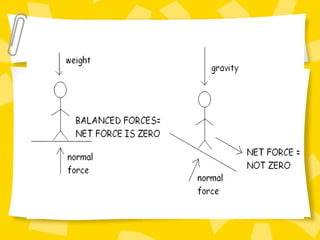
Combining Forces Net force: combination of all forces acting on an object at one time Balanced/Not Balanced.
What forces are acting on the football in the air?
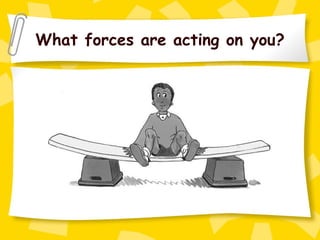
What forces are acting on you?
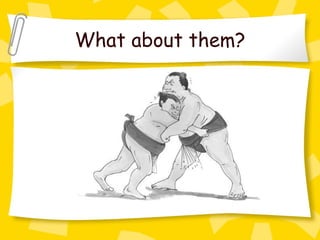
What about them?
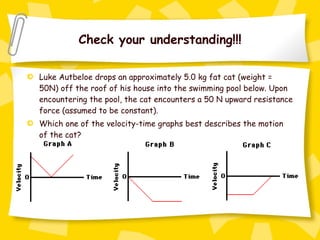
Check your understanding!!! Luke Autbeloe drops an approximately 5.0 kg fat cat (weight = 50N) off the roof of his house into the swimming pool below. Upon encountering the pool, the cat encounters a 50 N upward resistance force (assumed to be constant).  Which one of the velocity-time graphs best describes the motion of the cat?
Gravity Attraction between all matter (balanced) Downward force of gravity on you is called  weight . Earth: acceleration due to gravity = 9.8m/s 2 Force: mass x acceleration (F=ma) unit: Newton (N) Newton realized it is universal Law of Universal Gravitation Factors affecting:  mass  and  distance
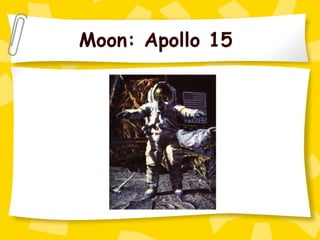
Gravity Free fall : when the only force acting on an object is gravity (object accelerates) When there is no  air resistance  (fluid friction): all objects fall with same acceleration (moon experiment) Air resistance increases with velocity When air resistance = gravity -> terminal velocity (forces are balanced/no acceleration)
Moon: Apollo 15
Friction Force that 2 surfaces exert on each other Causes: type of surface involved + how hard surfaces push together Acts in a direction opposite to the direction of the object’s motion Solid/solid Gas/solid Liquid/solid
Types of friction Static : acts on objects that are not moving (desk) Sliding : when 2 solid surfaces slide over each other (bicycle brakes) Rolling : when an object rolls across a surface (skateboarding) Fluid : when a solid object moves through a fluid (oil-hinges)
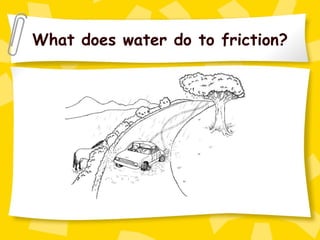
What does water do to friction?
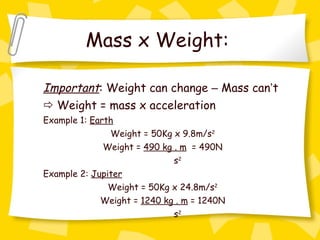
Mass x Weight:   Important : Weight can change  –  Mass can ’ t    Weight = mass x acceleration Example 1:  Earth Weight = 50Kg x 9.8m/s 2 Weight =  490 kg . m   = 490N     s 2 Example 2:  Jupiter Weight = 50Kg x 24.8m/s 2 Weight =  1240 kg . m  = 1240N     s 2
Which one is wrong? 1) The elephant and the feather each have the same force of gravity.  2) The elephant has more mass, yet both elephant and feather experience the same force of gravity.  3) On earth, all objects (whether an elephant or a feather) have the same force of gravity.  4) The elephant clearly has more mass than the feather, yet they each weigh the same.  5) The elephant clearly has more mass than the feather, yet the amount of gravity is the same for each.
G force 1g = 9.8m/s 2 Length of time / location / direction / posture Effects: grey out, tunnel vision, permanent loss of vision, death Jet pilots = high G training Modern pilots = more than 9g Vertical  blood towards feet = 9g Blood towards brain = 3g (red out) Horizontal Blood towards eyes = 17g Blood towards brain = 12g G force videos:  http://www.youtube.com/watch?v=3rQexWEwV6M&feature=related   http://www.youtube.com/watch?v=Qz2SO_3G4gA   http://www.youtube.com/watch?v=w8Fjsc90364&feature=related
NEWTON ’ S LAWS   The Three Laws of Motion by Sir Isaac Newton explain all aspects of motion.
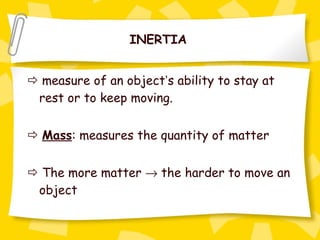
INERTIA      measure of an object ’ s ability to stay at rest or to keep moving.    Mass : measures the quantity of matter      The more matter    the harder to move an object
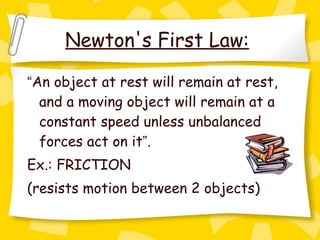
Newton's First Law:   “ An object at rest will remain at rest, and a moving object will remain at a constant speed unless unbalanced forces act on it ” .  Ex.: FRICTION  (resists motion between 2 objects)
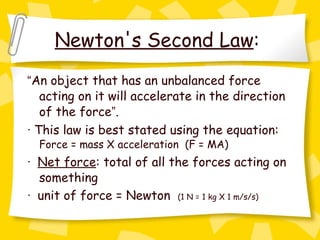
Newton's Second Law :  “ An object that has an unbalanced force acting on it will accelerate in the direction of the force ” . ·  This law is best stated using the equation:  Force = mass X acceleration  (F = MA) ·   Net force : total of all the forces acting on something ·   unit of force = Newton  (1 N = 1 kg X 1 m/s/s)
 
Newton's Third Law: “ For every action, there is an equal and opposite reaction ”   Forces act in pairs