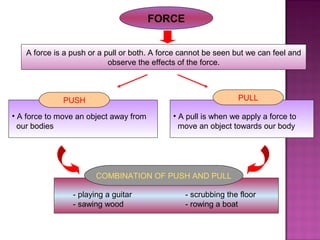
- playing a guitar - scrubbing the floor
- sawing wood - rowing a boat
• A pull is when we apply a force to
move an object towards our body
• A force to move an object away from
our bodies
FORCE
A force is a push or a pull or both. A force cannot be seen but we can feel and
observe the effects of the force.
PUSH PULL
COMBINATION OF PUSH AND PULL
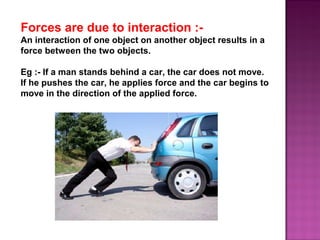
Forces are due to interaction :-
An interaction of one object on another object results in a
force between the two objects.
Eg :- If a man stands behind a car, the car does not move.
If he pushes the car, he applies force and the car begins to
move in the direction of the applied force.
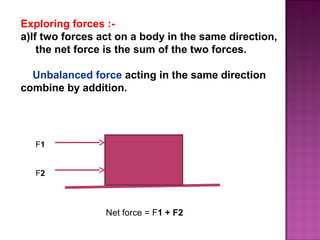
Exploring forces :-
a)If two forces act on a body in the same direction,
the net force is the sum of the two forces.
Unbalanced force acting in the same direction
combine by addition.
F1
F2
Net force = F1 + F2
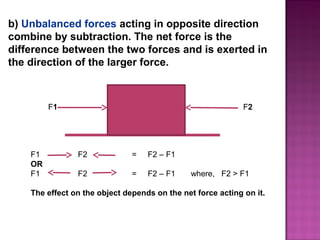
b) Unbalanced forces acting in opposite direction
combine by subtraction. The net force is the
difference between the two forces and is exerted in
the direction of the larger force.
F1 F2
F1 F2 = F2 – F1
OR
F1 F2 = F2 – F1 where, F2 > F1
The effect on the object depends on the net force acting on it.
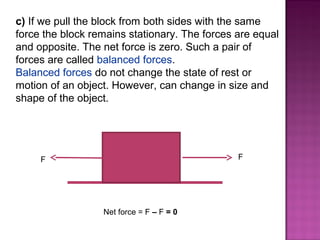
c) If we pull the block from both sides with the same
force the block remains stationary. The forces are equal
and opposite. The net force is zero. Such a pair of
forces are called balanced forces.
Balanced forces do not change the state of rest or
motion of an object. However, can change in size and
shape of the object.
F F
Net force = F – F = 0
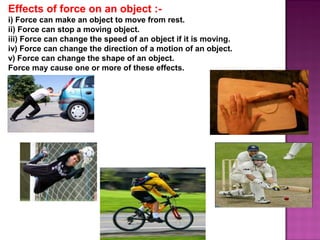
Effects of force on an object :-
i) Force can make an object to move from rest.
ii) Force can stop a moving object.
iii) Force can change the speed of an object if it is moving.
iv) Force can change the direction of a motion of an object.
v) Force can change the shape of an object.
Force may cause one or more of these effects.
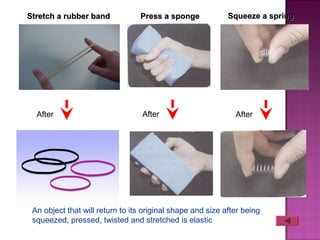
Stretch a rubber bandStretch a rubber band
After
An object that will return to its original shape and size after being
squeezed, pressed, twisted and stretched is elastic
After After
Press a spongePress a sponge Squeeze a springSqueeze a spring
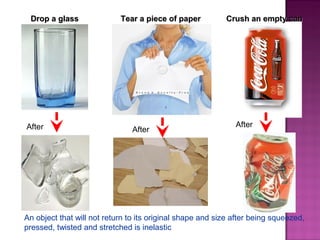
Drop a glassDrop a glass
After After
Tear a piece of paperTear a piece of paper
After
Crush an empty canCrush an empty can
An object that will not return to its original shape and size after being squeezed,
pressed, twisted and stretched is inelastic
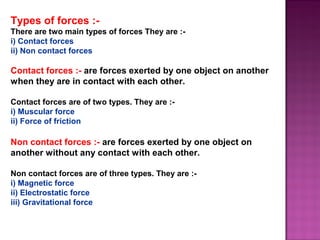
Types of forces :-
There are two main types of forces They are :-
i) Contact forces
ii) Non contact forces
Contact forces :- are forces exerted by one object on another
when they are in contact with each other.
Contact forces are of two types. They are :-
i) Muscular force
ii) Force of friction
Non contact forces :- are forces exerted by one object on
another without any contact with each other.
Non contact forces are of three types. They are :-
i) Magnetic force
ii) Electrostatic force
iii) Gravitational force
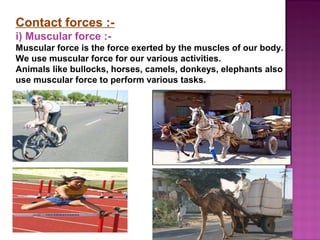
Contact forces :-
i) Muscular force :-
Muscular force is the force exerted by the muscles of our body.
We use muscular force for our various activities.
Animals like bullocks, horses, camels, donkeys, elephants also
use muscular force to perform various tasks.
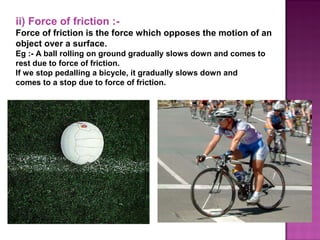
ii) Force of friction :-
Force of friction is the force which opposes the motion of an
object over a surface.
Eg :- A ball rolling on ground gradually slows down and comes to
rest due to force of friction.
If we stop pedalling a bicycle, it gradually slows down and
comes to a stop due to force of friction.
Non contact forces :-
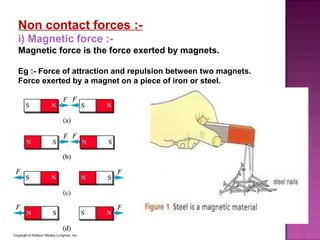
i) Magnetic force :-
Magnetic force is the force exerted by magnets.
Eg :- Force of attraction and repulsion between two magnets.
Force exerted by a magnet on a piece of iron or steel.
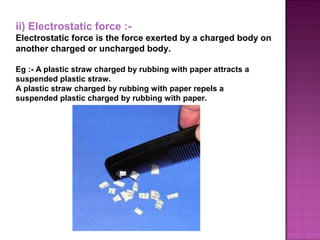
ii) Electrostatic force :-
Electrostatic force is the force exerted by a charged body on
another charged or uncharged body.
Eg :- A plastic straw charged by rubbing with paper attracts a
suspended plastic straw.
A plastic straw charged by rubbing with paper repels a
suspended plastic charged by rubbing with paper.
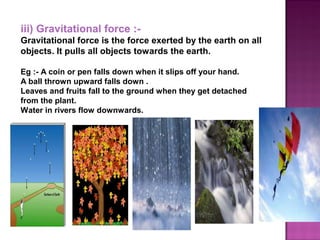
iii) Gravitational force :-
Gravitational force is the force exerted by the earth on all
objects. It pulls all objects towards the earth.
Eg :- A coin or pen falls down when it slips off your hand.
A ball thrown upward falls down .
Leaves and fruits fall to the ground when they get detached
from the plant.
Water in rivers flow downwards.
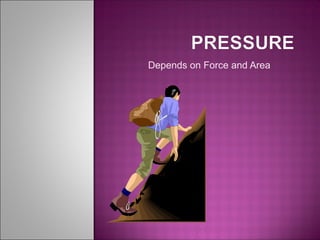
Depends on Force and Area
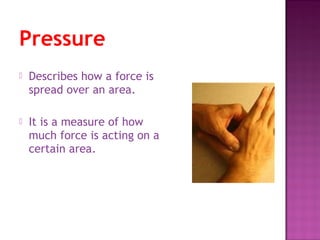
Pressure
 Describes how a force is
spread over an area.
 It is a measure of how
much force is acting on a
certain area.
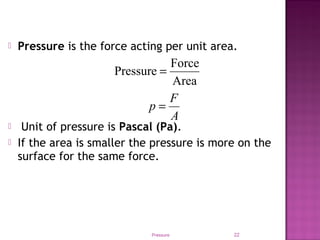
 Pressure is the force acting per unit area.
 Unit of pressure is Pascal (Pa).
 If the area is smaller the pressure is more on the
surface for the same force.
Pressure 22
Area
Force
Pressure =
A
F
p =
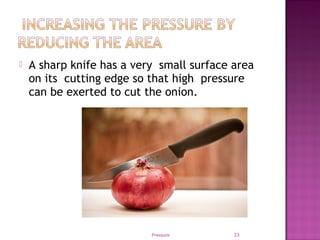
 A sharp knife has a very small surface area
on its cutting edge so that high pressure
can be exerted to cut the onion.
Pressure 23
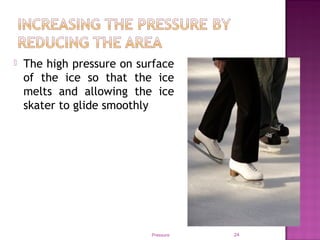
 The high pressure on surface
of the ice so that the ice
melts and allowing the ice
skater to glide smoothly
Pressure 24
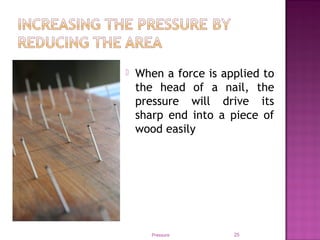
 When a force is applied to
the head of a nail, the
pressure will drive its
sharp end into a piece of
wood easily
Pressure 25
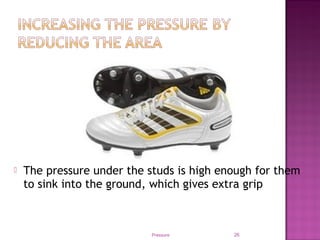
 The pressure under the studs is high enough for them
to sink into the ground, which gives extra grip
Pressure 26
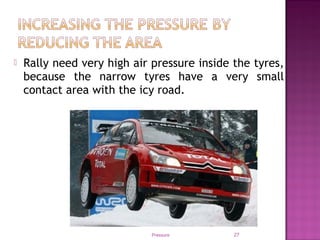
 Rally need very high air pressure inside the tyres,
because the narrow tyres have a very small
contact area with the icy road.
Pressure 27
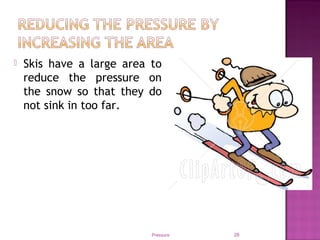
 Skis have a large area to
reduce the pressure on
the snow so that they do
not sink in too far.
Pressure 28
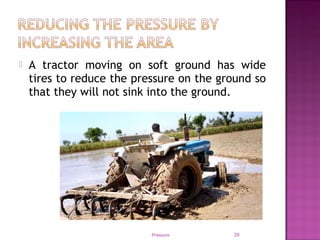
 A tractor moving on soft ground has wide
tires to reduce the pressure on the ground so
that they will not sink into the ground.
Pressure 29
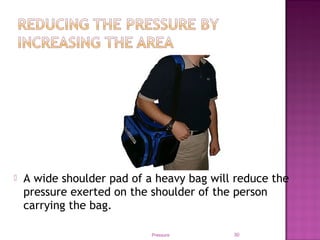
 A wide shoulder pad of a heavy bag will reduce the
pressure exerted on the shoulder of the person
carrying the bag.
Pressure 30
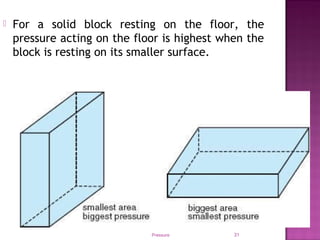
 For a solid block resting on the floor, the
pressure acting on the floor is highest when the
block is resting on its smaller surface.
Pressure 31
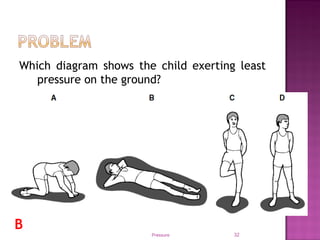
Which diagram shows the child exerting least
pressure on the ground?
Pressure 32
B
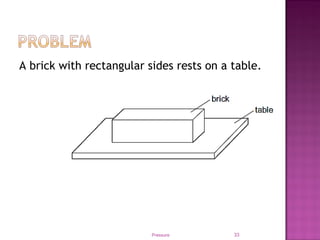
A brick with rectangular sides rests on a table.
Pressure 33
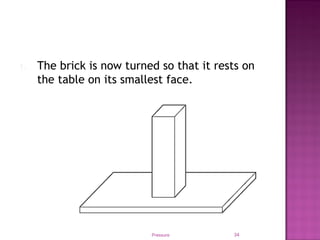
1. The brick is now turned so that it rests on
the table on its smallest face.
Pressure 34
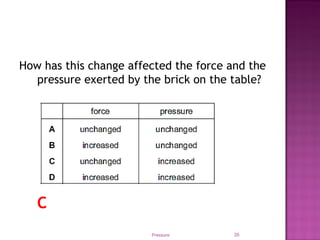
How has this change affected the force and the
pressure exerted by the brick on the table?
Pressure 35
C
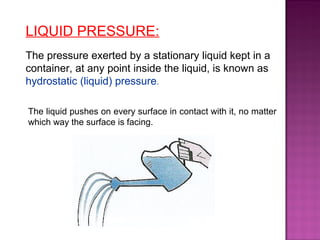
LIQUID PRESSURE:
The pressure exerted by a stationary liquid kept in a
container, at any point inside the liquid, is known as
hydrostatic (liquid) pressure.
The liquid pushes on every surface in contact with it, no matter
which way the surface is facing.
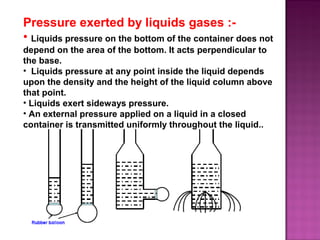
Pressure exerted by liquids gases :-
• Liquids pressure on the bottom of the container does not
depend on the area of the bottom. It acts perpendicular to
the base.
• Liquids pressure at any point inside the liquid depends
upon the density and the height of the liquid column above
that point.
• Liquids exert sideways pressure.
• An external pressure applied on a liquid in a closed
container is transmitted uniformly throughout the liquid..
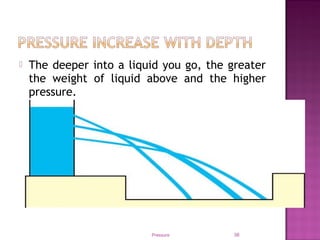
 The deeper into a liquid you go, the greater
the weight of liquid above and the higher
pressure.
Pressure 38
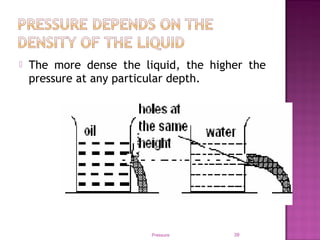
 The more dense the liquid, the higher the
pressure at any particular depth.
Pressure 39
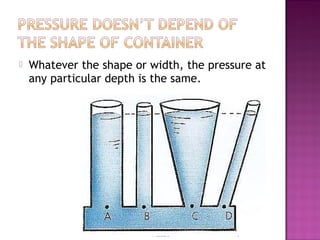
 Whatever the shape or width, the pressure at
any particular depth is the same.
Pressure 40
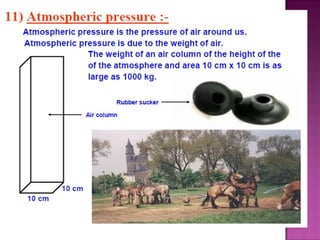
 The atmosphere is the layer of air enveloping the
Earth. It extends up to 1000 km above the
surface and has a total mass of 4.5 × 10¹⁸
kg.
 The pressure inside our bodies is almost the same
as the external pressure and so balances it.
 At high altitudes where the pressure is lower,
breathing is difficult. Nose bleeding may occur as
results from the pressure difference between the
body and the external pressure.
Pressure 42
Pressure 43
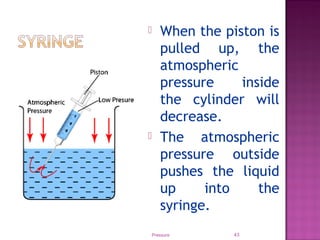
 When the piston is
pulled up, the
atmospheric
pressure inside
the cylinder will
decrease.
 The atmospheric
pressure outside
pushes the liquid
up into the
syringe.
Pressure 44
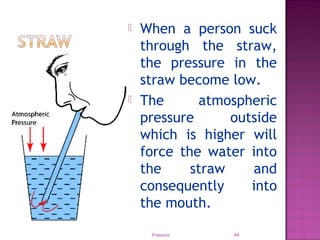
 When a person suck
through the straw,
the pressure in the
straw become low.
 The atmospheric
pressure outside
which is higher will
force the water into
the straw and
consequently into
the mouth.
Pressure 45
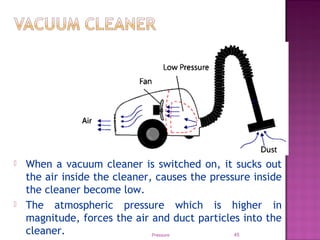
 When a vacuum cleaner is switched on, it sucks out
the air inside the cleaner, causes the pressure inside
the cleaner become low.
 The atmospheric pressure which is higher in
magnitude, forces the air and duct particles into the
cleaner.
Made By-
Ms. RUKSHAR KHAN

Force and Pressure

  • 3.
    - playing aguitar - scrubbing the floor - sawing wood - rowing a boat • A pull is when we apply a force to move an object towards our body • A force to move an object away from our bodies FORCE A force is a push or a pull or both. A force cannot be seen but we can feel and observe the effects of the force. PUSH PULL COMBINATION OF PUSH AND PULL
  • 4.
    Forces are dueto interaction :- An interaction of one object on another object results in a force between the two objects. Eg :- If a man stands behind a car, the car does not move. If he pushes the car, he applies force and the car begins to move in the direction of the applied force.
  • 5.
    Exploring forces :- a)Iftwo forces act on a body in the same direction, the net force is the sum of the two forces. Unbalanced force acting in the same direction combine by addition. F1 F2 Net force = F1 + F2
  • 6.
    b) Unbalanced forcesacting in opposite direction combine by subtraction. The net force is the difference between the two forces and is exerted in the direction of the larger force. F1 F2 F1 F2 = F2 – F1 OR F1 F2 = F2 – F1 where, F2 > F1 The effect on the object depends on the net force acting on it.
  • 7.
    c) If wepull the block from both sides with the same force the block remains stationary. The forces are equal and opposite. The net force is zero. Such a pair of forces are called balanced forces. Balanced forces do not change the state of rest or motion of an object. However, can change in size and shape of the object. F F Net force = F – F = 0
  • 8.
    Effects of forceon an object :- i) Force can make an object to move from rest. ii) Force can stop a moving object. iii) Force can change the speed of an object if it is moving. iv) Force can change the direction of a motion of an object. v) Force can change the shape of an object. Force may cause one or more of these effects.
  • 9.
    Stretch a rubberbandStretch a rubber band After An object that will return to its original shape and size after being squeezed, pressed, twisted and stretched is elastic After After Press a spongePress a sponge Squeeze a springSqueeze a spring
  • 10.
    Drop a glassDropa glass After After Tear a piece of paperTear a piece of paper After Crush an empty canCrush an empty can An object that will not return to its original shape and size after being squeezed, pressed, twisted and stretched is inelastic
  • 11.
    Types of forces:- There are two main types of forces They are :- i) Contact forces ii) Non contact forces Contact forces :- are forces exerted by one object on another when they are in contact with each other. Contact forces are of two types. They are :- i) Muscular force ii) Force of friction Non contact forces :- are forces exerted by one object on another without any contact with each other. Non contact forces are of three types. They are :- i) Magnetic force ii) Electrostatic force iii) Gravitational force
  • 12.
    Contact forces :- i)Muscular force :- Muscular force is the force exerted by the muscles of our body. We use muscular force for our various activities. Animals like bullocks, horses, camels, donkeys, elephants also use muscular force to perform various tasks.
  • 13.
    ii) Force offriction :- Force of friction is the force which opposes the motion of an object over a surface. Eg :- A ball rolling on ground gradually slows down and comes to rest due to force of friction. If we stop pedalling a bicycle, it gradually slows down and comes to a stop due to force of friction.
  • 14.
    Non contact forces:- i) Magnetic force :- Magnetic force is the force exerted by magnets. Eg :- Force of attraction and repulsion between two magnets. Force exerted by a magnet on a piece of iron or steel.
  • 15.
    ii) Electrostatic force:- Electrostatic force is the force exerted by a charged body on another charged or uncharged body. Eg :- A plastic straw charged by rubbing with paper attracts a suspended plastic straw. A plastic straw charged by rubbing with paper repels a suspended plastic charged by rubbing with paper.
  • 16.
    iii) Gravitational force:- Gravitational force is the force exerted by the earth on all objects. It pulls all objects towards the earth. Eg :- A coin or pen falls down when it slips off your hand. A ball thrown upward falls down . Leaves and fruits fall to the ground when they get detached from the plant. Water in rivers flow downwards.
  • 17.
  • 18.
    Pressure  Describes howa force is spread over an area.  It is a measure of how much force is acting on a certain area.
  • 19.
     Pressure isthe force acting per unit area.  Unit of pressure is Pascal (Pa).  If the area is smaller the pressure is more on the surface for the same force. Pressure 22 Area Force Pressure = A F p =
  • 20.
     A sharpknife has a very small surface area on its cutting edge so that high pressure can be exerted to cut the onion. Pressure 23
  • 21.
     The highpressure on surface of the ice so that the ice melts and allowing the ice skater to glide smoothly Pressure 24
  • 22.
     When aforce is applied to the head of a nail, the pressure will drive its sharp end into a piece of wood easily Pressure 25
  • 23.
     The pressureunder the studs is high enough for them to sink into the ground, which gives extra grip Pressure 26
  • 24.
     Rally needvery high air pressure inside the tyres, because the narrow tyres have a very small contact area with the icy road. Pressure 27
  • 25.
     Skis havea large area to reduce the pressure on the snow so that they do not sink in too far. Pressure 28
  • 26.
     A tractormoving on soft ground has wide tires to reduce the pressure on the ground so that they will not sink into the ground. Pressure 29
  • 27.
     A wideshoulder pad of a heavy bag will reduce the pressure exerted on the shoulder of the person carrying the bag. Pressure 30
  • 28.
     For asolid block resting on the floor, the pressure acting on the floor is highest when the block is resting on its smaller surface. Pressure 31
  • 29.
    Which diagram showsthe child exerting least pressure on the ground? Pressure 32 B
  • 30.
    A brick withrectangular sides rests on a table. Pressure 33
  • 31.
    1. The brickis now turned so that it rests on the table on its smallest face. Pressure 34
  • 32.
    How has thischange affected the force and the pressure exerted by the brick on the table? Pressure 35 C
  • 33.
    LIQUID PRESSURE: The pressureexerted by a stationary liquid kept in a container, at any point inside the liquid, is known as hydrostatic (liquid) pressure. The liquid pushes on every surface in contact with it, no matter which way the surface is facing.
  • 34.
    Pressure exerted byliquids gases :- • Liquids pressure on the bottom of the container does not depend on the area of the bottom. It acts perpendicular to the base. • Liquids pressure at any point inside the liquid depends upon the density and the height of the liquid column above that point. • Liquids exert sideways pressure. • An external pressure applied on a liquid in a closed container is transmitted uniformly throughout the liquid..
  • 35.
     The deeperinto a liquid you go, the greater the weight of liquid above and the higher pressure. Pressure 38
  • 36.
     The moredense the liquid, the higher the pressure at any particular depth. Pressure 39
  • 37.
     Whatever theshape or width, the pressure at any particular depth is the same. Pressure 40
  • 39.
     The atmosphereis the layer of air enveloping the Earth. It extends up to 1000 km above the surface and has a total mass of 4.5 × 10¹⁸ kg.  The pressure inside our bodies is almost the same as the external pressure and so balances it.  At high altitudes where the pressure is lower, breathing is difficult. Nose bleeding may occur as results from the pressure difference between the body and the external pressure. Pressure 42
  • 40.
    Pressure 43  Whenthe piston is pulled up, the atmospheric pressure inside the cylinder will decrease.  The atmospheric pressure outside pushes the liquid up into the syringe.
  • 41.
    Pressure 44  Whena person suck through the straw, the pressure in the straw become low.  The atmospheric pressure outside which is higher will force the water into the straw and consequently into the mouth.
  • 42.
    Pressure 45  Whena vacuum cleaner is switched on, it sucks out the air inside the cleaner, causes the pressure inside the cleaner become low.  The atmospheric pressure which is higher in magnitude, forces the air and duct particles into the cleaner.
  • 43.