Air Resistance
If only gravity is present, all objects accelerate at 9.8 m/s 2 Air resistance-  the force air exerts on a moving object.  This force acts in the opposite direction to the object’s motion.  Air resistance pushes up as gravity pulls an object down.
Ex:  The larger the surface area of objects, the greater amount of air resistance on it.  This is why a leaf falls more slowly than an acorn. Terminal Velocity-  the highest velocity that will be reached by a falling object.
Ex:  As an object falls through the air, air resistance gradually increases until it balances the pull of gravity. When this happens, the falling object will stop accelerating.  This is the terminal velocity.
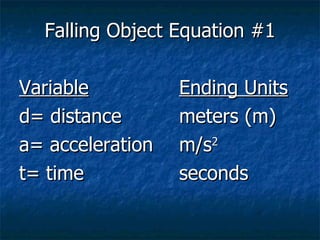
Falling Object Equation #1 Variable Ending Units d= distance meters (m) a= acceleration m/s 2 t= time seconds
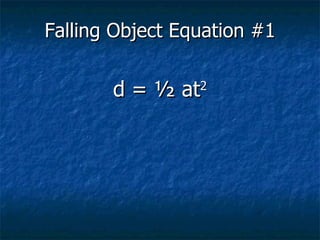
Falling Object Equation #1 d = ½ at 2
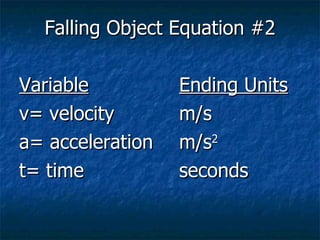
Falling Object Equation #2 Variable Ending Units v= velocity m/s a= acceleration m/s 2   t= time seconds
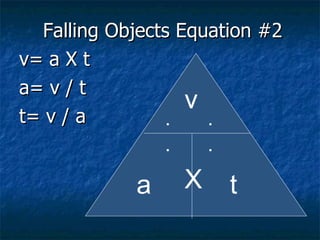
Falling Objects Equation #2 v= a X t a= v / t t= v / a v . . . . X a t

2 air resistance

  • 1.
  • 2.
    If only gravityis present, all objects accelerate at 9.8 m/s 2 Air resistance- the force air exerts on a moving object. This force acts in the opposite direction to the object’s motion. Air resistance pushes up as gravity pulls an object down.
  • 3.
    Ex: Thelarger the surface area of objects, the greater amount of air resistance on it. This is why a leaf falls more slowly than an acorn. Terminal Velocity- the highest velocity that will be reached by a falling object.
  • 4.
    Ex: Asan object falls through the air, air resistance gradually increases until it balances the pull of gravity. When this happens, the falling object will stop accelerating. This is the terminal velocity.
  • 5.
    Falling Object Equation#1 Variable Ending Units d= distance meters (m) a= acceleration m/s 2 t= time seconds
  • 6.
  • 7.
    Falling Object Equation#2 Variable Ending Units v= velocity m/s a= acceleration m/s 2 t= time seconds
  • 8.
    Falling Objects Equation#2 v= a X t a= v / t t= v / a v . . . . X a t