Fluid Mechanics
•Buoyancy
•Liquids & Gasses
•Pressure
•Pascals
•Density
•Pascal’s Principle
•Archimedes’ Principle
•Bernoulli’s Principle
Review; Ch. 3
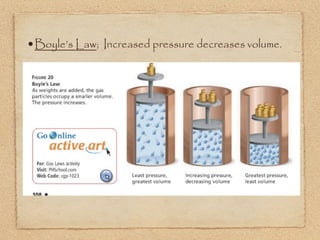
•Boyle’s Law; When the pressure of a fluid at
constant temperature is increased, the volume of fluid
decreases, when the pressure is decreased, the
volume increases.
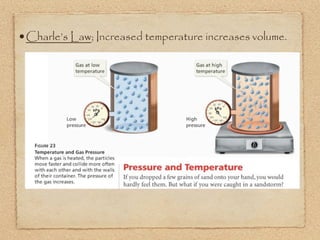
•Charle’s Law; When the temperature of a fluid
increases at constant pressure, its volume increases.
When the temperature decreases its volume
decreases.
Pressure
•Pressure is a “pressing” force; a push.
•Pressure depends on the amount of area over which it
is exerted.
•Pressure = Force/Area (add to circle formula sheet).
•Units: Newtons/Meters2
•which is called “Pascals”
•Also measured in atm,
•mmHg, etc.
Fluid Pressure
•Gas or Liquid
•“In a fluid the molecules exert an
equal pressure in all directions”.
•We live at the bottom of 100km of
fluid air which exerts a pressure of
14.7 lbs/square inch.
•This pressure is exerted equally in
all directions: up and down and is said
to be “balanced”.
•Unbalanced forces produce motion
Fluid Pressure, cont.
•Air pressure decreases with altitude.
•Liquid pressure increases with depth below surface.
•Air pressure is measured with a barometer.
•Liquid pressure is measured with a hydrometer.
Density & Buoyant
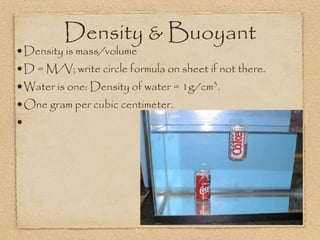
•Density is mass/volume
•D = M/V; write circle formula on sheet if not there.
•Water is one: Density of water = 1g/cm .3

•One gram per cubic centimeter.
•
Predicting Floating & Sinking
•Knowing that water is one you can predict if an
object will float or sink
•Less than one will float, more than one will sink.
•                       D = m/v.
•Density will increase if Mass increases or Volume
decreases.
•Density will decrease if Mass decreases or Volume
increases.
Buoyancy
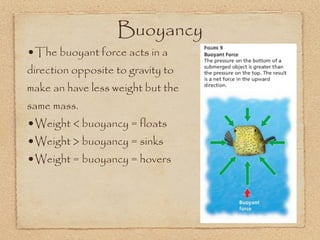
•The buoyant force acts in a
direction opposite to gravity to
make an have less weight but the
same mass.
•Weight < buoyancy = floats
•Weight > buoyancy = sinks
•Weight = buoyancy = hovers
Archimedes’ Principle
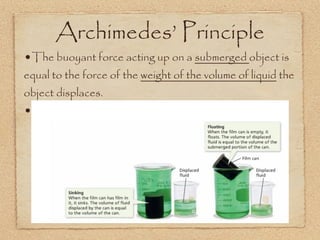
•The buoyant force acting up on a submerged object is
equal to the force of the weight of the volume of liquid the
object displaces.
•
Archimedes’ Principle
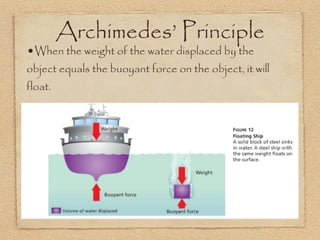
•When the weight of the water displaced by the
object equals the buoyant force on the object, it will
float.
Conversions
•Newtons = grams times 0.01N/g (for Archimedes’
lab p. 430)
•
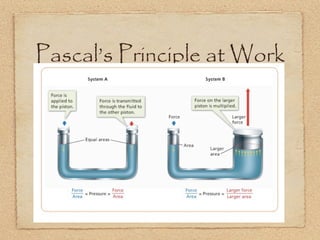
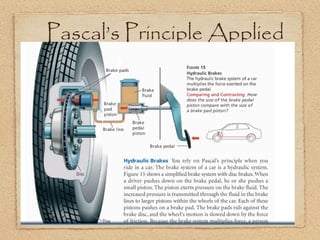
Pascal’s Principle
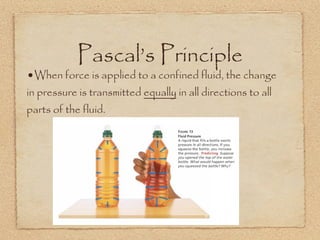
•When force is applied to a confined fluid, the change
in pressure is transmitted equally in all directions to all
parts of the fluid.
Pascal’s Principle at Work
Pascal’s Principle Applied
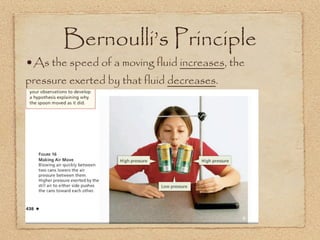
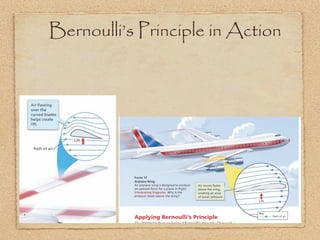
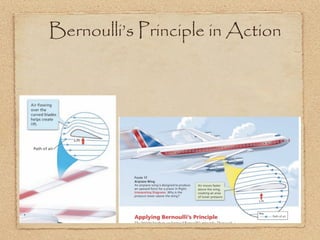
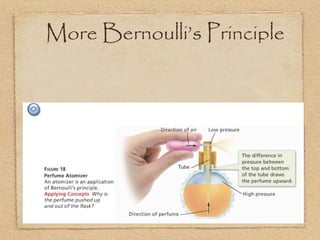
Bernoulli’s Principle
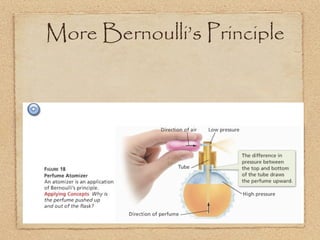
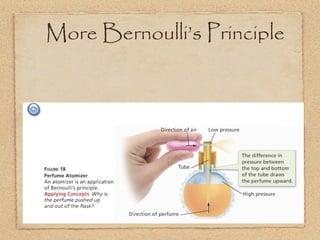
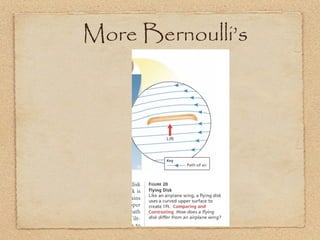
•As the speed of a moving fluid increases, the
pressure exerted by that fluid decreases.
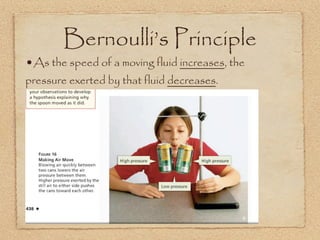
Bernoulli’s Principle
•As the speed of a moving fluid increases, the
pressure exerted by that fluid decreases.
Bernoulli’s Principle in Action
More Bernoulli’s Principle
More Bernoulli’s
Ch. 11; What to know
•Predict if an object will float or sink.
•Unbalanced forces produce motion.
•Boyle’s Law; Increased pressure decreases volume.
•Charle’s Law; Increased temperature increases volume.
•Archimedes Principle; Buoyant force equals weight of
the volume of water displaced.
•Pascal’s Principle; Pressure in confined fluid
exerted equally in all direction.
•Bernoulli’s Principle; Increase in speed of fluid
decreases pressure exerted by that fluid.