PHYSICS
CLASS : VII
Chapter-2
FORCE AND PRESSURE
: MOTION
CONCEPTS IN MODULE
 Introduction
 Rest and motion
 Types of motion
 Motion of a simple pendulum
 Scalar and vector quantity
 Distance and displacement
 Slow and fast motion
 Velocity
 Uniform and non uniform motion
 Acceleration
 Equation of motion of a body
 Mass and weight
 Glossary
 Evaluation
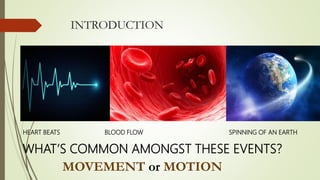
INTRODUCTION
HEART BEATS BLOOD FLOW SPINNING OF AN EARTH
WHAT’S COMMON AMONGST THESE EVENTS?
MOVEMENT or MOTION
IF THINGS STOPPED MOVING?
WHAT WOULD HAPPEN IF THE ASPECT OF MOVEMENT WAS
REMOVED FROM THESE EVENTS?
UNIMAGINABLE!!!
Example
 During the phase of traumatic event ?
Move on!!
Movement is life
Prove the phrase
MOTION : introduction
What are these people doing in common?
And
What is common in these events?
MOVING
OR
MOTION
Move with time
motion
MOTION
RELATED /COMPARED TO
“SOMETHING”
MOVING - MOTION
NOT MOVING – STATIONARY /REST
REST AND MOTION
RESTwhy do things
appear stationary to
us?
 A body is said to be at rest if it does not changes its position with respect to time and with
respect to its surroundings.
 Example: the passengers sitting in a moving bus are said to be at rest w.r.t to the driver of
the same bus.
Motion Is RELATIVE
MOTION
DRIVER’S
PERSPECTIVE
MAN’S PERSPECTIVE
 A body is said to be in MOTION when it changes its position with time w.r.t its surroundings.
 Example: The persons sitting in a car appears to be in motion w.r.t to an observer sitting outside the car.
The object or the thing with respect to which a body is observed as being at rest or motion are relative is known as reference
point.
Types of motion
Types of
motion
Translational
motion
Rotational
Motion
Periodic
motion
Oscillatory
Motion
Curvilinear
motion
Types of motion
Rectilinear
motion
TRANSLATORY MOTION
 In translational motion, a body moves along a straight line or a
smooth curve.
 It covers equal distance in equal interval of time .
 For example: a car moving in a straight line and a train moving along
a straight line also has translational motion
ROTATIONAL MOTION
 Rotational motion can be defined as a motion of an object around a circular
path, in a fixed orbit.
or
 The distance moved by different points on the object is not the same but all the
points complete the rotation in the same time.
PERIODIC MOTION
 If the motion of an object is repeated along the same path at regular
interval of time, such motion is called periodic motion.
 One complete round of motion of the object which is being repeated is
called a cycle.
 The time taken to complete one cycle is called time period.
 Examples:
OSCILLATORY MOTION
 When a body moves “to and fro” about a fixed point it is said
to be oscillatory motion
Difference between oscillatory and
periodic motion
Oscillatory motion
 Oscillatory motion is a to and fro
motion of an object.
 It is a continuous motion.
 All oscillatory motion is periodic.
 Example:
The motion of a pendulum
Periodic motion
 Periodic is a repeated motion of an
object at regular interval of time.
 It is a regular motion.
 Not all periodic motion is oscillatory.
 Example:
The motion of the wheels of a car.
A SIMPLE PENDULUM
A simple pendulum consist of a bob suspended by an inextensible or non-elastic thread
from a fixed point.
On displacing the bob through a small distance, we observe that it oscillates.
Thus , a pendulum passes through its position of rest after a fixed interval of time.
The force applied on the oscillating pendulum is always directed towards its mean
position.
Motion of a simple pendulum
1) Mean position: The rest position of a bob is called the mean position or equilibrium position.
2) Extreme position: The position at which the bob moves the maximum distance from the mean position is called extreme
position (A and C).
3) One cycle: when the pendulum moves from one extreme position (A) to the another extreme position (C) and back to the
mean position (B).
4) Amplitude: the maximum displacement made by a bob from the mean position to the extreme position . (BA and BC).
5) Frequency: The number of oscillations made by a pendulum in one second is called its frequency.
6) Time period: the time taken by a pendulum to complete one oscillation or one cycle.
(the time period varies with length of the string but do not vary with the mass of a bob or distance of a bob from the
mean position)
TERMS:
COMBINATION OF
MOTION In many situations, a body is in more than one type of motion. Thus, the body is said to exhibit
combination of motions.
EXAMPLES:
Movement of a ball wheel of a vehicle The earth’s motion around the
sun
A cricket ball undergoes
both translational and
rotational motion
Undergoes rotational
and translational
motion
Undergoes circular and
rotational motion
FACTORS AFFECTING THE TIME
PERIOD OF A PENDULUM
 Time period of a simple pendulum with fixed masses and varying length.
 Time period of a simple pendulum with fixed length and varying mass.
 Time period of a simple pendulum with bobs made of different materials.
 Variation of time period of a simple pendulum with varying acceleration due to gravity.
SCALAR AND VECTOR
QUANTITIY
Quantities that can be measured are known as physical quantities
Physical quantities are divided into:
 Scalar quantity
 Vector quantity
The physical quantity that have only magnitude
is called scalar quantity
The physical quantity that have both magnitude and
direction is called vector quantity
DISTANCE AND DISPLACEMENT
A
B
C
100M
100M
150M
(shortest path)
Distance: the total length/path covered by an object.
Displacement: the shortest path covered by an object in a particular direction.
NUMERICAL PROBLEMS
PREREQUISITE :
SLOW AND FAST MOTION
500 M
19 min
22 min
25min
 The time taken in covering a fixed distance helps us to decide whether a vehicle is moving faster
or slower than the rest of the vehicles.
VELOCITY
Velocity of a body is the displacement of a body in unit time in a given direction
Velocity is a vector quantity .
Velocity =
displacement
time
V= s
t
Where,
V= velocity
S= displacement
T= time taken
NEGATIVE VELOCITY
V= -45m/hr V=55km/hr
Bus B
Bus A
DIFFERENCE BETWEEN SPEED
AND VELOCITY
Speed
 Distance covered by a body in unit
time.
 It is scalar quantity.
 Speed of a moving body can never
be negative.
 The speed does not tell us the
direction of the moving object.
 Speed =distance
time
velocity
 It is a displacement of the body in
unit time.
 It is a vector quantity.
 Velocity of a moving body can be
negative , positive or zero.
 The velocity tells us the speed and
direction of the moving object.
 Velocity =displacement
time
NUMERICAL PROBLEMS
 Q1. A bus travels 90kms towards the
east in 1 hour and 30 minutes. What
would be the velocity of the vehicle?
Sol: displacement = 90kms
time: 1h + 30 min = 1+ 30
60
= 3/2 h
Velocity = displacement = 90
time 3/2
= 90 x 2
3
=60km/h
(towards east)
 Q2. It took 3.5 hours for a train to
travel the distance between two
cities at a velocity of 120km/h.
Sol: velocity = 120 km/hr
time = 3.5 h
distance = velocity x time
= 120 x 3.5
= 420 km
UNIFORM AND NON UNIFORM MOTION
UNIFORM MOTION
 A Body that covers equal distance in
equal intervals of time.
 The speed of the body is constant.
 Example:
1. the movement of the clock hands.
2. The movement of the car.
NON UNIFORM MOTION
 A body that covers unequal distances
in equal interval of time is said to be
non- uniform motion.
 The speed of the body is not
constant.
 Example:
1. The boy running
2. the ball bouncing.
ACCELERATION
Acceleration is the rate of change of velocity of an object in unit time.
Acceleration = change in velocity
Time
SI unit of acceleration is m/s2
Note: when an object starts from rest, initial velocity is zero (u = 0)
when a moving object comes to rest, its final velocity is zero (v= 0)
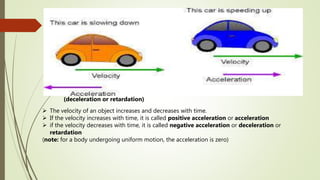
 The velocity of an object increases and decreases with time.
 If the velocity increases with time, it is called positive acceleration or acceleration
 if the velocity decreases with time, it is called negative acceleration or deceleration or
retardation
(note: for a body undergoing uniform motion, the acceleration is zero)
(deceleration or retardation)
EQUATION OF MOTION OF
A BODY
V= u+ at
Mass and weight
MASS
It measures the amount of matter present in a body.
 Does not vary from place to place.
 Mass is constant every where. Mass is a scalar quantity
F
OR EXAMPLE:
2 KG sugar 4 kg sugar
IN PHYSICS
SUGAR IS MATTER
OCCUPY SPACE
SOME MASS
SI unit of mass is Kg
MEASUREMENT OF MASS
BEAM BALANCE PHYSICAL BALANCE
 Measures the mass of an object.
 It has a horizontal metal rod supported by a
vertical rod.
 Two pans are hooked at the end of the horizontal
rod.
 To measure the mass of any object the standard
weight or gradation stones made of iron or
copper.
 Two pans stands horizontal when two pans have
 small masses of the order grams and
milligrams
 Used in laboratories.
 It has two pans with a fixed pointer fixed
in the middle of the horizontal rod.
 The pointer oscillates according to the
motion of the horizontal bar.
 The pointer helps to make the two pans
with equal masses.
WEIGHT
SI unit of weight is newton (N)
It is a vector quantity
Weight indicates how heavy an object is.
Weight depends on mass of the body and gravitational force of the earth.
W = mg
Acceleration due to gavity
 It is the increase of the velocity of a falling body under the influence of
gravitational force.
 Weight ∝ acceleration due to gravity
 Example:
The weight of any body on moon is less than that on Earth.
 Acceleration due to gravity o n Earth = 9.8 m/s2
The weight of an object of mass 1kg on earth = 1kg x 9.8 m/s2
= 9.8 N
acceleration due to gravity on moon is 1.6m/s2
MEASUREMENT OF WEIGHT
 Spring balance is used to measure the weight of
an object.
 It consist of a spring fixed to a metallic rod.
 The upper end is either fixed to a ceiling or held
by someone .
 The lower end has a hook attached to it.
 The object to be weight is hung to the hook.
 The more the weight the more the spring
stretches.
 The slit has a scale markings beside.
 The pointer moving against the scale marking
indicated the weight of an object.
SPRING BALANCE
force and pressure : motion

force and pressure : motion

  • 1.
  • 2.
    CONCEPTS IN MODULE Introduction  Rest and motion  Types of motion  Motion of a simple pendulum  Scalar and vector quantity  Distance and displacement  Slow and fast motion  Velocity  Uniform and non uniform motion  Acceleration  Equation of motion of a body  Mass and weight  Glossary  Evaluation
  • 3.
    INTRODUCTION HEART BEATS BLOODFLOW SPINNING OF AN EARTH WHAT’S COMMON AMONGST THESE EVENTS? MOVEMENT or MOTION
  • 4.
    IF THINGS STOPPEDMOVING? WHAT WOULD HAPPEN IF THE ASPECT OF MOVEMENT WAS REMOVED FROM THESE EVENTS? UNIMAGINABLE!!!
  • 5.
    Example  During thephase of traumatic event ? Move on!! Movement is life Prove the phrase
  • 6.
    MOTION : introduction Whatare these people doing in common? And What is common in these events?
  • 7.
  • 8.
  • 9.
    MOTION RELATED /COMPARED TO “SOMETHING” MOVING- MOTION NOT MOVING – STATIONARY /REST
  • 10.
  • 11.
    RESTwhy do things appearstationary to us?  A body is said to be at rest if it does not changes its position with respect to time and with respect to its surroundings.  Example: the passengers sitting in a moving bus are said to be at rest w.r.t to the driver of the same bus.
  • 12.
    Motion Is RELATIVE MOTION DRIVER’S PERSPECTIVE MAN’SPERSPECTIVE  A body is said to be in MOTION when it changes its position with time w.r.t its surroundings.  Example: The persons sitting in a car appears to be in motion w.r.t to an observer sitting outside the car. The object or the thing with respect to which a body is observed as being at rest or motion are relative is known as reference point.
  • 14.
  • 15.
  • 16.
    TRANSLATORY MOTION  Intranslational motion, a body moves along a straight line or a smooth curve.  It covers equal distance in equal interval of time .  For example: a car moving in a straight line and a train moving along a straight line also has translational motion
  • 19.
    ROTATIONAL MOTION  Rotationalmotion can be defined as a motion of an object around a circular path, in a fixed orbit. or  The distance moved by different points on the object is not the same but all the points complete the rotation in the same time.
  • 20.
    PERIODIC MOTION  Ifthe motion of an object is repeated along the same path at regular interval of time, such motion is called periodic motion.  One complete round of motion of the object which is being repeated is called a cycle.  The time taken to complete one cycle is called time period.  Examples:
  • 21.
    OSCILLATORY MOTION  Whena body moves “to and fro” about a fixed point it is said to be oscillatory motion
  • 22.
    Difference between oscillatoryand periodic motion Oscillatory motion  Oscillatory motion is a to and fro motion of an object.  It is a continuous motion.  All oscillatory motion is periodic.  Example: The motion of a pendulum Periodic motion  Periodic is a repeated motion of an object at regular interval of time.  It is a regular motion.  Not all periodic motion is oscillatory.  Example: The motion of the wheels of a car.
  • 23.
    A SIMPLE PENDULUM Asimple pendulum consist of a bob suspended by an inextensible or non-elastic thread from a fixed point. On displacing the bob through a small distance, we observe that it oscillates. Thus , a pendulum passes through its position of rest after a fixed interval of time. The force applied on the oscillating pendulum is always directed towards its mean position.
  • 24.
    Motion of asimple pendulum 1) Mean position: The rest position of a bob is called the mean position or equilibrium position. 2) Extreme position: The position at which the bob moves the maximum distance from the mean position is called extreme position (A and C). 3) One cycle: when the pendulum moves from one extreme position (A) to the another extreme position (C) and back to the mean position (B). 4) Amplitude: the maximum displacement made by a bob from the mean position to the extreme position . (BA and BC). 5) Frequency: The number of oscillations made by a pendulum in one second is called its frequency. 6) Time period: the time taken by a pendulum to complete one oscillation or one cycle. (the time period varies with length of the string but do not vary with the mass of a bob or distance of a bob from the mean position) TERMS:
  • 25.
    COMBINATION OF MOTION Inmany situations, a body is in more than one type of motion. Thus, the body is said to exhibit combination of motions. EXAMPLES: Movement of a ball wheel of a vehicle The earth’s motion around the sun A cricket ball undergoes both translational and rotational motion Undergoes rotational and translational motion Undergoes circular and rotational motion
  • 26.
    FACTORS AFFECTING THETIME PERIOD OF A PENDULUM  Time period of a simple pendulum with fixed masses and varying length.  Time period of a simple pendulum with fixed length and varying mass.  Time period of a simple pendulum with bobs made of different materials.  Variation of time period of a simple pendulum with varying acceleration due to gravity.
  • 27.
    SCALAR AND VECTOR QUANTITIY Quantitiesthat can be measured are known as physical quantities Physical quantities are divided into:  Scalar quantity  Vector quantity The physical quantity that have only magnitude is called scalar quantity The physical quantity that have both magnitude and direction is called vector quantity
  • 28.
  • 29.
    A B C 100M 100M 150M (shortest path) Distance: thetotal length/path covered by an object. Displacement: the shortest path covered by an object in a particular direction.
  • 32.
  • 33.
    SLOW AND FASTMOTION 500 M 19 min 22 min 25min  The time taken in covering a fixed distance helps us to decide whether a vehicle is moving faster or slower than the rest of the vehicles.
  • 34.
    VELOCITY Velocity of abody is the displacement of a body in unit time in a given direction Velocity is a vector quantity . Velocity = displacement time V= s t Where, V= velocity S= displacement T= time taken NEGATIVE VELOCITY V= -45m/hr V=55km/hr Bus B Bus A
  • 35.
    DIFFERENCE BETWEEN SPEED ANDVELOCITY Speed  Distance covered by a body in unit time.  It is scalar quantity.  Speed of a moving body can never be negative.  The speed does not tell us the direction of the moving object.  Speed =distance time velocity  It is a displacement of the body in unit time.  It is a vector quantity.  Velocity of a moving body can be negative , positive or zero.  The velocity tells us the speed and direction of the moving object.  Velocity =displacement time
  • 36.
    NUMERICAL PROBLEMS  Q1.A bus travels 90kms towards the east in 1 hour and 30 minutes. What would be the velocity of the vehicle? Sol: displacement = 90kms time: 1h + 30 min = 1+ 30 60 = 3/2 h Velocity = displacement = 90 time 3/2 = 90 x 2 3 =60km/h (towards east)  Q2. It took 3.5 hours for a train to travel the distance between two cities at a velocity of 120km/h. Sol: velocity = 120 km/hr time = 3.5 h distance = velocity x time = 120 x 3.5 = 420 km
  • 37.
    UNIFORM AND NONUNIFORM MOTION UNIFORM MOTION  A Body that covers equal distance in equal intervals of time.  The speed of the body is constant.  Example: 1. the movement of the clock hands. 2. The movement of the car. NON UNIFORM MOTION  A body that covers unequal distances in equal interval of time is said to be non- uniform motion.  The speed of the body is not constant.  Example: 1. The boy running 2. the ball bouncing.
  • 38.
    ACCELERATION Acceleration is therate of change of velocity of an object in unit time. Acceleration = change in velocity Time SI unit of acceleration is m/s2 Note: when an object starts from rest, initial velocity is zero (u = 0) when a moving object comes to rest, its final velocity is zero (v= 0)
  • 39.
     The velocityof an object increases and decreases with time.  If the velocity increases with time, it is called positive acceleration or acceleration  if the velocity decreases with time, it is called negative acceleration or deceleration or retardation (note: for a body undergoing uniform motion, the acceleration is zero) (deceleration or retardation)
  • 40.
    EQUATION OF MOTIONOF A BODY V= u+ at
  • 41.
    Mass and weight MASS Itmeasures the amount of matter present in a body.  Does not vary from place to place.  Mass is constant every where. Mass is a scalar quantity F OR EXAMPLE: 2 KG sugar 4 kg sugar IN PHYSICS SUGAR IS MATTER OCCUPY SPACE SOME MASS SI unit of mass is Kg
  • 42.
    MEASUREMENT OF MASS BEAMBALANCE PHYSICAL BALANCE  Measures the mass of an object.  It has a horizontal metal rod supported by a vertical rod.  Two pans are hooked at the end of the horizontal rod.  To measure the mass of any object the standard weight or gradation stones made of iron or copper.  Two pans stands horizontal when two pans have  small masses of the order grams and milligrams  Used in laboratories.  It has two pans with a fixed pointer fixed in the middle of the horizontal rod.  The pointer oscillates according to the motion of the horizontal bar.  The pointer helps to make the two pans with equal masses.
  • 43.
    WEIGHT SI unit ofweight is newton (N) It is a vector quantity Weight indicates how heavy an object is. Weight depends on mass of the body and gravitational force of the earth. W = mg
  • 44.
    Acceleration due togavity  It is the increase of the velocity of a falling body under the influence of gravitational force.  Weight ∝ acceleration due to gravity  Example: The weight of any body on moon is less than that on Earth.  Acceleration due to gravity o n Earth = 9.8 m/s2 The weight of an object of mass 1kg on earth = 1kg x 9.8 m/s2 = 9.8 N acceleration due to gravity on moon is 1.6m/s2
  • 45.
    MEASUREMENT OF WEIGHT Spring balance is used to measure the weight of an object.  It consist of a spring fixed to a metallic rod.  The upper end is either fixed to a ceiling or held by someone .  The lower end has a hook attached to it.  The object to be weight is hung to the hook.  The more the weight the more the spring stretches.  The slit has a scale markings beside.  The pointer moving against the scale marking indicated the weight of an object. SPRING BALANCE