Course: B.Sc CS.
Subject: Discrete Mathematics
Unit-1
RAI UNIVERSITY, AHMEDABAD
Unit-1 Successive Differentiation
 Review of Differentiation:
 The limit of incremental ratio. i.e. lim⁡
𝛿𝑦
𝛿𝑥
as ⁡𝛿𝑥 approaches zero is
called differential coefficient of 𝑦 with respect of 𝑥 and denoted by
𝑑𝑦
𝑑𝑥
.

𝑑𝑦
𝑑𝑥
=⁡ lim
𝛿𝑥→0
𝛿𝑦
𝛿𝑥

𝑑
𝑑𝑥
𝑓( 𝑥) = lim
𝛿𝑥→0
𝑓( 𝑥+⁡𝛿𝑥)−𝑓(𝑥)
⁡𝛿𝑥
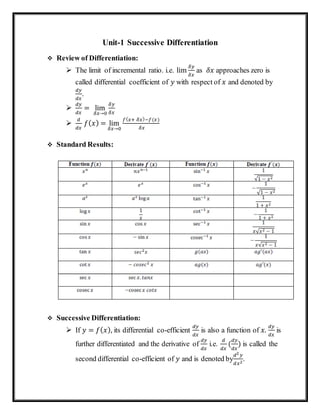
 Standard Results:
 Successive Differentiation:
 If 𝑦 = 𝑓( 𝑥), its differential co-efficient
𝑑𝑦
𝑑𝑥
is also a function of 𝑥.
𝑑𝑦
𝑑𝑥
is
further differentiated and the derivative of
𝑑𝑦
𝑑𝑥
i.e.
𝑑
𝑑𝑥
(
𝑑𝑦
𝑑𝑥
) is called the
second differential co-efficient of 𝑦 and is denoted by
𝑑2 𝑦
𝑑𝑥2
.
Similarly third differential coefficient of 𝑦 with respect to 𝑥 is written
as
𝑑3 𝑦
𝑑𝑥3
.
 Other notations of successivederivatives are
𝐷𝑦, 𝐷2
𝑦, 𝐷3
𝑦,………. . 𝐷 𝑛
𝑦 …… ……
𝑦1,⁡⁡⁡𝑦2,⁡⁡⁡⁡𝑦3, ………..⁡⁡𝑦𝑛⁡ ……………..
𝑦′
, 𝑦′′
,⁡𝑦′′′
,……… 𝑦 𝑛
…………….
Thus
𝑑 𝑛 𝑦
𝑑𝑥 𝑛
is 𝑛𝑡ℎ⁡derivative of 𝑦 with respectto 𝑥.
 Example-1. Find the value of
𝒅 𝟑 𝒚
𝒅𝒙 𝟑
if 𝒚 = 𝐥𝐨𝐠⁡( 𝒂𝒙 + 𝒃)
Solution: Here we have 𝑦 = log⁡( 𝑎𝑥 + 𝑏)

𝑑𝑦
𝑑𝑥
=
𝑎
𝑎𝑥+𝑏
 Differentiating it again, we get

𝑑2 𝑦
𝑑𝑥2
=
−𝑎2
( 𝑎𝑥+𝑏)2
 Similarly, ⁡
𝑑3 𝑦
𝑑𝑥3
=
2𝑎3
( 𝑎𝑥+𝑏)3
 𝒏𝒕𝒉 Derivative of 𝒙 𝒎
:
 Let 𝑦 = 𝑥 𝑚
 𝑦1 = 𝑚𝑥 𝑚−1
 𝑦2 = 𝑚( 𝑚 − 1) 𝑥 𝑚−2
 𝑦3 = 𝑚( 𝑚 − 1)( 𝑚 − 2) 𝑥 𝑚−3
 ………………………………………………………..
 …………………………………………………………
 𝑦𝑛 = [ 𝑚( 𝑚 − 1)( 𝑚 − 2)… …up⁡to⁡n⁡factors]⁡× 𝑥 𝑚−𝑛
 𝒚 𝒏 = 𝒎( 𝒎− 𝟏)( 𝒎 − 𝟐) ……………( 𝒎 − 𝒏 + 𝟏) 𝒙 𝒎−𝒏
where 𝒎 <
𝑛
 Example-1. Find the 𝟏𝟎𝒕𝒉 derivative of 𝒙 𝟏𝟐
.
Solution: let 𝑦 = 𝑥12
 𝑦10 = 12 × 11 × 10× ………× 3 × 𝑥2
Note : If m be Positive integer and if 𝑚 = 𝑛 then
𝑑 𝑚
𝑑𝑥 𝑚
𝑥 𝑚
= 𝑚!
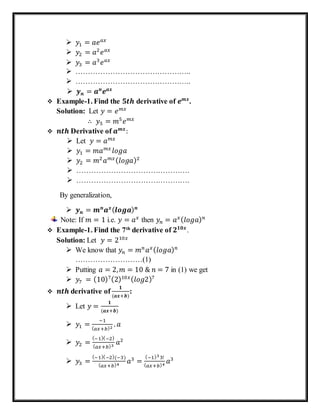
 𝒏𝒕𝒉⁡Derivative of 𝒆 𝒂𝒙
:
 𝑦 = 𝑒 𝑎𝑥
 𝑦1 = 𝑎𝑒 𝑎𝑥
 𝑦2 = 𝑎2
𝑒 𝑎𝑥
 𝑦3 = 𝑎3
𝑒 𝑎𝑥
 ………………………………………..
 ………………………………………..
 𝒚 𝒏 = 𝒂 𝒏
𝒆 𝒂𝒙
 Example-1. Find the 𝟓𝒕𝒉 derivative of⁡𝒆 𝒎𝒙
.
Solution: Let 𝑦 = 𝑒 𝑚𝑥
∴ 𝑦5 = 𝑚5
𝑒 𝑚𝑥
 𝒏𝒕𝒉⁡Derivative of 𝒂 𝒎𝒙
:
 Let 𝑦 = 𝑎 𝑚𝑥
 𝑦1 = 𝑚𝑎 𝑚𝑥
𝑙𝑜𝑔𝑎⁡
 𝑦2 = 𝑚2
𝑎 𝑚𝑥( 𝑙𝑜𝑔𝑎)2
 ……………………………………….
 ……………………………………….
By generalization,
 𝒚 𝒏 = 𝒎 𝒏
𝒂 𝒙(𝒍𝒐𝒈𝒂) 𝒏
Note: If 𝑚 = 1 i.e. 𝑦 = 𝑎 𝑥
then 𝑦𝑛 = 𝑎 𝑥( 𝑙𝑜𝑔𝑎) 𝑛
 Example-1. Find the 7th
derivative of 𝟐 𝟏𝟎𝒙
.
Solution: Let 𝑦 = 210𝑥
 We know that 𝑦𝑛 = 𝑚 𝑛
𝑎 𝑥( 𝑙𝑜𝑔𝑎) 𝑛
………………………(1)
 Putting 𝑎 = 2, 𝑚 = 10⁡&⁡𝑛 = 7 in (1) we get
 𝑦7⁡ = (10)7(2)10𝑥( 𝑙𝑜𝑔2)7
 𝒏𝒕𝒉⁡derivative of
𝟏
(𝒂𝒙+𝒃)
:
 Let 𝑦 =
𝟏
(𝒂𝒙+𝒃)
 𝑦1 =
−1
( 𝑎𝑥+𝑏)2
. 𝑎
 𝑦2 =
(−1)(−2)
( 𝑎𝑥+𝑏)3
𝑎2
 𝑦3 =
(−1)(−2)(−3)
( 𝑎𝑥+𝑏)4
𝑎3
=
(−1)33!
( 𝑎𝑥+𝑏)4
𝑎3
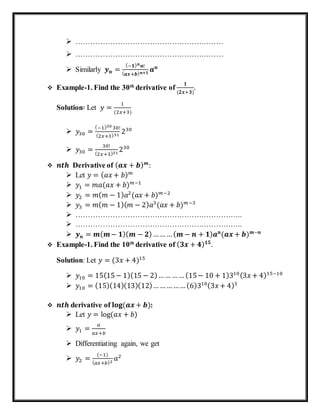
 ……………………………………………………
 ……………………………………………………
 Similarly 𝒚 𝒏 =
(−𝟏) 𝒏 𝒏!
( 𝒂𝒙+𝒃) 𝒏+𝟏
𝒂 𝒏
 Example-1. Find the 30th
derivative of
𝟏
(𝟐𝒙+𝟑)
.
Solution∶ Let ⁡𝑦 =
1
(2𝑥+3)
 𝑦30 =
(−1)30⁡30!
(2𝑥+3)31
230
 𝑦30 =
30!
(2𝑥+3)31
230
 𝒏𝒕𝒉⁡ Derivative of ( 𝒂𝒙 + 𝒃) 𝒎
:
 Let 𝑦 = ( 𝑎𝑥 + 𝑏) 𝑚
 𝑦1 = 𝑚𝑎(𝑎𝑥 + 𝑏) 𝑚−1
 𝑦2 = 𝑚( 𝑚 − 1) 𝑎2
(𝑎𝑥 + 𝑏) 𝑚−2
 𝑦3 = 𝑚( 𝑚 − 1)( 𝑚 − 2) 𝑎3
(𝑎𝑥 + 𝑏) 𝑚−3
 …………………………………………………………..
 …………………………………………………………..
 𝒚 𝒏 = 𝒎( 𝒎− 𝟏)( 𝒎 − 𝟐) ………( 𝒎 − 𝒏 + 𝟏) 𝒂 𝒏
(𝒂𝒙 + 𝒃) 𝒎−𝒏
 Example-1. Find the 10th
derivative of ( 𝟑𝒙 + 𝟒) 𝟏𝟓
.
Solution: Let 𝑦 = (3𝑥 + 4)15
 𝑦10 = 15(15− 1)(15 − 2)…… ……(15− 10 + 1)310(3𝑥 + 4)15−10
 𝑦10 = (15)(14)(13)(12)……………(6)310(3𝑥 + 4)5
 𝒏𝒕𝒉⁡derivative of 𝐥𝐨𝐠⁡( 𝒂𝒙 + 𝒃):
 Let 𝑦 = log⁡( 𝑎𝑥 + 𝑏)
 𝑦1 =
𝑎
𝑎𝑥+𝑏
 Differentiating again, we get
 𝑦2 =
(−1)
( 𝑎𝑥+𝑏)2
𝑎2
 𝑦3 =
(−1)(−2)
( 𝑎𝑥+𝑏)3
𝑎3
 𝑦4 =
(−1)(−2)(−3)
( 𝑎𝑥+𝑏)4
𝑎4
 ………………………………………………………………….
 ………………………………………………………………….
 𝑦𝑛 =
(−1)(−2)(−3)…(−𝑛+1)
( 𝑎𝑥+𝑏) 𝑛
𝑎 𝑛
 𝑦𝑛 =
(−1) 𝑛−11.2.3….(𝑛−1)
( 𝑎𝑥+𝑏) 𝑛
𝑎 𝑛
 𝒚 𝒏 =
(−𝟏) 𝒏−𝟏(𝒏−𝟏)!
( 𝒂𝒙+𝒃) 𝒏
𝒂 𝒏
 Example: 1. Find the 9th
derivative of⁡⁡𝒍𝒐𝒈(𝟓𝒙 + 𝟕).
Solution: Let 𝑦 = log(5𝑥 + 7)
 𝑦9 =
(−1)9−1(9−1)!
(5𝑥+7)9
59
 𝑦9 =
8!⁡59
(5𝑥+7)9
 𝒏𝒕𝒉 derivative of 𝐬𝐢𝐧( 𝒂𝒙 + 𝒃):
 Let 𝑦 = 𝑠𝑖𝑛(𝑎𝑥 + 𝑏)
 𝑦1 = ⁡𝑎𝑐𝑜𝑠(𝑎𝑥 + 𝑏) = 𝑎𝑠𝑖𝑛⁡( 𝑎𝑥 + 𝑏 +
𝜋
2
)
 𝑦2 = 𝑎2
cos (𝑎𝑥 + 𝑏 +
𝜋
2
) = 𝑎2
sin⁡( 𝑎𝑥 + 𝑏 +
2𝜋
2
)
 ………………………………………………………………………….
.
 ………………………………………………………………………….
.
 𝒚 𝒏 = 𝒂 𝒏
𝐬𝐢𝐧⁡( 𝒂𝒙 + 𝒃 +
𝒏𝝅
𝟐
)
 Similarly 𝒏𝒕𝒉 derivative of 𝒄𝒐𝒔( 𝒂𝒙 + 𝒃):
 𝒚 𝒏 = 𝒂 𝒏
𝒄𝒐𝒔(𝒂𝒙 + 𝒃 +
𝒏𝝅
𝟐
)
 Example-1. If⁡𝒚 = 𝒔𝒊𝒏𝟐𝒙𝒔𝒊𝒏𝟑𝒙, find⁡𝒚 𝒏.
 Here, we have 𝑦 = 𝑠𝑖𝑛2𝑥. 𝑠𝑖𝑛3𝑥
 𝑦 =
1
2
[2𝑠𝑖𝑛3𝑥𝑠𝑖𝑛2𝑥]
 𝑦 =
1
2
[𝑐𝑜𝑠𝑥 − 𝑐𝑜𝑠5𝑥]
 Differentiating 𝑛 times, we get
 𝑦𝑛 =
1
2
[
𝑑 𝑛
𝑑𝑥 𝑛
𝑐𝑜𝑠𝑥 −
𝑑 𝑛
𝑑𝑥 𝑛
𝑐𝑜𝑠5𝑥]
 𝑦𝑛 =
1
2
[𝑐𝑜𝑠(𝑥 +
𝑛𝜋
2
) − 5 𝑛
𝑐𝑜𝑠(5𝑥 +
𝑛𝜋
2
)]
 Example-2. If 𝒚 = 𝐬𝐢𝐧 𝟐
𝒙 𝐜𝐨𝐬 𝟑
𝒙 find⁡𝒚 𝒏.
Solution: Here we have
 𝑦 = 𝑠𝑖𝑛2
𝑥. 𝑐𝑜𝑠3
𝑥
 𝑦 = 𝑠𝑖𝑛2
𝑥. 𝑐𝑜𝑠2
𝑥. 𝑐𝑜𝑠𝑥⁡ (2𝑠𝑖𝑛𝑥. 𝑐𝑜𝑠𝑥 = 𝑠𝑖𝑛2𝑥)
 𝑦 =
1
4
( 𝑠𝑖𝑛2𝑥)2
𝑐𝑜𝑠𝑥 (sin2
2𝑥 =
1−𝑐𝑜𝑠4𝑥
2
)
 𝑦 =
1
8
(2 𝑠𝑖𝑛2
2𝑥)𝑐𝑜𝑠𝑥
 𝑦 =
1
8
(1 − 𝑐𝑜𝑠4𝑥) 𝑐𝑜𝑠𝑥
 𝑦 =
1
8
(𝑐𝑜𝑠𝑥 − 𝑐𝑜𝑠4𝑥. 𝑐𝑜𝑠𝑥)
 𝑦 =
1
8
( 𝑐𝑜𝑠𝑥) −
1
16
(2𝑐𝑜𝑠4𝑥. 𝑐𝑜𝑠𝑥)
 𝑦 =
1
8
𝑐𝑜𝑠𝑥 −
1
16
[𝑐𝑜𝑠5𝑥 + 𝑐𝑜𝑠3𝑥] ⁡⁡⁡⁡⁡⁡[∵ 2𝑐𝑜𝑠𝐴𝑐𝑜𝑠𝐵 = cos( 𝐴 + 𝐵) +
⁡⁡⁡⁡⁡⁡⁡⁡⁡⁡⁡⁡⁡⁡⁡⁡⁡⁡⁡⁡⁡⁡⁡⁡⁡⁡⁡⁡⁡⁡⁡⁡⁡⁡⁡⁡⁡⁡⁡⁡⁡⁡⁡⁡⁡⁡⁡⁡⁡⁡⁡⁡⁡⁡⁡⁡⁡⁡⁡⁡⁡⁡⁡⁡⁡⁡⁡⁡⁡⁡⁡⁡⁡⁡cos( 𝐴 − 𝐵)]
 Now Differentiating n times w.r.t. 𝑥 we get
 𝑦𝑛 =
1
8
cos (𝑥 +
𝑛𝜋
2
) −
1
16
5 𝑛
cos (5𝑥 +
𝑛𝜋
2
) −
1
16
. 3 𝑛
cos⁡(3𝑥 +
𝑛𝜋
2
)
 𝒏𝒕𝒉⁡derivative of 𝒆 𝒂𝒙
𝐬𝐢𝐧⁡( 𝒃𝒙 + 𝒄):
 Let 𝑦 = 𝑒 𝑎𝑥
𝑆𝑖𝑛(𝑏𝑥 + 𝑐)
 𝑦1 = 𝑎𝑒 𝑎𝑥
. sin( 𝑏𝑥 + 𝑐) + 𝑒 𝑎𝑥
. 𝑏cos( 𝑏𝑥 + 𝑐)
 𝑦1 = 𝑒 𝑎𝑥
[𝑎sin( 𝑏𝑥 + 𝑐) + 𝑏cos( 𝑏𝑥 + 𝑐)]
 𝑦1 = 𝑒 𝑎𝑥
[𝑟𝑐𝑜𝑠𝛼sin( 𝑏𝑥 + 𝑐) + 𝑟𝑠𝑖𝑛𝛼cos⁡( 𝑏𝑥 + 𝑐)]
 𝑦1 = 𝑒 𝑎𝑥
𝑟 sin( 𝑏𝑥 + 𝑐 + 𝛼)
 Similarly 𝑦2 = 𝑒 𝑎𝑥
𝑟2
sin( 𝑏𝑥 + 𝑐 + 2𝛼)
 …………………………………………………………………………………..
 …………………………………………………………………………………..
 𝑦𝑛 = 𝑒 𝑎𝑥
. 𝑟 𝑛
sin⁡( 𝑏𝑥 + 𝑐 + 𝑛𝛼)
Where 𝑟2
= 𝑎2
+ 𝑏2
and 𝑡𝑎𝑛𝛼 =
𝑏
𝑎
 Similarly if 𝒚 = 𝒆 𝒂𝒙
𝒄𝒐𝒔(𝒃𝒙 + 𝒄)
 𝒚 𝒏 = 𝒆 𝒂𝒙
. 𝒓 𝒏
. 𝒄𝒐𝒔(𝒃𝒙 + 𝒄 + 𝒏𝜶)
 Example: 1. Find the 𝒏𝒕𝒉 derivative of 𝒆 𝒙
. 𝐬𝐢𝐧 𝟑
𝒙
Solution: we have, 𝑦 = 𝑒 𝑥
sin3
𝑥
 We know that ,
 𝑠𝑖𝑛3𝑥 = 3𝑠𝑖𝑛𝑥 − 4sin3
𝑥
 ∴ 𝑆𝑖𝑛3
𝑥 =
1
4
[3𝑠𝑖𝑛𝑥 − 𝑠𝑖𝑛3𝑥]
 Let 𝑦 = 𝑒 𝑥
sin3
𝑥
 𝑦 = 𝑒 𝑥
.
1
4
[3𝑠𝑖𝑛𝑥 − 𝑠𝑖𝑛3𝑥]
 𝑦 =
3
4
𝑒 𝑥
𝑠𝑖𝑛𝑥 −
1
4
𝑒 𝑥
𝑠𝑖𝑛3𝑥
 Differentiating n times, we get
 𝑦𝑛 =
3
4
(12
+ 12)
𝑛
2. 𝑒 𝑥
sin (𝑥 + 𝑛𝑡𝑎𝑛−1 1
1
) −
1
4
(12
+ 32)
𝑛
2. 𝑒 𝑥
sin⁡[3𝑥 +
𝑛𝑡𝑎𝑛−1 3
1
]
 𝑦𝑛 =
3
4
2
𝑛
2 𝑒 𝑥
sin (𝑥 +
𝑛𝜋
4
) −
1
4
. 10
𝑛
2. 𝑒 𝑥
sin⁡(3𝑥 + 𝑛𝑡𝑎𝑛−1
3)
 Example: 2. Find the 𝒏𝒕𝒉 derivative of 𝒆 𝒂𝒙
. 𝒄𝒐𝒔 𝟐
𝒙. 𝒔𝒊𝒏𝒙
 𝑦 = 𝑒 𝑎𝑥
. 𝑐𝑜𝑠2
𝑥. 𝑠𝑖𝑛𝑥⁡
 𝑦 =
1
2
𝑒 𝑎𝑥 ( 𝑐𝑜𝑠2𝑥 + 1) 𝑠𝑖𝑛𝑥 (cos2
𝑥 =
1+𝑐𝑜𝑠2𝑥
2
)
 𝑦 =
1
2
𝑒 𝑎𝑥
. 𝑐𝑜𝑠2𝑥. 𝑠𝑖𝑛𝑥 +
1
2
𝑒 𝑎𝑥
𝑠𝑖𝑛𝑥
 𝑦 =
1
4
𝑒 𝑎𝑥 ( 𝑠𝑖𝑛3𝑥 − 𝑠𝑖𝑛𝑥) +
1
2
𝑒 𝑎𝑥
𝑠𝑖𝑛𝑥
{2𝑐𝑜𝑠𝐴𝑠𝑖𝑛𝐵 = 𝑆𝑖𝑛( 𝐴 + 𝐵) − 𝑆𝑖𝑛( 𝐴 − 𝐵)}
 𝑦 =
1
4
𝑒 𝑎𝑥
𝑠𝑖𝑛3𝑥 −
1
4
𝑒 𝑎𝑥
𝑠𝑖𝑛𝑥 +
1
2
𝑒 𝑎𝑥
𝑠𝑖𝑛𝑥
 𝑦 =
1
4
𝑒 𝑎𝑥
𝑠𝑖𝑛3𝑥 +
1
4
𝑒 𝑎𝑥
𝑠𝑖𝑛𝑥
 We know that
𝑑 𝑛
𝑑𝑥 𝑛
( 𝑒 𝑎𝑥
. 𝑠𝑖𝑛𝑏𝑥) = 𝑒 𝑎𝑥
. (𝑎2
+ 𝑏2
)
𝑛
2.sin⁡( 𝑏𝑥 +
𝑛 tan−1 𝑏
𝑎
)
 Thus,𝑦𝑛 =
1
4
( 𝑎2
+ 32)
𝑛
2 𝑒 𝑎𝑥
.sin⁡(3𝑥 + 𝑛 tan−1 3
𝑎
) +
1
4
( 𝑎2
+ 12)
𝑛
2 𝑒 𝑎𝑥
.
sin⁡( 𝑥 + 𝑛𝑡𝑎𝑛−1 1
𝑎
).
𝒏𝒕𝒉 derivative of function by using Partial Fraction:
 Example-1. If 𝒚 =
𝟏
𝟏−𝟓𝒙+𝟔𝒙 𝟐
⁡find 𝒚 𝒏.
Solution: Here, we have 𝑦 =
1
1−5𝑥+6𝑥2
 ∴ 𝑦 =
1
(2𝑥−1)(3𝑥−1)
 ∴
1
(2𝑥−1)(3𝑥−1)
=
𝐴
2𝑥−1
+
𝐵
3𝑥−1
 ∴ 1 = 𝐴(3𝑥 − 1) + 𝐵(2𝑥 − 1) -----------------------------------------(1)
 To find A and B
 we put first 𝑥 =
1
3
in equation (1) we get 𝐵 = −3
 we put 𝑥 =
1
2
in equation (1) we get 𝐴 = 2
 ∴
1
(2𝑥−1)(3𝑥−1)
=
2
2𝑥−1
−
3
3𝑥−1
 Differentiating n times ,we get 𝑦𝑛 = 2𝐷 𝑛
(
1
2𝑥−1
) − 3𝐷 𝑛
(
1
3𝑥−1
)
 𝑦𝑛 = 2[
(−1) 𝑛.𝑛!(2) 𝑛
(2𝑥−1) 𝑛+1
] − 3[
(−1) 𝑛 𝑛!(3) 𝑛
(3𝑥−1) 𝑛+1
]
 𝑦𝑛 = (−1) 𝑛
. 𝑛! [
2 𝑛+1
(2𝑥−1) 𝑛+1
−
3 𝑛+1
(3𝑥−1) 𝑛+1
]
 Example-2. If 𝒚 = 𝒙𝒍𝒐𝒈
𝒙−𝟏
𝒙+𝟏
, show that 𝒚 𝒏 = (−𝟏) 𝒏−𝟐( 𝒏 − 𝟐)![
𝒙−𝒏
( 𝒙−𝟏) 𝒏
−
𝒙+𝒏
( 𝒙+𝟏) 𝒏
]
Solution: Here, we have ⁡𝑦 = 𝑥𝑙𝑜𝑔
𝑥−1
𝑥+1
 𝑦 = 𝑥 [log( 𝑥 − 1) − log(𝑥 + 1)]
 Differentiating with respectto 𝑥 we get
 𝑦1 = 𝑥 (
1
𝑥−1
−
1
𝑥+1
) + log( 𝑥 − 1) − log( 𝑥 + 1)
 𝑦1 = (
𝑥
𝑥−1
−
𝑥
𝑥+1
) + log( 𝑥 − 1) − log( 𝑥 + 1)
 𝑦1 = 1 +
1
𝑥−1
− 1 +
1
𝑥+1
+ log( 𝑥 − 1) − log( 𝑥 + 1)
 𝑦1 =
1
𝑥−1
+
1
𝑥+1
+ log( 𝑥 − 1) − log( 𝑥 + 1)
 Again Differentiating ,(n-1) times with respectto ′𝑥′, we get
 𝑦𝑛 =
(−1) 𝑛−1(𝑛−1)!
( 𝑥−1) 𝑛
+
(−1) 𝑛−1(𝑛−1)!
( 𝑥+1) 𝑛
+
(−1) 𝑛−2(𝑛−2)!
( 𝑥−1) 𝑛−1
−
(−1) 𝑛−2(𝑛−2)!
( 𝑥+1) 𝑛−1
 𝑦𝑛 = (−1) 𝑛−2( 𝑛 − 2)![
(−1)( 𝑛−1)
( 𝑥−1) 𝑛
+
(−1)( 𝑛−1)
( 𝑥+1) 𝑛
+
𝑥−1
( 𝑥−1) 𝑛
−
𝑥+1
( 𝑥+1) 𝑛
]
 𝑦𝑛 = (−1) 𝑛−2( 𝑛 − 2)![
𝑥−𝑛
( 𝑥−1) 𝑛
−
𝑥+𝑛
( 𝑥+1) 𝑛
]
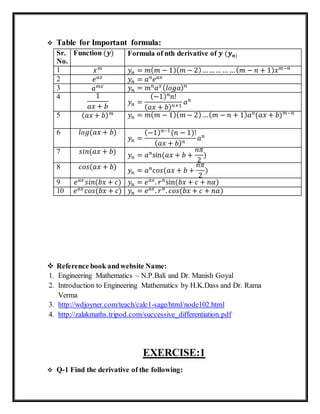
 Table for Important formula:
Sr.
No.
Function (𝒚) Formula of nth derivative of 𝒚 (𝒚 𝒏)
1 𝑥 𝑚
𝑦𝑛 = 𝑚( 𝑚 − 1)( 𝑚 − 2)………… …( 𝑚 − 𝑛 + 1) 𝑥 𝑚−𝑛
2 𝑒 𝑎𝑥
𝑦𝑛 = 𝑎 𝑛
𝑒 𝑎𝑥
3 𝑎 𝑚𝑥 𝑦𝑛 = 𝑚 𝑛
𝑎 𝑥 ( 𝑙𝑜𝑔𝑎) 𝑛
4 1
𝑎𝑥 + 𝑏
𝑦𝑛 =
(−1) 𝑛
𝑛!
( 𝑎𝑥 + 𝑏) 𝑛+1
𝑎 𝑛
5 ( 𝑎𝑥 + 𝑏) 𝑚 𝑦𝑛 = 𝑚( 𝑚 − 1)( 𝑚 − 2)…( 𝑚 − 𝑛 + 1) 𝑎 𝑛
(𝑎𝑥 + 𝑏) 𝑚−𝑛
6 𝑙𝑜𝑔(𝑎𝑥 + 𝑏)
𝑦𝑛 =
(−1) 𝑛−1
(𝑛 − 1)!
( 𝑎𝑥 + 𝑏) 𝑛
𝑎 𝑛
7 𝑠𝑖𝑛(𝑎𝑥 + 𝑏) 𝑦𝑛 = 𝑎 𝑛
sin⁡( 𝑎𝑥 + 𝑏 +
𝑛𝜋
2
)
8 𝑐𝑜𝑠(𝑎𝑥 + 𝑏) 𝑦𝑛 = 𝑎 𝑛
𝑐𝑜𝑠(𝑎𝑥 + 𝑏 +
𝑛𝜋
2
)
9 𝑒 𝑎𝑥
𝑠𝑖𝑛(𝑏𝑥 + 𝑐) 𝑦𝑛 = 𝑒 𝑎𝑥
. 𝑟 𝑛
sin⁡( 𝑏𝑥 + 𝑐 + 𝑛𝛼)
10 𝑒 𝑎𝑥
𝑐𝑜𝑠(𝑏𝑥 + 𝑐) 𝑦𝑛 = 𝑒 𝑎𝑥
. 𝑟 𝑛
. 𝑐𝑜𝑠(𝑏𝑥 + 𝑐 + 𝑛𝛼)
 Reference book andwebsite Name:
1. Engineering Mathematics – N.P.Bali and Dr. Manish Goyal
2. Introduction to Engineering Mathematics by H.K.Dass and Dr. Rama
Verma
3. http://wdjoyner.com/teach/calc1-sage/html/node102.html
4. http://zalakmaths.tripod.com/successive_differentiation.pdf
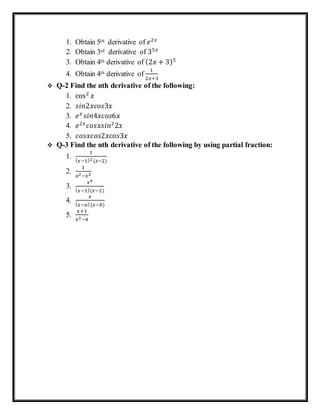
EXERCISE:1
 Q-1 Find the derivative of the following:
1. Obtain 5th ⁡derivative of 𝑒2𝑥
2. Obtain 3rd derivative of 35𝑥
3. Obtain 4th derivative of (2𝑥 + 3)5
4. Obtain 4th derivative of
1
2𝑥+3
 Q-2 Find the nth derivative of the following:
1. cos2
𝑥
2. 𝑠𝑖𝑛2𝑥𝑐𝑜𝑠3𝑥
3. 𝑒 𝑥
𝑠𝑖𝑛4𝑥𝑐𝑜𝑠6𝑥⁡
4. 𝑒2𝑥
𝑐𝑜𝑠𝑥𝑠𝑖𝑛2
2𝑥
5. 𝑐𝑜𝑠𝑥𝑐𝑜𝑠2𝑥𝑐𝑜𝑠3𝑥
 Q-3 Find the nth derivative of the following by using partial fraction:
1.
1
( 𝑥−1)2(𝑥−2)
2.
1
𝑎2−𝑥2
3.
𝑥4
( 𝑥−1)(𝑥−2)
4.
𝑥
( 𝑥−𝑎)(𝑥−𝑏)
5.
𝑥+1
𝑥2−4

BSC_Computer Science_Discrete Mathematics_Unit-I

  • 1.
    Course: B.Sc CS. Subject:Discrete Mathematics Unit-1 RAI UNIVERSITY, AHMEDABAD
  • 2.
    Unit-1 Successive Differentiation Review of Differentiation:  The limit of incremental ratio. i.e. lim⁡ 𝛿𝑦 𝛿𝑥 as ⁡𝛿𝑥 approaches zero is called differential coefficient of 𝑦 with respect of 𝑥 and denoted by 𝑑𝑦 𝑑𝑥 .  𝑑𝑦 𝑑𝑥 =⁡ lim 𝛿𝑥→0 𝛿𝑦 𝛿𝑥  𝑑 𝑑𝑥 𝑓( 𝑥) = lim 𝛿𝑥→0 𝑓( 𝑥+⁡𝛿𝑥)−𝑓(𝑥) ⁡𝛿𝑥  Standard Results:  Successive Differentiation:  If 𝑦 = 𝑓( 𝑥), its differential co-efficient 𝑑𝑦 𝑑𝑥 is also a function of 𝑥. 𝑑𝑦 𝑑𝑥 is further differentiated and the derivative of 𝑑𝑦 𝑑𝑥 i.e. 𝑑 𝑑𝑥 ( 𝑑𝑦 𝑑𝑥 ) is called the second differential co-efficient of 𝑦 and is denoted by 𝑑2 𝑦 𝑑𝑥2 .
  • 3.
    Similarly third differentialcoefficient of 𝑦 with respect to 𝑥 is written as 𝑑3 𝑦 𝑑𝑥3 .  Other notations of successivederivatives are 𝐷𝑦, 𝐷2 𝑦, 𝐷3 𝑦,………. . 𝐷 𝑛 𝑦 …… …… 𝑦1,⁡⁡⁡𝑦2,⁡⁡⁡⁡𝑦3, ………..⁡⁡𝑦𝑛⁡ …………….. 𝑦′ , 𝑦′′ ,⁡𝑦′′′ ,……… 𝑦 𝑛 ……………. Thus 𝑑 𝑛 𝑦 𝑑𝑥 𝑛 is 𝑛𝑡ℎ⁡derivative of 𝑦 with respectto 𝑥.  Example-1. Find the value of 𝒅 𝟑 𝒚 𝒅𝒙 𝟑 if 𝒚 = 𝐥𝐨𝐠⁡( 𝒂𝒙 + 𝒃) Solution: Here we have 𝑦 = log⁡( 𝑎𝑥 + 𝑏)  𝑑𝑦 𝑑𝑥 = 𝑎 𝑎𝑥+𝑏  Differentiating it again, we get  𝑑2 𝑦 𝑑𝑥2 = −𝑎2 ( 𝑎𝑥+𝑏)2  Similarly, ⁡ 𝑑3 𝑦 𝑑𝑥3 = 2𝑎3 ( 𝑎𝑥+𝑏)3  𝒏𝒕𝒉 Derivative of 𝒙 𝒎 :  Let 𝑦 = 𝑥 𝑚  𝑦1 = 𝑚𝑥 𝑚−1  𝑦2 = 𝑚( 𝑚 − 1) 𝑥 𝑚−2  𝑦3 = 𝑚( 𝑚 − 1)( 𝑚 − 2) 𝑥 𝑚−3  ………………………………………………………..  …………………………………………………………  𝑦𝑛 = [ 𝑚( 𝑚 − 1)( 𝑚 − 2)… …up⁡to⁡n⁡factors]⁡× 𝑥 𝑚−𝑛  𝒚 𝒏 = 𝒎( 𝒎− 𝟏)( 𝒎 − 𝟐) ……………( 𝒎 − 𝒏 + 𝟏) 𝒙 𝒎−𝒏 where 𝒎 < 𝑛  Example-1. Find the 𝟏𝟎𝒕𝒉 derivative of 𝒙 𝟏𝟐 . Solution: let 𝑦 = 𝑥12  𝑦10 = 12 × 11 × 10× ………× 3 × 𝑥2 Note : If m be Positive integer and if 𝑚 = 𝑛 then 𝑑 𝑚 𝑑𝑥 𝑚 𝑥 𝑚 = 𝑚!  𝒏𝒕𝒉⁡Derivative of 𝒆 𝒂𝒙 :  𝑦 = 𝑒 𝑎𝑥
  • 4.
     𝑦1 =𝑎𝑒 𝑎𝑥  𝑦2 = 𝑎2 𝑒 𝑎𝑥  𝑦3 = 𝑎3 𝑒 𝑎𝑥  ………………………………………..  ………………………………………..  𝒚 𝒏 = 𝒂 𝒏 𝒆 𝒂𝒙  Example-1. Find the 𝟓𝒕𝒉 derivative of⁡𝒆 𝒎𝒙 . Solution: Let 𝑦 = 𝑒 𝑚𝑥 ∴ 𝑦5 = 𝑚5 𝑒 𝑚𝑥  𝒏𝒕𝒉⁡Derivative of 𝒂 𝒎𝒙 :  Let 𝑦 = 𝑎 𝑚𝑥  𝑦1 = 𝑚𝑎 𝑚𝑥 𝑙𝑜𝑔𝑎⁡  𝑦2 = 𝑚2 𝑎 𝑚𝑥( 𝑙𝑜𝑔𝑎)2  ……………………………………….  ………………………………………. By generalization,  𝒚 𝒏 = 𝒎 𝒏 𝒂 𝒙(𝒍𝒐𝒈𝒂) 𝒏 Note: If 𝑚 = 1 i.e. 𝑦 = 𝑎 𝑥 then 𝑦𝑛 = 𝑎 𝑥( 𝑙𝑜𝑔𝑎) 𝑛  Example-1. Find the 7th derivative of 𝟐 𝟏𝟎𝒙 . Solution: Let 𝑦 = 210𝑥  We know that 𝑦𝑛 = 𝑚 𝑛 𝑎 𝑥( 𝑙𝑜𝑔𝑎) 𝑛 ………………………(1)  Putting 𝑎 = 2, 𝑚 = 10⁡&⁡𝑛 = 7 in (1) we get  𝑦7⁡ = (10)7(2)10𝑥( 𝑙𝑜𝑔2)7  𝒏𝒕𝒉⁡derivative of 𝟏 (𝒂𝒙+𝒃) :  Let 𝑦 = 𝟏 (𝒂𝒙+𝒃)  𝑦1 = −1 ( 𝑎𝑥+𝑏)2 . 𝑎  𝑦2 = (−1)(−2) ( 𝑎𝑥+𝑏)3 𝑎2  𝑦3 = (−1)(−2)(−3) ( 𝑎𝑥+𝑏)4 𝑎3 = (−1)33! ( 𝑎𝑥+𝑏)4 𝑎3
  • 5.
     ……………………………………………………  …………………………………………………… Similarly 𝒚 𝒏 = (−𝟏) 𝒏 𝒏! ( 𝒂𝒙+𝒃) 𝒏+𝟏 𝒂 𝒏  Example-1. Find the 30th derivative of 𝟏 (𝟐𝒙+𝟑) . Solution∶ Let ⁡𝑦 = 1 (2𝑥+3)  𝑦30 = (−1)30⁡30! (2𝑥+3)31 230  𝑦30 = 30! (2𝑥+3)31 230  𝒏𝒕𝒉⁡ Derivative of ( 𝒂𝒙 + 𝒃) 𝒎 :  Let 𝑦 = ( 𝑎𝑥 + 𝑏) 𝑚  𝑦1 = 𝑚𝑎(𝑎𝑥 + 𝑏) 𝑚−1  𝑦2 = 𝑚( 𝑚 − 1) 𝑎2 (𝑎𝑥 + 𝑏) 𝑚−2  𝑦3 = 𝑚( 𝑚 − 1)( 𝑚 − 2) 𝑎3 (𝑎𝑥 + 𝑏) 𝑚−3  …………………………………………………………..  …………………………………………………………..  𝒚 𝒏 = 𝒎( 𝒎− 𝟏)( 𝒎 − 𝟐) ………( 𝒎 − 𝒏 + 𝟏) 𝒂 𝒏 (𝒂𝒙 + 𝒃) 𝒎−𝒏  Example-1. Find the 10th derivative of ( 𝟑𝒙 + 𝟒) 𝟏𝟓 . Solution: Let 𝑦 = (3𝑥 + 4)15  𝑦10 = 15(15− 1)(15 − 2)…… ……(15− 10 + 1)310(3𝑥 + 4)15−10  𝑦10 = (15)(14)(13)(12)……………(6)310(3𝑥 + 4)5  𝒏𝒕𝒉⁡derivative of 𝐥𝐨𝐠⁡( 𝒂𝒙 + 𝒃):  Let 𝑦 = log⁡( 𝑎𝑥 + 𝑏)  𝑦1 = 𝑎 𝑎𝑥+𝑏  Differentiating again, we get  𝑦2 = (−1) ( 𝑎𝑥+𝑏)2 𝑎2
  • 6.
     𝑦3 = (−1)(−2) (𝑎𝑥+𝑏)3 𝑎3  𝑦4 = (−1)(−2)(−3) ( 𝑎𝑥+𝑏)4 𝑎4  ………………………………………………………………….  ………………………………………………………………….  𝑦𝑛 = (−1)(−2)(−3)…(−𝑛+1) ( 𝑎𝑥+𝑏) 𝑛 𝑎 𝑛  𝑦𝑛 = (−1) 𝑛−11.2.3….(𝑛−1) ( 𝑎𝑥+𝑏) 𝑛 𝑎 𝑛  𝒚 𝒏 = (−𝟏) 𝒏−𝟏(𝒏−𝟏)! ( 𝒂𝒙+𝒃) 𝒏 𝒂 𝒏  Example: 1. Find the 9th derivative of⁡⁡𝒍𝒐𝒈(𝟓𝒙 + 𝟕). Solution: Let 𝑦 = log(5𝑥 + 7)  𝑦9 = (−1)9−1(9−1)! (5𝑥+7)9 59  𝑦9 = 8!⁡59 (5𝑥+7)9  𝒏𝒕𝒉 derivative of 𝐬𝐢𝐧( 𝒂𝒙 + 𝒃):  Let 𝑦 = 𝑠𝑖𝑛(𝑎𝑥 + 𝑏)  𝑦1 = ⁡𝑎𝑐𝑜𝑠(𝑎𝑥 + 𝑏) = 𝑎𝑠𝑖𝑛⁡( 𝑎𝑥 + 𝑏 + 𝜋 2 )  𝑦2 = 𝑎2 cos (𝑎𝑥 + 𝑏 + 𝜋 2 ) = 𝑎2 sin⁡( 𝑎𝑥 + 𝑏 + 2𝜋 2 )  …………………………………………………………………………. .  …………………………………………………………………………. .  𝒚 𝒏 = 𝒂 𝒏 𝐬𝐢𝐧⁡( 𝒂𝒙 + 𝒃 + 𝒏𝝅 𝟐 )  Similarly 𝒏𝒕𝒉 derivative of 𝒄𝒐𝒔( 𝒂𝒙 + 𝒃):  𝒚 𝒏 = 𝒂 𝒏 𝒄𝒐𝒔(𝒂𝒙 + 𝒃 + 𝒏𝝅 𝟐 )  Example-1. If⁡𝒚 = 𝒔𝒊𝒏𝟐𝒙𝒔𝒊𝒏𝟑𝒙, find⁡𝒚 𝒏.  Here, we have 𝑦 = 𝑠𝑖𝑛2𝑥. 𝑠𝑖𝑛3𝑥  𝑦 = 1 2 [2𝑠𝑖𝑛3𝑥𝑠𝑖𝑛2𝑥]
  • 7.
     𝑦 = 1 2 [𝑐𝑜𝑠𝑥− 𝑐𝑜𝑠5𝑥]  Differentiating 𝑛 times, we get  𝑦𝑛 = 1 2 [ 𝑑 𝑛 𝑑𝑥 𝑛 𝑐𝑜𝑠𝑥 − 𝑑 𝑛 𝑑𝑥 𝑛 𝑐𝑜𝑠5𝑥]  𝑦𝑛 = 1 2 [𝑐𝑜𝑠(𝑥 + 𝑛𝜋 2 ) − 5 𝑛 𝑐𝑜𝑠(5𝑥 + 𝑛𝜋 2 )]  Example-2. If 𝒚 = 𝐬𝐢𝐧 𝟐 𝒙 𝐜𝐨𝐬 𝟑 𝒙 find⁡𝒚 𝒏. Solution: Here we have  𝑦 = 𝑠𝑖𝑛2 𝑥. 𝑐𝑜𝑠3 𝑥  𝑦 = 𝑠𝑖𝑛2 𝑥. 𝑐𝑜𝑠2 𝑥. 𝑐𝑜𝑠𝑥⁡ (2𝑠𝑖𝑛𝑥. 𝑐𝑜𝑠𝑥 = 𝑠𝑖𝑛2𝑥)  𝑦 = 1 4 ( 𝑠𝑖𝑛2𝑥)2 𝑐𝑜𝑠𝑥 (sin2 2𝑥 = 1−𝑐𝑜𝑠4𝑥 2 )  𝑦 = 1 8 (2 𝑠𝑖𝑛2 2𝑥)𝑐𝑜𝑠𝑥  𝑦 = 1 8 (1 − 𝑐𝑜𝑠4𝑥) 𝑐𝑜𝑠𝑥  𝑦 = 1 8 (𝑐𝑜𝑠𝑥 − 𝑐𝑜𝑠4𝑥. 𝑐𝑜𝑠𝑥)  𝑦 = 1 8 ( 𝑐𝑜𝑠𝑥) − 1 16 (2𝑐𝑜𝑠4𝑥. 𝑐𝑜𝑠𝑥)  𝑦 = 1 8 𝑐𝑜𝑠𝑥 − 1 16 [𝑐𝑜𝑠5𝑥 + 𝑐𝑜𝑠3𝑥] ⁡⁡⁡⁡⁡⁡[∵ 2𝑐𝑜𝑠𝐴𝑐𝑜𝑠𝐵 = cos( 𝐴 + 𝐵) + ⁡⁡⁡⁡⁡⁡⁡⁡⁡⁡⁡⁡⁡⁡⁡⁡⁡⁡⁡⁡⁡⁡⁡⁡⁡⁡⁡⁡⁡⁡⁡⁡⁡⁡⁡⁡⁡⁡⁡⁡⁡⁡⁡⁡⁡⁡⁡⁡⁡⁡⁡⁡⁡⁡⁡⁡⁡⁡⁡⁡⁡⁡⁡⁡⁡⁡⁡⁡⁡⁡⁡⁡⁡⁡cos( 𝐴 − 𝐵)]  Now Differentiating n times w.r.t. 𝑥 we get  𝑦𝑛 = 1 8 cos (𝑥 + 𝑛𝜋 2 ) − 1 16 5 𝑛 cos (5𝑥 + 𝑛𝜋 2 ) − 1 16 . 3 𝑛 cos⁡(3𝑥 + 𝑛𝜋 2 )  𝒏𝒕𝒉⁡derivative of 𝒆 𝒂𝒙 𝐬𝐢𝐧⁡( 𝒃𝒙 + 𝒄):  Let 𝑦 = 𝑒 𝑎𝑥 𝑆𝑖𝑛(𝑏𝑥 + 𝑐)  𝑦1 = 𝑎𝑒 𝑎𝑥 . sin( 𝑏𝑥 + 𝑐) + 𝑒 𝑎𝑥 . 𝑏cos( 𝑏𝑥 + 𝑐)  𝑦1 = 𝑒 𝑎𝑥 [𝑎sin( 𝑏𝑥 + 𝑐) + 𝑏cos( 𝑏𝑥 + 𝑐)]  𝑦1 = 𝑒 𝑎𝑥 [𝑟𝑐𝑜𝑠𝛼sin( 𝑏𝑥 + 𝑐) + 𝑟𝑠𝑖𝑛𝛼cos⁡( 𝑏𝑥 + 𝑐)]  𝑦1 = 𝑒 𝑎𝑥 𝑟 sin( 𝑏𝑥 + 𝑐 + 𝛼)  Similarly 𝑦2 = 𝑒 𝑎𝑥 𝑟2 sin( 𝑏𝑥 + 𝑐 + 2𝛼)
  • 8.
     …………………………………………………………………………………..  ………………………………………………………………………………….. 𝑦𝑛 = 𝑒 𝑎𝑥 . 𝑟 𝑛 sin⁡( 𝑏𝑥 + 𝑐 + 𝑛𝛼) Where 𝑟2 = 𝑎2 + 𝑏2 and 𝑡𝑎𝑛𝛼 = 𝑏 𝑎  Similarly if 𝒚 = 𝒆 𝒂𝒙 𝒄𝒐𝒔(𝒃𝒙 + 𝒄)  𝒚 𝒏 = 𝒆 𝒂𝒙 . 𝒓 𝒏 . 𝒄𝒐𝒔(𝒃𝒙 + 𝒄 + 𝒏𝜶)  Example: 1. Find the 𝒏𝒕𝒉 derivative of 𝒆 𝒙 . 𝐬𝐢𝐧 𝟑 𝒙 Solution: we have, 𝑦 = 𝑒 𝑥 sin3 𝑥  We know that ,  𝑠𝑖𝑛3𝑥 = 3𝑠𝑖𝑛𝑥 − 4sin3 𝑥  ∴ 𝑆𝑖𝑛3 𝑥 = 1 4 [3𝑠𝑖𝑛𝑥 − 𝑠𝑖𝑛3𝑥]  Let 𝑦 = 𝑒 𝑥 sin3 𝑥  𝑦 = 𝑒 𝑥 . 1 4 [3𝑠𝑖𝑛𝑥 − 𝑠𝑖𝑛3𝑥]  𝑦 = 3 4 𝑒 𝑥 𝑠𝑖𝑛𝑥 − 1 4 𝑒 𝑥 𝑠𝑖𝑛3𝑥  Differentiating n times, we get  𝑦𝑛 = 3 4 (12 + 12) 𝑛 2. 𝑒 𝑥 sin (𝑥 + 𝑛𝑡𝑎𝑛−1 1 1 ) − 1 4 (12 + 32) 𝑛 2. 𝑒 𝑥 sin⁡[3𝑥 + 𝑛𝑡𝑎𝑛−1 3 1 ]  𝑦𝑛 = 3 4 2 𝑛 2 𝑒 𝑥 sin (𝑥 + 𝑛𝜋 4 ) − 1 4 . 10 𝑛 2. 𝑒 𝑥 sin⁡(3𝑥 + 𝑛𝑡𝑎𝑛−1 3)  Example: 2. Find the 𝒏𝒕𝒉 derivative of 𝒆 𝒂𝒙 . 𝒄𝒐𝒔 𝟐 𝒙. 𝒔𝒊𝒏𝒙  𝑦 = 𝑒 𝑎𝑥 . 𝑐𝑜𝑠2 𝑥. 𝑠𝑖𝑛𝑥⁡  𝑦 = 1 2 𝑒 𝑎𝑥 ( 𝑐𝑜𝑠2𝑥 + 1) 𝑠𝑖𝑛𝑥 (cos2 𝑥 = 1+𝑐𝑜𝑠2𝑥 2 )  𝑦 = 1 2 𝑒 𝑎𝑥 . 𝑐𝑜𝑠2𝑥. 𝑠𝑖𝑛𝑥 + 1 2 𝑒 𝑎𝑥 𝑠𝑖𝑛𝑥  𝑦 = 1 4 𝑒 𝑎𝑥 ( 𝑠𝑖𝑛3𝑥 − 𝑠𝑖𝑛𝑥) + 1 2 𝑒 𝑎𝑥 𝑠𝑖𝑛𝑥
  • 9.
    {2𝑐𝑜𝑠𝐴𝑠𝑖𝑛𝐵 = 𝑆𝑖𝑛(𝐴 + 𝐵) − 𝑆𝑖𝑛( 𝐴 − 𝐵)}  𝑦 = 1 4 𝑒 𝑎𝑥 𝑠𝑖𝑛3𝑥 − 1 4 𝑒 𝑎𝑥 𝑠𝑖𝑛𝑥 + 1 2 𝑒 𝑎𝑥 𝑠𝑖𝑛𝑥  𝑦 = 1 4 𝑒 𝑎𝑥 𝑠𝑖𝑛3𝑥 + 1 4 𝑒 𝑎𝑥 𝑠𝑖𝑛𝑥  We know that 𝑑 𝑛 𝑑𝑥 𝑛 ( 𝑒 𝑎𝑥 . 𝑠𝑖𝑛𝑏𝑥) = 𝑒 𝑎𝑥 . (𝑎2 + 𝑏2 ) 𝑛 2.sin⁡( 𝑏𝑥 + 𝑛 tan−1 𝑏 𝑎 )  Thus,𝑦𝑛 = 1 4 ( 𝑎2 + 32) 𝑛 2 𝑒 𝑎𝑥 .sin⁡(3𝑥 + 𝑛 tan−1 3 𝑎 ) + 1 4 ( 𝑎2 + 12) 𝑛 2 𝑒 𝑎𝑥 . sin⁡( 𝑥 + 𝑛𝑡𝑎𝑛−1 1 𝑎 ). 𝒏𝒕𝒉 derivative of function by using Partial Fraction:  Example-1. If 𝒚 = 𝟏 𝟏−𝟓𝒙+𝟔𝒙 𝟐 ⁡find 𝒚 𝒏. Solution: Here, we have 𝑦 = 1 1−5𝑥+6𝑥2  ∴ 𝑦 = 1 (2𝑥−1)(3𝑥−1)  ∴ 1 (2𝑥−1)(3𝑥−1) = 𝐴 2𝑥−1 + 𝐵 3𝑥−1  ∴ 1 = 𝐴(3𝑥 − 1) + 𝐵(2𝑥 − 1) -----------------------------------------(1)  To find A and B  we put first 𝑥 = 1 3 in equation (1) we get 𝐵 = −3  we put 𝑥 = 1 2 in equation (1) we get 𝐴 = 2  ∴ 1 (2𝑥−1)(3𝑥−1) = 2 2𝑥−1 − 3 3𝑥−1  Differentiating n times ,we get 𝑦𝑛 = 2𝐷 𝑛 ( 1 2𝑥−1 ) − 3𝐷 𝑛 ( 1 3𝑥−1 )  𝑦𝑛 = 2[ (−1) 𝑛.𝑛!(2) 𝑛 (2𝑥−1) 𝑛+1 ] − 3[ (−1) 𝑛 𝑛!(3) 𝑛 (3𝑥−1) 𝑛+1 ]  𝑦𝑛 = (−1) 𝑛 . 𝑛! [ 2 𝑛+1 (2𝑥−1) 𝑛+1 − 3 𝑛+1 (3𝑥−1) 𝑛+1 ]
  • 10.
     Example-2. If𝒚 = 𝒙𝒍𝒐𝒈 𝒙−𝟏 𝒙+𝟏 , show that 𝒚 𝒏 = (−𝟏) 𝒏−𝟐( 𝒏 − 𝟐)![ 𝒙−𝒏 ( 𝒙−𝟏) 𝒏 − 𝒙+𝒏 ( 𝒙+𝟏) 𝒏 ] Solution: Here, we have ⁡𝑦 = 𝑥𝑙𝑜𝑔 𝑥−1 𝑥+1  𝑦 = 𝑥 [log( 𝑥 − 1) − log(𝑥 + 1)]  Differentiating with respectto 𝑥 we get  𝑦1 = 𝑥 ( 1 𝑥−1 − 1 𝑥+1 ) + log( 𝑥 − 1) − log( 𝑥 + 1)  𝑦1 = ( 𝑥 𝑥−1 − 𝑥 𝑥+1 ) + log( 𝑥 − 1) − log( 𝑥 + 1)  𝑦1 = 1 + 1 𝑥−1 − 1 + 1 𝑥+1 + log( 𝑥 − 1) − log( 𝑥 + 1)  𝑦1 = 1 𝑥−1 + 1 𝑥+1 + log( 𝑥 − 1) − log( 𝑥 + 1)  Again Differentiating ,(n-1) times with respectto ′𝑥′, we get  𝑦𝑛 = (−1) 𝑛−1(𝑛−1)! ( 𝑥−1) 𝑛 + (−1) 𝑛−1(𝑛−1)! ( 𝑥+1) 𝑛 + (−1) 𝑛−2(𝑛−2)! ( 𝑥−1) 𝑛−1 − (−1) 𝑛−2(𝑛−2)! ( 𝑥+1) 𝑛−1  𝑦𝑛 = (−1) 𝑛−2( 𝑛 − 2)![ (−1)( 𝑛−1) ( 𝑥−1) 𝑛 + (−1)( 𝑛−1) ( 𝑥+1) 𝑛 + 𝑥−1 ( 𝑥−1) 𝑛 − 𝑥+1 ( 𝑥+1) 𝑛 ]  𝑦𝑛 = (−1) 𝑛−2( 𝑛 − 2)![ 𝑥−𝑛 ( 𝑥−1) 𝑛 − 𝑥+𝑛 ( 𝑥+1) 𝑛 ]
  • 11.
     Table forImportant formula: Sr. No. Function (𝒚) Formula of nth derivative of 𝒚 (𝒚 𝒏) 1 𝑥 𝑚 𝑦𝑛 = 𝑚( 𝑚 − 1)( 𝑚 − 2)………… …( 𝑚 − 𝑛 + 1) 𝑥 𝑚−𝑛 2 𝑒 𝑎𝑥 𝑦𝑛 = 𝑎 𝑛 𝑒 𝑎𝑥 3 𝑎 𝑚𝑥 𝑦𝑛 = 𝑚 𝑛 𝑎 𝑥 ( 𝑙𝑜𝑔𝑎) 𝑛 4 1 𝑎𝑥 + 𝑏 𝑦𝑛 = (−1) 𝑛 𝑛! ( 𝑎𝑥 + 𝑏) 𝑛+1 𝑎 𝑛 5 ( 𝑎𝑥 + 𝑏) 𝑚 𝑦𝑛 = 𝑚( 𝑚 − 1)( 𝑚 − 2)…( 𝑚 − 𝑛 + 1) 𝑎 𝑛 (𝑎𝑥 + 𝑏) 𝑚−𝑛 6 𝑙𝑜𝑔(𝑎𝑥 + 𝑏) 𝑦𝑛 = (−1) 𝑛−1 (𝑛 − 1)! ( 𝑎𝑥 + 𝑏) 𝑛 𝑎 𝑛 7 𝑠𝑖𝑛(𝑎𝑥 + 𝑏) 𝑦𝑛 = 𝑎 𝑛 sin⁡( 𝑎𝑥 + 𝑏 + 𝑛𝜋 2 ) 8 𝑐𝑜𝑠(𝑎𝑥 + 𝑏) 𝑦𝑛 = 𝑎 𝑛 𝑐𝑜𝑠(𝑎𝑥 + 𝑏 + 𝑛𝜋 2 ) 9 𝑒 𝑎𝑥 𝑠𝑖𝑛(𝑏𝑥 + 𝑐) 𝑦𝑛 = 𝑒 𝑎𝑥 . 𝑟 𝑛 sin⁡( 𝑏𝑥 + 𝑐 + 𝑛𝛼) 10 𝑒 𝑎𝑥 𝑐𝑜𝑠(𝑏𝑥 + 𝑐) 𝑦𝑛 = 𝑒 𝑎𝑥 . 𝑟 𝑛 . 𝑐𝑜𝑠(𝑏𝑥 + 𝑐 + 𝑛𝛼)  Reference book andwebsite Name: 1. Engineering Mathematics – N.P.Bali and Dr. Manish Goyal 2. Introduction to Engineering Mathematics by H.K.Dass and Dr. Rama Verma 3. http://wdjoyner.com/teach/calc1-sage/html/node102.html 4. http://zalakmaths.tripod.com/successive_differentiation.pdf EXERCISE:1  Q-1 Find the derivative of the following:
  • 12.
    1. Obtain 5th⁡derivative of 𝑒2𝑥 2. Obtain 3rd derivative of 35𝑥 3. Obtain 4th derivative of (2𝑥 + 3)5 4. Obtain 4th derivative of 1 2𝑥+3  Q-2 Find the nth derivative of the following: 1. cos2 𝑥 2. 𝑠𝑖𝑛2𝑥𝑐𝑜𝑠3𝑥 3. 𝑒 𝑥 𝑠𝑖𝑛4𝑥𝑐𝑜𝑠6𝑥⁡ 4. 𝑒2𝑥 𝑐𝑜𝑠𝑥𝑠𝑖𝑛2 2𝑥 5. 𝑐𝑜𝑠𝑥𝑐𝑜𝑠2𝑥𝑐𝑜𝑠3𝑥  Q-3 Find the nth derivative of the following by using partial fraction: 1. 1 ( 𝑥−1)2(𝑥−2) 2. 1 𝑎2−𝑥2 3. 𝑥4 ( 𝑥−1)(𝑥−2) 4. 𝑥 ( 𝑥−𝑎)(𝑥−𝑏) 5. 𝑥+1 𝑥2−4