Market Structure
BSC AGRI 2
PAE
UNIT 3
Market Structure
• Market structure – identifies how a market
is made up in terms of:
– The number of firms in the industry
– The nature of the product produced
– The degree of monopoly power each firm has
– The degree to which the firm can influence price
– Profit levels
– Firms’ behavior – pricing strategies, non-price competition, output
levels
– The extent of barriers to entry
– The impact on efficiency
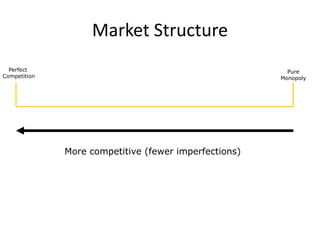
Market Structure
More competitive (fewer imperfections)
Perfect
Competition
Pure
Monopoly
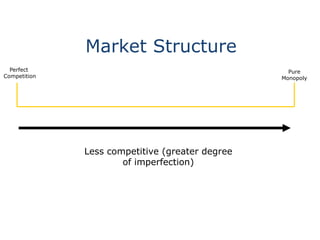
Market Structure
Less competitive (greater degree
of imperfection)
Perfect
Competition
Pure
Monopoly
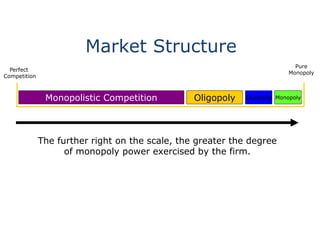
Market Structure
Perfect
Competition
Pure
Monopoly
Monopolistic Competition Oligopoly Duopoly Monopoly
The further right on the scale, the greater the degree
of monopoly power exercised by the firm.
Market Structure
• Importance:
• Degree of competition affects
the consumer – will it benefit
the consumer or not?
• Impacts on the performance
and behavior of the company/companies
involved
Market Structure
• Models – a word of warning!
– Market structure deals with a number of economic ‘models’
– These models are a representation of reality to help us to understand
what may be happening in real life
– There are extremes to the model that are unlikely
to occur in reality
– They still have value as they enable us to draw comparisons and
contrasts with what is observed
in reality
– Models help therefore in analyzing and evaluating – they offer a
benchmark
Market Structure
• Characteristics of each model:
– Number and size of firms that make up
the industry
– Control over price or output
– Freedom of entry and exit from the industry
– Nature of the product – degree of similarity of the
products in the industry (extent to which products can be
regarded as substitutes for each other)
Market Structure
Characteristics: Look at these everyday products – what type of
market structure are the producers of these products operating
in?
Remember to
think about the
nature of the
product, entry and
exit, behavior of
the firms, number
and size of the
firms in the
industry.
You might even
have to ask what
the industry is??Canon SLR CameraBananas
Mercedes CLK Coupe
Vodka
Electric
Guitar –
Jazz Body
Perfect Competition
• One extreme of the market structure spectrum
• Characteristics:
– Large number of firms
– Products are identical – consumer has no reason to express a
preference for any firm
– Freedom of entry and exit into and out
of the industry
– Firms are price takers – have no control
over the price they charge for their product
– Each producer supplies a very small proportion
of total industry output
– Consumers and producers have perfect knowledge about the market
Monopolistic or Imperfect Competition
• Where the conditions of perfect competition do
not hold, ‘imperfect competition’ will exist
• Varying degrees of imperfection give rise to
varying market structures
• Monopolistic competition is one of these – not to
be confused with monopoly!
Monopolistic or Imperfect Competition
• Characteristics:
– Large number of firms in the industry
– May have some element of control over price due to the
fact that they are able to differentiate their product in
some way from their rivals – products are therefore close,
but not perfect, substitutes
– Entry and exit from the industry is relatively easy – few
barriers to entry and exit
– Consumer and producer knowledge imperfect
Monopolistic or Imperfect Competition
• Some important points about monopolistic
competition:
– May reflect a wide range of markets
– Not just one point on a scale – reflects many
degrees
of ‘imperfection’
– Examples?
Monopolistic or Imperfect Competition
• Restaurants
• Plumbers/electricians/local builders
• Private schools
• Plant hire firms
• Insurance brokers
• Health clubs
• Hairdressers
• Real Estate agents
Monopolistic or Imperfect Competition
• In each case there are many firms
in the industry
• Each can try to differentiate its product
in some way
• Entry and exit to the industry is relatively free
• Consumers and producers do not have perfect knowledge of
the market – the market may indeed be relatively localised.
Can you imagine trying to search out the details, prices,
reliability, quality of service, etc for every plumber in the
United States in the event of an emergency??
Oligopoly
• Competition between the few
– May be a large number of firms in the industry but the
industry is dominated
by a small number of very large producers
• Concentration Ratio – the proportion of total market
sales (share) held by the top 3,4,5, etc firms:
– A 4 firm concentration ratio of 75% means the top 4 firms
account for 75% of all
the sales in the industry
Oligopoly
• Example:
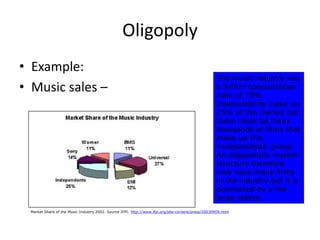
• Music sales –
The music industry has
a 5-firm concentration
ratio of 75%.
Independents make up
25% of the market but
there could be many
thousands of firms that
make up this
‘independents’ group.
An oligopolistic market
structure therefore
may have many firms
in the industry but it is
dominated by a few
large sellers.
Market Share of the Music Industry 2002. Source IFPI: http://www.ifpi.org/site-content/press/20030909.html
Oligopoly
• Features of an oligopolistic market structure:
– Price may be relatively stable across the industry
– Behaviour of firms affected by what they believe their rivals
might do – interdependence of firms
– Goods could be identical or highly differentiated
– Branding and brand loyalty may be a potent source of competitive advantage
– Non-price competition may be prevalent
– Game theory can be used to explain some behaviour
– High barriers to entry
Duopoly
• Market structure where the industry is dominated
by two large producers
– Price leadership by the larger of the two firms may exist – the
smaller firm follows the price lead
of the larger one
– Highly interdependent
– High barriers to entry
– In reality, local duopolies may exist
Monopoly
• Pure monopoly – where only
one producer exists in the industry
• In reality, rarely exists – usually
some form of substitute available!
• Firms may be investigated for examples of
monopoly power when market share exceeds
25%
• Use term ‘monopoly power’ with care!
Monopoly
• Monopoly power – refers to cases where firms influence
the market in some way through their behavior –
determined by the degree
of concentration in the industry
– Influencing prices
– Influencing output
– Erecting barriers to entry
– Pricing strategies to prevent or stifle competition
– May not pursue profit maximization – encourages unwanted
entrants to the market
– Sometimes seen as a cause of market failure
Monopoly
• Origins of monopoly:
– Through growth of the firm
– Through uniting, merger or takeover
– Through acquiring patent or license
Monopoly
• Summary of characteristics of firms exercising
monopoly power:
– Price – could be deemed too high, may be set to destroy
competition (destroyer or predatory pricing), price
discrimination possible.
– Efficiency – could be inefficient due to lack of competition
(X- inefficiency) or…
• could be higher due to availability of high profits
Monopoly
• Innovation - could be high because
of the promise of high profits, Possibly encourages
high investment in research and development (R&D)
• High levels of branding, advertising
and non-price competition
Monopoly
• Problems with models – a reminder:
– Often difficult to distinguish between a monopoly
and an oligopoly – both may exhibit behavior
that reflects monopoly power
– Monopolies and oligopolies do not necessarily aim
for traditional assumption of profit maximisation
– Degree of contestability of the market may influence behavior
– Monopolies not always ‘bad’ – may be desirable
in some cases but may need strong regulation
– Monopolies do not have to be big – could exist locally
Market Structures
• Final reminders:
• Models can be used as a comparison – they are not necessarily meant to BE
reality!
• When looking at real world examples, focus on the behaviour of the firm in
relation to what the model predicts would happen – that gives the basis for
analysis and evaluation of the real world situation.
• Regulation – or the threat of regulation may well affect
the way a firm behaves.
• Remember that these models are based on certain assumptions – in the real world
some of these assumptions may not be valid, this allows us to draw comparisons
and contrasts.
• The way that governments deal with firms may be based on a general assumption
that more competition is better than less!
Source
• 1. Elementary economic theory - K.K. Dewett
and J.D. Verma
• 2. International Economics - B. Mishra
• 3. Fundamentals of Agricultural Economics -
A.N. Sadhu and A. Singh
• 4. Economics - Paul A. Samelson and W.D.
Nordhans (Pearson Publications)

Bsc agri 2 pae u-3.1 marketstructure

  • 1.
  • 2.
    Market Structure • Marketstructure – identifies how a market is made up in terms of: – The number of firms in the industry – The nature of the product produced – The degree of monopoly power each firm has – The degree to which the firm can influence price – Profit levels – Firms’ behavior – pricing strategies, non-price competition, output levels – The extent of barriers to entry – The impact on efficiency
  • 3.
    Market Structure More competitive(fewer imperfections) Perfect Competition Pure Monopoly
  • 4.
    Market Structure Less competitive(greater degree of imperfection) Perfect Competition Pure Monopoly
  • 5.
    Market Structure Perfect Competition Pure Monopoly Monopolistic CompetitionOligopoly Duopoly Monopoly The further right on the scale, the greater the degree of monopoly power exercised by the firm.
  • 6.
    Market Structure • Importance: •Degree of competition affects the consumer – will it benefit the consumer or not? • Impacts on the performance and behavior of the company/companies involved
  • 7.
    Market Structure • Models– a word of warning! – Market structure deals with a number of economic ‘models’ – These models are a representation of reality to help us to understand what may be happening in real life – There are extremes to the model that are unlikely to occur in reality – They still have value as they enable us to draw comparisons and contrasts with what is observed in reality – Models help therefore in analyzing and evaluating – they offer a benchmark
  • 8.
    Market Structure • Characteristicsof each model: – Number and size of firms that make up the industry – Control over price or output – Freedom of entry and exit from the industry – Nature of the product – degree of similarity of the products in the industry (extent to which products can be regarded as substitutes for each other)
  • 9.
    Market Structure Characteristics: Lookat these everyday products – what type of market structure are the producers of these products operating in? Remember to think about the nature of the product, entry and exit, behavior of the firms, number and size of the firms in the industry. You might even have to ask what the industry is??Canon SLR CameraBananas Mercedes CLK Coupe Vodka Electric Guitar – Jazz Body
  • 10.
    Perfect Competition • Oneextreme of the market structure spectrum • Characteristics: – Large number of firms – Products are identical – consumer has no reason to express a preference for any firm – Freedom of entry and exit into and out of the industry – Firms are price takers – have no control over the price they charge for their product – Each producer supplies a very small proportion of total industry output – Consumers and producers have perfect knowledge about the market
  • 11.
    Monopolistic or ImperfectCompetition • Where the conditions of perfect competition do not hold, ‘imperfect competition’ will exist • Varying degrees of imperfection give rise to varying market structures • Monopolistic competition is one of these – not to be confused with monopoly!
  • 12.
    Monopolistic or ImperfectCompetition • Characteristics: – Large number of firms in the industry – May have some element of control over price due to the fact that they are able to differentiate their product in some way from their rivals – products are therefore close, but not perfect, substitutes – Entry and exit from the industry is relatively easy – few barriers to entry and exit – Consumer and producer knowledge imperfect
  • 13.
    Monopolistic or ImperfectCompetition • Some important points about monopolistic competition: – May reflect a wide range of markets – Not just one point on a scale – reflects many degrees of ‘imperfection’ – Examples?
  • 14.
    Monopolistic or ImperfectCompetition • Restaurants • Plumbers/electricians/local builders • Private schools • Plant hire firms • Insurance brokers • Health clubs • Hairdressers • Real Estate agents
  • 15.
    Monopolistic or ImperfectCompetition • In each case there are many firms in the industry • Each can try to differentiate its product in some way • Entry and exit to the industry is relatively free • Consumers and producers do not have perfect knowledge of the market – the market may indeed be relatively localised. Can you imagine trying to search out the details, prices, reliability, quality of service, etc for every plumber in the United States in the event of an emergency??
  • 16.
    Oligopoly • Competition betweenthe few – May be a large number of firms in the industry but the industry is dominated by a small number of very large producers • Concentration Ratio – the proportion of total market sales (share) held by the top 3,4,5, etc firms: – A 4 firm concentration ratio of 75% means the top 4 firms account for 75% of all the sales in the industry
  • 17.
    Oligopoly • Example: • Musicsales – The music industry has a 5-firm concentration ratio of 75%. Independents make up 25% of the market but there could be many thousands of firms that make up this ‘independents’ group. An oligopolistic market structure therefore may have many firms in the industry but it is dominated by a few large sellers. Market Share of the Music Industry 2002. Source IFPI: http://www.ifpi.org/site-content/press/20030909.html
  • 18.
    Oligopoly • Features ofan oligopolistic market structure: – Price may be relatively stable across the industry – Behaviour of firms affected by what they believe their rivals might do – interdependence of firms – Goods could be identical or highly differentiated – Branding and brand loyalty may be a potent source of competitive advantage – Non-price competition may be prevalent – Game theory can be used to explain some behaviour – High barriers to entry
  • 19.
    Duopoly • Market structurewhere the industry is dominated by two large producers – Price leadership by the larger of the two firms may exist – the smaller firm follows the price lead of the larger one – Highly interdependent – High barriers to entry – In reality, local duopolies may exist
  • 20.
    Monopoly • Pure monopoly– where only one producer exists in the industry • In reality, rarely exists – usually some form of substitute available! • Firms may be investigated for examples of monopoly power when market share exceeds 25% • Use term ‘monopoly power’ with care!
  • 21.
    Monopoly • Monopoly power– refers to cases where firms influence the market in some way through their behavior – determined by the degree of concentration in the industry – Influencing prices – Influencing output – Erecting barriers to entry – Pricing strategies to prevent or stifle competition – May not pursue profit maximization – encourages unwanted entrants to the market – Sometimes seen as a cause of market failure
  • 22.
    Monopoly • Origins ofmonopoly: – Through growth of the firm – Through uniting, merger or takeover – Through acquiring patent or license
  • 23.
    Monopoly • Summary ofcharacteristics of firms exercising monopoly power: – Price – could be deemed too high, may be set to destroy competition (destroyer or predatory pricing), price discrimination possible. – Efficiency – could be inefficient due to lack of competition (X- inefficiency) or… • could be higher due to availability of high profits
  • 24.
    Monopoly • Innovation -could be high because of the promise of high profits, Possibly encourages high investment in research and development (R&D) • High levels of branding, advertising and non-price competition
  • 25.
    Monopoly • Problems withmodels – a reminder: – Often difficult to distinguish between a monopoly and an oligopoly – both may exhibit behavior that reflects monopoly power – Monopolies and oligopolies do not necessarily aim for traditional assumption of profit maximisation – Degree of contestability of the market may influence behavior – Monopolies not always ‘bad’ – may be desirable in some cases but may need strong regulation – Monopolies do not have to be big – could exist locally
  • 26.
    Market Structures • Finalreminders: • Models can be used as a comparison – they are not necessarily meant to BE reality! • When looking at real world examples, focus on the behaviour of the firm in relation to what the model predicts would happen – that gives the basis for analysis and evaluation of the real world situation. • Regulation – or the threat of regulation may well affect the way a firm behaves. • Remember that these models are based on certain assumptions – in the real world some of these assumptions may not be valid, this allows us to draw comparisons and contrasts. • The way that governments deal with firms may be based on a general assumption that more competition is better than less!
  • 27.
    Source • 1. Elementaryeconomic theory - K.K. Dewett and J.D. Verma • 2. International Economics - B. Mishra • 3. Fundamentals of Agricultural Economics - A.N. Sadhu and A. Singh • 4. Economics - Paul A. Samelson and W.D. Nordhans (Pearson Publications)