9.1 Systems of Linear Equations
Chapter 9 Systems and Matrices
Concepts and Objectives
 Systems of Linear Equations
 Review solving systems by substitution and
elimination
 Determine whether a system is inconsistent or has
infinitely many solutions.
Systems of Linear Equations
 A set of equations is called a system of equations. If all of
the variables in all of the equations are of degree one,
then the system is a linear system. In a linear system,
there are three possibilities:
 There is a single solution that satifies all the
equations.
 There is no single solution that satisfies all the
equations.
 There are infinitely many solutions to the equations.
Systems of Linear Equations
 There are four different methods of solving a linear
system of equations:
1. Substitution – Solve one equation for one variable,
and substitute it into the other equation(s).
2. Elimination – Transform the equations such that if
you add them together, one of the variables is
eliminated. Then solve by substitution.
3. Graphing – Graph the equations, and the solution is
their intersection.
4. Matrices – Convert the system into one or two
matrices and solve.
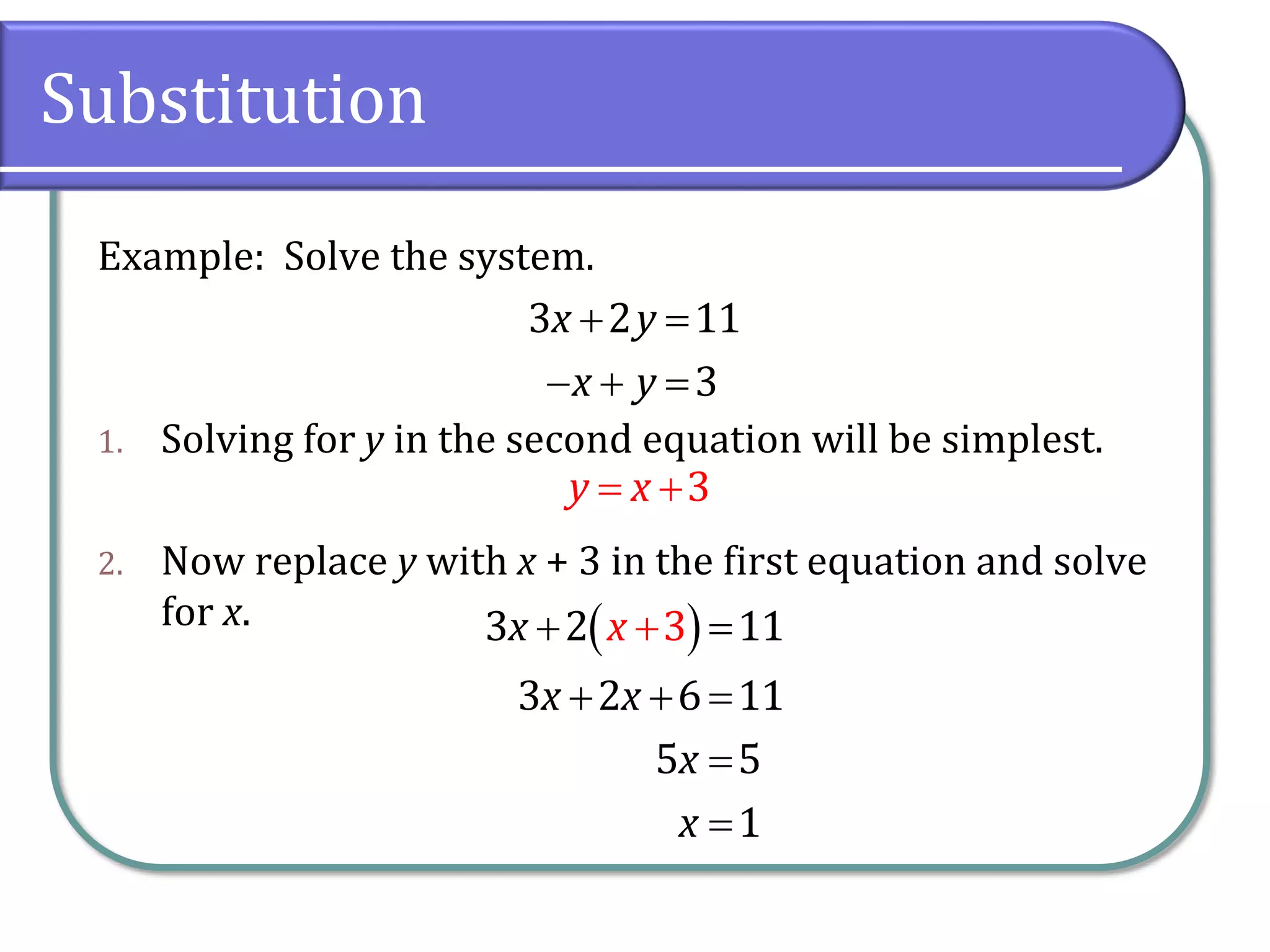
Substitution
Example: Solve the system.
1. Solving for y in the second equation will be simplest.
2. Now replace y with x + 3 in the first equation and solve
for x.
3 2 11
3
x y
x y
 
  
3y x 
 3 2 11
3 2 6 11
5 5
1
3xx
x x
x
x
 
  



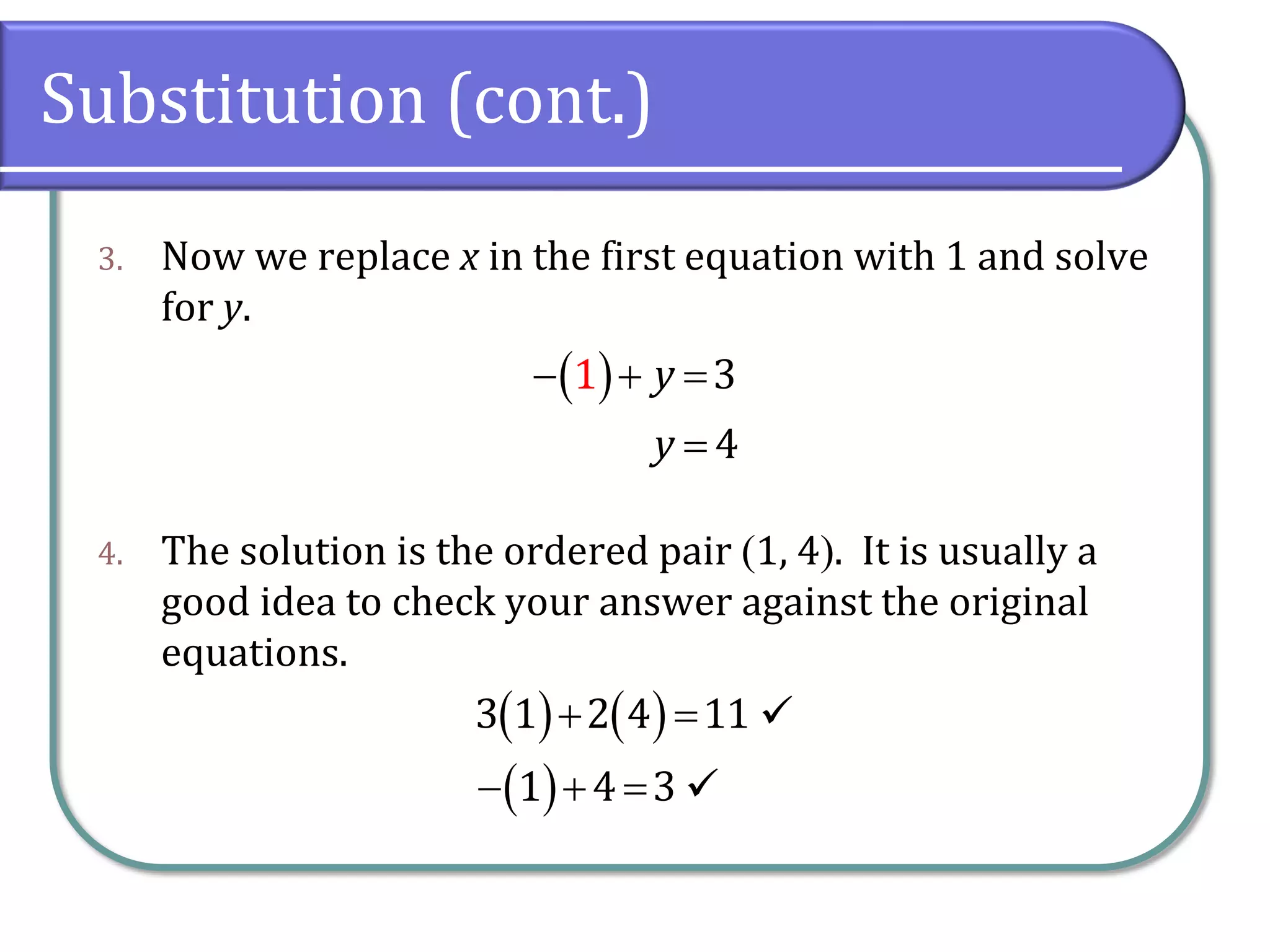
Substitution (cont.)
3. Now we replace x in the first equation with 1 and solve
for y.
4. The solution is the ordered pair 1, 4. It is usually a
good idea to check your answer against the original
equations.
 
4
1 3y
y
  

   
 
3 1 2 4 11
1 4 3
 
  
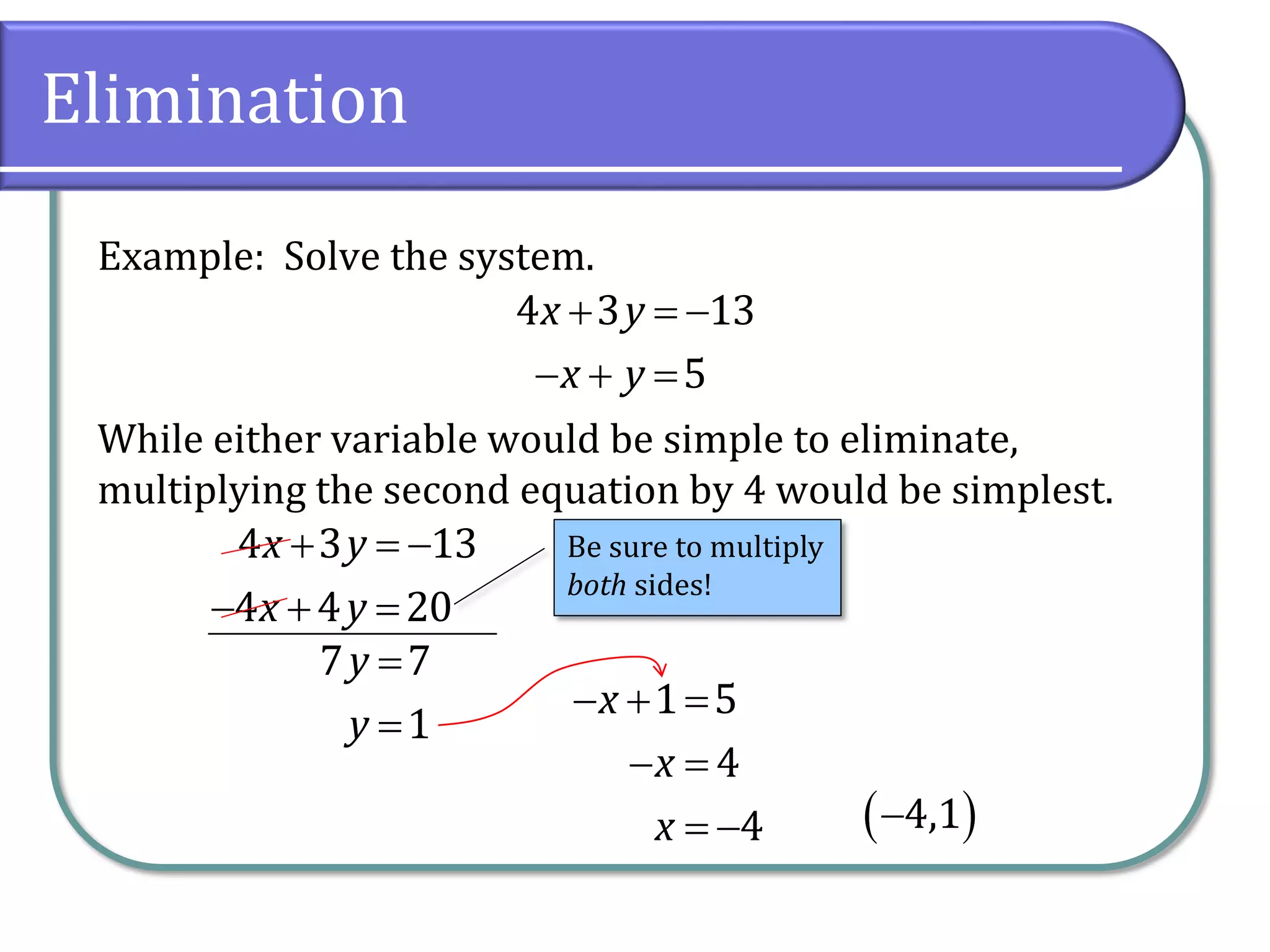
Elimination
Example: Solve the system.
While either variable would be simple to eliminate,
multiplying the second equation by 4 would be simplest.
4 3 13
5
x y
x y
  
  
4 3 13
4 4 20
x y
x y
  
  
7 7
1
y
y


Be sure to multiply
both sides!
1 5
4
4
x
x
x
  
 
   4,1
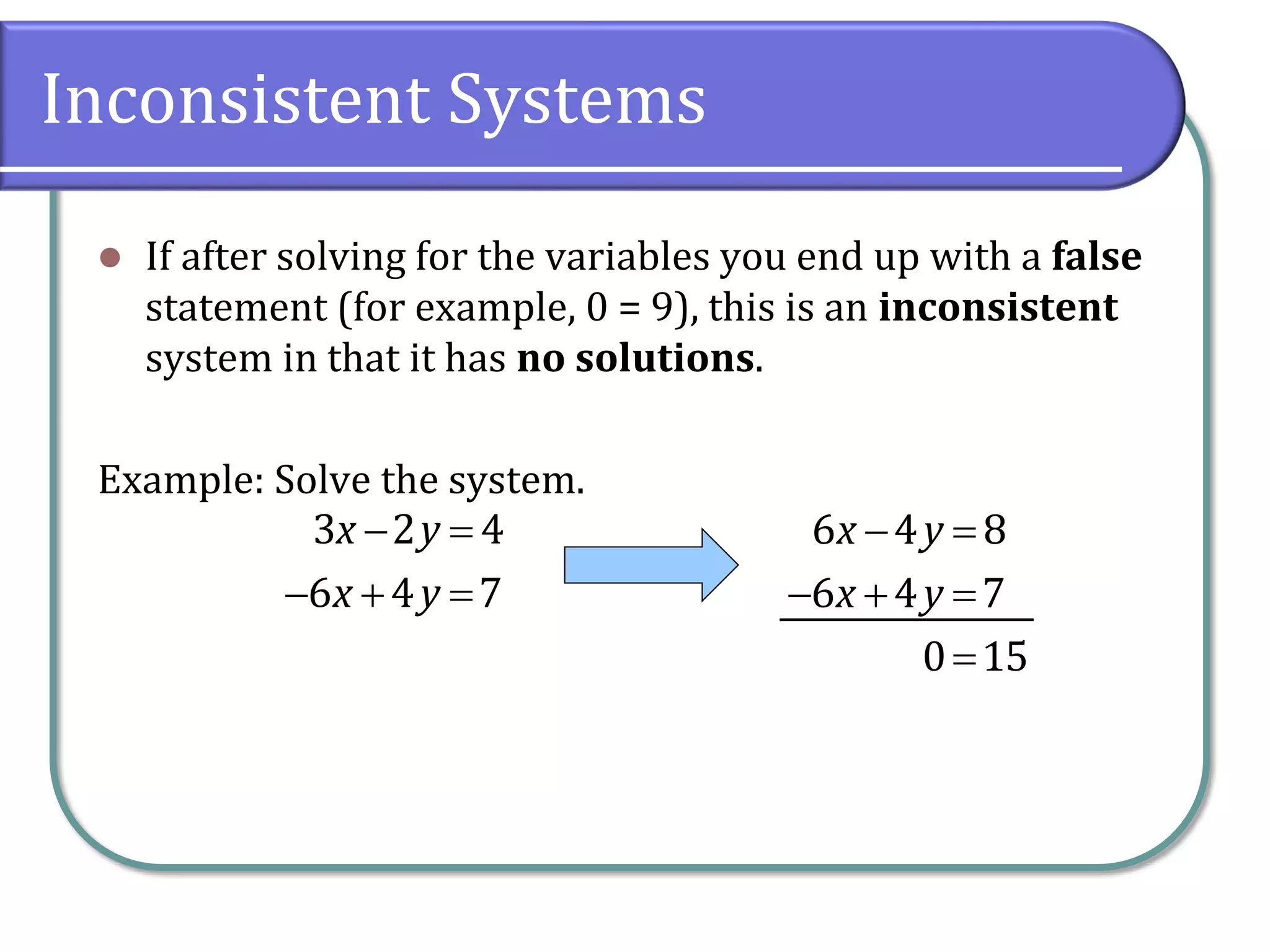
Inconsistent Systems
 If after solving for the variables you end up with a false
statement (for example, 0 = 9), this is an inconsistent
system in that it has no solutions.
Example: Solve the system.
3 2 4
6 4 7
x y
x y
 
  
6 4 8
6 4 7
0 15
x y
x y
 
  

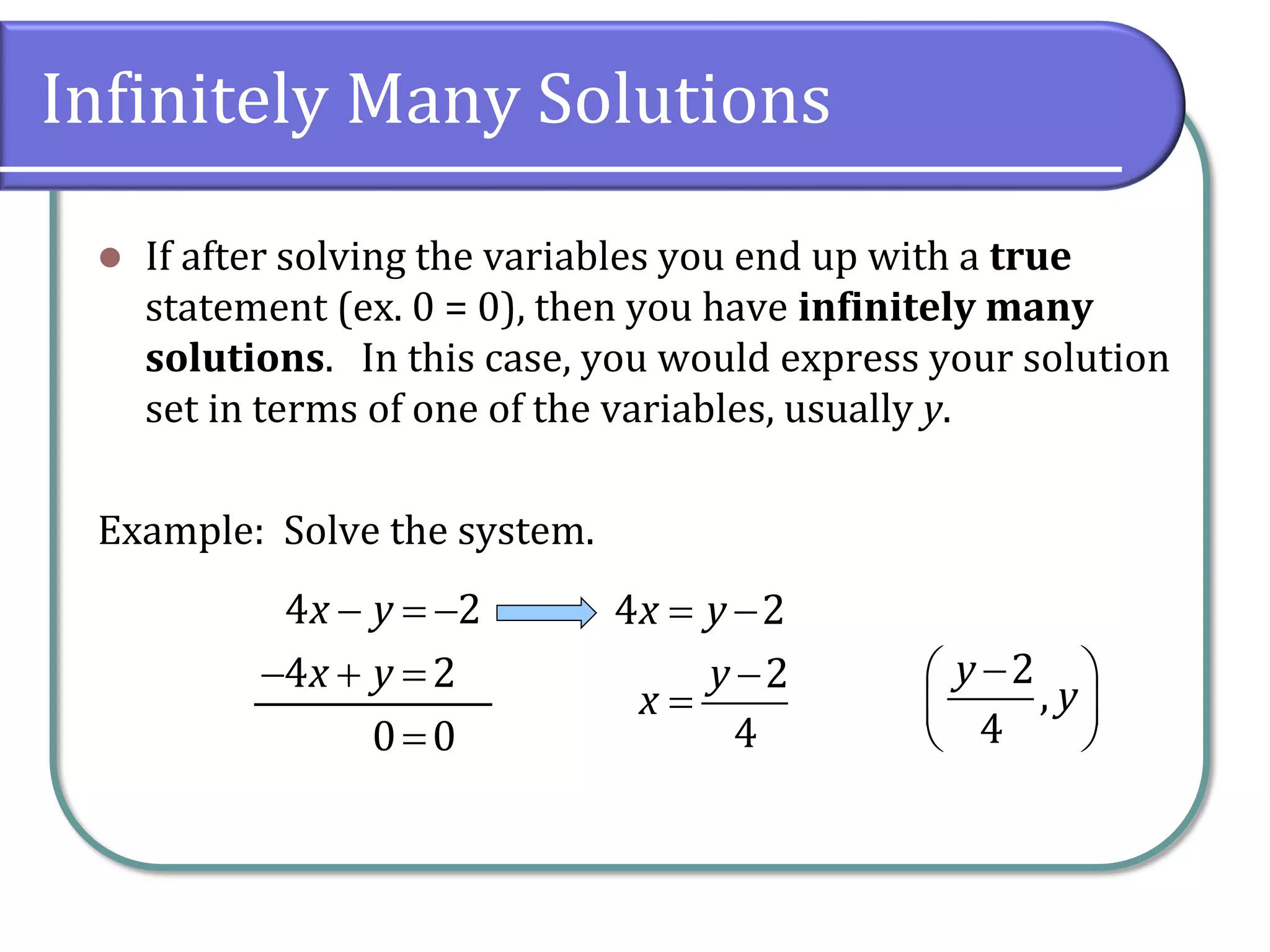
Infinitely Many Solutions
 If after solving the variables you end up with a true
statement (ex. 0 = 0), then you have infinitely many
solutions. In this case, you would express your solution
set in terms of one of the variables, usually y.
Example: Solve the system.
4 2
4 2
0 0
x y
x y
  
  

4 2
2
4
x y
y
x
 


2
,
4
y
y
 
 
 
Classwork
 College Algebra & Trigonometry
 Page 848: 8-48 (4); page 788: 24-36 (even);
page 776: 6-10

9.1 Systems of Linear Equations

  • 1.
    9.1 Systems ofLinear Equations Chapter 9 Systems and Matrices
  • 2.
    Concepts and Objectives Systems of Linear Equations  Review solving systems by substitution and elimination  Determine whether a system is inconsistent or has infinitely many solutions.
  • 3.
    Systems of LinearEquations  A set of equations is called a system of equations. If all of the variables in all of the equations are of degree one, then the system is a linear system. In a linear system, there are three possibilities:  There is a single solution that satifies all the equations.  There is no single solution that satisfies all the equations.  There are infinitely many solutions to the equations.
  • 4.
    Systems of LinearEquations  There are four different methods of solving a linear system of equations: 1. Substitution – Solve one equation for one variable, and substitute it into the other equation(s). 2. Elimination – Transform the equations such that if you add them together, one of the variables is eliminated. Then solve by substitution. 3. Graphing – Graph the equations, and the solution is their intersection. 4. Matrices – Convert the system into one or two matrices and solve.
  • 5.
    Substitution Example: Solve thesystem. 1. Solving for y in the second equation will be simplest. 2. Now replace y with x + 3 in the first equation and solve for x. 3 2 11 3 x y x y      3y x   3 2 11 3 2 6 11 5 5 1 3xx x x x x        
  • 6.
    Substitution (cont.) 3. Nowwe replace x in the first equation with 1 and solve for y. 4. The solution is the ordered pair 1, 4. It is usually a good idea to check your answer against the original equations.   4 1 3y y           3 1 2 4 11 1 4 3     
  • 7.
    Elimination Example: Solve thesystem. While either variable would be simple to eliminate, multiplying the second equation by 4 would be simplest. 4 3 13 5 x y x y       4 3 13 4 4 20 x y x y       7 7 1 y y   Be sure to multiply both sides! 1 5 4 4 x x x         4,1
  • 8.
    Inconsistent Systems  Ifafter solving for the variables you end up with a false statement (for example, 0 = 9), this is an inconsistent system in that it has no solutions. Example: Solve the system. 3 2 4 6 4 7 x y x y      6 4 8 6 4 7 0 15 x y x y      
  • 9.
    Infinitely Many Solutions If after solving the variables you end up with a true statement (ex. 0 = 0), then you have infinitely many solutions. In this case, you would express your solution set in terms of one of the variables, usually y. Example: Solve the system. 4 2 4 2 0 0 x y x y        4 2 2 4 x y y x     2 , 4 y y      
  • 10.
    Classwork  College Algebra& Trigonometry  Page 848: 8-48 (4); page 788: 24-36 (even); page 776: 6-10