RULES OF DIFFERENTIATION
PART 2
GOOD
AFTERNOON
MS. JESSEL 0RENCIO
2
GOALS FOR THIS WEEK
I AM ABLE TO:
● derive the differentiation rules;
● apply the differentiation rules in computing the derivatives
1. algebraic functions,
2. exponential functions,
3. logarithmic functions, and
4. trigonometric functions;
● display perseverance to solve for the derivatives of functions.
3
CHAIN RULE
𝑑
𝑑𝑥
𝑢𝑛
= 𝑛𝑢𝑛−1
𝑑𝑢
𝑑𝑥
EXAMPLE 1. Find the derivative of 𝑦 = 𝑥2 + 5
𝑦 = 𝑥2 + 5 1/2
CHAIN RULE
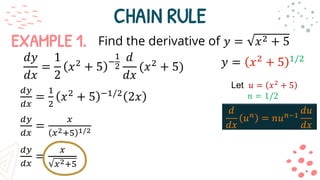
EXAMPLE 1. Find the derivative of 𝑦 = 𝑥2 + 5
𝑦 = 𝑥2
+ 5 1/2
Let 𝑢 = 𝑥2
+ 5
𝑛 = 1/2
𝑑𝑦
𝑑𝑥
=
1
2
𝑥2 + 5 −
1
2
𝑑
𝑑𝑥
(𝑥2 + 5)
𝑑𝑦
𝑑𝑥
=
1
2
𝑥2 + 5 −1/2 2𝑥
𝑑𝑦
𝑑𝑥
=
𝑥
𝑥2+5 1/2
𝑑𝑦
𝑑𝑥
=
𝑥
𝑥2+5
CHAIN RULE
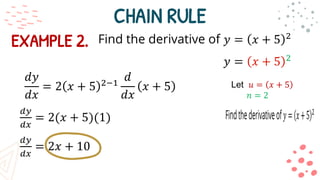
EXAMPLE 2. Find the derivative of 𝑦 = 𝑥 + 5 2
𝑦 = 𝑥 + 5 2
Let 𝑢 = 𝑥 + 5
𝑛 = 2
𝑑𝑦
𝑑𝑥
= 2 𝑥 + 5 2−1
𝑑
𝑑𝑥
𝑥 + 5
𝑑𝑦
𝑑𝑥
= 2(𝑥 + 5)(1)
𝑑𝑦
𝑑𝑥
= 2𝑥 + 10
Differentiation of
Exponential and
Logarithmic Functions
LESSON 7.2
7
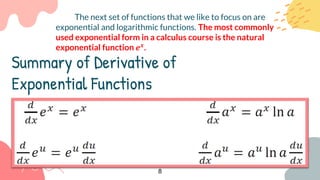
The next set of functions that we like to focus on are
exponential and logarithmic functions. The most commonly
used exponential form in a calculus course is the natural
exponential function 𝒆𝒙
.
8
Summary of Derivative of
Exponential Functions
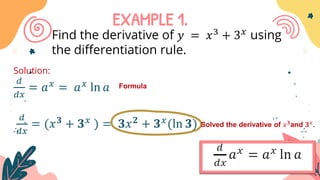
Solution:
𝑑
𝑑𝑥
= 𝑎𝑥
= 𝑎𝑥
ln 𝑎
𝑑
𝑑𝑥
= (𝑥𝟑
+ 𝟑𝑥
) = 𝟑𝑥𝟐
+ 𝟑𝑥
(ln 𝟑)
EXAMPLE 1.
Find the derivative of 𝑦 = 𝑥3 + 3𝑥 using
the differentiation rule.
Formula
Solved the derivative of 𝑥𝟑
and 𝟑𝑥
.
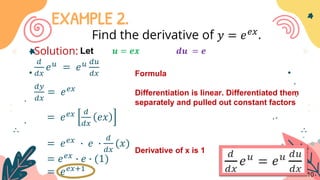
Solution:
𝑑
𝑑𝑥
𝑒𝑢 = 𝑒𝑢 𝑑𝑢
𝑑𝑥
𝑑𝑦
𝑑𝑥
= 𝑒𝑒𝑥
= 𝑒𝑒𝑥 𝑑
𝑑𝑥
𝑒𝑥
= 𝑒𝑒𝑥
∙ 𝑒 ∙
𝑑
𝑑𝑥
(𝑥)
= 𝑒𝑒𝑥 ∙ 𝑒 ∙ (1)
= 𝑒𝑒𝑥+1
EXAMPLE 2.
Find the derivative of 𝑦 = 𝑒𝑒𝑥.
10
Let 𝒖 = 𝒆𝒙 𝒅𝒖 = 𝒆
Formula
Differentiation is linear. Differentiated them
separately and pulled out constant factors
Derivative of x is 1
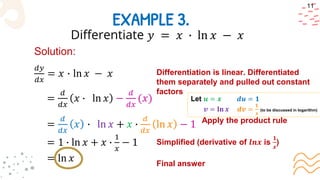
EXAMPLE 3.
Differentiate 𝑦 = 𝑥 ∙ ln 𝑥 − 𝑥
11
Solution:
𝑑𝑦
𝑑𝑥
= 𝑥 ∙ ln 𝑥 − 𝑥
=
𝑑
𝑑𝑥
𝑥 ∙ ln 𝑥 −
𝑑
𝑑𝑥
(𝑥)
=
𝑑
𝑑𝑥
𝑥 ∙ ln 𝑥 + 𝑥 ∙
𝑑
𝑑𝑥
ln 𝑥 − 1
= 1 ∙ ln 𝑥 + 𝑥 ∙
1
𝑥
− 1
= ln 𝑥
Let 𝒖 = 𝒙 𝒅𝒖 = 𝟏
𝒗 = 𝐥𝐧 𝒙 𝒅𝒗 =
𝟏
𝒙
(to be discussed in logarithm)
Differentiation is linear. Differentiated
them separately and pulled out constant
factors
Apply the product rule
Simplified (derivative of 𝒍𝒏𝒙 is
𝟏
𝒙
)
Final answer
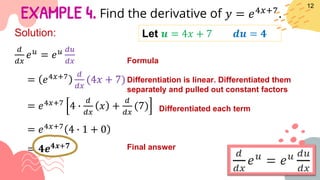
EXAMPLE 4. Find the derivative of 𝑦 = 𝑒4𝑥+7.
12
Solution:
𝑑
𝑑𝑥
𝑒𝑢
= 𝑒𝑢 𝑑𝑢
𝑑𝑥
= 𝑒4𝑥+7 𝑑
𝑑𝑥
(4𝑥 + 7)
= 𝑒4𝑥+7 4 ∙
𝑑
𝑑𝑥
𝑥 +
𝑑
𝑑𝑥
(7)
= 𝑒4𝑥+7
4 ∙ 1 + 0
= 𝟒𝒆𝟒𝒙+𝟕
Let 𝒖 = 4𝑥 + 7 𝒅𝒖 = 𝟒
Formula
Differentiation is linear. Differentiated them
separately and pulled out constant factors
Differentiated each term
Final answer
Differentiating a
Logarithmic Function
Expressions written in exponential form can be converted
to logarithmic function and vice versa.
Exponential Form to Logarithmic Form
53
= 125 ⟹ log5 125 = 3
490.5
= 7 ⟹ log49 7 = 0.5
Logarithmic Form to Exponential Form
log2 8 = 3 ⟹ 23
= 8
log3 81 = 4 ⟹ 34
= 81
Hence 𝒚 = 𝐥𝐨𝐠𝒃 𝒙 can be written as 𝑏𝑦 = 𝑥 and
𝒚 = 𝐥𝐨𝐠𝒆 𝒙 can be written as 𝑒𝑦 = 𝑥.
• natural logarithms are to the base 𝒆
• 𝐥𝐧 𝒙 is used for natural logarithms
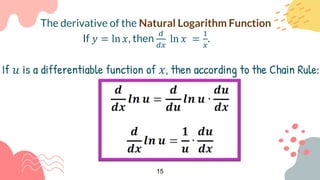
The derivative of the Natural Logarithm Function
If 𝑦 = ln 𝑥, then
𝑑
𝑑𝑥
ln 𝑥 =
1
𝑥
.
15
If 𝑢 is a differentiable function of 𝑥, then according to the Chain Rule:
Derivative of Logarithmic Functions other than the
natural logarithms.
𝑑
𝑑𝑥
(log𝑏 𝑥) =
1
𝑥 ln 𝑏
.
16
If 𝑢 is a differentiable function of 𝑥, then
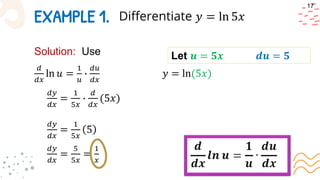
EXAMPLE 1. Differentiate 𝑦 = ln 5𝑥
17
Solution: Use
𝑑
𝑑𝑥
ln 𝑢 =
1
𝑢
∙
𝑑𝑢
𝑑𝑥
𝑦 = ln(5𝑥)
𝑑𝑦
𝑑𝑥
=
1
5𝑥
∙
𝑑
𝑑𝑥
(5𝑥)
𝑑𝑦
𝑑𝑥
=
1
5𝑥
5
𝑑𝑦
𝑑𝑥
=
5
5𝑥
=
1
𝑥
Let 𝒖 = 𝟓𝒙 𝒅𝒖 = 𝟓
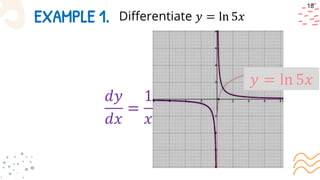
EXAMPLE 1. Differentiate 𝑦 = ln 5𝑥
18
𝑦 = ln 5𝑥
𝑑𝑦
𝑑𝑥
=
1
𝑥
EXAMPLE 2.Find the derivative of 𝑦 = ln(𝑥3 + 4).
19
Solution: Use
𝑑
𝑑𝑥
ln 𝑢 =
1
𝑢
∙
𝑑𝑢
𝑑𝑥
𝑦 = ln(𝑥3 + 4)
𝑑𝑦
𝑑𝑥
=
1
𝑥3+4
∙
𝑑
𝑑𝑥
(𝑥3 + 4)
𝑑𝑦
𝑑𝑥
=
1
𝑥3+4
3𝑥2
𝑑𝑦
𝑑𝑥
=
3𝑥2
𝑥3+4
Let 𝒖 = 𝑥3 + 4 𝒅𝒖 = 𝟑𝒙𝟐
20
𝑑𝑦
𝑑𝑥
=
3𝑥2
𝑥3 + 4
𝑦 = ln 5𝑥
EXAMPLE 2.Find the derivative of 𝑦 = ln(𝑥3 + 4).
Differentiation of
Trigonometric
Functions
LESSON 7.3
21
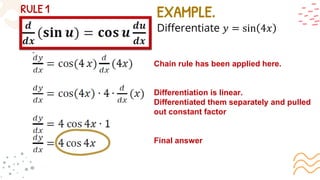
EXAMPLE.
Differentiate 𝑦 = sin 4𝑥
Chain rule has been applied here.
Differentiation is linear.
Differentiated them separately and pulled
out constant factor
Final answer
EXAMPLE.
Differentiate 𝑦 = cos(2𝑥)
Chain rule has been applied here.
Differentiation is linear.
Differentiated them separately and pulled
out constant factor
Derivative of 𝒙 is 1.
Final answer
EXAMPLE.
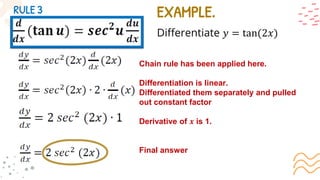
Differentiate 𝑦 = tan(2𝑥)
Chain rule has been applied here.
Differentiation is linear.
Differentiated them separately and pulled
out constant factor
Derivative of 𝒙 is 1.
Final answer
EXAMPLE.
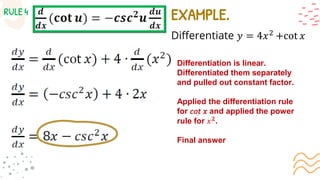
Differentiate 𝑦 = 4𝑥2 +cot 𝑥
Differentiation is linear.
Differentiated them separately
and pulled out constant factor.
Applied the differentiation rule
for 𝑐𝑜𝑡 𝑥 and applied the power
rule for 𝑥𝟐.
Final answer
EXAMPLE.
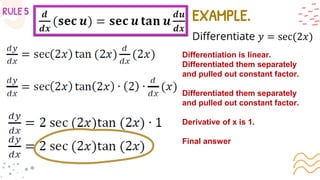
Differentiate 𝑦 = sec(2𝑥)
Differentiation is linear.
Differentiated them separately
and pulled out constant factor.
Differentiated them separately
and pulled out constant factor.
Derivative of x is 1.
Final answer
EXAMPLE.
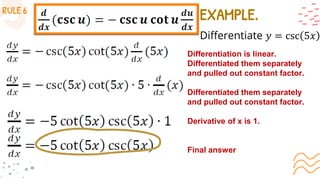
Differentiate 𝑦 = csc 5𝑥
Differentiation is linear.
Differentiated them separately
and pulled out constant factor.
Differentiated them separately
and pulled out constant factor.
Derivative of x is 1.
Final answer
SUMMARY
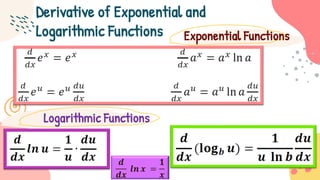
Derivative of Exponential and
Logarithmic Functions Exponential Functions
Logarithmic Functions
𝒅
𝒅𝒙
𝒍𝒏 𝒙 =
𝟏
𝒙
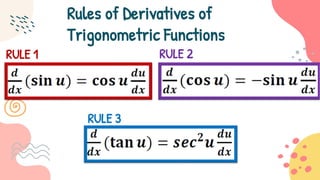
Rules of Derivatives of
Trigonometric Functions
RULE 1 RULE 2
RULE 3
Rules of Derivatives of
Trigonometric Functions
RULE 4
RULE 5
RULE 6
32
NICE job for
LISTENING
WELL!
Ask me question/s…
Message me @:
❑ messenger: Jessel-Ann Orencio Lpt
❑ email: jessel-ann.orencio@deped.gov.ph
REFERENCES
❑ Basic Calculus – Grade 11 Alternative Delivery Mode
Quarter 3 – Module 7: Rules of Differentiation, First
Edition, 2020 Department of Education
❑ Department of Education (2016). Teaching Guide for
Senior High School Basic Calculus
❑ Differential Calculus Technological University of the
Philippines
CREDITS: This presentation template was created by Slidesgo,
including icons by Flaticon, infographics & images by Freepik
Does anyone have any questions?
addyouremail@freepik.com
+91 620 421 838
yourcompany.com
THANKS!

Basic Cal_7.Rules of Differentiation (Part 2).pdf

  • 1.
  • 2.
  • 3.
    GOALS FOR THISWEEK I AM ABLE TO: ● derive the differentiation rules; ● apply the differentiation rules in computing the derivatives 1. algebraic functions, 2. exponential functions, 3. logarithmic functions, and 4. trigonometric functions; ● display perseverance to solve for the derivatives of functions. 3
  • 4.
    CHAIN RULE 𝑑 𝑑𝑥 𝑢𝑛 = 𝑛𝑢𝑛−1 𝑑𝑢 𝑑𝑥 EXAMPLE1. Find the derivative of 𝑦 = 𝑥2 + 5 𝑦 = 𝑥2 + 5 1/2
  • 5.
    CHAIN RULE EXAMPLE 1.Find the derivative of 𝑦 = 𝑥2 + 5 𝑦 = 𝑥2 + 5 1/2 Let 𝑢 = 𝑥2 + 5 𝑛 = 1/2 𝑑𝑦 𝑑𝑥 = 1 2 𝑥2 + 5 − 1 2 𝑑 𝑑𝑥 (𝑥2 + 5) 𝑑𝑦 𝑑𝑥 = 1 2 𝑥2 + 5 −1/2 2𝑥 𝑑𝑦 𝑑𝑥 = 𝑥 𝑥2+5 1/2 𝑑𝑦 𝑑𝑥 = 𝑥 𝑥2+5
  • 6.
    CHAIN RULE EXAMPLE 2.Find the derivative of 𝑦 = 𝑥 + 5 2 𝑦 = 𝑥 + 5 2 Let 𝑢 = 𝑥 + 5 𝑛 = 2 𝑑𝑦 𝑑𝑥 = 2 𝑥 + 5 2−1 𝑑 𝑑𝑥 𝑥 + 5 𝑑𝑦 𝑑𝑥 = 2(𝑥 + 5)(1) 𝑑𝑦 𝑑𝑥 = 2𝑥 + 10
  • 7.
  • 8.
    The next setof functions that we like to focus on are exponential and logarithmic functions. The most commonly used exponential form in a calculus course is the natural exponential function 𝒆𝒙 . 8 Summary of Derivative of Exponential Functions
  • 9.
    Solution: 𝑑 𝑑𝑥 = 𝑎𝑥 = 𝑎𝑥 ln𝑎 𝑑 𝑑𝑥 = (𝑥𝟑 + 𝟑𝑥 ) = 𝟑𝑥𝟐 + 𝟑𝑥 (ln 𝟑) EXAMPLE 1. Find the derivative of 𝑦 = 𝑥3 + 3𝑥 using the differentiation rule. Formula Solved the derivative of 𝑥𝟑 and 𝟑𝑥 .
  • 10.
    Solution: 𝑑 𝑑𝑥 𝑒𝑢 = 𝑒𝑢𝑑𝑢 𝑑𝑥 𝑑𝑦 𝑑𝑥 = 𝑒𝑒𝑥 = 𝑒𝑒𝑥 𝑑 𝑑𝑥 𝑒𝑥 = 𝑒𝑒𝑥 ∙ 𝑒 ∙ 𝑑 𝑑𝑥 (𝑥) = 𝑒𝑒𝑥 ∙ 𝑒 ∙ (1) = 𝑒𝑒𝑥+1 EXAMPLE 2. Find the derivative of 𝑦 = 𝑒𝑒𝑥. 10 Let 𝒖 = 𝒆𝒙 𝒅𝒖 = 𝒆 Formula Differentiation is linear. Differentiated them separately and pulled out constant factors Derivative of x is 1
  • 11.
    EXAMPLE 3. Differentiate 𝑦= 𝑥 ∙ ln 𝑥 − 𝑥 11 Solution: 𝑑𝑦 𝑑𝑥 = 𝑥 ∙ ln 𝑥 − 𝑥 = 𝑑 𝑑𝑥 𝑥 ∙ ln 𝑥 − 𝑑 𝑑𝑥 (𝑥) = 𝑑 𝑑𝑥 𝑥 ∙ ln 𝑥 + 𝑥 ∙ 𝑑 𝑑𝑥 ln 𝑥 − 1 = 1 ∙ ln 𝑥 + 𝑥 ∙ 1 𝑥 − 1 = ln 𝑥 Let 𝒖 = 𝒙 𝒅𝒖 = 𝟏 𝒗 = 𝐥𝐧 𝒙 𝒅𝒗 = 𝟏 𝒙 (to be discussed in logarithm) Differentiation is linear. Differentiated them separately and pulled out constant factors Apply the product rule Simplified (derivative of 𝒍𝒏𝒙 is 𝟏 𝒙 ) Final answer
  • 12.
    EXAMPLE 4. Findthe derivative of 𝑦 = 𝑒4𝑥+7. 12 Solution: 𝑑 𝑑𝑥 𝑒𝑢 = 𝑒𝑢 𝑑𝑢 𝑑𝑥 = 𝑒4𝑥+7 𝑑 𝑑𝑥 (4𝑥 + 7) = 𝑒4𝑥+7 4 ∙ 𝑑 𝑑𝑥 𝑥 + 𝑑 𝑑𝑥 (7) = 𝑒4𝑥+7 4 ∙ 1 + 0 = 𝟒𝒆𝟒𝒙+𝟕 Let 𝒖 = 4𝑥 + 7 𝒅𝒖 = 𝟒 Formula Differentiation is linear. Differentiated them separately and pulled out constant factors Differentiated each term Final answer
  • 13.
  • 14.
    Expressions written inexponential form can be converted to logarithmic function and vice versa. Exponential Form to Logarithmic Form 53 = 125 ⟹ log5 125 = 3 490.5 = 7 ⟹ log49 7 = 0.5 Logarithmic Form to Exponential Form log2 8 = 3 ⟹ 23 = 8 log3 81 = 4 ⟹ 34 = 81 Hence 𝒚 = 𝐥𝐨𝐠𝒃 𝒙 can be written as 𝑏𝑦 = 𝑥 and 𝒚 = 𝐥𝐨𝐠𝒆 𝒙 can be written as 𝑒𝑦 = 𝑥. • natural logarithms are to the base 𝒆 • 𝐥𝐧 𝒙 is used for natural logarithms
  • 15.
    The derivative ofthe Natural Logarithm Function If 𝑦 = ln 𝑥, then 𝑑 𝑑𝑥 ln 𝑥 = 1 𝑥 . 15 If 𝑢 is a differentiable function of 𝑥, then according to the Chain Rule:
  • 16.
    Derivative of LogarithmicFunctions other than the natural logarithms. 𝑑 𝑑𝑥 (log𝑏 𝑥) = 1 𝑥 ln 𝑏 . 16 If 𝑢 is a differentiable function of 𝑥, then
  • 17.
    EXAMPLE 1. Differentiate𝑦 = ln 5𝑥 17 Solution: Use 𝑑 𝑑𝑥 ln 𝑢 = 1 𝑢 ∙ 𝑑𝑢 𝑑𝑥 𝑦 = ln(5𝑥) 𝑑𝑦 𝑑𝑥 = 1 5𝑥 ∙ 𝑑 𝑑𝑥 (5𝑥) 𝑑𝑦 𝑑𝑥 = 1 5𝑥 5 𝑑𝑦 𝑑𝑥 = 5 5𝑥 = 1 𝑥 Let 𝒖 = 𝟓𝒙 𝒅𝒖 = 𝟓
  • 18.
    EXAMPLE 1. Differentiate𝑦 = ln 5𝑥 18 𝑦 = ln 5𝑥 𝑑𝑦 𝑑𝑥 = 1 𝑥
  • 19.
    EXAMPLE 2.Find thederivative of 𝑦 = ln(𝑥3 + 4). 19 Solution: Use 𝑑 𝑑𝑥 ln 𝑢 = 1 𝑢 ∙ 𝑑𝑢 𝑑𝑥 𝑦 = ln(𝑥3 + 4) 𝑑𝑦 𝑑𝑥 = 1 𝑥3+4 ∙ 𝑑 𝑑𝑥 (𝑥3 + 4) 𝑑𝑦 𝑑𝑥 = 1 𝑥3+4 3𝑥2 𝑑𝑦 𝑑𝑥 = 3𝑥2 𝑥3+4 Let 𝒖 = 𝑥3 + 4 𝒅𝒖 = 𝟑𝒙𝟐
  • 20.
    20 𝑑𝑦 𝑑𝑥 = 3𝑥2 𝑥3 + 4 𝑦= ln 5𝑥 EXAMPLE 2.Find the derivative of 𝑦 = ln(𝑥3 + 4).
  • 21.
  • 22.
    EXAMPLE. Differentiate 𝑦 =sin 4𝑥 Chain rule has been applied here. Differentiation is linear. Differentiated them separately and pulled out constant factor Final answer
  • 23.
    EXAMPLE. Differentiate 𝑦 =cos(2𝑥) Chain rule has been applied here. Differentiation is linear. Differentiated them separately and pulled out constant factor Derivative of 𝒙 is 1. Final answer
  • 24.
    EXAMPLE. Differentiate 𝑦 =tan(2𝑥) Chain rule has been applied here. Differentiation is linear. Differentiated them separately and pulled out constant factor Derivative of 𝒙 is 1. Final answer
  • 25.
    EXAMPLE. Differentiate 𝑦 =4𝑥2 +cot 𝑥 Differentiation is linear. Differentiated them separately and pulled out constant factor. Applied the differentiation rule for 𝑐𝑜𝑡 𝑥 and applied the power rule for 𝑥𝟐. Final answer
  • 26.
    EXAMPLE. Differentiate 𝑦 =sec(2𝑥) Differentiation is linear. Differentiated them separately and pulled out constant factor. Differentiated them separately and pulled out constant factor. Derivative of x is 1. Final answer
  • 27.
    EXAMPLE. Differentiate 𝑦 =csc 5𝑥 Differentiation is linear. Differentiated them separately and pulled out constant factor. Differentiated them separately and pulled out constant factor. Derivative of x is 1. Final answer
  • 28.
  • 29.
    Derivative of Exponentialand Logarithmic Functions Exponential Functions Logarithmic Functions 𝒅 𝒅𝒙 𝒍𝒏 𝒙 = 𝟏 𝒙
  • 30.
    Rules of Derivativesof Trigonometric Functions RULE 1 RULE 2 RULE 3
  • 31.
    Rules of Derivativesof Trigonometric Functions RULE 4 RULE 5 RULE 6
  • 32.
    32 NICE job for LISTENING WELL! Askme question/s… Message me @: ❑ messenger: Jessel-Ann Orencio Lpt ❑ email: jessel-ann.orencio@deped.gov.ph
  • 33.
    REFERENCES ❑ Basic Calculus– Grade 11 Alternative Delivery Mode Quarter 3 – Module 7: Rules of Differentiation, First Edition, 2020 Department of Education ❑ Department of Education (2016). Teaching Guide for Senior High School Basic Calculus ❑ Differential Calculus Technological University of the Philippines
  • 34.
    CREDITS: This presentationtemplate was created by Slidesgo, including icons by Flaticon, infographics & images by Freepik Does anyone have any questions? addyouremail@freepik.com +91 620 421 838 yourcompany.com THANKS!