Calculus with Analytic Geometry I
(Derivative of a Function)
JULIUS V. BENITEZ, Ph.D.
julius.benitez@g.msuiit.edu.ph
Department of Mathematics and Statistics, College of Science and Mathematics
Mindanao State University-Iligan Institute of Technology
email: csm.mathstat@g.msuiit.edu.ph
1st Sem, 2018-2019
J.V. Benitez Calculus with Analytic Geometry I 1st Sem, 2018-2019 1 / 39
Contents
.
DMS
Department of
MATHEMATICS
and STATISTICS
1
MINDANAO STATE UNIVERSITY
ILIGAN INSTITUTE OF TECHNOLOGY
1 The Derivative of a Function
The Derivative of a Function
Formulas for Differentiation of Algebraic and Transcendental
Functions
Implicit Differentiation and Higher-Order Derivatives
Indeterminate Forms and L’Hôpital’s Rule
Increasing and Decreasing Functions, and the First Derivative Test
Concavity and the Second Derivative Test
Sketching Graphs of Functions
Mean-Value Theorem
J.V. Benitez Calculus with Analytic Geometry I 1st Sem, 2018-2019 2 / 39
The Derivative of a Function
.
DMS
Department of
MATHEMATICS
and STATISTICS
1
MINDANAO STATE UNIVERSITY
ILIGAN INSTITUTE OF TECHNOLOGY
Definition 2.1 (Derivative of a Function)
If f is a function of an independent variable, say x, then the derivative of
f at x0, denoted by f0(x0), is given by
f0
(x0) = lim
h→0
f(x0 + h) − f(x0)
h
,
if this limit exists. If f0(x0) exists, then f is said to be differentiable at x0.
The function f is said to be differentiable if it is differentiable at each
point in the domain of f.
J.V. Benitez Calculus with Analytic Geometry I 1st Sem, 2018-2019 3 / 39
The Derivative of a Function
.
DMS
Department of
MATHEMATICS
and STATISTICS
1
MINDANAO STATE UNIVERSITY
ILIGAN INSTITUTE OF TECHNOLOGY
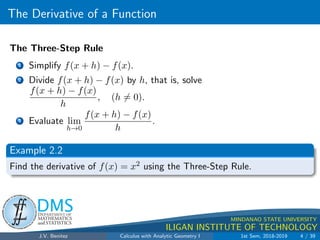
The Three-Step Rule
1 Simplify f(x + h) − f(x).
2 Divide f(x + h) − f(x) by h, that is, solve
f(x + h) − f(x)
h
, (h 6= 0).
3 Evaluate lim
h→0
f(x + h) − f(x)
h
.
Example 2.2
Find the derivative of f(x) = x2 using the Three-Step Rule.
J.V. Benitez Calculus with Analytic Geometry I 1st Sem, 2018-2019 4 / 39
The Derivative of a Function
.
DMS
Department of
MATHEMATICS
and STATISTICS
1
MINDANAO STATE UNIVERSITY
ILIGAN INSTITUTE OF TECHNOLOGY
The process of finding the derivative of a given function is called
differentiation.
Notation 2.3 (Derivative)
If the function f is defined by the equation y = f(x), then the derivative
of f at x can be denoted by any of the following symbols:
f0
(x),
dy
dx
, Dxf, Dx(f(x)), Dxy,
d
dx
[f(x)], y0
J.V. Benitez Calculus with Analytic Geometry I 1st Sem, 2018-2019 5 / 39
Differentiation Formulas
.
DMS
Department of
MATHEMATICS
and STATISTICS
1
MINDANAO STATE UNIVERSITY
ILIGAN INSTITUTE OF TECHNOLOGY
Theorem 2.4
1 If k is a constant, then Dxk = 0
2 Dx[xr] = rxr−1 (r ∈ Q)
3 Dx[k · f(x)] = k · Dxf(x)
4 Dx[f(x) + g(x)] = Dxf(x) + Dxg(x) (Addition Rule)
5 Dx[f(x) · g(x)] = g(x) · Dxf(x) + f(x) · Dxg(x) (Product Rule)
6 Dx

f(x)
g(x)

=
g(x) · Dxf(x) − f(x) · Dxg(x)
g2(x)
(Quotient Rule)
7 Dx[(f ◦ g)(x)] = f0
(g(x)) · g0
(x) (Chain Rule)
J.V. Benitez Calculus with Analytic Geometry I 1st Sem, 2018-2019 6 / 39
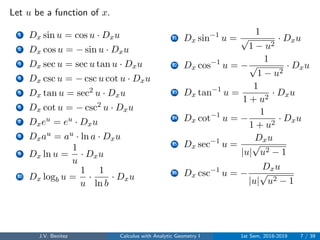
Let u be a function of x.
1 Dx sin u = cos u · Dxu
2 Dx cos u = − sin u · Dxu
3 Dx sec u = sec u tan u · Dxu
4 Dx csc u = − csc u cot u · Dxu
5 Dx tan u = sec2 u · Dxu
6 Dx cot u = − csc2 u · Dxu
7 Dxeu = eu · Dxu
8 Dxau = au · ln a · Dxu
9 Dx ln u =
1
u
· Dxu
10 Dx logb u =
1
u
·
1
ln b
· Dxu
11 Dx sin−1
u =
1
√
1 − u2
· Dxu
12 Dx cos−1
u = −
1
√
1 − u2
· Dxu
13 Dx tan−1
u =
1
1 + u2
· Dxu
14 Dx cot−1
u = −
1
1 + u2
· Dxu
15 Dx sec−1
u =
Dxu
|u|
√
u2 − 1
16 Dx csc−1
u = −
Dxu
|u|
√
u2 − 1
J.V. Benitez Calculus with Analytic Geometry I 1st Sem, 2018-2019 7 / 39
Differentiation Formulas
.
DMS
Department of
MATHEMATICS
and STATISTICS
1
MINDANAO STATE UNIVERSITY
ILIGAN INSTITUTE OF TECHNOLOGY
Differentiate the following: (Algebraic)
1
d
dx
(x3
− 12x + 5)
2 Dx(2
√
x +
√
2x)
3 Dx(5x4
− 5x3
+ 30x + 15)
4
d
dx
(2x
3
p
2x3 + 4)
5 Dx((x + 2)(x − 5)−1
)
6 Dx

5
x3
+
1
x

7
d
dx

x3 − 8
x3 + 8

8
d
dx

x2 + 2x + 1
x2 − 2x + 1

9
d
dx
(x2
+ [x3
+ (x4
+ x)2
]3
)
10 Dx

2x + 1
x + 5
(3x − 1)

11 Dx

x
√
3 + 2x
4x − 1

12
d
dx

3
x4
−
5
x
− 7x2

J.V. Benitez Calculus with Analytic Geometry I 1st Sem, 2018-2019 8 / 39
Differentiation Formulas
.
DMS
Department of
MATHEMATICS
and STATISTICS
1
MINDANAO STATE UNIVERSITY
ILIGAN INSTITUTE OF TECHNOLOGY
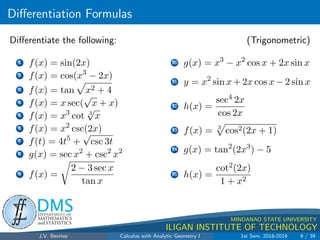
Differentiate the following: (Trigonometric)
1 f(x) = sin(2x)
2 f(x) = cos(x3
− 2x)
3 f(x) = tan
p
x2 + 4
4 f(x) = x sec(
√
x + x)
5 f(x) = x3
cot 3
√
x
6 f(x) = x2
csc(2x)
7 f(t) = 4t5
+
√
csc 3t
8 g(x) = sec x2
+ csc2
x2
9 f(x) =
r
2 − 3 sec x
tan x
10 g(x) = x3
− x2
cos x + 2x sin x
11 y = x2
sin x + 2x cos x − 2 sin x
12 h(x) =
sec4 2x
cos 2x
13 f(x) = 3
p
cos2(2x + 1)
14 g(x) = tan2
(2x3
) − 5
15 h(x) =
cot2(2x)
1 + x2
J.V. Benitez Calculus with Analytic Geometry I 1st Sem, 2018-2019 9 / 39
Differentiation Formulas
.
DMS
Department of
MATHEMATICS
and STATISTICS
1
MINDANAO STATE UNIVERSITY
ILIGAN INSTITUTE OF TECHNOLOGY
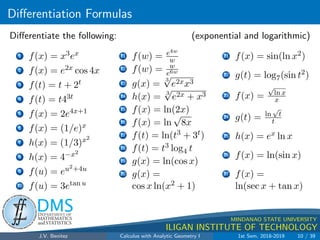
Differentiate the following: (exponential and logarithmic)
1 f(x) = x3ex
2 f(x) = e2x cos 4x
3 f(t) = t + 2t
4 f(t) = t43t
5 f(x) = 2e4x+1
6 f(x) = (1/e)x
7 h(x) = (1/3)x2
8 h(x) = 4−x2
9 f(u) = eu2+4u
10 f(u) = 3etan u
11 f(w) = e4w
w
12 f(w) = w
e6w
13 g(x) =
3
√
e2xx3
14 h(x) = 3
√
e2x + x3
15 f(x) = ln(2x)
16 f(x) = ln
√
8x
17 f(t) = ln(t3 + 3t)
18 f(t) = t3 log4 t
19 g(x) = ln(cos x)
20 g(x) =
cos x ln(x2 + 1)
21 f(x) = sin(ln x2)
22 g(t) = log7(sin t2)
23 f(x) =
√
ln x
x
24 g(t) = ln
√
t
t
25 h(x) = ex ln x
26 f(x) = ln(sin x)
27 f(x) =
ln(sec x + tan x)
J.V. Benitez Calculus with Analytic Geometry I 1st Sem, 2018-2019 10 / 39
Differentiation Formulas
.
DMS
Department of
MATHEMATICS
and STATISTICS
1
MINDANAO STATE UNIVERSITY
ILIGAN INSTITUTE OF TECHNOLOGY
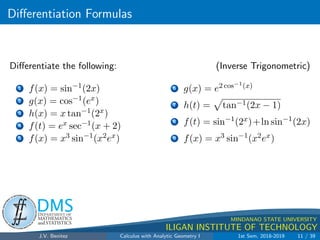
Differentiate the following: (Inverse Trigonometric)
1 f(x) = sin−1
(2x)
2 g(x) = cos−1(ex)
3 h(x) = x tan−1(2x)
4 f(t) = ex sec−1(x + 2)
5 f(x) = x3 sin−1
(x2ex)
6 g(x) = e2 cos−1(x)
7 h(t) =
p
tan−1(2x − 1)
8 f(t) = sin−1
(2x)+ln sin−1
(2x)
9 f(x) = x3 sin−1
(x2ex)
J.V. Benitez Calculus with Analytic Geometry I 1st Sem, 2018-2019 11 / 39
Implicit Differentiation
.
DMS
Department of
MATHEMATICS
and STATISTICS
1
MINDANAO STATE UNIVERSITY
ILIGAN INSTITUTE OF TECHNOLOGY
If a function f is given by f = {(x, y)| y = 3x2 + 2}, then we say that the
equation y = 3x2 + 2 defines the function f explicitly. However, not all
relations can be defined in such a manner. For instance, consider the
equation x2 − y2 = 16. This given equation does not describe a function
((5, 3) and (5, −3) are in the locus). Now, the function g defined by
y = g(x) =
√
x2 − 16 satisfies x2 − y2 = 16, that is x2 − [g(x)]2 = 16.
Also, the function h defined by
y = h(x) = −
p
x2 − 16
satisfies x2 − y2 = 16, that is, x2 − [h(x)]2 = 16. In this case, we say that
function g (or the function h) is defined implicitly by the equation
x2 − y2 = 16. The process of finding the derivative of a function that is
defined implicitly is called implicit differentiation.
J.V. Benitez Calculus with Analytic Geometry I 1st Sem, 2018-2019 12 / 39
Implicit Differentiation
.
DMS
Department of
MATHEMATICS
and STATISTICS
1
MINDANAO STATE UNIVERSITY
ILIGAN INSTITUTE OF TECHNOLOGY
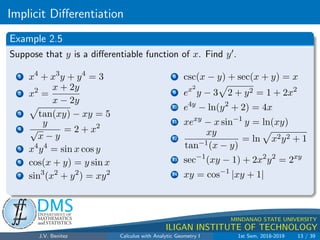
Example 2.5
Suppose that y is a differentiable function of x. Find y0.
1 x4
+ x3
y + y4
= 3
2 x2
=
x + 2y
x − 2y
3
p
tan(xy) − xy = 5
4
y
√
x − y
= 2 + x2
5 x4
y4
= sin x cos y
6 cos(x + y) = y sin x
7 sin3
(x2
+ y2
) = xy2
8 csc(x − y) + sec(x + y) = x
9 ex2
y − 3
p
2 + y2 = 1 + 2x2
10 e4y
− ln(y2
+ 2) = 4x
11 xexy
− x sin−1
y = ln(xy)
12
xy
tan−1(x − y)
= ln
p
x2y2 + 1
13 sec−1
(xy − 1) + 2x2
y2
= 2xy
14 xy = cos−1
|xy + 1|
J.V. Benitez Calculus with Analytic Geometry I 1st Sem, 2018-2019 13 / 39
Higher-Order Derivatives
.
DMS
Department of
MATHEMATICS
and STATISTICS
1
MINDANAO STATE UNIVERSITY
ILIGAN INSTITUTE OF TECHNOLOGY
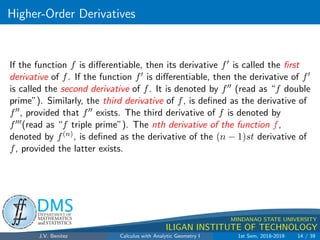
If the function f is differentiable, then its derivative f0 is called the first
derivative of f. If the function f0 is differentiable, then the derivative of f0
is called the second derivative of f. It is denoted by f00 (read as “f double
prime”). Similarly, the third derivative of f, is defined as the derivative of
f00, provided that f00 exists. The third derivative of f is denoted by
f000(read as “f triple prime”). The nth derivative of the function f,
denoted by f(n), is defined as the derivative of the (n − 1)st derivative of
f, provided the latter exists.
J.V. Benitez Calculus with Analytic Geometry I 1st Sem, 2018-2019 14 / 39
Higher-Order Derivatives
.
DMS
Department of
MATHEMATICS
and STATISTICS
1
MINDANAO STATE UNIVERSITY
ILIGAN INSTITUTE OF TECHNOLOGY
The Leibniz notation for the first derivative is
dy
dx
, where y = f(x). The
Leibniz notation for the second derivative of f with respect to x is
d2y
dx2
=
d
dx

dy
dx

=
d
dx

d
dx
(y)

.
In general, the symbol
dny
dxn
denotes the nth derivative of y with respect to
x. Other symbols for the nth derivative of f with respect of x are
dn
dxn
[f(x)] and Dn
x[f(x)].
J.V. Benitez Calculus with Analytic Geometry I 1st Sem, 2018-2019 15 / 39
Higher-Order Derivatives
.
DMS
Department of
MATHEMATICS
and STATISTICS
1
MINDANAO STATE UNIVERSITY
ILIGAN INSTITUTE OF TECHNOLOGY
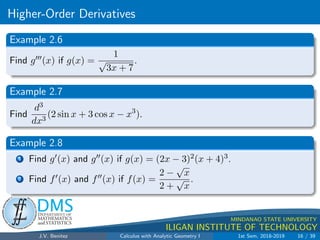
Example 2.6
Find g000(x) if g(x) =
1
√
3x + 7
.
Example 2.7
Find
d3
dx3
(2 sin x + 3 cos x − x3
).
Example 2.8
1 Find g0(x) and g00(x) if g(x) = (2x − 3)2(x + 4)3.
2 Find f0(x) and f00(x) if f(x) =
2 −
√
x
2 +
√
x
.
J.V. Benitez Calculus with Analytic Geometry I 1st Sem, 2018-2019 16 / 39
Higher-Order Derivatives
.
DMS
Department of
MATHEMATICS
and STATISTICS
1
MINDANAO STATE UNIVERSITY
ILIGAN INSTITUTE OF TECHNOLOGY
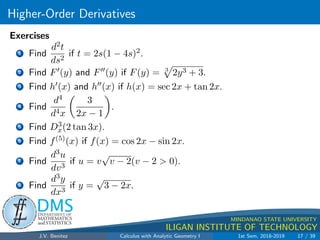
Exercises
1 Find
d2t
ds2
if t = 2s(1 − 4s)2.
2 Find F0(y) and F00(y) if F(y) = 3
p
2y3 + 3.
3 Find h0(x) and h00(x) if h(x) = sec 2x + tan 2x.
4 Find
d4
d4x

3
2x − 1

.
5 Find D3
x(2 tan 3x).
6 Find f(5)(x) if f(x) = cos 2x − sin 2x.
7 Find
d3u
dv3
if u = v
√
v − 2(v − 2  0).
8 Find
d3y
dx3
if y =
√
3 − 2x.
J.V. Benitez Calculus with Analytic Geometry I 1st Sem, 2018-2019 17 / 39
Higher-Order Derivatives
.
DMS
Department of
MATHEMATICS
and STATISTICS
1
MINDANAO STATE UNIVERSITY
ILIGAN INSTITUTE OF TECHNOLOGY
9 Given x3 + y3 = 1, show that
d2y
dx2
= −
2x
y5
.
10 Given x
1
2 + y
1
2 = 2, show that
d2y
dx2
=
1
x
3
2
.
11 Given x3 − y3 = 5, show that y00
= −
10x
y5
.
12 Let R(x) =
cos x
1 + sin x
. Show that
R(x)R0(x)
R00(x)
= −1.
13 Let F(x) =
1
1 + sin x
. Show that
(1 + sin x)3
· F00
(x) = cos2
x + sin x + 1.
14 Let x + y = tan y. Show that y00 = −2[cot5 y + cot3 y].
J.V. Benitez Calculus with Analytic Geometry I 1st Sem, 2018-2019 18 / 39
Indeterminate Forms and L’Hôpital’s Rule
.
DMS
Department of
MATHEMATICS
and STATISTICS
1
MINDANAO STATE UNIVERSITY
ILIGAN INSTITUTE OF TECHNOLOGY
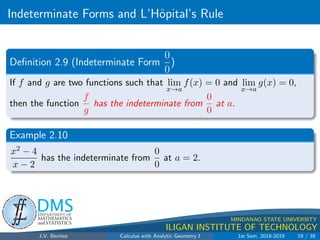
Definition 2.9 (Indeterminate Form
0
0
)
If f and g are two functions such that lim
x→a
f(x) = 0 and lim
x→a
g(x) = 0,
then the function
f
g
has the indeterminate from
0
0
at a.
Example 2.10
x2 − 4
x − 2
has the indeterminate from
0
0
at a = 2.
J.V. Benitez Calculus with Analytic Geometry I 1st Sem, 2018-2019 19 / 39
Indeterminate Forms and L’Hôpital’s Rule
.
DMS
Department of
MATHEMATICS
and STATISTICS
1
MINDANAO STATE UNIVERSITY
ILIGAN INSTITUTE OF TECHNOLOGY
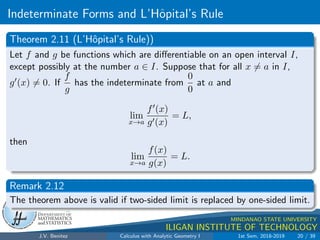
Theorem 2.11 (L’Hôpital’s Rule))
Let f and g be functions which are differentiable on an open interval I,
except possibly at the number a ∈ I. Suppose that for all x 6= a in I,
g0(x) 6= 0. If
f
g
has the indeterminate from
0
0
at a and
lim
x→a
f0(x)
g0(x)
= L,
then
lim
x→a
f(x)
g(x)
= L.
Remark 2.12
The theorem above is valid if two-sided limit is replaced by one-sided limit.
J.V. Benitez Calculus with Analytic Geometry I 1st Sem, 2018-2019 20 / 39
Indeterminate Forms and L’Hôpital’s Rule
.
DMS
Department of
MATHEMATICS
and STATISTICS
1
MINDANAO STATE UNIVERSITY
ILIGAN INSTITUTE OF TECHNOLOGY
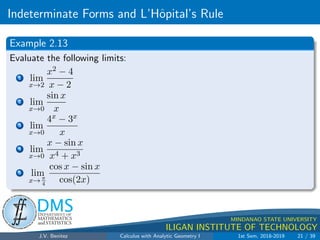
Example 2.13
Evaluate the following limits:
1 lim
x→2
x2 − 4
x − 2
2 lim
x→0
sin x
x
3 lim
x→0
4x − 3x
x
4 lim
x→0
x − sin x
x4 + x3
5 lim
x→ π
4
cos x − sin x
cos(2x)
J.V. Benitez Calculus with Analytic Geometry I 1st Sem, 2018-2019 21 / 39
Indeterminate Forms and L’Hôpital’s Rule
.
DMS
Department of
MATHEMATICS
and STATISTICS
1
MINDANAO STATE UNIVERSITY
ILIGAN INSTITUTE OF TECHNOLOGY
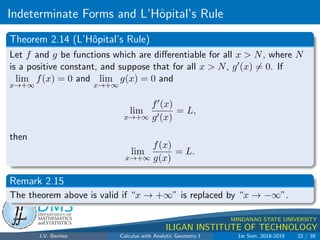
Theorem 2.14 (L’Hôpital’s Rule)
Let f and g be functions which are differentiable for all x  N, where N
is a positive constant, and suppose that for all x  N, g0(x) 6= 0. If
lim
x→+∞
f(x) = 0 and lim
x→+∞
g(x) = 0 and
lim
x→+∞
f0(x)
g0(x)
= L,
then
lim
x→+∞
f(x)
g(x)
= L.
Remark 2.15
The theorem above is valid if “x → +∞” is replaced by “x → −∞”.
J.V. Benitez Calculus with Analytic Geometry I 1st Sem, 2018-2019 22 / 39
Indeterminate Forms and L’Hôpital’s Rule
.
DMS
Department of
MATHEMATICS
and STATISTICS
1
MINDANAO STATE UNIVERSITY
ILIGAN INSTITUTE OF TECHNOLOGY
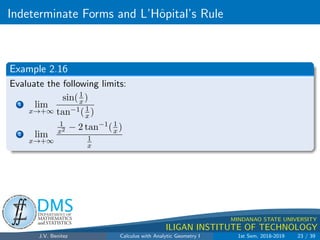
Example 2.16
Evaluate the following limits:
1 lim
x→+∞
sin(1
x )
tan−1(1
x )
2 lim
x→+∞
1
x2 − 2 tan−1(1
x )
1
x
J.V. Benitez Calculus with Analytic Geometry I 1st Sem, 2018-2019 23 / 39
Indeterminate Forms and L’Hôpital’s Rule
.
DMS
Department of
MATHEMATICS
and STATISTICS
1
MINDANAO STATE UNIVERSITY
ILIGAN INSTITUTE OF TECHNOLOGY
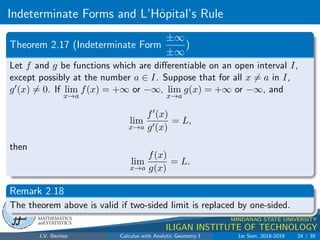
Theorem 2.17 (Indeterminate Form
±∞
±∞
)
Let f and g be functions which are differentiable on an open interval I,
except possibly at the number a ∈ I. Suppose that for all x 6= a in I,
g0(x) 6= 0. If lim
x→a
f(x) = +∞ or −∞, lim
x→a
g(x) = +∞ or −∞, and
lim
x→a
f0(x)
g0(x)
= L,
then
lim
x→a
f(x)
g(x)
= L.
Remark 2.18
The theorem above is valid if two-sided limit is replaced by one-sided.
J.V. Benitez Calculus with Analytic Geometry I 1st Sem, 2018-2019 24 / 39
Indeterminate Forms and L’Hôpital’s Rule
.
DMS
Department of
MATHEMATICS
and STATISTICS
1
MINDANAO STATE UNIVERSITY
ILIGAN INSTITUTE OF TECHNOLOGY
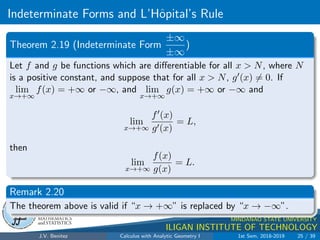
Theorem 2.19 (Indeterminate Form
±∞
±∞
)
Let f and g be functions which are differentiable for all x  N, where N
is a positive constant, and suppose that for all x  N, g0(x) 6= 0. If
lim
x→+∞
f(x) = +∞ or −∞, and lim
x→+∞
g(x) = +∞ or −∞ and
lim
x→+∞
f0(x)
g0(x)
= L,
then
lim
x→+∞
f(x)
g(x)
= L.
Remark 2.20
The theorem above is valid if “x → +∞” is replaced by “x → −∞”.
J.V. Benitez Calculus with Analytic Geometry I 1st Sem, 2018-2019 25 / 39
Indeterminate Forms and L’Hôpital’s Rule
.
DMS
Department of
MATHEMATICS
and STATISTICS
1
MINDANAO STATE UNIVERSITY
ILIGAN INSTITUTE OF TECHNOLOGY
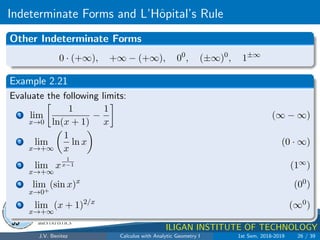
Other Indeterminate Forms
0 · (+∞), +∞ − (+∞), 00
, (±∞)0
, 1±∞
Example 2.21
Evaluate the following limits:
1 lim
x→0

1
ln(x + 1)
−
1
x

(∞ − ∞)
2 lim
x→+∞

1
x
ln x

(0 · ∞)
3 lim
x→+∞
x
1
x−1 (1∞)
4 lim
x→0+
(sin x)x
(00)
5 lim
x→+∞
(x + 1)2/x
(∞0)
J.V. Benitez Calculus with Analytic Geometry I 1st Sem, 2018-2019 26 / 39
Indeterminate Forms and L’Hôpital’s Rule
.
DMS
Department of
MATHEMATICS
and STATISTICS
1
MINDANAO STATE UNIVERSITY
ILIGAN INSTITUTE OF TECHNOLOGY
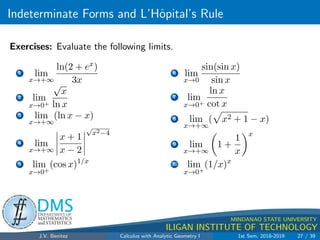
Exercises: Evaluate the following limits.
1 lim
x→+∞
ln(2 + ex)
3x
2 lim
x→0+
√
x
ln x
3 lim
x→+∞
(ln x − x)
4 lim
x→+∞
x + 1
x − 2
√
x2−4
5 lim
x→0+
(cos x)1/x
6 lim
x→0
sin(sin x)
sin x
7 lim
x→0+
ln x
cot x
8 lim
x→+∞
(
p
x2 + 1 − x)
9 lim
x→+∞

1 +
1
x
x
10 lim
x→0+
(1/x)x
J.V. Benitez Calculus with Analytic Geometry I 1st Sem, 2018-2019 27 / 39
Increasing/Decreasing Fncs.  the First Derivative Test
.
DMS
Department of
MATHEMATICS
and STATISTICS
1
MINDANAO STATE UNIVERSITY
ILIGAN INSTITUTE OF TECHNOLOGY
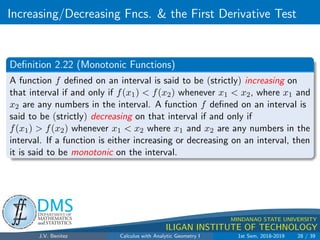
Definition 2.22 (Monotonic Functions)
A function f defined on an interval is said to be (strictly) increasing on
that interval if and only if f(x1)  f(x2) whenever x1  x2, where x1 and
x2 are any numbers in the interval. A function f defined on an interval is
said to be (strictly) decreasing on that interval if and only if
f(x1)  f(x2) whenever x1  x2 where x1 and x2 are any numbers in the
interval. If a function is either increasing or decreasing on an interval, then
it is said to be monotonic on the interval.
J.V. Benitez Calculus with Analytic Geometry I 1st Sem, 2018-2019 28 / 39
Increasing/Decreasing Fncs.  the First Derivative Test
.
DMS
Department of
MATHEMATICS
and STATISTICS
1
MINDANAO STATE UNIVERSITY
ILIGAN INSTITUTE OF TECHNOLOGY
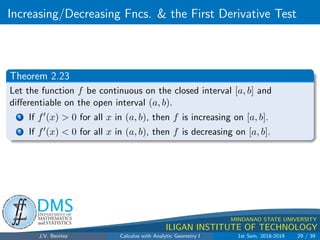
Theorem 2.23
Let the function f be continuous on the closed interval [a, b] and
differentiable on the open interval (a, b).
1 If f0(x)  0 for all x in (a, b), then f is increasing on [a, b].
2 If f0(x)  0 for all x in (a, b), then f is decreasing on [a, b].
J.V. Benitez Calculus with Analytic Geometry I 1st Sem, 2018-2019 29 / 39
Increasing/Decreasing Fncs.  the First Derivative Test
.
DMS
Department of
MATHEMATICS
and STATISTICS
1
MINDANAO STATE UNIVERSITY
ILIGAN INSTITUTE OF TECHNOLOGY
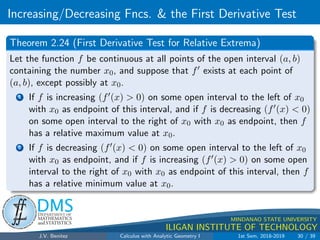
Theorem 2.24 (First Derivative Test for Relative Extrema)
Let the function f be continuous at all points of the open interval (a, b)
containing the number x0, and suppose that f0 exists at each point of
(a, b), except possibly at x0.
1 If f is increasing (f0(x)  0) on some open interval to the left of x0
with x0 as endpoint of this interval, and if f is decreasing (f0(x)  0)
on some open interval to the right of x0 with x0 as endpoint, then f
has a relative maximum value at x0.
2 If f is decreasing (f0(x)  0) on some open interval to the left of x0
with x0 as endpoint, and if f is increasing (f0(x)  0) on some open
interval to the right of x0 with x0 as endpoint of this interval, then f
has a relative minimum value at x0.
J.V. Benitez Calculus with Analytic Geometry I 1st Sem, 2018-2019 30 / 39
Increasing/Decreasing Fncs.  the First Derivative Test
.
DMS
Department of
MATHEMATICS
and STATISTICS
1
MINDANAO STATE UNIVERSITY
ILIGAN INSTITUTE OF TECHNOLOGY
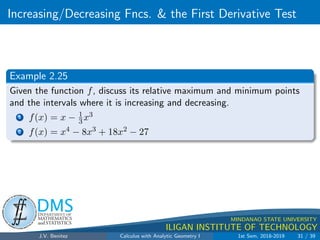
Example 2.25
Given the function f, discuss its relative maximum and minimum points
and the intervals where it is increasing and decreasing.
1 f(x) = x − 1
3x3
2 f(x) = x4 − 8x3 + 18x2 − 27
J.V. Benitez Calculus with Analytic Geometry I 1st Sem, 2018-2019 31 / 39

2_derivative.pdf

  • 1.
    Calculus with AnalyticGeometry I (Derivative of a Function) JULIUS V. BENITEZ, Ph.D. julius.benitez@g.msuiit.edu.ph Department of Mathematics and Statistics, College of Science and Mathematics Mindanao State University-Iligan Institute of Technology email: csm.mathstat@g.msuiit.edu.ph 1st Sem, 2018-2019 J.V. Benitez Calculus with Analytic Geometry I 1st Sem, 2018-2019 1 / 39
  • 2.
    Contents . DMS Department of MATHEMATICS and STATISTICS 1 MINDANAOSTATE UNIVERSITY ILIGAN INSTITUTE OF TECHNOLOGY 1 The Derivative of a Function The Derivative of a Function Formulas for Differentiation of Algebraic and Transcendental Functions Implicit Differentiation and Higher-Order Derivatives Indeterminate Forms and L’Hôpital’s Rule Increasing and Decreasing Functions, and the First Derivative Test Concavity and the Second Derivative Test Sketching Graphs of Functions Mean-Value Theorem J.V. Benitez Calculus with Analytic Geometry I 1st Sem, 2018-2019 2 / 39
  • 3.
    The Derivative ofa Function . DMS Department of MATHEMATICS and STATISTICS 1 MINDANAO STATE UNIVERSITY ILIGAN INSTITUTE OF TECHNOLOGY Definition 2.1 (Derivative of a Function) If f is a function of an independent variable, say x, then the derivative of f at x0, denoted by f0(x0), is given by f0 (x0) = lim h→0 f(x0 + h) − f(x0) h , if this limit exists. If f0(x0) exists, then f is said to be differentiable at x0. The function f is said to be differentiable if it is differentiable at each point in the domain of f. J.V. Benitez Calculus with Analytic Geometry I 1st Sem, 2018-2019 3 / 39
  • 4.
    The Derivative ofa Function . DMS Department of MATHEMATICS and STATISTICS 1 MINDANAO STATE UNIVERSITY ILIGAN INSTITUTE OF TECHNOLOGY The Three-Step Rule 1 Simplify f(x + h) − f(x). 2 Divide f(x + h) − f(x) by h, that is, solve f(x + h) − f(x) h , (h 6= 0). 3 Evaluate lim h→0 f(x + h) − f(x) h . Example 2.2 Find the derivative of f(x) = x2 using the Three-Step Rule. J.V. Benitez Calculus with Analytic Geometry I 1st Sem, 2018-2019 4 / 39
  • 5.
    The Derivative ofa Function . DMS Department of MATHEMATICS and STATISTICS 1 MINDANAO STATE UNIVERSITY ILIGAN INSTITUTE OF TECHNOLOGY The process of finding the derivative of a given function is called differentiation. Notation 2.3 (Derivative) If the function f is defined by the equation y = f(x), then the derivative of f at x can be denoted by any of the following symbols: f0 (x), dy dx , Dxf, Dx(f(x)), Dxy, d dx [f(x)], y0 J.V. Benitez Calculus with Analytic Geometry I 1st Sem, 2018-2019 5 / 39
  • 6.
    Differentiation Formulas . DMS Department of MATHEMATICS andSTATISTICS 1 MINDANAO STATE UNIVERSITY ILIGAN INSTITUTE OF TECHNOLOGY Theorem 2.4 1 If k is a constant, then Dxk = 0 2 Dx[xr] = rxr−1 (r ∈ Q) 3 Dx[k · f(x)] = k · Dxf(x) 4 Dx[f(x) + g(x)] = Dxf(x) + Dxg(x) (Addition Rule) 5 Dx[f(x) · g(x)] = g(x) · Dxf(x) + f(x) · Dxg(x) (Product Rule) 6 Dx f(x) g(x) = g(x) · Dxf(x) − f(x) · Dxg(x) g2(x) (Quotient Rule) 7 Dx[(f ◦ g)(x)] = f0 (g(x)) · g0 (x) (Chain Rule) J.V. Benitez Calculus with Analytic Geometry I 1st Sem, 2018-2019 6 / 39
  • 7.
    Let u bea function of x. 1 Dx sin u = cos u · Dxu 2 Dx cos u = − sin u · Dxu 3 Dx sec u = sec u tan u · Dxu 4 Dx csc u = − csc u cot u · Dxu 5 Dx tan u = sec2 u · Dxu 6 Dx cot u = − csc2 u · Dxu 7 Dxeu = eu · Dxu 8 Dxau = au · ln a · Dxu 9 Dx ln u = 1 u · Dxu 10 Dx logb u = 1 u · 1 ln b · Dxu 11 Dx sin−1 u = 1 √ 1 − u2 · Dxu 12 Dx cos−1 u = − 1 √ 1 − u2 · Dxu 13 Dx tan−1 u = 1 1 + u2 · Dxu 14 Dx cot−1 u = − 1 1 + u2 · Dxu 15 Dx sec−1 u = Dxu |u| √ u2 − 1 16 Dx csc−1 u = − Dxu |u| √ u2 − 1 J.V. Benitez Calculus with Analytic Geometry I 1st Sem, 2018-2019 7 / 39
  • 8.
    Differentiation Formulas . DMS Department of MATHEMATICS andSTATISTICS 1 MINDANAO STATE UNIVERSITY ILIGAN INSTITUTE OF TECHNOLOGY Differentiate the following: (Algebraic) 1 d dx (x3 − 12x + 5) 2 Dx(2 √ x + √ 2x) 3 Dx(5x4 − 5x3 + 30x + 15) 4 d dx (2x 3 p 2x3 + 4) 5 Dx((x + 2)(x − 5)−1 ) 6 Dx 5 x3 + 1 x 7 d dx x3 − 8 x3 + 8 8 d dx x2 + 2x + 1 x2 − 2x + 1 9 d dx (x2 + [x3 + (x4 + x)2 ]3 ) 10 Dx 2x + 1 x + 5 (3x − 1) 11 Dx x √ 3 + 2x 4x − 1 12 d dx 3 x4 − 5 x − 7x2 J.V. Benitez Calculus with Analytic Geometry I 1st Sem, 2018-2019 8 / 39
  • 9.
    Differentiation Formulas . DMS Department of MATHEMATICS andSTATISTICS 1 MINDANAO STATE UNIVERSITY ILIGAN INSTITUTE OF TECHNOLOGY Differentiate the following: (Trigonometric) 1 f(x) = sin(2x) 2 f(x) = cos(x3 − 2x) 3 f(x) = tan p x2 + 4 4 f(x) = x sec( √ x + x) 5 f(x) = x3 cot 3 √ x 6 f(x) = x2 csc(2x) 7 f(t) = 4t5 + √ csc 3t 8 g(x) = sec x2 + csc2 x2 9 f(x) = r 2 − 3 sec x tan x 10 g(x) = x3 − x2 cos x + 2x sin x 11 y = x2 sin x + 2x cos x − 2 sin x 12 h(x) = sec4 2x cos 2x 13 f(x) = 3 p cos2(2x + 1) 14 g(x) = tan2 (2x3 ) − 5 15 h(x) = cot2(2x) 1 + x2 J.V. Benitez Calculus with Analytic Geometry I 1st Sem, 2018-2019 9 / 39
  • 10.
    Differentiation Formulas . DMS Department of MATHEMATICS andSTATISTICS 1 MINDANAO STATE UNIVERSITY ILIGAN INSTITUTE OF TECHNOLOGY Differentiate the following: (exponential and logarithmic) 1 f(x) = x3ex 2 f(x) = e2x cos 4x 3 f(t) = t + 2t 4 f(t) = t43t 5 f(x) = 2e4x+1 6 f(x) = (1/e)x 7 h(x) = (1/3)x2 8 h(x) = 4−x2 9 f(u) = eu2+4u 10 f(u) = 3etan u 11 f(w) = e4w w 12 f(w) = w e6w 13 g(x) = 3 √ e2xx3 14 h(x) = 3 √ e2x + x3 15 f(x) = ln(2x) 16 f(x) = ln √ 8x 17 f(t) = ln(t3 + 3t) 18 f(t) = t3 log4 t 19 g(x) = ln(cos x) 20 g(x) = cos x ln(x2 + 1) 21 f(x) = sin(ln x2) 22 g(t) = log7(sin t2) 23 f(x) = √ ln x x 24 g(t) = ln √ t t 25 h(x) = ex ln x 26 f(x) = ln(sin x) 27 f(x) = ln(sec x + tan x) J.V. Benitez Calculus with Analytic Geometry I 1st Sem, 2018-2019 10 / 39
  • 11.
    Differentiation Formulas . DMS Department of MATHEMATICS andSTATISTICS 1 MINDANAO STATE UNIVERSITY ILIGAN INSTITUTE OF TECHNOLOGY Differentiate the following: (Inverse Trigonometric) 1 f(x) = sin−1 (2x) 2 g(x) = cos−1(ex) 3 h(x) = x tan−1(2x) 4 f(t) = ex sec−1(x + 2) 5 f(x) = x3 sin−1 (x2ex) 6 g(x) = e2 cos−1(x) 7 h(t) = p tan−1(2x − 1) 8 f(t) = sin−1 (2x)+ln sin−1 (2x) 9 f(x) = x3 sin−1 (x2ex) J.V. Benitez Calculus with Analytic Geometry I 1st Sem, 2018-2019 11 / 39
  • 12.
    Implicit Differentiation . DMS Department of MATHEMATICS andSTATISTICS 1 MINDANAO STATE UNIVERSITY ILIGAN INSTITUTE OF TECHNOLOGY If a function f is given by f = {(x, y)| y = 3x2 + 2}, then we say that the equation y = 3x2 + 2 defines the function f explicitly. However, not all relations can be defined in such a manner. For instance, consider the equation x2 − y2 = 16. This given equation does not describe a function ((5, 3) and (5, −3) are in the locus). Now, the function g defined by y = g(x) = √ x2 − 16 satisfies x2 − y2 = 16, that is x2 − [g(x)]2 = 16. Also, the function h defined by y = h(x) = − p x2 − 16 satisfies x2 − y2 = 16, that is, x2 − [h(x)]2 = 16. In this case, we say that function g (or the function h) is defined implicitly by the equation x2 − y2 = 16. The process of finding the derivative of a function that is defined implicitly is called implicit differentiation. J.V. Benitez Calculus with Analytic Geometry I 1st Sem, 2018-2019 12 / 39
  • 13.
    Implicit Differentiation . DMS Department of MATHEMATICS andSTATISTICS 1 MINDANAO STATE UNIVERSITY ILIGAN INSTITUTE OF TECHNOLOGY Example 2.5 Suppose that y is a differentiable function of x. Find y0. 1 x4 + x3 y + y4 = 3 2 x2 = x + 2y x − 2y 3 p tan(xy) − xy = 5 4 y √ x − y = 2 + x2 5 x4 y4 = sin x cos y 6 cos(x + y) = y sin x 7 sin3 (x2 + y2 ) = xy2 8 csc(x − y) + sec(x + y) = x 9 ex2 y − 3 p 2 + y2 = 1 + 2x2 10 e4y − ln(y2 + 2) = 4x 11 xexy − x sin−1 y = ln(xy) 12 xy tan−1(x − y) = ln p x2y2 + 1 13 sec−1 (xy − 1) + 2x2 y2 = 2xy 14 xy = cos−1 |xy + 1| J.V. Benitez Calculus with Analytic Geometry I 1st Sem, 2018-2019 13 / 39
  • 14.
    Higher-Order Derivatives . DMS Department of MATHEMATICS andSTATISTICS 1 MINDANAO STATE UNIVERSITY ILIGAN INSTITUTE OF TECHNOLOGY If the function f is differentiable, then its derivative f0 is called the first derivative of f. If the function f0 is differentiable, then the derivative of f0 is called the second derivative of f. It is denoted by f00 (read as “f double prime”). Similarly, the third derivative of f, is defined as the derivative of f00, provided that f00 exists. The third derivative of f is denoted by f000(read as “f triple prime”). The nth derivative of the function f, denoted by f(n), is defined as the derivative of the (n − 1)st derivative of f, provided the latter exists. J.V. Benitez Calculus with Analytic Geometry I 1st Sem, 2018-2019 14 / 39
  • 15.
    Higher-Order Derivatives . DMS Department of MATHEMATICS andSTATISTICS 1 MINDANAO STATE UNIVERSITY ILIGAN INSTITUTE OF TECHNOLOGY The Leibniz notation for the first derivative is dy dx , where y = f(x). The Leibniz notation for the second derivative of f with respect to x is d2y dx2 = d dx dy dx = d dx d dx (y) . In general, the symbol dny dxn denotes the nth derivative of y with respect to x. Other symbols for the nth derivative of f with respect of x are dn dxn [f(x)] and Dn x[f(x)]. J.V. Benitez Calculus with Analytic Geometry I 1st Sem, 2018-2019 15 / 39
  • 16.
    Higher-Order Derivatives . DMS Department of MATHEMATICS andSTATISTICS 1 MINDANAO STATE UNIVERSITY ILIGAN INSTITUTE OF TECHNOLOGY Example 2.6 Find g000(x) if g(x) = 1 √ 3x + 7 . Example 2.7 Find d3 dx3 (2 sin x + 3 cos x − x3 ). Example 2.8 1 Find g0(x) and g00(x) if g(x) = (2x − 3)2(x + 4)3. 2 Find f0(x) and f00(x) if f(x) = 2 − √ x 2 + √ x . J.V. Benitez Calculus with Analytic Geometry I 1st Sem, 2018-2019 16 / 39
  • 17.
    Higher-Order Derivatives . DMS Department of MATHEMATICS andSTATISTICS 1 MINDANAO STATE UNIVERSITY ILIGAN INSTITUTE OF TECHNOLOGY Exercises 1 Find d2t ds2 if t = 2s(1 − 4s)2. 2 Find F0(y) and F00(y) if F(y) = 3 p 2y3 + 3. 3 Find h0(x) and h00(x) if h(x) = sec 2x + tan 2x. 4 Find d4 d4x 3 2x − 1 . 5 Find D3 x(2 tan 3x). 6 Find f(5)(x) if f(x) = cos 2x − sin 2x. 7 Find d3u dv3 if u = v √ v − 2(v − 2 0). 8 Find d3y dx3 if y = √ 3 − 2x. J.V. Benitez Calculus with Analytic Geometry I 1st Sem, 2018-2019 17 / 39
  • 18.
    Higher-Order Derivatives . DMS Department of MATHEMATICS andSTATISTICS 1 MINDANAO STATE UNIVERSITY ILIGAN INSTITUTE OF TECHNOLOGY 9 Given x3 + y3 = 1, show that d2y dx2 = − 2x y5 . 10 Given x 1 2 + y 1 2 = 2, show that d2y dx2 = 1 x 3 2 . 11 Given x3 − y3 = 5, show that y00 = − 10x y5 . 12 Let R(x) = cos x 1 + sin x . Show that R(x)R0(x) R00(x) = −1. 13 Let F(x) = 1 1 + sin x . Show that (1 + sin x)3 · F00 (x) = cos2 x + sin x + 1. 14 Let x + y = tan y. Show that y00 = −2[cot5 y + cot3 y]. J.V. Benitez Calculus with Analytic Geometry I 1st Sem, 2018-2019 18 / 39
  • 19.
    Indeterminate Forms andL’Hôpital’s Rule . DMS Department of MATHEMATICS and STATISTICS 1 MINDANAO STATE UNIVERSITY ILIGAN INSTITUTE OF TECHNOLOGY Definition 2.9 (Indeterminate Form 0 0 ) If f and g are two functions such that lim x→a f(x) = 0 and lim x→a g(x) = 0, then the function f g has the indeterminate from 0 0 at a. Example 2.10 x2 − 4 x − 2 has the indeterminate from 0 0 at a = 2. J.V. Benitez Calculus with Analytic Geometry I 1st Sem, 2018-2019 19 / 39
  • 20.
    Indeterminate Forms andL’Hôpital’s Rule . DMS Department of MATHEMATICS and STATISTICS 1 MINDANAO STATE UNIVERSITY ILIGAN INSTITUTE OF TECHNOLOGY Theorem 2.11 (L’Hôpital’s Rule)) Let f and g be functions which are differentiable on an open interval I, except possibly at the number a ∈ I. Suppose that for all x 6= a in I, g0(x) 6= 0. If f g has the indeterminate from 0 0 at a and lim x→a f0(x) g0(x) = L, then lim x→a f(x) g(x) = L. Remark 2.12 The theorem above is valid if two-sided limit is replaced by one-sided limit. J.V. Benitez Calculus with Analytic Geometry I 1st Sem, 2018-2019 20 / 39
  • 21.
    Indeterminate Forms andL’Hôpital’s Rule . DMS Department of MATHEMATICS and STATISTICS 1 MINDANAO STATE UNIVERSITY ILIGAN INSTITUTE OF TECHNOLOGY Example 2.13 Evaluate the following limits: 1 lim x→2 x2 − 4 x − 2 2 lim x→0 sin x x 3 lim x→0 4x − 3x x 4 lim x→0 x − sin x x4 + x3 5 lim x→ π 4 cos x − sin x cos(2x) J.V. Benitez Calculus with Analytic Geometry I 1st Sem, 2018-2019 21 / 39
  • 22.
    Indeterminate Forms andL’Hôpital’s Rule . DMS Department of MATHEMATICS and STATISTICS 1 MINDANAO STATE UNIVERSITY ILIGAN INSTITUTE OF TECHNOLOGY Theorem 2.14 (L’Hôpital’s Rule) Let f and g be functions which are differentiable for all x N, where N is a positive constant, and suppose that for all x N, g0(x) 6= 0. If lim x→+∞ f(x) = 0 and lim x→+∞ g(x) = 0 and lim x→+∞ f0(x) g0(x) = L, then lim x→+∞ f(x) g(x) = L. Remark 2.15 The theorem above is valid if “x → +∞” is replaced by “x → −∞”. J.V. Benitez Calculus with Analytic Geometry I 1st Sem, 2018-2019 22 / 39
  • 23.
    Indeterminate Forms andL’Hôpital’s Rule . DMS Department of MATHEMATICS and STATISTICS 1 MINDANAO STATE UNIVERSITY ILIGAN INSTITUTE OF TECHNOLOGY Example 2.16 Evaluate the following limits: 1 lim x→+∞ sin(1 x ) tan−1(1 x ) 2 lim x→+∞ 1 x2 − 2 tan−1(1 x ) 1 x J.V. Benitez Calculus with Analytic Geometry I 1st Sem, 2018-2019 23 / 39
  • 24.
    Indeterminate Forms andL’Hôpital’s Rule . DMS Department of MATHEMATICS and STATISTICS 1 MINDANAO STATE UNIVERSITY ILIGAN INSTITUTE OF TECHNOLOGY Theorem 2.17 (Indeterminate Form ±∞ ±∞ ) Let f and g be functions which are differentiable on an open interval I, except possibly at the number a ∈ I. Suppose that for all x 6= a in I, g0(x) 6= 0. If lim x→a f(x) = +∞ or −∞, lim x→a g(x) = +∞ or −∞, and lim x→a f0(x) g0(x) = L, then lim x→a f(x) g(x) = L. Remark 2.18 The theorem above is valid if two-sided limit is replaced by one-sided. J.V. Benitez Calculus with Analytic Geometry I 1st Sem, 2018-2019 24 / 39
  • 25.
    Indeterminate Forms andL’Hôpital’s Rule . DMS Department of MATHEMATICS and STATISTICS 1 MINDANAO STATE UNIVERSITY ILIGAN INSTITUTE OF TECHNOLOGY Theorem 2.19 (Indeterminate Form ±∞ ±∞ ) Let f and g be functions which are differentiable for all x N, where N is a positive constant, and suppose that for all x N, g0(x) 6= 0. If lim x→+∞ f(x) = +∞ or −∞, and lim x→+∞ g(x) = +∞ or −∞ and lim x→+∞ f0(x) g0(x) = L, then lim x→+∞ f(x) g(x) = L. Remark 2.20 The theorem above is valid if “x → +∞” is replaced by “x → −∞”. J.V. Benitez Calculus with Analytic Geometry I 1st Sem, 2018-2019 25 / 39
  • 26.
    Indeterminate Forms andL’Hôpital’s Rule . DMS Department of MATHEMATICS and STATISTICS 1 MINDANAO STATE UNIVERSITY ILIGAN INSTITUTE OF TECHNOLOGY Other Indeterminate Forms 0 · (+∞), +∞ − (+∞), 00 , (±∞)0 , 1±∞ Example 2.21 Evaluate the following limits: 1 lim x→0 1 ln(x + 1) − 1 x (∞ − ∞) 2 lim x→+∞ 1 x ln x (0 · ∞) 3 lim x→+∞ x 1 x−1 (1∞) 4 lim x→0+ (sin x)x (00) 5 lim x→+∞ (x + 1)2/x (∞0) J.V. Benitez Calculus with Analytic Geometry I 1st Sem, 2018-2019 26 / 39
  • 27.
    Indeterminate Forms andL’Hôpital’s Rule . DMS Department of MATHEMATICS and STATISTICS 1 MINDANAO STATE UNIVERSITY ILIGAN INSTITUTE OF TECHNOLOGY Exercises: Evaluate the following limits. 1 lim x→+∞ ln(2 + ex) 3x 2 lim x→0+ √ x ln x 3 lim x→+∞ (ln x − x) 4 lim x→+∞
  • 31.
    x + 1 x− 2
  • 35.
    √ x2−4 5 lim x→0+ (cos x)1/x 6lim x→0 sin(sin x) sin x 7 lim x→0+ ln x cot x 8 lim x→+∞ ( p x2 + 1 − x) 9 lim x→+∞ 1 + 1 x x 10 lim x→0+ (1/x)x J.V. Benitez Calculus with Analytic Geometry I 1st Sem, 2018-2019 27 / 39
  • 36.
    Increasing/Decreasing Fncs. the First Derivative Test . DMS Department of MATHEMATICS and STATISTICS 1 MINDANAO STATE UNIVERSITY ILIGAN INSTITUTE OF TECHNOLOGY Definition 2.22 (Monotonic Functions) A function f defined on an interval is said to be (strictly) increasing on that interval if and only if f(x1) f(x2) whenever x1 x2, where x1 and x2 are any numbers in the interval. A function f defined on an interval is said to be (strictly) decreasing on that interval if and only if f(x1) f(x2) whenever x1 x2 where x1 and x2 are any numbers in the interval. If a function is either increasing or decreasing on an interval, then it is said to be monotonic on the interval. J.V. Benitez Calculus with Analytic Geometry I 1st Sem, 2018-2019 28 / 39
  • 37.
    Increasing/Decreasing Fncs. the First Derivative Test . DMS Department of MATHEMATICS and STATISTICS 1 MINDANAO STATE UNIVERSITY ILIGAN INSTITUTE OF TECHNOLOGY Theorem 2.23 Let the function f be continuous on the closed interval [a, b] and differentiable on the open interval (a, b). 1 If f0(x) 0 for all x in (a, b), then f is increasing on [a, b]. 2 If f0(x) 0 for all x in (a, b), then f is decreasing on [a, b]. J.V. Benitez Calculus with Analytic Geometry I 1st Sem, 2018-2019 29 / 39
  • 38.
    Increasing/Decreasing Fncs. the First Derivative Test . DMS Department of MATHEMATICS and STATISTICS 1 MINDANAO STATE UNIVERSITY ILIGAN INSTITUTE OF TECHNOLOGY Theorem 2.24 (First Derivative Test for Relative Extrema) Let the function f be continuous at all points of the open interval (a, b) containing the number x0, and suppose that f0 exists at each point of (a, b), except possibly at x0. 1 If f is increasing (f0(x) 0) on some open interval to the left of x0 with x0 as endpoint of this interval, and if f is decreasing (f0(x) 0) on some open interval to the right of x0 with x0 as endpoint, then f has a relative maximum value at x0. 2 If f is decreasing (f0(x) 0) on some open interval to the left of x0 with x0 as endpoint, and if f is increasing (f0(x) 0) on some open interval to the right of x0 with x0 as endpoint of this interval, then f has a relative minimum value at x0. J.V. Benitez Calculus with Analytic Geometry I 1st Sem, 2018-2019 30 / 39
  • 39.
    Increasing/Decreasing Fncs. the First Derivative Test . DMS Department of MATHEMATICS and STATISTICS 1 MINDANAO STATE UNIVERSITY ILIGAN INSTITUTE OF TECHNOLOGY Example 2.25 Given the function f, discuss its relative maximum and minimum points and the intervals where it is increasing and decreasing. 1 f(x) = x − 1 3x3 2 f(x) = x4 − 8x3 + 18x2 − 27 J.V. Benitez Calculus with Analytic Geometry I 1st Sem, 2018-2019 31 / 39