Unit-5 VECTOR INTEGRATION
RAI UNIVERSITY, AHMEDABAD 1
Course: B.Tech- II
Subject: Engineering Mathematics II
Unit-5
RAI UNIVERSITY, AHMEDABAD
Unit-5 VECTOR INTEGRATION
RAI UNIVERSITY, AHMEDABAD 2
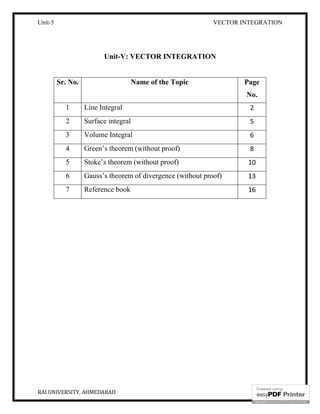
Unit-V: VECTOR INTEGRATION
Sr. No. Name of the Topic Page
No.
1 Line Integral 2
2 Surface integral 5
3 Volume Integral 6
4 Green’s theorem (without proof) 8
5 Stoke’s theorem (without proof) 10
6 Gauss’s theorem of divergence (without proof) 13
7 Reference book 16
Unit-5 VECTOR INTEGRATION
RAI UNIVERSITY, AHMEDABAD 3
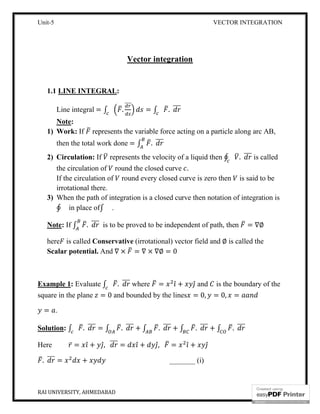
Vector integration
1.1 LINE INTEGRAL:
Line integral = ∫ .
⃗
= ∫ .
Note:
1) Work: If represents the variable force acting on a particle along arc AB,
then the total work done = ∫ .
2) Circulation: If represents the velocity of a liquid then ∮ . is called
the circulation of round the closed curve .
If the circulation of round every closed curve is zero then is said to be
irrotational there.
3) When the path of integration is a closed curve then notation of integration is
∮ in place of∫ .
Note: If ∫ . is to be proved to be independent of path, then = ∇∅
here is called Conservative (irrotational) vector field and ∅ is called the
Scalar potential. And ∇ × = ∇ × ∇∅ = 0
Example 1: Evaluate ∫ . where = ̂ + ̂ and is the boundary of the
square in the plane = 0 and bounded by the lines = 0, = 0, =
= .
Solution: ∫ . = ∫ . + ∫ . + ∫ . + ∫ .
Here ̅ = ̂ + ̂, = ̂ + ̂, = ̂ + ̂
. = + _______ (i)
Unit-5
RAI UNIVERSITY, AHMEDABAD
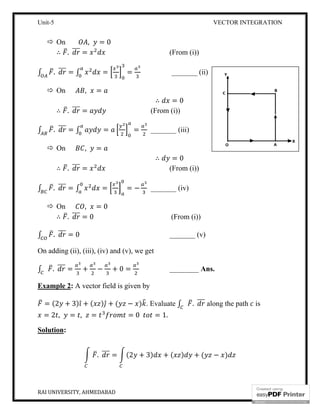
 On , = 0
∴ . =
∫ . = ∫ =
 On , =
∴ . =
∫ . = ∫ =
 On , =
∴ . =
∫ . = ∫ =
 On , = 0
∴ . = 0
∫ . = 0
On adding (ii), (iii), (iv) and (v), we
∫ . = + − + 0
Example 2: A vector field is given by
= (2 + 3) ̂ + ( ) ̂ + (
= 2 , = , =
Solution:
. =
VECTOR INTEGRATION
(From (i))
= _______ (ii)
∴ = 0
(From (i))
= _______ (iii)
∴ = 0
(From (i))
= − _______ (iv)
(From (i))
_______ (v)
On adding (ii), (iii), (iv) and (v), we get
0 = ________ Ans.
A vector field is given by
− ) . Evaluate ∫ . along the path
= 0 = 1.
(2 + 3) + ( ) + ( − )
VECTOR INTEGRATION
4
along the path is
Unit-5 VECTOR INTEGRATION
RAI UNIVERSITY, AHMEDABAD 5
= 2 = =
∴ = 2 = 1 = 3
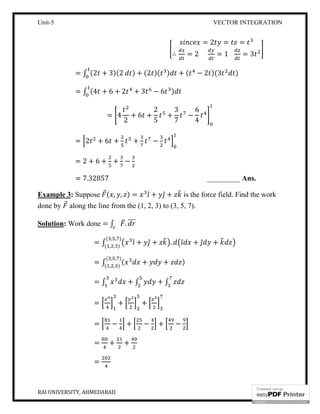
= ∫ (2 + 3)(2 ) + (2 )( ) + ( − 2 )(3 )
= ∫ (4 + 6 + 2 + 3 − 6 )
= 4
2
+ 6 +
2
5
+
3
7
−
6
4
= 2 + 6 + + −
= 2 + 6 + + −
= 7.32857 _________ Ans.
Example 3: Suppose ⃗( , , ) = ̂ + ̂ + is the force field. Find the work
done by ⃗ along the line from the (1, 2, 3) to (3, 5, 7).
Solution: Work done = ∫ .
= ∫ ̂ + ̂ + . ̂ + ̂ +
( , , )
( , , )
= ∫ ( + + )
( , , )
( , , )
= ∫ + ∫ + ∫
= + +
= − + − + −
= + +
=
Unit-5
RAI UNIVERSITY, AHMEDABAD
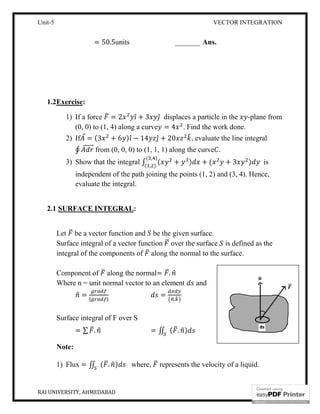
= 50.5units
1.2Exercise:
1) If a force = 2
(0, 0) to (1, 4) along a curve
2) If ⃗ = (3 + 6
∮ ⃗ ⃗ from (0, 0, 0) to (1, 1, 1) along the curve
3) Show that the integral
independent of the path joining the points (1, 2) and (3, 4). Hence,
evaluate the integral.
2.1 SURFACE INTEGRAL
Let be a vector function and
Surface integral of a vector function
integral of the components of
Component of along the normal
Where n = unit normal vector to an element
= | |
Surface integral of F over S
= ∑ .
Note:
1) Flux = ∬ ( . )
VECTOR INTEGRATION
nits _______ Ans.
2 ̂ + 3 ̂ displaces a particle in the
(0, 0) to (1, 4) along a curve = 4 . Find the work done.
6 ) ̂ − 14 ̂ + 20 , evaluate the line integral
from (0, 0, 0) to (1, 1, 1) along the curve .
Show that the integral ∫ ( + ) + ( + 3
( , )
( , )
independent of the path joining the points (1, 2) and (3, 4). Hence,
evaluate the integral.
SURFACE INTEGRAL:
be a vector function and be the given surface.
Surface integral of a vector function over the surface is defined as
integral of the components of along the normal to the surface.
along the normal= .
Where n = unit normal vector to an element and
=
.
Surface integral of F over S
= ∬ ( . )
) where, represents the velocity of a liquid.
VECTOR INTEGRATION
6
displaces a particle in the -plane from
. Find the work done.
, evaluate the line integral
) is
independent of the path joining the points (1, 2) and (3, 4). Hence,
is defined as the
along the normal to the surface.
represents the velocity of a liquid.
Unit-5 VECTOR INTEGRATION
RAI UNIVERSITY, AHMEDABAD 7
If∬ ( . ) = 0, then is said to be a Solenoidal vector point function.
3.1 VOLUME INTEGRAL:
Let be a vector point function and volume enclosed by a closed surface.
The volume integral = ∭
Example 1: Evaluate ∬ ̂ + ̂ + . where the surface of the
sphere is + + = in the first octant.
Solution: Here, ∅ = + + −
Vector normal to the surface = ∇∅
= ̂
∅
+ ̂
∅
+
∅
= ̂ + ̂ + ( + + − )
= 2 ̂ + 2 ̂ + 2
=
∇∅
|∇∅|
=
̂ ̂
=
̂ ̂
=
̂ ̂
[∵ + + = ]
Here, ⃗ = ̂ + ̂ +
Unit-5 VECTOR INTEGRATION
RAI UNIVERSITY, AHMEDABAD 8
⃗. = ̂ + ̂ + .
̂ ̂
=
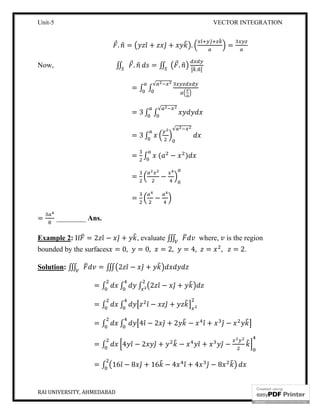
Now, ∬ ⃗. = ∬ ⃗.
.
= ∫ ∫
√
= 3 ∫ ∫
√
= 3 ∫
√
= ∫ ( − )
= −
= −
= ________ Ans.
Example 2: If = 2 ̂ − ̂ + , evaluate ∭ where, is the region
bounded by the surfaces = 0, = 0, = 2, = 4, = , = 2.
Solution: ∭ = ∭ 2 ̂ − ̂ +
= ∫ ∫ ∫ 2 ̂ − ̂ +
= ∫ ∫ ̂ − ̂ +
= ∫ ∫ 4 ̂ − 2 ̂ + 2 − ̂ + ̂ −
= ∫ 4 ̂ − 2 ̂ + − ̂ + ̂ −
= ∫ 16 ̂ − 8 ̂ + 16 − 4 ̂ + 4 ̂ − 8
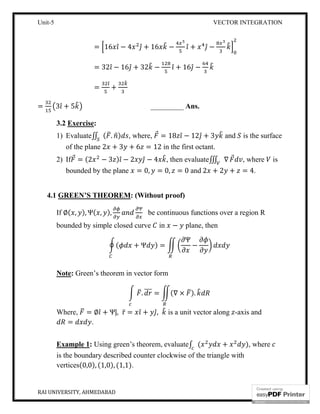
Unit-5 VECTOR INTEGRATION
RAI UNIVERSITY, AHMEDABAD 9
= 16 ̂ − 4 ̂ + 16 − ̂ + ̂ −
= 32 ̂ − 16 ̂ + 32 − ̂ + 16 ̂ −
=
̂
+
= 3 ̂ + 5 _________ Ans.
3.2 Exercise:
1) Evaluate∬ ( . ) , where, ⃗ = 18 ̂ − 12 ̂ + 3 and is the surface
of the plane 2 + 3 + 6 = 12 in the first octant.
2) If ⃗ = (2 − 3 ) ̂ − 2 ̂ − 4 , then evaluate∭ ∇ ⃗ , where is
bounded by the plane = 0, = 0, = 0 and 2 + 2 + = 4.
4.1 GREEN’S THEOREM: (Without proof)
If ∅( , ), Ψ( , ),
Ψ
be continuous functions over a region R
bounded by simple closed curve in − plane, then
( + Ψ ) =
Ψ
−
Note: Green’s theorem in vector form
. = (∇ × ).
Where, = ∅ ̂ + Ψȷ̂, r̅ = ̂ + ̂, is a unit vector along -axis and
= .
Example 1: Using green’s theorem, evaluate∫ ( + ), where
is the boundary described counter clockwise of the triangle with
vertices(0,0), (1,0), (1,1).
Unit-5
RAI UNIVERSITY, AHMEDABAD
Solution: By green’s theorem, we
(
(
=
=
=
=
=
=
Example 2: Use green’s theorem to evaluate
∫ ( + ) + (
= ±1, = ±1.
Solution: By green’s theorem, we have
(
=
=
=
=
VECTOR INTEGRATION
: By green’s theorem, we have
( + Ψ ) =
Ψ
−
( + ) = (2 − )
∫ (2 − ) ∫
∫ (2 − ) [ ]
∫ (2 − )
−
−
_______ Ans.
Use green’s theorem to evaluate
+ ) , where c is the square formed by the lines
By green’s theorem, we have
( + Ψ ) =
Ψ
−
∫ ∫ ( + ) − ( + )
∫ ∫ (2 − )
∫ ∫
∫ ∫
VECTOR INTEGRATION
10
Ans.
, where c is the square formed by the lines
Unit-5
RAI UNIVERSITY, AHMEDABAD
=
=
=
=
=
=
4.2 Exercise:
1) Apply Green’s theorem to evaluate
∫ [(2 − )
enclosed by the -
2) A vector field
Evaluate the line integral
by + = .
5.1 STOKE’S THEOREM
integral)
Surface integral of the component of curl
taken over the surface
the vector point function
Mathematically
∮ . = ∬
VECTOR INTEGRATION
∫ ( )
∫ (1 + 1)
∫ 2
( )
1 − 1
0________ Ans.
Apply Green’s theorem to evaluate
) + ( + ) ], where is the boundary of the area
-axis and the upper half of circle + =
is given by = sin ̂ + (1 + cos )
Evaluate the line integral ∫ . where is the circular path given
THEOREM:(Relation between Line integral and Surface
(Without Proof)
Surface integral of the component of curl along the normal to the surface
taken over the surface bounded by curve is equal to the line integral of
the vector point function taken along the closed curve .
.
VECTOR INTEGRATION
11
is the boundary of the area
= .
̂.
is the circular path given
:(Relation between Line integral and Surface
(Without Proof)
along the normal to the surface ,
is equal to the line integral of
Unit-5 VECTOR INTEGRATION
RAI UNIVERSITY, AHMEDABAD 12
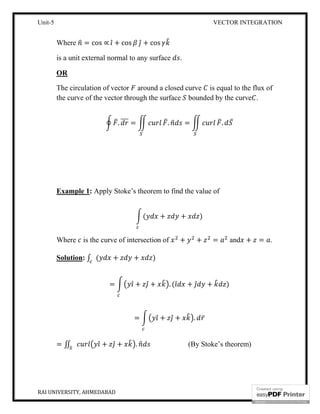
Where = cos ∝ ̂ + cos ̂ + cos
is a unit external normal to any surface .
OR
The circulation of vector around a closed curve is equal to the flux of
the curve of the vector through the surface bounded by the curve .
. = . = . ̅
Example 1: Apply Stoke’s theorem to find the value of
( + + )
Where is the curve of intersection of + + = and + = .
Solution: ∫ ( + + )
= ̂ + ̂ + . ( ̂ + ̂ + )
= ̂ + ̂ + . ̅
= ∬ ̂ + ̂ + . (By Stoke’s theorem)
Unit-5
RAI UNIVERSITY, AHMEDABAD
= ̂
= ∬ – ( ̂ + ̂ + ).
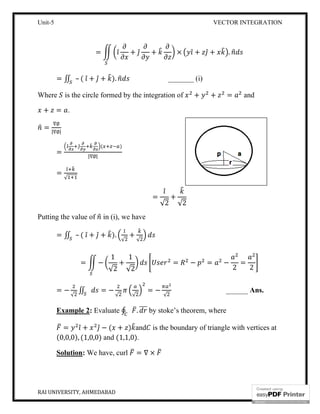
Where is the circle formed by the integration of
+ = .
=
∇∅
|∇∅|
=
̂ ̂ (
|∇∅|
=
̂
√
Putting the value of in (i), we have
= ∬ – ( ̂ + ̂ + ).
= −
1
√2
+
= −
√
∬ = −
√
Example 2: Evaluate
= ̂ + ̂ − ( +
(0,0,0), (1,0,0) and (1
Solution: We have, curl
VECTOR INTEGRATION
̂ + ̂ + × ̂ + ̂ + .
_______ (i)
is the circle formed by the integration of + + =
)
=
̂
√2
+
√2
in (i), we have
̂
√
+
√
+
1
√2
= − = −
2
√
= −
√
______
Evaluate ∮ . by stoke’s theorem, where
+ ) and is the boundary of triangle with vertices at
1,1,0).
We have, curl = ∇ ×
VECTOR INTEGRATION
13
and
=
2
______ Ans.
is the boundary of triangle with vertices at
Unit-5 VECTOR INTEGRATION
RAI UNIVERSITY, AHMEDABAD 14
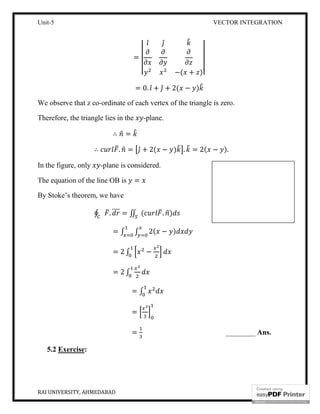
=
̂ ̂
−( + )
= 0. ̂ + ̂ + 2( − )
We observe that z co-ordinate of each vertex of the triangle is zero.
Therefore, the triangle lies in the -plane.
∴ =
∴ . = ̂ + 2( − ) . = 2( − ).
In the figure, only -plane is considered.
The equation of the line OB is =
By Stoke’s theorem, we have
∮ . = ∬ ( . )
= ∫ ∫ 2( − )
= 2 ∫ −
= 2 ∫
= ∫
=
= ________ Ans.
5.2 Exercise:
Unit-5 VECTOR INTEGRATION
RAI UNIVERSITY, AHMEDABAD 15
1) Use the Stoke’s theorem to evaluate ∫ [( + 2 ) + ( − ) +
( − ) ] where is the boundary of the triangle with vertices
(2,0,0), (0,3,0) (0,0,6) oriented in the anti-clockwise direction.
2) Apply Stoke’s theorem to calculate ∫ 4 + 2 + 6
Where is the curve of intersection of + + = 6 and
= + 3
3) Use the Stoke’s theorem to evaluate∫ + + ,
where is the bounding curve of the hemisphere + + = 1,
≥ 0, oriented in the positive direction.
6.1 GAUSS’S THEOREM OF DIVERGENCE: (Without Proof)
The surface integral of the normal component of a vector function taken
around a closed surface is equal to the integral of the divergence of
taken over the volume enclosed by the surface .
Mathematically
⃗. = ⃗
Example 1: Evaluate ∬ ⃗. where ⃗ = 4 ̂ − ̂ + and is the
surface of the cube bounded by = 0, = 1, = 0, = 1, = 0, = 1.
Solution: By Gauss’s divergence theorem,
∬ ⃗. = ∭ ∇. ⃗
= ∭ ̂ + ̂ + . 4 ̂ − ̂ +
= ∭ (4 ) + (− ) + ( )
= ∭ (4 − 2 + )
= ∭ (4 − )
= ∫ ∫ −
Unit-5
RAI UNIVERSITY, AHMEDABAD
=
=
=
=
=
=
=
Example 2: Evaluate surface integral
) ̂ + ̂ + , is the surface of the tetrahedron
+ = 2 and n is the unit normal in the outward direction to the closed
surface .
Solution: By gauss’s divergence theorem,
Where is the surface of tetrahedron
= ∭ ̂ + ̂ +
= ∭ (2 + 2 + 2
=
VECTOR INTEGRATION
∫ ∫ (2 − )
∫ ∫ (2 − )
∫ 2 −
∫
[ ]
(1)
________ Ans.
Evaluate surface integral ∬ ⃗. , where ⃗ = (
is the surface of the tetrahedron = 0, =
and n is the unit normal in the outward direction to the closed
By gauss’s divergence theorem,
⃗. = ⃗.
is the surface of tetrahedron = 0, = 0, = 0, +
. ( + + ) ̂ + ̂ +
)
= 2 ( + + )
2 ( + + )
VECTOR INTEGRATION
16
Ans.
( + +
0, = 0, +
and n is the unit normal in the outward direction to the closed
+ = 2
Unit-5 VECTOR INTEGRATION
RAI UNIVERSITY, AHMEDABAD 17
= 2 + +
2
= 2 2 − − + 2 − − +
(2 − − )
2
= 2 2 − − + −
3
−
(2 − − )
6
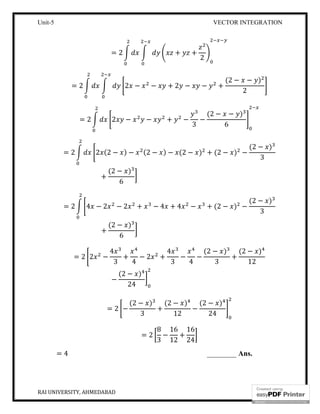
= 2 2 (2 − ) − (2 − ) − (2 − ) + (2 − ) −
(2 − )
3
+
(2 − )
6
= 2 4 − 2 − 2 + − 4 + 4 − + (2 − ) −
(2 − )
3
+
(2 − )
6
= 2 2 −
4
3
+
4
− 2 +
4
3
−
4
−
(2 − )
3
+
(2 − )
12
−
(2 − )
24
= 2 −
(2 − )
3
+
(2 − )
12
−
(2 − )
24
= 2
8
3
−
16
12
+
16
24
= 4 ________ Ans.
Unit-5 VECTOR INTEGRATION
RAI UNIVERSITY, AHMEDABAD 18
6.2 Exercise:
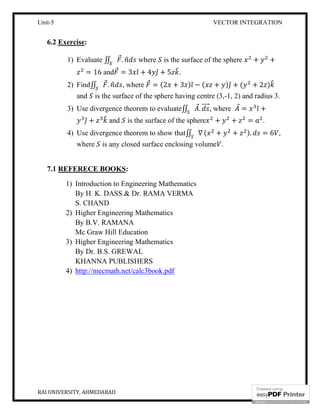
1) Evaluate ∬ ⃗. where is the surface of the sphere + +
= 16 and ⃗ = 3 ̂ + 4 ̂ + 5 .
2) Find∬ ⃗. , where ⃗ = (2 + 3 ) ̂ − ( + ) ̂ + ( + 2 )
and is the surface of the sphere having centre (3,-1, 2) and radius 3.
3) Use divergence theorem to evaluate∬ ⃗. ⃗, where ⃗ = ̂ +
̂ + and is the surface of the sphere + + = .
4) Use divergence theorem to show that∬ ∇ ( + + ). = 6 ,
where is any closed surface enclosing volume .
7.1 REFERECE BOOKS:
1) Introduction to Engineering Mathematics
By H. K. DASS.& Dr. RAMA VERMA
S. CHAND
2) Higher Engineering Mathematics
By B.V. RAMANA
Mc Graw Hill Education
3) Higher Engineering Mathematics
By Dr. B.S. GREWAL
KHANNA PUBLISHERS
4) http://mecmath.net/calc3book.pdf

B.Tech-II_Unit-V

  • 1.
    Unit-5 VECTOR INTEGRATION RAIUNIVERSITY, AHMEDABAD 1 Course: B.Tech- II Subject: Engineering Mathematics II Unit-5 RAI UNIVERSITY, AHMEDABAD
  • 2.
    Unit-5 VECTOR INTEGRATION RAIUNIVERSITY, AHMEDABAD 2 Unit-V: VECTOR INTEGRATION Sr. No. Name of the Topic Page No. 1 Line Integral 2 2 Surface integral 5 3 Volume Integral 6 4 Green’s theorem (without proof) 8 5 Stoke’s theorem (without proof) 10 6 Gauss’s theorem of divergence (without proof) 13 7 Reference book 16
  • 3.
    Unit-5 VECTOR INTEGRATION RAIUNIVERSITY, AHMEDABAD 3 Vector integration 1.1 LINE INTEGRAL: Line integral = ∫ . ⃗ = ∫ . Note: 1) Work: If represents the variable force acting on a particle along arc AB, then the total work done = ∫ . 2) Circulation: If represents the velocity of a liquid then ∮ . is called the circulation of round the closed curve . If the circulation of round every closed curve is zero then is said to be irrotational there. 3) When the path of integration is a closed curve then notation of integration is ∮ in place of∫ . Note: If ∫ . is to be proved to be independent of path, then = ∇∅ here is called Conservative (irrotational) vector field and ∅ is called the Scalar potential. And ∇ × = ∇ × ∇∅ = 0 Example 1: Evaluate ∫ . where = ̂ + ̂ and is the boundary of the square in the plane = 0 and bounded by the lines = 0, = 0, = = . Solution: ∫ . = ∫ . + ∫ . + ∫ . + ∫ . Here ̅ = ̂ + ̂, = ̂ + ̂, = ̂ + ̂ . = + _______ (i)
  • 4.
    Unit-5 RAI UNIVERSITY, AHMEDABAD On , = 0 ∴ . = ∫ . = ∫ =  On , = ∴ . = ∫ . = ∫ =  On , = ∴ . = ∫ . = ∫ =  On , = 0 ∴ . = 0 ∫ . = 0 On adding (ii), (iii), (iv) and (v), we ∫ . = + − + 0 Example 2: A vector field is given by = (2 + 3) ̂ + ( ) ̂ + ( = 2 , = , = Solution: . = VECTOR INTEGRATION (From (i)) = _______ (ii) ∴ = 0 (From (i)) = _______ (iii) ∴ = 0 (From (i)) = − _______ (iv) (From (i)) _______ (v) On adding (ii), (iii), (iv) and (v), we get 0 = ________ Ans. A vector field is given by − ) . Evaluate ∫ . along the path = 0 = 1. (2 + 3) + ( ) + ( − ) VECTOR INTEGRATION 4 along the path is
  • 5.
    Unit-5 VECTOR INTEGRATION RAIUNIVERSITY, AHMEDABAD 5 = 2 = = ∴ = 2 = 1 = 3 = ∫ (2 + 3)(2 ) + (2 )( ) + ( − 2 )(3 ) = ∫ (4 + 6 + 2 + 3 − 6 ) = 4 2 + 6 + 2 5 + 3 7 − 6 4 = 2 + 6 + + − = 2 + 6 + + − = 7.32857 _________ Ans. Example 3: Suppose ⃗( , , ) = ̂ + ̂ + is the force field. Find the work done by ⃗ along the line from the (1, 2, 3) to (3, 5, 7). Solution: Work done = ∫ . = ∫ ̂ + ̂ + . ̂ + ̂ + ( , , ) ( , , ) = ∫ ( + + ) ( , , ) ( , , ) = ∫ + ∫ + ∫ = + + = − + − + − = + + =
  • 6.
    Unit-5 RAI UNIVERSITY, AHMEDABAD =50.5units 1.2Exercise: 1) If a force = 2 (0, 0) to (1, 4) along a curve 2) If ⃗ = (3 + 6 ∮ ⃗ ⃗ from (0, 0, 0) to (1, 1, 1) along the curve 3) Show that the integral independent of the path joining the points (1, 2) and (3, 4). Hence, evaluate the integral. 2.1 SURFACE INTEGRAL Let be a vector function and Surface integral of a vector function integral of the components of Component of along the normal Where n = unit normal vector to an element = | | Surface integral of F over S = ∑ . Note: 1) Flux = ∬ ( . ) VECTOR INTEGRATION nits _______ Ans. 2 ̂ + 3 ̂ displaces a particle in the (0, 0) to (1, 4) along a curve = 4 . Find the work done. 6 ) ̂ − 14 ̂ + 20 , evaluate the line integral from (0, 0, 0) to (1, 1, 1) along the curve . Show that the integral ∫ ( + ) + ( + 3 ( , ) ( , ) independent of the path joining the points (1, 2) and (3, 4). Hence, evaluate the integral. SURFACE INTEGRAL: be a vector function and be the given surface. Surface integral of a vector function over the surface is defined as integral of the components of along the normal to the surface. along the normal= . Where n = unit normal vector to an element and = . Surface integral of F over S = ∬ ( . ) ) where, represents the velocity of a liquid. VECTOR INTEGRATION 6 displaces a particle in the -plane from . Find the work done. , evaluate the line integral ) is independent of the path joining the points (1, 2) and (3, 4). Hence, is defined as the along the normal to the surface. represents the velocity of a liquid.
  • 7.
    Unit-5 VECTOR INTEGRATION RAIUNIVERSITY, AHMEDABAD 7 If∬ ( . ) = 0, then is said to be a Solenoidal vector point function. 3.1 VOLUME INTEGRAL: Let be a vector point function and volume enclosed by a closed surface. The volume integral = ∭ Example 1: Evaluate ∬ ̂ + ̂ + . where the surface of the sphere is + + = in the first octant. Solution: Here, ∅ = + + − Vector normal to the surface = ∇∅ = ̂ ∅ + ̂ ∅ + ∅ = ̂ + ̂ + ( + + − ) = 2 ̂ + 2 ̂ + 2 = ∇∅ |∇∅| = ̂ ̂ = ̂ ̂ = ̂ ̂ [∵ + + = ] Here, ⃗ = ̂ + ̂ +
  • 8.
    Unit-5 VECTOR INTEGRATION RAIUNIVERSITY, AHMEDABAD 8 ⃗. = ̂ + ̂ + . ̂ ̂ = Now, ∬ ⃗. = ∬ ⃗. . = ∫ ∫ √ = 3 ∫ ∫ √ = 3 ∫ √ = ∫ ( − ) = − = − = ________ Ans. Example 2: If = 2 ̂ − ̂ + , evaluate ∭ where, is the region bounded by the surfaces = 0, = 0, = 2, = 4, = , = 2. Solution: ∭ = ∭ 2 ̂ − ̂ + = ∫ ∫ ∫ 2 ̂ − ̂ + = ∫ ∫ ̂ − ̂ + = ∫ ∫ 4 ̂ − 2 ̂ + 2 − ̂ + ̂ − = ∫ 4 ̂ − 2 ̂ + − ̂ + ̂ − = ∫ 16 ̂ − 8 ̂ + 16 − 4 ̂ + 4 ̂ − 8
  • 9.
    Unit-5 VECTOR INTEGRATION RAIUNIVERSITY, AHMEDABAD 9 = 16 ̂ − 4 ̂ + 16 − ̂ + ̂ − = 32 ̂ − 16 ̂ + 32 − ̂ + 16 ̂ − = ̂ + = 3 ̂ + 5 _________ Ans. 3.2 Exercise: 1) Evaluate∬ ( . ) , where, ⃗ = 18 ̂ − 12 ̂ + 3 and is the surface of the plane 2 + 3 + 6 = 12 in the first octant. 2) If ⃗ = (2 − 3 ) ̂ − 2 ̂ − 4 , then evaluate∭ ∇ ⃗ , where is bounded by the plane = 0, = 0, = 0 and 2 + 2 + = 4. 4.1 GREEN’S THEOREM: (Without proof) If ∅( , ), Ψ( , ), Ψ be continuous functions over a region R bounded by simple closed curve in − plane, then ( + Ψ ) = Ψ − Note: Green’s theorem in vector form . = (∇ × ). Where, = ∅ ̂ + Ψȷ̂, r̅ = ̂ + ̂, is a unit vector along -axis and = . Example 1: Using green’s theorem, evaluate∫ ( + ), where is the boundary described counter clockwise of the triangle with vertices(0,0), (1,0), (1,1).
  • 10.
    Unit-5 RAI UNIVERSITY, AHMEDABAD Solution:By green’s theorem, we ( ( = = = = = = Example 2: Use green’s theorem to evaluate ∫ ( + ) + ( = ±1, = ±1. Solution: By green’s theorem, we have ( = = = = VECTOR INTEGRATION : By green’s theorem, we have ( + Ψ ) = Ψ − ( + ) = (2 − ) ∫ (2 − ) ∫ ∫ (2 − ) [ ] ∫ (2 − ) − − _______ Ans. Use green’s theorem to evaluate + ) , where c is the square formed by the lines By green’s theorem, we have ( + Ψ ) = Ψ − ∫ ∫ ( + ) − ( + ) ∫ ∫ (2 − ) ∫ ∫ ∫ ∫ VECTOR INTEGRATION 10 Ans. , where c is the square formed by the lines
  • 11.
    Unit-5 RAI UNIVERSITY, AHMEDABAD = = = = = = 4.2Exercise: 1) Apply Green’s theorem to evaluate ∫ [(2 − ) enclosed by the - 2) A vector field Evaluate the line integral by + = . 5.1 STOKE’S THEOREM integral) Surface integral of the component of curl taken over the surface the vector point function Mathematically ∮ . = ∬ VECTOR INTEGRATION ∫ ( ) ∫ (1 + 1) ∫ 2 ( ) 1 − 1 0________ Ans. Apply Green’s theorem to evaluate ) + ( + ) ], where is the boundary of the area -axis and the upper half of circle + = is given by = sin ̂ + (1 + cos ) Evaluate the line integral ∫ . where is the circular path given THEOREM:(Relation between Line integral and Surface (Without Proof) Surface integral of the component of curl along the normal to the surface taken over the surface bounded by curve is equal to the line integral of the vector point function taken along the closed curve . . VECTOR INTEGRATION 11 is the boundary of the area = . ̂. is the circular path given :(Relation between Line integral and Surface (Without Proof) along the normal to the surface , is equal to the line integral of
  • 12.
    Unit-5 VECTOR INTEGRATION RAIUNIVERSITY, AHMEDABAD 12 Where = cos ∝ ̂ + cos ̂ + cos is a unit external normal to any surface . OR The circulation of vector around a closed curve is equal to the flux of the curve of the vector through the surface bounded by the curve . . = . = . ̅ Example 1: Apply Stoke’s theorem to find the value of ( + + ) Where is the curve of intersection of + + = and + = . Solution: ∫ ( + + ) = ̂ + ̂ + . ( ̂ + ̂ + ) = ̂ + ̂ + . ̅ = ∬ ̂ + ̂ + . (By Stoke’s theorem)
  • 13.
    Unit-5 RAI UNIVERSITY, AHMEDABAD =̂ = ∬ – ( ̂ + ̂ + ). Where is the circle formed by the integration of + = . = ∇∅ |∇∅| = ̂ ̂ ( |∇∅| = ̂ √ Putting the value of in (i), we have = ∬ – ( ̂ + ̂ + ). = − 1 √2 + = − √ ∬ = − √ Example 2: Evaluate = ̂ + ̂ − ( + (0,0,0), (1,0,0) and (1 Solution: We have, curl VECTOR INTEGRATION ̂ + ̂ + × ̂ + ̂ + . _______ (i) is the circle formed by the integration of + + = ) = ̂ √2 + √2 in (i), we have ̂ √ + √ + 1 √2 = − = − 2 √ = − √ ______ Evaluate ∮ . by stoke’s theorem, where + ) and is the boundary of triangle with vertices at 1,1,0). We have, curl = ∇ × VECTOR INTEGRATION 13 and = 2 ______ Ans. is the boundary of triangle with vertices at
  • 14.
    Unit-5 VECTOR INTEGRATION RAIUNIVERSITY, AHMEDABAD 14 = ̂ ̂ −( + ) = 0. ̂ + ̂ + 2( − ) We observe that z co-ordinate of each vertex of the triangle is zero. Therefore, the triangle lies in the -plane. ∴ = ∴ . = ̂ + 2( − ) . = 2( − ). In the figure, only -plane is considered. The equation of the line OB is = By Stoke’s theorem, we have ∮ . = ∬ ( . ) = ∫ ∫ 2( − ) = 2 ∫ − = 2 ∫ = ∫ = = ________ Ans. 5.2 Exercise:
  • 15.
    Unit-5 VECTOR INTEGRATION RAIUNIVERSITY, AHMEDABAD 15 1) Use the Stoke’s theorem to evaluate ∫ [( + 2 ) + ( − ) + ( − ) ] where is the boundary of the triangle with vertices (2,0,0), (0,3,0) (0,0,6) oriented in the anti-clockwise direction. 2) Apply Stoke’s theorem to calculate ∫ 4 + 2 + 6 Where is the curve of intersection of + + = 6 and = + 3 3) Use the Stoke’s theorem to evaluate∫ + + , where is the bounding curve of the hemisphere + + = 1, ≥ 0, oriented in the positive direction. 6.1 GAUSS’S THEOREM OF DIVERGENCE: (Without Proof) The surface integral of the normal component of a vector function taken around a closed surface is equal to the integral of the divergence of taken over the volume enclosed by the surface . Mathematically ⃗. = ⃗ Example 1: Evaluate ∬ ⃗. where ⃗ = 4 ̂ − ̂ + and is the surface of the cube bounded by = 0, = 1, = 0, = 1, = 0, = 1. Solution: By Gauss’s divergence theorem, ∬ ⃗. = ∭ ∇. ⃗ = ∭ ̂ + ̂ + . 4 ̂ − ̂ + = ∭ (4 ) + (− ) + ( ) = ∭ (4 − 2 + ) = ∭ (4 − ) = ∫ ∫ −
  • 16.
    Unit-5 RAI UNIVERSITY, AHMEDABAD = = = = = = = Example2: Evaluate surface integral ) ̂ + ̂ + , is the surface of the tetrahedron + = 2 and n is the unit normal in the outward direction to the closed surface . Solution: By gauss’s divergence theorem, Where is the surface of tetrahedron = ∭ ̂ + ̂ + = ∭ (2 + 2 + 2 = VECTOR INTEGRATION ∫ ∫ (2 − ) ∫ ∫ (2 − ) ∫ 2 − ∫ [ ] (1) ________ Ans. Evaluate surface integral ∬ ⃗. , where ⃗ = ( is the surface of the tetrahedron = 0, = and n is the unit normal in the outward direction to the closed By gauss’s divergence theorem, ⃗. = ⃗. is the surface of tetrahedron = 0, = 0, = 0, + . ( + + ) ̂ + ̂ + ) = 2 ( + + ) 2 ( + + ) VECTOR INTEGRATION 16 Ans. ( + + 0, = 0, + and n is the unit normal in the outward direction to the closed + = 2
  • 17.
    Unit-5 VECTOR INTEGRATION RAIUNIVERSITY, AHMEDABAD 17 = 2 + + 2 = 2 2 − − + 2 − − + (2 − − ) 2 = 2 2 − − + − 3 − (2 − − ) 6 = 2 2 (2 − ) − (2 − ) − (2 − ) + (2 − ) − (2 − ) 3 + (2 − ) 6 = 2 4 − 2 − 2 + − 4 + 4 − + (2 − ) − (2 − ) 3 + (2 − ) 6 = 2 2 − 4 3 + 4 − 2 + 4 3 − 4 − (2 − ) 3 + (2 − ) 12 − (2 − ) 24 = 2 − (2 − ) 3 + (2 − ) 12 − (2 − ) 24 = 2 8 3 − 16 12 + 16 24 = 4 ________ Ans.
  • 18.
    Unit-5 VECTOR INTEGRATION RAIUNIVERSITY, AHMEDABAD 18 6.2 Exercise: 1) Evaluate ∬ ⃗. where is the surface of the sphere + + = 16 and ⃗ = 3 ̂ + 4 ̂ + 5 . 2) Find∬ ⃗. , where ⃗ = (2 + 3 ) ̂ − ( + ) ̂ + ( + 2 ) and is the surface of the sphere having centre (3,-1, 2) and radius 3. 3) Use divergence theorem to evaluate∬ ⃗. ⃗, where ⃗ = ̂ + ̂ + and is the surface of the sphere + + = . 4) Use divergence theorem to show that∬ ∇ ( + + ). = 6 , where is any closed surface enclosing volume . 7.1 REFERECE BOOKS: 1) Introduction to Engineering Mathematics By H. K. DASS.& Dr. RAMA VERMA S. CHAND 2) Higher Engineering Mathematics By B.V. RAMANA Mc Graw Hill Education 3) Higher Engineering Mathematics By Dr. B.S. GREWAL KHANNA PUBLISHERS 4) http://mecmath.net/calc3book.pdf