Chapter 7.
Iterative Solutions of Systems
         of Equations
         of Equations

       EFLUM – ENAC ‐ EPFL
Contents
1.
1 Introduction
2. First example: Scalar Equation
3.
3 Iterative solutions of a system of equations: 
          i    l i     f             f      i
   Jacobi iteration method
4. Iterative methods for finite difference 
   equations: Back to problem 6.3
5. The Successive Over Relaxation (SOR)
Introduction: The fixed point iteration
                            p


Previous Method (used on previous class)
Uses Gaussian Elimination (or “” in MatLab)
Introduction: The fixed point iteration
                                        p

The main concept:                            xk +1 = g ( xk )
 Example:
                                                                            xk
3x = 6                        2x + x = 6                           xk +1 = − + 3
 X0 = 4
      4
                                                                            2
                3.5

                 3
  Value of xn


                2.5
         f


                 2

                1.5

 X0 = 1
      1

                0.5

 X0 = 00
      0
                      1   2   3   4         5          6   7   8    9   10
                                      Iteration step
Introduction: The fixed point iteration
                           p
                                     xk
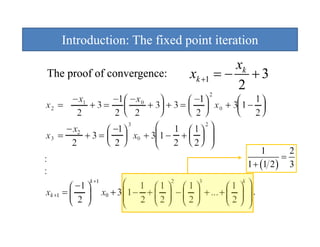
The proof of convergence:   xk +1 = − + 3
                                     2


                                           1       2
                                                 =
                                       1 + (1 2 ) 3
Introduction: The fixed point iteration
                                  p

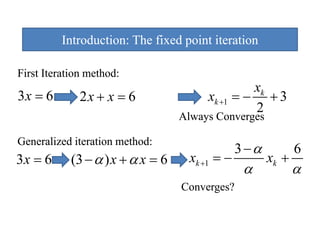
First Iteration method:
                                                 xk
3x = 6        2x + x = 6                xk +1 = − + 3
                                                 2
                                   Always Converges

Generalized iteration method:
G     li d it ti        th d
                                                3 −α          6
3x = 6      (3 − α ) x + α x = 6    xk +1 = −          xk +
                                                 α            α
                                   Converges?
Introduction: The fixed point iteration
                                                                   p
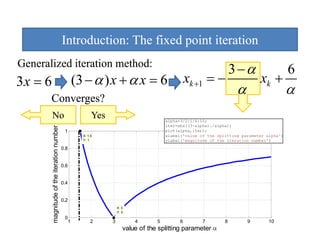
Generalized iteration method:
                                                                                                                  3 −α            6
3x = 6                                               (3 − α ) x + α x = 6                        xk +1 = −                 xk +
                                                                                                                   α              α
       Converges?
         No                                                 Yes
                                    mber


                                            1
                         teration num


                                                       X: 1.5
                                                       Y:
                                                       Y 1

                                           0.8


                                           0.6
         magnitu of the it


                                           0.4
               ude


                                           0.2
                                                                      X: 3
                                                                      Y: 0
                                            0
                                                 1         2      3          4       5       6       7        8        9    10
                                                                         value of the splitting parameter α
Introduction: The fixed point iteration
                                 p
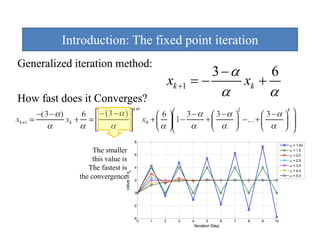
Generalized iteration method:
                                                                             3 −α                   6
                                                             xk +1 = −                      xk +
How fast does it Converges?
                                                                                    α               α


                                            8
                                                                                                         α   = 1.42
                  The smaller                                                                            α   = 1.5
                                            6                                                            α   = 2.0
                  this value is                                                                          α   = 2.5
                                                                                                         α   = 3.0
                The fastest is              4
                                                                                                         α   =40
                                                                                                               4.0
                              value of xn


             the convergence                                                                             α   = 5.0
                                            2


                                            0


                                            -2


                                            -4
                                                 0   1   2     3   4     5          6   7   8   9   10
                                                                   Iteration Step
Iterative solution of a system of equations
                              y         q
                  Jacobi interaction approach
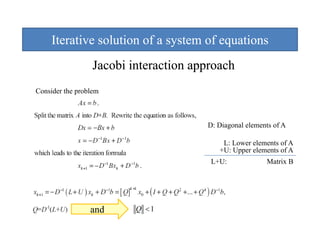
Consider the problem


                                       D: Diagonal elements of A

                                           L: Lower elements of A
                                          +U: Upper elements of A
                                        L+U:             Matrix B


                 and      Q <1
Iterative solution of a system of equations
                         y         q
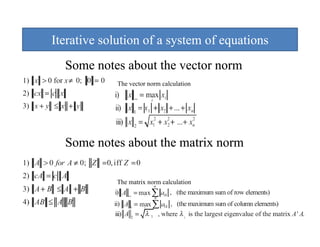
  Some notes about the vector norm
             The vector norm calculation


  Some notes about the matrix norm
  S      t    b t th     ti

            The matrix norm calculation
Iterative solution of a system of equations
                         y         q
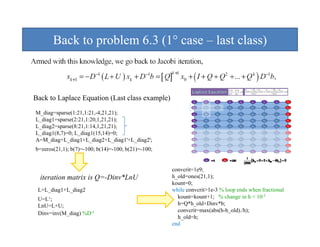
Back to problem 6.3 ( ° case – last class)
               p           (1°
                           (1                   )


Back to Laplace Equation (Last class example)
M_diag=sparse(1:21,1:21,-4,21,21);
L_diag1=sparse(2:21,1:20,1,21,21);
L_diag2=sparse(8:21,1:14,1,21,21);
L_diag1(8,7)=0; L_diag1(15,14)=0;
A=M_diag+L_diag1+L_diag2+L_diag1'+L_diag2';
A M di +L di 1+L di 2+L di 1'+L di 2'
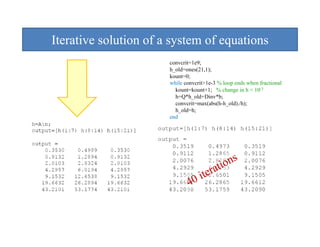
b=zeros(21,1); b(7)=-100; b(14)=-100; b(21)=-100;


                                                    convcrit 1e9;
                                                    convcrit=1e9;
  iteration matrix is Q=-Dinv*LnU                   h_old=ones(21,1);
                                                    kount=0;
 L=L_diag1+L_diag2                                  while convcrit>1e-3 % loop ends when fractional
 U=L‘;
     ;                                                kount=kount+1; % change in h < 10-3
 LnU=L+U;                                             h=Q*h_old+Dinv*b;
                                                      convcrit=max(abs(h-h_old)./h);
 Dinv=inv(M_diag) %D-1
                                                      h_old=h;
                                                    end
Iterative solution of a system of equations
                         y         q
                       convcrit=1e9;
                       h_old=ones(21,1);
                       kount=0;
                       while convcrit>1e-3 % loop ends when fractional
                         kount=kount+1; % change in h < 10-3
                         h=Q*h_old+Dinv*b;
                         convcrit=max(abs(h-h_old)./h);
                         h_old=h;
                       end
Successive over relaxation method
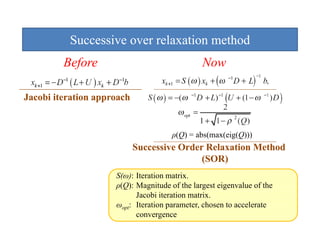
         Before                                Now

Jacobi iteration approach


                                      ρ(Q) = abs(max(eig(Q)))
                                                (   ( g(Q)))
                            Successive Order Relaxation Method
                                            (SOR)
                     S(ω): Iteration matrix.
                     ρ(Q): Magnitude of the largest eigenvalue of the
                           Jacobi iteration matrix.
                     ωopt: Iteration parameter, chosen to accelerate
                           convergence
Iterative solution of a system of equations
                               y         q
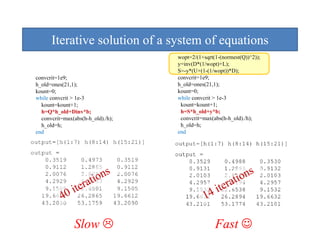
                                   wopt=2/(1+sqrt(1-(normest(Q))^2));
                                   y=inv(D*(1/wopt)+L);
                                   S=-y*(U+(1-(1/wopt))*D);
convcrit=1e9;
       it 1 9                             it 1 9
                                   convcrit=1e9;
h_old=ones(21,1);                  h_old=ones(21,1);
kount=0;                           kount=0;
while convcrit > 1e-3              while convcrit > 1e-3
  kount=kount+1;                    kount=kount+1;
  h=Q*h_old+Dinv*b;                 h=S*h_old+y*b;
  convcrit=max(abs(h-h_old)./h);    convcrit=max(abs(h-h_old)./h);
  h_old=h;                          h_old=h;
end                                end


               Slow                               Fast ☺

METHOD OF JACOBI

  • 1.
    Chapter 7. Iterative Solutions of Systems of Equations of Equations EFLUM – ENAC ‐ EPFL
  • 2.
    Contents 1. 1 Introduction 2. First example: Scalar Equation 3. 3Iterative solutions of a system of equations:  i l i f f i Jacobi iteration method 4. Iterative methods for finite difference  equations: Back to problem 6.3 5. The Successive Over Relaxation (SOR)
  • 3.
    Introduction: The fixedpoint iteration p Previous Method (used on previous class) Uses Gaussian Elimination (or “” in MatLab)
  • 4.
    Introduction: The fixedpoint iteration p The main concept: xk +1 = g ( xk ) Example: xk 3x = 6 2x + x = 6 xk +1 = − + 3 X0 = 4 4 2 3.5 3 Value of xn 2.5 f 2 1.5 X0 = 1 1 0.5 X0 = 00 0 1 2 3 4 5 6 7 8 9 10 Iteration step
  • 5.
    Introduction: The fixedpoint iteration p xk The proof of convergence: xk +1 = − + 3 2 1 2 = 1 + (1 2 ) 3
  • 6.
    Introduction: The fixedpoint iteration p First Iteration method: xk 3x = 6 2x + x = 6 xk +1 = − + 3 2 Always Converges Generalized iteration method: G li d it ti th d 3 −α 6 3x = 6 (3 − α ) x + α x = 6 xk +1 = − xk + α α Converges?
  • 7.
    Introduction: The fixedpoint iteration p Generalized iteration method: 3 −α 6 3x = 6 (3 − α ) x + α x = 6 xk +1 = − xk + α α Converges? No Yes mber 1 teration num X: 1.5 Y: Y 1 0.8 0.6 magnitu of the it 0.4 ude 0.2 X: 3 Y: 0 0 1 2 3 4 5 6 7 8 9 10 value of the splitting parameter α
  • 8.
    Introduction: The fixedpoint iteration p Generalized iteration method: 3 −α 6 xk +1 = − xk + How fast does it Converges? α α 8 α = 1.42 The smaller α = 1.5 6 α = 2.0 this value is α = 2.5 α = 3.0 The fastest is 4 α =40 4.0 value of xn the convergence α = 5.0 2 0 -2 -4 0 1 2 3 4 5 6 7 8 9 10 Iteration Step
  • 9.
    Iterative solution ofa system of equations y q Jacobi interaction approach Consider the problem D: Diagonal elements of A L: Lower elements of A +U: Upper elements of A L+U: Matrix B and Q <1
  • 10.
    Iterative solution ofa system of equations y q Some notes about the vector norm The vector norm calculation Some notes about the matrix norm S t b t th ti The matrix norm calculation
  • 11.
    Iterative solution ofa system of equations y q
  • 12.
    Back to problem6.3 ( ° case – last class) p (1° (1 ) Back to Laplace Equation (Last class example) M_diag=sparse(1:21,1:21,-4,21,21); L_diag1=sparse(2:21,1:20,1,21,21); L_diag2=sparse(8:21,1:14,1,21,21); L_diag1(8,7)=0; L_diag1(15,14)=0; A=M_diag+L_diag1+L_diag2+L_diag1'+L_diag2'; A M di +L di 1+L di 2+L di 1'+L di 2' b=zeros(21,1); b(7)=-100; b(14)=-100; b(21)=-100; convcrit 1e9; convcrit=1e9; iteration matrix is Q=-Dinv*LnU h_old=ones(21,1); kount=0; L=L_diag1+L_diag2 while convcrit>1e-3 % loop ends when fractional U=L‘; ; kount=kount+1; % change in h < 10-3 LnU=L+U; h=Q*h_old+Dinv*b; convcrit=max(abs(h-h_old)./h); Dinv=inv(M_diag) %D-1 h_old=h; end
  • 13.
    Iterative solution ofa system of equations y q convcrit=1e9; h_old=ones(21,1); kount=0; while convcrit>1e-3 % loop ends when fractional kount=kount+1; % change in h < 10-3 h=Q*h_old+Dinv*b; convcrit=max(abs(h-h_old)./h); h_old=h; end
  • 14.
    Successive over relaxationmethod Before Now Jacobi iteration approach ρ(Q) = abs(max(eig(Q))) ( ( g(Q))) Successive Order Relaxation Method (SOR) S(ω): Iteration matrix. ρ(Q): Magnitude of the largest eigenvalue of the Jacobi iteration matrix. ωopt: Iteration parameter, chosen to accelerate convergence
  • 15.
    Iterative solution ofa system of equations y q wopt=2/(1+sqrt(1-(normest(Q))^2)); y=inv(D*(1/wopt)+L); S=-y*(U+(1-(1/wopt))*D); convcrit=1e9; it 1 9 it 1 9 convcrit=1e9; h_old=ones(21,1); h_old=ones(21,1); kount=0; kount=0; while convcrit > 1e-3 while convcrit > 1e-3 kount=kount+1; kount=kount+1; h=Q*h_old+Dinv*b; h=S*h_old+y*b; convcrit=max(abs(h-h_old)./h); convcrit=max(abs(h-h_old)./h); h_old=h; h_old=h; end end Slow Fast ☺