Product and product line
Course: MBA
Subject: MM II
Unit: 2
• Definition: A product is the item offered for sale. A product
can be a service or an item. It can be physical or in virtual or
cyber form. Every product is made at a cost and each is sold
at a price. The price that can be charged depends on the
market, the quality, the marketing and the segment that is
targeted. Each product has a useful life after which it needs
replacement, and a life cycle after which it has to be re-
invented. In FMCG parlance, a brand can be revamped, re-
launched or extended to make it more relevant to the
segment and times, often keeping the product almost the
same
•
Description: A product needs to be relevant: the users must have
an immediate use for it. A product needs to be functionally able
to do what it is supposed to, and do it with a good quality.
A product needs to be communicated: Users and potential users
must know why they need to use it, what benefits they can
derive from it, and what it does difference it does to their lives.
Advertising and 'brand building' best do this.
A product needs a name: a name that people remember and
relate to. A product with a name becomes a brand. It helps it
stand out from the clutter of products and names.
A product should be adaptable: with trends, time and change in
segments, the product should lend itself to adaptation to make it
more relevant and maintain its revenue stream
The product hierarchy
The product hierarchy stretches from basic
needs to particular items that satisfy those
needs. We can identity six levels of the
product hierarchy (using life insurance as an
example)
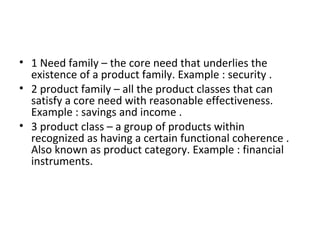
• 1 Need family – the core need that underlies the
existence of a product family. Example : security .
• 2 product family – all the product classes that can
satisfy a core need with reasonable effectiveness.
Example : savings and income .
• 3 product class – a group of products within
recognized as having a certain functional coherence .
Also known as product category. Example : financial
instruments.
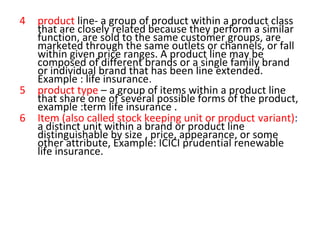
4 product line- a group of product within a product class
that are closely related because they perform a similar
function, are sold to the same customer groups, are
marketed through the same outlets or channels, or fall
within given price ranges. A product line may be
composed of different brands or a single family brand
or individual brand that has been line extended.
Example : life insurance.
5 product type – a group of items within a product line
that share one of several possible forms of the product,
example :term life insurance .
6 Item (also called stock keeping unit or product variant):
a distinct unit within a brand or product line
distinguishable by size , price, appearance, or some
other attribute, Example: ICICI prudential renewable
life insurance.
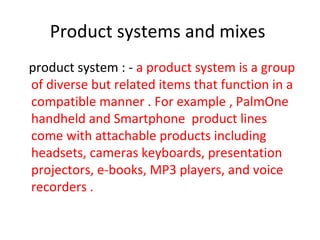
Product systems and mixes
product system : - a product system is a group
of diverse but related items that function in a
compatible manner . For example , PalmOne
handheld and Smartphone product lines
come with attachable products including
headsets, cameras keyboards, presentation
projectors, e-books, MP3 players, and voice
recorders .
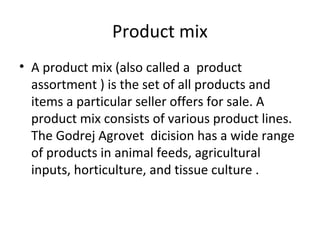
Product mix
• A product mix (also called a product
assortment ) is the set of all products and
items a particular seller offers for sale. A
product mix consists of various product lines.
The Godrej Agrovet dicision has a wide range
of products in animal feeds, agricultural
inputs, horticulture, and tissue culture .
Classification of Products
• The classification of the product depends
upon the TANGIBILITY and DURABILITY found
in an offering.
• Typical classification of Product:
 Service
 Durable
 Non Durable
Non Durable Products
• Products that are consumed fast and are
purchased on a regular basis. The consumer
here spends minimum time and effort in
comparing and buying the item.
• Consumer Products are further classified
according to its use: Personal, Family and
Household as Convenience, Shopping and
Specialty.
FMCG
• Fast Moving Consumer Goods are the Non
Durable Goods. Eg. Sot Drinks, Chips, Ice
Creams etc…. The consumer shows minimum
effort in buying these articles.
• FMCG is further sub divided into 3 Classes…
• Staples
These are goods purchased on a regular basis.
Eg. Soap, Pulses, Toothpaste etc…
Whenever the stock is about to end the
consumer buys these products again.
• Impulse Goods
These are the goods which are purchased
without planning or search… Our external
stimuli provokes us to buy these products. Eg.
Cold drinks, Chocolates, Chips….
Most of the time the consumers aim is not
buying the product solely but when spots
them, feels, attracted and ends up in buying
them.
• Emergency Goods
These goods are purchased when the need
arises. Eg. Umbrellas in rainy season, Pullovers
in winters etc..
The marketers tries for a very good
distribution chain, as the sales is not the same
throughout and whenever the need arises, the
product should be available at maximum
places…
Characteristics of FMCG
Consumers Point
• FMCG has a very low shelf life
1. Frequent Purchases: Salt, Rice, Chocolates
2. Low Involvement: The consumer will buy an
alternative if the brand ask for is not
available….
Exceptions to the rule: Products like Cigarettes,
Personal Hygiene Products, Brand Loyalty.
Characteristics of FMCG
Marketers Point
• High Volumes
The volume of the product required is very
high.
Eg. An average family may require 3-4 Soaps a
month… Imagine No. of family using it in the
whole country???
If the organization cannot ensure high sales
volume, they will have difficulties in surviving.
• Low Margins
As the product is required in high volume, there is an
intense competition which makes the marketer sell
the product with very less margin.
They earn through high volume sales to maximize
their turnover.
The Key Becomes High Volumes Low Margins.
• Extensive Distribution Networks
 Consumer preference in FMCG products are
not that rigid.
 Recall plays a very important role.
 Brand Loyalty is not very high.
 Consumer allows shopkeeper to decide for
him.
Due to all this it becomes very important for the
marketer to make its product available at maximum
place possible.
• High Stock Turnover
It is a characteristic feature of FMCG. It is
because these products are bought frequently
or on a regular basis.
Which in turn allows the marketer to rotate
the capital invested.
Product Mix
• It is the set of product lines and items that a
particular company offers to buyers.
• The Width of product mix refers to how many
different product lines a company carries.
Product Line: It is a group of products that is closely
related because they perform a similar function,
targeted at the same customer groups, marketed
through same channel.
• Eg. Products line of P & G :
Detergents
Bathing Soaps
Shampoos
Disposable Diapers etc.
If, Pantene comes in 4 variants in 3 different
sizes, the depth of the product mix becomes 4
X 3 = 12. This can also be referred as Stock
Keeping Units (SKU’s)
• Consistency of a product mix refers to how
closely related the various product lines are to
the end user.
• The Width, Depth and consistency of product
mix enables the company to define the
Product Portfolio.
• Line Filling : A product line can be extended by
adding more items to the existing range.
Reasons:
 Reaching for more profits
 Trying to satisfy dealers who complain about lost
sales due to missing items in the line
 Trying to utilize excess capacity
 Trying to offer a full line of the production
 Trying to plug holes in the positioning map.
• Line Modernization : Modernization is carried
out continuously as competitors are
constantly growing and coming out with new
products and ideas.
• In this process an Organization should not be
too early, if so, It can harm the existing
product or late so that competitors already
have a hold in the market.
• Line Featuring
Its about featuring a particular product of the
product line, so as to increase foot falls and
then making the consumer exposed to other
products too.
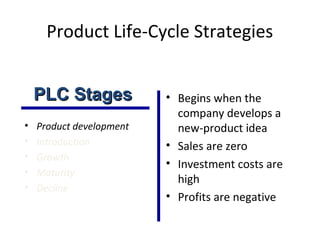
Product Life-Cycle Strategies
• Product development
• Introduction
• Growth
• Maturity
• Decline
• Begins when the
company develops a
new-product idea
• Sales are zero
• Investment costs are
high
• Profits are negative
PLC StagesPLC Stages
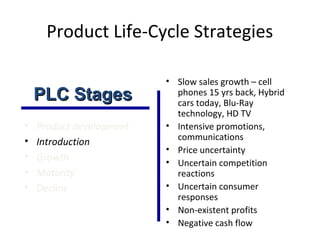
Product Life-Cycle Strategies
• Product development
• Introduction
• Growth
• Maturity
• Decline
• Slow sales growth – cell
phones 15 yrs back, Hybrid
cars today, Blu-Ray
technology, HD TV
• Intensive promotions,
communications
• Price uncertainty
• Uncertain competition
reactions
• Uncertain consumer
responses
• Non-existent profits
• Negative cash flow
PLC StagesPLC Stages
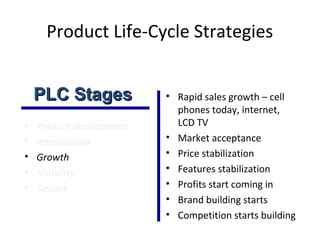
Product Life-Cycle Strategies
• Product development
• Introduction
• Growth
• Maturity
• Decline
• Rapid sales growth – cell
phones today, internet,
LCD TV
• Market acceptance
• Price stabilization
• Features stabilization
• Profits start coming in
• Brand building starts
• Competition starts building
PLC StagesPLC Stages
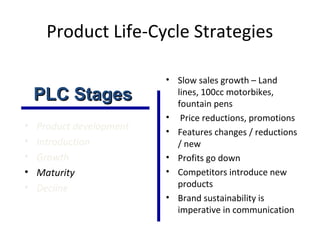
Product Life-Cycle Strategies
• Product development
• Introduction
• Growth
• Maturity
• Decline
• Slow sales growth – Land
lines, 100cc motorbikes,
fountain pens
• Price reductions, promotions
• Features changes / reductions
/ new
• Profits go down
• Competitors introduce new
products
• Brand sustainability is
imperative in communication
PLC StagesPLC Stages
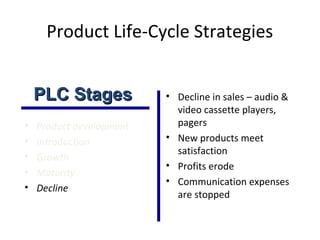
Product Life-Cycle Strategies
• Product development
• Introduction
• Growth
• Maturity
• Decline
• Decline in sales – audio &
video cassette players,
pagers
• New products meet
satisfaction
• Profits erode
• Communication expenses
are stopped
PLC StagesPLC Stages
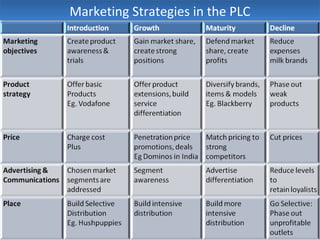
Marketing Strategies in the PLCMarketing Strategies in the PLC
• http://economictimes.indiatimes.com/definition/product
• http://www.slideshare.net/LalitSharma16/the-product-hierarchy
• http://www.slideshare.net/vagoel84/classification-of-product
Sources:-

Mm unit 2 point 1

  • 1.
    Product and productline Course: MBA Subject: MM II Unit: 2
  • 2.
    • Definition: Aproduct is the item offered for sale. A product can be a service or an item. It can be physical or in virtual or cyber form. Every product is made at a cost and each is sold at a price. The price that can be charged depends on the market, the quality, the marketing and the segment that is targeted. Each product has a useful life after which it needs replacement, and a life cycle after which it has to be re- invented. In FMCG parlance, a brand can be revamped, re- launched or extended to make it more relevant to the segment and times, often keeping the product almost the same
  • 3.
    • Description: A productneeds to be relevant: the users must have an immediate use for it. A product needs to be functionally able to do what it is supposed to, and do it with a good quality. A product needs to be communicated: Users and potential users must know why they need to use it, what benefits they can derive from it, and what it does difference it does to their lives. Advertising and 'brand building' best do this. A product needs a name: a name that people remember and relate to. A product with a name becomes a brand. It helps it stand out from the clutter of products and names. A product should be adaptable: with trends, time and change in segments, the product should lend itself to adaptation to make it more relevant and maintain its revenue stream
  • 4.
    The product hierarchy Theproduct hierarchy stretches from basic needs to particular items that satisfy those needs. We can identity six levels of the product hierarchy (using life insurance as an example)
  • 5.
    • 1 Needfamily – the core need that underlies the existence of a product family. Example : security . • 2 product family – all the product classes that can satisfy a core need with reasonable effectiveness. Example : savings and income . • 3 product class – a group of products within recognized as having a certain functional coherence . Also known as product category. Example : financial instruments.
  • 6.
    4 product line-a group of product within a product class that are closely related because they perform a similar function, are sold to the same customer groups, are marketed through the same outlets or channels, or fall within given price ranges. A product line may be composed of different brands or a single family brand or individual brand that has been line extended. Example : life insurance. 5 product type – a group of items within a product line that share one of several possible forms of the product, example :term life insurance . 6 Item (also called stock keeping unit or product variant): a distinct unit within a brand or product line distinguishable by size , price, appearance, or some other attribute, Example: ICICI prudential renewable life insurance.
  • 7.
    Product systems andmixes product system : - a product system is a group of diverse but related items that function in a compatible manner . For example , PalmOne handheld and Smartphone product lines come with attachable products including headsets, cameras keyboards, presentation projectors, e-books, MP3 players, and voice recorders .
  • 8.
    Product mix • Aproduct mix (also called a product assortment ) is the set of all products and items a particular seller offers for sale. A product mix consists of various product lines. The Godrej Agrovet dicision has a wide range of products in animal feeds, agricultural inputs, horticulture, and tissue culture .
  • 9.
    Classification of Products •The classification of the product depends upon the TANGIBILITY and DURABILITY found in an offering. • Typical classification of Product:  Service  Durable  Non Durable
  • 10.
    Non Durable Products •Products that are consumed fast and are purchased on a regular basis. The consumer here spends minimum time and effort in comparing and buying the item. • Consumer Products are further classified according to its use: Personal, Family and Household as Convenience, Shopping and Specialty.
  • 11.
    FMCG • Fast MovingConsumer Goods are the Non Durable Goods. Eg. Sot Drinks, Chips, Ice Creams etc…. The consumer shows minimum effort in buying these articles. • FMCG is further sub divided into 3 Classes…
  • 12.
    • Staples These aregoods purchased on a regular basis. Eg. Soap, Pulses, Toothpaste etc… Whenever the stock is about to end the consumer buys these products again.
  • 13.
    • Impulse Goods Theseare the goods which are purchased without planning or search… Our external stimuli provokes us to buy these products. Eg. Cold drinks, Chocolates, Chips…. Most of the time the consumers aim is not buying the product solely but when spots them, feels, attracted and ends up in buying them.
  • 14.
    • Emergency Goods Thesegoods are purchased when the need arises. Eg. Umbrellas in rainy season, Pullovers in winters etc.. The marketers tries for a very good distribution chain, as the sales is not the same throughout and whenever the need arises, the product should be available at maximum places…
  • 15.
    Characteristics of FMCG ConsumersPoint • FMCG has a very low shelf life 1. Frequent Purchases: Salt, Rice, Chocolates 2. Low Involvement: The consumer will buy an alternative if the brand ask for is not available…. Exceptions to the rule: Products like Cigarettes, Personal Hygiene Products, Brand Loyalty.
  • 16.
    Characteristics of FMCG MarketersPoint • High Volumes The volume of the product required is very high. Eg. An average family may require 3-4 Soaps a month… Imagine No. of family using it in the whole country??? If the organization cannot ensure high sales volume, they will have difficulties in surviving.
  • 17.
    • Low Margins Asthe product is required in high volume, there is an intense competition which makes the marketer sell the product with very less margin. They earn through high volume sales to maximize their turnover. The Key Becomes High Volumes Low Margins.
  • 18.
    • Extensive DistributionNetworks  Consumer preference in FMCG products are not that rigid.  Recall plays a very important role.  Brand Loyalty is not very high.  Consumer allows shopkeeper to decide for him. Due to all this it becomes very important for the marketer to make its product available at maximum place possible.
  • 19.
    • High StockTurnover It is a characteristic feature of FMCG. It is because these products are bought frequently or on a regular basis. Which in turn allows the marketer to rotate the capital invested.
  • 20.
    Product Mix • Itis the set of product lines and items that a particular company offers to buyers. • The Width of product mix refers to how many different product lines a company carries. Product Line: It is a group of products that is closely related because they perform a similar function, targeted at the same customer groups, marketed through same channel.
  • 21.
    • Eg. Productsline of P & G : Detergents Bathing Soaps Shampoos Disposable Diapers etc. If, Pantene comes in 4 variants in 3 different sizes, the depth of the product mix becomes 4 X 3 = 12. This can also be referred as Stock Keeping Units (SKU’s)
  • 22.
    • Consistency ofa product mix refers to how closely related the various product lines are to the end user. • The Width, Depth and consistency of product mix enables the company to define the Product Portfolio.
  • 23.
    • Line Filling: A product line can be extended by adding more items to the existing range. Reasons:  Reaching for more profits  Trying to satisfy dealers who complain about lost sales due to missing items in the line  Trying to utilize excess capacity  Trying to offer a full line of the production  Trying to plug holes in the positioning map.
  • 24.
    • Line Modernization: Modernization is carried out continuously as competitors are constantly growing and coming out with new products and ideas. • In this process an Organization should not be too early, if so, It can harm the existing product or late so that competitors already have a hold in the market.
  • 25.
    • Line Featuring Itsabout featuring a particular product of the product line, so as to increase foot falls and then making the consumer exposed to other products too.
  • 26.
    Product Life-Cycle Strategies •Product development • Introduction • Growth • Maturity • Decline • Begins when the company develops a new-product idea • Sales are zero • Investment costs are high • Profits are negative PLC StagesPLC Stages
  • 27.
    Product Life-Cycle Strategies •Product development • Introduction • Growth • Maturity • Decline • Slow sales growth – cell phones 15 yrs back, Hybrid cars today, Blu-Ray technology, HD TV • Intensive promotions, communications • Price uncertainty • Uncertain competition reactions • Uncertain consumer responses • Non-existent profits • Negative cash flow PLC StagesPLC Stages
  • 28.
    Product Life-Cycle Strategies •Product development • Introduction • Growth • Maturity • Decline • Rapid sales growth – cell phones today, internet, LCD TV • Market acceptance • Price stabilization • Features stabilization • Profits start coming in • Brand building starts • Competition starts building PLC StagesPLC Stages
  • 29.
    Product Life-Cycle Strategies •Product development • Introduction • Growth • Maturity • Decline • Slow sales growth – Land lines, 100cc motorbikes, fountain pens • Price reductions, promotions • Features changes / reductions / new • Profits go down • Competitors introduce new products • Brand sustainability is imperative in communication PLC StagesPLC Stages
  • 30.
    Product Life-Cycle Strategies •Product development • Introduction • Growth • Maturity • Decline • Decline in sales – audio & video cassette players, pagers • New products meet satisfaction • Profits erode • Communication expenses are stopped PLC StagesPLC Stages
  • 31.
    Marketing Strategies inthe PLCMarketing Strategies in the PLC
  • 32.

Editor's Notes

  • #32 Voafone : Introduction” Product Strategy Blackberry: Maturity Market segments New segments emerge, new segments sought Consolidation of market segments Move to only profitable segments