Downloaded 19 times
![UNIT-III: Basics Of Matrix
Definition: Matrix
A ractangular array of m rows and n columns, enclosed by brackets [ ] is
called a matrix of order 𝑚 × 𝑛. A matrix of order 3 × 3 is expressed as,
𝐴 = [
𝑎11 𝑎12 𝑎13
𝑎21 𝑎22 𝑎23
𝑎31 𝑎32 𝑎33
]
An element 𝑎𝑖𝑗 denotes, ith row and jth column
𝑎23 denotes, 2nd row and 3rd column.
Matrices are denoted by capital letters A,B,C,……..etc.
Types of Matrices:
1. Row Matrix:
A matrix having only single row is called row matrix. Its order is 1 × 𝑛.
For example,
𝐴 = [1 4]1×2
𝐴 = [2 4 −3]1×3
2. Column Matrix:
A matrix having single column is called column matrix. Its order is 𝑛 × 1.
For example,
𝐴 = [
2
1
]
2×1
𝐴 = [
4
−2
6
]
3×1
3. Square Matrix:
A matrx in which the number of rows is equal to number columns is called a
square matrix.](https://image.slidesharecdn.com/coursepackunit-3-150314065006-conversion-gate01/85/BSC_COMPUTER-_SCIENCE_UNIT-3_DISCRETE-MATHEMATICS-2-320.jpg)
![∴ 𝑚 = 𝑛.
∴ No. of rows = No. of columns
For example,
𝐴 = [
1 3
−4 2
]
2×2
𝐴 = [
−3 2 1
2 3 1
3 1 −5
]
3×3
4. Null Matrix:
A matrix whose all elements are zero, is called null matrix.
For example,
𝐴 = [
0 0
0 0
]
𝐴 = [
0 0 0
0 0 0
0 0 0
]
5. Unit Matrix or Identity Matrix:
A matrix in which all the elements of its principal diagonal are unity(one)
and remaining elements are zero is called unit matrix.
It is denoted by I.
𝐼 = [
1 0
0 1
]
𝐼 = [
1 0 0
0 1 0
0 0 1
]
6. DiagonalMatrix:
A square matrix in which the elements on the principal diagonal are non zero
and all the other elements are zero, is called a diagonal matrix.
For example,
𝐴 = [
1 0
0 −5
]](https://image.slidesharecdn.com/coursepackunit-3-150314065006-conversion-gate01/85/BSC_COMPUTER-_SCIENCE_UNIT-3_DISCRETE-MATHEMATICS-3-320.jpg)
![𝐴 = [
3 0 0
0 −1 0
0 0 2
]
7. ScalarMatrix:
A diagonal matrix in which all the elements of its principal diagonal are
equal is called scalar matrix.
For example,
𝐴 = [
5 0 0
0 5 0
0 0 5
]
𝐴 = [
−2 0
0 −2
]
8. Transpose Matrix:
For a given matrix A, if rows and column are interchanged ,the new matrix
obtained 𝐴’ is called transposeof a matrix.
Transposeof matrix A is denoted by 𝐴′ or 𝐴 𝑇
.
For example,
𝐴 = [
2 1 4
7 6 −3
4 1 0
] ∴ 𝐴′
= 𝐴 𝑇
= [
2 7 4
1 6 1
4 −3 0
]
( 𝐴′)′
= 𝐴
9. Symmetric Matrix:
A square matrix 𝐴 = [𝑎𝑖𝑗] is said to be symmetric, if 𝑎𝑖𝑗 = 𝑎𝑗𝑖 of each pair
(i, j) .
For Symmetric matrix 𝐴′
= 𝐴
For example,
𝐴 = [
4 2 0
2 −3 5
0 5 6
] ∴ 𝐴′
= [
4 2 0
2 −3 5
0 5 6
]](https://image.slidesharecdn.com/coursepackunit-3-150314065006-conversion-gate01/85/BSC_COMPUTER-_SCIENCE_UNIT-3_DISCRETE-MATHEMATICS-4-320.jpg)
![10. Skew Symmetric Matrix:
A square matrix 𝐴 = [𝑎𝑖𝑗] is said to be skew symmetric if 𝑎𝑖𝑗 = −𝑎𝑗𝑖 for
each pair (i, j).
For Skew symmetric matrix 𝐴′
= −𝐴.
For example,
𝐴 = [
0 3 5
−3 0 4
−5 −4 0
] 𝐴′
= [
0 −3 −5
3 0 −4
5 4 0
]
11. Singular Matrix:
For a square matrix, if value of its determinant is zero, it is called singular
matrix.
For example,
𝐴 = |
6 2
9 3
| ∴ | 𝐴| = (6 × 3) − (9 × 2) = 18 − 18 = 0
𝐴 = |
1 2 3
4 1 5
3 6 9
| ∴ | 𝐴| = 1(9− 30) − 2(36− 15) + 3(24 − 3).
| 𝐴| = −21 − 42+ 63
| 𝐴| = 0
If | 𝐴| = 0 is called singular matrix.
If | 𝐴| ≠ 0 is called Non singular matrix.
12. Equal Matrix:
For two matrices, if their correspondingelements are equal, they are called
equal matrices.
For example,
𝐴 = [
2 3
−4 5
] 𝐵 = [
2 3
−4 5
] ∴ 𝐴 = 𝐵
13. Negative matrix:](https://image.slidesharecdn.com/coursepackunit-3-150314065006-conversion-gate01/85/BSC_COMPUTER-_SCIENCE_UNIT-3_DISCRETE-MATHEMATICS-5-320.jpg)
![For two matrices, if their correspondingelements are equal but opposite,
they are called Negative matrix.
For example,
𝐴 = [
1 −2
3 −5
] ∴ (−𝐴) = [
−1 2
−3 5
]
14. Orthogonalmatrix:
For square matrix A if Productof matirx A & its transpose matrix A’ (i.e.
AA’) is Identity matrix (I).
𝐴 = [
𝑐𝑜𝑠𝜃 −𝑠𝑖𝑛𝜃
𝑠𝑖𝑛𝜃 𝑐𝑜𝑠𝜃
]
𝐴′
= [
𝑐𝑜𝑠𝜃 𝑠𝑖𝑛𝜃
−𝑠𝑖𝑛𝜃 𝑐𝑜𝑠𝜃
]
𝐴𝐴′
= [
1 0
0 1
] = 𝐼
15. Upper Triangular Matrix:
For square matrix A if all the elements below the main diagonal are zero
then it is called a Upper Triangular Matrix.
For example,
𝐴 = [
1 4 5
0 −2 3
0 0 3
]
16. LowerTriangular Matrix:
For square matrix A if all the elements above the main diagonal are zero
then it is called a Lower Triangular Matrix.
For example,
𝐴 = [
1 0 0
4 2 0
3 −1 6
]
17. Trace ofMatrix:](https://image.slidesharecdn.com/coursepackunit-3-150314065006-conversion-gate01/85/BSC_COMPUTER-_SCIENCE_UNIT-3_DISCRETE-MATHEMATICS-6-320.jpg)
![For square matrix A sum of all diagonal elements are called trace of matrix
A.
For example,
𝐴 = [
−1 2 7
3 5 −8
1 2 7
]
𝑡𝑟( 𝐴) = −1 + 5 + 7 = 11
18. Idempotent Matrix:
Matrix A is said to be Idempotent matrix if matrix 𝐴 satisfy the equation
𝐴2
= 𝐴.
For example
𝐴 = [
2 −2 −4
−1 3 4
1 −2 −3
]
19. Involuntary Matrix:
Matrix A is said to be Involuntary matrix if matrix A satisfy the equation
𝐴2
= 𝐼. Since 𝐼2
= 𝐼 always. Therefore Unit matrix is involuntary.
20. Conjugate Matrix:
Let 𝐴 = [
1 + 𝑖 2 + 3𝑖 4
7 + 2𝑖 −𝑖 3 − 2𝑖
]
Conjugate of matrix A is 𝐴̅
𝐴̅ = [
1 − 𝑖 2 − 3𝑖 4
7 − 2𝑖 𝑖 3 + 2𝑖
]
Note: Transposeof the conjugate of a matrix A is denoted by 𝐴 𝜃
.
21.Unitary Matrix:
A square matrix A is said to be unitary if 𝐴 𝜃
𝐴 = 𝐼
For example,](https://image.slidesharecdn.com/coursepackunit-3-150314065006-conversion-gate01/85/BSC_COMPUTER-_SCIENCE_UNIT-3_DISCRETE-MATHEMATICS-7-320.jpg)
![𝐴 = [
1+𝑖
2
−1+𝑖
2
−1−𝑖
2
1−𝑖
2
] , 𝐴 𝜃
= [
1−𝑖
2
1−𝑖
2
−1−𝑖
2
1+𝑖
2
], 𝐴. 𝐴 𝜃
= 𝐼
22. Hermitian Matrix:
A square matrix 𝐴 = (𝑎𝑖𝑗) is called Hermitian matrix, if every i-jth element
of A is equal to conjugate complex j-ith element of A.
In other words, 𝑎𝑖𝑗 = 𝑎𝑗𝑖̅̅̅̅
For example,
[
1 2 + 3𝑖 3 + 𝑖
2 − 3𝑖 2 1 − 2𝑖
3 − 𝑖 1 + 2𝑖 5
]
23. Skew Hermitian Matrix:
A square matrix 𝐴 = (𝑎𝑖𝑗) will be calledd a Skew Hermitian matrix if every
i-jth element of A is equal to negative conjugate complex of j-ith element of
A.
In other words , 𝑎𝑖𝑗 = −𝑎𝑗𝑖̅̅̅̅
For example, [
𝑖 2 − 3𝑖 4 + 5𝑖
−(2 + 3𝑖) 0 2𝑖
−(4 − 5𝑖) 2𝑖 −3𝑖
]
24. Minor:
The minor of an element in a third order determinant is a second order
determinant obtained by deletinng the row and column which contain that
element.
For example,
𝐴 = |
1 2 1
3 4 5
−1 1 2
|
Minor of element 2 = |
3 5
−1 2
|](https://image.slidesharecdn.com/coursepackunit-3-150314065006-conversion-gate01/85/BSC_COMPUTER-_SCIENCE_UNIT-3_DISCRETE-MATHEMATICS-8-320.jpg)
![Minor of element 3 = |
2 1
1 2
|
Operations On Matrices and it’s Properties:
Addition of Matrices :
If A and B be two matrices of the same order, then their sum, A+B is defined
as the matrix ,each element of which is the sum of the corresponding
elements of A and B.
Thus if 𝐴 = [
4 2 5
1 3 −6
] , 𝐵 = [
1 0 2
3 1 4
]
Then 𝐴 + 𝐵 = [
4 + 1 2 + 0 5 + 2
1 + 3 3 + 1 −6 + 4
]
𝐴 + 𝐵 = [
5 2 7
4 4 −2
].
If 𝐴 = [𝑎𝑖𝑗], 𝐵 = [𝑏𝑖𝑗] then 𝐴 + 𝐵 = [𝑎𝑖𝑗 + 𝑏𝑖𝑗]
Properties Of Matrix Addition:
Only matrices of the same order can be added or subtracted.
i. Commutative law: A + B = B + A
ii. Associative law: A + (B + C) = (A + B) + C
Subtraction of Matrices:
The difference of two matrices is a matrix, each element of which is obtained
by subtracting the elements of the second matrix from the
Corresponding element of the first.
𝐴 − 𝐵 = [𝑎𝑖𝑗 − 𝑎𝑗𝑖]
Thus [
8 6 4
1 2 0
] − [
3 5 1
7 6 2
]
= [
8 − 3 6 − 5 4 − 1
1 − 7 2 − 6 0 − 2
]
= [
5 1 3
−6 −4 −2
]
ScalarMultiple of a Matrix:](https://image.slidesharecdn.com/coursepackunit-3-150314065006-conversion-gate01/85/BSC_COMPUTER-_SCIENCE_UNIT-3_DISCRETE-MATHEMATICS-9-320.jpg)
![If a matrix is multiplied by a scalar quantity K, then each element is
multiplied by k,
i.e. 𝐴 = [
2 3 4
4 5 6
6 7 9
]
3𝐴 = 3[
3 × 2 3 × 3 3 × 4
3 × 4 3 × 5 3 × 6
3 × 6 3 × 7 3 × 9
] = [
6 9 12
12 15 18
18 21 27
]
Multiplication:
The productof two matrices A and B is only possible if the number of
columns in A is equal to the number of rows in B.
Let 𝐴 = [𝑎𝑖𝑗] be an 𝑚 × 𝑛 matrix and 𝐵 = [𝑏𝑖𝑗] be an 𝑛 × 𝑝 matrix. Then
the productAB of these matrices is an 𝑚 × 𝑝 matrix 𝐶 = [𝑐𝑖𝑗] where,
𝑐𝑖𝑗 = 𝑎𝑖1 𝑏1𝑗 + 𝑎𝑖2 𝑏2𝑗 + 𝑎𝑖3 𝑏3𝑗 + ⋯+ 𝑎𝑖𝑛 𝑏 𝑛𝑗
Properties of Matrix Multiplication:
a) Multiplication of matrix is not commutative.
𝑨𝑩 ≠ 𝑩𝑨
b) Matrix multiplication is associative , if conformability is assured.
𝑨( 𝑩𝑪) = ( 𝑨𝑩) 𝑪
c) Matrix multiplication is distributive with respectto addition.
𝑨( 𝑩 + 𝑪) = 𝑨𝑩 + 𝑨𝑪
d) Multiplcation of matrix A by unit matrix.
𝑨𝑰 = 𝑰𝑨 = 𝑨
e) Multiplicative inverse of a matrix exists if | 𝐴| ≠ 0.
𝑨. 𝑨−𝟏
= 𝑨−𝟏
. 𝑨 = 𝑰
f) If A is a square then 𝑨 × 𝑨 = 𝑨 𝟐
, 𝑨 × 𝑨 × 𝑨 = 𝑨 𝟑
g) 𝑨 𝟎
= 𝑰
h) 𝑰 𝒏
= 𝑰, where 𝑛 is positive integer.](https://image.slidesharecdn.com/coursepackunit-3-150314065006-conversion-gate01/85/BSC_COMPUTER-_SCIENCE_UNIT-3_DISCRETE-MATHEMATICS-10-320.jpg)
![i) ( 𝑨𝑩)′
= 𝑩′
𝑨′
j) ( 𝑨𝑩)−𝟏
= 𝑩−𝟏
𝑨−𝟏
Example-1. If 𝑨 = [
𝟐 𝟐 𝟐
𝟐 𝟏 −𝟑
𝟏 𝟎 𝟒
], 𝑩 = [
𝟑 𝟑 𝟑
𝟑 𝟎 𝟓
𝟗 𝟗 −𝟏
], 𝑪 = [
𝟒 𝟒 𝟒
𝟓 −𝟏 𝟓
−𝟕 𝟖 −𝟏
]
Find 𝟐𝑨 − 𝟑𝑩 + 𝑪.
Solution:
2𝐴 − 3𝐵 + 𝐶 = 2 [
2 2 2
2 1 −3
1 0 4
] − 3[
3 3 3
3 0 5
9 9 −1
] + [
4 4 4
5 −1 5
−7 8 −1
]
2𝐴 − 3𝐵 + 𝐶 = [
4 4 4
4 2 −6
2 0 8
] + [
−9 −9 −9
−9 0 −15
−27 −27 3
] + [
4 4 4
5 −1 5
−7 8 −1
].
2𝐴 − 3𝐵 + 𝐶 = [
4 − 9 + 4 4 − 9 + 4 4 − 9 + 4
4 − 9 + 5 2 + 0 − 1 −6 − 15 + 5
2 − 27 − 7 0 − 27 + 8 8 + 3 − 1
].
2𝐴 − 3𝐵 + 𝐶 = [
−1 −1 −1
0 1 −16
−32 −19 10
].
Example-2. If 𝑨 = [
𝟏 𝟐 𝟏
𝟑 𝟒 𝟐
] , 𝑩 = [
𝟑 −𝟐 𝟒
𝟏 𝟓 𝟎
] find matrix𝑿 from 𝑿 +
𝑨 + 𝑩 = 𝟎
Solution: 𝑋 + 𝐴 + 𝐵 = 0
∴ 𝑋 + [
1 2 1
3 4 2
] + [
3 −2 4
1 5 0
] = 0.
∴ 𝑋 + [
4 0 5
4 9 2
] = [
0 0 0
0 0 0
]
∴ 𝑋 = [
−4 0 −5
−4 −9 −2
]
Example-3: show that any square matrix can be expressedas the sum of
two matrices, one symmetric and the other anti-symmetric.
Solution: Let A be a given square matrix.](https://image.slidesharecdn.com/coursepackunit-3-150314065006-conversion-gate01/85/BSC_COMPUTER-_SCIENCE_UNIT-3_DISCRETE-MATHEMATICS-11-320.jpg)
![ Then 𝐴 =
1
2
( 𝐴 + 𝐴′) +
1
2
(𝐴 − 𝐴′
)
Now, ( 𝐴 + 𝐴′)′
= 𝐴′
+ ( 𝐴′)′
= 𝐴′
+ 𝐴 = 𝐴 + 𝐴′
∴ 𝐴 + 𝐴′ is a symmetric matrix.
Also, ( 𝐴 − 𝐴′)′
= 𝐴′
− ( 𝐴′)′
= 𝐴′
− 𝐴 = −(𝐴 − 𝐴′
)
∴ ( 𝐴 − 𝐴′) 𝑜𝑟
1
2
(𝐴 − 𝐴′
) is an anti symmetric matrix.
∴ 𝑨 =
𝟏
𝟐
( 𝑨 + 𝑨′) +
𝟏
𝟐
(𝑨 − 𝑨′
)
Example-4.Express 𝑨 = [
𝟏 −𝟐 −𝟑
𝟑 𝟎 𝟓
𝟓 𝟔 𝟏
] as the sum of a lower triangular
matrix and upper triangular matrix.
Solution: Let 𝐴 = 𝐿 + 𝑈
[
1 −2 −3
3 0 5
5 6 1
] = [
𝑎 0 0
𝑏 𝑐 0
𝑑 𝑒 𝑓
] + [
1 𝑝 𝑞
0 1 𝑟
0 0 1
]
[
1 −2 −3
3 0 5
5 6 1
] = [
𝑎 + 1 0 0
𝑏 + 0 𝑐 + 1 0 + 𝑟
𝑑 + 0 𝑒 + 0 𝑓 + 1
]
Equating the correspondingelements on both the sides, we get
𝑎 + 1 = 1 𝑝 = −2 𝑞 = −3
𝑏 = 3 𝑐 + 1 = 0 𝑟 = 5
𝑑 = 5 𝑒 = 6 𝑓 + 1 = 1
On Solving these equations, we get
𝑎 = 0 𝑝 = −2 𝑞 = −3
𝑏 = 3 𝑐 = −1 𝑟 = 5
𝑑 = 5 𝑒 = 6 𝑓 = 0
Hence 𝐿 = [
0 0 0
3 −1 0
5 6 0
] & 𝑈 = [
1 −2 −3
0 1 5
0 0 1
]](https://image.slidesharecdn.com/coursepackunit-3-150314065006-conversion-gate01/85/BSC_COMPUTER-_SCIENCE_UNIT-3_DISCRETE-MATHEMATICS-12-320.jpg)
![ Example-5 If 𝑨 = [
𝟏 𝟐 𝟑
𝟒 𝟓 𝟔
] and 𝑩 = [
𝟏 𝟐
𝟐 𝟏
𝟏 𝟐
] find 𝑨𝑩 and 𝑩𝑨.
Solution: 𝐴𝐵 = [
1 2 3
4 5 6
] [
1 2
2 1
1 2
]
𝐴𝐵 = [
(1 × 1) + (2 × 2) + (3 × 1) (1 × 2) + (2 × 1) + (3 × 2)
(4 × 1) + (5 × 2) + (6 × 1) (4 × 2) + (5 × 1) + (6 × 2)
]
𝐴𝐵 = [
(1 + 4 + 3) (2 + 2 + 6)
(4 + 10 + 6) (8 + 5 + 12)
]
𝐴𝐵 = [
8 10
20 25
]
Now 𝐵𝐴 = [
1 2
2 1
1 2
][
1 2 3
4 5 6
]
𝐴 = [
(1 × 1) + (2 × 4) (1 × 2) + (2 × 5) (1 × 3) + (2 × 6)
(2 × 1) + (1 × 4) (2 × 2) + (1 × 5) (2 × 3) + (1 × 6)
(1 × 1) + (2 × 4) (1 × 2) + (2 × 5) (1 × 3) + (2 × 6)
]
𝐴 = [
(1 + 8) (2 + 10) (3 + 12)
(2 + 4) (4 + 5) (6 + 6)
(1 + 8) (2 + 10) (3 + 12)
]
𝐴 = [
9 12 15
6 9 12
9 12 15
]
Example-6. If 𝑨 = [
𝟏 𝟐
−𝟐 𝟑
] , 𝑩 = [
𝟐 𝟏
𝟐 𝟑
] and 𝑪 = [
−𝟑 𝟏
𝟐 𝟎
].
Verify that ( 𝑨𝑩) 𝑪 = 𝑨(𝑩𝑪) and 𝑨( 𝑩 + 𝑪) = 𝑨𝑩 + 𝑨𝑪.
Solution: 𝐴𝐵 = [
1 2
−2 3
] × [
2 1
2 3
]
𝐴𝐵 = [
(1)(2) + (2)(2) (1)(1) + (2)(3)
(−2)(2) + (3)(2) (−2)(1) + (3)(3)
]
𝐴𝐵 = [
6 7
2 7
]](https://image.slidesharecdn.com/coursepackunit-3-150314065006-conversion-gate01/85/BSC_COMPUTER-_SCIENCE_UNIT-3_DISCRETE-MATHEMATICS-13-320.jpg)
![ 𝐵𝐶 = [
2 1
2 3
] × [
−3 1
2 0
]
𝐵𝐶 = [
−6 + 2 2 + 0
−6 + 6 2 + 0
]
𝐵𝐶 = [
−4 2
0 2
]
𝐴𝐶 = [
1 2
−2 3
] × [
−3 1
2 0
]
𝐴𝐶 = [
−3 + 4 1 + 0
6 + 6 −2 + 0
]
𝐴𝐶 = [
1 1
12 −2
]
𝐵 + 𝐶 = [
2 1
2 3
] + [
−3 1
2 0
]
𝐵 + 𝐶 = [
2 + (−3) 1 + 1
2 + 2 3 + 0
]
𝐵 + 𝐶 = [
−1 2
4 3
]
i. ( 𝐴𝐵) 𝐶 = [
6 7
2 7
] × [
−3 1
2 0
]
( 𝐴𝐵) 𝐶 = [
−18 + 14 6 + 0
−6 + 14 2 + 0
]
( 𝐴𝐵) 𝐶 = [
−4 6
8 2
] .……………………………………………..(1)
& 𝐴( 𝐵𝐶) = [
1 2
−2 3
] × [
−4 2
0 2
]
𝐴( 𝐵𝐶) = [
−4 + 0 2 + 4
8 + 0 −4 + 6
]
𝐴( 𝐵𝐶) = [
−4 6
8 2
] ……………………………………………….(2)
Thus from (1) and (2), we get
( 𝐴𝐵) 𝐶 = 𝐴(𝐵𝐶)
ii. 𝐴( 𝐵 + 𝐶) = [
1 2
−2 3
][
−1 2
4 3
]](https://image.slidesharecdn.com/coursepackunit-3-150314065006-conversion-gate01/85/BSC_COMPUTER-_SCIENCE_UNIT-3_DISCRETE-MATHEMATICS-14-320.jpg)
![ 𝐴( 𝐵 + 𝐶) = [
−1 + 8 2 + 6
2 + 12 −4 + 9
]
𝐴( 𝐵 + 𝐶) = [
7 8
14 5
] ………………………………………….(3)
𝐴𝐵 + 𝐴𝐶 = [
6 + 1 7 + 1
2 + 12 7 − 2
]
𝐴𝐵 + 𝐴𝐶 = [
7 8
24 5
] …………………………………………..(4)
Thus from (3) and (4), we get
𝐴( 𝐵 + 𝐶) = 𝐴𝐵 + 𝐴𝐶
Example-7. If 𝑨 = [
𝟏 𝟐 𝟐
𝟐 𝟏 𝟐
𝟐 𝟐 𝟏
] show that 𝑨 𝟐
− 𝟒𝑨 − 𝟓𝑰 = 𝟎 where I, 0 are
the unit matrix and the null matrix of order 3 respectively. Use this
result to find 𝑨−𝟏
.
Solution: Here, we have 𝐴 = [
1 2 2
2 1 2
2 2 1
]
𝐴2
= [
1 2 2
2 1 2
2 2 1
][
1 2 2
2 1 2
2 2 1
]
𝐴2
= [
9 8 8
8 9 8
8 8 9
]
𝐴2
− 4𝐴 − 5𝐼 = [
9 8 8
8 9 8
8 8 9
] − 4[
1 2 2
2 1 2
2 2 1
] − 5[
1 0 0
0 1 0
0 0 1
]
𝐴2
− 4𝐴 − 5𝐼 = [
9 − 4 − 5 8 − 8 + 0 8 − 8 + 0
8 − 8 + 0 9 − 4 − 5 8 − 8 + 0
8 − 8 + 0 8 − 8 + 0 9 − 4 − 5
]
𝐴2
− 4𝐴 − 5𝐼 = [
0 0 0
0 0 0
0 0 0
]](https://image.slidesharecdn.com/coursepackunit-3-150314065006-conversion-gate01/85/BSC_COMPUTER-_SCIENCE_UNIT-3_DISCRETE-MATHEMATICS-15-320.jpg)
![ 𝐴2
− 4𝐴 − 5𝐼 = 0 ⟹ 5𝐼 = 𝐴2
− 4𝐴
Both the side multiplying by 𝐴−1
, we get
5𝐴−1
= 𝐴 − 4𝐼
5𝐴−1
= [
1 2 2
2 1 2
2 2 1
] − 4[
1 0 0
0 1 0
0 0 1
]
5𝐴−1
= [
−3 2 2
2 −3 2
2 2 −3
]
𝐴−1
=
1
5
[
−3 2 2
2 −3 2
2 2 −3
]
Adjoint of a square Matrix:
Let the determinant of the square matrix 𝐴 be | 𝐴| = [
𝑎1 𝑎2 𝑎3
𝑏1 𝑏2 𝑏3
𝑐1 𝑐2 𝑐3
]
The matrix formed by the co-factors ofthe elements in
| 𝐴| 𝑖𝑠 [
𝐴1 𝐴2 𝐴3
𝐵1 𝐵2 𝐵3
𝐶1 𝐶2 𝐶3
]
Where 𝐴1 = |
𝑏2 𝑏3
𝑐2 𝑐3
|= 𝑏2 𝑐3 − 𝑏3 𝑐2,
𝐴2 = −|
𝑏1 𝑏3
𝑐1 𝑐3
| = −𝑏1 𝑐3 − 𝑏3 𝑐1,
𝐴3 = |
𝑏1 𝑏2
𝑐1 𝑐2
| = 𝑏1 𝑐2 − 𝑏2 𝑐1,
𝐵1 = − |
𝑎2 𝑎3
𝑐2 𝑐3
| = −𝑎2 𝑐3 + 𝑎3 𝑐2,
𝐵2 = |
𝑎1 𝑎3
𝑐1 𝑐3
| = 𝑎1 𝑐3 − 𝑎3 𝑐1,
𝐵3 = −|
𝑎1 𝑎2
𝑐1 𝑐2
| = −𝑎1 𝑐2 + 𝑎2 𝑐1,
𝐶1 = |
𝑎2 𝑎3
𝑏2 𝑏3
| = 𝑎2 𝑏3 − 𝑎3 𝑏2,](https://image.slidesharecdn.com/coursepackunit-3-150314065006-conversion-gate01/85/BSC_COMPUTER-_SCIENCE_UNIT-3_DISCRETE-MATHEMATICS-16-320.jpg)
![ 𝐶2 = −|
𝑎1 𝑎3
𝑏1 𝑏3
| = −𝑎1 𝑏3 + 𝑎3 𝑏1,
𝐶3 = |
𝑎1 𝑎2
𝑏1 𝑏2
| = 𝑎1 𝑏2 − 𝑎2 𝑏1,
Then the transposeof the matrix of co-factors
[
𝐴1 𝐵1 𝐶1
𝐴2 𝐵2 𝐶2
𝐴3 𝐵3 𝐶3
]
Is called the adjoint of the matrix 𝐴 and is written as 𝑎𝑑𝑗 𝐴.
Note:For 𝟐 × 𝟐 order matrix Adj A is defined as:
If 𝐴 = [
𝑎1 𝑎2
𝑏1 𝑏2
] then Adj A = [
𝑏2 −𝑎2
𝑏1 𝑎1
]
i.e. Change location of elelment of principal diagonal
and change sign of elements of subsidary diagonal.
Property of Adjoint Matrix:
The productof a matrix 𝐴 and its adjoint is equal to unit matrix multiplied by
the determinant 𝐴.
Example-1: If 𝑨 = [
𝟓 𝟐
𝟕 𝟑
] then find 𝑨−𝟏
.
Solution: Since here, given matrix 𝐴 is of the Order 2 × 2.
∴ 𝑎𝑑𝑗 𝐴 = [
3 −2
−7 5
]
Example-2: For matrix 𝑨 = [
𝟐 𝟏 𝟓
𝟎 𝟑 −𝟏
𝟐 𝟓 𝟎
] find co-factormatrix 𝒂𝒅𝒋 𝑨.
Solution: Let 𝐴 = [𝑎𝑖𝑗]
First we will find co-factors ofeach element.
𝐴11 = |
3 −1
5 0
| = 0 − (−5) = 5
𝐴12 = −|
0 −1
2 0
| = −[0 − (−2)] = −2](https://image.slidesharecdn.com/coursepackunit-3-150314065006-conversion-gate01/85/BSC_COMPUTER-_SCIENCE_UNIT-3_DISCRETE-MATHEMATICS-17-320.jpg)
![ 𝐴13 = |
0 3
2 5
| = (0 − 6) = −6
𝐴21 = −|
1 5
5 0
| = −(0 − 25) = 25
𝐴22 = |
2 5
2 0
| = (0 − 10) = −10
𝐴23 = −|
2 1
2 5
| = −(10 − 2) = −8
𝐴31 = |
1 5
3 −1
| = (−1 − 15) = −16
𝐴32 = −|
2 5
0 −1
| = −(−2 − 0) = 2
𝐴33 = |
2 1
0 3
| = (6 − 0) = 6
∴ 𝑎𝑑𝑗 𝐴 = [
𝐴11 𝐴21 𝐴31
𝐴12 𝐴22 𝐴32
𝐴13 𝐴23 𝐴33
] = [
5 25 −16
−2 −10 2
−6 −8 6
]
Inverse of a Matrix:
If A and B are two square matrices of the same order, such that
𝐴𝐵 = 𝐵𝐴 = 𝐼
Then 𝐵 is called the inverse of 𝐴 i.e. 𝐵 = 𝐴−1
and 𝐴 is the invese of B.
Condition for a square matrix 𝐴 to possess aninverse is that matrix 𝐴 is
non-singular.
i.e. | 𝑨| ≠ 𝟎
If 𝐴 is square matrix and 𝐵 its inverse, then 𝐴𝐵 = 𝐼. Taking determinant of
both sides, we get
| 𝐴𝐵| = | 𝐼| 𝑜𝑟 | 𝐴|| 𝐵| = 𝐼
From this relation it is clear that | 𝐴| ≠ 0
i.e. the matrix 𝐴 is non singular.
To find the inverse matrix with the help of adjoint matrix:](https://image.slidesharecdn.com/coursepackunit-3-150314065006-conversion-gate01/85/BSC_COMPUTER-_SCIENCE_UNIT-3_DISCRETE-MATHEMATICS-18-320.jpg)
![ We know that 𝐴. ( 𝐴𝑑𝑗𝐴) = | 𝐴| 𝐼
𝐴.
1
| 𝐴|
( 𝐴𝑑𝑗 𝐴) = 𝐼 (Provided | 𝐴| ≠ 0) ………………………..(1)
Since 𝐴. 𝐴−1
= 𝐼 …………………………………………….(2)
From (1) and (2), we have
∴ 𝑨−𝟏
=
𝟏
| 𝑨|
( 𝑨𝒅𝒋 𝑨) = 𝑰
Example-1: If 𝑨 = [
𝟏 𝟐
−𝟏 𝟑
] find 𝑨−𝟏
.
Solution: | 𝐴| = |
1 2
−1 3
| = 3 − (−2) = 5 ≠ 0
∴ 𝐴−1
is possible.
𝐴𝑑𝑗 𝐴 = [
3 −2
1 1
]
∴ 𝐴−1
=
𝑎𝑑𝑗 𝐴
| 𝐴|
𝐴−1
=
1
5
[
3 −2
1 1
]
𝐴−1
= [
3
5
−
2
5
1
5
1
5
]
Example-2: If 𝑨 = [
𝟏 −𝟏 𝟏
𝟐 −𝟏 𝟎
𝟏 𝟎 𝟏
] then find 𝑨−𝟏
.
Solution: Let given matrix is 𝐴.
∴ | 𝐴| = |
1 −1 1
2 −1 0
1 0 1
|
∴ | 𝐴| = 1(−1 − 0) + 1(2 − 0) + 1[0− (−1)]
∴ | 𝐴| = −1 + 2 + 1 = 2 ≠ 0
∴ 𝐴−1
is possible.
First we will calculate, co-factors ofeach element.](https://image.slidesharecdn.com/coursepackunit-3-150314065006-conversion-gate01/85/BSC_COMPUTER-_SCIENCE_UNIT-3_DISCRETE-MATHEMATICS-19-320.jpg)
![ 𝐴11 = |
−1 0
0 1
| = (−1 − 0) = −1
𝐴12 = −|
2 0
1 1
| = [−(2− 0)] = −2
𝐴13 = |
2 −1
1 0
| = [0 − (−1)] = 1
𝐴21 = −|
−1 1
0 1
| = [−(−1 − 0)] = 1
𝐴22 = |
1 1
1 1
| = (1 − 1) = 0
𝐴23 = −|
1 −1
1 0
| = −[0 − (−1)] = −1
𝐴31 = |
−1 1
−1 0
| = [0 − (−1)] = 1
𝐴32 = −|
1 1
2 0
| = [−(0 − 2)] = 2
𝐴33 = |
1 −1
2 −1
| = [−1 − (−2)] = 1
∴ 𝑎𝑑𝑗 𝐴 = [
𝐴11 𝐴21 𝐴31
𝐴12 𝐴22 𝐴32
𝐴13 𝐴23 𝐴33
] = [
−1 1 1
−2 0 2
1 −1 1
]
𝐴−1
= 𝐴𝑑𝑗
𝐴
| 𝐴|
=
1
2
× [
−1 1 1
−2 0 2
1 −1 1
]
𝐴−1
= [
−
1
2
1
2
1
2
−1 0 1
1
2
−
1
2
1
2
]
Example-3. If a matrix 𝑨 satisfies a relation 𝑨 𝟐
+ 𝑨 − 𝑰 = 𝟎 prove that
𝑨−𝟏
exists and that 𝑨−𝟏
= 𝑰 + 𝑨, 𝑰 being an identity matrix.
Solution: Here, 𝐴2
+ 𝐴 − 𝐼 = 0
∴ 𝐴2
+ 𝐴 = 𝐼
∴ 𝐴( 𝐴 + 𝐼) = 𝐼](https://image.slidesharecdn.com/coursepackunit-3-150314065006-conversion-gate01/85/BSC_COMPUTER-_SCIENCE_UNIT-3_DISCRETE-MATHEMATICS-20-320.jpg)
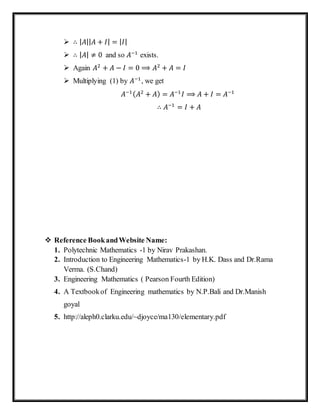
![EXERCISE-3
Q-1.Evaluate the following Questions:
1. If 𝐴 = [
0 2 0
1 0 3
1 1 2
], 𝐵 = [
1 2 1
2 1 0
0 0 3
] find ( 𝑖)2𝐴 + 3𝐵 ( 𝑖𝑖)3𝐴 − 4𝐵
2. Express [
1 2 0
3 7 1
5 9 3
] as a sum of symmetric matrix and skew-symmetric
matrix.
3. If 𝐴 = [
2 3
1 0
], 𝐵 = [
4 1
2 −3
] prove that ( 𝐴 + 𝐵) 𝑇
= 𝐴 𝑇
+ 𝐵 𝑇
.
4. If 𝐴 = [
2 −1 0
3 2 −4
5 1 9
] and 𝐵 = [
17 −1 3
−24 −1 −16
−7 1 1
] and 4𝐴 + 3𝐶 = 𝐵,
then find matrix 𝐶.
Q-2. Evaluate the following Questions:
1. If 𝐴 = [
0 1 2
1 2 3
2 3 4
] and 𝐵 = [
1 −2
−1 0
2 −1
] Obtain the product 𝐴𝐵 and
explain why 𝐵𝐴 is not defined.
2. If 𝐴 = [
1 2 −1
3 0 2
4 5 0
] and 𝐵 = [
1 0 0
2 1 0
0 1 3
] verify that ( 𝐴𝐵)′
= 𝐵′
𝐴′
.
3. Compute 𝐴𝐵 if 𝐴 = [
1 2 3
4 5 6
] and 𝐵 = [
2 5 3
3 6 4
4 7 5
].
4. Verify that 𝐴 =
1
3
[
1 2 2
2 1 −2
−2 2 −1
] is Orthogonal.
Q-3. Evaluate the following Questions:](https://image.slidesharecdn.com/coursepackunit-3-150314065006-conversion-gate01/85/BSC_COMPUTER-_SCIENCE_UNIT-3_DISCRETE-MATHEMATICS-22-320.jpg)
![1. If 𝐴 = [
2 5 3
3 1 2
1 2 1
] then find 𝐴𝑑𝑗 𝐴.
2. If 𝐴 = [
1 1 2
1 9 3
1 4 2
] then find 𝐴−1
.
3. If 𝐴 = [
1 1 1
1 2 3
1 4 9
], 𝐵 = [
2 5 3
3 1 2
1 2 1
], then show that ( 𝐴𝐵)−1
= 𝐵−1
𝐴−1
.
4. If 𝐴 = [
−4 −3 −3
1 0 1
4 4 3
] Prove that 𝐴𝑑𝑗 𝐴 = 𝐴.](https://image.slidesharecdn.com/coursepackunit-3-150314065006-conversion-gate01/85/BSC_COMPUTER-_SCIENCE_UNIT-3_DISCRETE-MATHEMATICS-23-320.jpg)

The document provides information about matrices including: - Definitions of matrix, order of a matrix, types of matrices like row, column, square, null, identity, diagonal, scalar, and transpose matrices. - Operations on matrices like addition, subtraction, scalar multiplication and matrix multiplication along with their properties. - Examples of finding the sum of matrices. - The document discusses various types of matrices like symmetric, skew-symmetric, singular, equal, negative, orthogonal, upper/lower triangular, trace, idempotent, involuntary, conjugate, unitary, Hermitian, skew-Hermitian matrices and minors of a matrix.


