Absorption and Stripping in Packed
Column
Megha Rajasekhar
Mass Transfer Self Study – Phase 1
Absorption and Stripping
• Absorption – removal of a solute gas from a
mixture of gases by extracting into a liquid
solvent.
• Stripping is the reverse process of absorption,
also known as desorption
• It is removal of a solute gas from a liquid
Comparison between plate and packed
columns
• Packed columns do not hold much liquid and
hence can be used for absorption of toxic and
flammable liquids, keep size of the unit small.
• Plate columns have are used for solvents
which contain large amounts of solids.
• It easier to install cooling systems in plate
columns.
Absorption
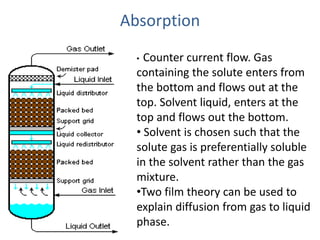
• Counter current flow. Gas
containing the solute enters from
the bottom and flows out at the
top. Solvent liquid, enters at the
top and flows out the bottom.
• Solvent is chosen such that the
solute gas is preferentially soluble
in the solvent rather than the gas
mixture.
•Two film theory can be used to
explain diffusion from gas to liquid
phase.
Selection of solvent
• Gas Solubility- High solubility of a gas in the solvent is
preferred and it should not dissolve carrier gas. If chemical
reaction takes place between solute and solvent, rate of
absorption is extremely high. But the reaction should be
reversible to recover solvent during desorption.
• Volatility- Low volatility or low vapor pressure of the
solvent enhances the adsorption operation as solvent loss
with carrier gas is very small.
• Viscosity- Greater amount of power is required for high
viscous solvent and flooding is also caused at lower liquid
and gas flow rates.
Selection of solvent
• Corrosiveness- Non-corrosive or less corrosive solvent.
• Cost- The solvent should be cheap.
• Toxicity and Hazard- The solvent should be non-toxic,
nonflammable, non-hazardous and should be chemically
stable.
For stripping, an inert gas must be selected. Steam is usually
used for this purpose as, it is easy to condense and
separate from solute gas at the outlet.
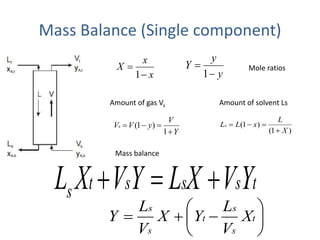
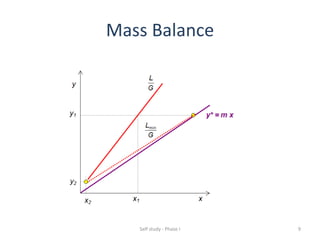
Mass Balance (Single component)
y
y
Y


1x
x
X


1
Mole ratios
Amount of gas Vs
Y
V
yVVs


1
)1(
Amount of solvent Ls
)1(
)1(
X
L
xLLs


tsssts YVXLYVXL 
Mass balance






 t
s
s
t
s
s
X
V
L
YX
V
L
Y
Mass Balance
9Self study - Phase I
Packed Column Height
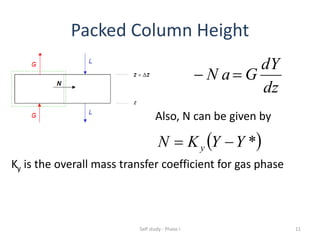
Considering a section of the
column and applying mass
balance,
Gasin = Gasout + gastransferred
If S is the cross sectional area of the column and G, N are the
molar fluxes of gas entering and gas getting diffused,
zSaNzzYGSzYGS  )()(
a- Interfacial area of contact
10Self study - Phase I
Packed Column Height
dz
dY
GaN 
Also, N can be given by
 *YYKN y 
Ky is the overall mass transfer coefficient for gas phase
11Self study - Phase I
Packed Column Height
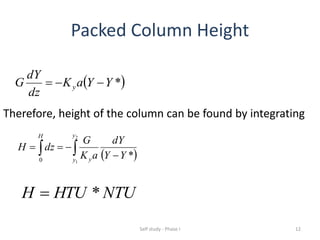
 *YYaK
dz
dY
G y 
 *0
2
1
YY
dY
aK
G
dzH
H y
y y 
  
Therefore, height of the column can be found by integrating
NTUHTUH *
12Self study - Phase I
Packed Column Height
Y* can be replaced by the equation of the
equilibrium curve and hence, NTU can be
evaluated to find the height of the column.
Height of the column can also be evaluated by
HETP (Height Equivalent to a Theoretical
Plate), which is an empirically determined
value, specific to a column.
Self study - Phase I 13
Applications
Absorption
– Removal of gases like H2S from hydrocarbons
using amines as solvent.
– Washing of ammonia from ammonia-air mixture
using water as solvent.
– Gas purification by removal of CO2.
Applications
Desorption
– Removal of volatile organic solvents from
groundwater.
– Removal of TBT(tributyltin) from harbour soils.
– Removal of sulphides and ammonia from ‘sour
water’

Absorption and Stripping - mass transfer

  • 1.
    Absorption and Strippingin Packed Column Megha Rajasekhar Mass Transfer Self Study – Phase 1
  • 2.
    Absorption and Stripping •Absorption – removal of a solute gas from a mixture of gases by extracting into a liquid solvent. • Stripping is the reverse process of absorption, also known as desorption • It is removal of a solute gas from a liquid
  • 3.
    Comparison between plateand packed columns • Packed columns do not hold much liquid and hence can be used for absorption of toxic and flammable liquids, keep size of the unit small. • Plate columns have are used for solvents which contain large amounts of solids. • It easier to install cooling systems in plate columns.
  • 4.
    Absorption • Counter currentflow. Gas containing the solute enters from the bottom and flows out at the top. Solvent liquid, enters at the top and flows out the bottom. • Solvent is chosen such that the solute gas is preferentially soluble in the solvent rather than the gas mixture. •Two film theory can be used to explain diffusion from gas to liquid phase.
  • 5.
    Selection of solvent •Gas Solubility- High solubility of a gas in the solvent is preferred and it should not dissolve carrier gas. If chemical reaction takes place between solute and solvent, rate of absorption is extremely high. But the reaction should be reversible to recover solvent during desorption. • Volatility- Low volatility or low vapor pressure of the solvent enhances the adsorption operation as solvent loss with carrier gas is very small. • Viscosity- Greater amount of power is required for high viscous solvent and flooding is also caused at lower liquid and gas flow rates.
  • 6.
    Selection of solvent •Corrosiveness- Non-corrosive or less corrosive solvent. • Cost- The solvent should be cheap. • Toxicity and Hazard- The solvent should be non-toxic, nonflammable, non-hazardous and should be chemically stable. For stripping, an inert gas must be selected. Steam is usually used for this purpose as, it is easy to condense and separate from solute gas at the outlet.
  • 7.
    Mass Balance (Singlecomponent) y y Y   1x x X   1 Mole ratios Amount of gas Vs Y V yVVs   1 )1( Amount of solvent Ls )1( )1( X L xLLs   tsssts YVXLYVXL  Mass balance        t s s t s s X V L YX V L Y
  • 9.
  • 10.
    Packed Column Height Consideringa section of the column and applying mass balance, Gasin = Gasout + gastransferred If S is the cross sectional area of the column and G, N are the molar fluxes of gas entering and gas getting diffused, zSaNzzYGSzYGS  )()( a- Interfacial area of contact 10Self study - Phase I
  • 11.
    Packed Column Height dz dY GaN Also, N can be given by  *YYKN y  Ky is the overall mass transfer coefficient for gas phase 11Self study - Phase I
  • 12.
    Packed Column Height *YYaK dz dY G y   *0 2 1 YY dY aK G dzH H y y y     Therefore, height of the column can be found by integrating NTUHTUH * 12Self study - Phase I
  • 13.
    Packed Column Height Y*can be replaced by the equation of the equilibrium curve and hence, NTU can be evaluated to find the height of the column. Height of the column can also be evaluated by HETP (Height Equivalent to a Theoretical Plate), which is an empirically determined value, specific to a column. Self study - Phase I 13
  • 14.
    Applications Absorption – Removal ofgases like H2S from hydrocarbons using amines as solvent. – Washing of ammonia from ammonia-air mixture using water as solvent. – Gas purification by removal of CO2.
  • 15.
    Applications Desorption – Removal ofvolatile organic solvents from groundwater. – Removal of TBT(tributyltin) from harbour soils. – Removal of sulphides and ammonia from ‘sour water’

Editor's Notes

  • #11 A = mass transfer surface/volume of column
  • #12 A = mass transfer surface/volume of column