KEEP YOUR
MICROPHONE
ON MUTE
Reduce background noise and distractions.
Microphones can pick up background sounds that may not
bother you but may bother your classmates and teacher. If you
want to say something, raise your hand and wait for the teacher
to acknowledge you before unmuting.
TURN ON YOUR
CAMERA
It sends a message that you are engaged in
class.
It's also easier to respond to teachers with a quick nod is than
typing into the chat or unmuting. You'll also stand out in
classes where most students do not have their camera on.
BE FULLY PRESENT
Pay attention and participate actively.
Don't play games on your phone, check your social media or watch
videos. Focus on the event, take notes and participate in the
discussion. Also, avoid constantly moving away from your study
area because that may be distracting to your teacher and
classmates.
ACTS COMPUTER COLLEGE
Sta. Cruz, Laguna
Basic Calculus
Prepared by:
MS. CHRISHELYN DACSIL
5/16/2022 1:48 PM
ACTS Computer College | Sta. Cruz, Laguna 6
In this lesson you will:
• apply the definition of the derivative of a
function at a given number.
OBJECTIVES:
Introduction to
Derivatives
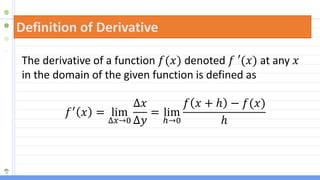
Definition of Derivative
The derivative of a function 𝑓(𝑥) denoted 𝑓 ′(𝑥) at any 𝑥
in the domain of the given function is defined as
𝑓′
𝑥 = lim
∆𝑥→0
∆𝑥
∆𝑦
= lim
ℎ→0
𝑓 𝑥 + ℎ − 𝑓(𝑥)
ℎ
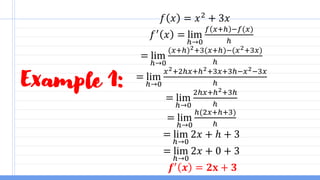
Example 1:
𝑓 𝑥 = 𝑥2
+ 3𝑥
𝑓′
𝑥 = lim
ℎ→0
𝑓 𝑥+ℎ −𝑓(𝑥)
ℎ
= lim
ℎ→0
(𝑥+ℎ)2+3(𝑥+ℎ)−(𝑥2+3𝑥)
ℎ
= lim
ℎ→0
𝑥2+2ℎ𝑥+ℎ2+3𝑥+3ℎ−𝑥2−3𝑥
ℎ
= lim
ℎ→0
2ℎ𝑥+ℎ2+3ℎ
ℎ
= lim
ℎ→0
ℎ(2𝑥+ℎ+3)
ℎ
= lim
ℎ→0
2𝑥 + ℎ + 3
= lim
ℎ→0
2𝑥 + 0 + 3
𝒇′
𝒙 = 𝟐𝐱 + 𝟑
Example 2:
𝑓 𝑥 = 5𝑥 − 1, 𝑠𝑜𝑙𝑣𝑒 𝑓𝑜𝑟 𝑓′(1)
𝑓′
𝑥 = lim
𝑥→𝑥0
𝑓 𝑥 −𝑓(𝑥0)
𝑥−𝑥0
𝑓′
1 = lim
𝑥→1
5𝑥 − 1 − [5 1 − 1]
𝑥 − 1
𝑓′
1 = lim
𝑥→1
5𝑥 − 1 − 4
𝑥 − 1
𝑓′
1 = lim
𝑥→1
5𝑥 − 5
𝑥 − 1
𝑓′
1 = lim
𝑥→1
5(𝑥 − 1)
𝑥 − 1
𝑓′
1 = lim
𝑥→1
5
𝒇′
𝟏 = 𝟓
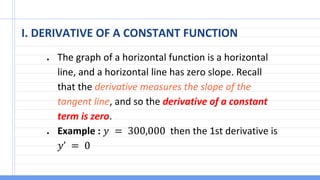
I. DERIVATIVE OF A CONSTANT FUNCTION
● The graph of a horizontal function is a horizontal
line, and a horizontal line has zero slope. Recall
that the derivative measures the slope of the
tangent line, and so the derivative of a constant
term is zero.
● Example : 𝑦 = 300,000 then the 1st derivative is
𝑦’ = 0
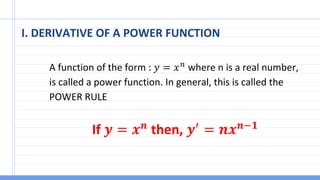
I. DERIVATIVE OF A POWER FUNCTION
A function of the form : 𝑦 = 𝑥𝑛
where n is a real number,
is called a power function. In general, this is called the
POWER RULE
If 𝒚 = 𝒙𝒏
then, 𝒚′
= 𝒏𝒙𝒏−𝟏
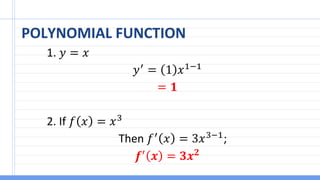
POLYNOMIAL FUNCTION
1. 𝑦 = 𝑥
𝑦′
= 1 𝑥1−1
= 𝟏
2. If 𝑓 𝑥 = 𝑥3
Then 𝑓′
𝑥 = 3𝑥3−1
;
𝒇′
𝒙 = 𝟑𝒙𝟐
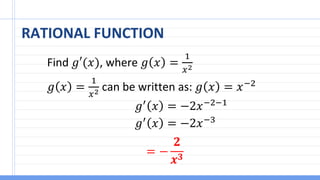
RATIONAL FUNCTION
Find 𝑔′(𝑥), where 𝑔 𝑥 =
1
𝑥2
𝑔 𝑥 =
1
𝑥2 can be written as: 𝑔 𝑥 = 𝑥−2
𝑔′
𝑥 = −2𝑥−2−1
𝑔′
𝑥 = −2𝑥−3
= −
𝟐
𝒙𝟑
RADICAL FUNCTION
Find the derivative of 𝑦 =
4
𝑥3
SOLUTIONS:
𝑦 =
4
𝑥3
𝑦 = 𝑥
3
4 rewrite the expression to exponential form
𝑦′ =
3
4
𝑥
3
4
−1
apply the power rule
=
3
4
𝑥−
1
4 subtract the exponents
𝑦′ =
3
4𝑥 ൗ
1
4
=
𝟑
𝟒𝟒
𝒙
simplify to radical form
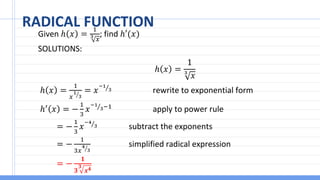
RADICAL FUNCTION
Given ℎ 𝑥 =
1
3
𝑥
; find ℎ′(𝑥)
SOLUTIONS:
ℎ 𝑥 =
1
3
𝑥
ℎ 𝑥 =
1
𝑥 ൗ
1
3
= 𝑥 Τ
−1
3 rewrite to exponential form
ℎ′
𝑥 = −
1
3
𝑥 Τ
−1
3−1
apply to power rule
= −
1
3
𝑥 Τ
−4
3 subtract the exponents
= −
1
3𝑥 ൗ
4
3
simplified radical expression
= −
𝟏
𝟑
𝟑
𝒙𝟒
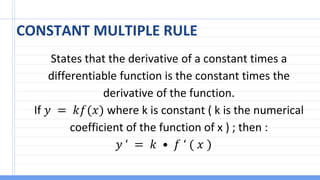
CONSTANT MULTIPLE RULE
States that the derivative of a constant times a
differentiable function is the constant times the
derivative of the function.
If 𝑦 = 𝑘𝑓(𝑥) where k is constant ( k is the numerical
coefficient of the function of x ) ; then :
𝑦 ‘ = 𝑘 • 𝑓 ‘ ( 𝑥 )
CONSTANT MULTIPLE RULE
Given: ℎ 𝑥 = 5𝑥 Τ
3
4; 𝑓𝑖𝑛𝑑
𝑑𝑦
𝑑𝑥
SOLUTION : Let 𝑦 = ℎ ( 𝑥 )
𝑦 = 5𝑥 Τ
3
4
𝑦 = 5 ∙ 𝑥 Τ
3
4 rewrite in the form
𝑘 ∙ 𝑥𝑛
𝑦′
= 5 ∙
3
4
𝑥
3
4
−1
apply constant
multiple
and power rule
=
15
4
𝑥−
1
4 subtract exponents
and combine similar terms
=
15
4𝑥
1
4
expressed in positive
exponent
𝑦′ =
15
44
𝑥
simplest
radical form
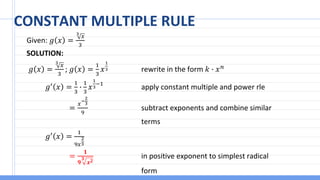
CONSTANT MULTIPLE RULE
Given: 𝑔 𝑥 =
3
𝑥
3
SOLUTION:
𝑔 𝑥 =
3
𝑥
3
; 𝑔 𝑥 =
1
3
𝑥
1
3 rewrite in the form 𝑘 ∙ 𝑥𝑛
𝑔′ 𝑥 =
1
3
∙
1
3
𝑥
1
3
−1
apply constant multiple and power rle
=
𝑥
−
2
3
9
subtract exponents and combine similar
terms
𝑔′ 𝑥 =
1
9𝑥
2
3
=
𝟏
𝟗
𝟑
𝒙𝟐
in positive exponent to simplest radical
form
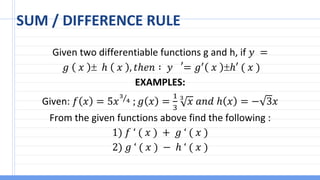
SUM / DIFFERENCE RULE
Given two differentiable functions g and h, if 𝑦 =
𝑔 𝑥  ℎ 𝑥 , 𝑡ℎ𝑒𝑛 ∶ 𝑦 ′
= 𝑔′
𝑥 ℎ′ ( 𝑥 )
EXAMPLES:
Given: 𝑓 𝑥 = 5𝑥 Τ
3
4 ; 𝑔 𝑥 =
1
3
3
𝑥 𝑎𝑛𝑑 ℎ 𝑥 = − 3𝑥
From the given functions above find the following :
1) 𝑓 ‘ ( 𝑥 ) + 𝑔 ‘ ( 𝑥 )
2) 𝑔 ‘ ( 𝑥 ) − ℎ ‘ ( 𝑥 )
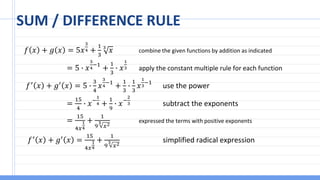
SUM / DIFFERENCE RULE
𝑓 𝑥 + 𝑔 𝑥 = 5𝑥
3
4 +
1
3
3
𝑥 combine the given functions by addition as indicated
= 5 ∙ 𝑥
3
4
−1
+
1
3
∙ 𝑥
1
3 apply the constant multiple rule for each function
𝑓′
𝑥 + 𝑔′
𝑥 = 5 ∙
3
4
𝑥
3
4
−1
+
1
3
∙
1
3
𝑥
1
3
−1
use the power
=
15
4
∙ 𝑥−
1
4 +
1
9
∙ 𝑥−
2
3 subtract the exponents
=
15
4𝑥
1
4
+
1
9
3
𝑥2
expressed the terms with positive exponents
𝑓′
𝑥 + 𝑔′
𝑥 =
15
4𝑥
1
4
+
1
9
3
𝑥2
simplified radical expression
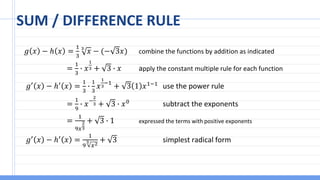
SUM / DIFFERENCE RULE
𝑔 𝑥 − ℎ 𝑥 =
1
3
3
𝑥 − (− 3𝑥) combine the functions by addition as indicated
=
1
3
∙ 𝑥
1
3 + 3 ∙ 𝑥 apply the constant multiple rule for each function
𝑔′
𝑥 − ℎ′
𝑥 =
1
3
∙
1
3
𝑥
1
3
−1
+ 3 1 𝑥1−1
use the power rule
=
1
9
∙ 𝑥−
2
3 + 3 ∙ 𝑥0 subtract the exponents
=
1
9𝑥
2
3
+ 3 ∙ 1 expressed the terms with positive exponents
𝑔′ 𝑥 − ℎ′ 𝑥 =
1
9
3
𝑥2
+ 3 simplest radical form
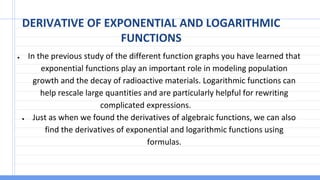
DERIVATIVE OF EXPONENTIAL AND LOGARITHMIC
FUNCTIONS
● In the previous study of the different function graphs you have learned that
exponential functions play an important role in modeling population
growth and the decay of radioactive materials. Logarithmic functions can
help rescale large quantities and are particularly helpful for rewriting
complicated expressions.
● Just as when we found the derivatives of algebraic functions, we can also
find the derivatives of exponential and logarithmic functions using
formulas.
DIFFERENTIATION FORMULAS : EXPONENTIAL AND
LOGARITHMIC FUNCTIONS
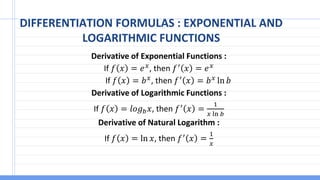
Derivative of Exponential Functions :
If 𝑓 𝑥 = 𝑒𝑥
, then 𝑓′
𝑥 = 𝑒𝑥
If 𝑓 𝑥 = 𝑏𝑥, then 𝑓′ 𝑥 = 𝑏𝑥 ln 𝑏
Derivative of Logarithmic Functions :
If 𝑓 𝑥 = 𝑙𝑜𝑔𝑏𝑥, then 𝑓′ 𝑥 =
1
𝑥 ln 𝑏
Derivative of Natural Logarithm :
If 𝑓 𝑥 = ln 𝑥, then 𝑓′ 𝑥 =
1
𝑥
DIFFERENTIATION FORMULAS : EXPONENTIAL AND
LOGARITHMIC FUNCTIONS
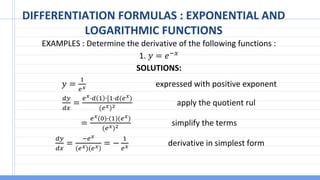
EXAMPLES : Determine the derivative of the following functions :
1. 𝑦 = 𝑒−𝑥
SOLUTIONS:
𝑦 =
1
𝑒𝑥 expressed with positive exponent
𝑑𝑦
𝑑𝑥
=
𝑒𝑥∙𝑑 1 ∙[1∙𝑑(𝑒𝑥)
(𝑒𝑥)2 apply the quotient rul
=
𝑒𝑥(0)∙(1)(𝑒𝑥)
(𝑒𝑥)2 simplify the terms
𝑑𝑦
𝑑𝑥
=
−𝑒𝑥
(𝑒𝑥)(𝑒𝑥)
= −
1
𝑒𝑥 derivative in simplest form
DIFFERENTIATION FORMULAS : EXPONENTIAL AND
LOGARITHMIC FUNCTIONS
EXAMPLES : Determine the derivative of the following functions :
1. 𝑦 = 𝑒−𝑥
SOLUTIONS:
𝑦 =
1
𝑒𝑥 expressed with positive exponent
𝑑𝑦
𝑑𝑥
=
𝑒𝑥∙𝑑 1 ∙[1∙𝑑(𝑒𝑥)
(𝑒𝑥)2 apply the quotient rul
=
𝑒𝑥(0)∙(1)(𝑒𝑥)
(𝑒𝑥)2 simplify the terms
𝑑𝑦
𝑑𝑥
=
−𝑒𝑥
(𝑒𝑥)(𝑒𝑥)
= −
1
𝑒𝑥 derivative in simplest form
DIFFERENTIATION FORMULAS : EXPONENTIAL AND
LOGARITHMIC FUNCTIONS
EXAMPLES : Determine the derivative of the following functions :
1. 𝑦 = 𝑒−𝑥
SOLUTIONS:
𝑦 =
1
𝑒𝑥 expressed with positive exponent
𝑑𝑦
𝑑𝑥
=
𝑒𝑥∙𝑑 1 ∙[1∙𝑑(𝑒𝑥)
(𝑒𝑥)2 apply the quotient rul
=
𝑒𝑥(0)∙(1)(𝑒𝑥)
(𝑒𝑥)2 simplify the terms
𝑑𝑦
𝑑𝑥
=
−𝑒𝑥
(𝑒𝑥)(𝑒𝑥)
= −
1
𝑒𝑥 derivative in simplest form
DIFFERENTIATION FORMULAS : EXPONENTIAL AND
LOGARITHMIC FUNCTIONS
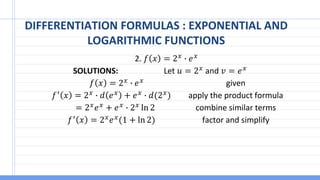
2. 𝑓 𝑥 = 2𝑥 ∙ 𝑒𝑥
SOLUTIONS: Let 𝑢 = 2𝑥 and 𝑣 = 𝑒𝑥
𝑓 𝑥 = 2𝑥 ∙ 𝑒𝑥 given
𝑓′ 𝑥 = 2𝑥 ∙ 𝑑 𝑒𝑥 + 𝑒𝑥 ∙ 𝑑(2𝑥) apply the product formula
= 2𝑥𝑒𝑥 + 𝑒𝑥 ∙ 2𝑥 ln 2 combine similar terms
𝑓′
𝑥 = 2𝑥
𝑒𝑥
(1 + ln 2) factor and simplify
DIFFERENTIATION FORMULAS : EXPONENTIAL AND
LOGARITHMIC FUNCTIONS
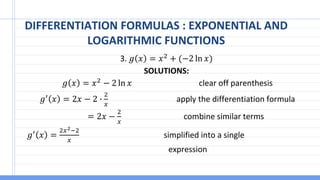
3. 𝑔 𝑥 = 𝑥2 + (−2 ln 𝑥)
SOLUTIONS:
𝑔 𝑥 = 𝑥2 − 2 ln 𝑥 clear off parenthesis
𝑔′
𝑥 = 2𝑥 − 2 ∙
2
𝑥
apply the differentiation formula
= 2𝑥 −
2
𝑥
combine similar terms
𝑔′
𝑥 =
2𝑥2−2
𝑥
simplified into a single
expression
Basic Calculus (Module 9) - Intermediate Value Theorem

Basic Calculus (Module 9) - Intermediate Value Theorem

  • 2.
    KEEP YOUR MICROPHONE ON MUTE Reducebackground noise and distractions. Microphones can pick up background sounds that may not bother you but may bother your classmates and teacher. If you want to say something, raise your hand and wait for the teacher to acknowledge you before unmuting.
  • 3.
    TURN ON YOUR CAMERA Itsends a message that you are engaged in class. It's also easier to respond to teachers with a quick nod is than typing into the chat or unmuting. You'll also stand out in classes where most students do not have their camera on.
  • 4.
    BE FULLY PRESENT Payattention and participate actively. Don't play games on your phone, check your social media or watch videos. Focus on the event, take notes and participate in the discussion. Also, avoid constantly moving away from your study area because that may be distracting to your teacher and classmates.
  • 5.
    ACTS COMPUTER COLLEGE Sta.Cruz, Laguna Basic Calculus Prepared by: MS. CHRISHELYN DACSIL
  • 6.
    5/16/2022 1:48 PM ACTSComputer College | Sta. Cruz, Laguna 6 In this lesson you will: • apply the definition of the derivative of a function at a given number. OBJECTIVES:
  • 7.
  • 8.
    Definition of Derivative Thederivative of a function 𝑓(𝑥) denoted 𝑓 ′(𝑥) at any 𝑥 in the domain of the given function is defined as 𝑓′ 𝑥 = lim ∆𝑥→0 ∆𝑥 ∆𝑦 = lim ℎ→0 𝑓 𝑥 + ℎ − 𝑓(𝑥) ℎ
  • 9.
    Example 1: 𝑓 𝑥= 𝑥2 + 3𝑥 𝑓′ 𝑥 = lim ℎ→0 𝑓 𝑥+ℎ −𝑓(𝑥) ℎ = lim ℎ→0 (𝑥+ℎ)2+3(𝑥+ℎ)−(𝑥2+3𝑥) ℎ = lim ℎ→0 𝑥2+2ℎ𝑥+ℎ2+3𝑥+3ℎ−𝑥2−3𝑥 ℎ = lim ℎ→0 2ℎ𝑥+ℎ2+3ℎ ℎ = lim ℎ→0 ℎ(2𝑥+ℎ+3) ℎ = lim ℎ→0 2𝑥 + ℎ + 3 = lim ℎ→0 2𝑥 + 0 + 3 𝒇′ 𝒙 = 𝟐𝐱 + 𝟑
  • 10.
    Example 2: 𝑓 𝑥= 5𝑥 − 1, 𝑠𝑜𝑙𝑣𝑒 𝑓𝑜𝑟 𝑓′(1) 𝑓′ 𝑥 = lim 𝑥→𝑥0 𝑓 𝑥 −𝑓(𝑥0) 𝑥−𝑥0 𝑓′ 1 = lim 𝑥→1 5𝑥 − 1 − [5 1 − 1] 𝑥 − 1 𝑓′ 1 = lim 𝑥→1 5𝑥 − 1 − 4 𝑥 − 1 𝑓′ 1 = lim 𝑥→1 5𝑥 − 5 𝑥 − 1 𝑓′ 1 = lim 𝑥→1 5(𝑥 − 1) 𝑥 − 1 𝑓′ 1 = lim 𝑥→1 5 𝒇′ 𝟏 = 𝟓
  • 13.
    I. DERIVATIVE OFA CONSTANT FUNCTION ● The graph of a horizontal function is a horizontal line, and a horizontal line has zero slope. Recall that the derivative measures the slope of the tangent line, and so the derivative of a constant term is zero. ● Example : 𝑦 = 300,000 then the 1st derivative is 𝑦’ = 0
  • 14.
    I. DERIVATIVE OFA POWER FUNCTION A function of the form : 𝑦 = 𝑥𝑛 where n is a real number, is called a power function. In general, this is called the POWER RULE If 𝒚 = 𝒙𝒏 then, 𝒚′ = 𝒏𝒙𝒏−𝟏
  • 15.
    POLYNOMIAL FUNCTION 1. 𝑦= 𝑥 𝑦′ = 1 𝑥1−1 = 𝟏 2. If 𝑓 𝑥 = 𝑥3 Then 𝑓′ 𝑥 = 3𝑥3−1 ; 𝒇′ 𝒙 = 𝟑𝒙𝟐
  • 16.
    RATIONAL FUNCTION Find 𝑔′(𝑥),where 𝑔 𝑥 = 1 𝑥2 𝑔 𝑥 = 1 𝑥2 can be written as: 𝑔 𝑥 = 𝑥−2 𝑔′ 𝑥 = −2𝑥−2−1 𝑔′ 𝑥 = −2𝑥−3 = − 𝟐 𝒙𝟑
  • 17.
    RADICAL FUNCTION Find thederivative of 𝑦 = 4 𝑥3 SOLUTIONS: 𝑦 = 4 𝑥3 𝑦 = 𝑥 3 4 rewrite the expression to exponential form 𝑦′ = 3 4 𝑥 3 4 −1 apply the power rule = 3 4 𝑥− 1 4 subtract the exponents 𝑦′ = 3 4𝑥 ൗ 1 4 = 𝟑 𝟒𝟒 𝒙 simplify to radical form
  • 18.
    RADICAL FUNCTION Given ℎ𝑥 = 1 3 𝑥 ; find ℎ′(𝑥) SOLUTIONS: ℎ 𝑥 = 1 3 𝑥 ℎ 𝑥 = 1 𝑥 ൗ 1 3 = 𝑥 Τ −1 3 rewrite to exponential form ℎ′ 𝑥 = − 1 3 𝑥 Τ −1 3−1 apply to power rule = − 1 3 𝑥 Τ −4 3 subtract the exponents = − 1 3𝑥 ൗ 4 3 simplified radical expression = − 𝟏 𝟑 𝟑 𝒙𝟒
  • 19.
    CONSTANT MULTIPLE RULE Statesthat the derivative of a constant times a differentiable function is the constant times the derivative of the function. If 𝑦 = 𝑘𝑓(𝑥) where k is constant ( k is the numerical coefficient of the function of x ) ; then : 𝑦 ‘ = 𝑘 • 𝑓 ‘ ( 𝑥 )
  • 20.
    CONSTANT MULTIPLE RULE Given:ℎ 𝑥 = 5𝑥 Τ 3 4; 𝑓𝑖𝑛𝑑 𝑑𝑦 𝑑𝑥 SOLUTION : Let 𝑦 = ℎ ( 𝑥 ) 𝑦 = 5𝑥 Τ 3 4 𝑦 = 5 ∙ 𝑥 Τ 3 4 rewrite in the form 𝑘 ∙ 𝑥𝑛 𝑦′ = 5 ∙ 3 4 𝑥 3 4 −1 apply constant multiple and power rule = 15 4 𝑥− 1 4 subtract exponents and combine similar terms = 15 4𝑥 1 4 expressed in positive exponent 𝑦′ = 15 44 𝑥 simplest radical form
  • 21.
    CONSTANT MULTIPLE RULE Given:𝑔 𝑥 = 3 𝑥 3 SOLUTION: 𝑔 𝑥 = 3 𝑥 3 ; 𝑔 𝑥 = 1 3 𝑥 1 3 rewrite in the form 𝑘 ∙ 𝑥𝑛 𝑔′ 𝑥 = 1 3 ∙ 1 3 𝑥 1 3 −1 apply constant multiple and power rle = 𝑥 − 2 3 9 subtract exponents and combine similar terms 𝑔′ 𝑥 = 1 9𝑥 2 3 = 𝟏 𝟗 𝟑 𝒙𝟐 in positive exponent to simplest radical form
  • 22.
    SUM / DIFFERENCERULE Given two differentiable functions g and h, if 𝑦 = 𝑔 𝑥  ℎ 𝑥 , 𝑡ℎ𝑒𝑛 ∶ 𝑦 ′ = 𝑔′ 𝑥 ℎ′ ( 𝑥 ) EXAMPLES: Given: 𝑓 𝑥 = 5𝑥 Τ 3 4 ; 𝑔 𝑥 = 1 3 3 𝑥 𝑎𝑛𝑑 ℎ 𝑥 = − 3𝑥 From the given functions above find the following : 1) 𝑓 ‘ ( 𝑥 ) + 𝑔 ‘ ( 𝑥 ) 2) 𝑔 ‘ ( 𝑥 ) − ℎ ‘ ( 𝑥 )
  • 23.
    SUM / DIFFERENCERULE 𝑓 𝑥 + 𝑔 𝑥 = 5𝑥 3 4 + 1 3 3 𝑥 combine the given functions by addition as indicated = 5 ∙ 𝑥 3 4 −1 + 1 3 ∙ 𝑥 1 3 apply the constant multiple rule for each function 𝑓′ 𝑥 + 𝑔′ 𝑥 = 5 ∙ 3 4 𝑥 3 4 −1 + 1 3 ∙ 1 3 𝑥 1 3 −1 use the power = 15 4 ∙ 𝑥− 1 4 + 1 9 ∙ 𝑥− 2 3 subtract the exponents = 15 4𝑥 1 4 + 1 9 3 𝑥2 expressed the terms with positive exponents 𝑓′ 𝑥 + 𝑔′ 𝑥 = 15 4𝑥 1 4 + 1 9 3 𝑥2 simplified radical expression
  • 24.
    SUM / DIFFERENCERULE 𝑔 𝑥 − ℎ 𝑥 = 1 3 3 𝑥 − (− 3𝑥) combine the functions by addition as indicated = 1 3 ∙ 𝑥 1 3 + 3 ∙ 𝑥 apply the constant multiple rule for each function 𝑔′ 𝑥 − ℎ′ 𝑥 = 1 3 ∙ 1 3 𝑥 1 3 −1 + 3 1 𝑥1−1 use the power rule = 1 9 ∙ 𝑥− 2 3 + 3 ∙ 𝑥0 subtract the exponents = 1 9𝑥 2 3 + 3 ∙ 1 expressed the terms with positive exponents 𝑔′ 𝑥 − ℎ′ 𝑥 = 1 9 3 𝑥2 + 3 simplest radical form
  • 25.
    DERIVATIVE OF EXPONENTIALAND LOGARITHMIC FUNCTIONS ● In the previous study of the different function graphs you have learned that exponential functions play an important role in modeling population growth and the decay of radioactive materials. Logarithmic functions can help rescale large quantities and are particularly helpful for rewriting complicated expressions. ● Just as when we found the derivatives of algebraic functions, we can also find the derivatives of exponential and logarithmic functions using formulas.
  • 26.
    DIFFERENTIATION FORMULAS :EXPONENTIAL AND LOGARITHMIC FUNCTIONS Derivative of Exponential Functions : If 𝑓 𝑥 = 𝑒𝑥 , then 𝑓′ 𝑥 = 𝑒𝑥 If 𝑓 𝑥 = 𝑏𝑥, then 𝑓′ 𝑥 = 𝑏𝑥 ln 𝑏 Derivative of Logarithmic Functions : If 𝑓 𝑥 = 𝑙𝑜𝑔𝑏𝑥, then 𝑓′ 𝑥 = 1 𝑥 ln 𝑏 Derivative of Natural Logarithm : If 𝑓 𝑥 = ln 𝑥, then 𝑓′ 𝑥 = 1 𝑥
  • 27.
    DIFFERENTIATION FORMULAS :EXPONENTIAL AND LOGARITHMIC FUNCTIONS EXAMPLES : Determine the derivative of the following functions : 1. 𝑦 = 𝑒−𝑥 SOLUTIONS: 𝑦 = 1 𝑒𝑥 expressed with positive exponent 𝑑𝑦 𝑑𝑥 = 𝑒𝑥∙𝑑 1 ∙[1∙𝑑(𝑒𝑥) (𝑒𝑥)2 apply the quotient rul = 𝑒𝑥(0)∙(1)(𝑒𝑥) (𝑒𝑥)2 simplify the terms 𝑑𝑦 𝑑𝑥 = −𝑒𝑥 (𝑒𝑥)(𝑒𝑥) = − 1 𝑒𝑥 derivative in simplest form
  • 28.
    DIFFERENTIATION FORMULAS :EXPONENTIAL AND LOGARITHMIC FUNCTIONS EXAMPLES : Determine the derivative of the following functions : 1. 𝑦 = 𝑒−𝑥 SOLUTIONS: 𝑦 = 1 𝑒𝑥 expressed with positive exponent 𝑑𝑦 𝑑𝑥 = 𝑒𝑥∙𝑑 1 ∙[1∙𝑑(𝑒𝑥) (𝑒𝑥)2 apply the quotient rul = 𝑒𝑥(0)∙(1)(𝑒𝑥) (𝑒𝑥)2 simplify the terms 𝑑𝑦 𝑑𝑥 = −𝑒𝑥 (𝑒𝑥)(𝑒𝑥) = − 1 𝑒𝑥 derivative in simplest form
  • 29.
    DIFFERENTIATION FORMULAS :EXPONENTIAL AND LOGARITHMIC FUNCTIONS EXAMPLES : Determine the derivative of the following functions : 1. 𝑦 = 𝑒−𝑥 SOLUTIONS: 𝑦 = 1 𝑒𝑥 expressed with positive exponent 𝑑𝑦 𝑑𝑥 = 𝑒𝑥∙𝑑 1 ∙[1∙𝑑(𝑒𝑥) (𝑒𝑥)2 apply the quotient rul = 𝑒𝑥(0)∙(1)(𝑒𝑥) (𝑒𝑥)2 simplify the terms 𝑑𝑦 𝑑𝑥 = −𝑒𝑥 (𝑒𝑥)(𝑒𝑥) = − 1 𝑒𝑥 derivative in simplest form
  • 30.
    DIFFERENTIATION FORMULAS :EXPONENTIAL AND LOGARITHMIC FUNCTIONS 2. 𝑓 𝑥 = 2𝑥 ∙ 𝑒𝑥 SOLUTIONS: Let 𝑢 = 2𝑥 and 𝑣 = 𝑒𝑥 𝑓 𝑥 = 2𝑥 ∙ 𝑒𝑥 given 𝑓′ 𝑥 = 2𝑥 ∙ 𝑑 𝑒𝑥 + 𝑒𝑥 ∙ 𝑑(2𝑥) apply the product formula = 2𝑥𝑒𝑥 + 𝑒𝑥 ∙ 2𝑥 ln 2 combine similar terms 𝑓′ 𝑥 = 2𝑥 𝑒𝑥 (1 + ln 2) factor and simplify
  • 31.
    DIFFERENTIATION FORMULAS :EXPONENTIAL AND LOGARITHMIC FUNCTIONS 3. 𝑔 𝑥 = 𝑥2 + (−2 ln 𝑥) SOLUTIONS: 𝑔 𝑥 = 𝑥2 − 2 ln 𝑥 clear off parenthesis 𝑔′ 𝑥 = 2𝑥 − 2 ∙ 2 𝑥 apply the differentiation formula = 2𝑥 − 2 𝑥 combine similar terms 𝑔′ 𝑥 = 2𝑥2−2 𝑥 simplified into a single expression