Unit-5 VECTOR INTEGRATION
RAI UNIVERSITY, AHMEDABAD 1
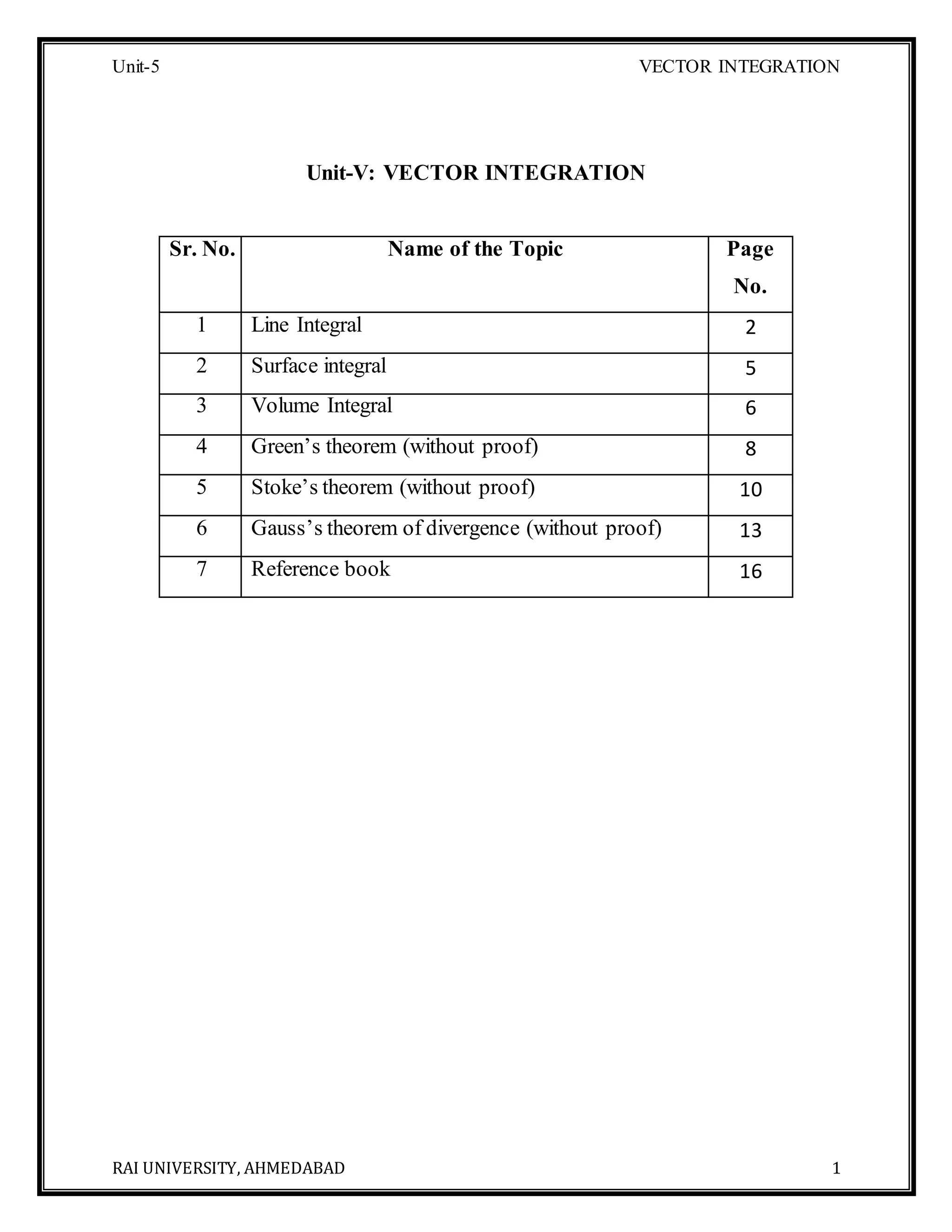
Unit-V: VECTOR INTEGRATION
Sr. No. Name of the Topic Page
No.
1 Line Integral 2
2 Surface integral 5
3 Volume Integral 6
4 Green’s theorem (without proof) 8
5 Stoke’s theorem (without proof) 10
6 Gauss’s theorem of divergence (without proof) 13
7 Reference book 16
Unit-5 VECTOR INTEGRATION
RAI UNIVERSITY, AHMEDABAD 2
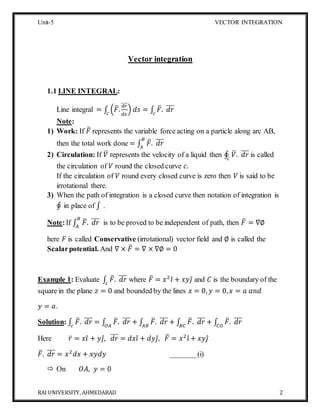
Vector integration
1.1 LINE INTEGRAL:
Line integral = ∫ (š¹Ģ….
š‘‘š‘Ÿāƒ—āƒ—āƒ—āƒ—āƒ—
š‘‘š‘ 
)š‘
š‘‘š‘  = ∫ š¹Ģ…. š‘‘š‘ŸĢ…Ģ…Ģ…
š‘
Note:
1) Work: If š¹Ģ… represents the variable force acting on a particle along arc AB,
then the total work done = ∫ š¹Ģ…. š‘‘š‘ŸĢ…Ģ…Ģ…šµ
š“
2) Circulation: If š‘‰Ģ… represents the velocity of a liquid then ∮ š‘‰Ģ…. š‘‘š‘ŸĢ…Ģ…Ģ…
š‘
is called
the circulation of š‘‰ round the closed curve š‘.
If the circulation of š‘‰ round every closed curve is zero then š‘‰ is said to be
irrotational there.
3) When the path of integration is a closed curve then notation of integration is
∮ in place of ∫ .
Note:If ∫ š¹Ģ…. š‘‘š‘ŸĢ…Ģ…Ģ…šµ
š“
is to be proved to be independent of path, then š¹Ģ… = āˆ‡āˆ…
here š¹ is called Conservative (irrotational) vector field and āˆ… is called the
Scalarpotential. And āˆ‡ Ɨ š¹Ģ… = āˆ‡ Ɨ āˆ‡āˆ… = 0
Example 1: Evaluate ∫ š¹Ģ…. š‘‘š‘ŸĢ…Ģ…Ģ…
š‘
where š¹Ģ… = š‘„2
š‘–Ģ‚ + š‘„š‘¦š‘—Ģ‚ and š¶ is the boundary of the
square in the plane š‘§ = 0 and bounded by the lines š‘„ = 0, š‘¦ = 0, š‘„ = š‘Ž š‘Žš‘›š‘‘
š‘¦ = š‘Ž.
Solution: ∫ š¹Ģ…. š‘‘š‘ŸĢ…Ģ…Ģ…
š‘
= ∫ š¹Ģ…. š‘‘š‘ŸĢ…Ģ…Ģ…
š‘‚š“
+ ∫ š¹Ģ…. š‘‘š‘ŸĢ…Ģ…Ģ…
š“šµ
+ ∫ š¹Ģ…. š‘‘š‘ŸĢ…Ģ…Ģ…
šµš¶
+ ∫ š¹Ģ…. š‘‘š‘ŸĢ…Ģ…Ģ…
š¶š‘‚
Here š‘ŸĢ… = š‘„š‘–Ģ‚ + š‘¦š‘—Ģ‚, š‘‘š‘ŸĢ…Ģ…Ģ… = š‘‘š‘„š‘–Ģ‚ + š‘‘š‘¦š‘—Ģ‚, š¹Ģ… = š‘„2
š‘–Ģ‚ + š‘„š‘¦š‘—Ģ‚
š¹Ģ…. š‘‘š‘ŸĢ…Ģ…Ģ… = š‘„2
š‘‘š‘„ + š‘„š‘¦š‘‘š‘¦ _______(i)
 On š‘‚š“, š‘¦ = 0
Unit-5 VECTOR INTEGRATION
RAI UNIVERSITY, AHMEDABAD 3
∓ š¹Ģ…. š‘‘š‘ŸĢ…Ģ…Ģ… = š‘„2
š‘‘š‘„ (From (i))
∫ š¹Ģ…. š‘‘š‘ŸĢ…Ģ…Ģ…
š‘‚š“
= ∫ š‘„2
š‘‘š‘„ = [
š‘„3
3
]
0
3
=
š‘Ž3
3
š‘Ž
0
_______ (ii)
 On š“šµ, š‘„ = š‘Ž
∓ š‘‘š‘„ = 0
∓ š¹Ģ…. š‘‘š‘ŸĢ…Ģ…Ģ… = š‘Žš‘¦ š‘‘š‘¦ (From (i))
∫ š¹Ģ…. š‘‘š‘ŸĢ…Ģ…Ģ…
š“šµ
= ∫ š‘Žš‘¦ š‘‘š‘¦ = š‘Ž [
š‘¦2
2
]
0
š‘Ž
=
š‘Ž3
2
š‘Ž
0
_______(iii)
 On šµš¶, š‘¦ = š‘Ž
∓ š‘‘š‘¦ = 0
∓ š¹Ģ…. š‘‘š‘ŸĢ…Ģ…Ģ… = š‘„2
š‘‘š‘„ (From (i))
∫ š¹Ģ…. š‘‘š‘ŸĢ…Ģ…Ģ…
šµš¶
= ∫ š‘„2
š‘‘š‘„ = [
š‘„3
3
]
š‘Ž
0
= āˆ’
š‘Ž3
3
0
š‘Ž
_______(iv)
 On š¶š‘‚, š‘„ = 0
∓ š¹Ģ…. š‘‘š‘ŸĢ…Ģ…Ģ… = 0 (From (i))
∫ š¹Ģ…. š‘‘š‘ŸĢ…Ģ…Ģ…
š¶š‘‚
= 0 _______(v)
On adding (ii), (iii), (iv) and (v), we get
∫ š¹Ģ…. š‘‘š‘ŸĢ…Ģ…Ģ…
š¶
=
š‘Ž3
3
+
š‘Ž3
2
āˆ’
š‘Ž3
3
+ 0 =
š‘Ž3
2
________ Ans.
Example 2: A vector field is given by
š¹Ģ… = (2š‘¦ + 3) š‘–Ģ‚ + ( š‘„š‘§) š‘—Ģ‚ + (š‘¦š‘§āˆ’ š‘„)š‘˜Ģ‚. Evaluate ∫ š¹Ģ…. š‘‘š‘ŸĢ…Ģ…Ģ…
š¶
along the path š‘ is š‘„ =
2š‘”, š‘¦ = š‘”, š‘§ = š‘”3
š‘“š‘Ÿš‘œš‘š š‘” = 0 š‘”š‘œ š‘” = 1.
Solution:
∫ š¹Ģ…. š‘‘š‘ŸĢ…Ģ…Ģ…
š¶
= ∫ (2š‘¦ + 3) š‘‘š‘„ + ( š‘„š‘§) š‘‘š‘¦ + (š‘¦š‘§āˆ’ š‘„)š‘‘š‘§š¶
[
š‘ š‘–š‘›š‘š‘’ š‘„ = 2š‘” š‘¦ = š‘” š‘§ = š‘”3
∓
š‘‘š‘„
š‘‘š‘”
= 2
š‘‘š‘¦
š‘‘š‘”
= 1
š‘‘š‘§
š‘‘š‘”
= 3š‘”2 ]
Unit-5 VECTOR INTEGRATION
RAI UNIVERSITY, AHMEDABAD 4
= ∫ (2š‘” + 3)(2 š‘‘š‘”) + (2š‘”)( š‘”3) š‘‘š‘” + ( š‘”4
āˆ’ 2š‘”)(3š‘”2
š‘‘š‘”)
1
0
= ∫ (4š‘” + 6 + 2š‘”4
+ 3š‘”6
āˆ’ 6š‘”3) š‘‘š‘”
1
0
= [4
š‘”2
2
+ 6š‘” +
2
5
š‘”5
+
3
7
š‘”7
āˆ’
6
4
š‘”4
]
0
1
= [2š‘”2
+ 6š‘” +
2
5
š‘”5
+
3
7
š‘”7
āˆ’
3
2
š‘”4
]
0
1
= 2 + 6 +
2
5
+
3
7
āˆ’
3
2
= 7.32857 _________Ans.
Example 3: Suppose š¹( š‘„, š‘¦, š‘§) = š‘„3
š‘–Ģ‚ + š‘¦š‘—Ģ‚ + š‘§š‘˜Ģ‚ is the force field. Find the work
done by š¹ along the line from the (1, 2, 3) to (3, 5, 7).
Solution: Work done= ∫ š¹Ģ…. š‘‘š‘ŸĢ…Ģ…Ģ…
š‘
= ∫ (š‘„3
š‘–Ģ‚ + š‘¦š‘—Ģ‚ + š‘§š‘˜Ģ‚). š‘‘(š‘–Ģ‚ š‘‘š‘„ + š‘—Ģ‚ š‘‘š‘¦ + š‘˜Ģ‚ š‘‘š‘§)
(3,5,7)
(1,2,3)
= ∫ ( š‘„3
š‘‘š‘„ + š‘¦š‘‘š‘¦ + š‘§š‘‘š‘§)
(3,5,7)
(1,2,3)
= ∫ š‘„3
š‘‘š‘„ + ∫ š‘¦ š‘‘š‘¦ + ∫ š‘§ š‘‘š‘§
7
3
5
2
3
1
= [
š‘„4
4
]
1
3
+ [
š‘¦2
2
]
2
5
+ [
š‘§2
2
]
3
7
= [
81
4
āˆ’
1
4
] + [
25
2
āˆ’
4
2
] + [
49
2
āˆ’
9
2
]
=
80
4
+
21
2
+
40
2
=
202
4
= 50.5 units _______Ans.
Unit-5 VECTOR INTEGRATION
RAI UNIVERSITY, AHMEDABAD 5
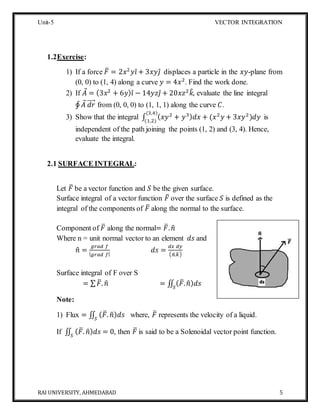
1.2Exercise:
1) If a force š¹Ģ… = 2š‘„2
š‘¦š‘–Ģ‚ + 3š‘„š‘¦š‘—Ģ‚ displaces a particle in the š‘„š‘¦-plane from
(0, 0) to (1, 4) along a curve š‘¦ = 4š‘„2
. Find the work done.
2) If š“ = (3š‘„2
+ 6š‘¦) š‘–Ģ‚ āˆ’ 14š‘¦š‘§š‘—Ģ‚ + 20š‘„š‘§2
š‘˜Ģ‚, evaluate the line integral
∮ š“ š‘‘š‘Ÿāƒ—āƒ—āƒ—āƒ— from (0, 0, 0) to (1, 1, 1) along the curve š¶.
3) Show that the integral ∫ ( š‘„š‘¦2
+ š‘¦3) š‘‘š‘„ + (š‘„2
š‘¦ + 3š‘„š‘¦2
)š‘‘š‘¦
(3,4)
(1,2)
is
independent of the path joining the points (1, 2) and (3, 4). Hence,
evaluate the integral.
2.1 SURFACE INTEGRAL:
Let š¹Ģ… be a vector function and š‘† be the given surface.
Surface integral of a vector function š¹Ģ… over the surface š‘† is defined as the
integral of the components of š¹Ģ… along the normal to the surface.
Component of š¹Ģ… along the normal= š¹Ģ…. š‘›Ģ‚
Where n = unit normal vector to an element š‘‘š‘  and
š‘›Ģ‚ =
š‘”š‘Ÿš‘Žš‘‘ š‘“
| š‘”š‘Ÿš‘Žš‘‘ š‘“|
š‘‘š‘  =
š‘‘š‘„ š‘‘š‘¦
( š‘›Ģ‚.š‘˜Ģ‚)
Surface integral of F over S
= āˆ‘ š¹Ģ…. š‘›Ģ‚ = ∬ ( š¹Ģ…. š‘›Ģ‚) š‘‘š‘ š‘†
Note:
1) Flux = ∬ ( š¹Ģ…. š‘›Ģ‚) š‘‘š‘ š‘†
where, š¹Ģ… represents the velocity of a liquid.
If ∬ ( š¹Ģ…. š‘›Ģ‚) š‘‘š‘ š‘†
= 0, then š¹Ģ… is said to be a Solenoidal vector point function.
Unit-5 VECTOR INTEGRATION
RAI UNIVERSITY, AHMEDABAD 6
3.1 VOLUME INTEGRAL:
Let š¹Ģ… be a vector point function and volume š‘‰ enclosed by a closed surface.
The volume integral = ∭ š¹Ģ… š‘‘š‘£š‘‰
Example 1: Evaluate ∬ (š‘¦š‘§š‘–Ģ‚ + š‘§š‘„š‘—Ģ‚ + š‘„š‘¦š‘˜Ģ‚). š‘‘š‘ š‘†
where š‘† the surface of the
sphere is š‘„2
+ š‘¦2
+ š‘§2
= š‘Ž2
in the first octant.
Solution: Here, āˆ… = š‘„2
+ š‘¦2
+ š‘§2
āˆ’ š‘Ž2
Vector normal to the surface = āˆ‡āˆ…
= š‘–Ģ‚
šœ•āˆ…
šœ•š‘„
+ š‘—Ģ‚
šœ•āˆ…
šœ•š‘¦
+ š‘˜Ģ‚ šœ•āˆ…
šœ•š‘§
= (š‘–Ģ‚
šœ•
šœ•š‘„
+ š‘—Ģ‚
šœ•
šœ•š‘¦
+ š‘˜Ģ‚ šœ•
šœ•š‘§
)( š‘„2
+ š‘¦2
+ š‘§2
āˆ’ š‘Ž2)
= 2š‘„š‘–Ģ‚ + 2š‘¦š‘—Ģ‚ + 2š‘§š‘˜Ģ‚
š‘›Ģ‚ =
āˆ‡āˆ…
|āˆ‡āˆ…|
=
2š‘„š‘–Ģ‚+2š‘¦š‘—Ģ‚+2š‘§š‘˜Ģ‚
√4š‘„2+4š‘¦2+4š‘§2
=
š‘„š‘–Ģ‚+ š‘¦š‘—Ģ‚+ š‘§š‘˜Ģ‚
āˆšš‘„2+š‘¦2+š‘§2
=
š‘„š‘–Ģ‚+ š‘¦š‘—Ģ‚+ š‘§š‘˜Ģ‚
š‘Ž
[∵ š‘„2
+ š‘¦2
+ š‘§2
= š‘Ž2]
Here, š¹ = š‘¦š‘§š‘–Ģ‚ + š‘§š‘„š‘—Ģ‚ + š‘„š‘¦š‘˜Ģ‚
š¹. š‘›Ģ‚ = (š‘¦š‘§š‘–Ģ‚ + š‘§š‘„š‘—Ģ‚ + š‘„š‘¦š‘˜Ģ‚).(
š‘„š‘–Ģ‚+ š‘¦š‘—Ģ‚+ š‘§š‘˜Ģ‚
š‘Ž
) =
3š‘„š‘¦š‘§
š‘Ž
Now, ∬ š¹. š‘›Ģ‚š‘†
š‘‘š‘  = ∬ (š¹. š‘›Ģ‚)š‘†
š‘‘š‘„ š‘‘š‘¦
| š‘˜Ģ‚.š‘›Ģ‚|
= ∫ ∫
3š‘„š‘¦š‘§ š‘‘š‘„ š‘‘š‘¦
š‘Ž (
š‘§
š‘Ž
)
āˆšš‘Ž2āˆ’š‘„2
0
š‘Ž
0
Unit-5 VECTOR INTEGRATION
RAI UNIVERSITY, AHMEDABAD 7
= 3∫ ∫ š‘„š‘¦ š‘‘š‘¦ š‘‘š‘„
āˆšš‘Ž2āˆ’š‘„2
0
š‘Ž
0
= 3∫ š‘„ (
š‘¦2
2
)
0
āˆšš‘Ž2āˆ’š‘„2
š‘‘š‘„
š‘Ž
0
=
3
2
∫ š‘„ (š‘Ž2
āˆ’ š‘„2
)š‘‘š‘„
š‘Ž
0
=
3
2
(
š‘Ž2 š‘„2
2
āˆ’
š‘„4
4
)
0
š‘Ž
=
3
2
(
š‘Ž4
2
āˆ’
š‘Ž4
4
)
=
3š‘Ž4
8
________Ans.
Example 2: If š¹Ģ… = 2š‘§š‘–Ģ‚ āˆ’ š‘„š‘—Ģ‚ + š‘¦š‘˜Ģ‚, evaluate ∭ š¹Ģ… š‘‘š‘£š‘‰
where, š‘£ is the region
bounded by the surfaces š‘„ = 0, š‘¦ = 0, š‘„ = 2, š‘¦ = 4, š‘§ = š‘„2
, š‘§ = 2.
Solution: ∭ š¹Ģ… š‘‘š‘£š‘‰
= ∭(2š‘§š‘–Ģ‚ āˆ’ š‘„š‘—Ģ‚ + š‘¦š‘˜Ģ‚) š‘‘š‘„ š‘‘š‘¦ š‘‘š‘§
= ∫ š‘‘š‘„ ∫ š‘‘š‘¦ ∫ (2š‘§š‘–Ģ‚ āˆ’ š‘„š‘—Ģ‚ + š‘¦š‘˜Ģ‚) š‘‘š‘§
2
š‘„2
4
0
2
0
= ∫ š‘‘š‘„ ∫ š‘‘š‘¦ [š‘§2
š‘–Ģ‚ āˆ’ š‘„š‘§š‘—Ģ‚ + š‘¦š‘§š‘˜Ģ‚] š‘„2
24
0
2
0
= ∫ š‘‘š‘„ ∫ š‘‘š‘¦ [4š‘–Ģ‚ āˆ’ 2š‘„š‘—Ģ‚ + 2š‘¦š‘˜Ģ‚ āˆ’ š‘„4
š‘–Ģ‚ + š‘„3
š‘—Ģ‚ āˆ’ š‘„2
š‘¦š‘˜Ģ‚]
4
0
2
0
= ∫ š‘‘š‘„ [4š‘¦š‘–Ģ‚ āˆ’ 2š‘„š‘¦š‘—Ģ‚ + š‘¦2
š‘˜Ģ‚ āˆ’ š‘„4
š‘¦š‘–Ģ‚ + š‘„3
š‘¦š‘—Ģ‚ āˆ’
š‘„2 š‘¦2
2
š‘˜Ģ‚]
0
42
0
= ∫ (16š‘–Ģ‚ āˆ’ 8š‘„š‘—Ģ‚ + 16š‘˜Ģ‚ āˆ’ 4š‘„4
š‘–Ģ‚ + 4š‘„3
š‘—Ģ‚ āˆ’ 8š‘„2
š‘˜Ģ‚)
2
0
š‘‘š‘„
= [16š‘„š‘–Ģ‚ āˆ’ 4š‘„2
š‘—Ģ‚ + 16š‘„š‘˜Ģ‚ āˆ’
4š‘„5
5
š‘–Ģ‚ + š‘„4
š‘—Ģ‚ āˆ’
8š‘„3
3
š‘˜Ģ‚]
0
2
= 32š‘–Ģ‚ āˆ’ 16š‘—Ģ‚ + 32š‘˜Ģ‚ āˆ’
128
5
š‘–Ģ‚ + 16š‘—Ģ‚ āˆ’
64
3
š‘˜Ģ‚
=
32š‘–Ģ‚
5
+
32š‘˜Ģ‚
3
Unit-5 VECTOR INTEGRATION
RAI UNIVERSITY, AHMEDABAD 8
=
32
15
(3š‘–Ģ‚ + 5š‘˜Ģ‚) _________ Ans.
3.2 Exercise:
1) Evaluate ∬ ( š¹Ģ…. š‘›Ģ‚) š‘‘š‘ š‘†
, where, š¹ = 18š‘§š‘–Ģ‚ āˆ’ 12š‘—Ģ‚ + 3š‘¦š‘˜Ģ‚ and š‘† is the surface
of the plane 2š‘„ + 3š‘¦ + 6š‘§ = 12 in the first octant.
2) If š¹ = (2š‘„2
āˆ’ 3š‘§) š‘–Ģ‚ āˆ’ 2š‘„š‘¦š‘—Ģ‚ āˆ’ 4š‘„š‘˜Ģ‚, then evaluate ∭ āˆ‡š‘‰
š¹ š‘‘š‘£, where š‘‰ is
bounded by the plane š‘„ = 0, š‘¦ = 0, š‘§ = 0 and 2š‘„ + 2š‘¦ + š‘§ = 4.
4.1 GREEN’S THEOREM:(Without proof)
If āˆ…( š‘„, š‘¦),ĪØ( š‘„, š‘¦),
šœ•šœ™
šœ•š‘¦
š‘Žš‘›š‘‘
šœ•ĪØ
šœ•š‘„
be continuous functions over a region R
bounded by simple closed curve š¶ in š‘„ āˆ’ š‘¦ plane, then
∮( šœ™ š‘‘š‘„ + ĪØ š‘‘š‘¦) = ∬(
šœ•ĪØ
šœ•š‘„
āˆ’
šœ•šœ™
šœ•š‘¦
) š‘‘š‘„ š‘‘š‘¦
š‘…š¶
Note:Green’s theorem in vector form
∫ š¹Ģ…. š‘‘š‘ŸĢ…Ģ…Ģ… = ∬(āˆ‡ Ɨ š¹Ģ…). š‘˜Ģ‚ š‘‘š‘…
š‘…š‘
Where, š¹Ģ… = āˆ…š‘–Ģ‚ + ĪØjĢ‚, rĢ… = š‘„š‘–Ģ‚ + š‘¦š‘—Ģ‚, š‘˜Ģ‚ is a unit vector along š‘§-axis and š‘‘š‘… =
š‘‘š‘„ š‘‘š‘¦.
Example 1: Using green’s theorem, evaluate ∫(š‘„2
š‘¦ š‘‘š‘„ + š‘„2
š‘‘š‘¦)š‘
, where š‘
is the boundary described counter clockwise of the triangle with
vertices (0,0),(1,0),(1,1).
Solution: By green’s theorem, we have
∮ ( šœ™ š‘‘š‘„ + ĪØ š‘‘š‘¦) = ∬ (
šœ•ĪØ
šœ•š‘„
āˆ’
šœ•šœ™
šœ•š‘¦
) š‘‘š‘„ š‘‘š‘¦š‘…š¶
∫ ( š‘„2
š‘¦ š‘‘š‘„ + š‘„2
š‘‘š‘¦) = ∬ (2š‘„ āˆ’ š‘„2) š‘‘š‘„ š‘‘š‘¦š‘…š‘
= ∫ (2š‘„ āˆ’ š‘„2) š‘‘š‘„āˆ« š‘‘š‘¦
š‘„
0
1
0
= ∫ (2š‘„ āˆ’ š‘„2) š‘‘š‘„ [ š‘¦]0
š‘„1
0
= ∫ (2š‘„2
āˆ’ š‘„3
)š‘‘š‘„
1
0
Unit-5 VECTOR INTEGRATION
RAI UNIVERSITY, AHMEDABAD 9
= (
2š‘„3
3
āˆ’
š‘„4
4
)
0
1
= (
2
3
āˆ’
1
4
)
=
5
12
_______Ans.
Example 2: Use green’s theorem to evaluate
∫ ( š‘„2
+ š‘„š‘¦) š‘‘š‘„ + (š‘„2
+ š‘¦2
)š‘‘š‘¦š‘
, where c is the square formed by the lines
š‘¦ = ±1, š‘„ = ±1.
Solution: By green’s theorem, we have
∮ ( šœ™ š‘‘š‘„ + ĪØ š‘‘š‘¦) = ∬ (
šœ•ĪØ
šœ•š‘„
āˆ’
šœ•šœ™
šœ•š‘¦
) š‘‘š‘„ š‘‘š‘¦š‘…š¶
= ∫ ∫ [
šœ•
šœ•š‘„
( š‘„2
+ š‘¦2) āˆ’
šœ•
šœ•š‘¦
(š‘„2
+ š‘„š‘¦)] š‘‘š‘„ š‘‘š‘¦
1
āˆ’1
1
āˆ’1
= ∫ ∫ (2š‘„ āˆ’ š‘„) š‘‘š‘„š‘‘š‘¦
1
āˆ’1
1
āˆ’1
= ∫ ∫ š‘„ š‘‘š‘„š‘‘š‘¦
1
āˆ’1
1
āˆ’1
= ∫ š‘„ š‘‘š‘„ ∫ š‘‘š‘¦
1
āˆ’1
1
āˆ’1
= ∫ š‘„ š‘‘š‘„ (š‘¦)āˆ’1
11
āˆ’1
= ∫ š‘„ š‘‘š‘„ (1 + 1)
1
āˆ’1
= ∫ 2š‘„ š‘‘š‘„
1
āˆ’1
= (š‘„2
)āˆ’1
1
= 1 āˆ’ 1
= 0 ________Ans.
Unit-5 VECTOR INTEGRATION
RAI UNIVERSITY, AHMEDABAD 10
4.2 Exercise:
1) Apply Green’s theorem to evaluate
∫ [(2š‘„2
āˆ’ š‘¦2) š‘‘š‘„ + (š‘„2
+ š‘¦2
)š‘‘š‘¦]š¶
, where š¶ is the boundary of the area
enclosed by the š‘„-axis and the upper half of circle š‘„2
+ š‘¦2
= š‘Ž2
.
2) A vector field š¹Ģ… is given by š¹Ģ… = sin š‘¦ š‘–Ģ‚ + š‘„ (1 + cos š‘¦) š‘—Ģ‚.
Evaluate the line integral ∫ š¹Ģ…. š‘‘š‘ŸĢ…Ģ…Ģ…
š¶
where š¶ is the circular path given
by š‘„2
+ š‘¦2
= š‘Ž2
.
5.1 STOKE’S THEOREM:(RelationbetweenLine integral and Surface
integral) (Without Proof)
Surface integral of the component of curl š¹Ģ… along the normal to the
surface š‘†, taken over the surface š‘† bounded by curve š¶ is equal to the line
integral of the vector point function š¹Ģ… taken along the closed curve š¶.
Mathematically
∮ š¹Ģ…. š‘‘š‘ŸĢ…Ģ…Ģ… = ∬ š‘š‘¢š‘Ÿš‘™š‘†
š¹Ģ…. š‘›Ģ‚ š‘‘š‘ 
Where š‘›Ģ‚ = cos āˆ š‘–Ģ‚ + cos š›½ š‘—Ģ‚ + cos š›¾ š‘˜Ģ‚
is a unit external normal to any surface š‘‘š‘ .
OR
The circulation of vector š¹ around a closed curve š¶ is equal to the flux of
the curve of the vector through the surface š‘† bounded by the curve š¶.
∮ š¹Ģ…. š‘‘š‘ŸĢ…Ģ…Ģ… = ∬ š‘š‘¢š‘Ÿš‘™
š‘†
š¹Ģ…. š‘›Ģ‚ š‘‘š‘  = ∬ š‘š‘¢š‘Ÿš‘™
š‘†
š¹Ģ…. š‘‘š‘†Ģ…
Unit-5 VECTOR INTEGRATION
RAI UNIVERSITY, AHMEDABAD 11
Example 1: Apply Stoke’s theorem to find the value of
∫ (š‘¦ š‘‘š‘„ + š‘§ š‘‘š‘¦ + š‘„ š‘‘š‘§)š‘
Where š‘ is the curve of intersection of š‘„2
+ š‘¦2
+ š‘§2
= š‘Ž2
and š‘„ + š‘§ = š‘Ž.
Solution: ∫ (š‘¦ š‘‘š‘„ + š‘§ š‘‘š‘¦ + š‘„ š‘‘š‘§)š‘
= ∫ (š‘¦ š‘–Ģ‚ + š‘§ š‘—Ģ‚ + š‘„ š‘˜Ģ‚).(š‘–Ģ‚ š‘‘š‘„ + š‘—Ģ‚ š‘‘š‘¦ + š‘˜Ģ‚ š‘‘š‘§)š‘
= ∫ (š‘¦ š‘–Ģ‚ + š‘§ š‘—Ģ‚ + š‘„ š‘˜Ģ‚). š‘‘š‘ŸĢ…š‘
= ∬ š‘š‘¢š‘Ÿš‘™ (š‘¦ š‘–Ģ‚ + š‘§ š‘—Ģ‚ + š‘„ š‘˜Ģ‚). š‘›Ģ‚ š‘‘š‘ š‘†
(By Stoke’s theorem)
= ∬ (š‘–Ģ‚
šœ•
šœ•š‘„
+ š‘—Ģ‚
šœ•
šœ•š‘¦
+ š‘˜Ģ‚ šœ•
šœ•š‘§
)Ć—š‘†
(š‘¦ š‘–Ģ‚ + š‘§ š‘—Ģ‚ + š‘„ š‘˜Ģ‚). š‘›Ģ‚ š‘‘š‘ 
= ∬ – ( š‘–Ģ‚ + š‘—Ģ‚ + š‘˜Ģ‚). š‘›Ģ‚ š‘‘š‘ š‘†
_______(i)
Where š‘† is the circle formed by the integration of š‘„2
+ š‘¦2
+ š‘§2
= š‘Ž2
and
š‘„ + š‘§ = š‘Ž.
š‘›Ģ‚ =
āˆ‡āˆ…
|āˆ‡āˆ…|
=
( š‘–Ģ‚
šœ•
šœ•š‘„
+š‘—Ģ‚
šœ•
šœ•š‘¦
+š‘˜Ģ‚ šœ•
šœ•š‘§
)(š‘„+š‘§āˆ’š‘Ž)
|āˆ‡āˆ…|
=
š‘–Ģ‚+ š‘˜Ģ‚
√1+1
=
š‘–Ģ‚
√2
+
š‘˜Ģ‚
√2
Putting the value of š‘›Ģ‚ in (i), we have
= ∬ –( š‘–Ģ‚ + š‘—Ģ‚ + š‘˜Ģ‚). (
š‘–Ģ‚
√2
+
š‘˜Ģ‚
√2
)š‘†
š‘‘š‘ 
= ∬ āˆ’š‘†
(
1
√2
+
1
√2
)š‘‘š‘  [š‘ˆš‘ š‘’ š‘Ÿ2
= š‘…2
āˆ’ š‘2
= š‘Ž2
āˆ’
š‘Ž2
2
=
š‘Ž2
2
]
Unit-5 VECTOR INTEGRATION
RAI UNIVERSITY, AHMEDABAD 12
= āˆ’
2
√2
∬ š‘‘š‘  = āˆ’
2
√2
šœ‹ (
š‘Ž
√2
)
2
= āˆ’
šœ‹š‘Ž2
√2š‘†
______Ans.
Example 2: Evaluate ∮ š¹Ģ…. š‘‘š‘ŸĢ…Ģ…Ģ…
š¶
by stoke’s theorem, where
š¹Ģ… = š‘¦2
š‘–Ģ‚ + š‘„2
š‘—Ģ‚ āˆ’ (š‘„ + š‘§)š‘˜Ģ‚ and š¶ is the boundary of triangle with vertices at
(0,0,0),(1,0,0) and (1,1,0).
Solution: We have, curl š¹Ģ… = āˆ‡ Ɨ š¹Ģ…
= ||
š‘–Ģ‚ š‘—Ģ‚ š‘˜Ģ‚
šœ•
šœ•š‘„
šœ•
šœ•š‘¦
šœ•
šœ•š‘§
š‘¦2
š‘„2
āˆ’(š‘„ + š‘§)
||
= 0. š‘–Ģ‚ + š‘—Ģ‚ + 2(š‘„ āˆ’ š‘¦)š‘˜Ģ‚
We observethat z co-ordinate of each vertex of the triangle is zero.
Therefore, the triangle lies in the š‘„š‘¦-plane.
∓ š‘›Ģ‚ = š‘˜Ģ‚
∓ š‘š‘¢š‘Ÿš‘™ š¹Ģ…. š‘›Ģ‚ = [š‘—Ģ‚ + 2(š‘„ āˆ’ š‘¦)š‘˜Ģ‚]. š‘˜Ģ‚ = 2( š‘„ āˆ’ š‘¦).
In the figure, only š‘„š‘¦-plane is considered.
The equation of the line OB is š‘¦ = š‘„
By Stoke’s theorem, we have
∮ š¹Ģ…. š‘‘š‘ŸĢ…Ģ…Ģ… = ∬ (š‘š‘¢š‘Ÿš‘™ š¹Ģ…. š‘›Ģ‚)š‘‘š‘ š‘†š¶
= ∫ ∫ 2( š‘„ āˆ’ š‘¦) š‘‘š‘„š‘‘š‘¦
š‘„
š‘¦=0
1
š‘„=0
= 2∫ [š‘„2
āˆ’
š‘„2
2
]
1
0
š‘‘š‘„
= 2 ∫
š‘„2
2
1
0
š‘‘š‘„
= ∫ š‘„2
š‘‘š‘„
1
0
Unit-5 VECTOR INTEGRATION
RAI UNIVERSITY, AHMEDABAD 13
= [
š‘„3
3
]
0
1
=
1
3
________ Ans.
5.2 Exercise:
1) Use the Stoke’s theorem to evaluate ∫ [( š‘„ + 2š‘¦) š‘‘š‘„ + ( š‘„ āˆ’ š‘§) š‘‘š‘¦ +š¶
(š‘¦ āˆ’ š‘§)š‘‘š‘§] where š¶ is the boundary of the triangle with vertices
(2,0,0),(0,3,0) š‘Žš‘›š‘‘ (0,0,6) oriented in the anti-clockwise direction.
2) Apply Stoke’s theorem to calculate ∫ 4 š‘¦ š‘‘š‘„ + 2š‘§ š‘‘š‘¦ + 6š‘¦ š‘‘š‘§š‘
Where š‘ is the curve of intersection of š‘„2
+ š‘¦2
+ š‘§2
= 6š‘§ and š‘§ =
š‘„ + 3
3) Use the Stoke’s theorem to evaluate ∫ š‘¦2
š‘‘š‘„ + š‘„š‘¦ š‘‘š‘¦ + š‘„š‘§ š‘‘š‘§š¶
,
where š¶ is the bounding curve of the hemisphere š‘„2
+ š‘¦2
+ š‘§2
= 1,
š‘§ ≄ 0, oriented in the positive direction.
6.1 GAUSS’S THEOREM OF DIVERGENCE:(Without Proof)
The surface integral of the normal component of a vector function š¹ taken
around a closed surface š‘† is equal to the integral of the divergence of š¹
taken over the volume š‘‰enclosed by the surface š‘†.
Mathematically
∬ š¹. š‘›Ģ‚ š‘‘š‘  = ∭ š‘‘š‘–š‘£ š¹ š‘‘š‘£
š‘‰š‘†
Example 1: Evaluate ∬ š¹. š‘›Ģ‚ š‘‘š‘ š‘†
where š¹ = 4š‘„š‘§š‘–Ģ‚ āˆ’ š‘¦2
š‘—Ģ‚ + š‘¦š‘§š‘˜Ģ‚ and š‘† is the
surface of the cube bounded by š‘„ = 0, š‘„ = 1, š‘¦ = 0, š‘¦ = 1, š‘§ = 0, š‘§ = 1.
Solution: By Gauss’s divergence theorem,
∬ š¹. š‘›Ģ‚ š‘‘š‘  = ∭ (āˆ‡. š¹) š‘‘š‘£š‘‰š‘†
= ∭ (š‘–Ģ‚
šœ•
šœ•š‘„
+ š‘—Ģ‚
šœ•
šœ•š‘¦
+ š‘˜Ģ‚ šœ•
šœ•š‘§
).š‘£
(4š‘„š‘§š‘–Ģ‚ āˆ’ š‘¦2
š‘—Ģ‚ + š‘¦š‘§š‘˜Ģ‚) š‘‘š‘£
= ∭ [
šœ•
šœ•š‘„
(4š‘„š‘§) +
šœ•
šœ•š‘¦
(āˆ’š‘¦2
) +
šœ•
šœ•š‘§
(š‘¦š‘§)] š‘‘š‘„ š‘‘š‘¦ š‘‘š‘§š‘£
= ∭ (4š‘§āˆ’ 2š‘¦ + š‘¦) š‘‘š‘„ š‘‘š‘¦ š‘‘š‘§š‘£
Unit-5 VECTOR INTEGRATION
RAI UNIVERSITY, AHMEDABAD 14
= ∭ (4š‘§āˆ’ š‘¦)š‘£
š‘‘š‘„ š‘‘š‘¦ š‘‘š‘§
= ∫ ∫ (
4š‘§2
2
āˆ’ š‘¦š‘§)
0
1
1
0
1
0
š‘‘š‘„ š‘‘š‘¦
= ∫ ∫ (2š‘§2
āˆ’ š‘¦š‘§)0
11
0
š‘‘š‘„ š‘‘š‘¦
1
0
= ∫ ∫ (2 āˆ’ š‘¦)
1
0
š‘‘š‘„ š‘‘š‘¦
1
0
= ∫ (2š‘¦ āˆ’
š‘¦2
2
)
0
1
š‘‘š‘„
1
0
=
3
2
∫ š‘‘š‘„
1
0
=
3
2
[ š‘„]0
1
=
3
2
(1)
=
3
2
________ Ans.
Example 2: Evaluate surface integral ∬ š¹. š‘›Ģ‚ š‘‘š‘ , where š¹ = ( š‘„2
+ š‘¦2
+
š‘§2)(š‘–Ģ‚ + š‘—Ģ‚ + š‘˜Ģ‚), š‘† is the surface of the tetrahedron š‘„ = 0, š‘¦ = 0, š‘§ = 0, š‘„ +
š‘¦ + š‘§ = 2 and n is the unit normal in the outward direction to the closed
surface š‘†.
Solution: By gauss’s divergence theorem,
∬ š¹. š‘›Ģ‚ š‘‘š‘  = ∭ š‘‘š‘–š‘£ š¹. š‘‘š‘£
š‘‰š‘†
Where š‘† is the surface of tetrahedron š‘„ = 0, š‘¦ = 0, š‘§ = 0, š‘„ + š‘¦ + š‘§ = 2
= ∭ (š‘–Ģ‚
šœ•
šœ•š‘„
+ š‘—Ģ‚
šœ•
šœ•š‘¦
+ š‘˜Ģ‚ šœ•
šœ•š‘§
). ( š‘„2
+ š‘¦2
+ š‘§2)(š‘–Ģ‚ + š‘—Ģ‚ + š‘˜Ģ‚)š‘‘š‘£š‘‰
= ∭ (2š‘„ + 2š‘¦ + 2š‘§)š‘‘š‘£š‘‰
= 2∭ ( š‘„ + š‘¦ + š‘§) š‘‘š‘„ š‘‘š‘¦ š‘‘š‘§š‘‰
= 2∫ š‘‘š‘„ ∫ š‘‘š‘¦
2āˆ’š‘„
0
∫ ( š‘„ + š‘¦ + š‘§) š‘‘š‘§
2āˆ’š‘„āˆ’š‘¦
0
2
0
Unit-5 VECTOR INTEGRATION
RAI UNIVERSITY, AHMEDABAD 15
= 2∫ š‘‘š‘„ ∫ š‘‘š‘¦
2āˆ’š‘„
0
(š‘„š‘§ + š‘¦š‘§ +
š‘§2
2
)
0
2āˆ’š‘„āˆ’š‘¦
2
0
= 2∫ š‘‘š‘„ ∫ š‘‘š‘¦
2āˆ’š‘„
0
[2š‘„ āˆ’ š‘„2
āˆ’ š‘„š‘¦ + 2š‘¦ āˆ’ š‘„š‘¦ āˆ’ š‘¦2
+
(2āˆ’š‘„āˆ’š‘¦)2
2
]
2
0
= 2∫ š‘‘š‘„ [2š‘„š‘¦ āˆ’ š‘„2
š‘¦ āˆ’ š‘„š‘¦2
+ š‘¦2
āˆ’
š‘¦3
3
āˆ’
(2āˆ’š‘„āˆ’š‘¦)3
6
]
0
2āˆ’š‘„
2
0
= 2∫ š‘‘š‘„ [2š‘„(2āˆ’ š‘„) āˆ’ š‘„2(2 āˆ’ š‘„) āˆ’ š‘„(2 āˆ’ š‘„)2
+ (2 āˆ’ š‘„)2
āˆ’
(2āˆ’š‘„)3
3
+
2
0
(2āˆ’š‘„)3
6
]
= 2∫ [4š‘„ āˆ’ 2š‘„2
āˆ’ 2š‘„2
+ š‘„3
āˆ’ 4š‘„ + 4š‘„2
āˆ’ š‘„3
+ (2 āˆ’ š‘„)2
āˆ’
(2āˆ’š‘„)3
3
+
2
0
(2āˆ’š‘„)3
6
]
= 2[2š‘„2
āˆ’
4š‘„3
3
+
š‘„4
4
āˆ’ 2š‘„2
+
4š‘„3
3
āˆ’
š‘„4
4
āˆ’
(2āˆ’š‘„)3
3
+
(2āˆ’š‘„)4
12
āˆ’
(2āˆ’š‘„)4
24
]
0
2
= 2[āˆ’
(2āˆ’š‘„)3
3
+
(2āˆ’š‘„)4
12
āˆ’
(2āˆ’š‘„)4
24
]
0
2
= 2[
8
3
āˆ’
16
12
+
16
24
]
= 4 ________Ans.
6.2 Exercise:
1) Evaluate ∬ š¹. š‘›Ģ‚ š‘‘š‘ š‘†
where š‘† is the surface of the sphere š‘„2
+ š‘¦2
+
š‘§2
= 16 and š¹ = 3š‘„š‘–Ģ‚ + 4š‘¦š‘—Ģ‚ + 5š‘§š‘˜Ģ‚.
2) Find ∬ š¹. š‘›Ģ‚ š‘‘š‘ š‘†
, where š¹ = (2š‘„ + 3š‘§) š‘–Ģ‚ āˆ’ ( š‘„š‘§ + š‘¦) š‘—Ģ‚ + (š‘¦2
+ 2š‘§)š‘˜Ģ‚
and š‘† is the surface of the sphere having centre (3,-1, 2) and radius 3.
3) Use divergence theorem to evaluate ∬ š“. š‘‘š‘ āƒ—āƒ—āƒ—āƒ—
š‘†
, where š“ = š‘„3
š‘–Ģ‚ +
š‘¦3
š‘—Ģ‚ + š‘§3
š‘˜Ģ‚ and š‘† is the surface of the sphere š‘„2
+ š‘¦2
+ š‘§2
= š‘Ž2
.
Unit-5 VECTOR INTEGRATION
RAI UNIVERSITY, AHMEDABAD 16
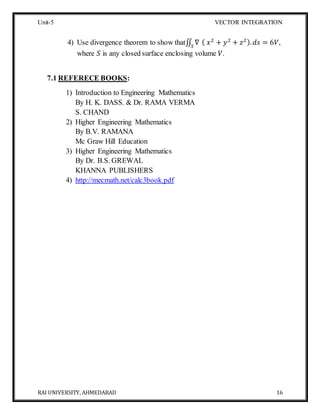
4) Use divergence theorem to show that∬ āˆ‡š‘†
( š‘„2
+ š‘¦2
+ š‘§2). š‘‘š‘  = 6š‘‰,
where š‘† is any closed surface enclosing volume š‘‰.
7.1 REFERECE BOOKS:
1) Introduction to Engineering Mathematics
By H. K. DASS. & Dr. RAMA VERMA
S. CHAND
2) Higher Engineering Mathematics
By B.V. RAMANA
Mc Graw Hill Education
3) Higher Engineering Mathematics
By Dr. B.S. GREWAL
KHANNA PUBLISHERS
4) http://mecmath.net/calc3book.pdf

B.tech ii unit-5 material vector integration

  • 1.
    Unit-5 VECTOR INTEGRATION RAIUNIVERSITY, AHMEDABAD 1 Unit-V: VECTOR INTEGRATION Sr. No. Name of the Topic Page No. 1 Line Integral 2 2 Surface integral 5 3 Volume Integral 6 4 Green’s theorem (without proof) 8 5 Stoke’s theorem (without proof) 10 6 Gauss’s theorem of divergence (without proof) 13 7 Reference book 16
  • 2.
    Unit-5 VECTOR INTEGRATION RAIUNIVERSITY, AHMEDABAD 2 Vector integration 1.1 LINE INTEGRAL: Line integral = ∫ (š¹Ģ…. š‘‘š‘Ÿāƒ—āƒ—āƒ—āƒ—āƒ— š‘‘š‘  )š‘ š‘‘š‘  = ∫ š¹Ģ…. š‘‘š‘ŸĢ…Ģ…Ģ… š‘ Note: 1) Work: If š¹Ģ… represents the variable force acting on a particle along arc AB, then the total work done = ∫ š¹Ģ…. š‘‘š‘ŸĢ…Ģ…Ģ…šµ š“ 2) Circulation: If š‘‰Ģ… represents the velocity of a liquid then ∮ š‘‰Ģ…. š‘‘š‘ŸĢ…Ģ…Ģ… š‘ is called the circulation of š‘‰ round the closed curve š‘. If the circulation of š‘‰ round every closed curve is zero then š‘‰ is said to be irrotational there. 3) When the path of integration is a closed curve then notation of integration is ∮ in place of ∫ . Note:If ∫ š¹Ģ…. š‘‘š‘ŸĢ…Ģ…Ģ…šµ š“ is to be proved to be independent of path, then š¹Ģ… = āˆ‡āˆ… here š¹ is called Conservative (irrotational) vector field and āˆ… is called the Scalarpotential. And āˆ‡ Ɨ š¹Ģ… = āˆ‡ Ɨ āˆ‡āˆ… = 0 Example 1: Evaluate ∫ š¹Ģ…. š‘‘š‘ŸĢ…Ģ…Ģ… š‘ where š¹Ģ… = š‘„2 š‘–Ģ‚ + š‘„š‘¦š‘—Ģ‚ and š¶ is the boundary of the square in the plane š‘§ = 0 and bounded by the lines š‘„ = 0, š‘¦ = 0, š‘„ = š‘Ž š‘Žš‘›š‘‘ š‘¦ = š‘Ž. Solution: ∫ š¹Ģ…. š‘‘š‘ŸĢ…Ģ…Ģ… š‘ = ∫ š¹Ģ…. š‘‘š‘ŸĢ…Ģ…Ģ… š‘‚š“ + ∫ š¹Ģ…. š‘‘š‘ŸĢ…Ģ…Ģ… š“šµ + ∫ š¹Ģ…. š‘‘š‘ŸĢ…Ģ…Ģ… šµš¶ + ∫ š¹Ģ…. š‘‘š‘ŸĢ…Ģ…Ģ… š¶š‘‚ Here š‘ŸĢ… = š‘„š‘–Ģ‚ + š‘¦š‘—Ģ‚, š‘‘š‘ŸĢ…Ģ…Ģ… = š‘‘š‘„š‘–Ģ‚ + š‘‘š‘¦š‘—Ģ‚, š¹Ģ… = š‘„2 š‘–Ģ‚ + š‘„š‘¦š‘—Ģ‚ š¹Ģ…. š‘‘š‘ŸĢ…Ģ…Ģ… = š‘„2 š‘‘š‘„ + š‘„š‘¦š‘‘š‘¦ _______(i)  On š‘‚š“, š‘¦ = 0
  • 3.
    Unit-5 VECTOR INTEGRATION RAIUNIVERSITY, AHMEDABAD 3 ∓ š¹Ģ…. š‘‘š‘ŸĢ…Ģ…Ģ… = š‘„2 š‘‘š‘„ (From (i)) ∫ š¹Ģ…. š‘‘š‘ŸĢ…Ģ…Ģ… š‘‚š“ = ∫ š‘„2 š‘‘š‘„ = [ š‘„3 3 ] 0 3 = š‘Ž3 3 š‘Ž 0 _______ (ii)  On š“šµ, š‘„ = š‘Ž ∓ š‘‘š‘„ = 0 ∓ š¹Ģ…. š‘‘š‘ŸĢ…Ģ…Ģ… = š‘Žš‘¦ š‘‘š‘¦ (From (i)) ∫ š¹Ģ…. š‘‘š‘ŸĢ…Ģ…Ģ… š“šµ = ∫ š‘Žš‘¦ š‘‘š‘¦ = š‘Ž [ š‘¦2 2 ] 0 š‘Ž = š‘Ž3 2 š‘Ž 0 _______(iii)  On šµš¶, š‘¦ = š‘Ž ∓ š‘‘š‘¦ = 0 ∓ š¹Ģ…. š‘‘š‘ŸĢ…Ģ…Ģ… = š‘„2 š‘‘š‘„ (From (i)) ∫ š¹Ģ…. š‘‘š‘ŸĢ…Ģ…Ģ… šµš¶ = ∫ š‘„2 š‘‘š‘„ = [ š‘„3 3 ] š‘Ž 0 = āˆ’ š‘Ž3 3 0 š‘Ž _______(iv)  On š¶š‘‚, š‘„ = 0 ∓ š¹Ģ…. š‘‘š‘ŸĢ…Ģ…Ģ… = 0 (From (i)) ∫ š¹Ģ…. š‘‘š‘ŸĢ…Ģ…Ģ… š¶š‘‚ = 0 _______(v) On adding (ii), (iii), (iv) and (v), we get ∫ š¹Ģ…. š‘‘š‘ŸĢ…Ģ…Ģ… š¶ = š‘Ž3 3 + š‘Ž3 2 āˆ’ š‘Ž3 3 + 0 = š‘Ž3 2 ________ Ans. Example 2: A vector field is given by š¹Ģ… = (2š‘¦ + 3) š‘–Ģ‚ + ( š‘„š‘§) š‘—Ģ‚ + (š‘¦š‘§āˆ’ š‘„)š‘˜Ģ‚. Evaluate ∫ š¹Ģ…. š‘‘š‘ŸĢ…Ģ…Ģ… š¶ along the path š‘ is š‘„ = 2š‘”, š‘¦ = š‘”, š‘§ = š‘”3 š‘“š‘Ÿš‘œš‘š š‘” = 0 š‘”š‘œ š‘” = 1. Solution: ∫ š¹Ģ…. š‘‘š‘ŸĢ…Ģ…Ģ… š¶ = ∫ (2š‘¦ + 3) š‘‘š‘„ + ( š‘„š‘§) š‘‘š‘¦ + (š‘¦š‘§āˆ’ š‘„)š‘‘š‘§š¶ [ š‘ š‘–š‘›š‘š‘’ š‘„ = 2š‘” š‘¦ = š‘” š‘§ = š‘”3 ∓ š‘‘š‘„ š‘‘š‘” = 2 š‘‘š‘¦ š‘‘š‘” = 1 š‘‘š‘§ š‘‘š‘” = 3š‘”2 ]
  • 4.
    Unit-5 VECTOR INTEGRATION RAIUNIVERSITY, AHMEDABAD 4 = ∫ (2š‘” + 3)(2 š‘‘š‘”) + (2š‘”)( š‘”3) š‘‘š‘” + ( š‘”4 āˆ’ 2š‘”)(3š‘”2 š‘‘š‘”) 1 0 = ∫ (4š‘” + 6 + 2š‘”4 + 3š‘”6 āˆ’ 6š‘”3) š‘‘š‘” 1 0 = [4 š‘”2 2 + 6š‘” + 2 5 š‘”5 + 3 7 š‘”7 āˆ’ 6 4 š‘”4 ] 0 1 = [2š‘”2 + 6š‘” + 2 5 š‘”5 + 3 7 š‘”7 āˆ’ 3 2 š‘”4 ] 0 1 = 2 + 6 + 2 5 + 3 7 āˆ’ 3 2 = 7.32857 _________Ans. Example 3: Suppose š¹( š‘„, š‘¦, š‘§) = š‘„3 š‘–Ģ‚ + š‘¦š‘—Ģ‚ + š‘§š‘˜Ģ‚ is the force field. Find the work done by š¹ along the line from the (1, 2, 3) to (3, 5, 7). Solution: Work done= ∫ š¹Ģ…. š‘‘š‘ŸĢ…Ģ…Ģ… š‘ = ∫ (š‘„3 š‘–Ģ‚ + š‘¦š‘—Ģ‚ + š‘§š‘˜Ģ‚). š‘‘(š‘–Ģ‚ š‘‘š‘„ + š‘—Ģ‚ š‘‘š‘¦ + š‘˜Ģ‚ š‘‘š‘§) (3,5,7) (1,2,3) = ∫ ( š‘„3 š‘‘š‘„ + š‘¦š‘‘š‘¦ + š‘§š‘‘š‘§) (3,5,7) (1,2,3) = ∫ š‘„3 š‘‘š‘„ + ∫ š‘¦ š‘‘š‘¦ + ∫ š‘§ š‘‘š‘§ 7 3 5 2 3 1 = [ š‘„4 4 ] 1 3 + [ š‘¦2 2 ] 2 5 + [ š‘§2 2 ] 3 7 = [ 81 4 āˆ’ 1 4 ] + [ 25 2 āˆ’ 4 2 ] + [ 49 2 āˆ’ 9 2 ] = 80 4 + 21 2 + 40 2 = 202 4 = 50.5 units _______Ans.
  • 5.
    Unit-5 VECTOR INTEGRATION RAIUNIVERSITY, AHMEDABAD 5 1.2Exercise: 1) If a force š¹Ģ… = 2š‘„2 š‘¦š‘–Ģ‚ + 3š‘„š‘¦š‘—Ģ‚ displaces a particle in the š‘„š‘¦-plane from (0, 0) to (1, 4) along a curve š‘¦ = 4š‘„2 . Find the work done. 2) If š“ = (3š‘„2 + 6š‘¦) š‘–Ģ‚ āˆ’ 14š‘¦š‘§š‘—Ģ‚ + 20š‘„š‘§2 š‘˜Ģ‚, evaluate the line integral ∮ š“ š‘‘š‘Ÿāƒ—āƒ—āƒ—āƒ— from (0, 0, 0) to (1, 1, 1) along the curve š¶. 3) Show that the integral ∫ ( š‘„š‘¦2 + š‘¦3) š‘‘š‘„ + (š‘„2 š‘¦ + 3š‘„š‘¦2 )š‘‘š‘¦ (3,4) (1,2) is independent of the path joining the points (1, 2) and (3, 4). Hence, evaluate the integral. 2.1 SURFACE INTEGRAL: Let š¹Ģ… be a vector function and š‘† be the given surface. Surface integral of a vector function š¹Ģ… over the surface š‘† is defined as the integral of the components of š¹Ģ… along the normal to the surface. Component of š¹Ģ… along the normal= š¹Ģ…. š‘›Ģ‚ Where n = unit normal vector to an element š‘‘š‘  and š‘›Ģ‚ = š‘”š‘Ÿš‘Žš‘‘ š‘“ | š‘”š‘Ÿš‘Žš‘‘ š‘“| š‘‘š‘  = š‘‘š‘„ š‘‘š‘¦ ( š‘›Ģ‚.š‘˜Ģ‚) Surface integral of F over S = āˆ‘ š¹Ģ…. š‘›Ģ‚ = ∬ ( š¹Ģ…. š‘›Ģ‚) š‘‘š‘ š‘† Note: 1) Flux = ∬ ( š¹Ģ…. š‘›Ģ‚) š‘‘š‘ š‘† where, š¹Ģ… represents the velocity of a liquid. If ∬ ( š¹Ģ…. š‘›Ģ‚) š‘‘š‘ š‘† = 0, then š¹Ģ… is said to be a Solenoidal vector point function.
  • 6.
    Unit-5 VECTOR INTEGRATION RAIUNIVERSITY, AHMEDABAD 6 3.1 VOLUME INTEGRAL: Let š¹Ģ… be a vector point function and volume š‘‰ enclosed by a closed surface. The volume integral = ∭ š¹Ģ… š‘‘š‘£š‘‰ Example 1: Evaluate ∬ (š‘¦š‘§š‘–Ģ‚ + š‘§š‘„š‘—Ģ‚ + š‘„š‘¦š‘˜Ģ‚). š‘‘š‘ š‘† where š‘† the surface of the sphere is š‘„2 + š‘¦2 + š‘§2 = š‘Ž2 in the first octant. Solution: Here, āˆ… = š‘„2 + š‘¦2 + š‘§2 āˆ’ š‘Ž2 Vector normal to the surface = āˆ‡āˆ… = š‘–Ģ‚ šœ•āˆ… šœ•š‘„ + š‘—Ģ‚ šœ•āˆ… šœ•š‘¦ + š‘˜Ģ‚ šœ•āˆ… šœ•š‘§ = (š‘–Ģ‚ šœ• šœ•š‘„ + š‘—Ģ‚ šœ• šœ•š‘¦ + š‘˜Ģ‚ šœ• šœ•š‘§ )( š‘„2 + š‘¦2 + š‘§2 āˆ’ š‘Ž2) = 2š‘„š‘–Ģ‚ + 2š‘¦š‘—Ģ‚ + 2š‘§š‘˜Ģ‚ š‘›Ģ‚ = āˆ‡āˆ… |āˆ‡āˆ…| = 2š‘„š‘–Ģ‚+2š‘¦š‘—Ģ‚+2š‘§š‘˜Ģ‚ √4š‘„2+4š‘¦2+4š‘§2 = š‘„š‘–Ģ‚+ š‘¦š‘—Ģ‚+ š‘§š‘˜Ģ‚ āˆšš‘„2+š‘¦2+š‘§2 = š‘„š‘–Ģ‚+ š‘¦š‘—Ģ‚+ š‘§š‘˜Ģ‚ š‘Ž [∵ š‘„2 + š‘¦2 + š‘§2 = š‘Ž2] Here, š¹ = š‘¦š‘§š‘–Ģ‚ + š‘§š‘„š‘—Ģ‚ + š‘„š‘¦š‘˜Ģ‚ š¹. š‘›Ģ‚ = (š‘¦š‘§š‘–Ģ‚ + š‘§š‘„š‘—Ģ‚ + š‘„š‘¦š‘˜Ģ‚).( š‘„š‘–Ģ‚+ š‘¦š‘—Ģ‚+ š‘§š‘˜Ģ‚ š‘Ž ) = 3š‘„š‘¦š‘§ š‘Ž Now, ∬ š¹. š‘›Ģ‚š‘† š‘‘š‘  = ∬ (š¹. š‘›Ģ‚)š‘† š‘‘š‘„ š‘‘š‘¦ | š‘˜Ģ‚.š‘›Ģ‚| = ∫ ∫ 3š‘„š‘¦š‘§ š‘‘š‘„ š‘‘š‘¦ š‘Ž ( š‘§ š‘Ž ) āˆšš‘Ž2āˆ’š‘„2 0 š‘Ž 0
  • 7.
    Unit-5 VECTOR INTEGRATION RAIUNIVERSITY, AHMEDABAD 7 = 3∫ ∫ š‘„š‘¦ š‘‘š‘¦ š‘‘š‘„ āˆšš‘Ž2āˆ’š‘„2 0 š‘Ž 0 = 3∫ š‘„ ( š‘¦2 2 ) 0 āˆšš‘Ž2āˆ’š‘„2 š‘‘š‘„ š‘Ž 0 = 3 2 ∫ š‘„ (š‘Ž2 āˆ’ š‘„2 )š‘‘š‘„ š‘Ž 0 = 3 2 ( š‘Ž2 š‘„2 2 āˆ’ š‘„4 4 ) 0 š‘Ž = 3 2 ( š‘Ž4 2 āˆ’ š‘Ž4 4 ) = 3š‘Ž4 8 ________Ans. Example 2: If š¹Ģ… = 2š‘§š‘–Ģ‚ āˆ’ š‘„š‘—Ģ‚ + š‘¦š‘˜Ģ‚, evaluate ∭ š¹Ģ… š‘‘š‘£š‘‰ where, š‘£ is the region bounded by the surfaces š‘„ = 0, š‘¦ = 0, š‘„ = 2, š‘¦ = 4, š‘§ = š‘„2 , š‘§ = 2. Solution: ∭ š¹Ģ… š‘‘š‘£š‘‰ = ∭(2š‘§š‘–Ģ‚ āˆ’ š‘„š‘—Ģ‚ + š‘¦š‘˜Ģ‚) š‘‘š‘„ š‘‘š‘¦ š‘‘š‘§ = ∫ š‘‘š‘„ ∫ š‘‘š‘¦ ∫ (2š‘§š‘–Ģ‚ āˆ’ š‘„š‘—Ģ‚ + š‘¦š‘˜Ģ‚) š‘‘š‘§ 2 š‘„2 4 0 2 0 = ∫ š‘‘š‘„ ∫ š‘‘š‘¦ [š‘§2 š‘–Ģ‚ āˆ’ š‘„š‘§š‘—Ģ‚ + š‘¦š‘§š‘˜Ģ‚] š‘„2 24 0 2 0 = ∫ š‘‘š‘„ ∫ š‘‘š‘¦ [4š‘–Ģ‚ āˆ’ 2š‘„š‘—Ģ‚ + 2š‘¦š‘˜Ģ‚ āˆ’ š‘„4 š‘–Ģ‚ + š‘„3 š‘—Ģ‚ āˆ’ š‘„2 š‘¦š‘˜Ģ‚] 4 0 2 0 = ∫ š‘‘š‘„ [4š‘¦š‘–Ģ‚ āˆ’ 2š‘„š‘¦š‘—Ģ‚ + š‘¦2 š‘˜Ģ‚ āˆ’ š‘„4 š‘¦š‘–Ģ‚ + š‘„3 š‘¦š‘—Ģ‚ āˆ’ š‘„2 š‘¦2 2 š‘˜Ģ‚] 0 42 0 = ∫ (16š‘–Ģ‚ āˆ’ 8š‘„š‘—Ģ‚ + 16š‘˜Ģ‚ āˆ’ 4š‘„4 š‘–Ģ‚ + 4š‘„3 š‘—Ģ‚ āˆ’ 8š‘„2 š‘˜Ģ‚) 2 0 š‘‘š‘„ = [16š‘„š‘–Ģ‚ āˆ’ 4š‘„2 š‘—Ģ‚ + 16š‘„š‘˜Ģ‚ āˆ’ 4š‘„5 5 š‘–Ģ‚ + š‘„4 š‘—Ģ‚ āˆ’ 8š‘„3 3 š‘˜Ģ‚] 0 2 = 32š‘–Ģ‚ āˆ’ 16š‘—Ģ‚ + 32š‘˜Ģ‚ āˆ’ 128 5 š‘–Ģ‚ + 16š‘—Ģ‚ āˆ’ 64 3 š‘˜Ģ‚ = 32š‘–Ģ‚ 5 + 32š‘˜Ģ‚ 3
  • 8.
    Unit-5 VECTOR INTEGRATION RAIUNIVERSITY, AHMEDABAD 8 = 32 15 (3š‘–Ģ‚ + 5š‘˜Ģ‚) _________ Ans. 3.2 Exercise: 1) Evaluate ∬ ( š¹Ģ…. š‘›Ģ‚) š‘‘š‘ š‘† , where, š¹ = 18š‘§š‘–Ģ‚ āˆ’ 12š‘—Ģ‚ + 3š‘¦š‘˜Ģ‚ and š‘† is the surface of the plane 2š‘„ + 3š‘¦ + 6š‘§ = 12 in the first octant. 2) If š¹ = (2š‘„2 āˆ’ 3š‘§) š‘–Ģ‚ āˆ’ 2š‘„š‘¦š‘—Ģ‚ āˆ’ 4š‘„š‘˜Ģ‚, then evaluate ∭ āˆ‡š‘‰ š¹ š‘‘š‘£, where š‘‰ is bounded by the plane š‘„ = 0, š‘¦ = 0, š‘§ = 0 and 2š‘„ + 2š‘¦ + š‘§ = 4. 4.1 GREEN’S THEOREM:(Without proof) If āˆ…( š‘„, š‘¦),ĪØ( š‘„, š‘¦), šœ•šœ™ šœ•š‘¦ š‘Žš‘›š‘‘ šœ•ĪØ šœ•š‘„ be continuous functions over a region R bounded by simple closed curve š¶ in š‘„ āˆ’ š‘¦ plane, then ∮( šœ™ š‘‘š‘„ + ĪØ š‘‘š‘¦) = ∬( šœ•ĪØ šœ•š‘„ āˆ’ šœ•šœ™ šœ•š‘¦ ) š‘‘š‘„ š‘‘š‘¦ š‘…š¶ Note:Green’s theorem in vector form ∫ š¹Ģ…. š‘‘š‘ŸĢ…Ģ…Ģ… = ∬(āˆ‡ Ɨ š¹Ģ…). š‘˜Ģ‚ š‘‘š‘… š‘…š‘ Where, š¹Ģ… = āˆ…š‘–Ģ‚ + ĪØjĢ‚, rĢ… = š‘„š‘–Ģ‚ + š‘¦š‘—Ģ‚, š‘˜Ģ‚ is a unit vector along š‘§-axis and š‘‘š‘… = š‘‘š‘„ š‘‘š‘¦. Example 1: Using green’s theorem, evaluate ∫(š‘„2 š‘¦ š‘‘š‘„ + š‘„2 š‘‘š‘¦)š‘ , where š‘ is the boundary described counter clockwise of the triangle with vertices (0,0),(1,0),(1,1). Solution: By green’s theorem, we have ∮ ( šœ™ š‘‘š‘„ + ĪØ š‘‘š‘¦) = ∬ ( šœ•ĪØ šœ•š‘„ āˆ’ šœ•šœ™ šœ•š‘¦ ) š‘‘š‘„ š‘‘š‘¦š‘…š¶ ∫ ( š‘„2 š‘¦ š‘‘š‘„ + š‘„2 š‘‘š‘¦) = ∬ (2š‘„ āˆ’ š‘„2) š‘‘š‘„ š‘‘š‘¦š‘…š‘ = ∫ (2š‘„ āˆ’ š‘„2) š‘‘š‘„āˆ« š‘‘š‘¦ š‘„ 0 1 0 = ∫ (2š‘„ āˆ’ š‘„2) š‘‘š‘„ [ š‘¦]0 š‘„1 0 = ∫ (2š‘„2 āˆ’ š‘„3 )š‘‘š‘„ 1 0
  • 9.
    Unit-5 VECTOR INTEGRATION RAIUNIVERSITY, AHMEDABAD 9 = ( 2š‘„3 3 āˆ’ š‘„4 4 ) 0 1 = ( 2 3 āˆ’ 1 4 ) = 5 12 _______Ans. Example 2: Use green’s theorem to evaluate ∫ ( š‘„2 + š‘„š‘¦) š‘‘š‘„ + (š‘„2 + š‘¦2 )š‘‘š‘¦š‘ , where c is the square formed by the lines š‘¦ = ±1, š‘„ = ±1. Solution: By green’s theorem, we have ∮ ( šœ™ š‘‘š‘„ + ĪØ š‘‘š‘¦) = ∬ ( šœ•ĪØ šœ•š‘„ āˆ’ šœ•šœ™ šœ•š‘¦ ) š‘‘š‘„ š‘‘š‘¦š‘…š¶ = ∫ ∫ [ šœ• šœ•š‘„ ( š‘„2 + š‘¦2) āˆ’ šœ• šœ•š‘¦ (š‘„2 + š‘„š‘¦)] š‘‘š‘„ š‘‘š‘¦ 1 āˆ’1 1 āˆ’1 = ∫ ∫ (2š‘„ āˆ’ š‘„) š‘‘š‘„š‘‘š‘¦ 1 āˆ’1 1 āˆ’1 = ∫ ∫ š‘„ š‘‘š‘„š‘‘š‘¦ 1 āˆ’1 1 āˆ’1 = ∫ š‘„ š‘‘š‘„ ∫ š‘‘š‘¦ 1 āˆ’1 1 āˆ’1 = ∫ š‘„ š‘‘š‘„ (š‘¦)āˆ’1 11 āˆ’1 = ∫ š‘„ š‘‘š‘„ (1 + 1) 1 āˆ’1 = ∫ 2š‘„ š‘‘š‘„ 1 āˆ’1 = (š‘„2 )āˆ’1 1 = 1 āˆ’ 1 = 0 ________Ans.
  • 10.
    Unit-5 VECTOR INTEGRATION RAIUNIVERSITY, AHMEDABAD 10 4.2 Exercise: 1) Apply Green’s theorem to evaluate ∫ [(2š‘„2 āˆ’ š‘¦2) š‘‘š‘„ + (š‘„2 + š‘¦2 )š‘‘š‘¦]š¶ , where š¶ is the boundary of the area enclosed by the š‘„-axis and the upper half of circle š‘„2 + š‘¦2 = š‘Ž2 . 2) A vector field š¹Ģ… is given by š¹Ģ… = sin š‘¦ š‘–Ģ‚ + š‘„ (1 + cos š‘¦) š‘—Ģ‚. Evaluate the line integral ∫ š¹Ģ…. š‘‘š‘ŸĢ…Ģ…Ģ… š¶ where š¶ is the circular path given by š‘„2 + š‘¦2 = š‘Ž2 . 5.1 STOKE’S THEOREM:(RelationbetweenLine integral and Surface integral) (Without Proof) Surface integral of the component of curl š¹Ģ… along the normal to the surface š‘†, taken over the surface š‘† bounded by curve š¶ is equal to the line integral of the vector point function š¹Ģ… taken along the closed curve š¶. Mathematically ∮ š¹Ģ…. š‘‘š‘ŸĢ…Ģ…Ģ… = ∬ š‘š‘¢š‘Ÿš‘™š‘† š¹Ģ…. š‘›Ģ‚ š‘‘š‘  Where š‘›Ģ‚ = cos āˆ š‘–Ģ‚ + cos š›½ š‘—Ģ‚ + cos š›¾ š‘˜Ģ‚ is a unit external normal to any surface š‘‘š‘ . OR The circulation of vector š¹ around a closed curve š¶ is equal to the flux of the curve of the vector through the surface š‘† bounded by the curve š¶. ∮ š¹Ģ…. š‘‘š‘ŸĢ…Ģ…Ģ… = ∬ š‘š‘¢š‘Ÿš‘™ š‘† š¹Ģ…. š‘›Ģ‚ š‘‘š‘  = ∬ š‘š‘¢š‘Ÿš‘™ š‘† š¹Ģ…. š‘‘š‘†Ģ…
  • 11.
    Unit-5 VECTOR INTEGRATION RAIUNIVERSITY, AHMEDABAD 11 Example 1: Apply Stoke’s theorem to find the value of ∫ (š‘¦ š‘‘š‘„ + š‘§ š‘‘š‘¦ + š‘„ š‘‘š‘§)š‘ Where š‘ is the curve of intersection of š‘„2 + š‘¦2 + š‘§2 = š‘Ž2 and š‘„ + š‘§ = š‘Ž. Solution: ∫ (š‘¦ š‘‘š‘„ + š‘§ š‘‘š‘¦ + š‘„ š‘‘š‘§)š‘ = ∫ (š‘¦ š‘–Ģ‚ + š‘§ š‘—Ģ‚ + š‘„ š‘˜Ģ‚).(š‘–Ģ‚ š‘‘š‘„ + š‘—Ģ‚ š‘‘š‘¦ + š‘˜Ģ‚ š‘‘š‘§)š‘ = ∫ (š‘¦ š‘–Ģ‚ + š‘§ š‘—Ģ‚ + š‘„ š‘˜Ģ‚). š‘‘š‘ŸĢ…š‘ = ∬ š‘š‘¢š‘Ÿš‘™ (š‘¦ š‘–Ģ‚ + š‘§ š‘—Ģ‚ + š‘„ š‘˜Ģ‚). š‘›Ģ‚ š‘‘š‘ š‘† (By Stoke’s theorem) = ∬ (š‘–Ģ‚ šœ• šœ•š‘„ + š‘—Ģ‚ šœ• šœ•š‘¦ + š‘˜Ģ‚ šœ• šœ•š‘§ )Ć—š‘† (š‘¦ š‘–Ģ‚ + š‘§ š‘—Ģ‚ + š‘„ š‘˜Ģ‚). š‘›Ģ‚ š‘‘š‘  = ∬ – ( š‘–Ģ‚ + š‘—Ģ‚ + š‘˜Ģ‚). š‘›Ģ‚ š‘‘š‘ š‘† _______(i) Where š‘† is the circle formed by the integration of š‘„2 + š‘¦2 + š‘§2 = š‘Ž2 and š‘„ + š‘§ = š‘Ž. š‘›Ģ‚ = āˆ‡āˆ… |āˆ‡āˆ…| = ( š‘–Ģ‚ šœ• šœ•š‘„ +š‘—Ģ‚ šœ• šœ•š‘¦ +š‘˜Ģ‚ šœ• šœ•š‘§ )(š‘„+š‘§āˆ’š‘Ž) |āˆ‡āˆ…| = š‘–Ģ‚+ š‘˜Ģ‚ √1+1 = š‘–Ģ‚ √2 + š‘˜Ģ‚ √2 Putting the value of š‘›Ģ‚ in (i), we have = ∬ –( š‘–Ģ‚ + š‘—Ģ‚ + š‘˜Ģ‚). ( š‘–Ģ‚ √2 + š‘˜Ģ‚ √2 )š‘† š‘‘š‘  = ∬ āˆ’š‘† ( 1 √2 + 1 √2 )š‘‘š‘  [š‘ˆš‘ š‘’ š‘Ÿ2 = š‘…2 āˆ’ š‘2 = š‘Ž2 āˆ’ š‘Ž2 2 = š‘Ž2 2 ]
  • 12.
    Unit-5 VECTOR INTEGRATION RAIUNIVERSITY, AHMEDABAD 12 = āˆ’ 2 √2 ∬ š‘‘š‘  = āˆ’ 2 √2 šœ‹ ( š‘Ž √2 ) 2 = āˆ’ šœ‹š‘Ž2 √2š‘† ______Ans. Example 2: Evaluate ∮ š¹Ģ…. š‘‘š‘ŸĢ…Ģ…Ģ… š¶ by stoke’s theorem, where š¹Ģ… = š‘¦2 š‘–Ģ‚ + š‘„2 š‘—Ģ‚ āˆ’ (š‘„ + š‘§)š‘˜Ģ‚ and š¶ is the boundary of triangle with vertices at (0,0,0),(1,0,0) and (1,1,0). Solution: We have, curl š¹Ģ… = āˆ‡ Ɨ š¹Ģ… = || š‘–Ģ‚ š‘—Ģ‚ š‘˜Ģ‚ šœ• šœ•š‘„ šœ• šœ•š‘¦ šœ• šœ•š‘§ š‘¦2 š‘„2 āˆ’(š‘„ + š‘§) || = 0. š‘–Ģ‚ + š‘—Ģ‚ + 2(š‘„ āˆ’ š‘¦)š‘˜Ģ‚ We observethat z co-ordinate of each vertex of the triangle is zero. Therefore, the triangle lies in the š‘„š‘¦-plane. ∓ š‘›Ģ‚ = š‘˜Ģ‚ ∓ š‘š‘¢š‘Ÿš‘™ š¹Ģ…. š‘›Ģ‚ = [š‘—Ģ‚ + 2(š‘„ āˆ’ š‘¦)š‘˜Ģ‚]. š‘˜Ģ‚ = 2( š‘„ āˆ’ š‘¦). In the figure, only š‘„š‘¦-plane is considered. The equation of the line OB is š‘¦ = š‘„ By Stoke’s theorem, we have ∮ š¹Ģ…. š‘‘š‘ŸĢ…Ģ…Ģ… = ∬ (š‘š‘¢š‘Ÿš‘™ š¹Ģ…. š‘›Ģ‚)š‘‘š‘ š‘†š¶ = ∫ ∫ 2( š‘„ āˆ’ š‘¦) š‘‘š‘„š‘‘š‘¦ š‘„ š‘¦=0 1 š‘„=0 = 2∫ [š‘„2 āˆ’ š‘„2 2 ] 1 0 š‘‘š‘„ = 2 ∫ š‘„2 2 1 0 š‘‘š‘„ = ∫ š‘„2 š‘‘š‘„ 1 0
  • 13.
    Unit-5 VECTOR INTEGRATION RAIUNIVERSITY, AHMEDABAD 13 = [ š‘„3 3 ] 0 1 = 1 3 ________ Ans. 5.2 Exercise: 1) Use the Stoke’s theorem to evaluate ∫ [( š‘„ + 2š‘¦) š‘‘š‘„ + ( š‘„ āˆ’ š‘§) š‘‘š‘¦ +š¶ (š‘¦ āˆ’ š‘§)š‘‘š‘§] where š¶ is the boundary of the triangle with vertices (2,0,0),(0,3,0) š‘Žš‘›š‘‘ (0,0,6) oriented in the anti-clockwise direction. 2) Apply Stoke’s theorem to calculate ∫ 4 š‘¦ š‘‘š‘„ + 2š‘§ š‘‘š‘¦ + 6š‘¦ š‘‘š‘§š‘ Where š‘ is the curve of intersection of š‘„2 + š‘¦2 + š‘§2 = 6š‘§ and š‘§ = š‘„ + 3 3) Use the Stoke’s theorem to evaluate ∫ š‘¦2 š‘‘š‘„ + š‘„š‘¦ š‘‘š‘¦ + š‘„š‘§ š‘‘š‘§š¶ , where š¶ is the bounding curve of the hemisphere š‘„2 + š‘¦2 + š‘§2 = 1, š‘§ ≄ 0, oriented in the positive direction. 6.1 GAUSS’S THEOREM OF DIVERGENCE:(Without Proof) The surface integral of the normal component of a vector function š¹ taken around a closed surface š‘† is equal to the integral of the divergence of š¹ taken over the volume š‘‰enclosed by the surface š‘†. Mathematically ∬ š¹. š‘›Ģ‚ š‘‘š‘  = ∭ š‘‘š‘–š‘£ š¹ š‘‘š‘£ š‘‰š‘† Example 1: Evaluate ∬ š¹. š‘›Ģ‚ š‘‘š‘ š‘† where š¹ = 4š‘„š‘§š‘–Ģ‚ āˆ’ š‘¦2 š‘—Ģ‚ + š‘¦š‘§š‘˜Ģ‚ and š‘† is the surface of the cube bounded by š‘„ = 0, š‘„ = 1, š‘¦ = 0, š‘¦ = 1, š‘§ = 0, š‘§ = 1. Solution: By Gauss’s divergence theorem, ∬ š¹. š‘›Ģ‚ š‘‘š‘  = ∭ (āˆ‡. š¹) š‘‘š‘£š‘‰š‘† = ∭ (š‘–Ģ‚ šœ• šœ•š‘„ + š‘—Ģ‚ šœ• šœ•š‘¦ + š‘˜Ģ‚ šœ• šœ•š‘§ ).š‘£ (4š‘„š‘§š‘–Ģ‚ āˆ’ š‘¦2 š‘—Ģ‚ + š‘¦š‘§š‘˜Ģ‚) š‘‘š‘£ = ∭ [ šœ• šœ•š‘„ (4š‘„š‘§) + šœ• šœ•š‘¦ (āˆ’š‘¦2 ) + šœ• šœ•š‘§ (š‘¦š‘§)] š‘‘š‘„ š‘‘š‘¦ š‘‘š‘§š‘£ = ∭ (4š‘§āˆ’ 2š‘¦ + š‘¦) š‘‘š‘„ š‘‘š‘¦ š‘‘š‘§š‘£
  • 14.
    Unit-5 VECTOR INTEGRATION RAIUNIVERSITY, AHMEDABAD 14 = ∭ (4š‘§āˆ’ š‘¦)š‘£ š‘‘š‘„ š‘‘š‘¦ š‘‘š‘§ = ∫ ∫ ( 4š‘§2 2 āˆ’ š‘¦š‘§) 0 1 1 0 1 0 š‘‘š‘„ š‘‘š‘¦ = ∫ ∫ (2š‘§2 āˆ’ š‘¦š‘§)0 11 0 š‘‘š‘„ š‘‘š‘¦ 1 0 = ∫ ∫ (2 āˆ’ š‘¦) 1 0 š‘‘š‘„ š‘‘š‘¦ 1 0 = ∫ (2š‘¦ āˆ’ š‘¦2 2 ) 0 1 š‘‘š‘„ 1 0 = 3 2 ∫ š‘‘š‘„ 1 0 = 3 2 [ š‘„]0 1 = 3 2 (1) = 3 2 ________ Ans. Example 2: Evaluate surface integral ∬ š¹. š‘›Ģ‚ š‘‘š‘ , where š¹ = ( š‘„2 + š‘¦2 + š‘§2)(š‘–Ģ‚ + š‘—Ģ‚ + š‘˜Ģ‚), š‘† is the surface of the tetrahedron š‘„ = 0, š‘¦ = 0, š‘§ = 0, š‘„ + š‘¦ + š‘§ = 2 and n is the unit normal in the outward direction to the closed surface š‘†. Solution: By gauss’s divergence theorem, ∬ š¹. š‘›Ģ‚ š‘‘š‘  = ∭ š‘‘š‘–š‘£ š¹. š‘‘š‘£ š‘‰š‘† Where š‘† is the surface of tetrahedron š‘„ = 0, š‘¦ = 0, š‘§ = 0, š‘„ + š‘¦ + š‘§ = 2 = ∭ (š‘–Ģ‚ šœ• šœ•š‘„ + š‘—Ģ‚ šœ• šœ•š‘¦ + š‘˜Ģ‚ šœ• šœ•š‘§ ). ( š‘„2 + š‘¦2 + š‘§2)(š‘–Ģ‚ + š‘—Ģ‚ + š‘˜Ģ‚)š‘‘š‘£š‘‰ = ∭ (2š‘„ + 2š‘¦ + 2š‘§)š‘‘š‘£š‘‰ = 2∭ ( š‘„ + š‘¦ + š‘§) š‘‘š‘„ š‘‘š‘¦ š‘‘š‘§š‘‰ = 2∫ š‘‘š‘„ ∫ š‘‘š‘¦ 2āˆ’š‘„ 0 ∫ ( š‘„ + š‘¦ + š‘§) š‘‘š‘§ 2āˆ’š‘„āˆ’š‘¦ 0 2 0
  • 15.
    Unit-5 VECTOR INTEGRATION RAIUNIVERSITY, AHMEDABAD 15 = 2∫ š‘‘š‘„ ∫ š‘‘š‘¦ 2āˆ’š‘„ 0 (š‘„š‘§ + š‘¦š‘§ + š‘§2 2 ) 0 2āˆ’š‘„āˆ’š‘¦ 2 0 = 2∫ š‘‘š‘„ ∫ š‘‘š‘¦ 2āˆ’š‘„ 0 [2š‘„ āˆ’ š‘„2 āˆ’ š‘„š‘¦ + 2š‘¦ āˆ’ š‘„š‘¦ āˆ’ š‘¦2 + (2āˆ’š‘„āˆ’š‘¦)2 2 ] 2 0 = 2∫ š‘‘š‘„ [2š‘„š‘¦ āˆ’ š‘„2 š‘¦ āˆ’ š‘„š‘¦2 + š‘¦2 āˆ’ š‘¦3 3 āˆ’ (2āˆ’š‘„āˆ’š‘¦)3 6 ] 0 2āˆ’š‘„ 2 0 = 2∫ š‘‘š‘„ [2š‘„(2āˆ’ š‘„) āˆ’ š‘„2(2 āˆ’ š‘„) āˆ’ š‘„(2 āˆ’ š‘„)2 + (2 āˆ’ š‘„)2 āˆ’ (2āˆ’š‘„)3 3 + 2 0 (2āˆ’š‘„)3 6 ] = 2∫ [4š‘„ āˆ’ 2š‘„2 āˆ’ 2š‘„2 + š‘„3 āˆ’ 4š‘„ + 4š‘„2 āˆ’ š‘„3 + (2 āˆ’ š‘„)2 āˆ’ (2āˆ’š‘„)3 3 + 2 0 (2āˆ’š‘„)3 6 ] = 2[2š‘„2 āˆ’ 4š‘„3 3 + š‘„4 4 āˆ’ 2š‘„2 + 4š‘„3 3 āˆ’ š‘„4 4 āˆ’ (2āˆ’š‘„)3 3 + (2āˆ’š‘„)4 12 āˆ’ (2āˆ’š‘„)4 24 ] 0 2 = 2[āˆ’ (2āˆ’š‘„)3 3 + (2āˆ’š‘„)4 12 āˆ’ (2āˆ’š‘„)4 24 ] 0 2 = 2[ 8 3 āˆ’ 16 12 + 16 24 ] = 4 ________Ans. 6.2 Exercise: 1) Evaluate ∬ š¹. š‘›Ģ‚ š‘‘š‘ š‘† where š‘† is the surface of the sphere š‘„2 + š‘¦2 + š‘§2 = 16 and š¹ = 3š‘„š‘–Ģ‚ + 4š‘¦š‘—Ģ‚ + 5š‘§š‘˜Ģ‚. 2) Find ∬ š¹. š‘›Ģ‚ š‘‘š‘ š‘† , where š¹ = (2š‘„ + 3š‘§) š‘–Ģ‚ āˆ’ ( š‘„š‘§ + š‘¦) š‘—Ģ‚ + (š‘¦2 + 2š‘§)š‘˜Ģ‚ and š‘† is the surface of the sphere having centre (3,-1, 2) and radius 3. 3) Use divergence theorem to evaluate ∬ š“. š‘‘š‘ āƒ—āƒ—āƒ—āƒ— š‘† , where š“ = š‘„3 š‘–Ģ‚ + š‘¦3 š‘—Ģ‚ + š‘§3 š‘˜Ģ‚ and š‘† is the surface of the sphere š‘„2 + š‘¦2 + š‘§2 = š‘Ž2 .
  • 16.
    Unit-5 VECTOR INTEGRATION RAIUNIVERSITY, AHMEDABAD 16 4) Use divergence theorem to show that∬ āˆ‡š‘† ( š‘„2 + š‘¦2 + š‘§2). š‘‘š‘  = 6š‘‰, where š‘† is any closed surface enclosing volume š‘‰. 7.1 REFERECE BOOKS: 1) Introduction to Engineering Mathematics By H. K. DASS. & Dr. RAMA VERMA S. CHAND 2) Higher Engineering Mathematics By B.V. RAMANA Mc Graw Hill Education 3) Higher Engineering Mathematics By Dr. B.S. GREWAL KHANNA PUBLISHERS 4) http://mecmath.net/calc3book.pdf