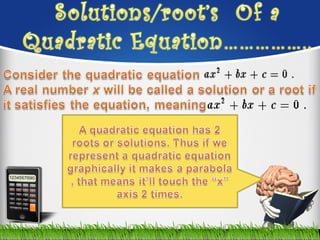
Quadratic Equation
BY- Utkarsh Sharma
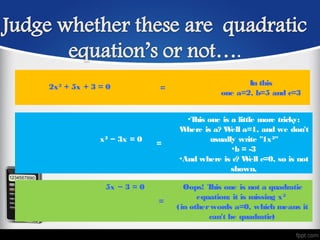
2x2
 + 5x + 3 = 0 =
In this
one a=2, b=5 and c=3
x2
 − 3x = 0
= 
•This one is a little more tricky:
Where is a? Well a=1, and we don't
usually write "1x2
"
•b = -3
•And where is c? Well c=0, so is not
shown.
5x − 3 = 0
 =
Oops! This one is not a quadratic
equation: it is missing x2
 
(in otherwords a=0, which means it
can't be quadratic)
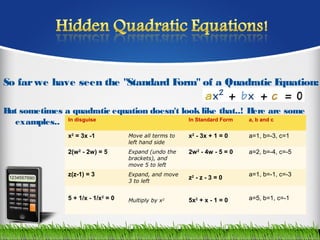
So farwe have seen the "Standard Form" of a Quadratic Equation:
But sometimes a quadratic equation doesn't look like that..! Here are some
examples.. In disguise In Standard Form a, b and c
x2
= 3x -1 Move all terms to
left hand side
x2
- 3x + 1 = 0 a=1, b=-3, c=1
2(w2
- 2w) = 5 Expand (undo the
brackets), and
move 5 to left
2w2
- 4w - 5 = 0 a=2, b=-4, c=-5
z(z-1) = 3 Expand, and move
3 to left
z2
- z - 3 = 0
a=1, b=-1, c=-3
5 + 1/x - 1/x2
= 0 Multiply by x2
5x2
+ x - 1 = 0 a=5, b=1, c=-1
Factor
method……………
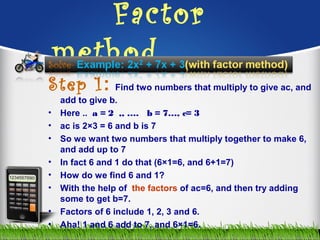
Step 1: Find two numbers that multiply to give ac, and
add to give b.
• Here .. a = 2 ,, …. b = 7…, c= 3
• ac is 2×3 = 6 and b is 7
• So we want two numbers that multiply together to make 6,
and add up to 7
• In fact 6 and 1 do that (6×1=6, and 6+1=7)
• How do we find 6 and 1?
• With the help of the factors of ac=6, and then try adding
some to get b=7.
• Factors of 6 include 1, 2, 3 and 6.
• Aha! 1 and 6 add to 7, and 6×1=6.
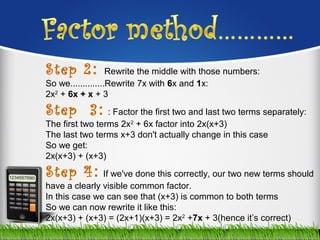
Step 2:  Rewrite the middle with those numbers:
So we..............Rewrite 7x with 6x and 1x:
2x2
 + 6x + x + 3
Step 3: : Factor the first two and last two terms separately:
The first two terms 2x2
 + 6x factor into 2x(x+3)
The last two terms x+3 don't actually change in this case
So we get:
2x(x+3) + (x+3)
Step 4: If we've done this correctly, our two new terms should 
have a clearly visible common factor.
In this case we can see that (x+3) is common to both terms
So we can now rewrite it like this:
2x(x+3) + (x+3) = (2x+1)(x+3) = 2x2
 +7x + 3(hence it’s correct)
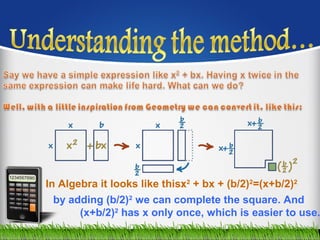
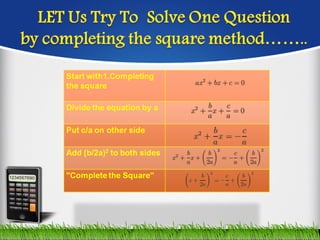
x2
+ bx + (b/2)2
=(x+b/2)2
In Algebra it looks like this:
by adding (b/2)2
we can complete the square. And
(x+b/2)2
has x only once, which is easier to use.
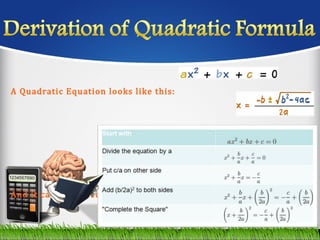
A Quadratic Equation looks like this:
And it can be solved using the Quadratic Formula:
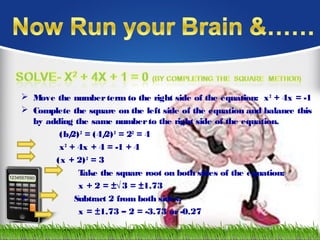
 Move the numberterm to the right side of the equation: x2
+ 4x = -1
 Complete the square on the left side of the equation and balance this
by adding the same numberto the right side of the equation.
(b/2)2
= (4/2)2
= 22
= 4
x2
+ 4x + 4 = -1 + 4
(x + 2)2
= 3
Take the square root on both sides of the equation:
x + 2 = ±√3 = ±1.73
 Subtract 2 from both sides:
x = ±1.73 – 2 = -3.73 or-0.27
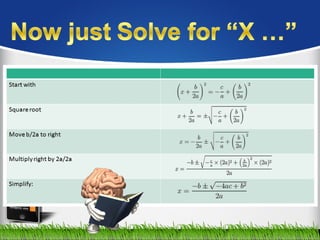
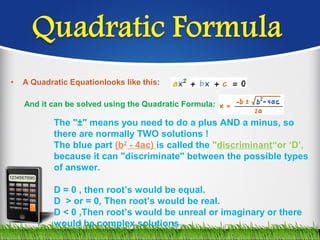
• A Quadratic Equationlooks like this:
And it can be solved using the Quadratic Formula:
The "±" means you need to do a plus AND a minus, so
there are normally TWO solutions !
The blue part (b2
- 4ac) is called the "discriminant“or ‘D’,
because it can "discriminate" between the possible types
of answer.
D = 0 , then root’s would be equal.
D > or = 0, Then root’s would be real.
D < 0 ,Then root’s would be unreal or imaginary or there
would be complex solutions .
• By using quadratic formula –
• Substitute a=6, b=5 and c=−6 into the formula:
• x = (−b ± √[b2
− 4ac]) / 2a
• x = (−5 ± √[52
− 4×6×(−6)]) / 2×6
• = (−5 ± √[25 + 144]) / 12
• = (−5 ± √169) / 12
• = (−5 ± 13) / 12
• So the two roots are:
• x = (-5 + 13) / 12 = 8/12 = 2/3,
• x = (-5 − 13) / 12 = −18/12 = −3/2
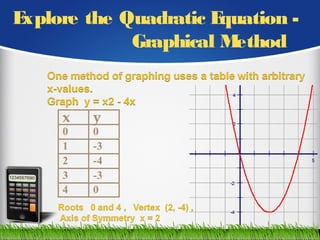
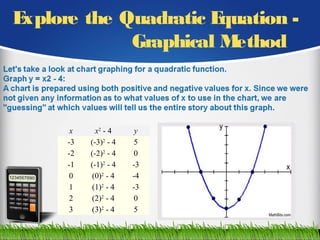
Explore the Quadratic Equation -
Graphical Method
Explore the Quadratic Equation -
Graphical Method
x x2
 - 4 y
-3 (-3)2
 - 4 5
-2 (-2)2
 - 4 0
-1 (-1)2
 - 4 -3
0 (0)2
 - 4 -4
1 (1)2
 - 4 -3
2 (2)2
 - 4 0
3 (3)2
 - 4 5
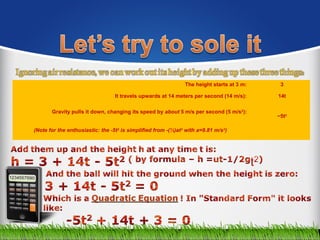
The height starts at 3 m: 3
It travels upwards at 14 meters per second (14 m/s): 14t
Gravity pulls it down, changing its speed by about 5 m/s per second (5 m/s2
):
−5t2
(Note for the enthusiastic: the -5t2
is simplified from -(½)at2
with a=9.81 m/s2
)
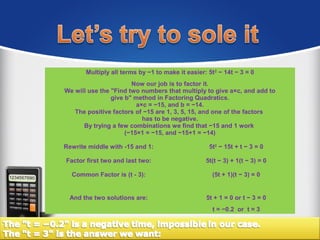
Multiply all terms by −1 to make it easier: 5t2
− 14t − 3 = 0
Now our job is to factor it.
We will use the "Find two numbers that multiply to give a×c, and add to
give b" method in Factoring Quadratics.
a×c = −15, and b = −14.
The positive factors of −15 are 1, 3, 5, 15, and one of the factors
has to be negative.
By trying a few combinations we find that −15 and 1 work
(−15×1 = −15, and −15+1 = −14)
Rewrite middle with -15 and 1: 5t2
− 15t + t − 3 = 0
Factor first two and last two: 5t(t − 3) + 1(t − 3) = 0
Common Factor is (t - 3): (5t + 1)(t − 3) = 0
And the two solutions are: 5t + 1 = 0 or t − 3 = 0
t = −0.2 or t = 3
Quadratic Equation

Quadratic Equation

  • 1.
  • 3.
    2x2  + 5x +3 = 0 = In this one a=2, b=5 and c=3 x2  − 3x = 0 =  •This one is a little more tricky: Where is a? Well a=1, and we don't usually write "1x2 " •b = -3 •And where is c? Well c=0, so is not shown. 5x − 3 = 0  = Oops! This one is not a quadratic equation: it is missing x2   (in otherwords a=0, which means it can't be quadratic)
  • 4.
    So farwe haveseen the "Standard Form" of a Quadratic Equation: But sometimes a quadratic equation doesn't look like that..! Here are some examples.. In disguise In Standard Form a, b and c x2 = 3x -1 Move all terms to left hand side x2 - 3x + 1 = 0 a=1, b=-3, c=1 2(w2 - 2w) = 5 Expand (undo the brackets), and move 5 to left 2w2 - 4w - 5 = 0 a=2, b=-4, c=-5 z(z-1) = 3 Expand, and move 3 to left z2 - z - 3 = 0 a=1, b=-1, c=-3 5 + 1/x - 1/x2 = 0 Multiply by x2 5x2 + x - 1 = 0 a=5, b=1, c=-1
  • 7.
    Factor method…………… Step 1: Findtwo numbers that multiply to give ac, and add to give b. • Here .. a = 2 ,, …. b = 7…, c= 3 • ac is 2×3 = 6 and b is 7 • So we want two numbers that multiply together to make 6, and add up to 7 • In fact 6 and 1 do that (6×1=6, and 6+1=7) • How do we find 6 and 1? • With the help of the factors of ac=6, and then try adding some to get b=7. • Factors of 6 include 1, 2, 3 and 6. • Aha! 1 and 6 add to 7, and 6×1=6.
  • 8.
    Step 2:  Rewrite the middle with those numbers: So we..............Rewrite 7x with 6x and 1x: 2x2  + 6x+ x + 3 Step 3: : Factor the first two and last two terms separately: The first two terms 2x2  + 6x factor into 2x(x+3) The last two terms x+3 don't actually change in this case So we get: 2x(x+3) + (x+3) Step 4: If we've done this correctly, our two new terms should  have a clearly visible common factor. In this case we can see that (x+3) is common to both terms So we can now rewrite it like this: 2x(x+3) + (x+3) = (2x+1)(x+3) = 2x2  +7x + 3(hence it’s correct)
  • 10.
    x2 + bx +(b/2)2 =(x+b/2)2 In Algebra it looks like this: by adding (b/2)2 we can complete the square. And (x+b/2)2 has x only once, which is easier to use.
  • 11.
    A Quadratic Equationlooks like this: And it can be solved using the Quadratic Formula:
  • 13.
     Move thenumberterm to the right side of the equation: x2 + 4x = -1  Complete the square on the left side of the equation and balance this by adding the same numberto the right side of the equation. (b/2)2 = (4/2)2 = 22 = 4 x2 + 4x + 4 = -1 + 4 (x + 2)2 = 3 Take the square root on both sides of the equation: x + 2 = ±√3 = ±1.73  Subtract 2 from both sides: x = ±1.73 – 2 = -3.73 or-0.27
  • 14.
    • A QuadraticEquationlooks like this: And it can be solved using the Quadratic Formula: The "±" means you need to do a plus AND a minus, so there are normally TWO solutions ! The blue part (b2 - 4ac) is called the "discriminant“or ‘D’, because it can "discriminate" between the possible types of answer. D = 0 , then root’s would be equal. D > or = 0, Then root’s would be real. D < 0 ,Then root’s would be unreal or imaginary or there would be complex solutions .
  • 16.
    • By usingquadratic formula – • Substitute a=6, b=5 and c=−6 into the formula: • x = (−b ± √[b2 − 4ac]) / 2a • x = (−5 ± √[52 − 4×6×(−6)]) / 2×6 • = (−5 ± √[25 + 144]) / 12 • = (−5 ± √169) / 12 • = (−5 ± 13) / 12 • So the two roots are: • x = (-5 + 13) / 12 = 8/12 = 2/3, • x = (-5 − 13) / 12 = −18/12 = −3/2
  • 17.
    Explore the QuadraticEquation - Graphical Method
  • 18.
    Explore the QuadraticEquation - Graphical Method x x2  - 4 y -3 (-3)2  - 4 5 -2 (-2)2  - 4 0 -1 (-1)2  - 4 -3 0 (0)2  - 4 -4 1 (1)2  - 4 -3 2 (2)2  - 4 0 3 (3)2  - 4 5
  • 21.
    The height startsat 3 m: 3 It travels upwards at 14 meters per second (14 m/s): 14t Gravity pulls it down, changing its speed by about 5 m/s per second (5 m/s2 ): −5t2 (Note for the enthusiastic: the -5t2 is simplified from -(½)at2 with a=9.81 m/s2 )
  • 22.
    Multiply all termsby −1 to make it easier: 5t2 − 14t − 3 = 0 Now our job is to factor it. We will use the "Find two numbers that multiply to give a×c, and add to give b" method in Factoring Quadratics. a×c = −15, and b = −14. The positive factors of −15 are 1, 3, 5, 15, and one of the factors has to be negative. By trying a few combinations we find that −15 and 1 work (−15×1 = −15, and −15+1 = −14) Rewrite middle with -15 and 1: 5t2 − 15t + t − 3 = 0 Factor first two and last two: 5t(t − 3) + 1(t − 3) = 0 Common Factor is (t - 3): (5t + 1)(t − 3) = 0 And the two solutions are: 5t + 1 = 0 or t − 3 = 0 t = −0.2 or t = 3