PRESENTATION
BY
MUHAMMAD TALHA
INTEGRATION BY SUBSITUTION
"
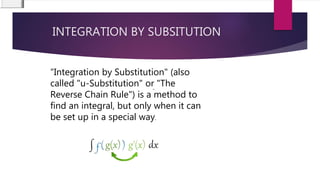
"Integration by Substitution" (also
called "u-Substitution" or "The
Reverse Chain Rule") is a method to
find an integral, but only when it can
be set up in a special way.
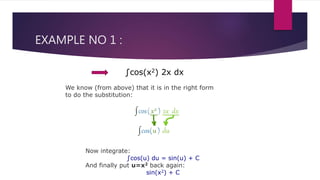
EXAMPLE NO 1 :
∫cos(x2) 2x dx
We know (from above) that it is in the right form
to do the substitution:
Now integrate:
∫cos(u) du = sin(u) + C
And finally put u=x2 back again:
sin(x2) + C
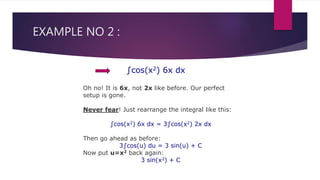
EXAMPLE NO 2 :
∫cos(x2) 6x dx
Oh no! It is 6x, not 2x like before. Our perfect
setup is gone.
Never fear! Just rearrange the integral like this:
∫cos(x2) 6x dx = 3∫cos(x2) 2x dx
Then go ahead as before:
3∫cos(u) du = 3 sin(u) + C
Now put u=x2 back again:
3 sin(x2) + C
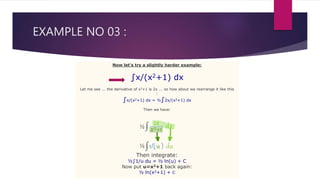
EXAMPLE NO 03 :
Now let's try a slightly harder example:
∫x/(x2+1) dx
Let me see ... the derivative of x2+1 is 2x ... so how about we rearrange it like this
:
∫x/(x2+1) dx = ½∫2x/(x2+1) dx
Then we have:
Then integrate:
½∫1/u du = ½ ln(u) + C
Now put u=x2+1 back again:
½ ln(x2+1) + C
INTEGRATION BY PARTS
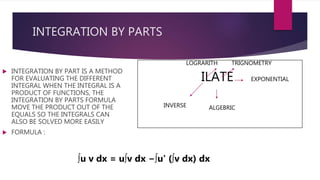
 INTEGRATION BY PART IS A METHOD
FOR EVALUATING THE DIFFERENT
INTEGRAL WHEN THE INTEGRAL IS A
PRODUCT OF FUNCTIONS, THE
INTEGRATION BY PARTS FORMULA
MOVE THE PRODUCT OUT OF THE
EQUALS SO THE INTEGRALS CAN
ALSO BE SOLVED MORE EASILY
 FORMULA :
ILATE
INVERSE
LOGRARITH
ALGEBRIC
TRIGNOMETRY
EXPONENTIAL
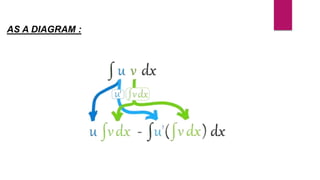
∫u v dx = u∫v dx −∫u' (∫v dx) dx
AS A DIAGRAM :
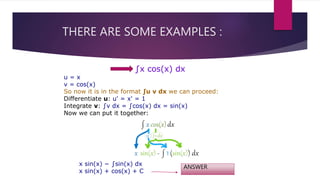
THERE ARE SOME EXAMPLES :
∫x cos(x) dx
u = x
v = cos(x)
So now it is in the format ∫u v dx we can proceed:
Differentiate u: u' = x' = 1
Integrate v: ∫v dx = ∫cos(x) dx = sin(x)
Now we can put it together:
x sin(x) − ∫sin(x) dx
x sin(x) + cos(x) + C
ANSWER
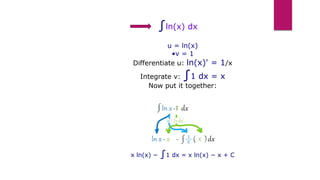
∫ln(x) dx
u = ln(x)
•v = 1
Differentiate u: ln(x)' = 1/x
Integrate v: ∫1 dx = x
Now put it together:
x ln(x) − ∫1 dx = x ln(x) − x + C
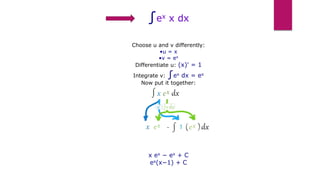
∫ex x dx
Choose u and v differently:
•u = x
•v = ex
Differentiate u: (x)' = 1
Integrate v: ∫ex dx = ex
Now put it together:
x ex − ex + C
ex(x−1) + C
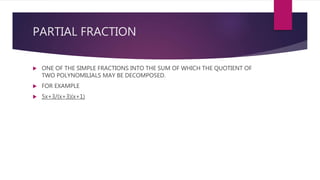
PARTIAL FRACTION
 ONE OF THE SIMPLE FRACTIONS INTO THE SUM OF WHICH THE QUOTIENT OF
TWO POLYNOMILIALS MAY BE DECOMPOSED.
 FOR EXAMPLE
 5x+3/(x+3)(x+1)
THANK YOU…

Integration by parts

  • 1.
  • 2.
    INTEGRATION BY SUBSITUTION " "Integrationby Substitution" (also called "u-Substitution" or "The Reverse Chain Rule") is a method to find an integral, but only when it can be set up in a special way.
  • 3.
    EXAMPLE NO 1: ∫cos(x2) 2x dx We know (from above) that it is in the right form to do the substitution: Now integrate: ∫cos(u) du = sin(u) + C And finally put u=x2 back again: sin(x2) + C
  • 4.
    EXAMPLE NO 2: ∫cos(x2) 6x dx Oh no! It is 6x, not 2x like before. Our perfect setup is gone. Never fear! Just rearrange the integral like this: ∫cos(x2) 6x dx = 3∫cos(x2) 2x dx Then go ahead as before: 3∫cos(u) du = 3 sin(u) + C Now put u=x2 back again: 3 sin(x2) + C
  • 5.
    EXAMPLE NO 03: Now let's try a slightly harder example: ∫x/(x2+1) dx Let me see ... the derivative of x2+1 is 2x ... so how about we rearrange it like this : ∫x/(x2+1) dx = ½∫2x/(x2+1) dx Then we have: Then integrate: ½∫1/u du = ½ ln(u) + C Now put u=x2+1 back again: ½ ln(x2+1) + C
  • 6.
    INTEGRATION BY PARTS INTEGRATION BY PART IS A METHOD FOR EVALUATING THE DIFFERENT INTEGRAL WHEN THE INTEGRAL IS A PRODUCT OF FUNCTIONS, THE INTEGRATION BY PARTS FORMULA MOVE THE PRODUCT OUT OF THE EQUALS SO THE INTEGRALS CAN ALSO BE SOLVED MORE EASILY  FORMULA : ILATE INVERSE LOGRARITH ALGEBRIC TRIGNOMETRY EXPONENTIAL ∫u v dx = u∫v dx −∫u' (∫v dx) dx
  • 7.
  • 8.
    THERE ARE SOMEEXAMPLES : ∫x cos(x) dx u = x v = cos(x) So now it is in the format ∫u v dx we can proceed: Differentiate u: u' = x' = 1 Integrate v: ∫v dx = ∫cos(x) dx = sin(x) Now we can put it together: x sin(x) − ∫sin(x) dx x sin(x) + cos(x) + C ANSWER
  • 9.
    ∫ln(x) dx u =ln(x) •v = 1 Differentiate u: ln(x)' = 1/x Integrate v: ∫1 dx = x Now put it together: x ln(x) − ∫1 dx = x ln(x) − x + C
  • 10.
    ∫ex x dx Chooseu and v differently: •u = x •v = ex Differentiate u: (x)' = 1 Integrate v: ∫ex dx = ex Now put it together: x ex − ex + C ex(x−1) + C
  • 11.
    PARTIAL FRACTION  ONEOF THE SIMPLE FRACTIONS INTO THE SUM OF WHICH THE QUOTIENT OF TWO POLYNOMILIALS MAY BE DECOMPOSED.  FOR EXAMPLE  5x+3/(x+3)(x+1)
  • 12.