NUMERICAL METHODS
(06CT42)
Dr. N. Meenakshi Sundaram
Asst. Prof. of Physics
Vivekananda College
Tiruvedakam West - Madurai
CONTENTS
Newton’s forward difference formula to get the derivative
Newton’s backward difference formula to compute the derivative
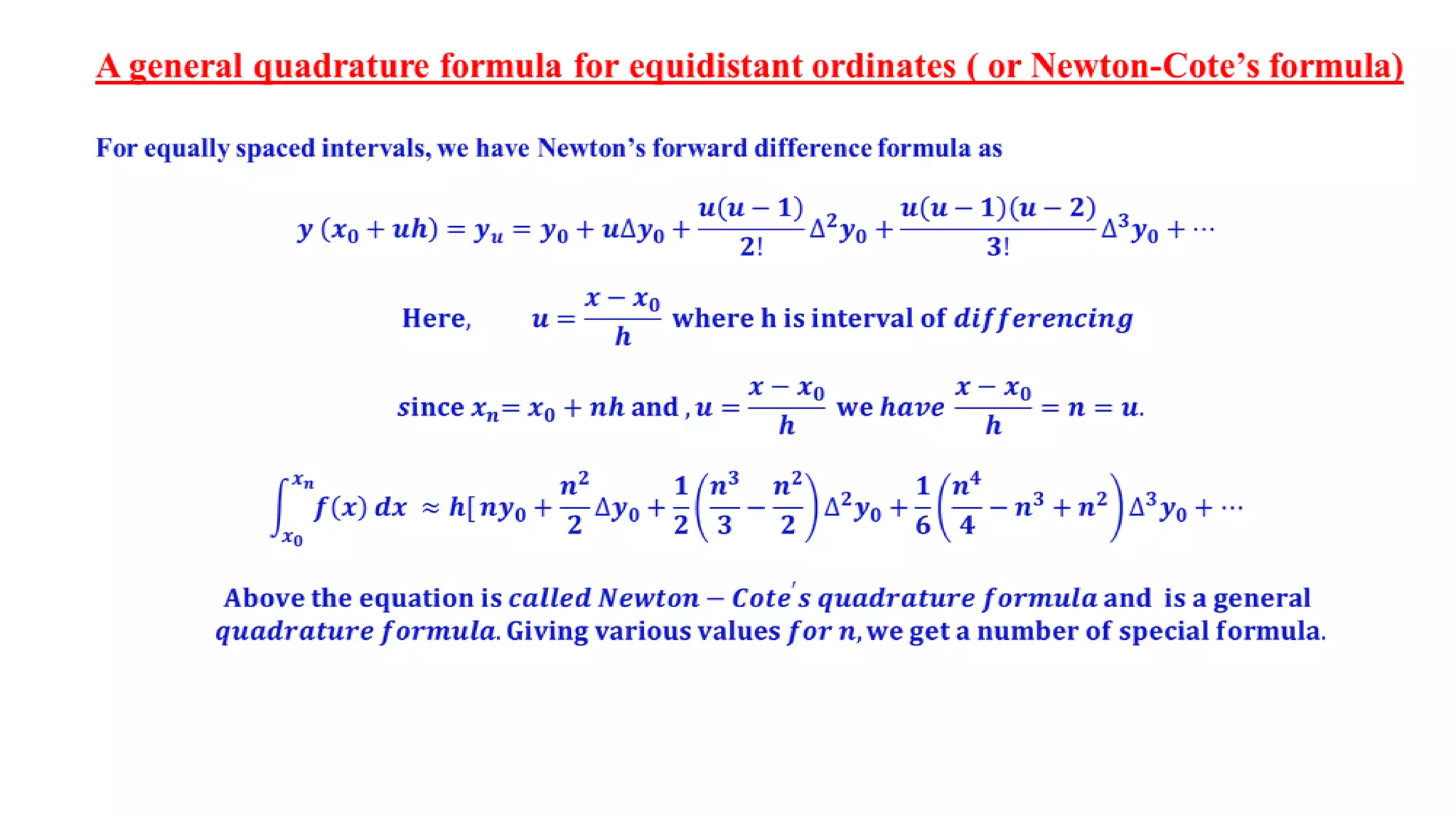
Newton-Cote’s formula
Trapezoidal rule
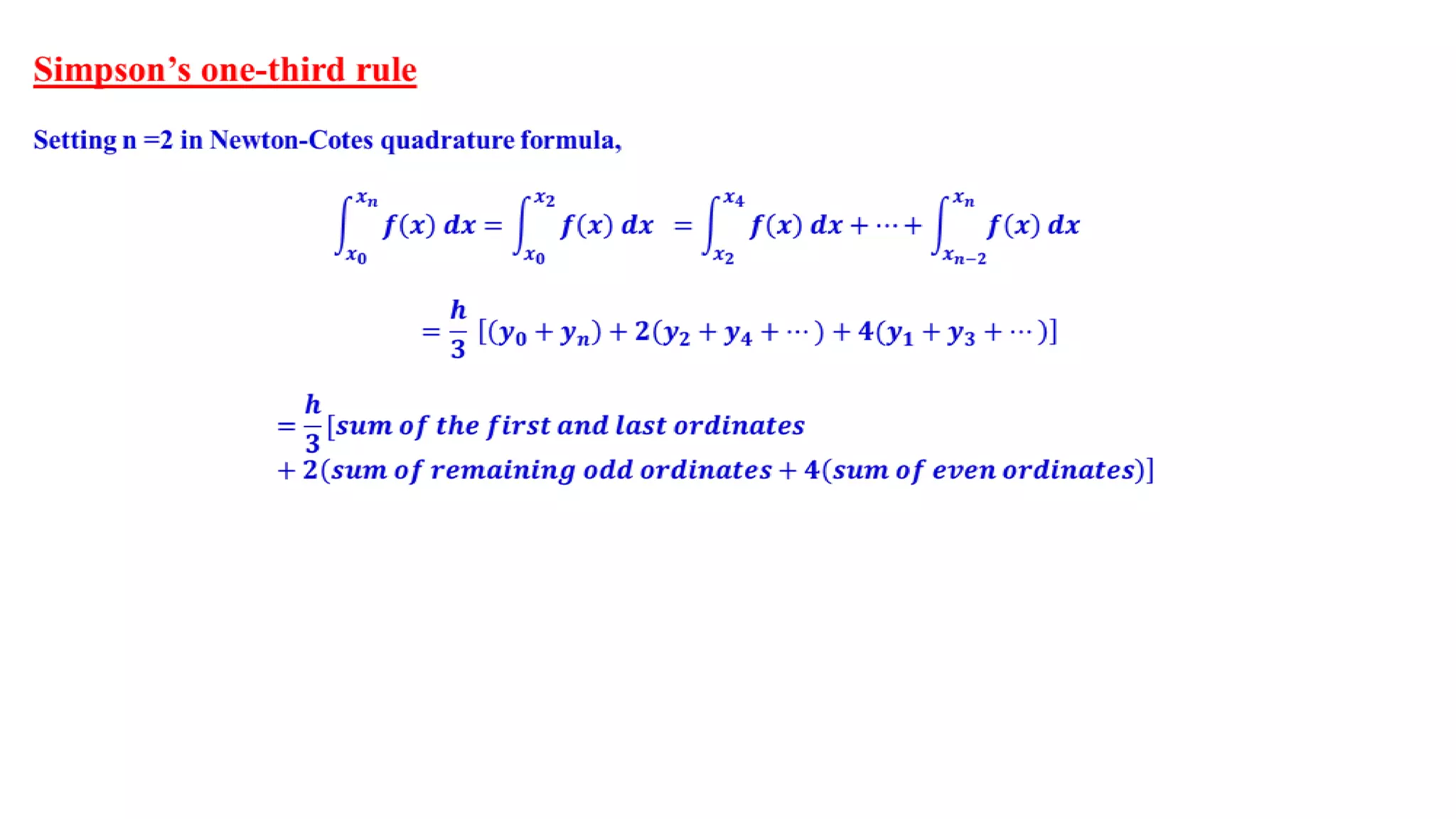
Simpson’s one-third rule
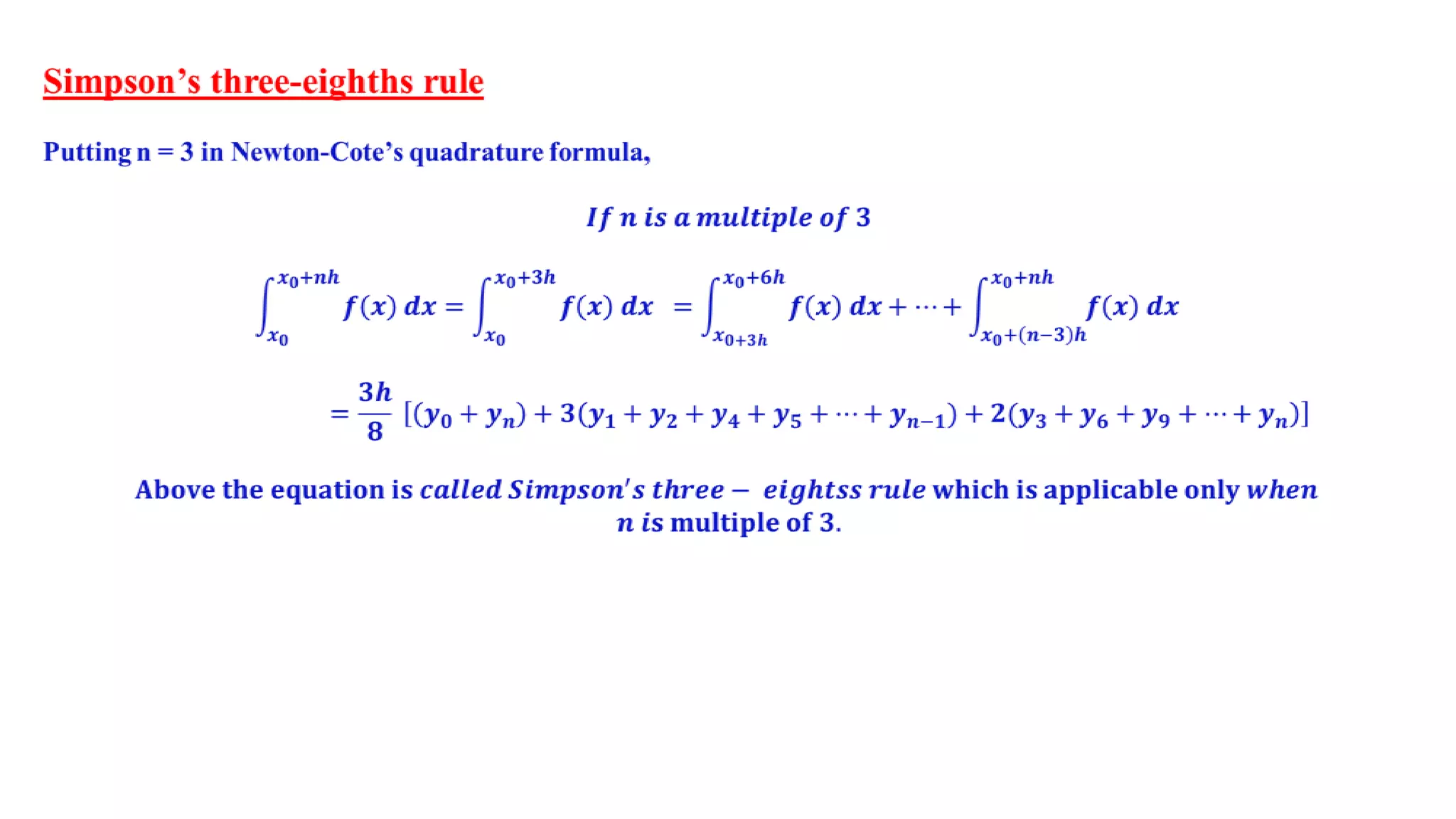
Simpson’s three-eighths rule
NUMERICAL OF DIFFERENTATION AND INTEGRATION
UNIT – IV Numerical Differentiation and Integration
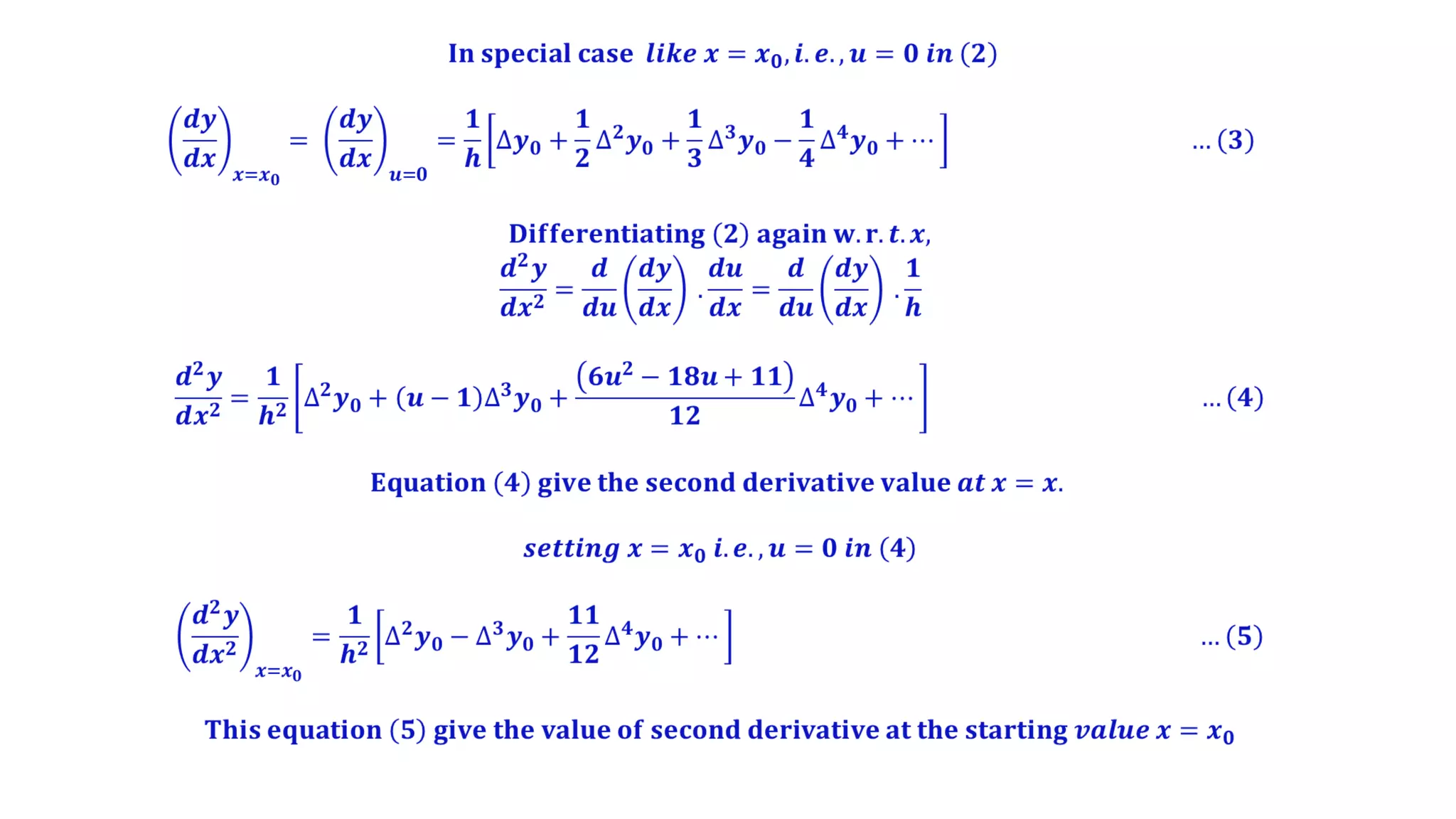
Numerical Differentiation
Introduction
We found the polynomial curve y = f (x), passing through the (n+1) ordered pairs (xi, yi), i=0, 1, 2…n.
Now we are trying to find the derivative value of such curves at a given x = xk (say), whose x0 < xk < xn.
To get derivative, we first find the curve y = f (x) through the points and then differentiate and get its value
at the required point.
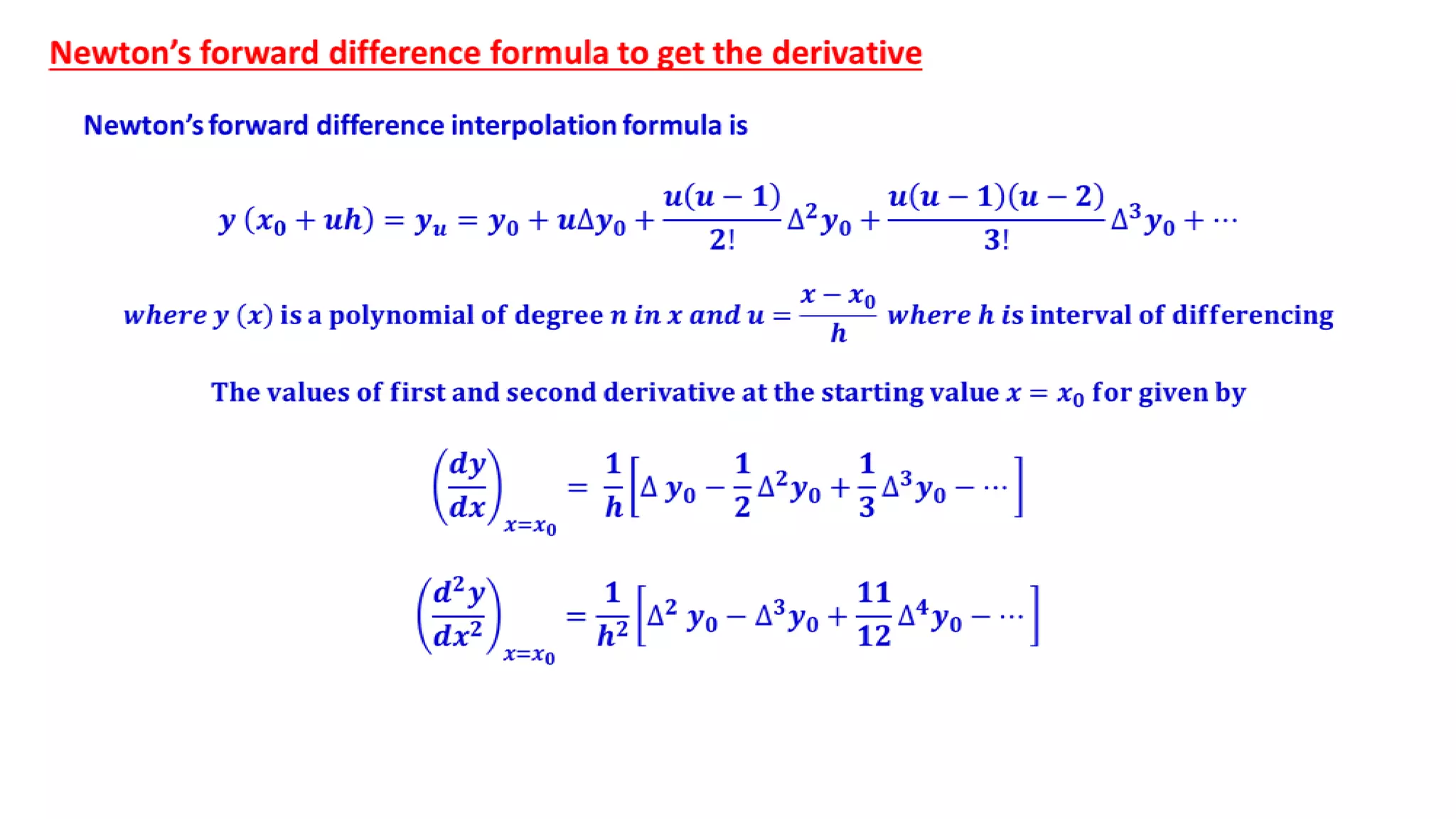
If the values of x are equally spaced. We get the interpolating polynomial due to Newton-Gregory.
• If the derivative is required at a point nearer to the starting value in the table, we use Newton’s
forward interpolation formula.
• If we require the derivative at the end of the table, we use Newton’s backward interpolation
formula.
• If the value of derivative is required near the middle of the table value, we use one of the central
difference interpolation formulae
Problems:
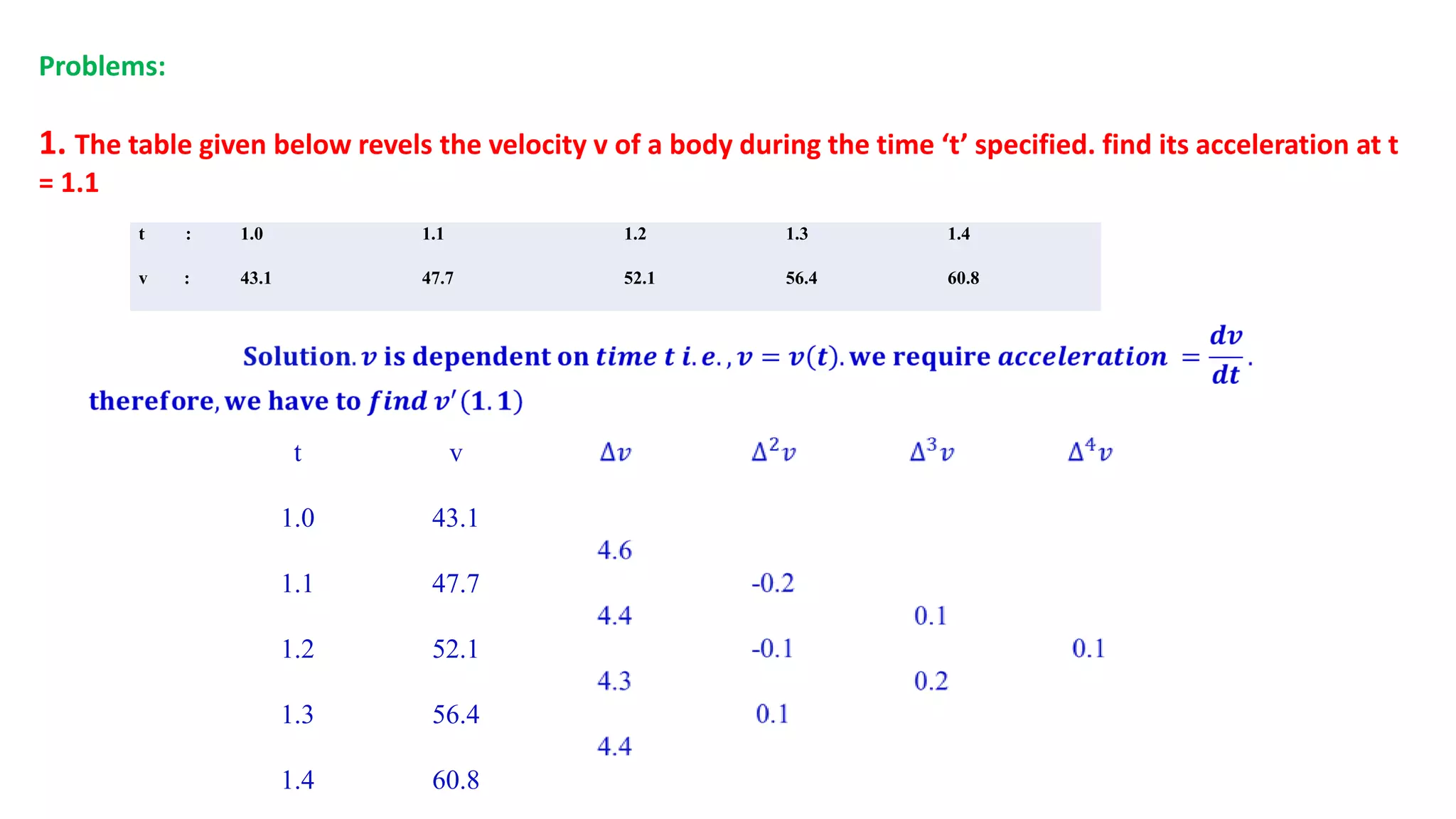
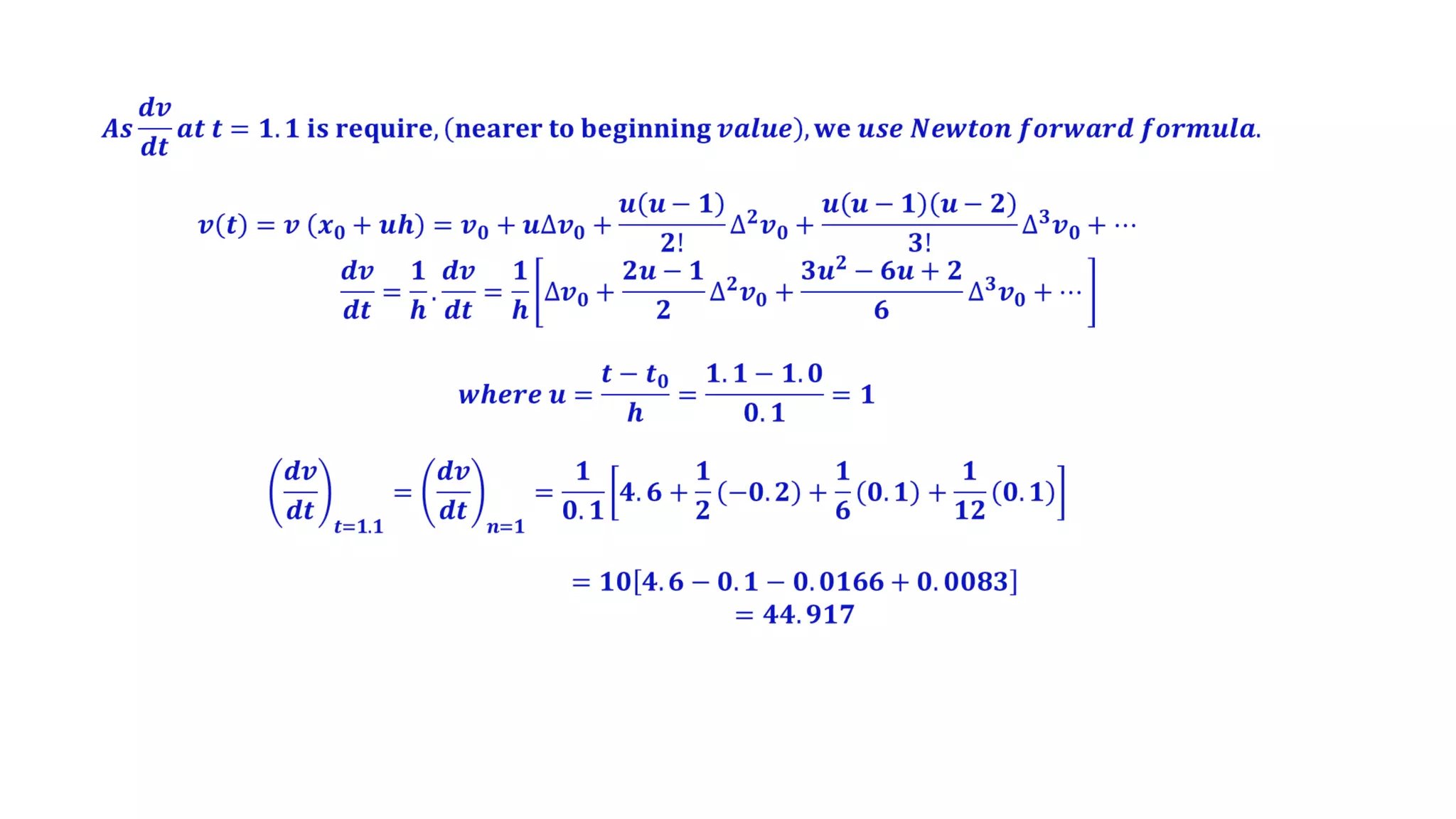
1. The table given below revels the velocity v of a body during the time ‘t’ specified. find its acceleration at t
= 1.1
t : 1.0 1.1 1.2 1.3 1.4
v : 43.1 47.7 52.1 56.4 60.8
t
1.0
1.1
1.2
1.3
1.4
v
43.1
47.7
52.1
56.4
60.8
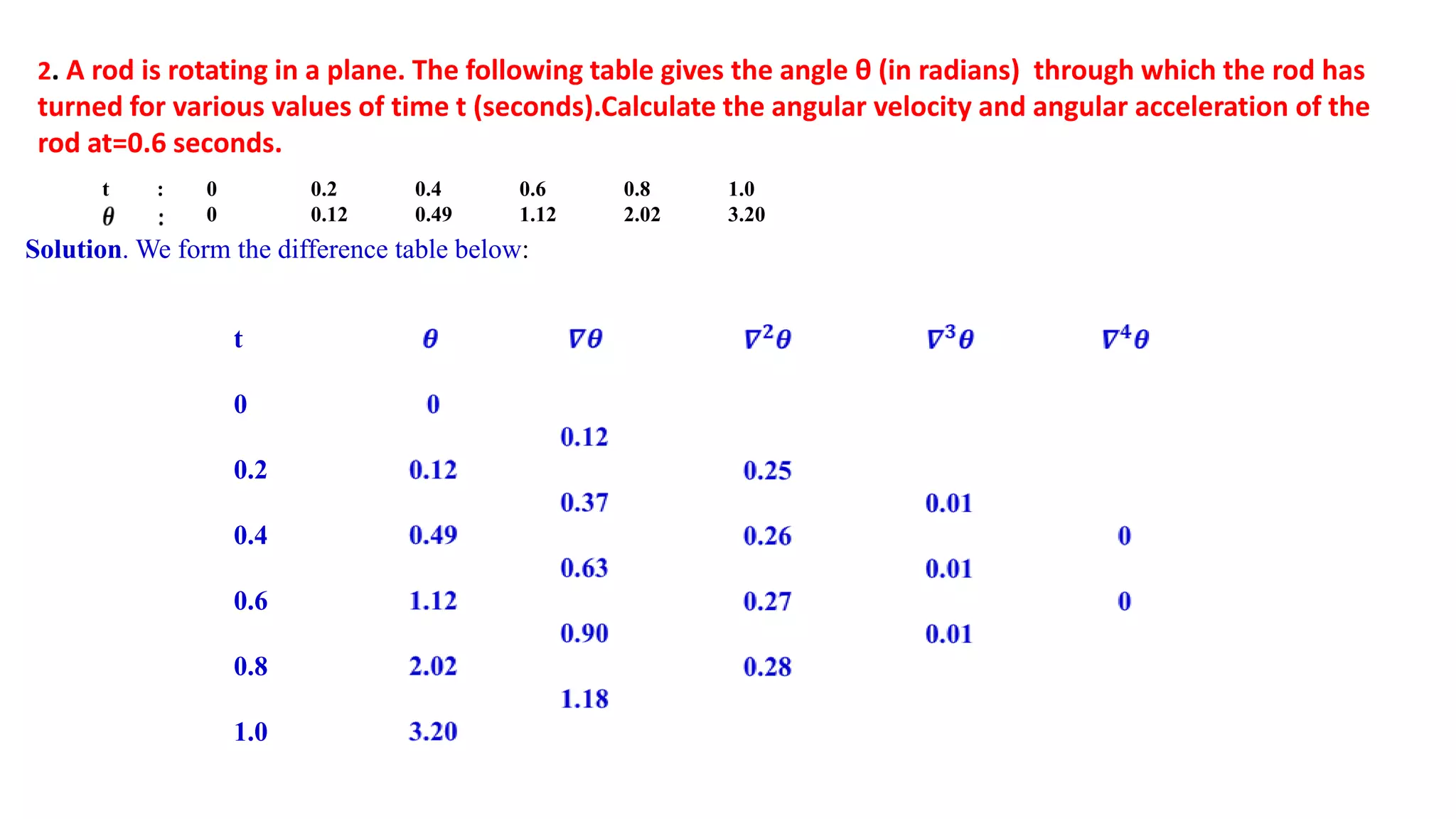
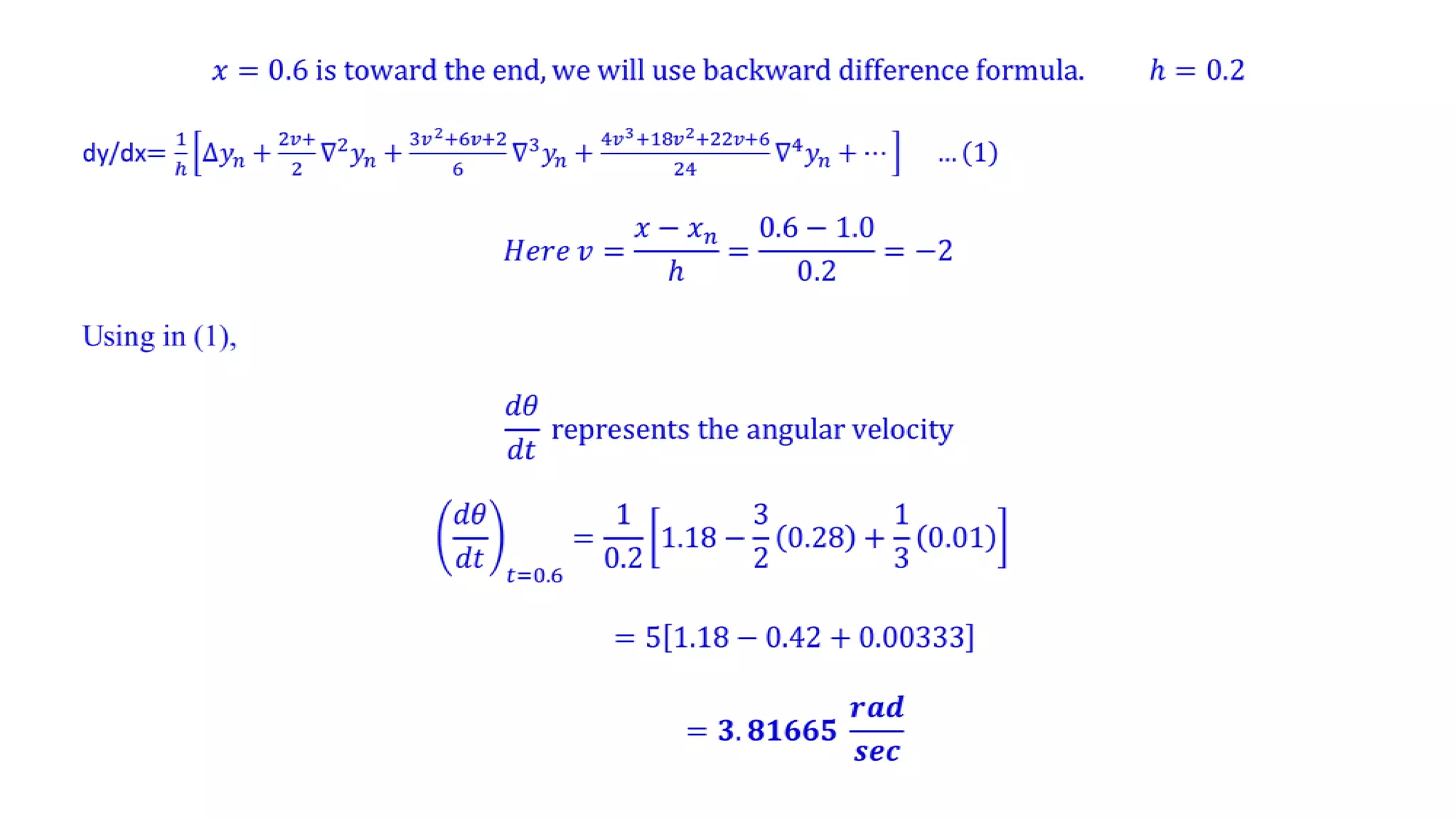
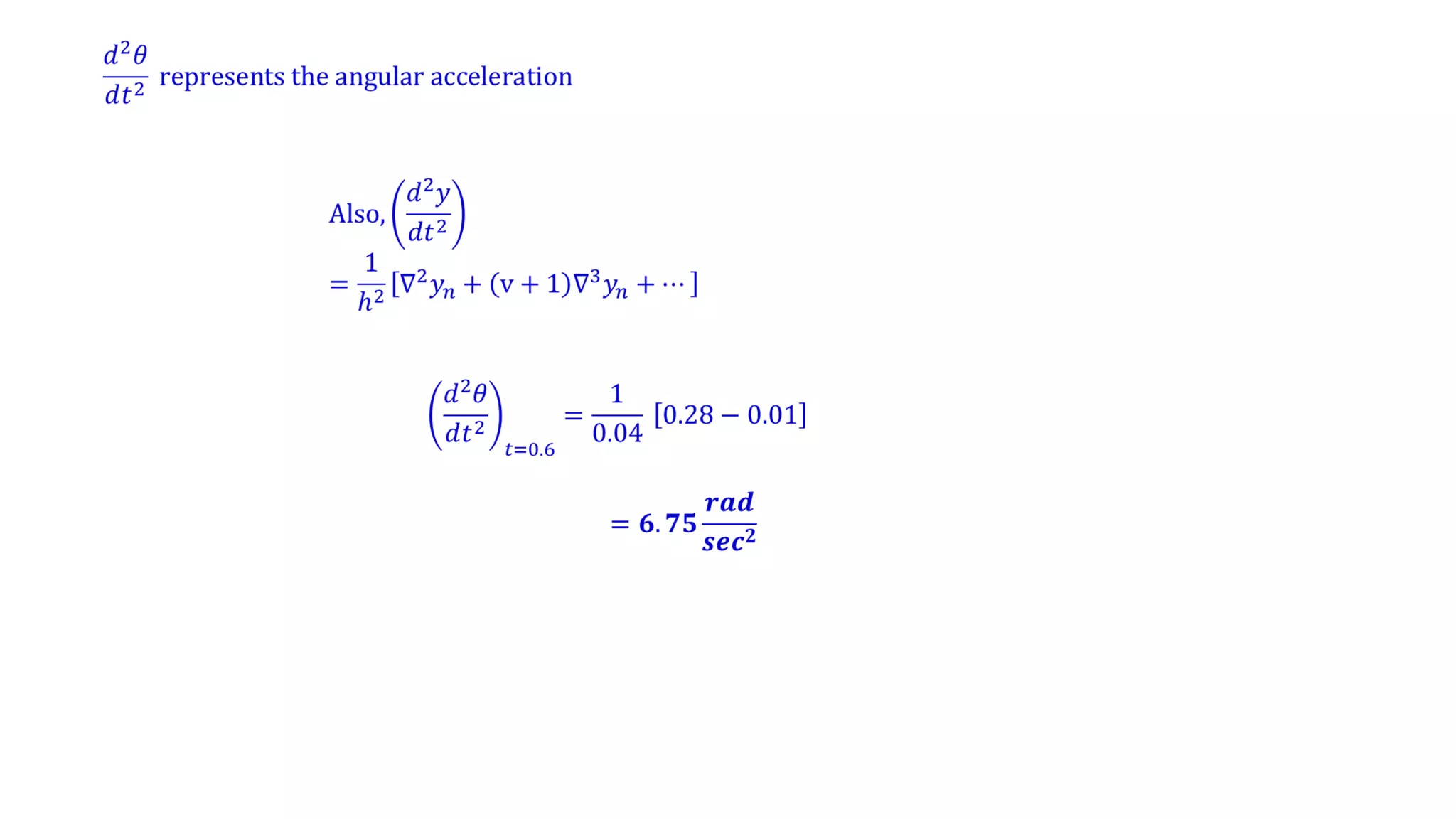
2. A rod is rotating in a plane. The following table gives the angle θ (in radians) through which the rod has
turned for various values of time t (seconds).Calculate the angular velocity and angular acceleration of the
rod at=0.6 seconds.
t : 0 0.2 0.4 0.6 0.8 1.0
0 0.12 0.49 1.12 2.02 3.20
Solution. We form the difference table below:
t
0
0.2
0.4
0.6
0.8
1.0
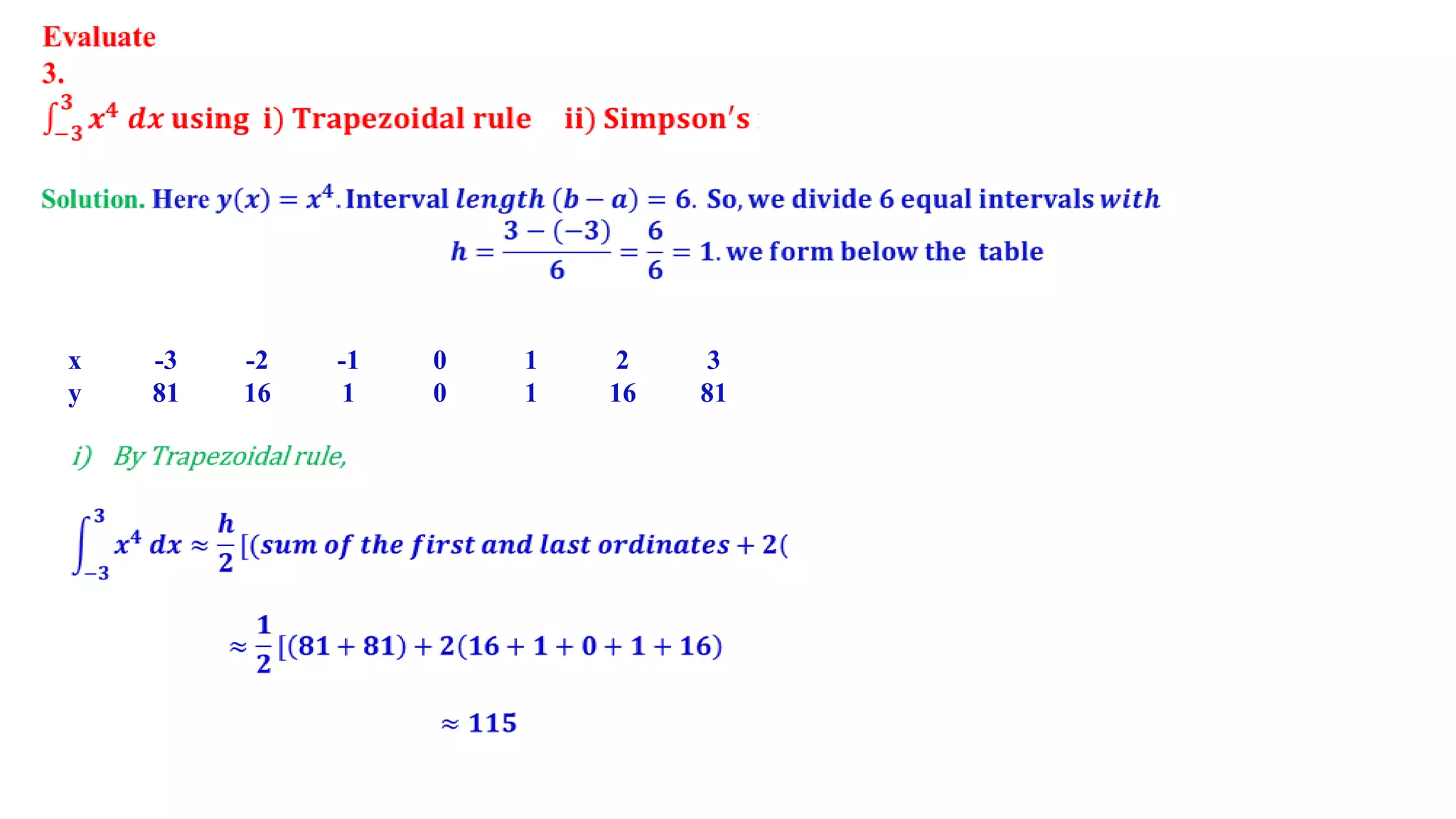
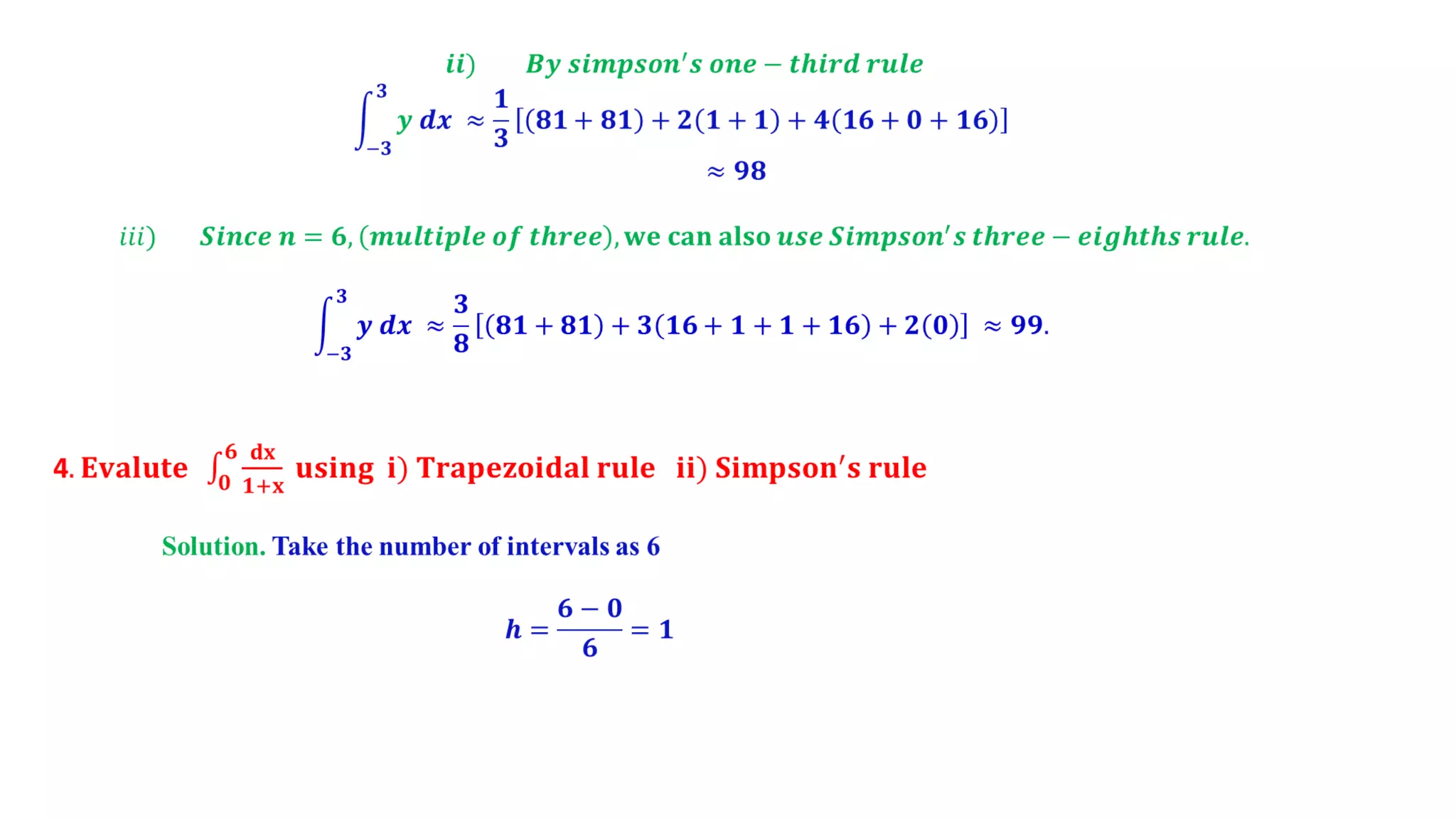
x -3 -2 -1 0 1 2 3
y 81 16 1 0 1 16 81
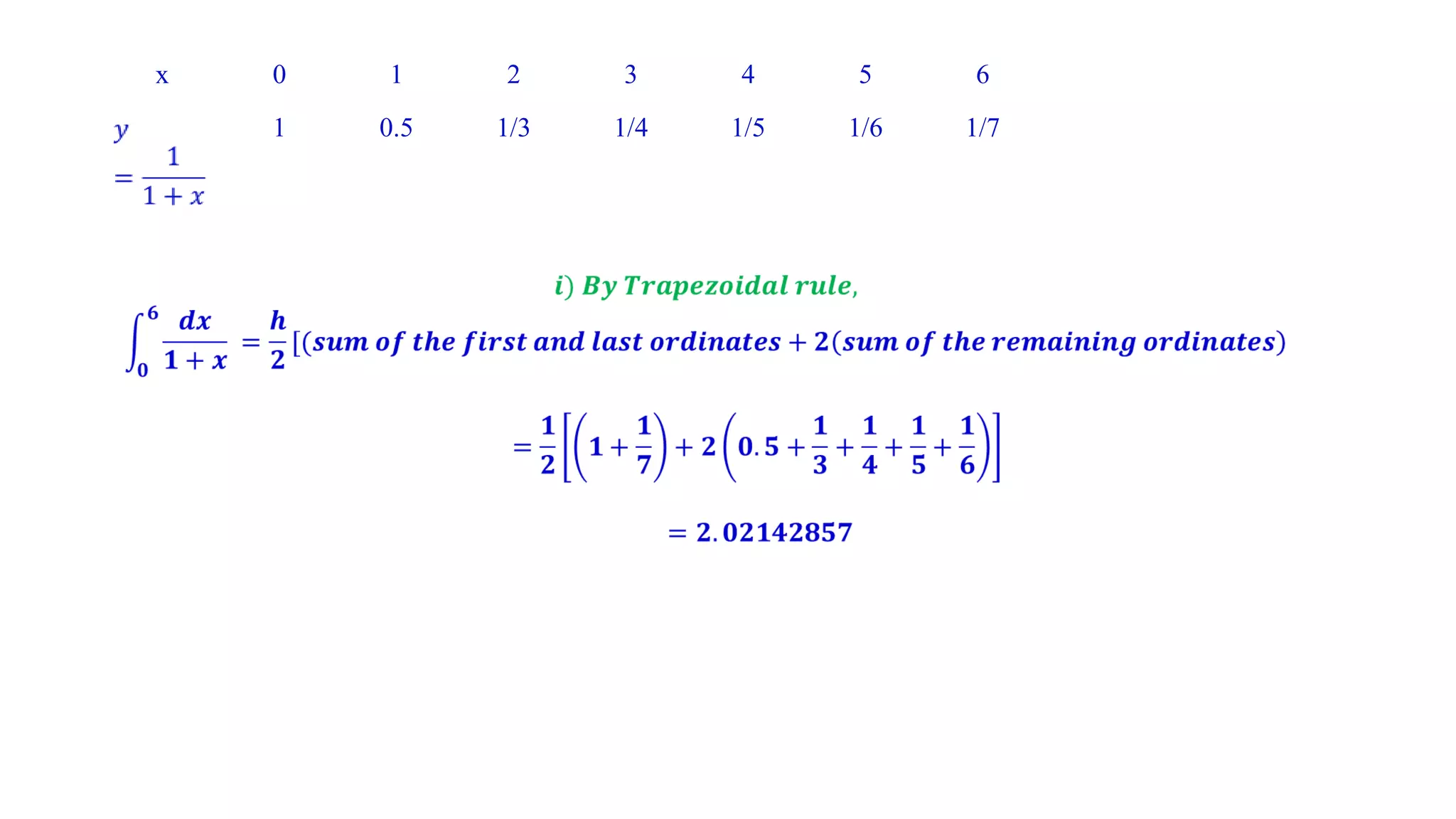
x 0 1 2 3 4 5 6
1 0.5 1/3 1/4 1/5 1/6 1/7
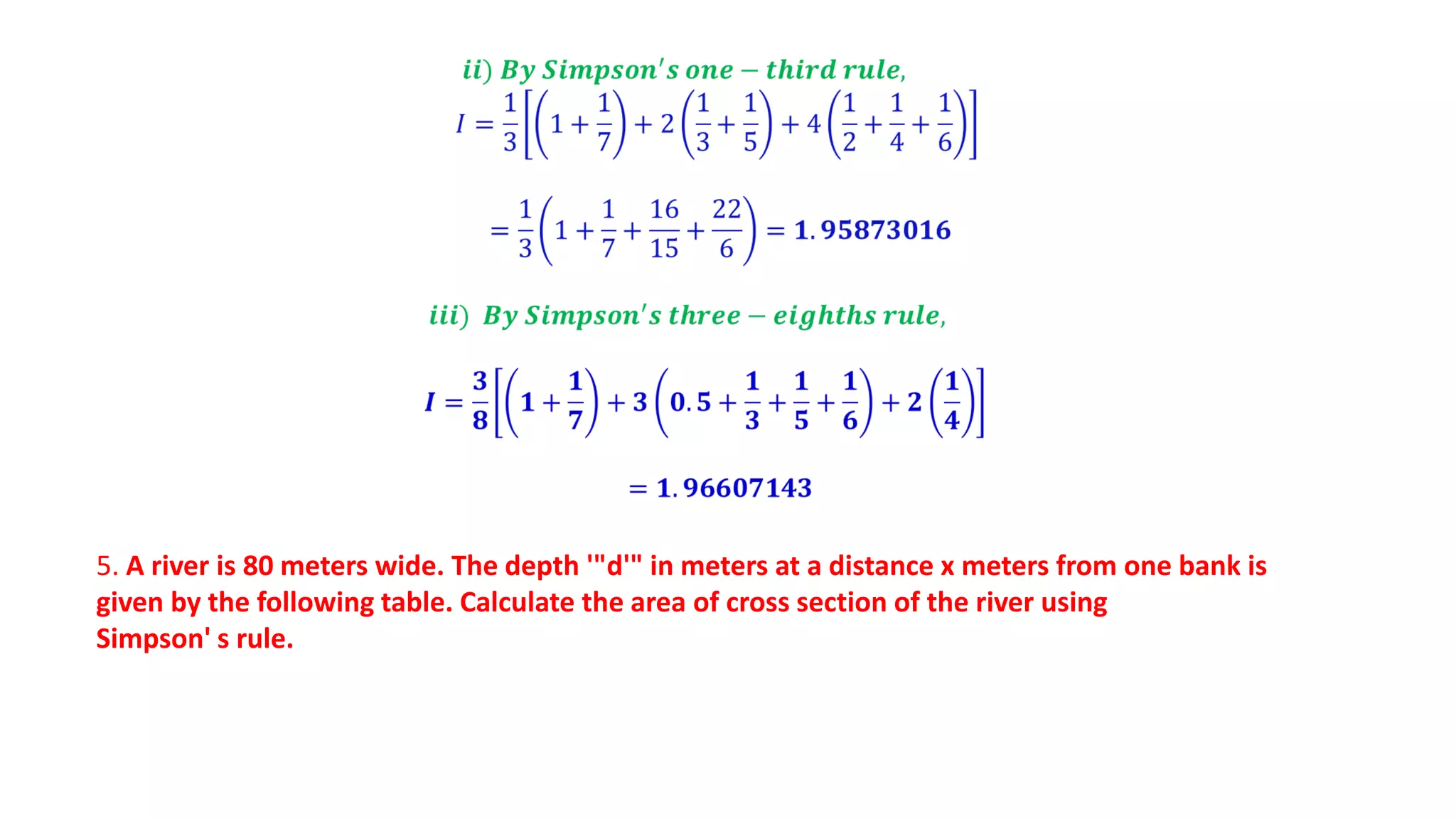
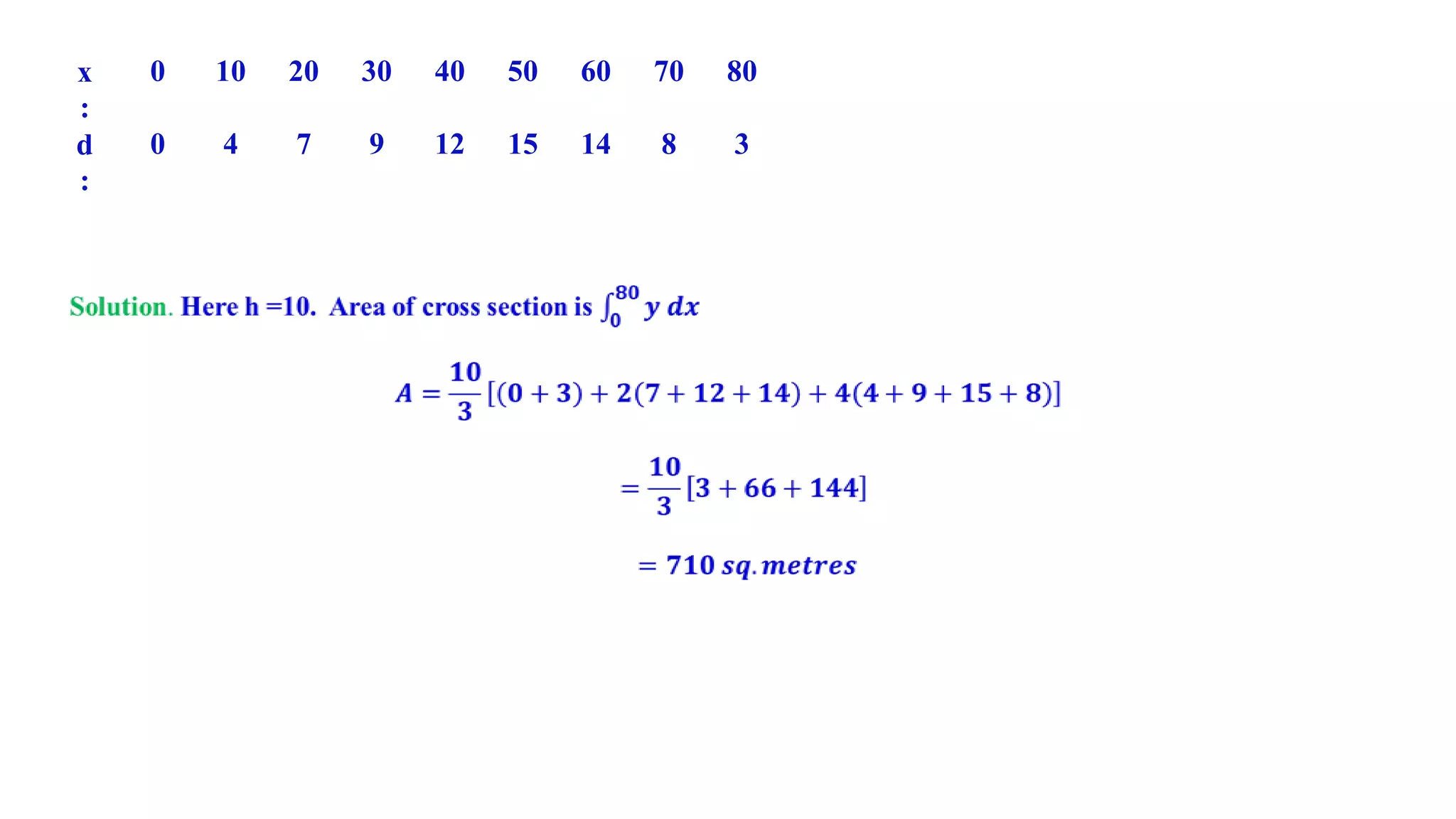
5. A river is 80 meters wide. The depth '"d'" in meters at a distance x meters from one bank is
given by the following table. Calculate the area of cross section of the river using
Simpson' s rule.
x
:
0 10 20 30 40 50 60 70 80
d
:
0 4 7 9 12 15 14 8 3
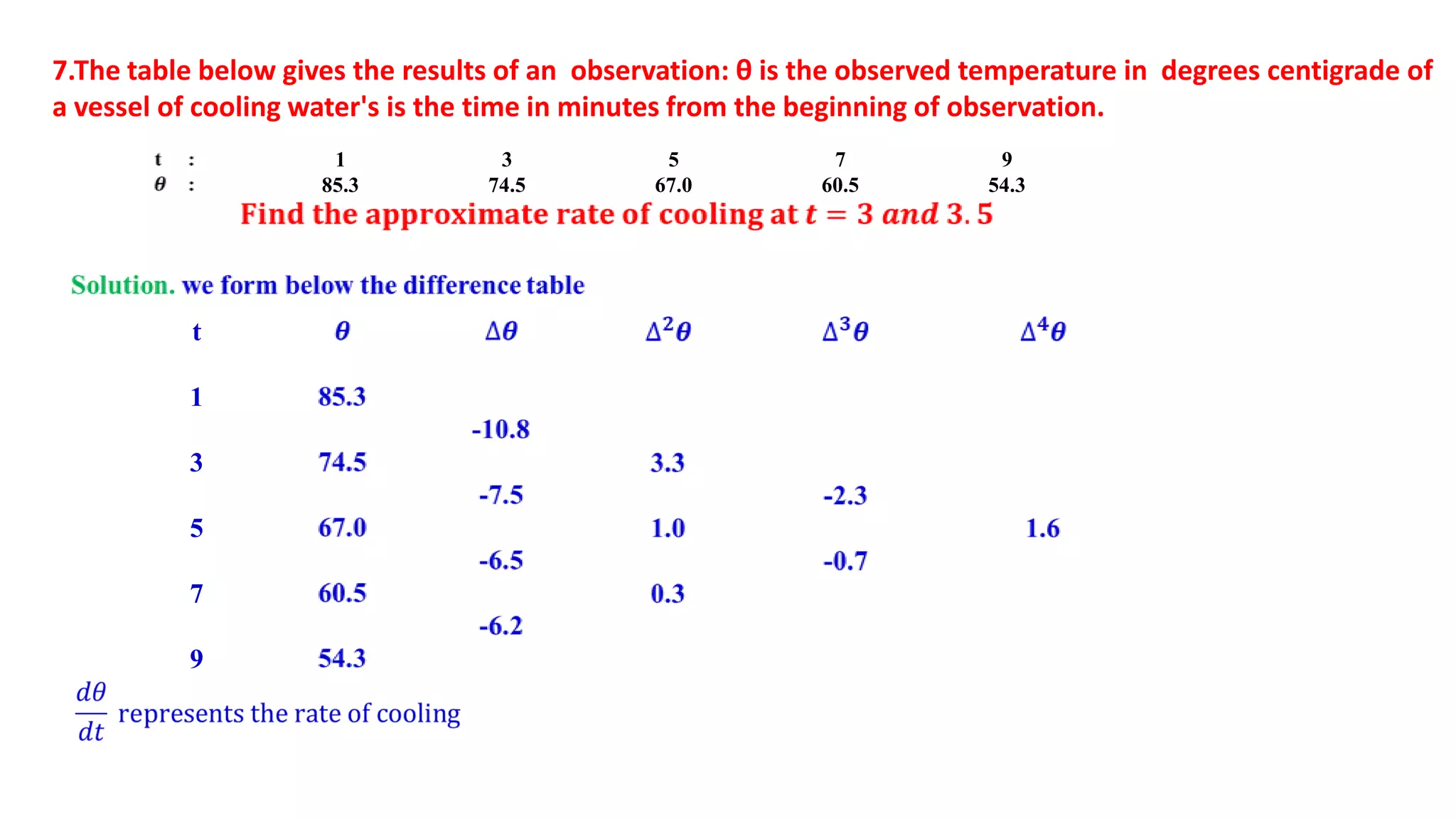
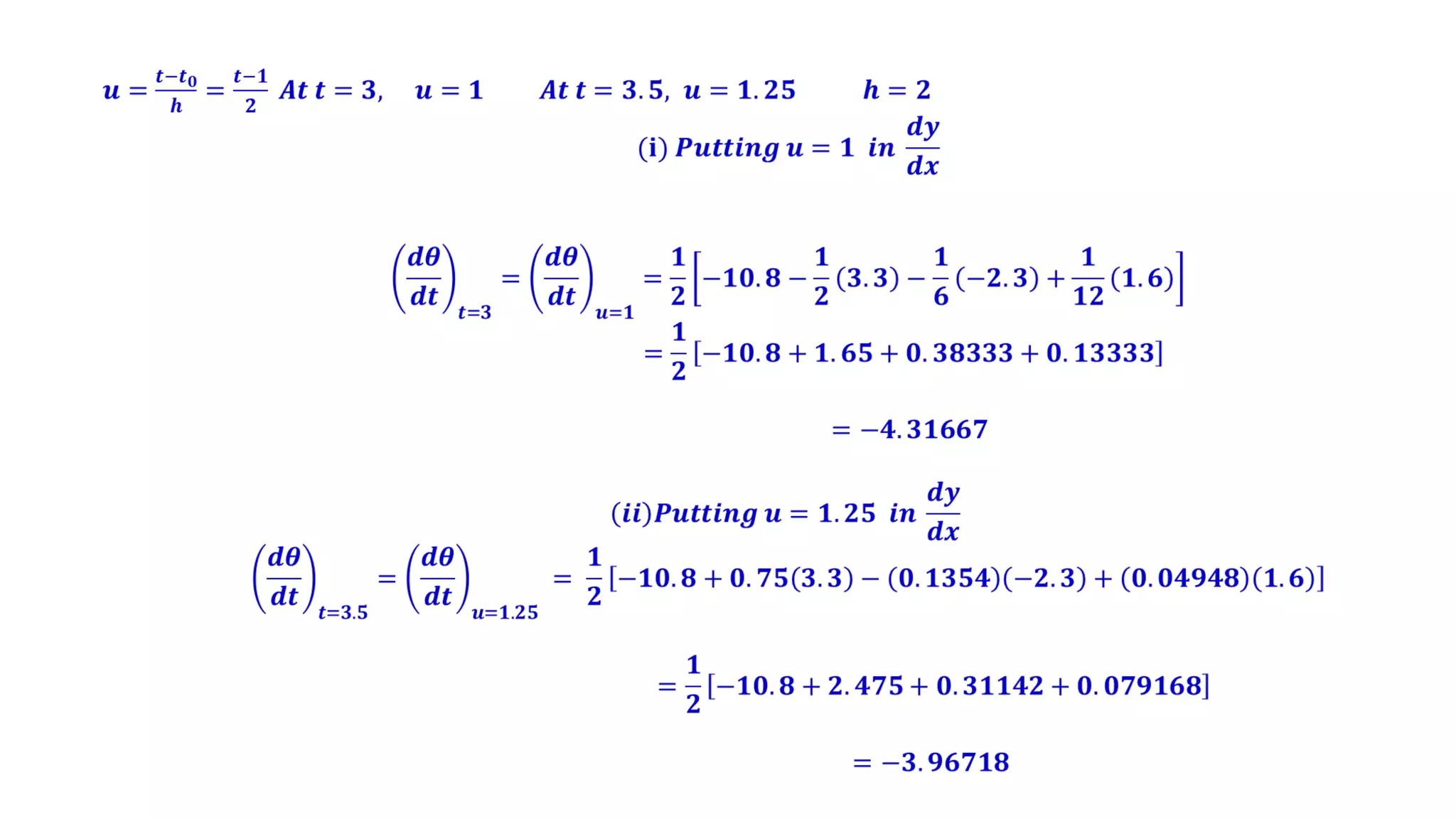
7.The table below gives the results of an observation: θ is the observed temperature in degrees centigrade of
a vessel of cooling water's is the time in minutes from the beginning of observation.
1
85.3
3
74.5
5
67.0
7
60.5
9
54.3
t
1
3
5
7
9
x
:
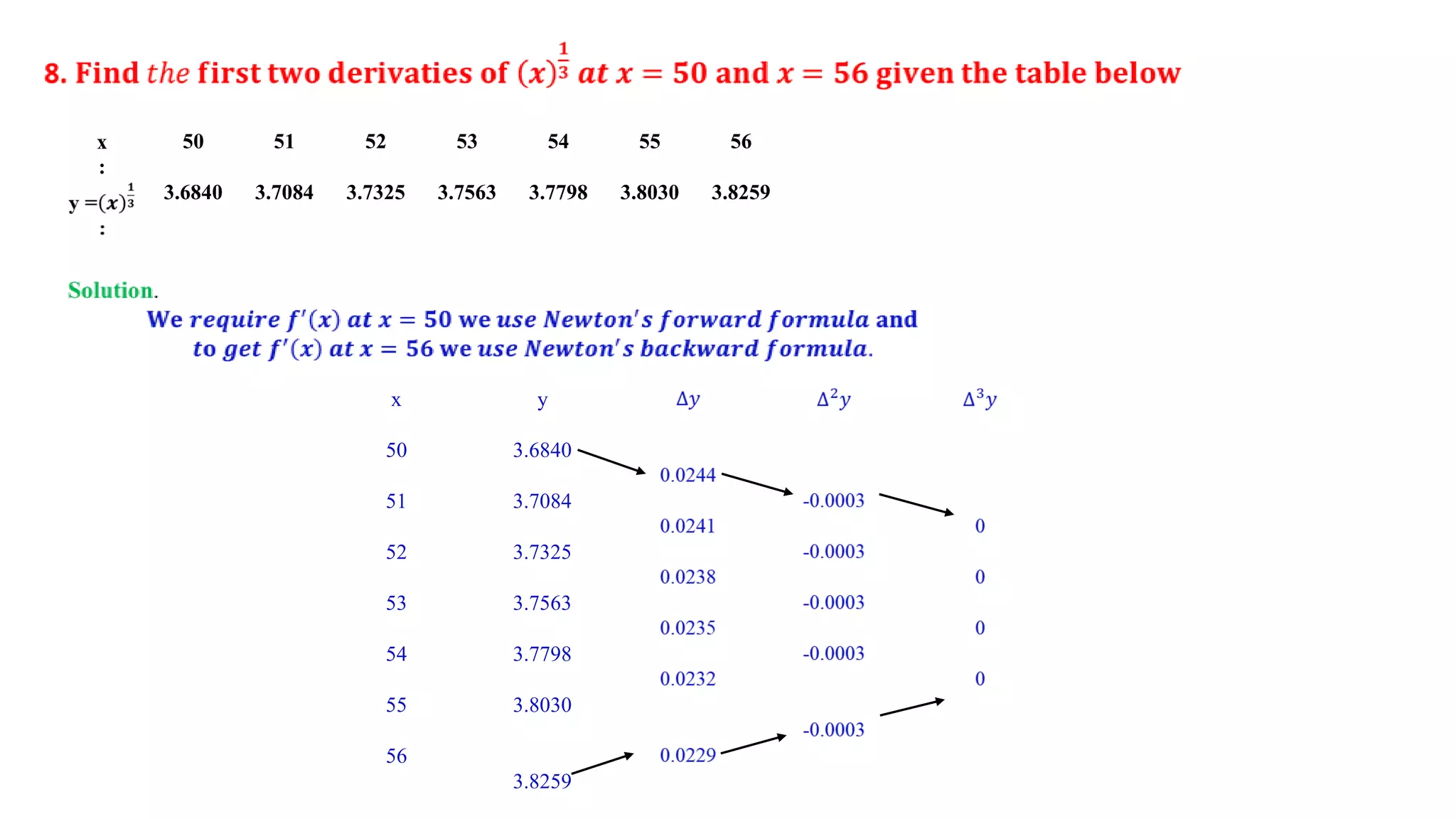
50 51 52 53 54 55 56
3.6840 3.7084 3.7325 3.7563 3.7798 3.8030 3.8259
x
50
51
52
53
54
55
56
y
3.6840
3.7084
3.7325
3.7563
3.7798
3.8030
3.8259
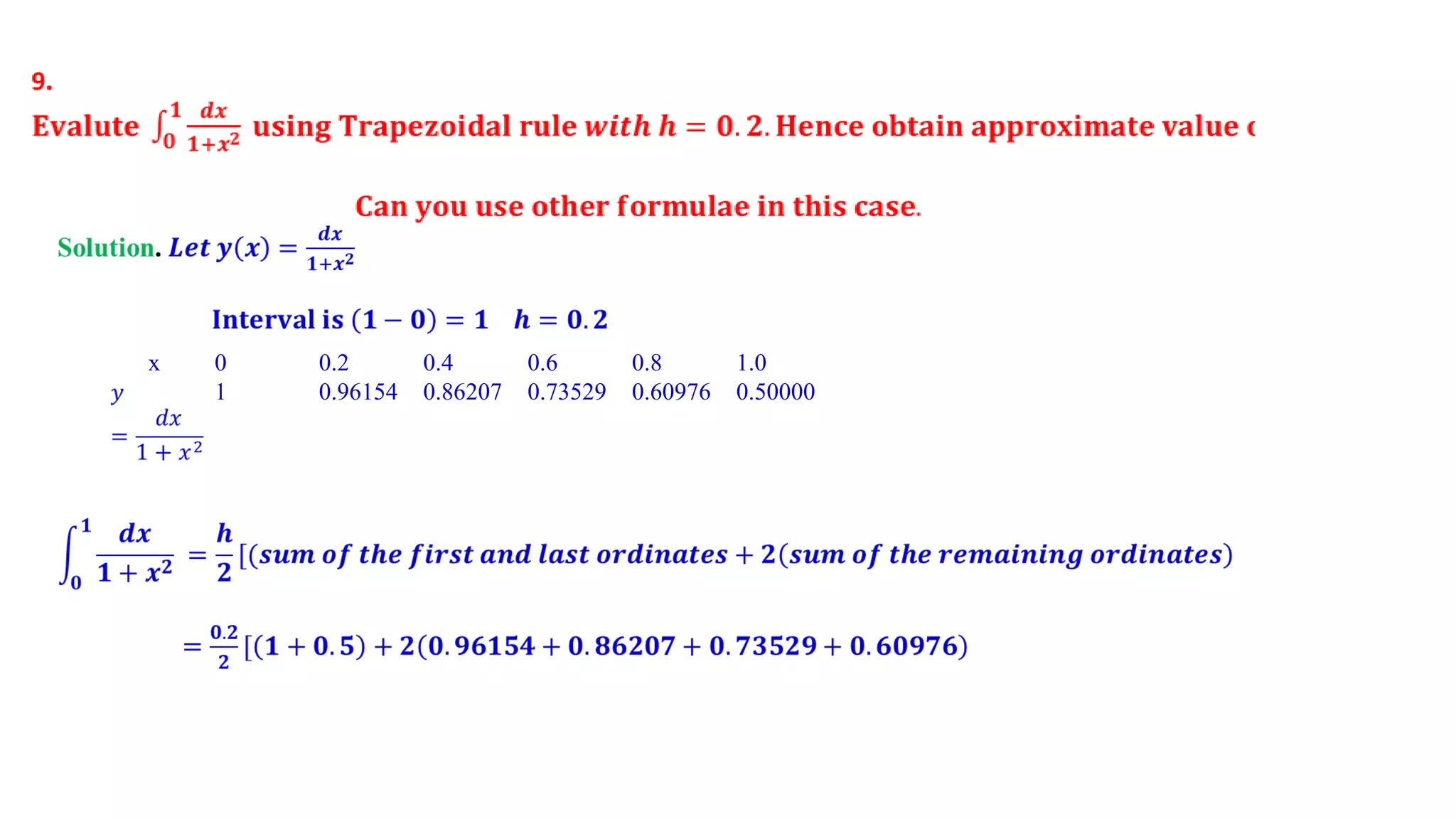
x 0 0.2 0.4 0.6 0.8 1.0
1 0.96154 0.86207 0.73529 0.60976 0.50000
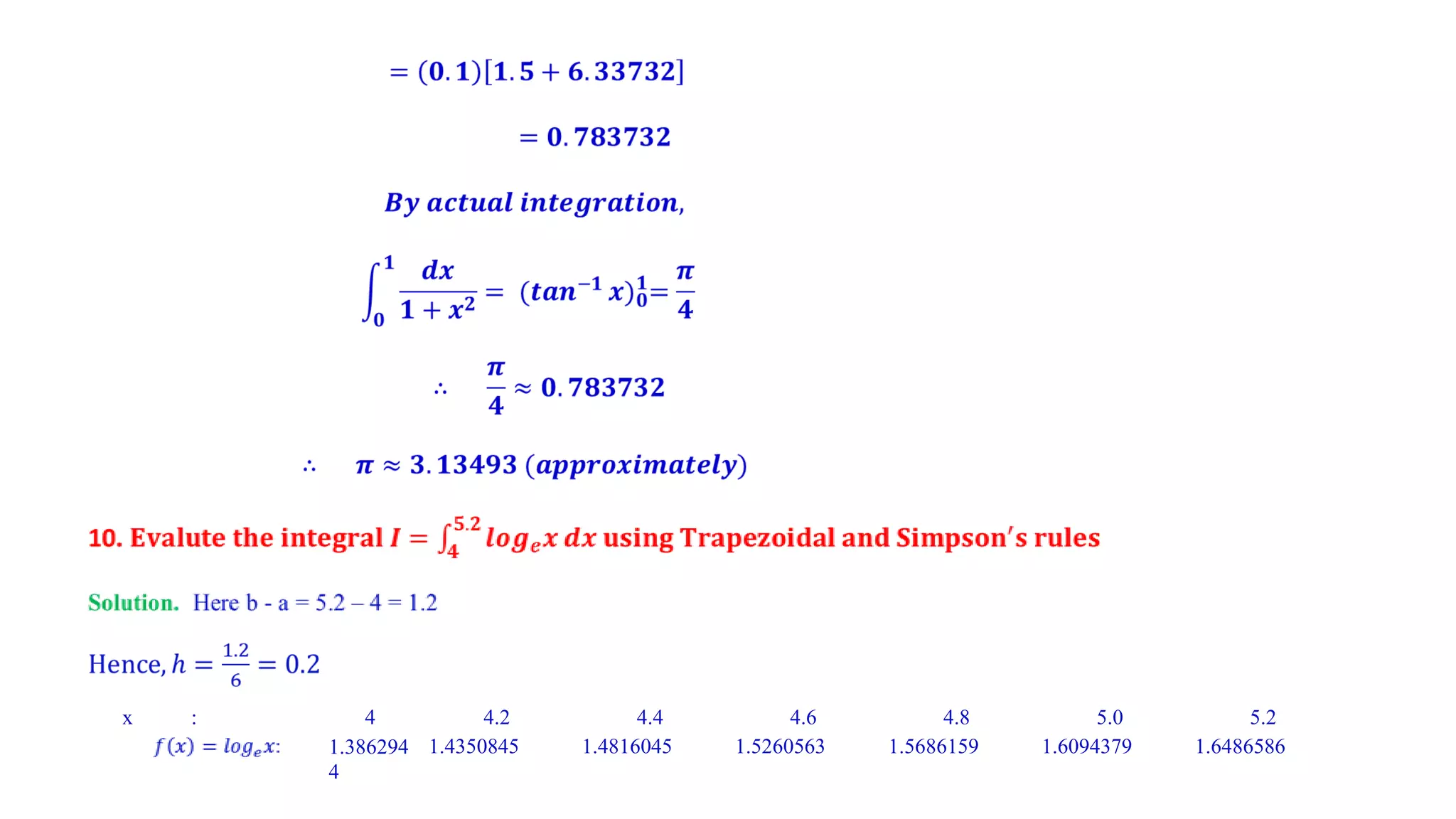
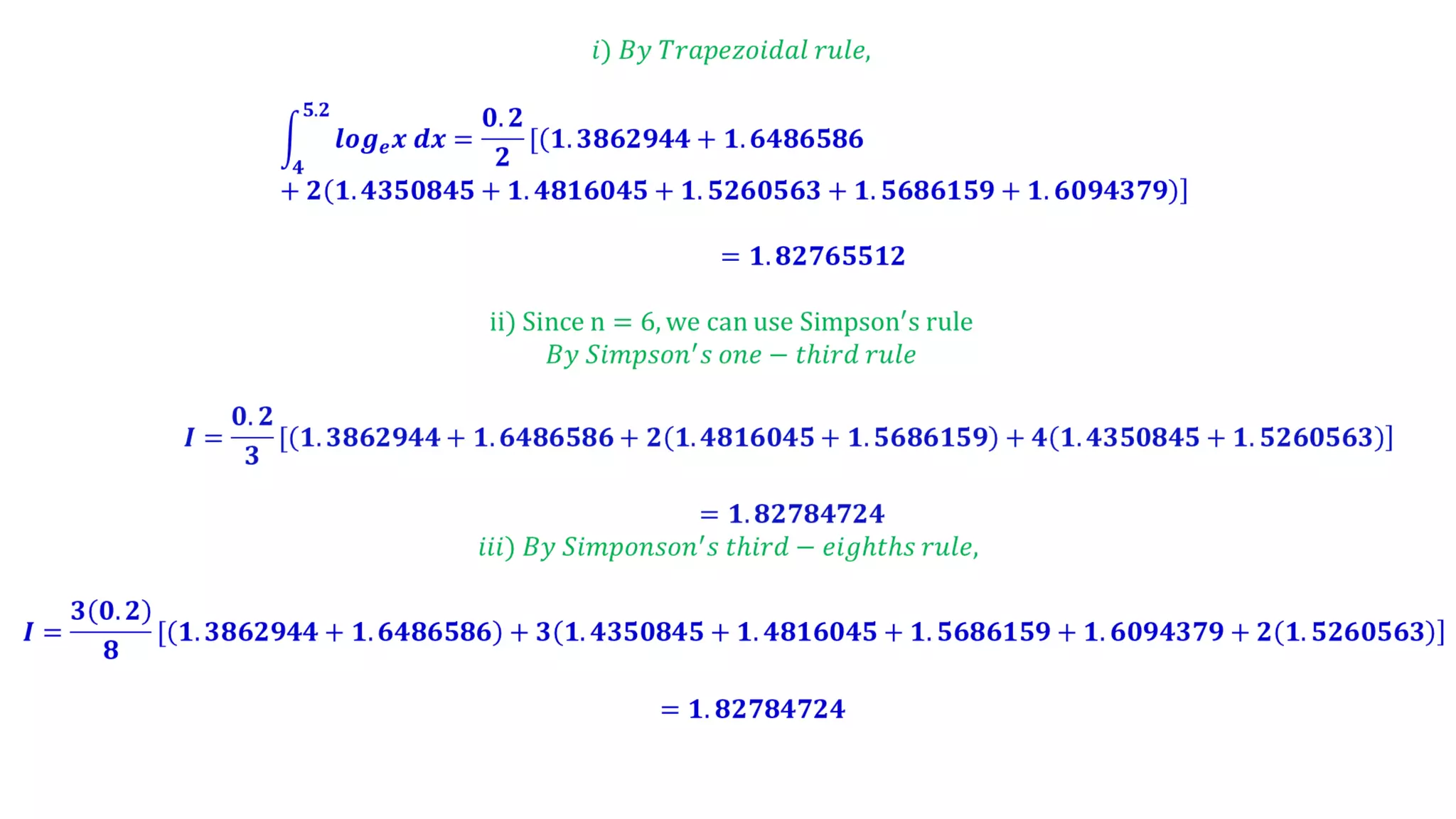
x : 4 4.2 4.4 4.6 4.8 5.0 5.2
1.386294
4
1.4350845 1.4816045 1.5260563 1.5686159 1.6094379 1.6486586
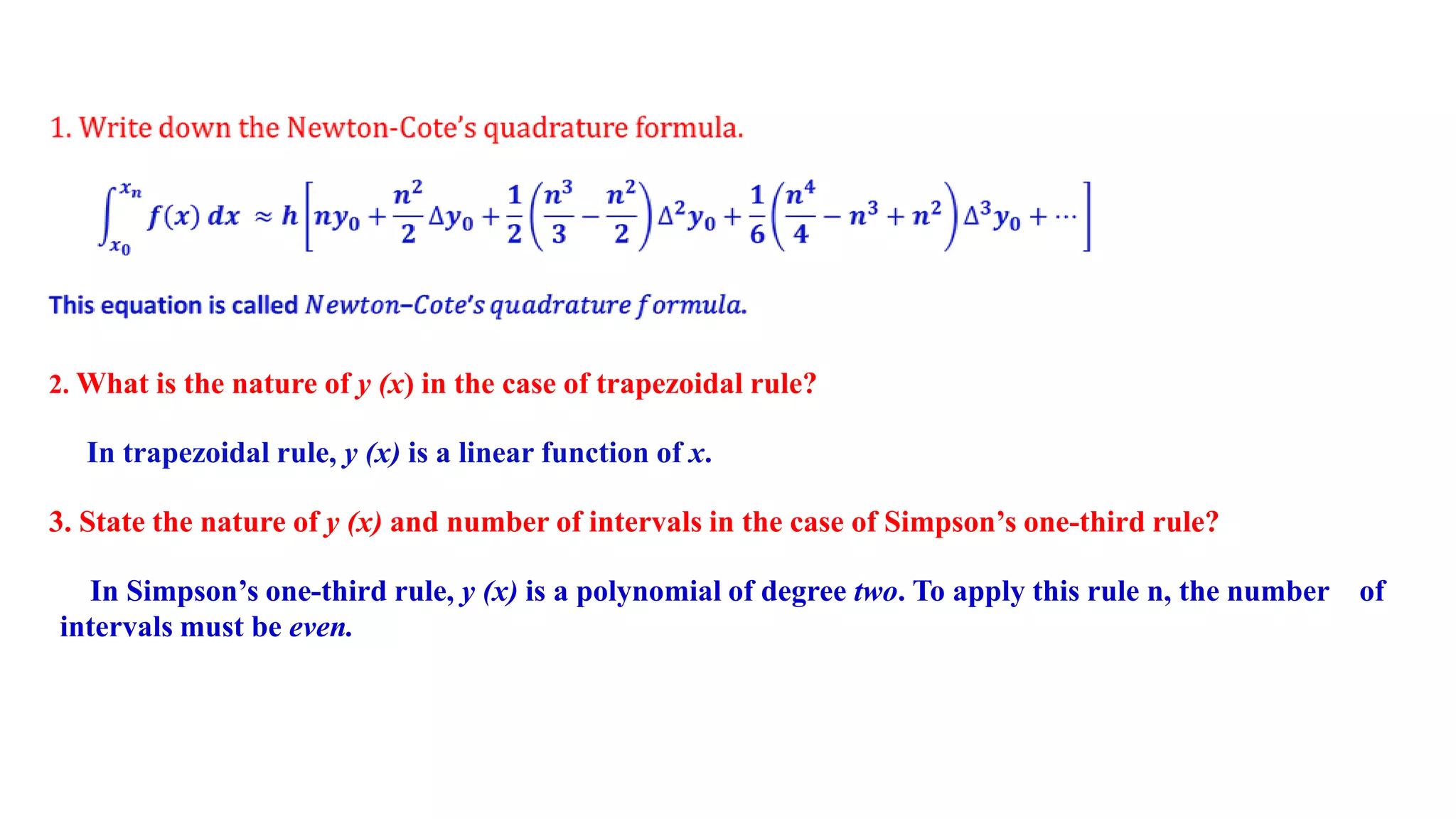
2. What is the nature of y (x) in the case of trapezoidal rule?
In trapezoidal rule, y (x) is a linear function of x.
3. State the nature of y (x) and number of intervals in the case of Simpson’s one-third rule?
In Simpson’s one-third rule, y (x) is a polynomial of degree two. To apply this rule n, the number of
intervals must be even.
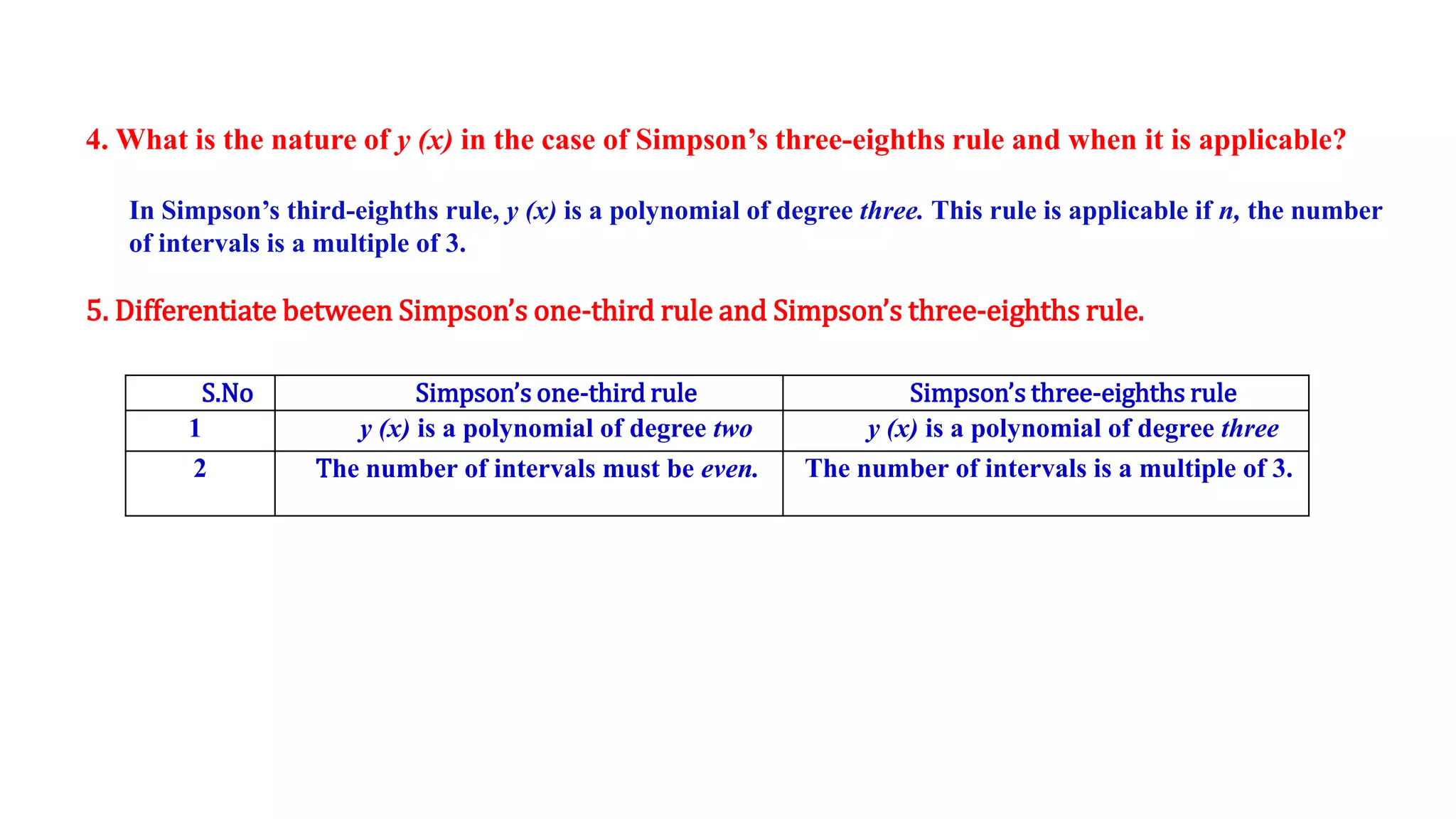
4. What is the nature of y (x) in the case of Simpson’s three-eighths rule and when it is applicable?
In Simpson’s third-eighths rule, y (x) is a polynomial of degree three. This rule is applicable if n, the number
of intervals is a multiple of 3.
5. Differentiate between Simpson’s one-third rule and Simpson’s three-eighths rule.
S.No Simpson’s one-third rule Simpson’s three-eighths rule
1 y (x) is a polynomial of degree two y (x) is a polynomial of degree three
2 The number of intervals must be even. The number of intervals is a multiple of 3.
Reference Text Book: Numerical Methods – P.Kandasamy, K.Thilagavathy & K.Gunavathi,
S.Chand & Company Ltd., New Delhi, 2014.
Thank you

Numerical Differentiation and Integration

  • 1.
    NUMERICAL METHODS (06CT42) Dr. N.Meenakshi Sundaram Asst. Prof. of Physics Vivekananda College Tiruvedakam West - Madurai
  • 2.
    CONTENTS Newton’s forward differenceformula to get the derivative Newton’s backward difference formula to compute the derivative Newton-Cote’s formula Trapezoidal rule Simpson’s one-third rule Simpson’s three-eighths rule NUMERICAL OF DIFFERENTATION AND INTEGRATION
  • 3.
    UNIT – IVNumerical Differentiation and Integration Numerical Differentiation Introduction We found the polynomial curve y = f (x), passing through the (n+1) ordered pairs (xi, yi), i=0, 1, 2…n. Now we are trying to find the derivative value of such curves at a given x = xk (say), whose x0 < xk < xn. To get derivative, we first find the curve y = f (x) through the points and then differentiate and get its value at the required point. If the values of x are equally spaced. We get the interpolating polynomial due to Newton-Gregory. • If the derivative is required at a point nearer to the starting value in the table, we use Newton’s forward interpolation formula. • If we require the derivative at the end of the table, we use Newton’s backward interpolation formula. • If the value of derivative is required near the middle of the table value, we use one of the central difference interpolation formulae
  • 11.
    Problems: 1. The tablegiven below revels the velocity v of a body during the time ‘t’ specified. find its acceleration at t = 1.1 t : 1.0 1.1 1.2 1.3 1.4 v : 43.1 47.7 52.1 56.4 60.8 t 1.0 1.1 1.2 1.3 1.4 v 43.1 47.7 52.1 56.4 60.8
  • 13.
    2. A rodis rotating in a plane. The following table gives the angle θ (in radians) through which the rod has turned for various values of time t (seconds).Calculate the angular velocity and angular acceleration of the rod at=0.6 seconds. t : 0 0.2 0.4 0.6 0.8 1.0 0 0.12 0.49 1.12 2.02 3.20 Solution. We form the difference table below: t 0 0.2 0.4 0.6 0.8 1.0
  • 16.
    x -3 -2-1 0 1 2 3 y 81 16 1 0 1 16 81
  • 18.
    x 0 12 3 4 5 6 1 0.5 1/3 1/4 1/5 1/6 1/7
  • 19.
    5. A riveris 80 meters wide. The depth '"d'" in meters at a distance x meters from one bank is given by the following table. Calculate the area of cross section of the river using Simpson' s rule.
  • 20.
    x : 0 10 2030 40 50 60 70 80 d : 0 4 7 9 12 15 14 8 3
  • 23.
    7.The table belowgives the results of an observation: θ is the observed temperature in degrees centigrade of a vessel of cooling water's is the time in minutes from the beginning of observation. 1 85.3 3 74.5 5 67.0 7 60.5 9 54.3 t 1 3 5 7 9
  • 25.
    x : 50 51 5253 54 55 56 3.6840 3.7084 3.7325 3.7563 3.7798 3.8030 3.8259 x 50 51 52 53 54 55 56 y 3.6840 3.7084 3.7325 3.7563 3.7798 3.8030 3.8259
  • 28.
    x 0 0.20.4 0.6 0.8 1.0 1 0.96154 0.86207 0.73529 0.60976 0.50000
  • 29.
    x : 44.2 4.4 4.6 4.8 5.0 5.2 1.386294 4 1.4350845 1.4816045 1.5260563 1.5686159 1.6094379 1.6486586
  • 31.
    2. What isthe nature of y (x) in the case of trapezoidal rule? In trapezoidal rule, y (x) is a linear function of x. 3. State the nature of y (x) and number of intervals in the case of Simpson’s one-third rule? In Simpson’s one-third rule, y (x) is a polynomial of degree two. To apply this rule n, the number of intervals must be even.
  • 32.
    4. What isthe nature of y (x) in the case of Simpson’s three-eighths rule and when it is applicable? In Simpson’s third-eighths rule, y (x) is a polynomial of degree three. This rule is applicable if n, the number of intervals is a multiple of 3. 5. Differentiate between Simpson’s one-third rule and Simpson’s three-eighths rule. S.No Simpson’s one-third rule Simpson’s three-eighths rule 1 y (x) is a polynomial of degree two y (x) is a polynomial of degree three 2 The number of intervals must be even. The number of intervals is a multiple of 3.
  • 33.
    Reference Text Book:Numerical Methods – P.Kandasamy, K.Thilagavathy & K.Gunavathi, S.Chand & Company Ltd., New Delhi, 2014.
  • 34.