Increasing and Decreasing Functions and
the First Derivative Test
AP Calculus – Section 3.3
Objectives:
1.Find

the intervals on which a function is
increasing or decreasing.
2.Use

the First Derivative Test to classify
extrema as either a maximum or a minimum.
Increasing and Decreasing Functions
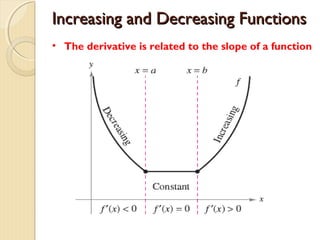
• The derivative is related to the slope of a function
Increasing and Decreasing Functions
On an interval in which a function f is
continuous and differentiable, a
function is…
increasing if f ‘(x) is positive on that
interval, ( f ‘ (x) > 0 )
decreasing if f ‘(x) is negative on that
interval, and ( f ‘ (x) < 0 )
constant if f ‘(x) = 0 on that interval.
Visual Example
f ‘(x) < 0 on (-5,-2)
f(x) is decreasing on (-5,-2)

f ‘(x) = 0 on (-2,1)
f(x) is constant on (-2,1)

f ‘(x) > 0 on (1,3)
f(x) is increasing on (1,3)
Finding Increasing/Decreasing
Intervals for a Function
To find the intervals on which a function is
increasing/decreasing:
1.Find critical numbers. - These determine
the boundaries of your intervals.
2.Pick a random x-value in each interval.
3.Determine the sign of the derivative on
that interval.
Example
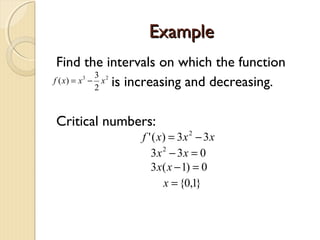
Find the intervals on which the function
3
f ( x) = x − x is increasing and decreasing.
2
3

2

Critical numbers:

f ' ( x) = 3x 2 − 3 x
3x 2 − 3x = 0
3 x( x − 1) = 0
x = {0,1}
Example
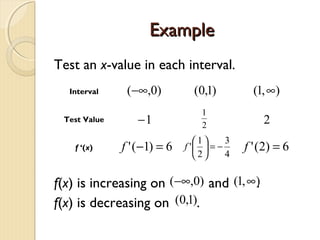
Test an x-value in each interval.
Interval
Test Value
f ‘(x)

(−∞,0)

(0,1)

(1, ∞)

−1

1
2

2

f ' (−1) = 6

3
1
f '  = −
4
2

f ' ( 2) = 6

f(x) is increasing on (−∞,0) and (1, ∞)
.
f(x) is decreasing on (0,1).
Practice
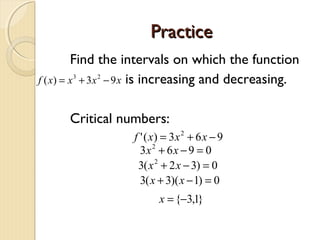
Find the intervals on which the function
f ( x) = x 3 + 3 x 2 − 9 x is increasing and decreasing.
Critical numbers:
f ' ( x) = 3x 2 + 6 x − 9
3x 2 + 6 x − 9 = 0
3( x 2 + 2 x − 3) = 0
3( x + 3)( x − 1) = 0

x = {−3,1}
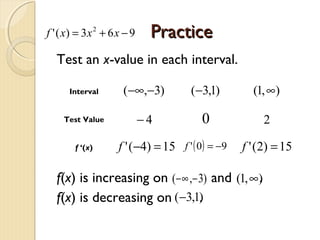
f ' ( x) = 3x 2 + 6 x − 9

Practice

Test an x-value in each interval.
Interval

(−∞,−3)

(−3,1)

(1, ∞)

Test Value

−4

0

2

f ‘(x)

f ' (−4) = 15 f ' ( 0) = −9

f ' (2) = 15

f(x) is increasing on (−∞ ,− 3) and (1, ∞)
.
f(x) is decreasing on (−3,1)
.
The First Derivative Test
AP Calculus – Section 3.3
The First Derivative Test
Summary
The

point where the first derivative
changes sign is an extrema.
The First Derivative Test
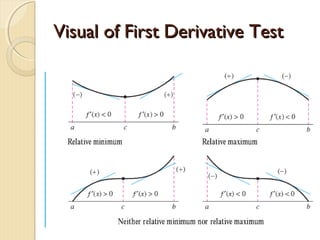
If c is a critical number of a function f, then:
If f ‘(c) changes from negative to positive
at c, then f(c) is a relative minimum.
If f ‘(c) changes from positive to negative
at c, then f(c) is a relative maximum.
If f ‘(c) does not change sign at c, then f(c)
is neither a relative minimum or
maximum.
GREAT picture on page 181!
Visual of First Derivative Test
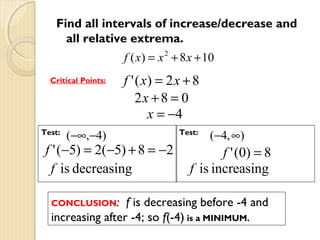
Find all intervals of increase/decrease and
all relative extrema.
f ( x) = x 2 + 8 x + 10
Critical Points:

Test:

(−∞,−4)

f ' ( x) = 2 x + 8
2x + 8 = 0
x = −4

f ' (−5) = 2(−5) + 8 = −2
f is decreasing
CONCLUSION:

Test:

(−4, ∞)

f ' ( 0) = 8
f is increasing

f is decreasing before -4 and
increasing after -4; so f(-4) is a MINIMUM.

Increasing and decreasing functions ap calc sec 3.3

  • 1.
    Increasing and DecreasingFunctions and the First Derivative Test AP Calculus – Section 3.3 Objectives: 1.Find the intervals on which a function is increasing or decreasing. 2.Use the First Derivative Test to classify extrema as either a maximum or a minimum.
  • 2.
    Increasing and DecreasingFunctions • The derivative is related to the slope of a function
  • 3.
    Increasing and DecreasingFunctions On an interval in which a function f is continuous and differentiable, a function is… increasing if f ‘(x) is positive on that interval, ( f ‘ (x) > 0 ) decreasing if f ‘(x) is negative on that interval, and ( f ‘ (x) < 0 ) constant if f ‘(x) = 0 on that interval.
  • 4.
    Visual Example f ‘(x)< 0 on (-5,-2) f(x) is decreasing on (-5,-2) f ‘(x) = 0 on (-2,1) f(x) is constant on (-2,1) f ‘(x) > 0 on (1,3) f(x) is increasing on (1,3)
  • 5.
    Finding Increasing/Decreasing Intervals fora Function To find the intervals on which a function is increasing/decreasing: 1.Find critical numbers. - These determine the boundaries of your intervals. 2.Pick a random x-value in each interval. 3.Determine the sign of the derivative on that interval.
  • 6.
    Example Find the intervalson which the function 3 f ( x) = x − x is increasing and decreasing. 2 3 2 Critical numbers: f ' ( x) = 3x 2 − 3 x 3x 2 − 3x = 0 3 x( x − 1) = 0 x = {0,1}
  • 7.
    Example Test an x-valuein each interval. Interval Test Value f ‘(x) (−∞,0) (0,1) (1, ∞) −1 1 2 2 f ' (−1) = 6 3 1 f '  = − 4 2 f ' ( 2) = 6 f(x) is increasing on (−∞,0) and (1, ∞) . f(x) is decreasing on (0,1).
  • 8.
    Practice Find the intervalson which the function f ( x) = x 3 + 3 x 2 − 9 x is increasing and decreasing. Critical numbers: f ' ( x) = 3x 2 + 6 x − 9 3x 2 + 6 x − 9 = 0 3( x 2 + 2 x − 3) = 0 3( x + 3)( x − 1) = 0 x = {−3,1}
  • 9.
    f ' (x) = 3x 2 + 6 x − 9 Practice Test an x-value in each interval. Interval (−∞,−3) (−3,1) (1, ∞) Test Value −4 0 2 f ‘(x) f ' (−4) = 15 f ' ( 0) = −9 f ' (2) = 15 f(x) is increasing on (−∞ ,− 3) and (1, ∞) . f(x) is decreasing on (−3,1) .
  • 10.
    The First DerivativeTest AP Calculus – Section 3.3
  • 11.
    The First DerivativeTest Summary The point where the first derivative changes sign is an extrema.
  • 12.
    The First DerivativeTest If c is a critical number of a function f, then: If f ‘(c) changes from negative to positive at c, then f(c) is a relative minimum. If f ‘(c) changes from positive to negative at c, then f(c) is a relative maximum. If f ‘(c) does not change sign at c, then f(c) is neither a relative minimum or maximum. GREAT picture on page 181!
  • 13.
    Visual of FirstDerivative Test
  • 14.
    Find all intervalsof increase/decrease and all relative extrema. f ( x) = x 2 + 8 x + 10 Critical Points: Test: (−∞,−4) f ' ( x) = 2 x + 8 2x + 8 = 0 x = −4 f ' (−5) = 2(−5) + 8 = −2 f is decreasing CONCLUSION: Test: (−4, ∞) f ' ( 0) = 8 f is increasing f is decreasing before -4 and increasing after -4; so f(-4) is a MINIMUM.