OPTICAL ISOMERISM
• All molecules have a mirror image –
  but in most of the cases image and
  object are the same molecule.

        H                     H

        C                     C
             H           H
   H                              H
            F             F
              fluoromethane
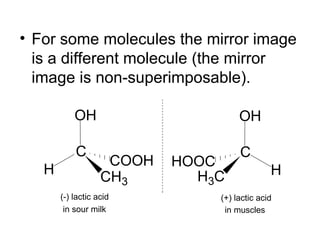
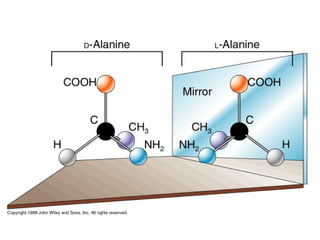
• For some molecules the mirror image
  is a different molecule (the mirror
  image is non-superimposable).

           OH                       OH

           C                        C
                    COOH   HOOC
   H                         H3C             H
                   CH3
       (-) lactic acid         (+) lactic acid
        in sour milk            in muscles
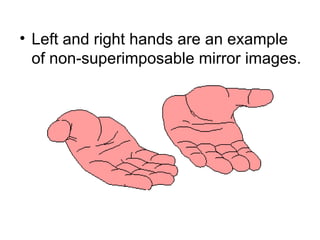
• Left and right hands are an example
  of non-superimposable mirror images.
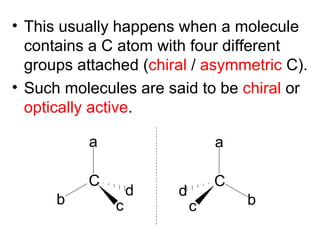
• This usually happens when a molecule
  contains a C atom with four different
  groups attached (chiral / asymmetric C).
• Such molecules are said to be chiral or
  optically active.

          a                    a

          C                    C
                  d    d
      b       c            c       b
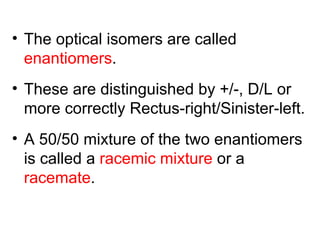
• The optical isomers are called
  enantiomers.
• These are distinguished by +/-, D/L or
  more correctly Rectus-right/Sinister-left.
• A 50/50 mixture of the two enantiomers
  is called a racemic mixture or a
  racemate.
TASK Which of the following
     molecules are optically active?

1)   propan-2-ol      •   butanone
2)   2-chlorobutane   •   2-methylbutanoic acid
3)   1-chlorobutane   •   butan-2-ol
4)   3-methylhexane   •   1-chloro-3-methylpentane
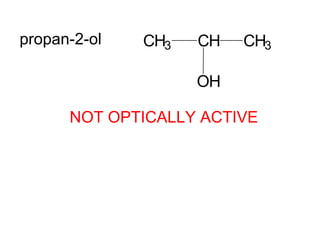
propan-2-ol   CH3   CH   CH3

                    OH

       NOT OPTICALLY ACTIVE
2-chlorobutane   CH3    CH     CH2   CH3

                        Cl

       CH2CH3                  CH2CH3

       C                       C
             CH3       H3C
  H                                  H
            Cl            Cl

           OPTICALLY ACTIVE
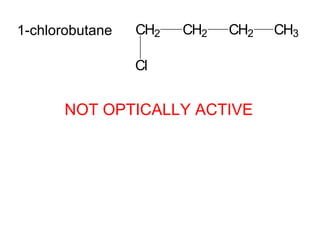
1-chlorobutane   CH2   CH2   CH2   CH3

                 Cl


      NOT OPTICALLY ACTIVE
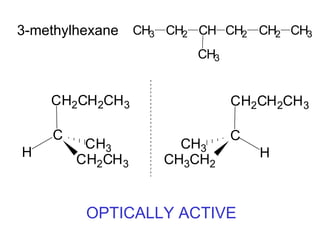
3-methylhexane    CH3 CH2 CH CH2 CH2 CH3
                         CH3


    CH2CH2CH3                  CH2CH 2CH 3

    C                          C
         CH3           CH3
H                                  H
        CH2CH 3      CH3CH2


         OPTICALLY ACTIVE
butanone          O

            CH3   C   CH2   CH3


      NOT OPTICALLY ACTIVE
propan-2-ol   CH3   CH   CH3

                    OH

      NOT OPTICALLY ACTIVE
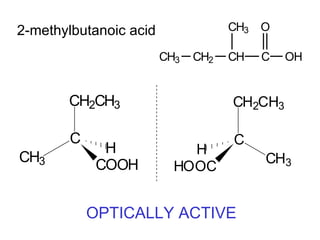
2-methylbutanoic acid               CH3   O

                        CH3   CH2   CH    C   OH


       CH2CH3                       CH2CH3

       C                            C
             H              H
CH3                                       CH3
            COOH          HOOC


           OPTICALLY ACTIVE
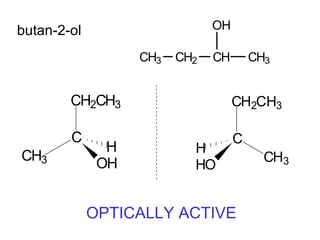
butan-2-ol                     OH

                   CH3   CH2   CH       CH3


        CH2CH3                      CH2CH3

        C                           C
               H           H
CH3                                       CH3
              OH           HO


             OPTICALLY ACTIVE
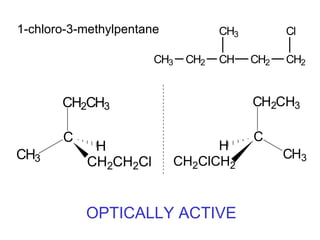
1-chloro-3-methylpentane            CH3         Cl

                       CH3    CH2   CH    CH2   CH2


       CH2CH3                             CH2CH3

       C                                  C
            H                      H
CH3                                             CH3
           CH2CH2Cl          CH2ClCH2


           OPTICALLY ACTIVE
• Molecules that are optical isomers are
  called enantiomers.
• Enantiomers have identical chemical
  and physical properties, except:
  • Their effect on plane polarised light;
  • Their reaction with other chiral molecules
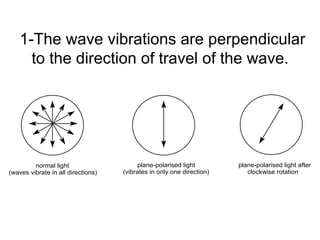
1-The wave vibrations are perpendicular
      to the direction of travel of the wave.


         normal light                     plane-polarised light        plane-polarised light after
(waves vibrate in all directions)   (vibrates in only one direction)      clockwise rotation
• Optical isomers rotate the plane of
    plane polarised light.


     (-)-enantiomer           (+)-enantiomer        (±)-racemate
(anticlockwise rotation)   (clockwise rotation)   (no overall effect)
2- Chiral molecules often react
  differently with other chiral molecules.
• This is like the idea that a right hand
  does not fit a left handed glove – the
  molecule must be the correct shape to
  fit the molecule it is reacting with.
• Many natural molecules are chiral and
  most natural reactions are affected by
  optical isomerism.
• For example, most amino acids (and
  so proteins) are chiral, along with
  many other molecules.
• The human body can consume amino
  acids that rotate polarised light to the
  left.
• Many drugs are optically active, with
  one enantiomer only having the
  beneficial effect.
• In the case of some drugs, the other
  enantiomer can even be harmful, e.g.
  thalidomide.
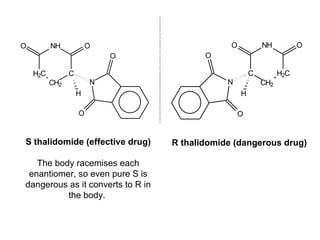
• In the 1960’s thalidomide was given
  to pregnant women to reduce the
  effects of morning sickness.
• This led to many disabilities in babies
  and early deaths in many cases.
O         NH            O                       O           NH          O
                            O             O

    H2C         C                                       C         H2C
          CH2           N                      N            CH2
                    H                               H

                    O                               O


S thalidomide (effective drug)     R thalidomide (dangerous drug)

   The body racemises each
 enantiomer, so even pure S is
dangerous as it converts to R in
          the body.
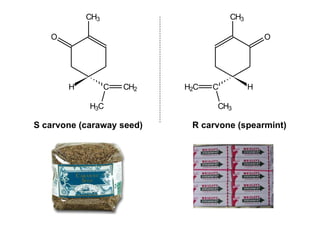
CH3                       CH3

   O                                           O


       H         C   CH2   H2C   C         H

            H3C                  CH3

S carvone (caraway seed)    R carvone (spearmint)
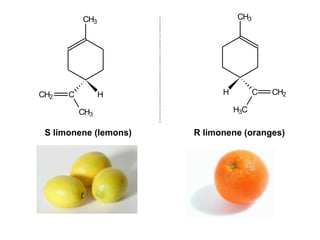
CH3                    CH3


CH2   C         H            H         C   CH2

          CH3                    H3C

 S limonene (lemons)   R limonene (oranges)

Optical isomers

  • 1.
  • 2.
    • All moleculeshave a mirror image – but in most of the cases image and object are the same molecule. H H C C H H H H F F fluoromethane
  • 3.
    • For somemolecules the mirror image is a different molecule (the mirror image is non-superimposable). OH OH C C COOH HOOC H H3C H CH3 (-) lactic acid (+) lactic acid in sour milk in muscles
  • 4.
    • Left andright hands are an example of non-superimposable mirror images.
  • 6.
    • This usuallyhappens when a molecule contains a C atom with four different groups attached (chiral / asymmetric C). • Such molecules are said to be chiral or optically active. a a C C d d b c c b
  • 7.
    • The opticalisomers are called enantiomers. • These are distinguished by +/-, D/L or more correctly Rectus-right/Sinister-left. • A 50/50 mixture of the two enantiomers is called a racemic mixture or a racemate.
  • 8.
    TASK Which ofthe following molecules are optically active? 1) propan-2-ol • butanone 2) 2-chlorobutane • 2-methylbutanoic acid 3) 1-chlorobutane • butan-2-ol 4) 3-methylhexane • 1-chloro-3-methylpentane
  • 9.
    propan-2-ol CH3 CH CH3 OH NOT OPTICALLY ACTIVE
  • 10.
    2-chlorobutane CH3 CH CH2 CH3 Cl CH2CH3 CH2CH3 C C CH3 H3C H H Cl Cl OPTICALLY ACTIVE
  • 11.
    1-chlorobutane CH2 CH2 CH2 CH3 Cl NOT OPTICALLY ACTIVE
  • 12.
    3-methylhexane CH3 CH2 CH CH2 CH2 CH3 CH3 CH2CH2CH3 CH2CH 2CH 3 C C CH3 CH3 H H CH2CH 3 CH3CH2 OPTICALLY ACTIVE
  • 13.
    butanone O CH3 C CH2 CH3 NOT OPTICALLY ACTIVE
  • 14.
    propan-2-ol CH3 CH CH3 OH NOT OPTICALLY ACTIVE
  • 15.
    2-methylbutanoic acid CH3 O CH3 CH2 CH C OH CH2CH3 CH2CH3 C C H H CH3 CH3 COOH HOOC OPTICALLY ACTIVE
  • 16.
    butan-2-ol OH CH3 CH2 CH CH3 CH2CH3 CH2CH3 C C H H CH3 CH3 OH HO OPTICALLY ACTIVE
  • 17.
    1-chloro-3-methylpentane CH3 Cl CH3 CH2 CH CH2 CH2 CH2CH3 CH2CH3 C C H H CH3 CH3 CH2CH2Cl CH2ClCH2 OPTICALLY ACTIVE
  • 18.
    • Molecules thatare optical isomers are called enantiomers. • Enantiomers have identical chemical and physical properties, except: • Their effect on plane polarised light; • Their reaction with other chiral molecules
  • 19.
    1-The wave vibrationsare perpendicular to the direction of travel of the wave. normal light plane-polarised light plane-polarised light after (waves vibrate in all directions) (vibrates in only one direction) clockwise rotation
  • 20.
    • Optical isomersrotate the plane of plane polarised light. (-)-enantiomer (+)-enantiomer (±)-racemate (anticlockwise rotation) (clockwise rotation) (no overall effect)
  • 22.
    2- Chiral moleculesoften react differently with other chiral molecules. • This is like the idea that a right hand does not fit a left handed glove – the molecule must be the correct shape to fit the molecule it is reacting with. • Many natural molecules are chiral and most natural reactions are affected by optical isomerism.
  • 23.
    • For example,most amino acids (and so proteins) are chiral, along with many other molecules. • The human body can consume amino acids that rotate polarised light to the left.
  • 24.
    • Many drugsare optically active, with one enantiomer only having the beneficial effect. • In the case of some drugs, the other enantiomer can even be harmful, e.g. thalidomide.
  • 25.
    • In the1960’s thalidomide was given to pregnant women to reduce the effects of morning sickness. • This led to many disabilities in babies and early deaths in many cases.
  • 26.
    O NH O O NH O O O H2C C C H2C CH2 N N CH2 H H O O S thalidomide (effective drug) R thalidomide (dangerous drug) The body racemises each enantiomer, so even pure S is dangerous as it converts to R in the body.
  • 27.
    CH3 CH3 O O H C CH2 H2C C H H3C CH3 S carvone (caraway seed) R carvone (spearmint)
  • 28.
    CH3 CH3 CH2 C H H C CH2 CH3 H3C S limonene (lemons) R limonene (oranges)