CHEMISTRY 3.5                                   ANSWERS

WORKSHEET TWO                    ORGANIC                  Isomerism
1.   Isomers have the same molecular formula but different structural formula.

2.   pentane CH3CH2CH2CH2CH3          2-methylbutane CH3CH(CH3)CH2CH3
     2,2-dimethylpropane (dimethylpropane) CH3 C(CH3)2CH3
3.   but-1-ene CH2CHCH2CH3        but-2-ene CH3CHCHCH3
     2-methylpropene CH2C(CH3)CH3
4.   propanal CH3CH2CHO                   propanone CH3COCH3
5.   (a)   The molecule will have a chiral carbon atom, ie a carbon atom with four
           different groups on it.
     (b)   Two enantiomers have identical chemical properties, but in biochemical
           systems they behave differently. They also have the same physical
           properties except for their effect on plane-polarised light. One
           enantiomer will rotate the plane of polarisation clockwise and the other
           anticlockwise.
     (c)   Many biological molecules such as amino acids are optically active.
           Often only one of the isomers is able to function properly in living
           things.
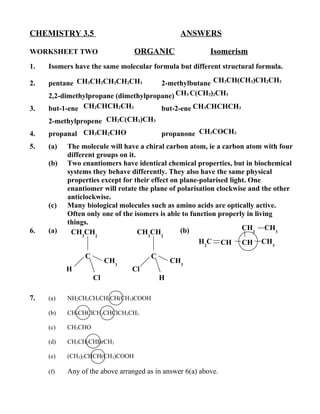
6.   (a)                                         (b)                 CH2 CH3
            CH3CH2                 CH3CH2
                                                       H2C CH CH CH3

                C                     C
                         CH3                  CH3
           H                    Cl
                    Cl                    H

7.   (a)   NH2CH2CH2CH2CH(CH3)COOH

     (b)   CH3CHClCH2CHClCH2CH3

     (c)   CH3CHO

     (d)   CH3CH2CHBrCH3

     (e)   (CH3)2CHCH(CH3)COOH

     (f)   Any of the above arranged as in answer 6(a) above.

Chem 3.5 answers #2

  • 1.
    CHEMISTRY 3.5 ANSWERS WORKSHEET TWO ORGANIC Isomerism 1. Isomers have the same molecular formula but different structural formula. 2. pentane CH3CH2CH2CH2CH3 2-methylbutane CH3CH(CH3)CH2CH3 2,2-dimethylpropane (dimethylpropane) CH3 C(CH3)2CH3 3. but-1-ene CH2CHCH2CH3 but-2-ene CH3CHCHCH3 2-methylpropene CH2C(CH3)CH3 4. propanal CH3CH2CHO propanone CH3COCH3 5. (a) The molecule will have a chiral carbon atom, ie a carbon atom with four different groups on it. (b) Two enantiomers have identical chemical properties, but in biochemical systems they behave differently. They also have the same physical properties except for their effect on plane-polarised light. One enantiomer will rotate the plane of polarisation clockwise and the other anticlockwise. (c) Many biological molecules such as amino acids are optically active. Often only one of the isomers is able to function properly in living things. 6. (a) (b) CH2 CH3 CH3CH2 CH3CH2 H2C CH CH CH3 C C CH3 CH3 H Cl Cl H 7. (a) NH2CH2CH2CH2CH(CH3)COOH (b) CH3CHClCH2CHClCH2CH3 (c) CH3CHO (d) CH3CH2CHBrCH3 (e) (CH3)2CHCH(CH3)COOH (f) Any of the above arranged as in answer 6(a) above.